GrowMeOrganic vs Minelead: Which Email Finder Wins in 2026?
One is an all-in-one prospecting suite with a LinkedIn scraper. The other is a lightweight email finder with a genuinely usable free tier. Here is how GrowMeOrganic and Minelead actually differ on data, credits, and cost per valid email.
TL;DR
- GrowMeOrganic is an all-in-one prospecting suite: LinkedIn scraping, a bundled B2B database, email finding, and a built-in cold email sender. You buy a workflow, not a lookup tool.
- Minelead is a narrow, fast email finder: domain search, single lookups, a Chrome extension, and an API — with a free tier that is unusually generous for casual use.
- If you already own a sequencer (Instantly, Smartlead, Lemlist), GrowMeOrganic's biggest selling point becomes redundant and you are paying for overlap.
- Neither tool publishes independently audited accuracy numbers. Budget for a separate verification step regardless of which you pick — bounce rate is the only metric that matters.
- Cost per valid email, not cost per credit, is the number to compare. A cheap plan that returns 60% deliverable addresses is more expensive than a pricier one at 95%.
What are GrowMeOrganic and Minelead?#
They solve different-sized problems, which is why a straight feature-count comparison misleads.
GrowMeOrganic launched as a LinkedIn automation and scraping product and grew outward into a full outbound platform. Today it bundles a contact database, a LinkedIn/Sales Navigator extractor, an email finder, an email verifier, and a drip-campaign sender under unlimited-usage-style pricing tied to seats. The pitch is consolidation: cancel four subscriptions, keep one.
Minelead went the opposite direction. It stayed a focused email-discovery utility — give it a domain, get back the addresses and patterns associated with it; give it a name plus a company, get back a single best-guess address. It ships a browser extension, a REST API, and a free plan that lets you actually evaluate the product before paying.
Here is the split that determines which one you should even shortlist:
- Scope — GrowMeOrganic is a suite (find + sequence + track). Minelead is a component (find, then export).
- Data origin — GrowMeOrganic leans on scraping plus a licensed database. Minelead leans on crawling public web sources and pattern inference.
- Pricing logic — GrowMeOrganic charges largely per user seat. Minelead charges per credit/request volume.
- Team fit — GrowMeOrganic suits a small agency or SDR pod with no existing stack. Minelead suits a developer, growth hacker, or anyone bolting lookups onto tooling they already run.
- Exit cost — leaving a suite means rebuilding sequences and reporting. Leaving a lookup tool means swapping an API key.
How do GrowMeOrganic and Minelead compare feature by feature?#
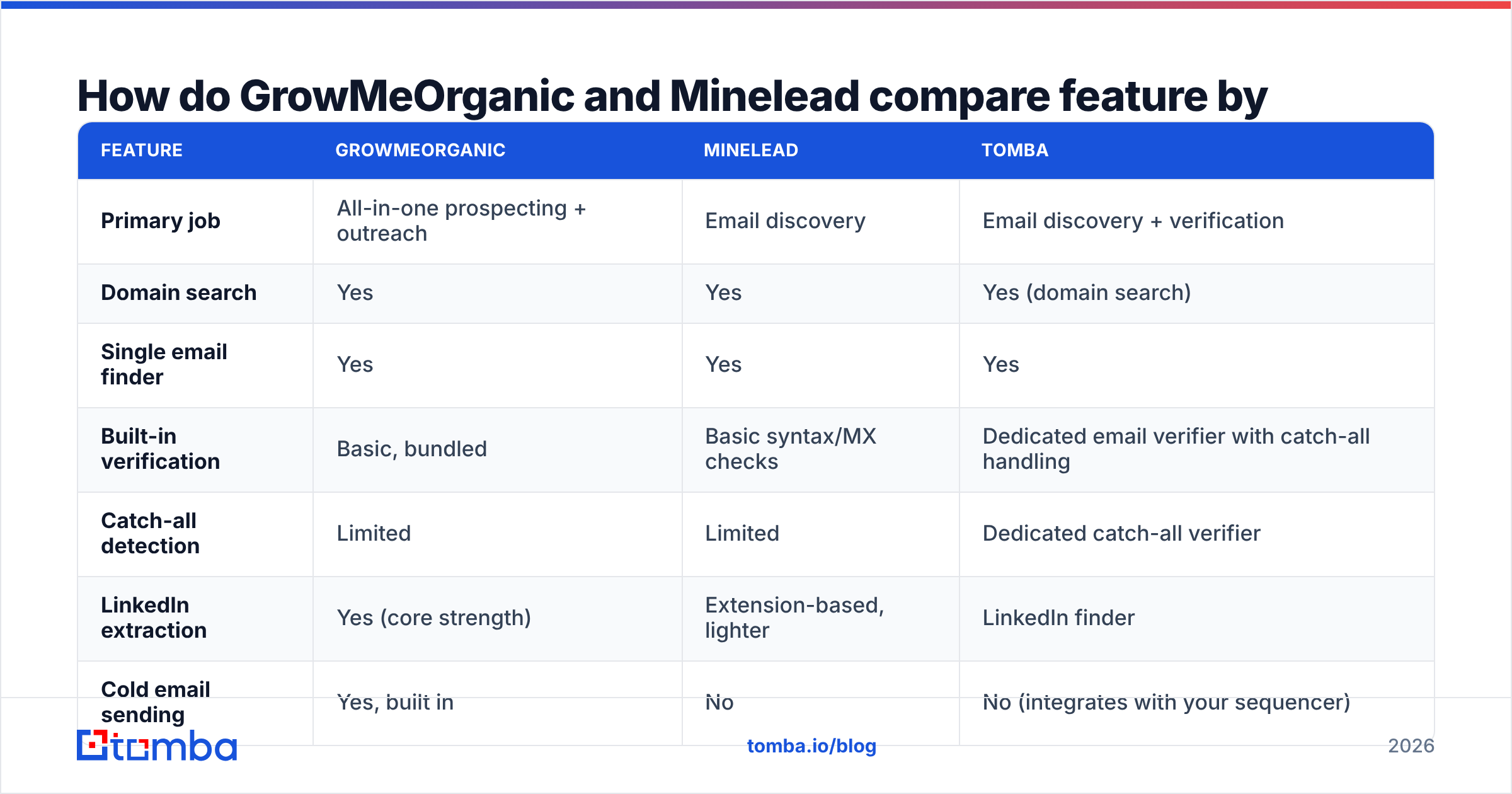
Feature parity is thin in both directions. GrowMeOrganic wins on breadth; Minelead wins on being un-opinionated about the rest of your stack.
| Feature | GrowMeOrganic | Minelead | Tomba |
|---|---|---|---|
| Primary job | All-in-one prospecting + outreach | Email discovery | Email discovery + verification |
| Domain search | Yes | Yes | Yes (domain search) |
| Single email finder | Yes | Yes | Yes |
| Built-in verification | Basic, bundled | Basic syntax/MX checks | Dedicated email verifier with catch-all handling |
| Catch-all detection | Limited | Limited | Dedicated catch-all verifier |
| LinkedIn extraction | Yes (core strength) | Extension-based, lighter | LinkedIn finder |
| Cold email sending | Yes, built in | No | No (integrates with your sequencer) |
| Bundled B2B database | Yes | No | Yes (B2B database) |
| Public API | Yes | Yes, well documented | Yes (Tomba API), plus CLI and MCP |
| Free tier | Trial-style | Yes, ongoing free credits | Yes — 25 searches/mo |
| Bulk processing | Yes | Yes | Yes (bulk email finder) |
| Best for | Solo founders and small agencies with no stack | Developers and lean growth teams | Teams that want accuracy-first data feeding an existing stack |
The honest read: GrowMeOrganic replaces three tools at once, and that is genuinely valuable if you own none of them. Minelead replaces exactly one tool and does not try to own your outbound process. Neither is "better" in the abstract — they are answers to different questions.
Which tool actually finds more valid emails?#
Nobody publishes a number you should trust, including the vendors. Both GrowMeOrganic and Minelead cite high accuracy figures on their marketing pages; neither submits to third-party auditing, and both measure against samples they choose. Treat vendor accuracy claims as directional at best.

What you can measure yourself, in an afternoon:
- Hit rate — of 200 target contacts, how many addresses come back at all? Suite tools with bundled databases usually win here on volume.
- Bounce rate — of the addresses returned, how many bounce on send? This is the only number your domain reputation cares about.
- Catch-all share — what percentage come back as "accept-all"? Catch-all domains are where most finders quietly inflate their hit rate, because the server accepts everything and the tool marks it deliverable.
- Freshness — sample 20 returned contacts and check LinkedIn. If more than three have changed jobs, the underlying data is stale.
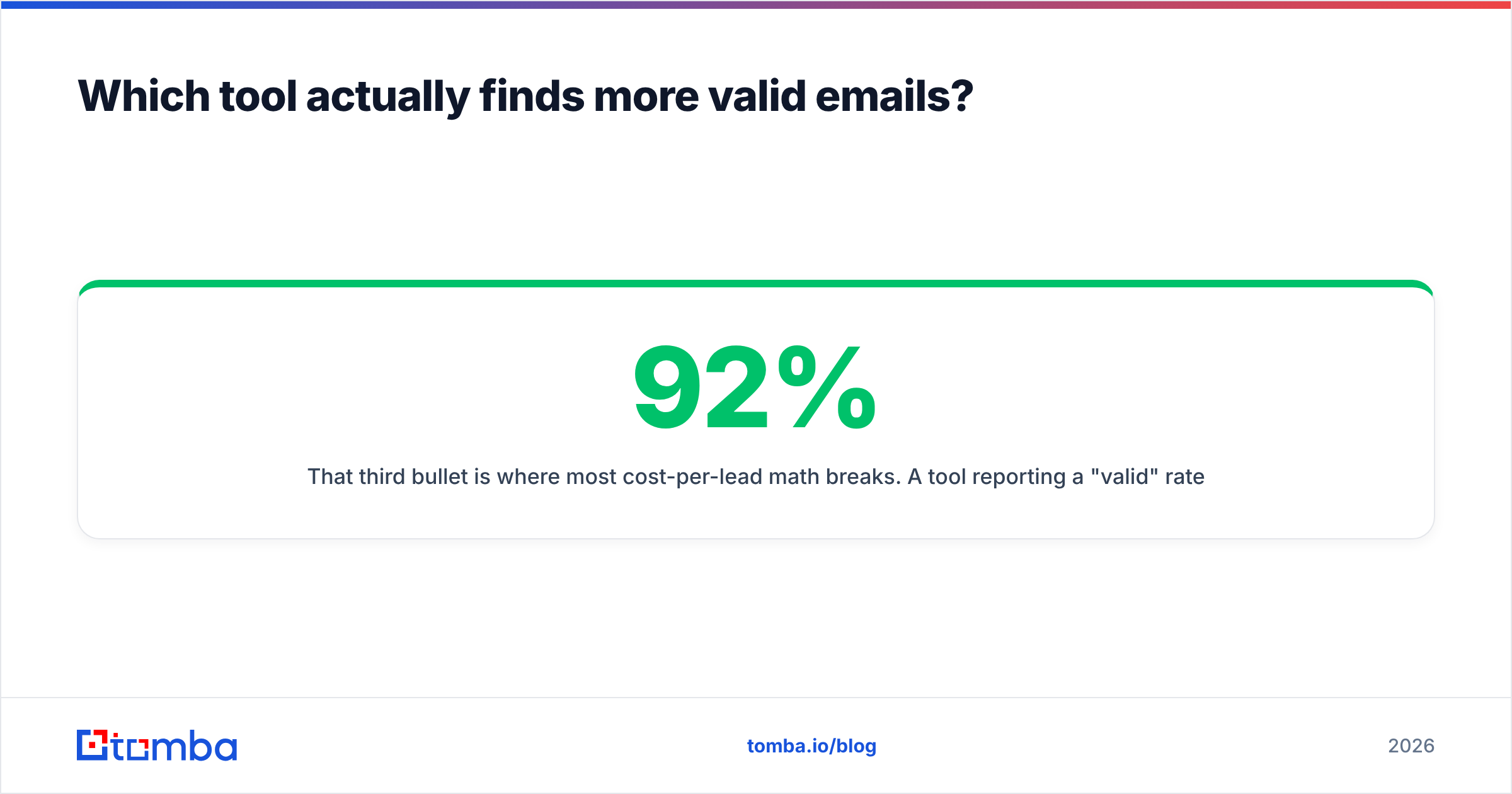
That third bullet is where most cost-per-lead math breaks. A tool reporting a 92% "valid" rate where 30% of results are unverified catch-alls is really running at somewhere near 65% deliverable. Pushing those into a sequencer is how you burn a sending domain in two weeks. Run every list through a dedicated verification pass before send — Minelead's built-in checks are syntax and MX level, and GrowMeOrganic's bundled verifier is adequate but not a specialist product.

For context on how much this matters, Gartner's coverage of B2B data quality has consistently tied revenue-team underperformance to contact-data decay rather than tooling gaps. The tool that finds fewer addresses but bounces less almost always wins on pipeline.
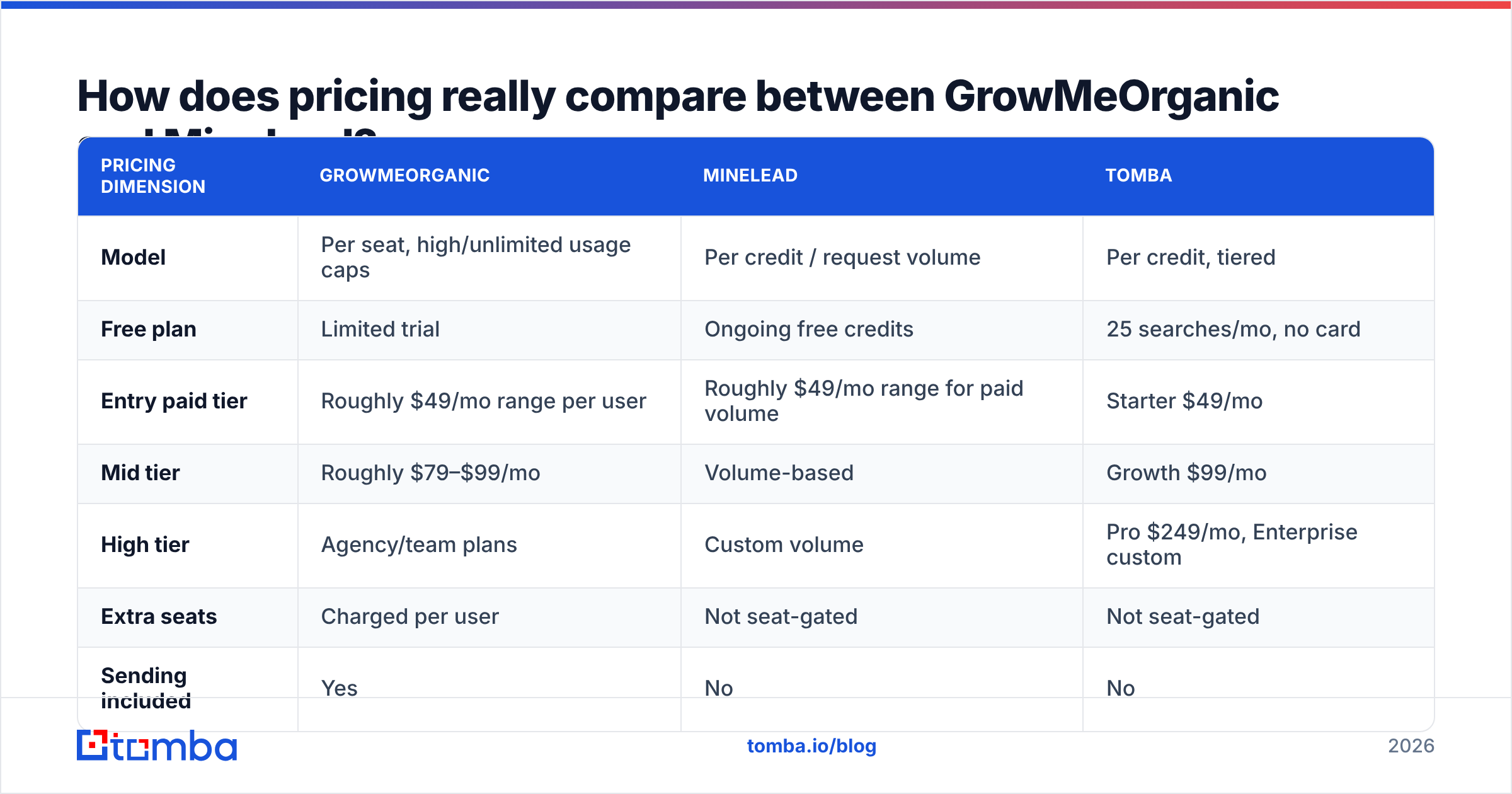
How does pricing really compare between GrowMeOrganic and Minelead?#
Two different billing philosophies, which makes the sticker price nearly useless as a comparison.

| Pricing dimension | GrowMeOrganic | Minelead | Tomba |
|---|---|---|---|
| Model | Per seat, high/unlimited usage caps | Per credit / request volume | Per credit, tiered |
| Free plan | Limited trial | Ongoing free credits | 25 searches/mo, no card |
| Entry paid tier | Roughly $49/mo range per user | Roughly $49/mo range for paid volume | Starter $49/mo |
| Mid tier | Roughly $79–$99/mo | Volume-based | Growth $99/mo |
| High tier | Agency/team plans | Custom volume | Pro $249/mo, Enterprise custom |
| Extra seats | Charged per user | Not seat-gated | Not seat-gated |
| Sending included | Yes | No | No |
| Annual discount | Yes | Yes | Yes — see Tomba pricing |
Vendor pricing changes often; verify current numbers on each vendor's own page before you commit. The structural point holds regardless of the exact figures: GrowMeOrganic gets expensive as your team grows, Minelead gets expensive as your volume grows.
Work out which curve you are on. A four-person SDR pod running 800 lookups a month pays four seats at GrowMeOrganic and one modest volume plan at Minelead. A solo growth engineer running 40,000 lookups a month has the inverse problem. The number to write on the whiteboard is cost per verified email:
cost per valid email = monthly cost ÷ (lookups × hit rate × deliverable rate)Run that with real numbers from a trial and the comparison usually stops being close.
Who should pick GrowMeOrganic?#
Choose GrowMeOrganic if most of these are true:
- You have no outbound stack yet. One subscription covering scraping, finding, and sending beats stitching three trials together.
- Your team is small and stable. Seat pricing is fine at two or three users; it hurts at ten.
- LinkedIn is your primary sourcing channel. The extractor is the product's strongest component and the reason most users land there.
- You want reporting in one place. Attribution across a suite is simpler than reconciling a finder, a verifier, and a sequencer.
- You are price-sensitive on total spend, not per-lookup cost. The bundle math works when you would otherwise pay for three products.
Where it disappoints: teams that already run a serious sequencer find themselves paying for a sending engine they will never use, and the bundled verification is not strong enough to replace a specialist. If you are evaluating suites more broadly, our breakdowns of Apollo alternatives and Instantly alternatives cover the same overlap problem.
Who should pick Minelead?#
Choose Minelead if most of these are true:
- You want a component, not a platform. It plugs in and gets out of the way.
- You are technical. The API is clean, documented, and easy to wire into a script or an internal tool.
- Your volume is bursty. Credit-based billing suits campaigns that spike and go quiet.
- You want to test before paying. The free tier is real, not a three-day countdown.
- You already own sending. Nothing in Minelead duplicates what Smartlead or Lemlist does.
Where it disappoints: there is no bundled contact database to prospect into, so you need a source of target companies before Minelead is useful. Catch-all handling is thin. And enrichment beyond email — phone numbers, firmographics, tech stack — is not part of the offering, so you will end up adding a data enrichment layer anyway.
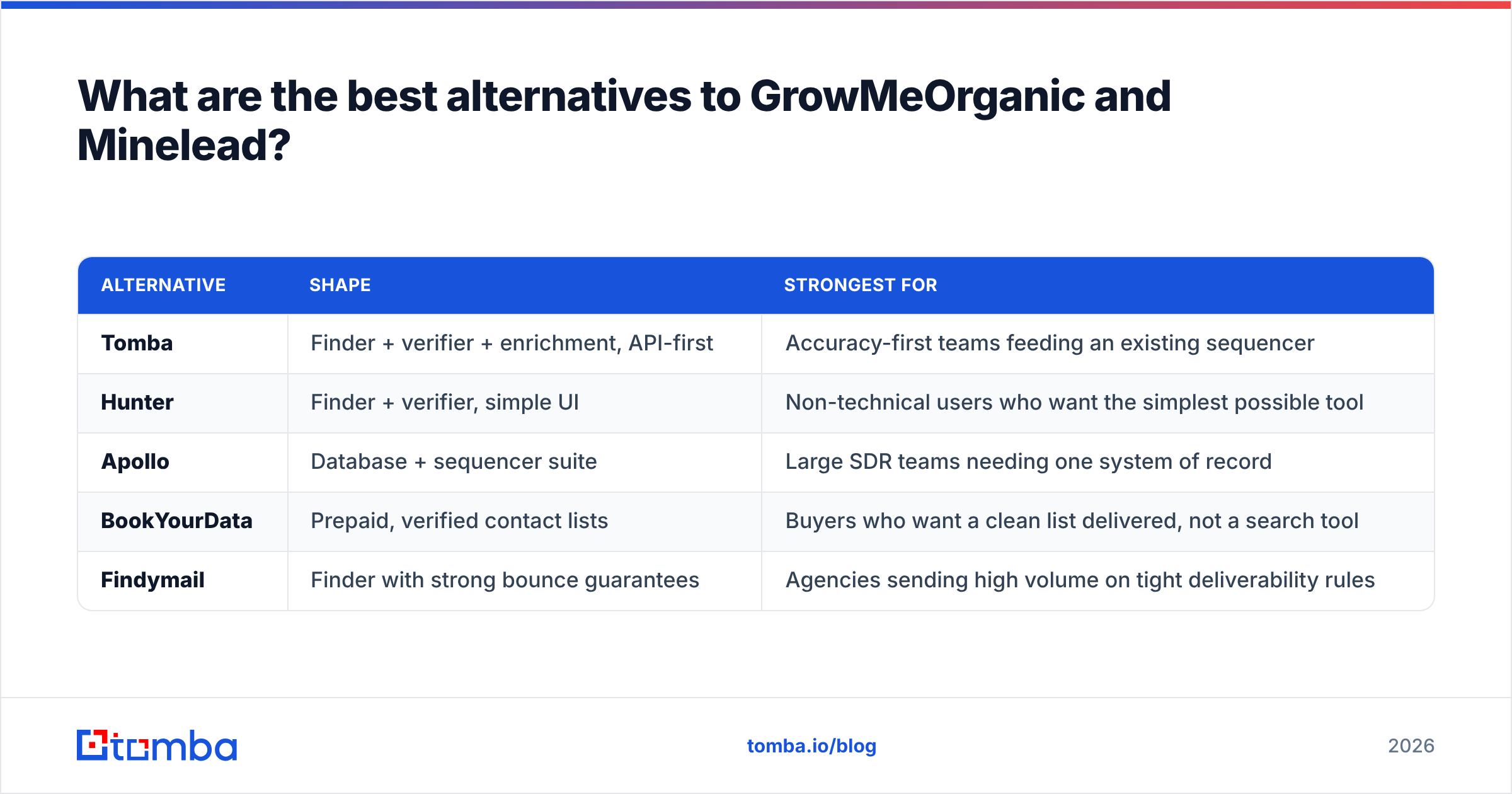
What are the best alternatives to GrowMeOrganic and Minelead?#
If neither shape fits, the field is wider than these two:
| Alternative | Shape | Strongest for |
|---|---|---|
| Tomba | Finder + verifier + enrichment, API-first | Accuracy-first teams feeding an existing sequencer |
| Hunter | Finder + verifier, simple UI | Non-technical users who want the simplest possible tool |
| Apollo | Database + sequencer suite | Large SDR teams needing one system of record |
| BookYourData | Prepaid, verified contact lists | Buyers who want a clean list delivered, not a search tool |
| Findymail | Finder with strong bounce guarantees | Agencies sending high volume on tight deliverability rules |
BookYourData is worth a look specifically when you would rather buy a verified list outright than run lookups — a legitimately different purchase, with a bounce guarantee attached. Findymail overlaps most directly with Minelead. Apollo overlaps most directly with GrowMeOrganic. Check current user sentiment on G2 before shortlisting anything; category leaders shift faster than review-site rankings suggest.
How do you test both in one week?#
Do not decide from marketing pages. Run this:
- Build one control list. 200 real target contacts — name, company, domain — that you can verify manually. Same list for every tool.
- Run it through each finder. Record hit rate, catch-all share, and time to complete.
- Verify the output independently. Push all results through one neutral verifier so the scoring is identical across tools. Do not use each vendor's own verifier to grade its own output.
- Spot-check freshness. Pull 20 random hits and confirm the person still holds the role.
- Send a small warm batch. 50 addresses per tool from a secondary domain. Measure actual bounces, not predicted ones.
- Compute cost per valid email. Divide plan cost by the verified deliverable count. That single number ends most debates.
Most teams discover the winner is not the tool with the biggest hit rate — it is the one whose results survive verification. Track email deliverability impact for two weeks after, because a spike in bounces costs more than any subscription you are comparing.
Frequently asked questions#
Is GrowMeOrganic or Minelead cheaper? Depends on the curve you are on. Minelead is cheaper for one technical user running moderate volume. GrowMeOrganic is cheaper for a small team that would otherwise pay for a scraper, a finder, and a sender separately.
Does either offer a real free tier? Minelead's free credits are ongoing and usable for evaluation. GrowMeOrganic's free access is trial-shaped.
Can I use either as a pure API? Both expose APIs. Minelead's is simpler and more developer-oriented; GrowMeOrganic's API is secondary to its UI workflow.
Do I still need a separate verifier? Yes, with either. Neither ships specialist-grade catch-all resolution, and that is where bounce risk concentrates.
Which handles LinkedIn better? GrowMeOrganic, clearly — that is its origin product.
Ready to test your list against a stricter finder?#
If your shortlist keeps coming back to "GrowMeOrganic has too much I won't use, Minelead has too little I need," run the same control list through the Tomba Email Finder. Start on the free tier — 25 searches a month, no card — and compare hit rate and post-verification deliverable rate side by side with whatever you are testing. Paid plans start at $49/mo (Starter), $99/mo (Growth), and $249/mo (Pro), with no seat gating, so cost scales with lookups instead of headcount. Bring your 200-contact list, run the test, and let the bounce numbers pick the winner.
Related guides#
Ready to find emails that actually work?
Join 150,000+ professionals who stopped guessing and started sending. Free credits on signup — no credit card required.
Get the Tomba newsletter
Practical outbound tactics and product updates — once every two weeks.
About the author