GrowMeOrganic vs SalesIntel: Honest 2026 Data Comparison
One tool sells you unlimited scraping for the price of a lunch. The other sells human-verified records at enterprise rates. Here is where each one actually earns its money — and where both fall short.
TL;DR
- GrowMeOrganic is a low-cost, all-in-one prospecting suite: LinkedIn scraping, an email finder, and a built-in cold email sender for roughly the price of a single seat on most sales tools.
- SalesIntel is an enterprise B2B data provider built around human-verified contacts, direct dials, technographics, and Bombora intent — priced by annual contract, not by credit card.
- They are not really competitors. GrowMeOrganic sells volume and workflow; SalesIntel sells confidence and compliance. Pick based on whether your bottleneck is list size or list quality.
- Both have a gap: GrowMeOrganic's verification is thin, and SalesIntel's coverage outside North America is limited. A dedicated verification layer fixes the first problem for a fraction of the second's cost.
- If you mostly need accurate work emails at a predictable price, a focused email finder plus a verifier beats paying for either platform's bundled extras.
What is GrowMeOrganic and who is it for?#
GrowMeOrganic is an Indian-built prospecting platform that bundles four jobs into one subscription: scrape prospects (mostly from LinkedIn and Sales Navigator via a Chrome extension), find their email addresses, enrich the row, and send a cold sequence — all without leaving the app. Its published plans sit in the tens-of-dollars-per-month range, and the marketing leans hard on "unlimited" language around exports and email credits on higher tiers. Check growmeorganic.com for current numbers before you buy; pricing on tools in this bracket changes often.
The buyer profile is obvious once you use it: a founder, a solo SDR, or a two-person agency who needs 3,000 contacts this month and cannot justify a five-figure data contract. It replaces a stack — a scraper, a finder, a sender — that would otherwise cost three subscriptions.
The tradeoff is equally obvious. Scraped-then-guessed emails carry higher bounce risk than records that a human confirmed by phone. GrowMeOrganic does run pattern detection and basic validation, but "validated" and "verified" are not the same claim, and your inbox reputation is the thing that pays the difference.
What is SalesIntel and what does it actually sell?#
SalesIntel is a US-centric B2B data platform whose whole positioning is human verification. Its research team re-checks contact records on a rolling cycle (the company markets a 90-day re-verification standard) and layers on direct-dial phone numbers, firmographics, technographics, and buyer intent through a Bombora partnership. You can read the current feature set at salesintel.io and skim real buyer reviews on G2.
SalesIntel does not publish list pricing. Deals are quoted annually, seat-based, with credit allocations negotiated per contract — the standard enterprise data motion. Expect a demo, a procurement cycle, and a contract term measured in years, not months.
That model buys real things. Direct dials that connect. Records with a verification timestamp you can show a compliance officer. CRM enrichment that runs on a schedule. Intent signals that tell you which accounts are already researching your category. If your ACV is $40,000 and one extra closed deal pays for the year, the math works without argument.
If your ACV is $500, it never works.
GrowMeOrganic vs SalesIntel: how do they compare head to head?#
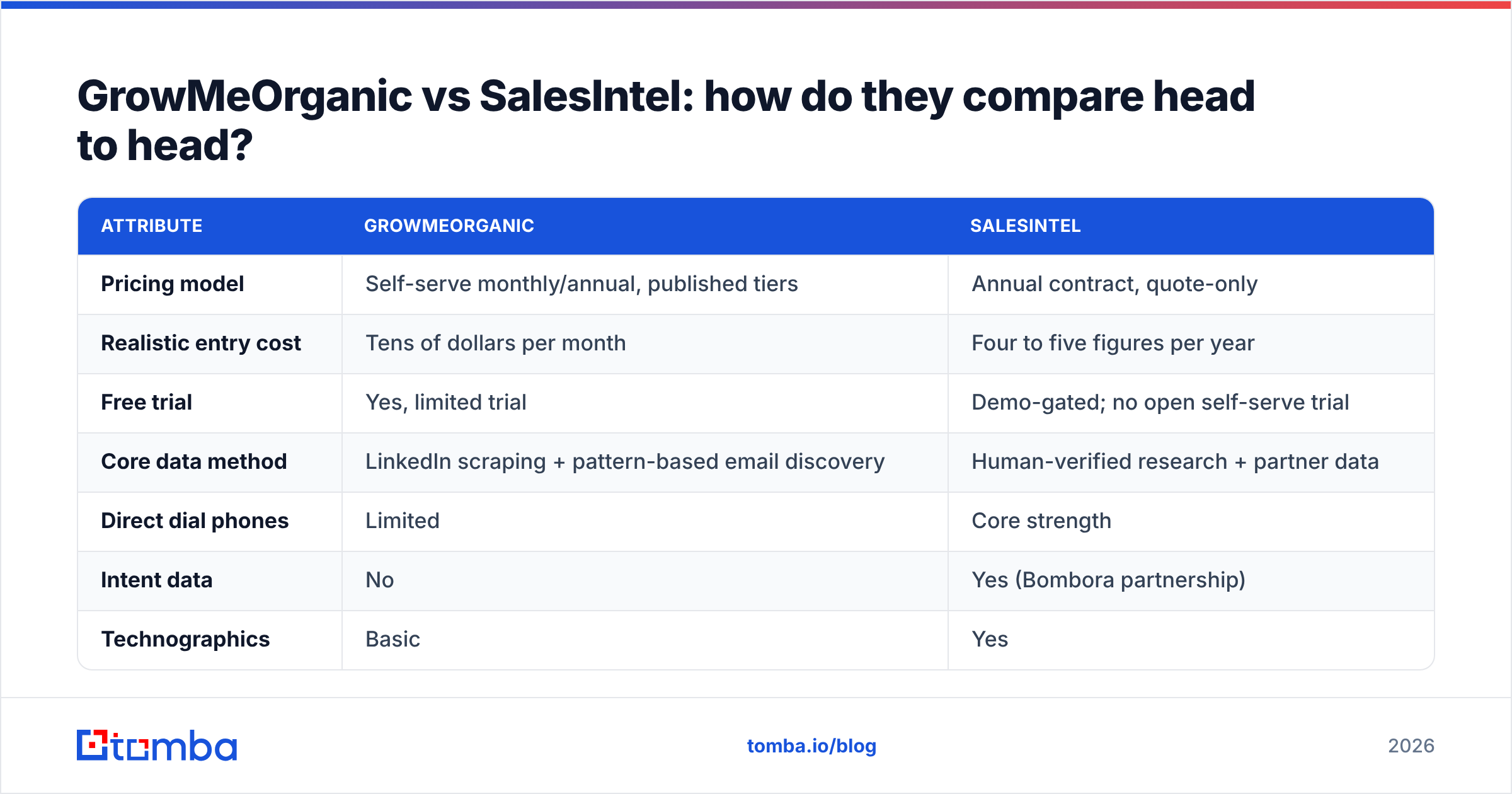
Here is the practical comparison, feature by feature. Treat pricing as directional — SalesIntel is quote-only and GrowMeOrganic revises its tiers regularly.
| Attribute | GrowMeOrganic | SalesIntel |
|---|---|---|
| Pricing model | Self-serve monthly/annual, published tiers | Annual contract, quote-only |
| Realistic entry cost | Tens of dollars per month | Four to five figures per year |
| Free trial | Yes, limited trial | Demo-gated; no open self-serve trial |
| Core data method | LinkedIn scraping + pattern-based email discovery | Human-verified research + partner data |
| Direct dial phones | Limited | Core strength |
| Intent data | No | Yes (Bombora partnership) |
| Technographics | Basic | Yes |
| Built-in email sending | Yes, native sequences | No — integrates with sequencers |
| CRM enrichment/sync | Basic integrations | Deep Salesforce/HubSpot enrichment |
| Geographic strength | Global scraping, uneven depth | Strong North America, thinner EMEA/APAC |
| Best fit | Founders, agencies, high-volume outbound | Mid-market and enterprise sales teams |
| Main weakness | Verification depth, deliverability risk | Cost, contract lock-in, non-US coverage |
Read that table as two different products rather than two grades of the same product. GrowMeOrganic optimises the cost per contact. SalesIntel optimises the cost per wasted dial.
Which one has more accurate data?#
SalesIntel wins on stated accuracy, and it should — you are paying for humans to check the work. The honest caveat is that no vendor's headline accuracy number survives contact with your specific ICP. A 95% claim measured across a database dominated by US mid-market companies tells you very little about your list of 400 Series-A CTOs in Berlin.

Four things actually drive the accuracy you experience:
- ICP overlap. A database with 20 million US records is worthless if your buyers are in Southeast Asia. Always run a sample against your real target list, not the vendor's demo account.
- Recency. B2B contact data decays roughly 2–3% per month through job changes alone. A record verified 14 months ago is a guess wearing a badge.
- Catch-all handling. Domains that accept every address break SMTP validation. Tools differ wildly here — some mark catch-alls as valid, some as risky, some refuse to guess. A dedicated catch-all verifier is the only reliable way to separate real mailboxes from accept-all noise.
- Verification at send time. Any record verified at export time and mailed six weeks later has already drifted. Re-verify the batch the day you send it.
The practical test costs you nothing: take 100 known-good contacts from your CRM, strip the emails, and ask each tool to find them. Score the hit rate and the accuracy separately. Ten minutes of that beats ten pages of vendor benchmarks.
Is GrowMeOrganic cheap enough to justify the bounce risk?#
Sometimes. Do the arithmetic instead of arguing about it.
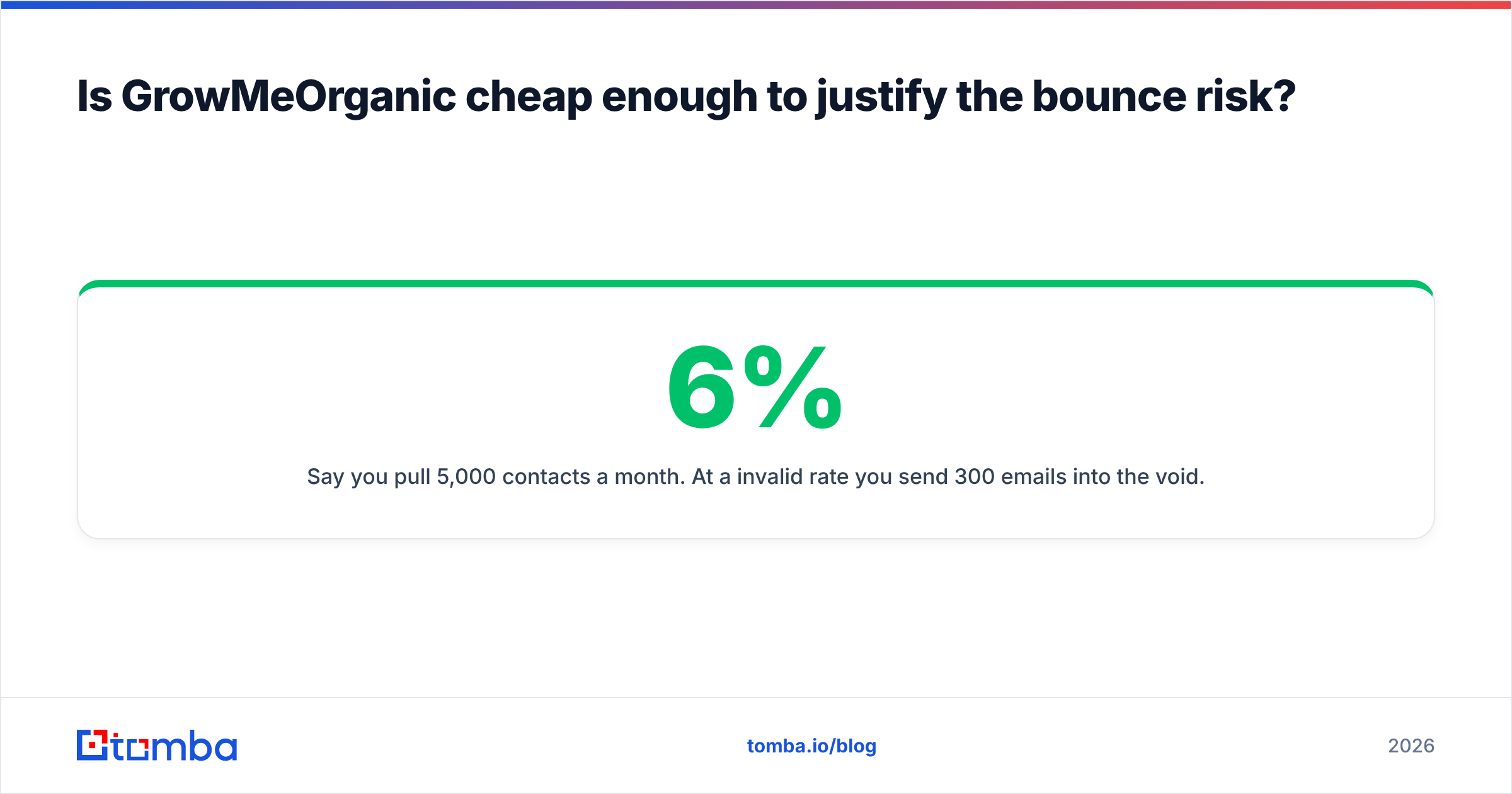
Say you pull 5,000 contacts a month. At a 6% invalid rate you send 300 emails into the void. That is survivable if — and only if — you filter them before they hit the sender. Bounce rates above 3% start pulling your domain reputation down, and at 5%+ mailbox providers begin routing you to spam regardless of what your copy says. The cheap list stops being cheap the moment it burns a sending domain you have spent three months warming.
So the correct comparison is not "GrowMeOrganic vs SalesIntel." It is:
- Option A: SalesIntel's verified data at enterprise pricing.
- Option B: Cheap sourcing plus an independent verification layer before send.
- Option C: Cheap sourcing, no verification, and a domain you replace every quarter.
Option C is the one most teams pick by accident. Option B is usually the best value, because verification is commodity-priced while verified sourcing is not. Running scraped lists through a dedicated email verifier before they enter a sequence recovers most of SalesIntel's deliverability advantage at a small fraction of the contract value.

Which tool fits your team size and motion?#
Choose GrowMeOrganic if:
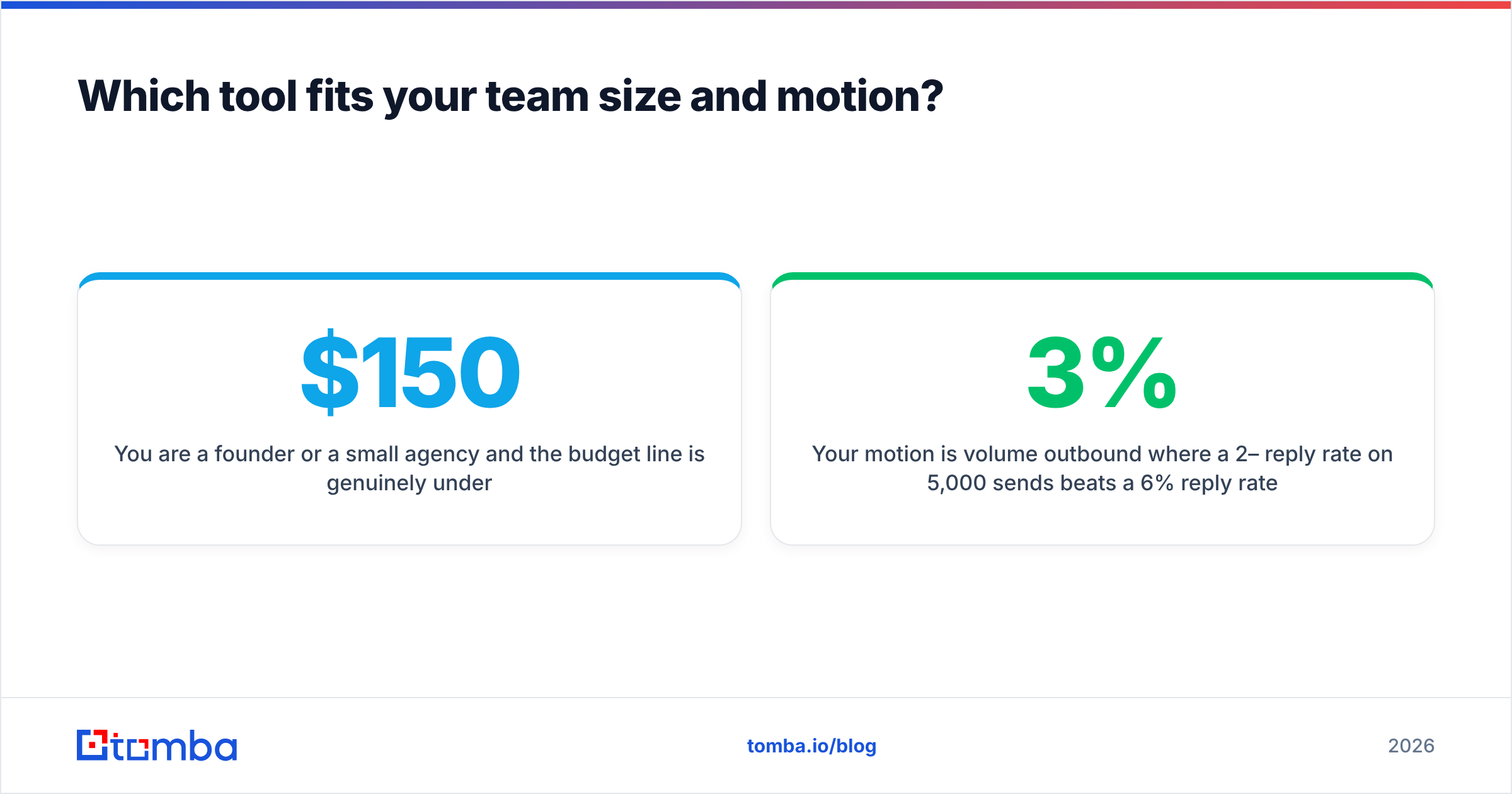
- You are a founder or a small agency and the budget line is genuinely under $150/month.
- Your motion is volume outbound where a 2–3% reply rate on 5,000 sends beats a 6% reply rate on 300.
- You want scraping, finding, and sending in one login and can tolerate each module being merely adequate rather than best in class.
- Your targets live on LinkedIn and you are comfortable with the platform's terms around automation.
Choose SalesIntel if:
- Your ACV is high enough that one incremental meeting per quarter pays the contract.
- You sell primarily into North America, where its coverage is deepest.
- Phone is a real channel for you and direct dials materially change your connect rate.
- You need intent data to prioritise accounts, and a defensible audit trail on where each record came from.
- A RevOps function exists to actually operationalise CRM enrichment — otherwise you are buying a database nobody maintains.
Choose neither if: your only real need is finding and verifying work email addresses. Both platforms bundle capabilities you will not use, and you will pay for them either way. A focused stack — domain search for company-wide discovery, an email finder for named prospects, and a verifier before send — covers that job at a predictable cost with a clean email finder API when you want to automate it.
What are the strongest alternatives in 2026?#
The GrowMeOrganic/SalesIntel decision is really a decision about where you sit on the price-versus-verification curve, and there are more than two points on that curve.

- Apollo.io — the default all-in-one for teams that want database plus sequencer plus dialer, with a usable free tier. Broad coverage, variable accuracy on niche segments. See our notes on picking an Apollo alternative if seat pricing gets away from you.
- BookYourData — pay-as-you-go verified B2B lists with a strong accuracy guarantee and no annual commitment. A genuinely good middle path for teams that want SalesIntel-grade confidence without a procurement cycle, especially for one-off campaign lists.
- ZoomInfo — the incumbent SalesIntel is usually compared against. Bigger database, bigger invoice, similar contract dynamics.
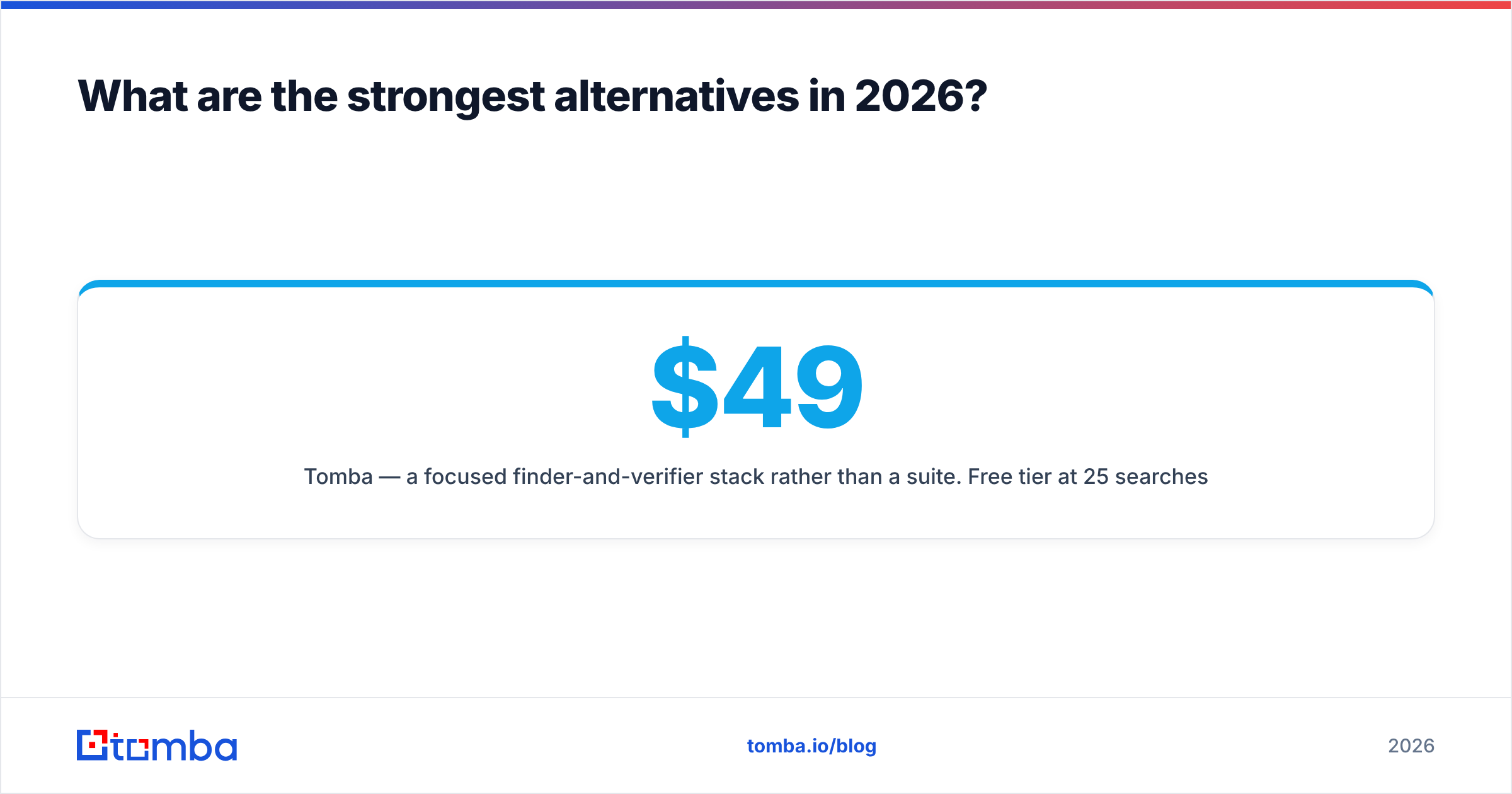
- Tomba — a focused finder-and-verifier stack rather than a suite. Free tier at 25 searches/month, Starter at $49/mo, Growth at $99/mo, Pro at $249/mo, with everything available through an API, CLI, Sheets add-on, and Chrome extension. Full Tomba pricing is public, which is itself a differentiator in this category.
The pattern worth noticing: the market has split into cheap-and-broad on one end and verified-and-expensive on the other, and the interesting products are the ones that let you compose the two. You do not have to buy verification and sourcing from the same vendor.
How should you actually run the evaluation?#
Give yourself two weeks and a scorecard rather than a gut feeling.
- Define the sample. 200 accounts that look exactly like your best customers. Not 200 random companies.
- Measure coverage first. What percentage of your target list does each tool return a contact for? A perfect record you never receive is worth zero.
- Measure accuracy second. Run every returned email through an independent verifier — not the source tool's own validator, which grades its own homework.
- Measure the workflow. Time how long it takes to go from "list defined" to "sequence loaded." Suite tools win here; point tools win on data quality.
- Price it per usable contact. Divide total monthly cost by verified, in-ICP contacts delivered. This single number ends most vendor debates immediately.
- Check the exit. Can you export your data if you leave? Annual contracts with export restrictions are a real cost that never appears on the quote.
Most teams that run this honestly discover their sourcing tool is fine and their verification step is missing. That is a cheaper problem to fix than a data contract.
The bottom line#
GrowMeOrganic and SalesIntel answer different questions. If your constraint is budget and your motion is volume, GrowMeOrganic gets you moving this week — provided you add a verification step before anything reaches your sending domain. If your constraint is credibility with high-value accounts and you sell into North America at real ACVs, SalesIntel's human-verified records and direct dials earn their price.
If what you actually need is accurate work emails, found fast, at a price you can read off a public page — start with Tomba Email Finder. Free tier gives you 25 searches a month to test against your own ICP before you spend anything, Starter is $49/mo, and every result can be pushed straight through the verifier so nothing untested ever reaches your sequence. Run your 100-contact benchmark against it alongside whichever suite you are considering, and let the hit rate decide.
Related guides#
Ready to find emails that actually work?
Join 150,000+ professionals who stopped guessing and started sending. Free credits on signup — no credit card required.
Get the Tomba newsletter
Practical outbound tactics and product updates — once every two weeks.
About the author