GrowMeOrganic vs Salutary Data (2026): Which B2B Data Wins?
One is a cheap self-serve LinkedIn scraper with outreach built in. The other is a quote-based US contact-data vendor with human verification. Here is which one actually fits your pipeline — and when neither does.
GrowMeOrganic vs Salutary Data is a choice between two very different buys. One sells cheap self-serve prospecting. The other sells curated, human-verified US contact data.
TL;DR
- GrowMeOrganic is a low-cost, self-serve prospecting suite. A Chrome extension pulls contacts off LinkedIn and Sales Navigator. You also get an email finder, a verifier, and built-in drip campaigns. You buy it with a card in three minutes.
- Salutary Data is a boutique US B2B contact-data vendor. It sells human-verified emails and mobile numbers as a file, an enrichment run, or an API. You buy it after a call.
The two are not really rivals. They answer different questions:
- "How do I run outbound cheaply this quarter?" GrowMeOrganic wins on price, speed to first email, and one login instead of four.
- "How do I get clean, compliant US data into my CRM?" Salutary Data wins on data hygiene, mobile-number depth, and contracts your procurement team will sign.
- "Can I skip both?" Often, yes. If you mostly need accurate emails on demand, an API-first email finder covers the middle ground for less than either.
What is GrowMeOrganic?#
GrowMeOrganic is an all-in-one B2B prospecting platform built around a browser extension. You open a LinkedIn or Sales Navigator search and click the extension. It exports the results: names, titles, companies, and LinkedIn URLs. Then it tries to find and verify a work email for each one. From there you can push the list into a drip sequence inside the same tool.
The pitch is bundling. A scraper, an email finder, a verifier, and a sequencer normally cost four subscriptions. Here you pay one and get a serviceable version of all four. For a two-person startup running its first outbound campaign, that math is genuinely attractive.
The tradeoffs are the ones you would expect from a bundle. Each module is decent rather than best in class. Deliverability tooling is thinner than a dedicated sender like Instantly or Smartlead.
There is also a sourcing question. Much of the contact data comes from LinkedIn scraping. LinkedIn's User Agreement bans automated extraction, and accounts that run heavy extension activity do get restricted.
Check current plans and limits on the GrowMeOrganic site. Self-serve pricing moves around, and annual billing changes the headline number.
What is Salutary Data?#
Salutary Data sits at the other end of the market. It is a US-focused B2B contact and company database, built and cleaned by a small team of data veterans. It is sold as data, not as software. There is no Chrome extension, no sequencer, and no free-trial button. There is a contact form, a scoping call, and a quote.
What you get back is the thing scrapers struggle with: verification discipline. Salutary layers human checks on top of automated validation. Direct-dial and mobile coverage is real, and the sourcing is documented.
That paperwork matters. Legal and RevOps teams ask for it before a list touches the CRM. Delivery is flexible too: a one-time file, an ongoing subscription, enrichment of your own records, or API access. Details and contact routes are on salutarydata.com.
The tradeoffs are predictable. You cannot try it in an afternoon. Minimums and contract terms make it a poor fit for a founder testing whether outbound works at all. US-centric coverage is a plus if you sell to North America. It is a dealbreaker if you sell to EMEA or APAC.
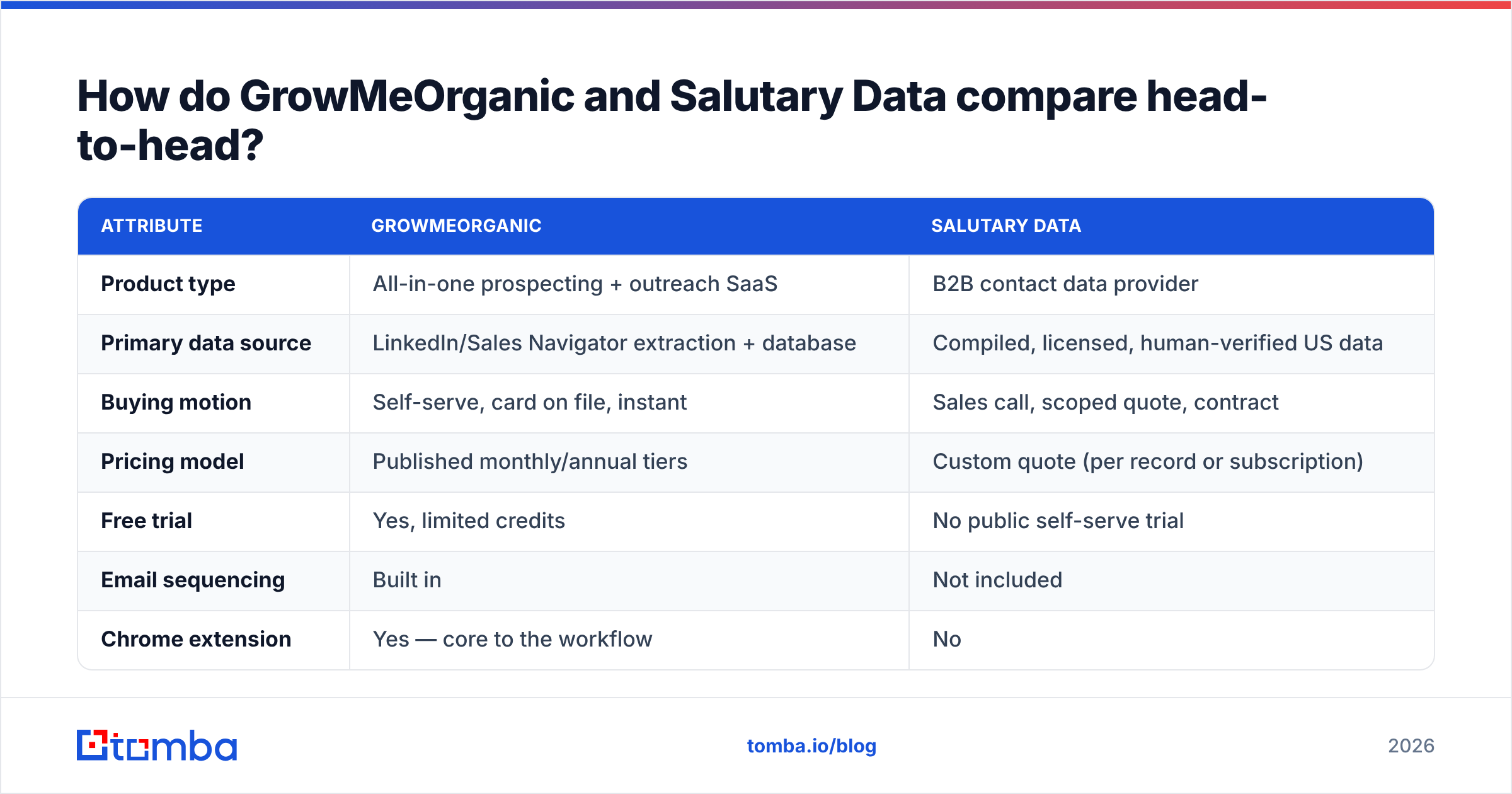
GrowMeOrganic vs Salutary Data: how do they compare head-to-head?#
| Attribute | GrowMeOrganic | Salutary Data |
|---|---|---|
| Product type | All-in-one prospecting + outreach SaaS | B2B contact data provider |
| Primary data source | LinkedIn/Sales Navigator extraction + database | Compiled, licensed, human-verified US data |
| Buying motion | Self-serve, card on file, instant | Sales call, scoped quote, contract |
| Pricing model | Published monthly/annual tiers | Custom quote (per record or subscription) |
| Free trial | Yes, limited credits | No public self-serve trial |
| Email sequencing | Built in | Not included |
| Chrome extension | Yes — core to the workflow | No |
| Mobile / direct dials | Limited | A core strength |
| Geographic strength | Broad but uneven outside the US | Deep US, thin elsewhere |
| Best fit | Founders, agencies, SDR teams under 10 | RevOps, demand gen, data teams |
| Compliance posture | Scraping-adjacent, review before use | Documented sourcing, procurement-friendly |

Read that table as a fork, not a scoreboard. If four of the five rows you care about sit on the left, GrowMeOrganic is your answer. If they sit on the right, a lower price will not save you. You will spend the savings cleaning records.
GrowMeOrganic vs Salutary Data: how accurate is the data?#
Accuracy is where the two diverge most. It is also where vendor marketing helps least.
GrowMeOrganic behaves like most extension-first tools. It is strong on mid-size tech firms with predictable email patterns. It is weaker on large companies with odd formats, on catch-all domains, and on small firms with no public footprint. The find rate looks good in aggregate because pattern guessing returns something for almost every contact. Whether that something lands is a separate question. So run an independent email verifier pass over any scraped export.

Salutary Data works from the other direction. Instead of guessing addresses on demand, it keeps a curated set and re-checks it on a cycle. Human review sits on top of the automated checks. You get lower coverage per query and higher confidence per record. For an ABM list of 3,000 named accounts, precision is worth more. For high-volume top of funnel, coverage usually wins.
Three practical notes before you trust either number:
- Bounce rate is not accuracy. A catch-all domain accepts everything. So a clean bounce report can hide a list where half the addresses never reach a human. Use a proper catch-all verifier instead of assuming acceptance means delivery.
- Verification decays. About a fifth of B2B contact data goes stale each year through job changes alone. A record verified in January is not a record verified today.
- Test on your ICP, not theirs. Pull 200 contacts you already know the answers for. Measure both tools against that set. Vendor accuracy figures come from samples that favor the vendor.
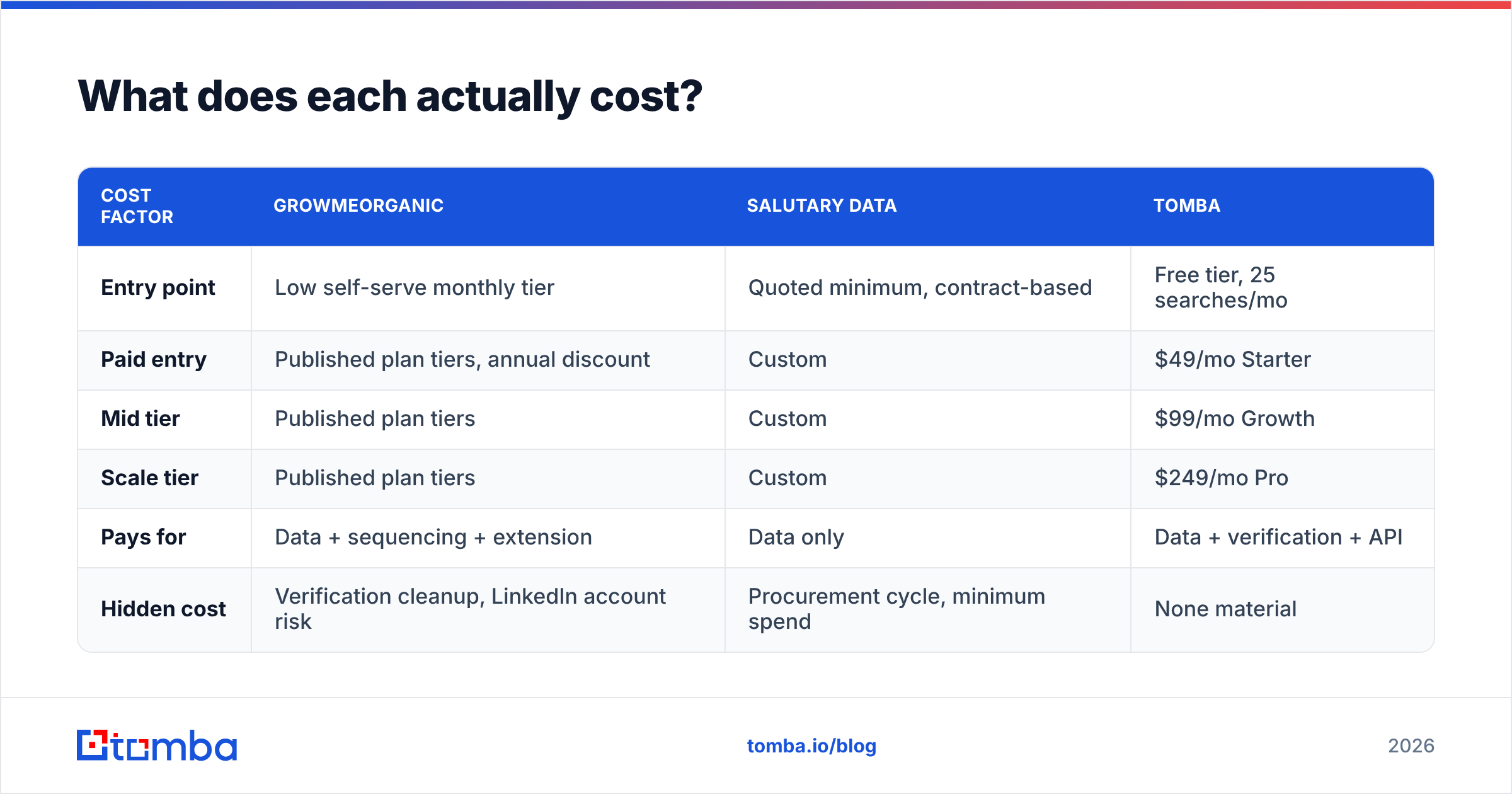
What does each actually cost?#
| Cost factor | GrowMeOrganic | Salutary Data | Tomba |
|---|---|---|---|
| Entry point | Low self-serve monthly tier | Quoted minimum, contract-based | Free tier, 25 searches/mo |
| Paid entry | Published plan tiers, annual discount | Custom | $49/mo Starter |
| Mid tier | Published plan tiers | Custom | $99/mo Growth |
| Scale tier | Published plan tiers | Custom | $249/mo Pro |
| Pays for | Data + sequencing + extension | Data only | Data + verification + API |
| Hidden cost | Verification cleanup, LinkedIn account risk | Procurement cycle, minimum spend | None material |
Check the vendor pages for today's exact numbers. Self-serve pricing changes often, and quoted pricing was never published to begin with.
The structural point holds either way. GrowMeOrganic's cost is mostly visible and mostly small, with a hidden tax in cleanup time and platform risk. Salutary Data's cost stays invisible until you talk to sales. It is priced for teams that already know their cost per qualified meeting.
Tomba's pricing is in the table because it is the reference point most buyers land on. They wanted neither a scraper nor a contract. They wanted reliable emails, billed monthly.

GrowMeOrganic vs Salutary Data: which one fits your workflow?#
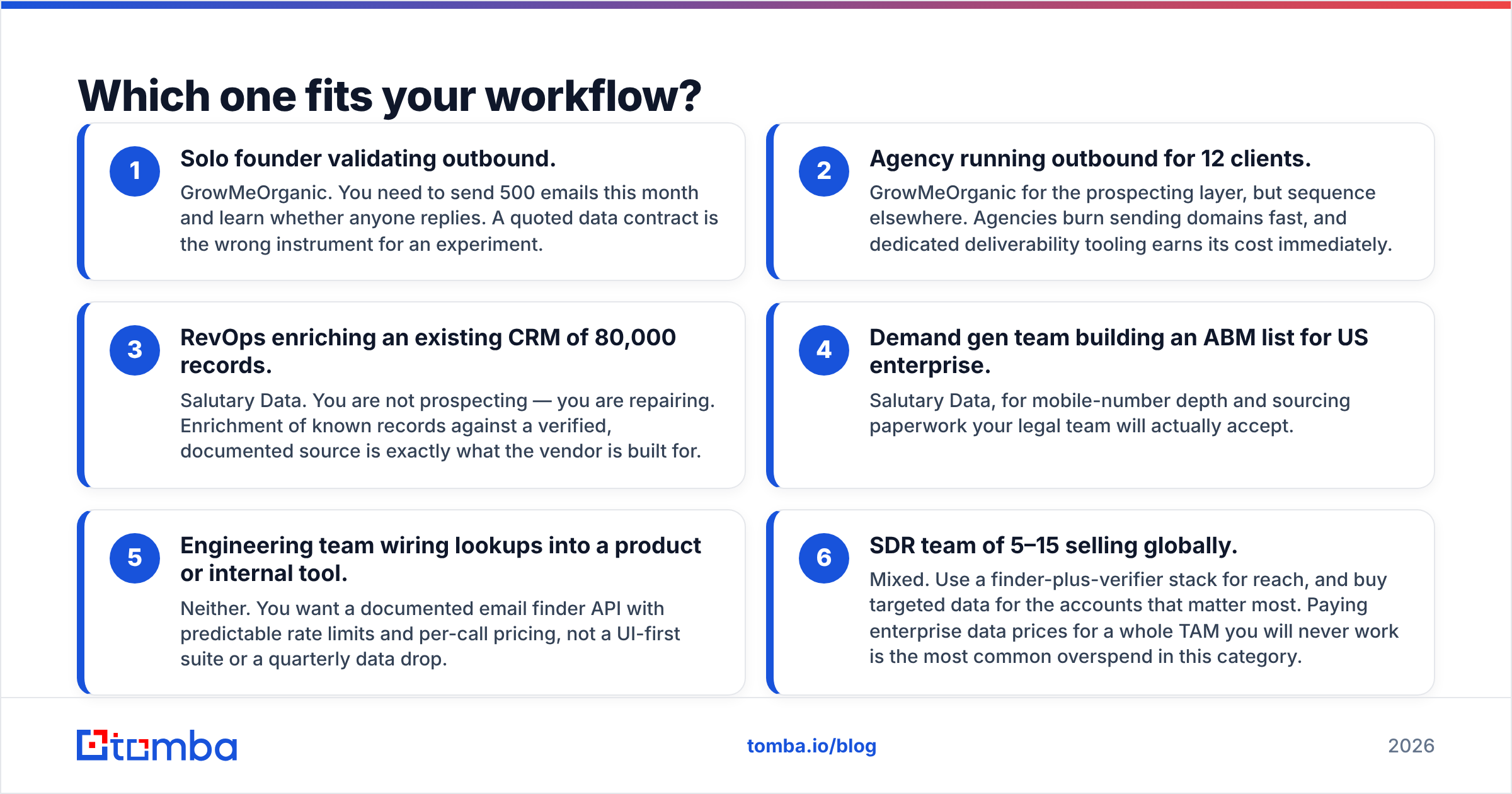
Match the tool to the motion, not to the feature list.
GrowMeOrganic fits these teams:
- Solo founder validating outbound. You need to send 500 emails this month and learn whether anyone replies. A quoted data contract is the wrong tool for an experiment.
- Agency running outbound for 12 clients. Use it for the prospecting layer, but sequence elsewhere. Agencies burn sending domains fast, so dedicated deliverability tooling pays for itself.
Salutary Data fits these teams:
- RevOps enriching a CRM of 80,000 records. You are not prospecting. You are repairing. Enrichment of known records against a verified, documented source is exactly what the vendor is built for.
- Demand gen building an ABM list for US enterprise. You get mobile-number depth and sourcing paperwork your legal team will accept.
Neither one is the right call here:
- Engineering team wiring lookups into a product. You want a documented email finder API with predictable rate limits and per-call pricing. A UI-first suite or a quarterly data drop will not do.
- SDR team of 5 to 15 selling globally. Mix the two. Use a finder-plus-verifier stack for reach, then buy targeted data for the accounts that matter most. Paying enterprise data prices for a whole market you will never work is the most common overspend here.
Is there a middle option between the two?#
Yes, and it is where most teams end up.
The gap between GrowMeOrganic and Salutary Data is a gap in commitment. One asks for almost nothing and gives you data of uncertain origin. The other asks for a contract and gives you data you can defend in a compliance review. Plenty of teams want the second quality bar at the first commitment level.
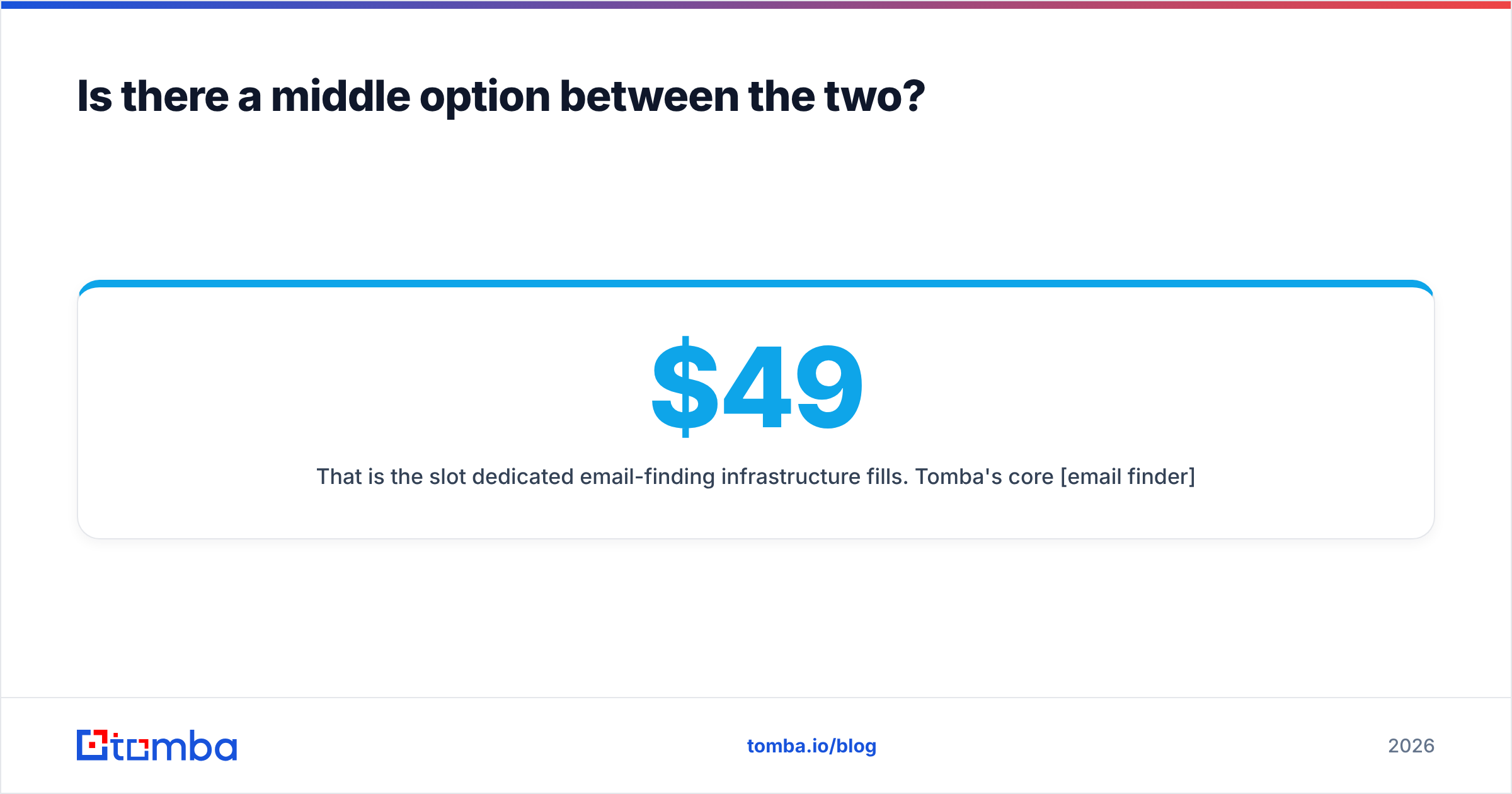
That is the slot dedicated email-finding infrastructure fills. Tomba's email finder resolves an address from a name and a domain. Domain search returns every known address at a company, plus the pattern it detected. The verifier and catch-all checks run before anything hits your sequencer.
Pricing is public: a free tier at 25 searches per month, then $49, $99, and $249 monthly tiers. There is no minimum and no annual lock. If you need volume, the bulk email finder processes lists without a procurement cycle.
It is not a like-for-like swap for either tool. It does not send email, so you still need a sender. It does not sell a curated US mobile-number file, so a specialist vendor is still the right call when direct dials are the point. What it does remove is the two worst outcomes: paying for a scraper you cannot use in a regulated deal, and signing a data contract before you know your cost per meeting.
Worth noting: this category has more credible options than the two names here. BookYourData sells pay-as-you-go verified B2B contacts with a bounce guarantee and no contract, which lands close to the middle ground above. Put three tools on the same 200-contact test set rather than two. And cross-check what real buyers report on G2 before you sign anything.
What should you check before you buy either?#
Run this list before the demo, not after:
- Ask for a sample against your ICP. Not a generic sample. Give them 100 companies from your target list, then compare fill rate and format accuracy.
- Ask where the data comes from. Salutary Data will answer readily. Ask GrowMeOrganic the same question and read the answer closely. If your deals touch regulated buyers, sourcing matters more than price.
Then check the terms and the true cost:
- Check refund and credit-rollover terms. Unused credits that expire each month quietly raise your real cost by 20% to 40%.
- Test deliverability separately. Data quality and inbox placement are different problems. A perfect list still bounces off a domain with a broken SPF record. Check yours with an SPF checker before you blame the data.
- Model the cleanup hours. If a cheaper tool costs you six hours a week of list scrubbing, it is not cheaper.
The verdict#
Pick GrowMeOrganic if you are early, budget-constrained, selling to SMB and mid-market, and you value one login over four.
Pick Salutary Data if you are past product-market fit and selling into US enterprise. At that stage a bad record costs more than the data does. A bounced domain, a compliance flag, or a wasted SDR hour adds up fast.
Most teams reading a "GrowMeOrganic vs Salutary Data" comparison are in between. They are too serious for a scraper and too early for a contract. If that is you, start with the layer that is hardest to replace and easiest to test.
Try the Tomba Email Finder free. You get 25 searches a month, with no card and no call. Run your 200-contact test set through it alongside whichever vendor is on your shortlist. Let the fill rate and the bounce numbers pick the winner instead of the pricing page.
Related guides#
Ready to find emails that actually work?
Join 150,000+ professionals who stopped guessing and started sending. Free credits on signup — no credit card required.
Get the Tomba newsletter
Practical outbound tactics and product updates — once every two weeks.
About the author