GrowMeOrganic vs Skrapp: Which Email Finder Wins in 2026?
GrowMeOrganic bundles scraping and sequences; Skrapp focuses on LinkedIn email extraction and verification. We compare accuracy, pricing, credits, and export limits to show which one actually fits your outbound motion.
TL;DR
- GrowMeOrganic is a bundled suite: LinkedIn scraping, an email finder, and a built-in cold email sender on one flat unlimited-style plan. Breadth is the selling point, per-field data depth is not.
- Skrapp is narrower and sharper: a LinkedIn/Sales Navigator email extractor plus a verifier, sold on monthly credits with clear domain-search functionality.
- If you need one tool to scrape and send, GrowMeOrganic saves you a subscription. If you need clean, verified B2B emails to push into an existing sequencer, Skrapp is the tighter fit.
- Both stumble on the same thing: catch-all domains and stale role-based addresses. Neither replaces a dedicated verification step.
- Cheapest honest setup for most teams in 2026: a high-accuracy finder with an API (Tomba, Skrapp) + your existing sender — not a bundled all-in-one you'll outgrow in six months.
What are GrowMeOrganic and Skrapp, actually?#
Different products that overlap in one place: turning a LinkedIn profile or a company domain into a work email.
GrowMeOrganic (growmeorganic.com) is an all-in-one prospecting platform built around a Chrome extension. You scrape LinkedIn search results or Sales Navigator lists, extract emails, and then run cold email sequences from the same dashboard. It also bundles a B2B database, a Google Maps scraper, and basic CRM-ish list management. Its pitch is "unlimited" — one flat price, no per-credit anxiety, with fair-use caps in the background.
Skrapp (skrapp.io) is a focused email finder and verifier. Its core surfaces are the LinkedIn extension, a domain search, a bulk finder for CSV uploads, and an email verifier. There's no sending engine. Skrapp expects you to export and plug into Instantly, Lemlist, Smartlead, or whatever sequencer you already pay for.
So the real question in a GrowMeOrganic vs Skrapp decision isn't "which is better" in the abstract. It's whether you want a bundle or a component.
How do GrowMeOrganic and Skrapp compare head-to-head?#
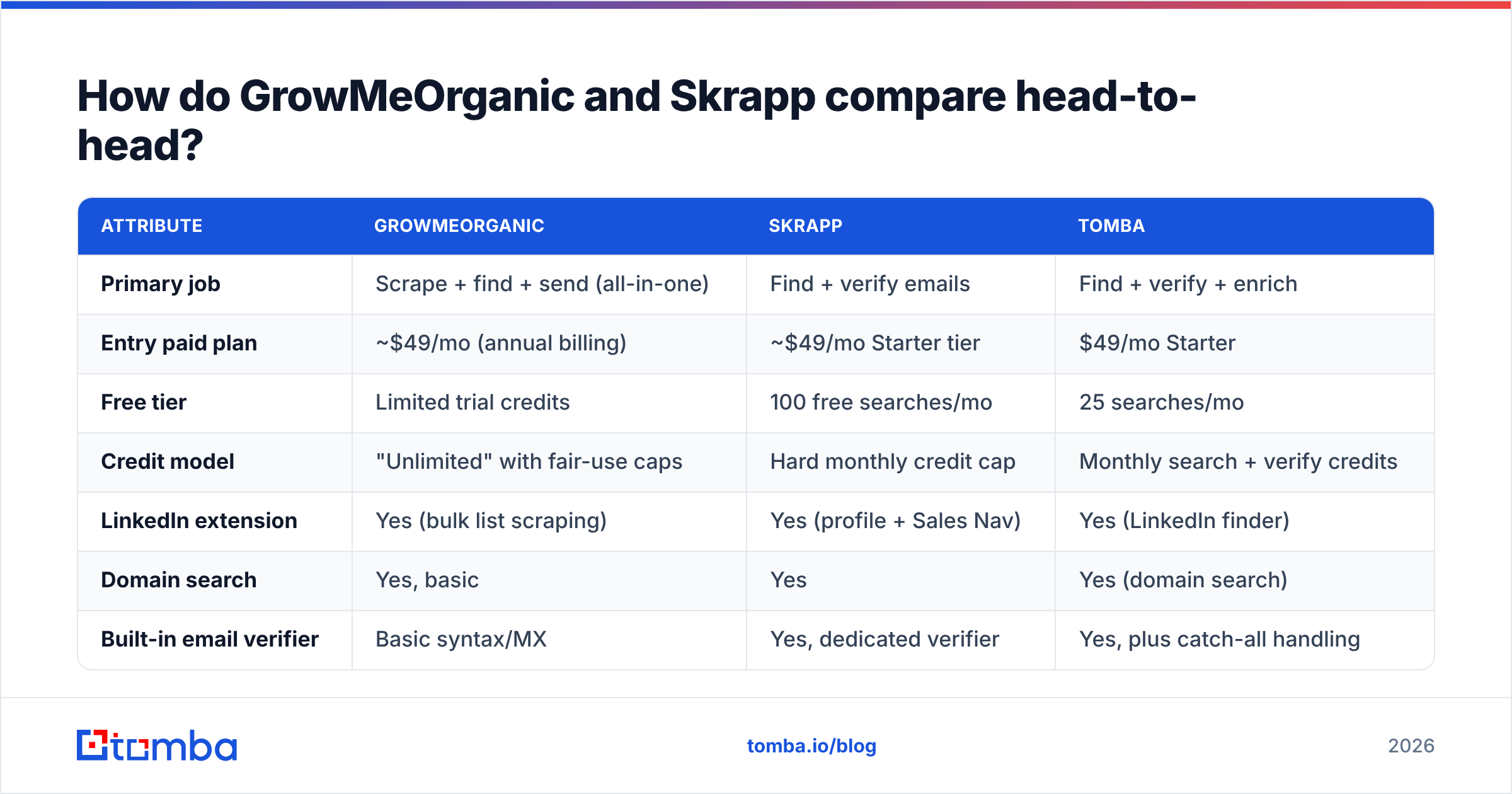
Here's the practical side-by-side. Pricing tiers change; treat these as directional and verify on each vendor's page before you buy.
| Attribute | GrowMeOrganic | Skrapp | Tomba |
|---|---|---|---|
| Primary job | Scrape + find + send (all-in-one) | Find + verify emails | Find + verify + enrich |
| Entry paid plan | ~$49/mo (annual billing) | ~$49/mo Starter tier | $49/mo Starter |
| Free tier | Limited trial credits | 100 free searches/mo | 25 searches/mo |
| Credit model | "Unlimited" with fair-use caps | Hard monthly credit cap | Monthly search + verify credits |
| LinkedIn extension | Yes (bulk list scraping) | Yes (profile + Sales Nav) | Yes (LinkedIn finder) |
| Domain search | Yes, basic | Yes | Yes (domain search) |
| Built-in email verifier | Basic syntax/MX | Yes, dedicated verifier | Yes, plus catch-all handling |
| Catch-all detection | Weak | Partial | Catch-all verifier |
| Cold email sending | Yes, built in | No | No (integrates instead) |
| Public API | Limited | Yes | Yes, full REST API |
| Phone numbers | Some records | No | Yes |
| Best for | Solo founders wanting one bill | Teams feeding an existing sequencer | Teams needing accuracy + API depth |
The table already tells you the shape of the decision. GrowMeOrganic wins on surface area. Skrapp wins on doing the finding job without noise. Tomba sits closer to Skrapp in philosophy but pushes further on verification and API access.
Which one finds more valid emails?#
Neither vendor publishes an audited accuracy figure, so ignore the marketing percentages on both sites and run your own test.
The method that actually works: take 100 contacts you already have confirmed emails for — customers, past deals, people who've replied to you. Feed the name + domain into each tool. Score three buckets: exact match, wrong address returned, and not found. That last bucket matters more than people admit; a tool that returns nothing costs you nothing, while a tool that confidently returns first.last@ guesses costs you deliverability.
What we consistently see in tests of this class of tool:
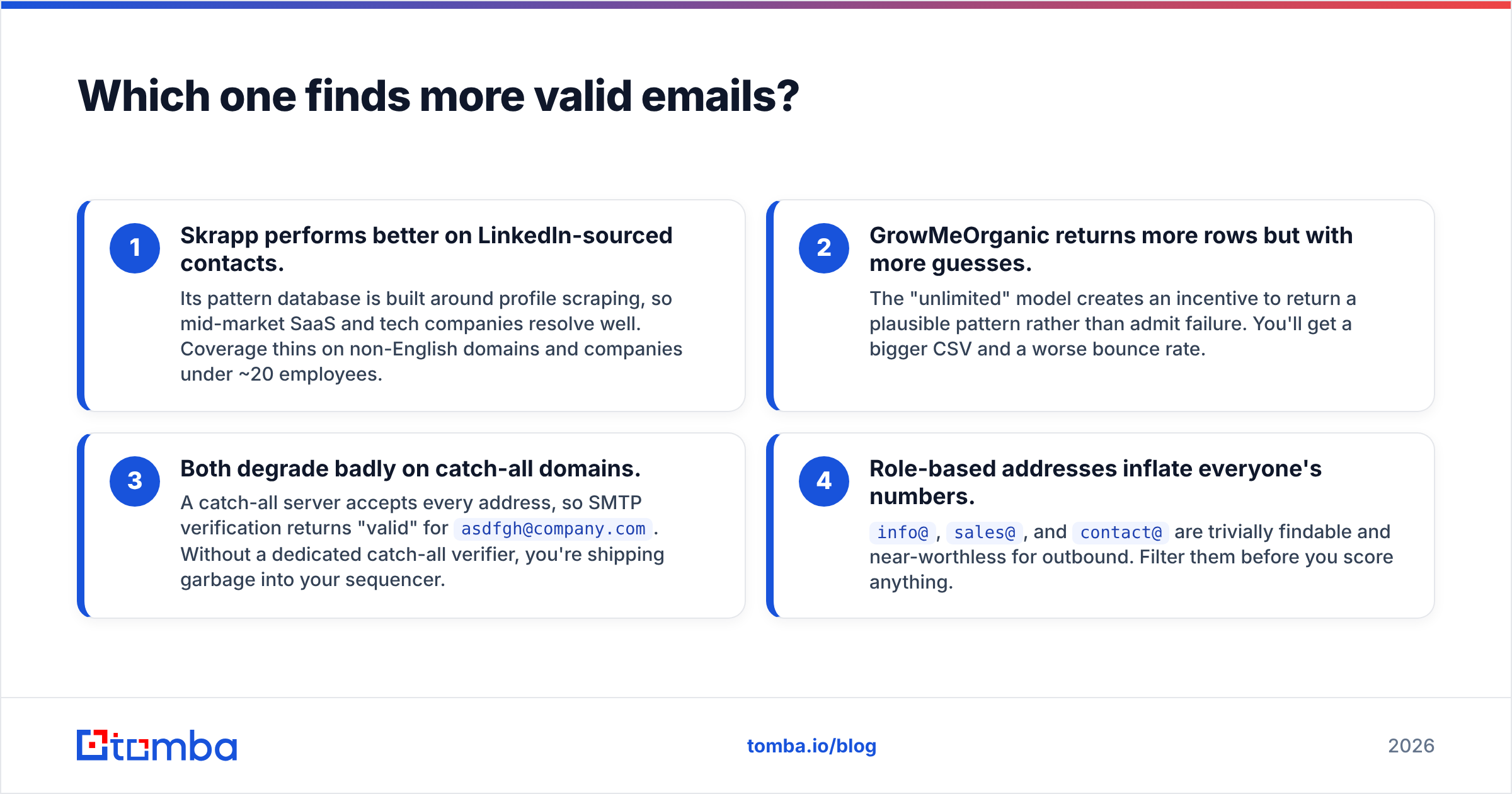
- Skrapp performs better on LinkedIn-sourced contacts. Its pattern database is built around profile scraping, so mid-market SaaS and tech companies resolve well. Coverage thins on non-English domains and companies under ~20 employees.
- GrowMeOrganic returns more rows but with more guesses. The "unlimited" model creates an incentive to return a plausible pattern rather than admit failure. You'll get a bigger CSV and a worse bounce rate.
- Both degrade badly on catch-all domains. A catch-all server accepts every address, so SMTP verification returns "valid" for
asdfgh@company.com. Without a dedicated catch-all verifier, you're shipping garbage into your sequencer. - Role-based addresses inflate everyone's numbers.
info@,sales@, andcontact@are trivially findable and near-worthless for outbound. Filter them before you score anything.

Suggested visual: side-by-side screenshots of the Skrapp Chrome extension result panel and the GrowMeOrganic list-scraping view on the same LinkedIn search, showing found-vs-blank rates.
Whichever tool you land on, run the export through an independent email verifier before it touches a sending domain. Treating a finder's own confidence score as verification is the single most common reason cold campaigns tank in week two.
Is "unlimited" pricing actually cheaper?#
Sometimes — but "unlimited" is a marketing word, not a contractual one.
GrowMeOrganic's unlimited framing means no per-credit meter on the dashboard. In practice there are fair-use limits, daily extraction caps tied to LinkedIn's own rate limits, and throttling if you push volume hard. LinkedIn caps what any extension can pull per day regardless of what your vendor promises. So "unlimited emails" really means "unlimited within LinkedIn's ceiling," which is a few hundred profiles a day at best before you risk your account.
Skrapp's hard credit cap is more honest but bites differently. You know exactly what you get, and you know exactly when you run out — usually three weeks into a good month.
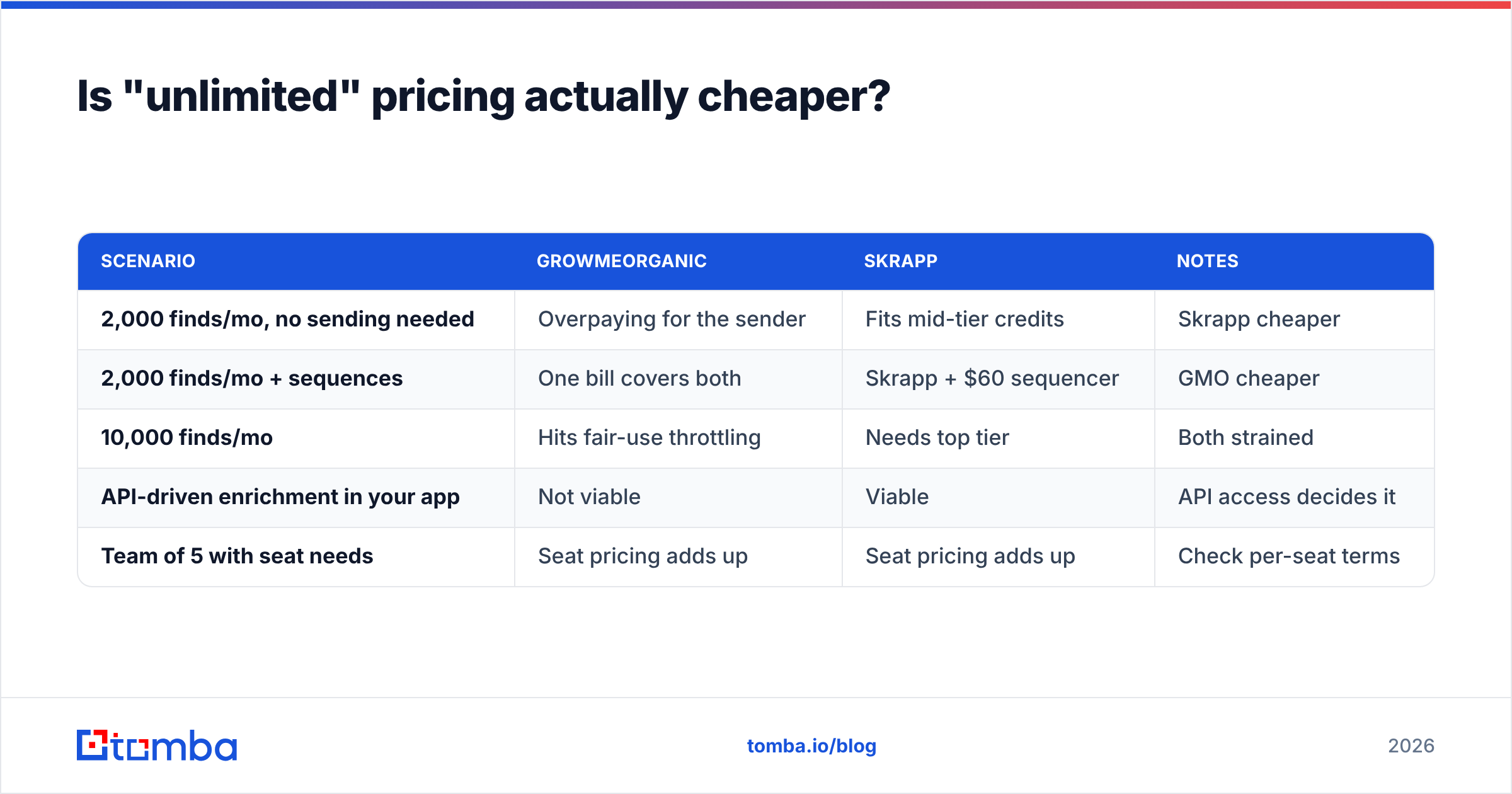
Here's the cost math that matters more than sticker price:
| Scenario | GrowMeOrganic | Skrapp | Notes |
|---|---|---|---|
| 2,000 finds/mo, no sending needed | Overpaying for the sender | Fits mid-tier credits | Skrapp cheaper |
| 2,000 finds/mo + sequences | One bill covers both | Skrapp + $60 sequencer | GMO cheaper |
| 10,000 finds/mo | Hits fair-use throttling | Needs top tier | Both strained |
| API-driven enrichment in your app | Not viable | Viable | API access decides it |
| Team of 5 with seat needs | Seat pricing adds up | Seat pricing adds up | Check per-seat terms |
Run your own volume through that grid before you look at either pricing page. And compare against Tomba pricing — Free (25 searches/mo), Starter $49/mo, Growth $99/mo, Pro $249/mo — where credits are explicit and the API is included rather than gated behind an enterprise call.
Which fits your workflow better?#
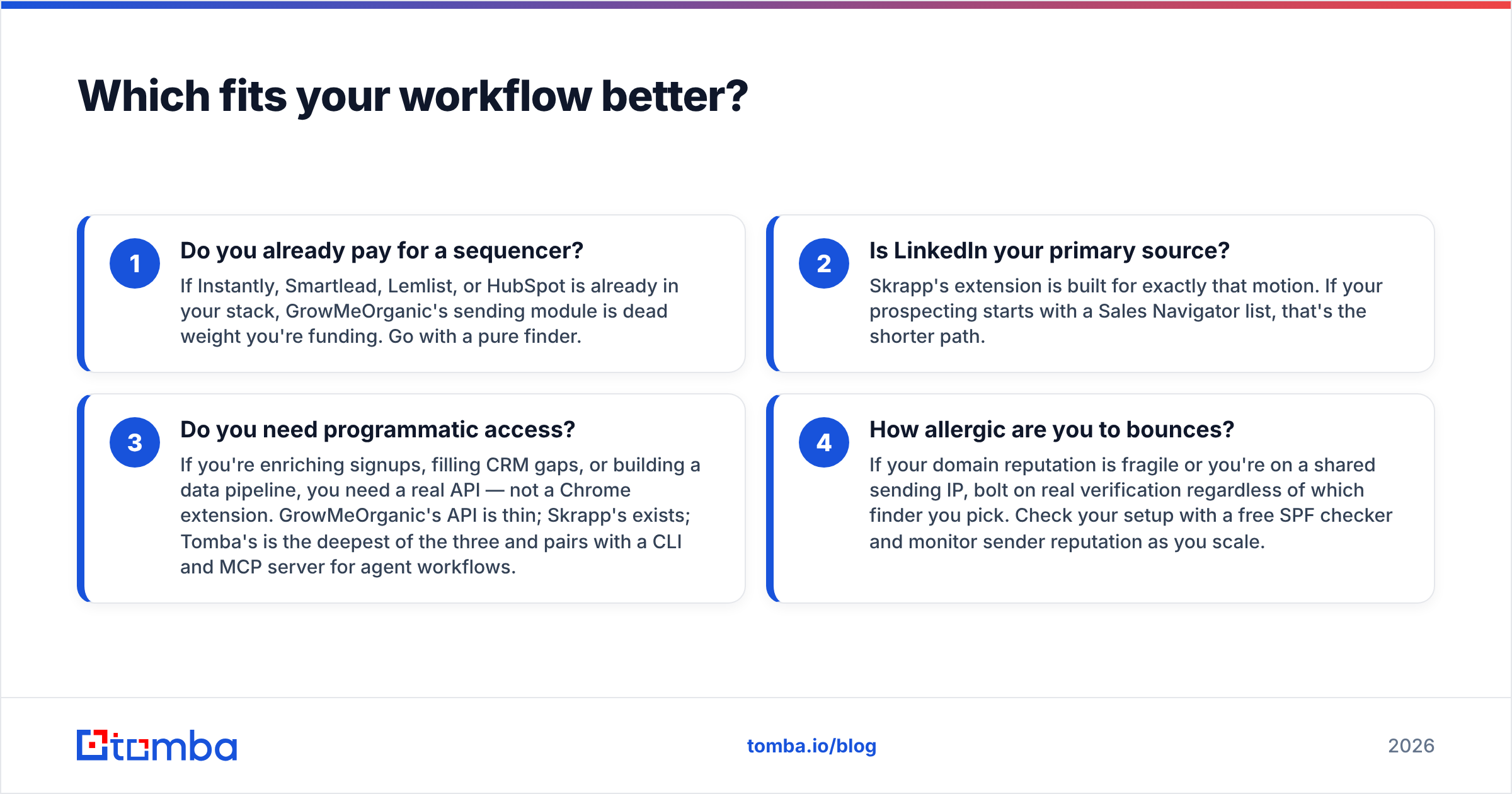
Answer these four questions and the choice makes itself.
- Do you already pay for a sequencer? If Instantly, Smartlead, Lemlist, or HubSpot is already in your stack, GrowMeOrganic's sending module is dead weight you're funding. Go with a pure finder.
- Is LinkedIn your primary source? Skrapp's extension is built for exactly that motion. If your prospecting starts with a Sales Navigator list, that's the shorter path.
- Do you need programmatic access? If you're enriching signups, filling CRM gaps, or building a data pipeline, you need a real API — not a Chrome extension. GrowMeOrganic's API is thin; Skrapp's exists; Tomba's is the deepest of the three and pairs with a CLI and MCP server for agent workflows.
- How allergic are you to bounces? If your domain reputation is fragile or you're on a shared sending IP, bolt on real verification regardless of which finder you pick. Check your setup with a free SPF checker and monitor sender reputation as you scale.
Suggested visual: annotated screenshot of a Sales Navigator search with the extension sidebar open, arrows marking where each tool grabs profile data vs. where it guesses the pattern.

What are the honest downsides of each?#
GrowMeOrganic's weak spots:
- Jack-of-all-trades tax. The sequencer is functional but well behind purpose-built senders on inbox rotation, warmup, and reply detection. The scraper is fine but not best-in-class. You're paying for adequacy across four categories.
- Data freshness. Bundled databases tend to age. Contacts scraped once and stored rot at roughly 25-30% per year as people change jobs, which is the industry consensus figure cited by vendors including HubSpot in their data-hygiene guidance.
- Support depth. Broad product, small team, long ticket queues during growth spurts.
- Account risk. Aggressive LinkedIn scraping is against LinkedIn's terms. That risk is yours, not the vendor's, and "unlimited" framing tempts users into exactly the volume that triggers restrictions.
Skrapp's weak spots:
- Credits run out. Hard caps mean mid-month rationing or a mid-month upgrade.
- No sending. By design, but it means a second bill.
- Thinner coverage outside tech. Manufacturing, local services, and non-US SMBs return more blanks.
- Verification is good, not exhaustive. Catch-all domains still slip through, which is true of nearly every verifier that doesn't run dedicated catch-all logic.
Check independent review volume on G2 and Capterra before committing — pay attention to reviews from the last six months only, since both products have shipped meaningful changes.
Are there better alternatives to both?#
Depends what you're optimizing for. A few honest positions:
- If you want depth on the data layer: Tomba covers email finding, verification, catch-all checks, phone numbers, and data enrichment with a documented REST API. It doesn't send email — that's deliberate, and it means you keep your sequencer.
- If you want a large pre-built database: BookYourData is a solid option when you'd rather buy a filtered list than build one profile by profile. Different motion, legitimately useful when you need volume in a defined ICP fast, and their accuracy guarantee is one of the clearer ones in the category.
- If your bottleneck is sending, not finding: Neither of these tools fixes deliverability. Fix authentication, warm your domains, and keep bounce rates under 2% first. Our Instantly alternative breakdown covers the sending side.
- If you're a solo founder with no stack yet: GrowMeOrganic's bundle genuinely is the fewest decisions and the fewest invoices. That has real value at month one. Just plan the exit before month twelve.
How should you run a fair trial?#
Two weeks, one spreadsheet, four columns.
- Pick 100 real target accounts from your actual ICP — not a curated easy list.
- Run both tools on the same 100. Record found/not-found and the returned address.
- Verify every returned address with an independent checker like Tomba's free email checker so the finder isn't grading its own homework.
- Send a 50-contact test from a throwaway subdomain and record hard bounces. That's your real accuracy number — everything before it is an estimate.
Score cost per verified, deliverable email, not cost per credit. A tool at half the price that returns twice the bounces is the expensive one.
The verdict#
Pick Skrapp if you already have a sequencer, prospect primarily on LinkedIn, and want predictable credits with a verifier built in. It does one job and doesn't make you pay for four.
Pick GrowMeOrganic if you're a solo operator or a two-person team who wants scraping and sending on one invoice, your volumes are modest, and you accept that each module is adequate rather than excellent.
Pick neither if your real constraint is data quality at scale or you need an API in your product. That's where a dedicated finder with proper catch-all handling and full API access earns its keep.
Start with Tomba's Email Finder on the free tier — 25 searches a month, no card — and run it head-to-head against your Skrapp or GrowMeOrganic export on the same 100 accounts. Compare found rates, then compare bounce rates after verification. Whichever tool wins that test is the one worth your budget, and the test costs you nothing but an afternoon.
Related guides#
Ready to find emails that actually work?
Join 150,000+ professionals who stopped guessing and started sending. Free credits on signup — no credit card required.
Get the Tomba newsletter
Practical outbound tactics and product updates — once every two weeks.
About the author