GrowMeOrganic vs Zintlr (2026): Which B2B Data Tool Wins?
GrowMeOrganic bundles scraping, email finding and sequences. Zintlr sells contact data plus personality intelligence. Here is how they actually differ on accuracy, pricing and fit — and when neither is the right buy.
GrowMeOrganic vs Zintlr is not a like-for-like fight. One tool scrapes lists and sends email. The other sells data and reads people. Here is the short answer, then the detail.
TL;DR
- GrowMeOrganic is an all-in-one outbound suite. It scrapes LinkedIn and Sales Navigator, finds emails, and runs cold email sequences. One flat fee covers all three. It wins on breadth per dollar.
- Zintlr is a B2B data platform with a twist. It adds personality intel ("Zintros") on top of contact records. It also covers Indian and APAC companies well.
- They are not the same product. GrowMeOrganic replaces three tools. Zintlr replaces one and adds a research angle no scraper gives you.
- Neither is a real verifier. Is your bounce rate above 3%? Then you need a verify layer, not another suite.
- Pick GrowMeOrganic for volume outbound on a small budget. Pick Zintlr for India and APAC, or for deep one-to-one personalization.
What are GrowMeOrganic and Zintlr?#
GrowMeOrganic started as a Chrome extension with a database behind it. It grew into a full outbound stack. You install the extension. You scrape a Sales Navigator search or a Google Maps result set. The tool pulls emails and phone numbers for those profiles. Then you push the list into a built-in drip sequence. Mail goes out from your own Gmail or Outlook mailbox. The pitch is bundling: one plan instead of three.
Zintlr comes at the same buyer from another angle. It is a B2B contact and company database. You filter by industry, headcount, title, and place. On top sits a layer called Zintros. It reads a prospect's public footprint and guesses their traits. So you do not just get an email address. You get a hint on tone. Some buyers want a short, direct line. Others want a case study full of numbers.
That gap in philosophy explains most of the GrowMeOrganic vs Zintlr debate. GrowMeOrganic is built for throughput. Zintlr is built for context.
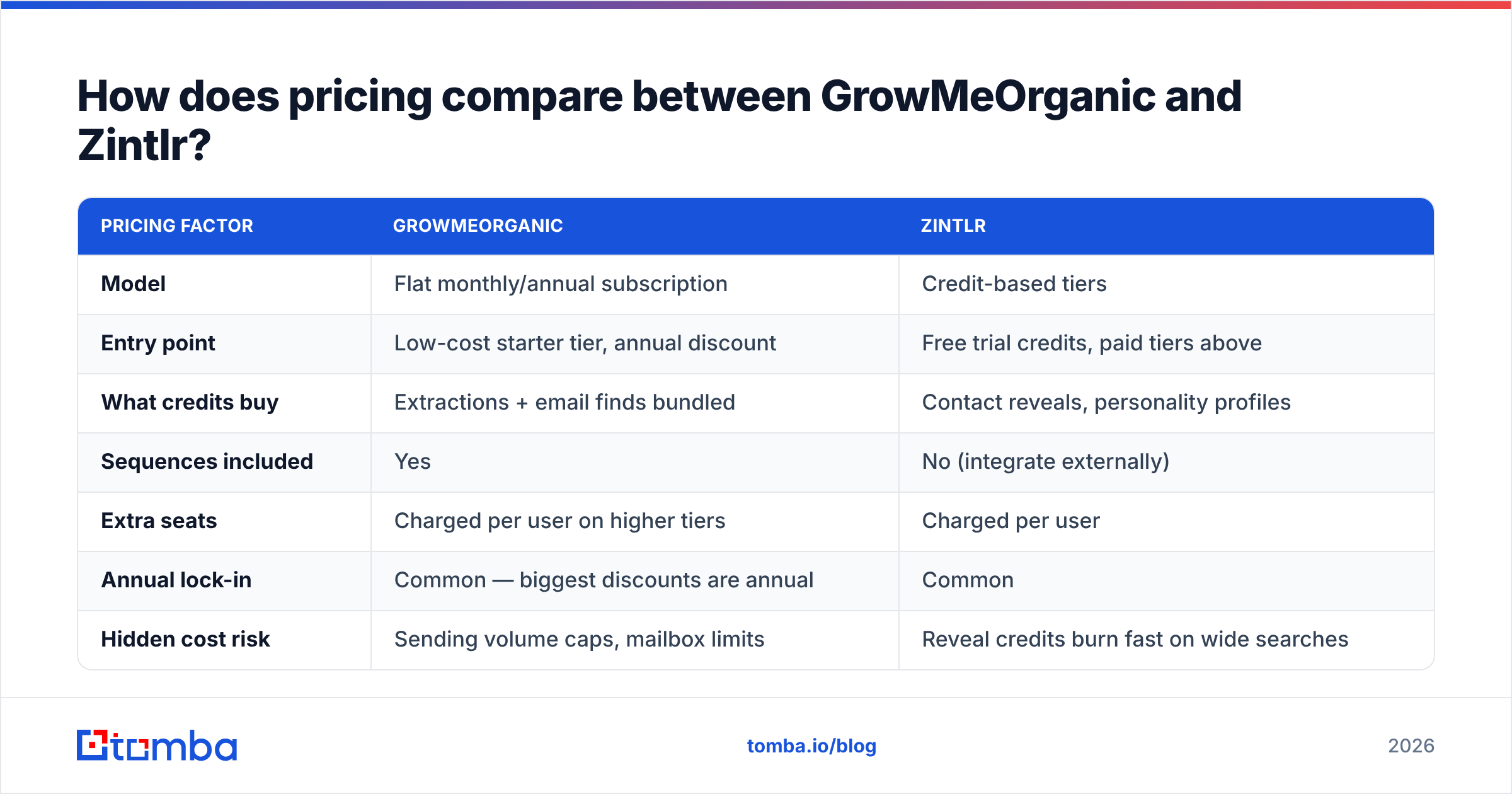
How do GrowMeOrganic vs Zintlr compare at a glance?#
| Dimension | GrowMeOrganic | Zintlr |
|---|---|---|
| Core product | All-in-one outbound suite | B2B contact database + personality intel |
| Data sourcing | Scraping (LinkedIn, Sales Nav, Maps) + database | Licensed/aggregated database, search-first |
| Email sequences | Built in, sends from your mailbox | Limited — designed to feed other tools |
| Standout feature | Bundled scraper + sender | Zintros personality profiling |
| Geographic strength | Global, US/EU heavy | Notably strong India/APAC coverage |
| Phone numbers | Yes, on higher tiers | Yes, including direct dials |
| Chrome extension | Yes, central to the workflow | Yes |
| Best for | Solo founders, agencies, volume outbound | SDR teams personalizing at account level |
| Weak spot | Verification depth, deliverability tooling | Fewer execution features, smaller ecosystem |
Read that table twice before you look at price. Some teams buy GrowMeOrganic just for data. Others buy Zintlr just to send mail. Both end up paying for a second tool six weeks later.

Which tool has better data accuracy?#
Neither vendor shares an audited accuracy score. So treat every marketing number as a ceiling, not a floor. What you can compare is how each tool gets its data. Sourcing tells you how fast that data goes stale.
GrowMeOrganic leans on live scraping plus pattern guessing. It reads the profile. It finds the company domain. Then it works out the likely email format. That is fast and cheap. It works well when the pattern is clean, like first.last@ or f.last@. It breaks on three things. Catch-all domains. Odd formats. And profiles where the listed employer is out of date.
Zintlr is database-first. Records sit in an index and refresh on a cycle. They are not built at query time. You get steadier extras: job function, seniority, tech stack. But records age between refreshes. About one in five B2B contacts change jobs each year.

On paper, GrowMeOrganic vs Zintlr is close to a draw here. The upshot is the same for both. You need a verify step that neither tool fully owns. GrowMeOrganic runs a basic validity check. Zintlr returns confidence flags. Neither matches a real email verifier. A proper one runs SMTP-level checks and names catch-all domains outright. Say you send 5,000 emails a month. A 2% bounce rate keeps your domain healthy. An 8% rate can cost you three weeks of repair.
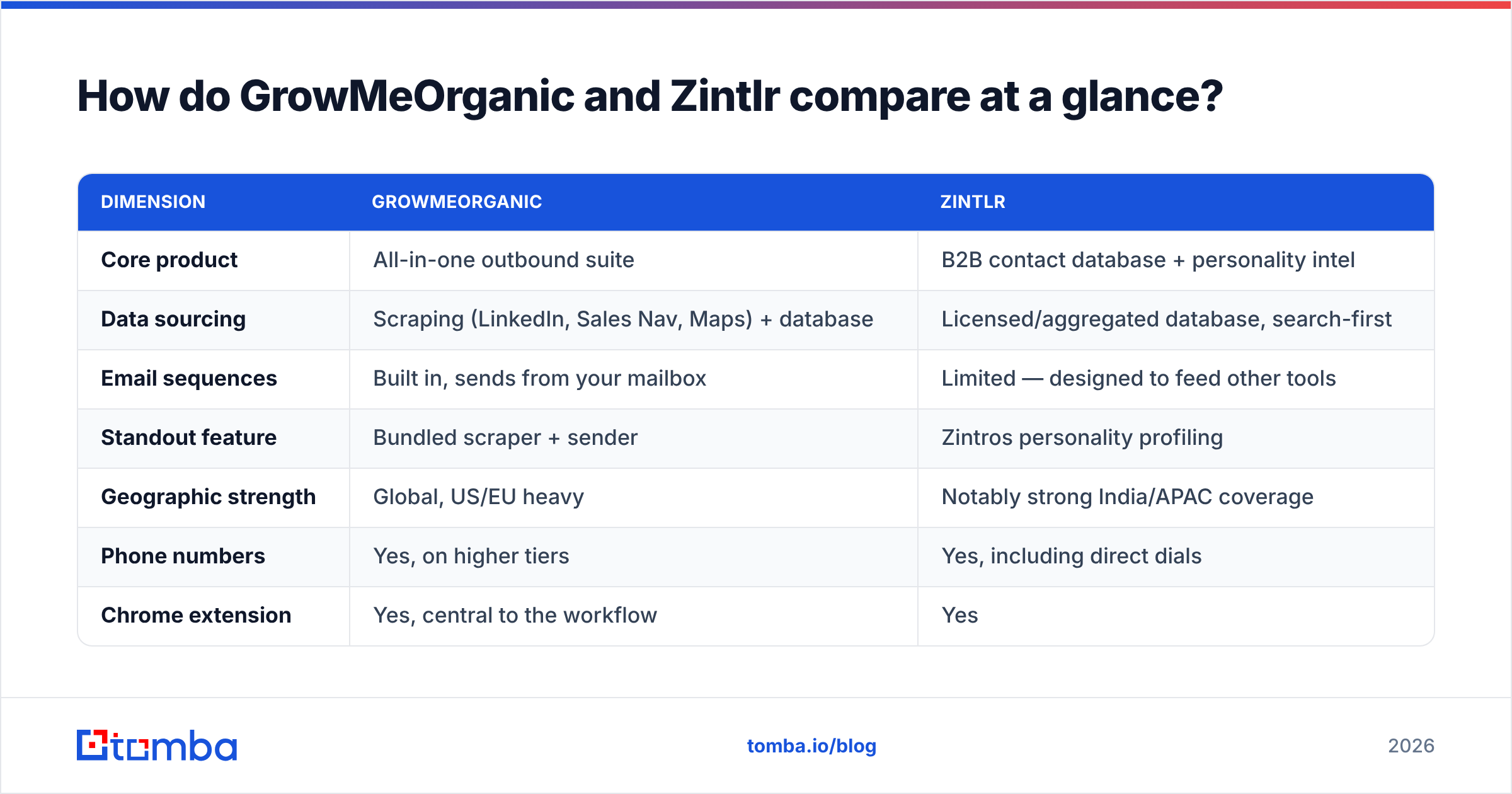
Run these checks on any list, from either tool, before you press send:
- Syntax and MX check — cheap and fast. It drops junk and dead domains.
- SMTP handshake — proves the mailbox takes mail, not just that it resolves.
- Catch-all flag — a domain that accepts everything is not proof. Treat it as its own risk bucket.
- Role account filter — info@, sales@ and support@ pad your list and drag down replies.
- Duplicate and suppression scrub — check your CRM and opt-out list before the first send.
How does pricing compare between GrowMeOrganic vs Zintlr?#
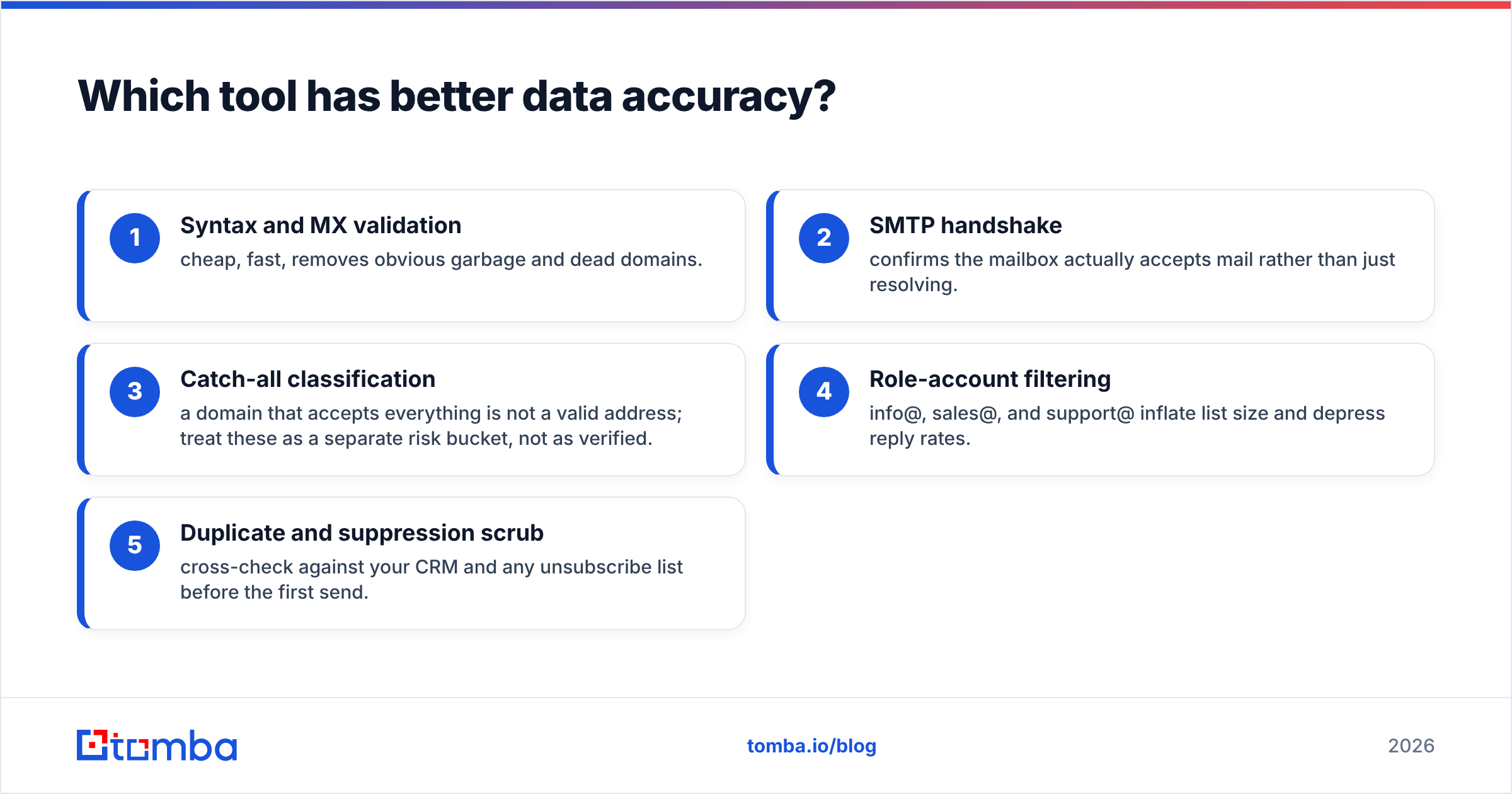
Both vendors move their tiers often. Check their own pricing pages before you commit. As of early 2026, the shape of the offer looks like this:
| Pricing factor | GrowMeOrganic | Zintlr |
|---|---|---|
| Model | Flat monthly/annual subscription | Credit-based tiers |
| Entry point | Low-cost starter tier, annual discount | Free trial credits, paid tiers above |
| What credits buy | Extractions + email finds bundled | Contact reveals, personality profiles |
| Sequences included | Yes | No (integrate externally) |
| Extra seats | Charged per user on higher tiers | Charged per user |
| Annual lock-in | Common — biggest discounts are annual | Common |
| Hidden cost risk | Sending volume caps, mailbox limits | Reveal credits burn fast on wide searches |
Credit shock hits teams on both platforms. You build a filter. It returns 12,000 matching contacts. You hit "reveal all". The search you called research just ate a month of budget in ninety seconds.

The defense is dull and it works. Narrow the filter until the result set is a few hundred rows. Reveal that batch. Run it through outreach. Widen only once you know the segment converts. Treat credits like ad spend, not like storage.
Clear per-tier pricing is one reason buyers look at other tools. Tomba pricing starts with a free tier at 25 searches a month. Starter is $49/mo. Growth is $99/mo. Pro is $249/mo. Verifying what you find costs nothing extra.
Who should choose GrowMeOrganic?#
Pick GrowMeOrganic when one bill matters more than depth in any single feature.
- Solo founders and two-person teams. You cannot pay for a database, a sequencer and a scraper. One tool that does 80% of each is the right trade.
- Agencies running client outbound. Scrape a niche, pull contacts, load a sequence. The same loop repeats for every client. Bundling cuts the moving parts.
- Local and SMB prospecting. The Google Maps path is genuinely handy. Think restaurants, clinics and dealerships, where LinkedIn data is thin.
- Teams on Gmail or Outlook. You send from your own mailbox. Your sender reputation stays yours, not a shared pool's.
Where it strains: enterprise buyers, regulated fields, and audit trails. Scraped data is hard to defend in a GDPR or procurement review. Licensed data with documented data sources is far easier.
Who should choose Zintlr?#
Zintlr earns its place in three cases.
You sell into India or APAC. This is the clearest win. Most Western databases are thin and stale on mid-market Indian firms. Zintlr was built with that market in mind. It shows in fill rates for direct dials and mid-level titles.
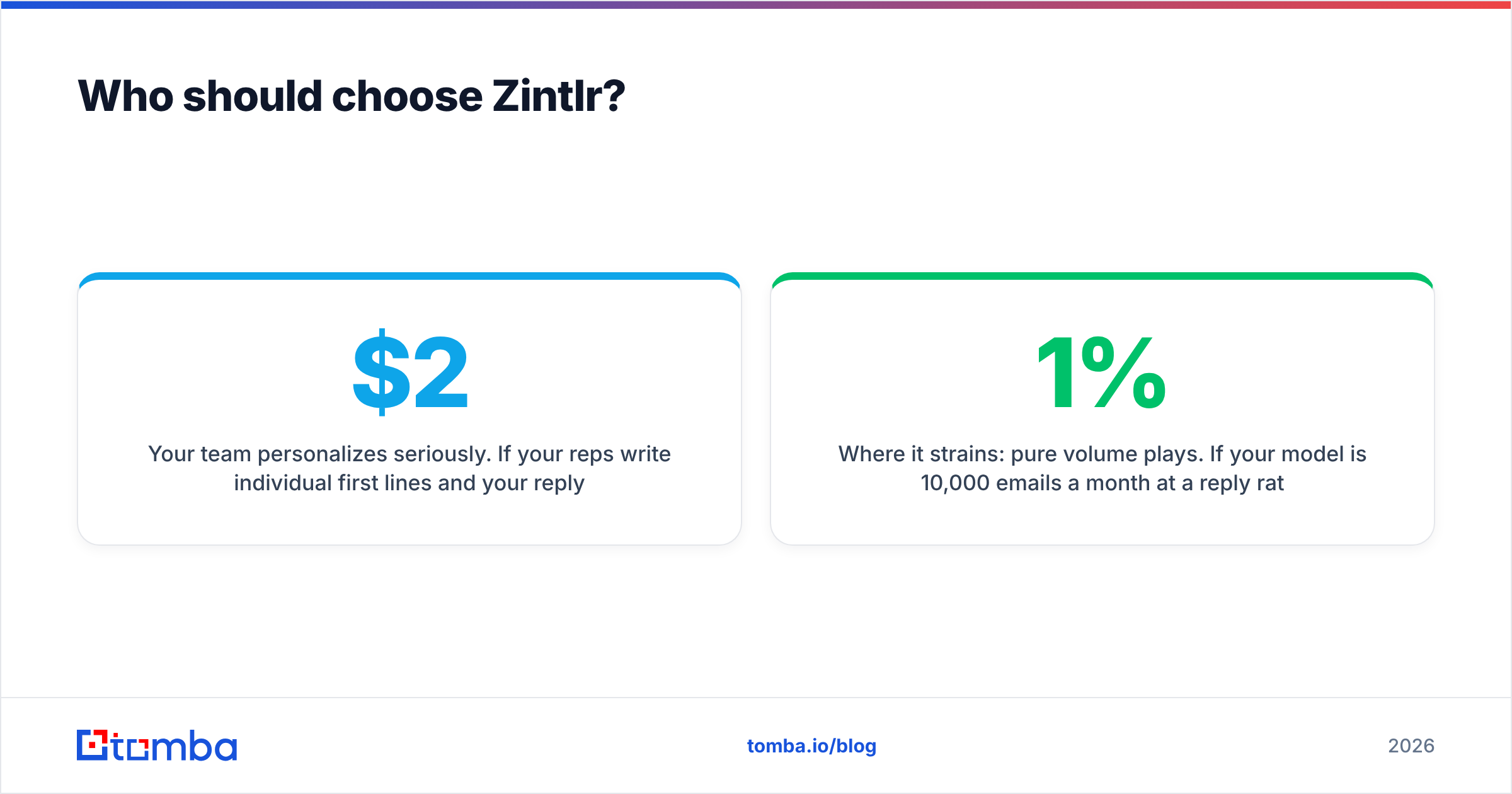
Your team personalizes for real. Do your reps write every first line by hand? Does your reply rate hinge on tone? Then the Zintros layer gives them a starting guess. It does not replace reading someone's last three posts. It does cut the research time. Whether that pays off depends on deal size. At $2,000 ACV, no. At $60,000 ACV, quite likely.
You already own the sending layer. Zintlr assumes you send elsewhere. On Instantly, Smartlead, Reply.io or your CRM, it slots in as the data source. You pay twice for nothing.
Where it strains: pure volume plays. Say you send 10,000 emails a month at a 1% reply rate. Personality profiling is a rounding error there. You are paying for a feature your process cannot use.

What do both tools get wrong about deliverability?#
GrowMeOrganic vs Zintlr is the wrong first question if your domain is not warm. Both market data quality. Neither fixes the thing that really kills cold email: sender setup.
You can hold a 99% valid list and still land in spam. Email deliverability rests on auth records, domain age, warmup pace, content and past engagement. A contact database controls none of that. Reviews on G2 repeat one line for both tools: "great data, but my open rates collapsed in week three". That is almost never a data problem.
The minimum stack around either tool:
- SPF, DKIM and DMARC on every sending domain. Test them with a checker. Do not assume.
- Separate sending domains from your main one. A bad campaign should not hurt your billing mail.
- A warmup ramp that starts under 20 emails a day per mailbox and climbs slowly.
- Verify right before you send. A list checked eight weeks ago is a list you have not checked.
Are there better alternatives to both?#
It depends what you are really buying. The GrowMeOrganic vs Zintlr choice only matters if a bundle is the right shape for you.
Is the job finding and verifying business emails? Then a specialist beats a bundle. A dedicated email finder gives you domain search, catch-all handling and an API. That beats a finder module inside a suite that also has to draw a scraper UI. The same holds for bulk email finder work. There you push thousands of rows and need steady throughput, not screens.
Is the job licensed, compliance-friendly records at scale? Then look at BookYourData next to Zintlr. It sells pre-verified list data, pay as you go. That suits teams who buy in bursts.
Is the job sequencing and inbox management? Then neither tool wins. Past a few thousand sends a month, a purpose-built platform pulls ahead.
The honest framing: all-in-one tools are right at the start and wrong at scale. The switch point comes when one function starts costing you real pipeline. It is almost always data quality or deliverability.
What is the verdict on GrowMeOrganic vs Zintlr?#
Choose GrowMeOrganic if you are early and budget-bound. It puts scrape-to-send in one place. Per dollar, it is the better generalist buy. The Maps path is a real edge for local B2B.
Choose Zintlr if you sell into India or APAC. Choose it too if research quality, not send volume, is your edge. The personality layer is not a gimmick. It only pays off in a process that uses it.
Choose neither as your data base if bounce rate is your bottleneck. In that case you need a find-and-verify layer you trust at the API level. Feed it into whichever sequencer you already like. That is the GrowMeOrganic vs Zintlr call in one line.
Start with a clean list, not a bigger one. Run your next segment through the Tomba Email Finder. The free tier gives you 25 searches a month. Use them to benchmark accuracy against your current tool. Domain search and catch-all handling are included, not sold as an add-on. Compare the bounce rates side by side. Then decide which subscription deserves the budget.
Related guides#
Ready to find emails that actually work?
Join 150,000+ professionals who stopped guessing and started sending. Free credits on signup — no credit card required.
Get the Tomba newsletter
Practical outbound tactics and product updates — once every two weeks.
About the author