Growth Hacking in 2026: What Actually Works Now
Growth hacking stopped meaning viral tricks years ago. Here is what the discipline looks like in 2026 — the loops, the data plumbing, the channels that still compound, and the tactics that quietly stopped working.
TL;DR
- Growth hacking in 2026 is not viral tricks. It is a repeatable experiment system layered on top of a product that already retains users.
- The tactics that still compound: product-led loops, owned data assets, distribution partnerships, and outbound built on verified contact data.
- The tactics that quietly died: mass LinkedIn automation, scraped-list spray-and-pray, and anything that depends on a platform loophole staying open.
- Your experiment velocity matters less than your experiment quality. Ten well-instrumented tests beat a hundred untracked ones.
- Bad data kills more growth experiments than bad ideas. Verify contacts before you test channels.
What is growth hacking, really?#
Growth hacking is running structured, measurable experiments across the entire customer journey — acquisition, activation, retention, referral, revenue — instead of confining growth work to a marketing department. Sean Ellis coined the term in 2010 when he needed a job title for people who cared about growth as an engineering problem rather than a brand problem. The Wikipedia entry on growth hacking still frames it that way, and the framing holds up.
What has changed is the environment. In 2012, a growth hacker could exploit an open API, an unpoliced email channel, or a platform desperate for content and generate a step-change in users. Those arbitrage windows closed. Gmail and Outlook tightened bulk-sender rules. LinkedIn throttled automation aggressively. App stores clamped down on incentivised installs. Every remaining "hack" now sits inside a policed system.
So the modern definition is narrower and more useful: growth hacking is the disciplined search for repeatable, compounding acquisition and retention mechanisms, run as experiments with defined hypotheses and instrumented outcomes.
The word "compounding" is the load-bearing one. A tactic that produces 500 signups once is a campaign. A tactic that produces 500 signups this month and 550 next month because each cohort feeds the next is a loop. Growth hacking is loop-hunting.
How is growth hacking different from growth marketing?#
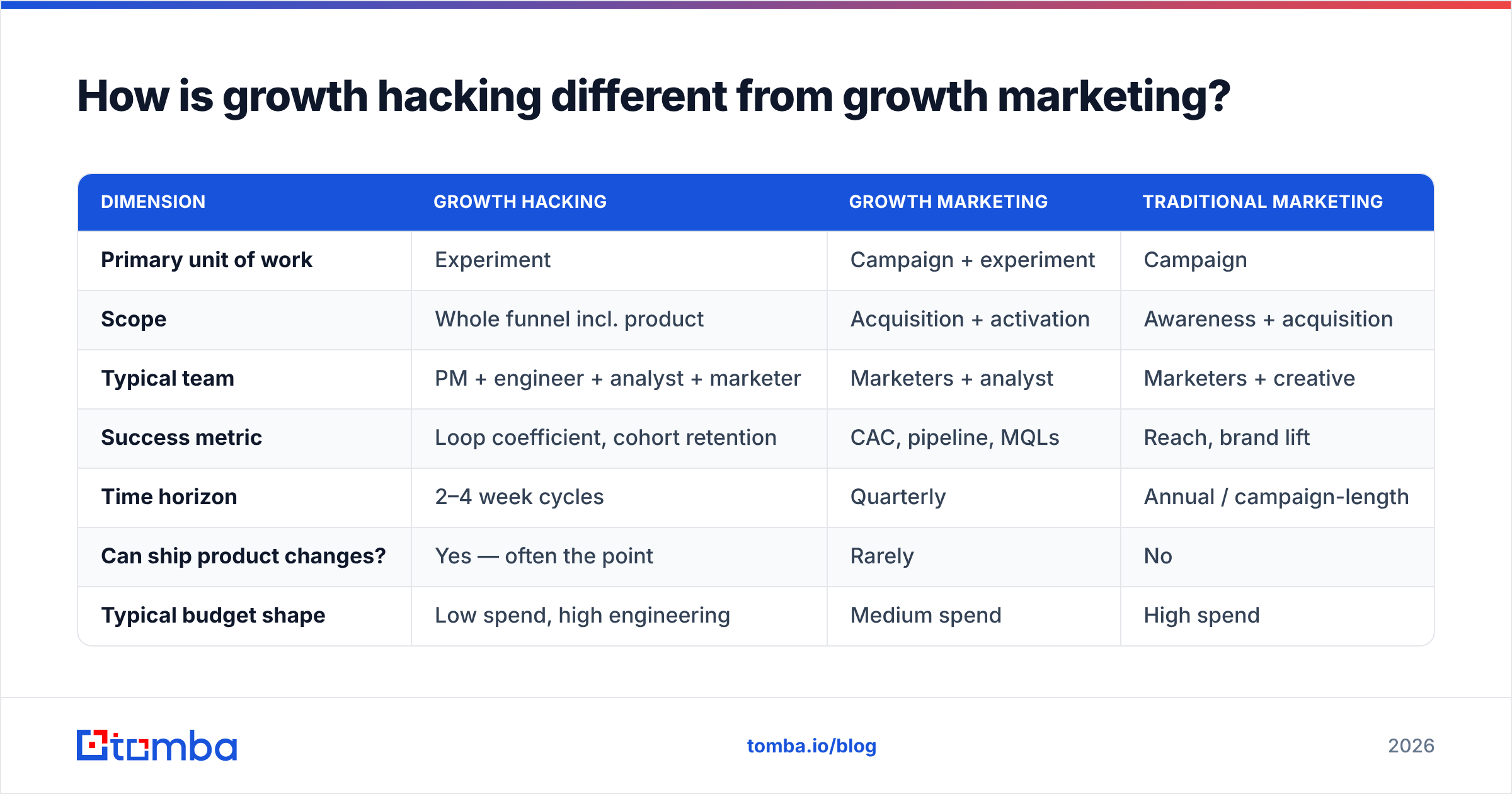
People use these interchangeably and then argue past each other. The practical distinction is scope and ownership.
| Dimension | Growth Hacking | Growth Marketing | Traditional Marketing |
|---|---|---|---|
| Primary unit of work | Experiment | Campaign + experiment | Campaign |
| Scope | Whole funnel incl. product | Acquisition + activation | Awareness + acquisition |
| Typical team | PM + engineer + analyst + marketer | Marketers + analyst | Marketers + creative |
| Success metric | Loop coefficient, cohort retention | CAC, pipeline, MQLs | Reach, brand lift |
| Time horizon | 2–4 week cycles | Quarterly | Annual / campaign-length |
| Can ship product changes? | Yes — often the point | Rarely | No |
| Typical budget shape | Low spend, high engineering | Medium spend | High spend |
The one row that decides everything is "can ship product changes." If your growth team cannot alter onboarding, the empty state, the invite flow, or the pricing page, you do not have a growth hacking function. You have a marketing team with a Notion board of experiment ideas and no way to run half of them.
That is not a criticism of marketing. It is a warning about mislabelling. If leadership hires a "growth hacker" but gives them no engineering time, the role degrades into channel management within a quarter.
What does a growth loop actually look like?#
A loop is any mechanism where the output of one cycle becomes the input of the next. Four types cover most B2B SaaS:
- Viral / invite loops — a user invites a colleague to collaborate, that colleague becomes a user, and invites more. Works when the product is inherently multiplayer (Figma, Slack, Notion). Mostly fails when collaboration is bolted on.
- Content loops — you publish something, it ranks or gets shared, new users arrive, some of them generate content or data that becomes more publishable material. Programmatic SEO pages built on user-generated data are the cleanest example.
- Paid loops — revenue from cohort N funds acquisition of cohort N+1. This only compounds if payback period is shorter than your cash cycle. Most teams discover their payback is 14 months and the loop is actually a slow leak.
- Sales-assisted loops — outbound lands an account, the account expands internally, expansion revenue funds more outbound headcount. Underrated and the most common real loop in B2B.
- Data loops — every customer improves the dataset, which improves the product, which wins the next customer. Hard to build, close to impossible to copy once built.
Pick one. Teams that try to build all five simultaneously build none. The diagnostic question: which loop, if it worked twice as well, would move your revenue number most? Instrument that one and ignore the rest for two quarters.
Which growth hacking channels still work in 2026?#
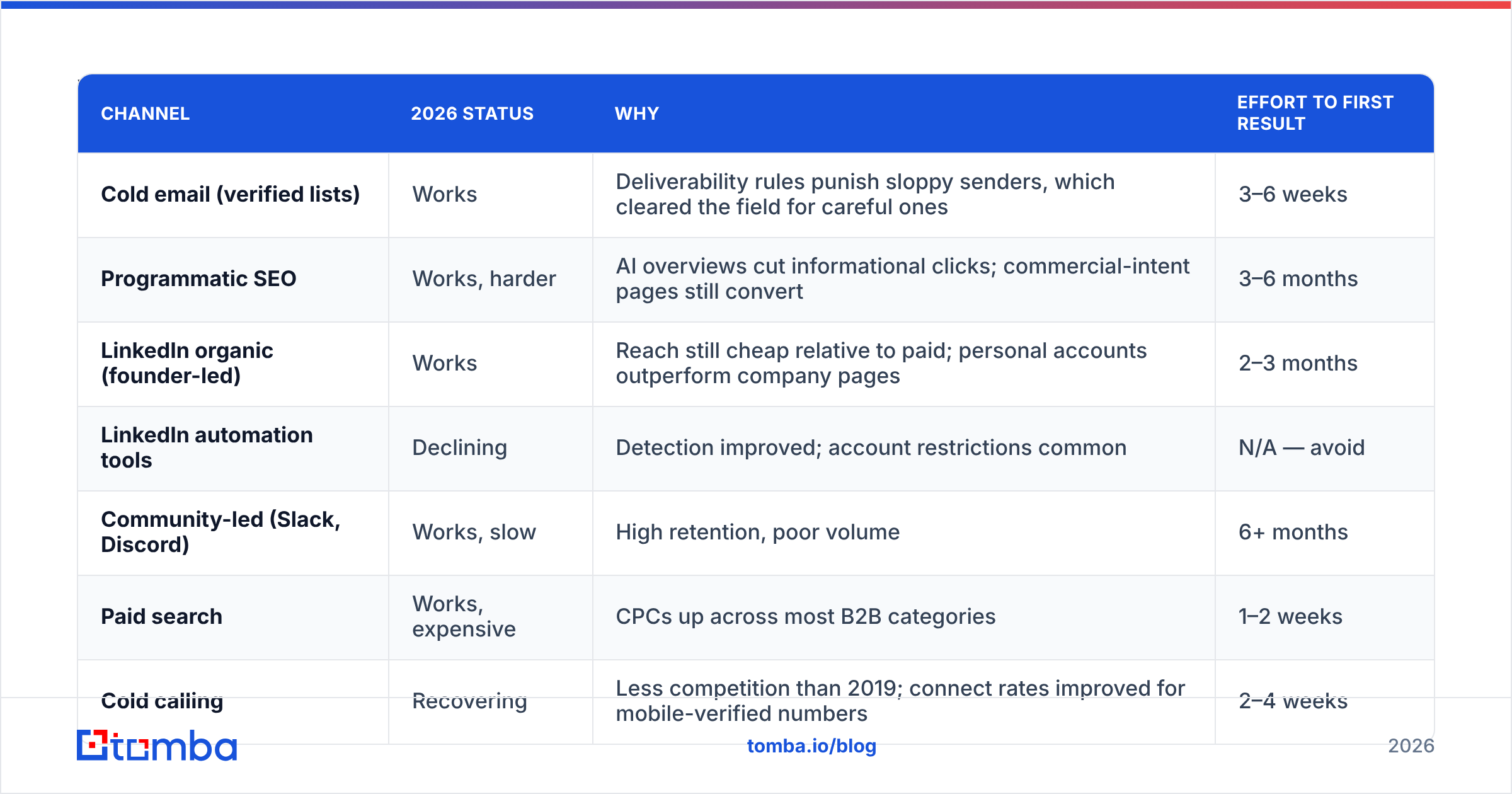
Here is the honest scoreboard, based on what B2B teams are actually reporting on G2 and in public benchmark data rather than on what conference talks claim.
| Channel | 2026 status | Why | Effort to first result |
|---|---|---|---|
| Cold email (verified lists) | Works | Deliverability rules punish sloppy senders, which cleared the field for careful ones | 3–6 weeks |
| Programmatic SEO | Works, harder | AI overviews cut informational clicks; commercial-intent pages still convert | 3–6 months |
| LinkedIn organic (founder-led) | Works | Reach still cheap relative to paid; personal accounts outperform company pages | 2–3 months |
| LinkedIn automation tools | Declining | Detection improved; account restrictions common | N/A — avoid |
| Community-led (Slack, Discord) | Works, slow | High retention, poor volume | 6+ months |
| Paid search | Works, expensive | CPCs up across most B2B categories | 1–2 weeks |
| Cold calling | Recovering | Less competition than 2019; connect rates improved for mobile-verified numbers | 2–4 weeks |
| Scraped lists, no verification | Dead | Bounce rates trigger domain-level penalties | Never |
| Product-led free tiers | Works | Still the lowest-CAC B2B motion when the product supports it | Ongoing |
Two lines in that table are worth expanding.
Cold email is not dead — sloppy cold email is dead. When Google and Yahoo tightened bulk-sender requirements, they mandated authentication, one-click unsubscribe, and a spam complaint rate under 0.3%. Read the actual requirements in Google's sender guidelines rather than a summary of a summary. The teams that treated this as a compliance chore and cleaned their sending infrastructure now see better inbox placement than they did in 2023, because the volume-spammers got filtered out around them.
Cold calling recovered because everyone abandoned it. Connect rates on verified mobile numbers improved measurably between 2023 and 2026 for exactly the reason you would expect: fewer people are dialing. This is the classic growth-hacking arbitrage shape — find the channel your competitors abandoned for reasons that no longer apply.
Why do most growth experiments fail before they start?#
Because the data underneath them is wrong.
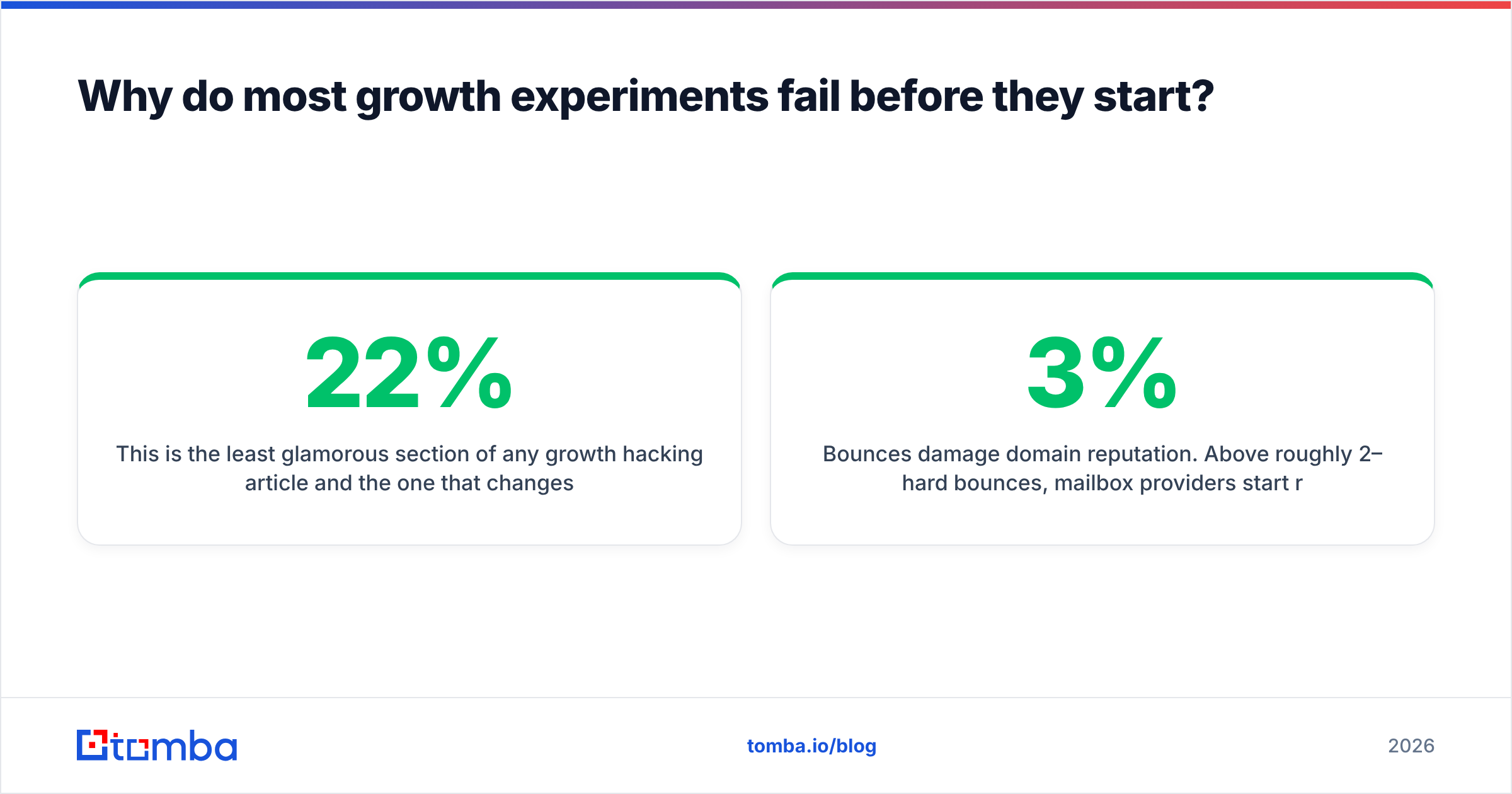
This is the least glamorous section of any growth hacking article and the one that changes the most outcomes. You design a beautiful three-touch outbound sequence, write copy that took a week, pick a smart ICP segment — and then send it to a list where 22% of the addresses do not exist. Your test result is now uninterpretable. Did the messaging fail, or did 22% of it never arrive? You cannot tell. So you iterate on messaging, which was fine, and the next test fails the same way.
The failure chain is mechanical:
- Bounces damage domain reputation. Above roughly 2–3% hard bounces, mailbox providers start routing your entire domain to spam — including your good sends.
- Spam placement destroys your control group. Every subsequent A/B test on that domain measures deliverability noise, not copy quality.
- Recovery takes weeks. Domain reputation is slow to build and fast to lose. One bad blast can cost a quarter.
The fix is boring and cheap. Before any outbound experiment: source contacts from a provider that verifies at lookup time, run the list through an email verifier, handle catch-all domains explicitly with a catch-all verifier rather than guessing, and check your authentication records with an SPF checker before the first send. That sequence takes an afternoon and protects every experiment you run for the next year.
If you want the deeper mechanics of what mailbox providers actually measure, the email deliverability entry covers the signals that matter.
What does a real growth experiment framework look like?#
Most teams over-engineer this. A workable framework needs five fields and a cadence.
1. Hypothesis, written as a falsifiable sentence. Not "test new subject lines." Instead: "Subject lines referencing the prospect's recent funding round will lift reply rate from 3.1% to above 5% for Series A/B SaaS accounts." If you cannot write the number you expect, you have not thought about the test yet.
2. Minimum detectable effect and sample size. If you send 200 emails and reply rate moves from 3% to 4%, you have learned nothing — that is six replies versus eight. Calculate the sample you need before you run, not after. Most B2B outbound tests need 1,000+ sends per variant to detect anything under a 2pp swing.
3. One variable. Everyone knows this. Almost nobody does it, because shipping one change feels slow. Ship one change.
4. A pre-registered decision rule. Write down before the test: "if reply rate exceeds 5%, we roll this out to all segments; if between 3.5% and 5%, we re-run with a larger sample; below 3.5%, we kill it." This prevents the universal failure mode of finding a favourable slice in the data afterward.
5. A documented result — including the failures. Your experiment archive is the actual asset. A team two years into disciplined testing knows things about its market that no competitor can buy.
Cadence: two-week cycles, three to five live experiments, one review meeting. More experiments than that and instrumentation quality collapses.
How do you build the data layer growth hacking needs?#
Growth experiments consume contact data the way an engine consumes fuel, and contaminated fuel wrecks the engine. Three practical requirements.
Coverage that matches your ICP, not global coverage. A database claiming 700 million contacts is irrelevant if it holds 40% of the mid-market European manufacturing companies you sell to. Test coverage on a sample of 50 accounts you already know before you buy anything. Providers vary enormously by geography and company size — BookYourData is strong on verified B2B lists with pay-as-you-go pricing, which suits teams that buy in bursts rather than continuously. Others index better on tech companies or US SMBs. Sample first.
Freshness, because B2B data decays fast. Roughly 25–30% of B2B contact records go stale each year through job changes alone. A static list bought in January is meaningfully wrong by September. This is the argument for API-based enrichment over one-time exports — the Tomba API lets you re-verify at send time rather than trusting a snapshot.
A path from list to CRM without manual steps. Every manual CSV handoff is a place experiments die. Whether you use a HubSpot integration, Zapier, or direct API calls, the requirement is the same: data flows from source to sequence without a human touching a spreadsheet.
For teams starting from a target-account list rather than named individuals, domain search is usually the fastest first step — feed it a company domain, get back the verified addresses and the company's email pattern, and you can build the rest of the org chart from there.
What growth hacking metrics should you actually track?#
Vanity metrics survive because they always go up. Here is the replacement set.
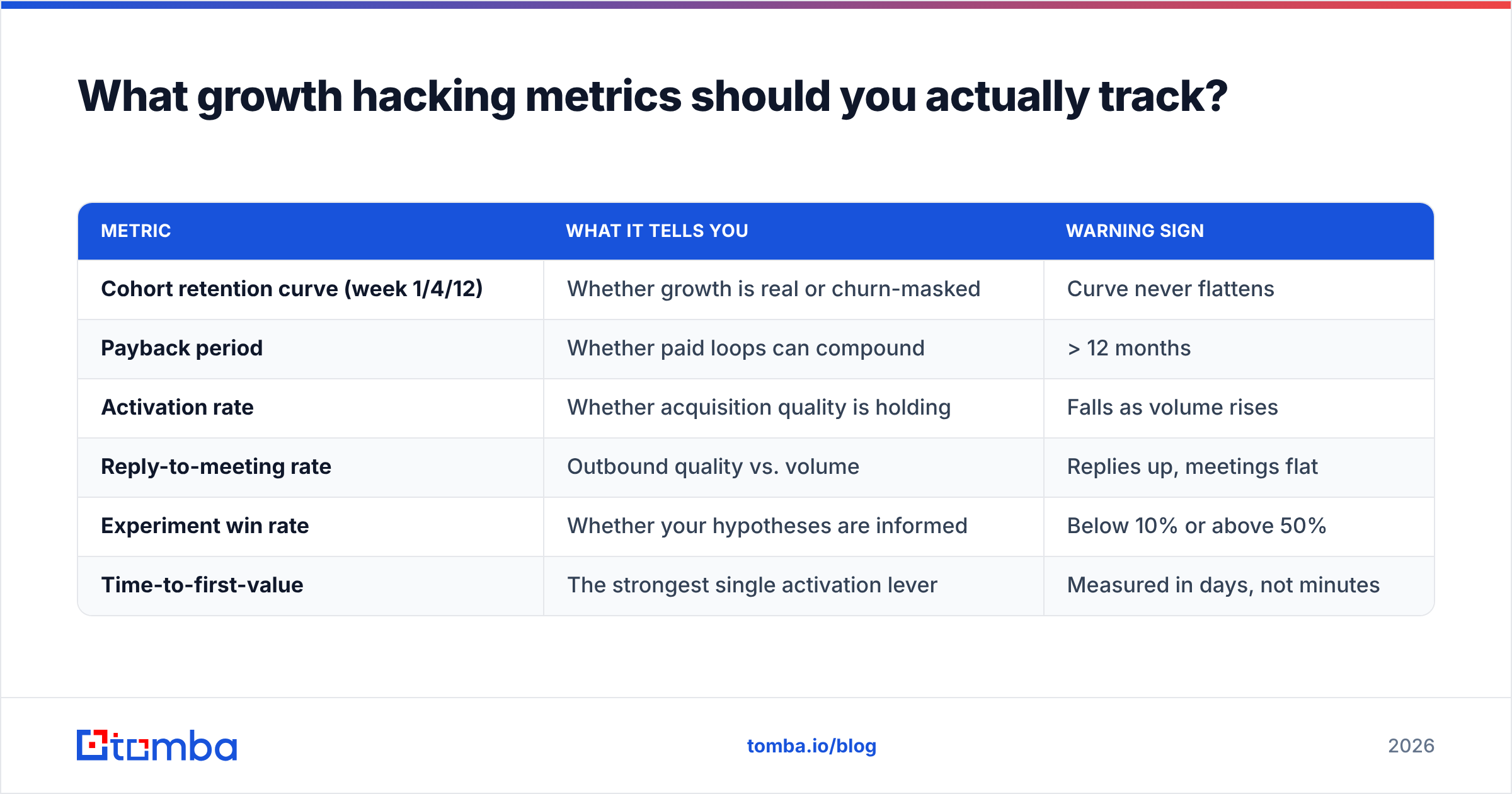
| Metric | What it tells you | Warning sign |
|---|---|---|
| Cohort retention curve (week 1/4/12) | Whether growth is real or churn-masked | Curve never flattens |
| Payback period | Whether paid loops can compound | > 12 months |
| Activation rate | Whether acquisition quality is holding | Falls as volume rises |
| Reply-to-meeting rate | Outbound quality vs. volume | Replies up, meetings flat |
| Experiment win rate | Whether your hypotheses are informed | Below 10% or above 50% |
| Time-to-first-value | The strongest single activation lever | Measured in days, not minutes |
That fifth row surprises people. An experiment win rate above 50% means you are only testing safe, obvious changes and leaving upside on the table. Below 10% means you are guessing. Somewhere between 15% and 35% is the zone where the team is testing real hypotheses and learning from them.
On retention specifically: if the cohort curve never flattens, no acquisition channel will save you. Fixing a leaky bucket is not glamorous growth work, but it is the highest-leverage work available. HubSpot's research library has good public benchmark data on where B2B retention curves typically settle by segment.
What should you avoid in 2026?#
Anything that depends on a loophole. If your channel works because a platform has not noticed yet, price in its death. Build on it if the payback is fast, but do not staff around it.
Copying tactics without copying context. The case study that produced 40% month-over-month growth had a product, market, and moment you do not have. Copy the method — how they instrumented, how they decided — not the tactic.
Volume as a substitute for targeting. Sending 50,000 emails to a badly-defined list will underperform 2,000 to a precise one, and it will cost you your domain. The response rate math works against volume in every deliverability regime that exists now.
Hiring a growth hacker before you have retention. Growth work on a product people churn out of accelerates the churn. Fix activation and retention first, then pour on acquisition. This ordering error is the most expensive one on the list.
Where should you start this quarter?#
If you have nothing running: pick one loop, instrument it, and run four experiments against it over eight weeks. Do not add a second loop until the first one has a documented win.
If you already have outbound running but flat results: audit your data before you touch your copy. Pull 200 contacts from your current list, verify them, and measure the invalid rate. If it is above 5%, your copy was never the problem, and every test you ran on that list should be re-run.
If you have clean data and disciplined tests but no lift: your ICP definition is probably too broad. Narrow it until the segment feels uncomfortably small, then test again. Precision beats reach in every B2B channel that still works.
The common thread in all three paths is that growth hacking rewards teams who fix the foundation before they optimise the surface. Verified contacts, instrumented funnels, falsifiable hypotheses, honest metrics. None of it is a hack. All of it compounds.
Start with the data layer. Before your next outbound experiment, run your target accounts through the Tomba Email Finder — verified professional addresses by domain, name, or company, with the verification built into the lookup rather than bolted on afterward. The free tier gives you 25 searches a month to test coverage against your own ICP, and paid plans start at $49/mo on Tomba pricing if the sample holds up. Test the data before you test the copy; it saves a quarter of ambiguous results.
Related guides#
Ready to find emails that actually work?
Join 150,000+ professionals who stopped guessing and started sending. Free credits on signup — no credit card required.
Get the Tomba newsletter
Practical outbound tactics and product updates — once every two weeks.
About the author