Growth Marketing vs Demand Generation: Which Drives Pipeline
Growth marketing and demand generation get treated as synonyms, then fight over the same budget. Here is what each function actually owns, which one to hire first, and how to run both without paying twice for the same pipeline.
TL;DR
- Demand generation creates and captures market demand for a defined ICP. It owns pipeline volume, channel mix, and the cost of a qualified opportunity.
- Growth marketing runs experiments across the whole funnel, including activation, retention, and expansion — places demand gen rarely touches.
- The practical difference is scope and time horizon: demand gen is accountable for a quarterly pipeline number; growth is accountable for a rate of improvement.
- If you sell a $30k ACV product to a known buyer list, hire demand gen first. If you sell PLG or self-serve, hire growth first.
- Both fail for the same reason: bad contact data. A perfect nurture sequence sent to a 40%-bounce list is a deliverability problem, not a strategy problem.
What is demand generation, exactly?#
Demand generation is the discipline of making a defined set of buyers aware they have a problem, then capturing them when they start shopping. It has two halves that get collapsed together and shouldn't be.
Demand creation is the part with no immediate attribution: podcasts, LinkedIn thought leadership, category education, analyst relations, field events. You are teaching a market that a problem is worth solving. Nobody fills out a form because of it this week.
Demand capture is the part that shows up in dashboards: paid search on high-intent keywords, review-site listings on G2, comparison pages, retargeting, and outbound to accounts showing intent signals. You are intercepting people who already decided to buy something.
A demand gen team owns a number — usually sourced or influenced pipeline in dollars — and works backward from it. That number forces a specific set of behaviors: budget allocation across channels, a lead scoring model, service-level agreements with sales on follow-up speed, and an obsessive relationship with cost per opportunity.
The scope is deliberately narrow. Demand gen stops at the moment a qualified opportunity enters the sales pipeline. What happens to activation, onboarding, or churn is somebody else's job.
What is growth marketing, exactly?#
Growth marketing is an experimentation practice applied across the entire customer lifecycle, not just the acquisition slice. The canonical framing is AARRR: Acquisition, Activation, Retention, Referral, Revenue. Demand gen lives almost entirely in the first letter.
A growth marketer's week looks structurally different from a demand gen manager's week. Instead of "how do we hit $2M in Q3 pipeline," the question is "what is the single biggest constraint in the funnel right now, and what is the cheapest test that would move it?"
That test might be a paid channel. It might also be:
- Onboarding email sequencing — moving a product-activation milestone from day 9 to day 2.
- Pricing page structure — testing whether a three-tier layout converts better than four.
- Self-serve trial length — 14 days versus 30, measured on paid conversion, not signups.
- In-product referral loops — a share prompt triggered at the moment of first value.
- Lifecycle reactivation — winning back dormant accounts with usage-triggered emails instead of calendar-triggered ones.
None of those five would appear on a demand gen roadmap. Three of them don't involve marketing spend at all.
The tradeoff is accountability. Growth marketing's output is a rate — conversion lift, payback period reduction, retention curve flattening — which is harder to forecast than a pipeline number. Boards like forecastable numbers. That tension is why growth roles get cut first in a downturn, even when their ROI is better.
Growth marketing vs demand generation: what's the actual difference?#
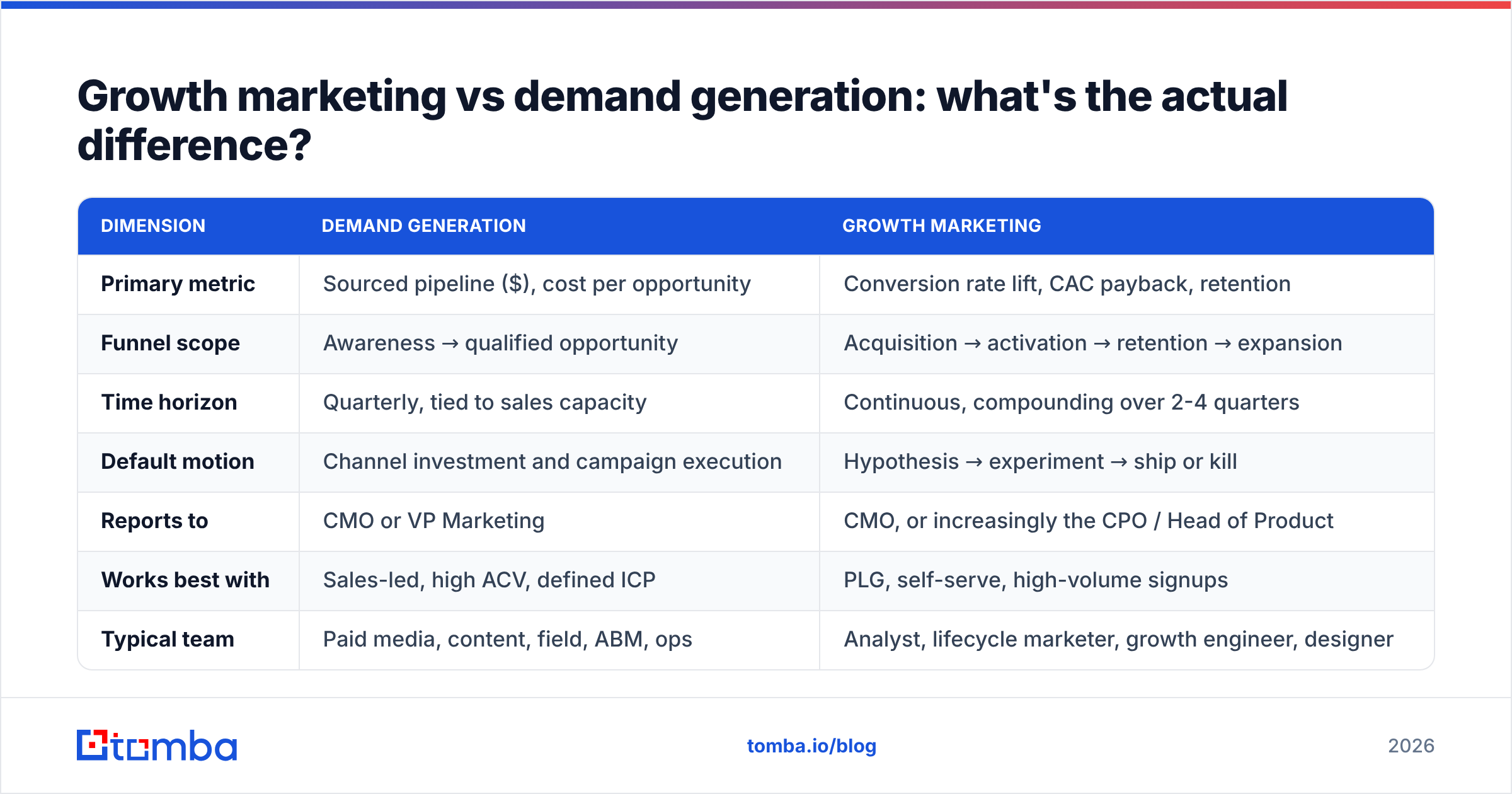
Here is the side-by-side that matters when you're writing a job description or splitting a budget.
| Dimension | Demand Generation | Growth Marketing |
|---|---|---|
| Primary metric | Sourced pipeline ($), cost per opportunity | Conversion rate lift, CAC payback, retention |
| Funnel scope | Awareness → qualified opportunity | Acquisition → activation → retention → expansion |
| Time horizon | Quarterly, tied to sales capacity | Continuous, compounding over 2-4 quarters |
| Default motion | Channel investment and campaign execution | Hypothesis → experiment → ship or kill |
| Reports to | CMO or VP Marketing | CMO, or increasingly the CPO / Head of Product |
| Works best with | Sales-led, high ACV, defined ICP | PLG, self-serve, high-volume signups |
| Typical team | Paid media, content, field, ABM, ops | Analyst, lifecycle marketer, growth engineer, designer |
| Fails when | ICP is undefined or TAM is tiny | No instrumentation, or traffic too low to reach significance |
| Budget shape | Mostly media spend | Mostly headcount and tooling |
| Typical seniority hire | Demand Gen Manager, $110k-$160k | Growth Lead, $130k-$190k |
The row that decides most arguments is funnel scope. If your biggest problem is that not enough qualified accounts know you exist, that is a demand gen problem and no amount of onboarding experimentation fixes it. If your biggest problem is that 4,000 people signed up last month and 300 activated, that is a growth problem and buying more traffic makes it worse.
Which one should you hire first?#
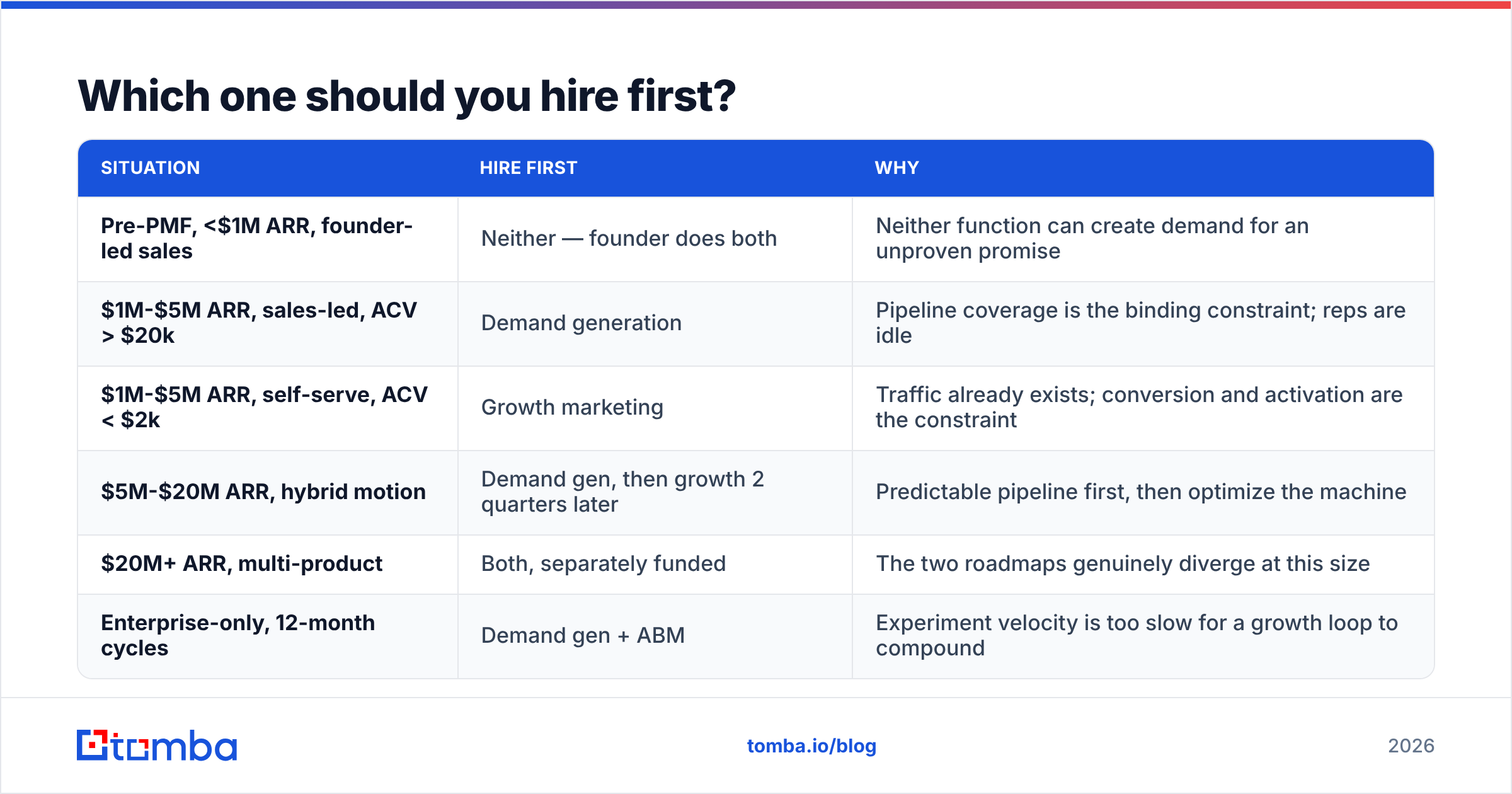
Company stage and sales motion decide this, not preference. Use the table below as a first-pass filter, then sanity-check it against where your funnel actually leaks.
| Situation | Hire first | Why |
|---|---|---|
| Pre-PMF, <$1M ARR, founder-led sales | Neither — founder does both | Neither function can create demand for an unproven promise |
| $1M-$5M ARR, sales-led, ACV > $20k | Demand generation | Pipeline coverage is the binding constraint; reps are idle |
| $1M-$5M ARR, self-serve, ACV < $2k | Growth marketing | Traffic already exists; conversion and activation are the constraint |
| $5M-$20M ARR, hybrid motion | Demand gen, then growth 2 quarters later | Predictable pipeline first, then optimize the machine |
| $20M+ ARR, multi-product | Both, separately funded | The two roadmaps genuinely diverge at this size |
| Enterprise-only, 12-month cycles | Demand gen + ABM | Experiment velocity is too slow for a growth loop to compound |
There is one shortcut that works surprisingly often: look at where prospects drop off in absolute numbers, not percentages. A 2% improvement on a step that 50,000 people hit is worth more than a 40% improvement on a step that 200 people hit. Whichever function owns the bigger absolute number is the one to hire.
Where do the two disciplines actually collide?#
Three predictable fights, all of them about ownership rather than method.
Lead scoring. Demand gen wants a scoring model that maximizes handoff volume within a quality floor. Growth wants a model that predicts retention, not just conversion. These produce different scores for the same lead. The resolution is usually two models: one routing model for sales, one propensity model for lifecycle. Trying to force one model to do both jobs produces something that does neither. If you're formalizing this, start with a shared definition of a marketing qualified lead that both sides sign.
Email volume. Demand gen wants to nurture the database. Growth wants to send product-triggered lifecycle mail. Both send from the same domain, and the domain has one reputation. When a batch-and-blast nurture to a stale list tanks your sender reputation, the growth team's activation emails land in Promotions and their experiment reads as a failure. This is the single most expensive unmanaged collision in most GTM orgs.
Attribution. Demand gen is measured on sourced pipeline, so it wants first-touch or a generous multi-touch model. Growth is measured on lift, so it wants holdout tests and incrementality. These worldviews are not reconcilable in a single dashboard, and pretending otherwise wastes quarters. Forrester and other analyst shops have been pushing B2B teams toward incrementality testing for years, but most CRMs still default to touch-based attribution. Decide which model governs budget decisions, and let the other one be a reporting artifact.
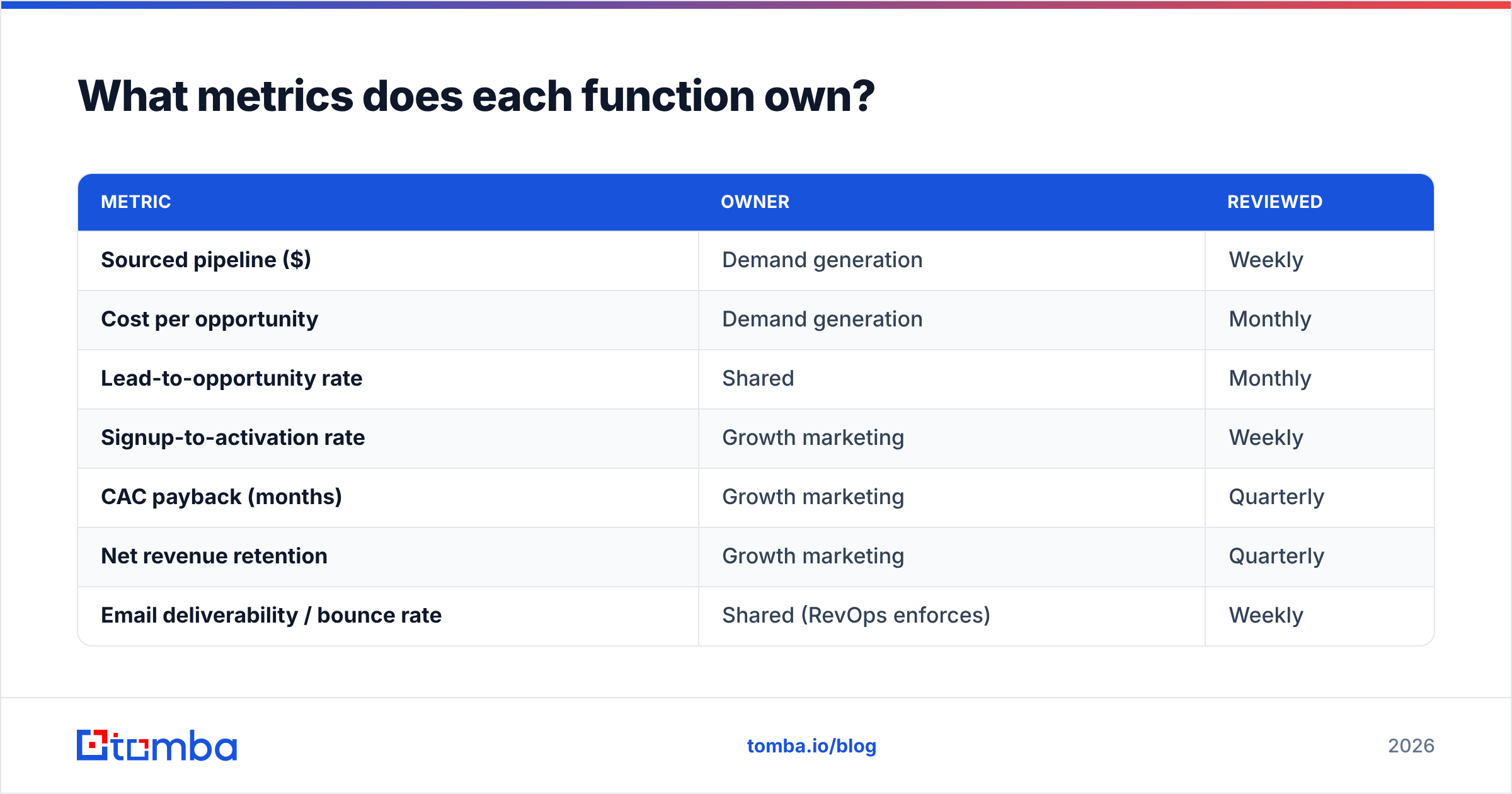
What metrics does each function own?#
Split the scorecard cleanly or you will spend every QBR arguing about whose number moved.
| Metric | Owner | Reviewed |
|---|---|---|
| Sourced pipeline ($) | Demand generation | Weekly |
| Cost per opportunity | Demand generation | Monthly |
| Lead-to-opportunity rate | Shared | Monthly |
| Signup-to-activation rate | Growth marketing | Weekly |
| CAC payback (months) | Growth marketing | Quarterly |
| Net revenue retention | Growth marketing | Quarterly |
| Email deliverability / bounce rate | Shared (RevOps enforces) | Weekly |
| Win rate by source | Shared with sales | Quarterly |
Note that two rows are shared. Shared metrics without an enforcing owner become orphans, which is why revenue operations usually ends up holding the deliverability and data-hygiene line. Someone has to own the list quality that both functions depend on, and neither function will volunteer.
How much does bad data cost each function?#
More than either team admits, and it hurts them differently.
For demand generation, bad contact data shows up as inflated cost per opportunity. You paid for the impression, paid for the click, captured the form fill, and then routed a lead with a role-based address and a typo'd company domain to a rep who burned 20 minutes on it. The waste is invisible because it's spread across thousands of records.
For growth marketing, bad data shows up as broken experiments. If 18% of your activation-email cohort never receives the email, your test result is noise. You will kill a variant that worked or ship one that didn't. The response rate you're measuring isn't a response rate at all — it's a delivery rate wearing a costume.

The fix is not glamorous. Three controls handle most of it:
- Verify at capture, not at send. Run every inbound address through an email verifier at the point of form submission. Rejecting a bad address in-form costs nothing; discovering it three weeks later costs a nurture cycle.
- Enrich instead of asking. Every field you add to a form drops conversion. Ask for a work email and use data enrichment to fill in company size, industry, and role. Shorter forms convert better and route better.
- Re-verify quarterly. B2B contact data decays roughly 2-3% per month through job changes alone. A list you cleaned in January is measurably worse by April.
For outbound-heavy demand gen programs, the same logic applies before the first send. Building target account lists from a domain search and verifying them before they enter the sequence keeps bounce rates in a range where your email deliverability doesn't degrade for everyone else sending from that domain, including the growth team.
Can you run both without paying twice?#
Yes, with two structural decisions.
Decision one: one shared data layer, two roadmaps. Both functions read from the same contact and account records, the same enrichment source, and the same verification standard. They do not share a roadmap, a sprint cadence, or a scorecard. Shared data, separate execution. When teams share roadmaps instead, growth work gets deprioritized every time pipeline slips — which is every quarter.
Decision two: a sending calendar with a hard cap. Every outbound and lifecycle send goes through one calendar with a per-domain daily volume ceiling. Growth gets guaranteed slots for triggered mail; demand gen gets guaranteed slots for campaigns. Nobody unilaterally decides to blast 40,000 records on a Tuesday.
The org chart matters less than most people think. Some companies put both under a CMO. Some put growth under product, following the model HubSpot and other PLG-heavy companies have described publicly. Both work. What doesn't work is having two teams that send email from the same domain and never talk about it.
If you're standing up the function for the first time and want a reference model for how analyst frameworks split these responsibilities, Gartner's marketing research is a reasonable starting point — though be aware it skews toward enterprise org structures that a 30-person company can't staff.
So which one actually wins?#
Neither, and the framing is the problem. Demand generation and growth marketing are answers to different questions:
- "Not enough of the right people know we exist" → demand generation.
- "Enough people arrive but too few become paying, retained customers" → growth marketing.
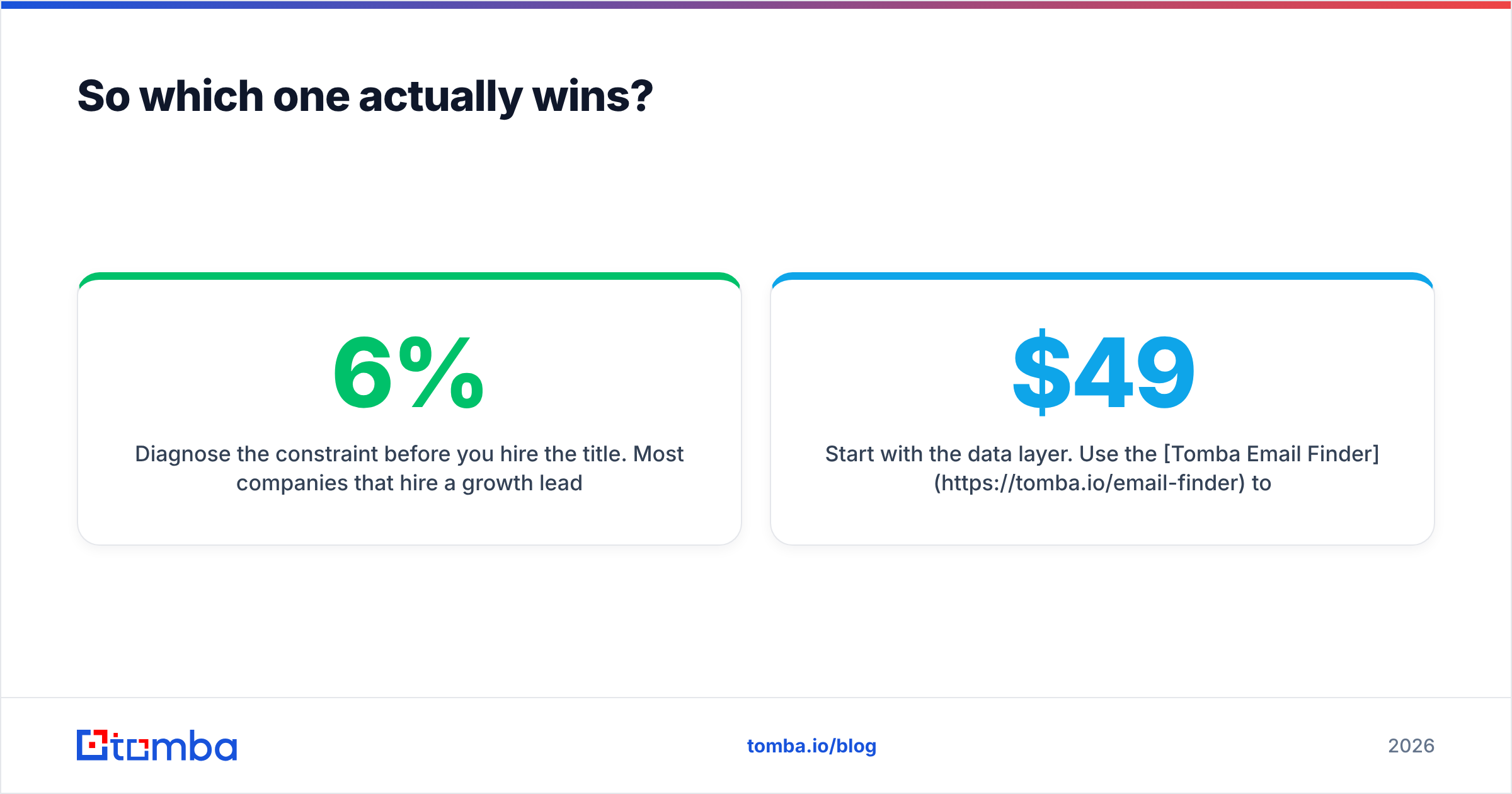
Diagnose the constraint before you hire the title. Most companies that hire a growth lead while their real problem is pipeline coverage end up with a very well-optimized funnel that nobody enters. Most companies that pour budget into demand gen while their activation rate sits at 6% just buy more expensive churn.
And whichever one you build first, the input is identical: accurate, verified contact data for the accounts you actually want. That is the layer both functions sit on, and it's the one that quietly decides whether either of them works.
Start with the data layer. Use the Tomba Email Finder to build verified contact lists for your ICP before you spend a dollar on media or a sprint on experiments. The free tier gives you 25 searches a month to test accuracy against your own known-good records; paid plans start at $49/mo on Starter, with Growth at $99/mo and Pro at $249/mo. Check full Tomba pricing to match a tier to your list volume — and verify before you send, not after.
Related guides#
Ready to find emails that actually work?
Join 150,000+ professionals who stopped guessing and started sending. Free credits on signup — no credit card required.
Get the Tomba newsletter
Practical outbound tactics and product updates — once every two weeks.
About the author