GTM AI in 2026: What Actually Works in Revenue Teams
GTM AI promises pipeline on autopilot. Most teams get expensive noise instead. Here's the honest breakdown of what AI actually automates in go-to-market, what it can't, and how to build a stack that pays back.
TL;DR
- GTM AI is not one product. It's four separate layers — data, targeting, execution, and analysis — and AI works dramatically better in some layers than others.
- The layer with the highest measured ROI is the least glamorous one: data quality and enrichment. AI-written cold email is the layer with the worst.
- "AI SDR" tools that promise fully autonomous pipeline generation almost always underperform a human rep with good data. The bottleneck is rarely writing speed.
- Your GTM AI stack fails at the input, not the model. Bad contact data produces confident, personalized, well-written emails sent to people who don't exist.
- Start with verified contact data, add AI for research and prioritization, and keep a human on the message. That sequence beats the reverse order every time.
What is GTM AI, actually?#
GTM AI is the application of machine learning and large language models to the go-to-market motion — everything between "we have a product" and "we closed revenue." That covers account selection, contact discovery, research, message generation, sequencing, call analysis, forecasting, and pipeline hygiene.
The problem with the term is that it flattens wildly different things into one bucket. A model that predicts which accounts are likely to buy and a model that writes your subject line are both "GTM AI," but they behave nothing alike. The first is a statistical scoring problem with decades of prior art. The second is a text generation problem where the output is graded by a human recipient who has seen ten thousand AI-written emails this quarter.
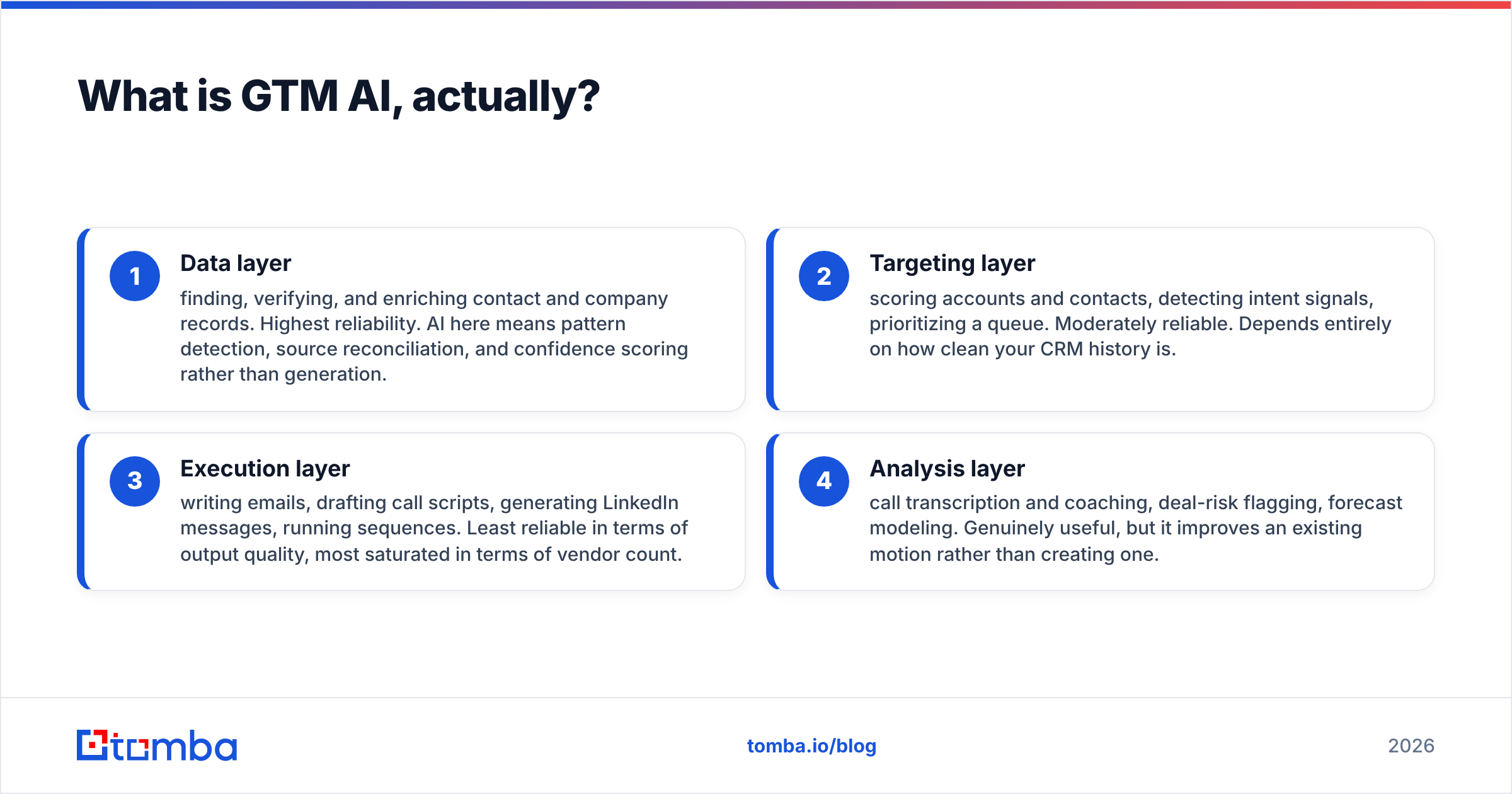
Treat GTM AI as four distinct layers, each with its own maturity level:
- Data layer — finding, verifying, and enriching contact and company records. Highest reliability. AI here means pattern detection, source reconciliation, and confidence scoring rather than generation.
- Targeting layer — scoring accounts and contacts, detecting intent signals, prioritizing a queue. Moderately reliable. Depends entirely on how clean your CRM history is.
- Execution layer — writing emails, drafting call scripts, generating LinkedIn messages, running sequences. Least reliable in terms of output quality, most saturated in terms of vendor count.
- Analysis layer — call transcription and coaching, deal-risk flagging, forecast modeling. Genuinely useful, but it improves an existing motion rather than creating one.
Most teams buy the execution layer first because it demos well. Then they discover their bounce rate is 14% and nothing downstream matters.
Why does most GTM AI fail before the model runs?#
Because the model is fed garbage. This is the single most common failure pattern in revenue operations tooling, and it has nothing to do with which LLM you picked.
Consider the pipeline: an AI agent scrapes a company page, infers a contact's role, guesses their email from a pattern, writes a hyper-personalized opener referencing their recent funding round, and fires it into a sequence. Four of those five steps can be flawless while step three — the email guess — is wrong. The result is a beautifully personalized message delivered to a hard bounce, which damages your sender reputation and pulls down deliverability for every other email you send that week.

The math is unforgiving. If your list is 80% accurate and you send 5,000 emails, that's 1,000 bounces. Most mailbox providers start throttling above a 2-3% bounce rate. You have now spent money on AI copy that will never be read, and degraded a domain you'll need for the next twelve months.
Fix the input first. Run contacts through an email verifier before anything touches a sequencer, and use a catch-all verifier for the domains that return ambiguous SMTP responses instead of just guessing on them.
Which GTM AI layer gives the best return?#
Here's how the four layers compare on the dimensions that actually determine whether a tool survives a renewal conversation.
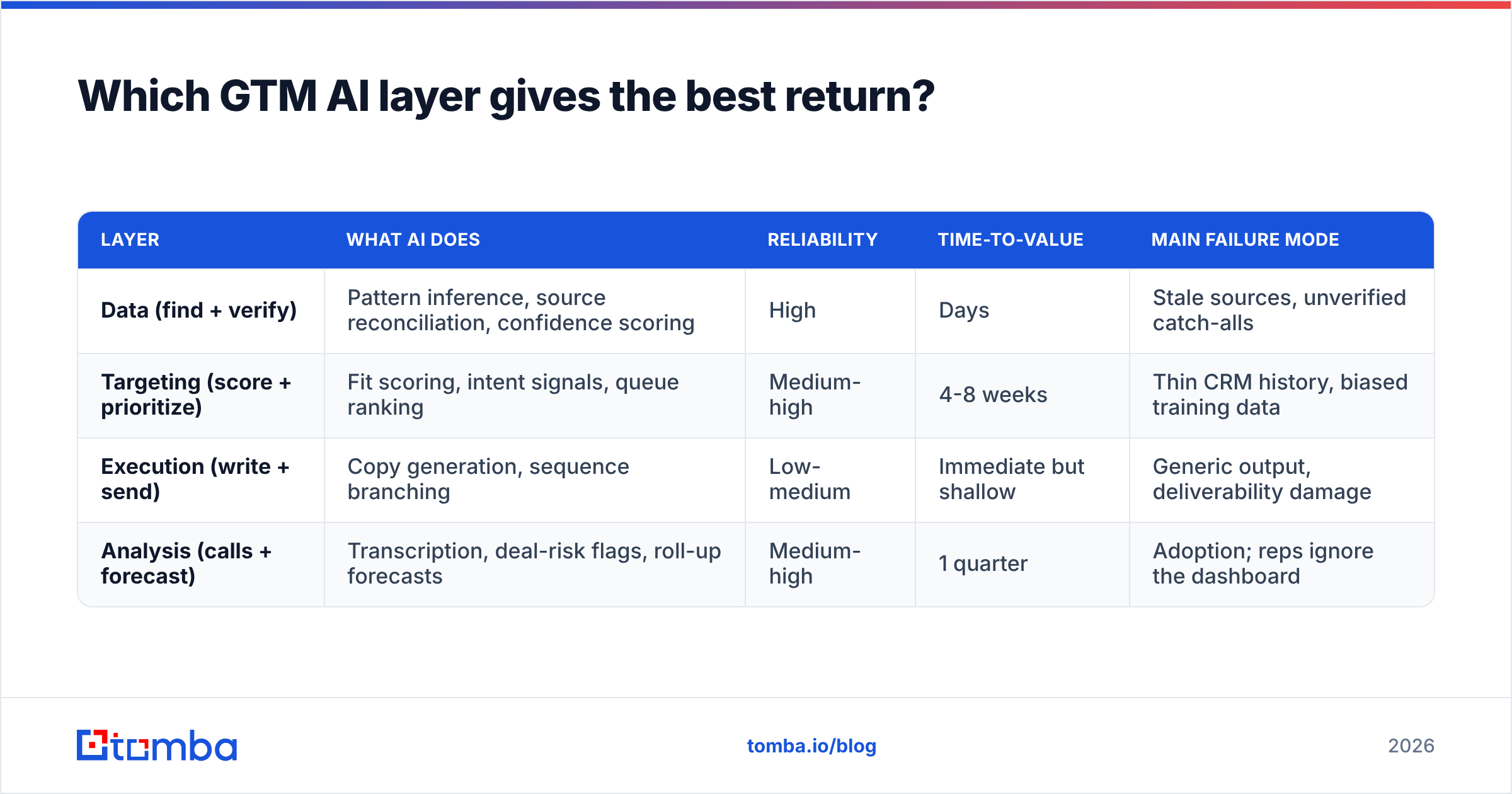
| Layer | What AI does | Reliability | Time-to-value | Main failure mode |
|---|---|---|---|---|
| Data (find + verify) | Pattern inference, source reconciliation, confidence scoring | High | Days | Stale sources, unverified catch-alls |
| Targeting (score + prioritize) | Fit scoring, intent signals, queue ranking | Medium-high | 4-8 weeks | Thin CRM history, biased training data |
| Execution (write + send) | Copy generation, sequence branching | Low-medium | Immediate but shallow | Generic output, deliverability damage |
| Analysis (calls + forecast) | Transcription, deal-risk flags, roll-up forecasts | Medium-high | 1 quarter | Adoption; reps ignore the dashboard |
The pattern is clear once you see it laid out. The layers where AI does retrieval and ranking outperform the layers where AI does generation aimed at a human reader. Retrieval has a verifiable ground truth — an email either delivers or it doesn't. Generation is graded subjectively by a prospect who is actively pattern-matching for AI slop.
That doesn't mean skip the execution layer. It means don't expect it to be your differentiator, because your competitor has the same model.
Is an AI SDR better than a human SDR with better data?#
Short answer: no, not yet, and the comparison is usually framed dishonestly.
Vendors selling autonomous "AI SDR" agents benchmark against an unproductive human rep — one spending six hours a day on manual list building. That's a real problem, but the fix isn't replacing the human. It's replacing the manual list building.

Break down what an SDR actually does in a week:
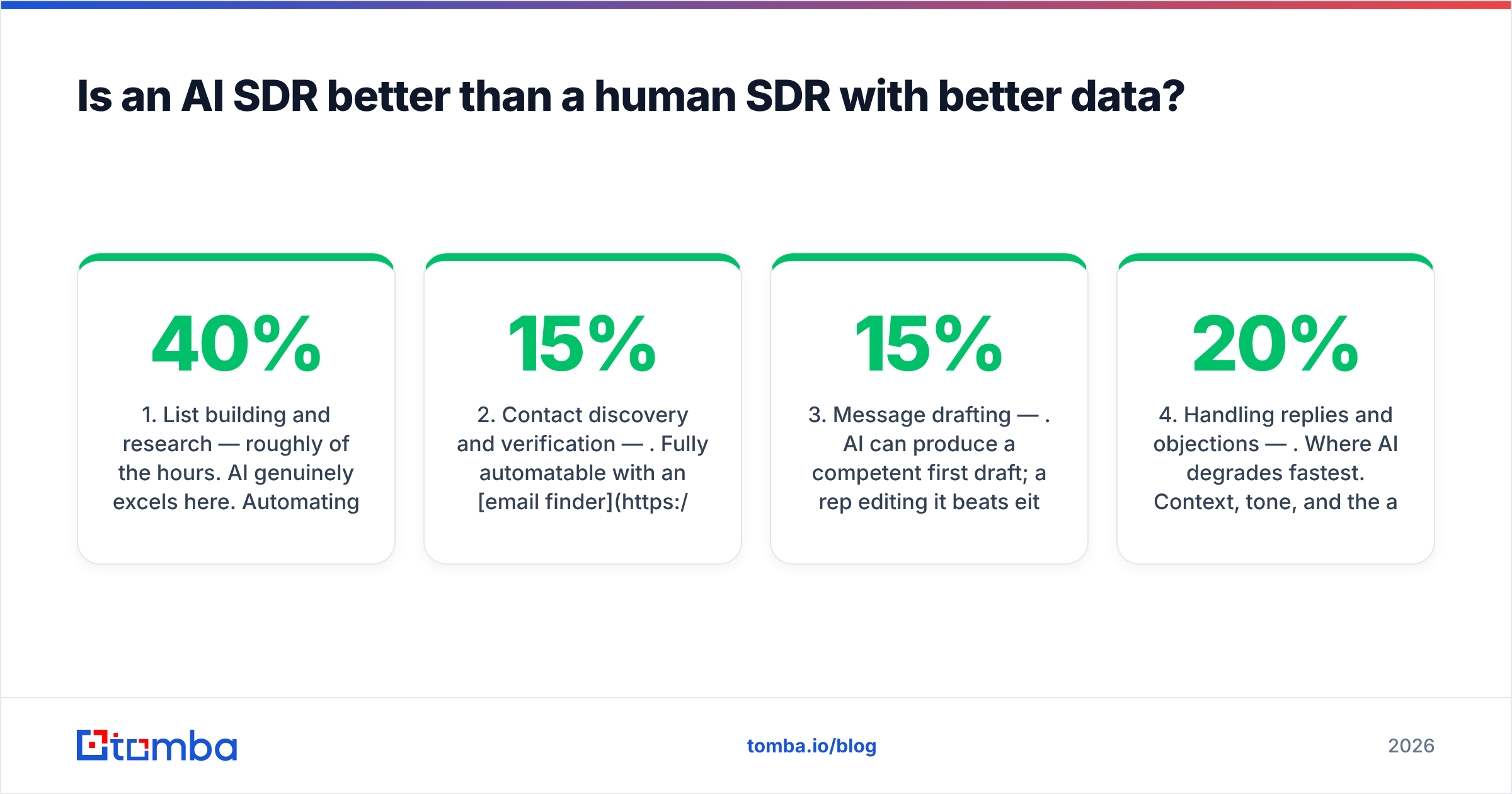
- List building and research — roughly 40% of the hours. AI genuinely excels here. Automating it is not controversial.
- Contact discovery and verification — 15%. Fully automatable with an email finder and a bulk verification step. No judgment required.
- Message drafting — 15%. AI can produce a competent first draft; a rep editing it beats either alone.
- Handling replies and objections — 20%. Where AI degrades fastest. Context, tone, and the ability to say "actually, we're not a fit for you" are not solved problems.
- Meeting qualification and handoff — 10%. Human required. This is the part that determines whether the meeting was worth booking.
Automate items 1 and 2 completely. Assist on 3. Keep humans on 4 and 5. A team that does this out-produces both a pure-human team and a pure-agent team, and it's not close.
The failure of most AI SDR deployments is that they automate item 3 — the visible, demo-friendly part — while leaving items 1 and 2 half-solved. You get faster production of emails to unverified addresses.
What does a GTM AI stack actually look like in 2026?#
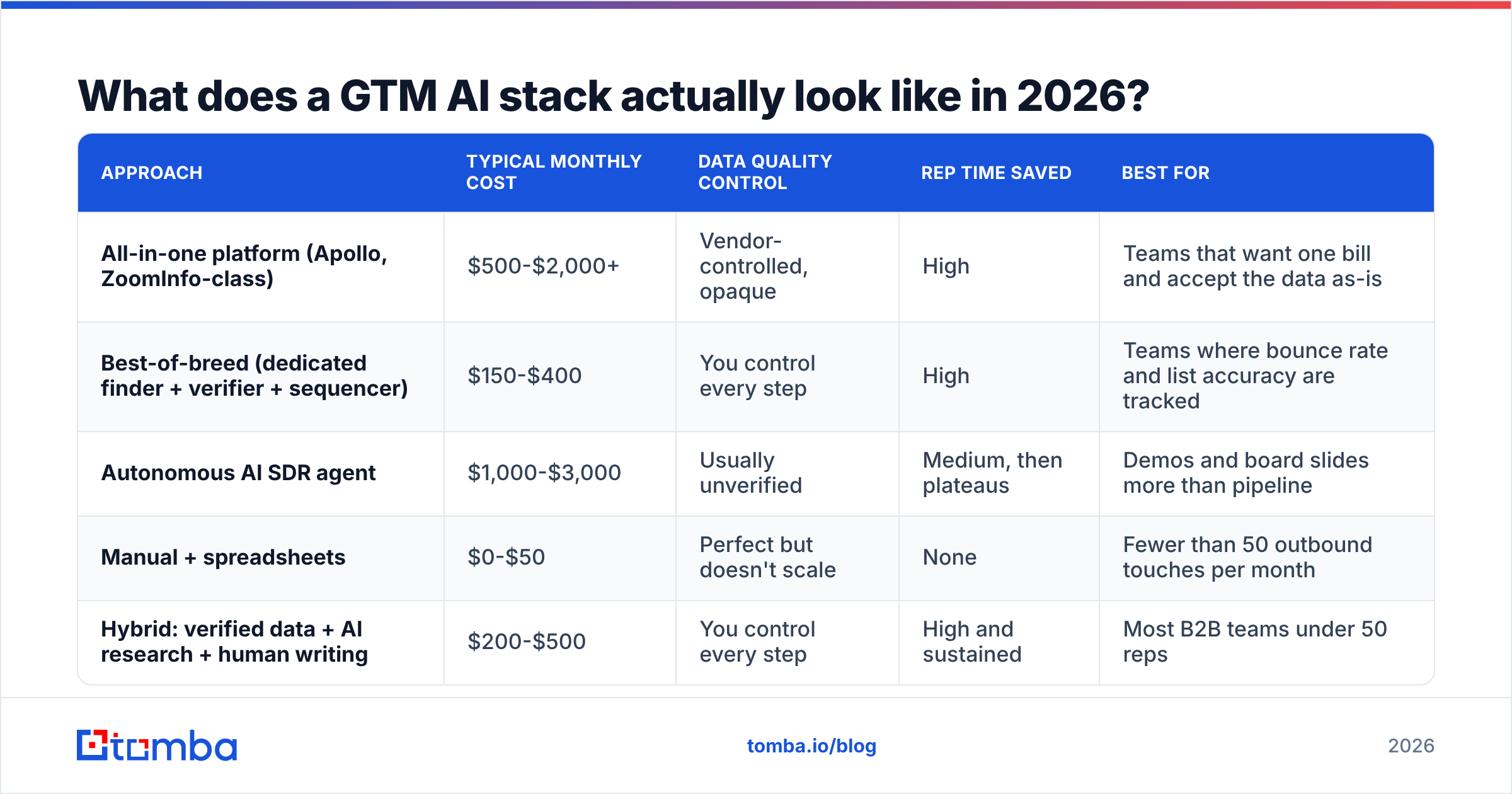
A working stack has one tool per layer, not five tools competing in the execution layer. Here's a comparison of the common approaches teams take:
| Approach | Typical monthly cost | Data quality control | Rep time saved | Best for |
|---|---|---|---|---|
| All-in-one platform (Apollo, ZoomInfo-class) | $500-$2,000+ | Vendor-controlled, opaque | High | Teams that want one bill and accept the data as-is |
| Best-of-breed (dedicated finder + verifier + sequencer) | $150-$400 | You control every step | High | Teams where bounce rate and list accuracy are tracked |
| Autonomous AI SDR agent | $1,000-$3,000 | Usually unverified | Medium, then plateaus | Demos and board slides more than pipeline |
| Manual + spreadsheets | $0-$50 | Perfect but doesn't scale | None | Fewer than 50 outbound touches per month |
| Hybrid: verified data + AI research + human writing | $200-$500 | You control every step | High and sustained | Most B2B teams under 50 reps |
The hybrid row is where the majority of successful teams land. It's unglamorous and it works. You pay for data accuracy, use AI for the research grind, and keep a human on anything a prospect will read.
For pricing context on the data layer specifically, Tomba pricing starts with a free tier at 25 searches per month, Starter at $49/mo, Growth at $99/mo, and Pro at $249/mo — which is roughly an order of magnitude below what all-in-one platforms charge for comparable contact volume, because you're paying for one layer instead of a bundle you'll use 30% of.
Competitors like BookYourData take a different and legitimate approach — pay-as-you-go prepaid credits with an accuracy guarantee, which suits teams doing occasional large list pulls rather than continuous enrichment. Both models work; pick based on whether your usage is spiky or steady.
How do you evaluate a GTM AI vendor without getting burned?#
Vendor demos are optimized environments. Here's what to test instead:
- Bring your own list. Ask the vendor to run 200 contacts you already have verified truth on. Measure match rate and accuracy against your known-good data, not their sample.
- Check the bounce rate downstream. Any tool can claim 95% accuracy. Send to a subset and read the actual bounce logs after 48 hours.
- Ask where the data comes from. Vendors that won't explain their sourcing are usually reselling a scraped dataset that's also in three competitors' products. Tomba publishes its data sources — expect the same transparency from anyone you're evaluating.
- Test the API, not the UI. If AI is in your GTM motion, the tool will eventually run headless. A clean email finder API matters more in month six than the dashboard does in week one.
- Interrogate the AI claims specifically. "AI-powered" applied to a rules engine is marketing. Ask what the model does, what it's trained on, and what happens when it's uncertain. A good answer includes "it returns a low confidence score and we don't charge you."
For broader vendor validation, G2's sales intelligence category and Gartner's peer reviews surface deployment complaints that vendor sites do not. Read the two-star reviews specifically; they tell you what breaks at scale.
What should you automate first?#
In order, and don't skip ahead:
- Contact discovery. Stop having humans hunt for email addresses. Use domain search to pull every contact at a target company in one call, or the bulk email finder for list-scale work.
- Verification. Every address goes through verification before it enters a sequencer. Non-negotiable. This one step protects email deliverability across your entire program.
- Account research. Let AI summarize the company, recent news, tech stack, and hiring signals into a two-line brief. Reps read the brief; they don't do the reading.
- Prioritization. Rank the queue by fit and signal strength. Even a crude score beats alphabetical order.
- First-draft copy. Now — and only now — bring AI into the writing, with a human editing pass before send.
- Call analysis and coaching. Once you have volume, transcription and deal-risk flagging pay for themselves in manager time.
Teams that run this order see compounding returns. Teams that start at step five see a spike in send volume and a decline in reply rate, which they then blame on the model.
What's the honest verdict on GTM AI?#
AI has genuinely changed go-to-market, but not where the marketing says. It has collapsed the cost of research and data assembly by roughly an order of magnitude. It has not solved the problem of getting a stranger to care about your product, and it has arguably made that harder by flooding inboxes with competent-but-forgettable copy.
The durable advantage in 2026 isn't having AI. Everyone has AI. It's having accurate data feeding your AI — because the model amplifies whatever you put into it. Feed it a verified, well-segmented list and it makes a good rep faster. Feed it a scraped list with 20% junk and it makes your domain reputation worse at machine speed.
That's the whole thesis. Every layer above the data layer inherits the data layer's error rate.
Start where the return is. Before you buy another AI agent, fix the input. Tomba Email Finder finds professional email addresses by domain, name, or company, with verification built into the same workflow — so the contacts entering your GTM AI stack are real before your models ever touch them. The free tier gives you 25 searches a month to test it against a list you already know the answer to. Run that test first; buy the rest of the stack second.
Related guides#
Ready to find emails that actually work?
Join 150,000+ professionals who stopped guessing and started sending. Free credits on signup — no credit card required.
Get the Tomba newsletter
Practical outbound tactics and product updates — once every two weeks.
About the author