GTM Consulting in 2026: What It Costs and When It Works
GTM consulting promises faster pipeline and a cleaner revenue engine — but engagements run $15k to $250k. Here's what consultants actually deliver, what they cost, and when hiring in-house beats a retainer.
TL;DR
- GTM consulting is paid outside help to fix how you find, reach, and close buyers — segmentation, ICP, channel mix, pricing, RevOps tooling, and sales process. It is not the same as a marketing agency or a fractional CRO.
- Real 2026 pricing: $10k–$40k for a scoped diagnostic, $15k–$60k/month for a full retainer, $200–$700/hour for advisory. Boutique operators land lower; Bain/McKinsey-tier GTM practices land far higher.
- The engagements that pay back are narrow: a pricing/packaging reset, an ICP redefinition after a pivot, a pipeline-model rebuild, or an outbound motion you have never run before.
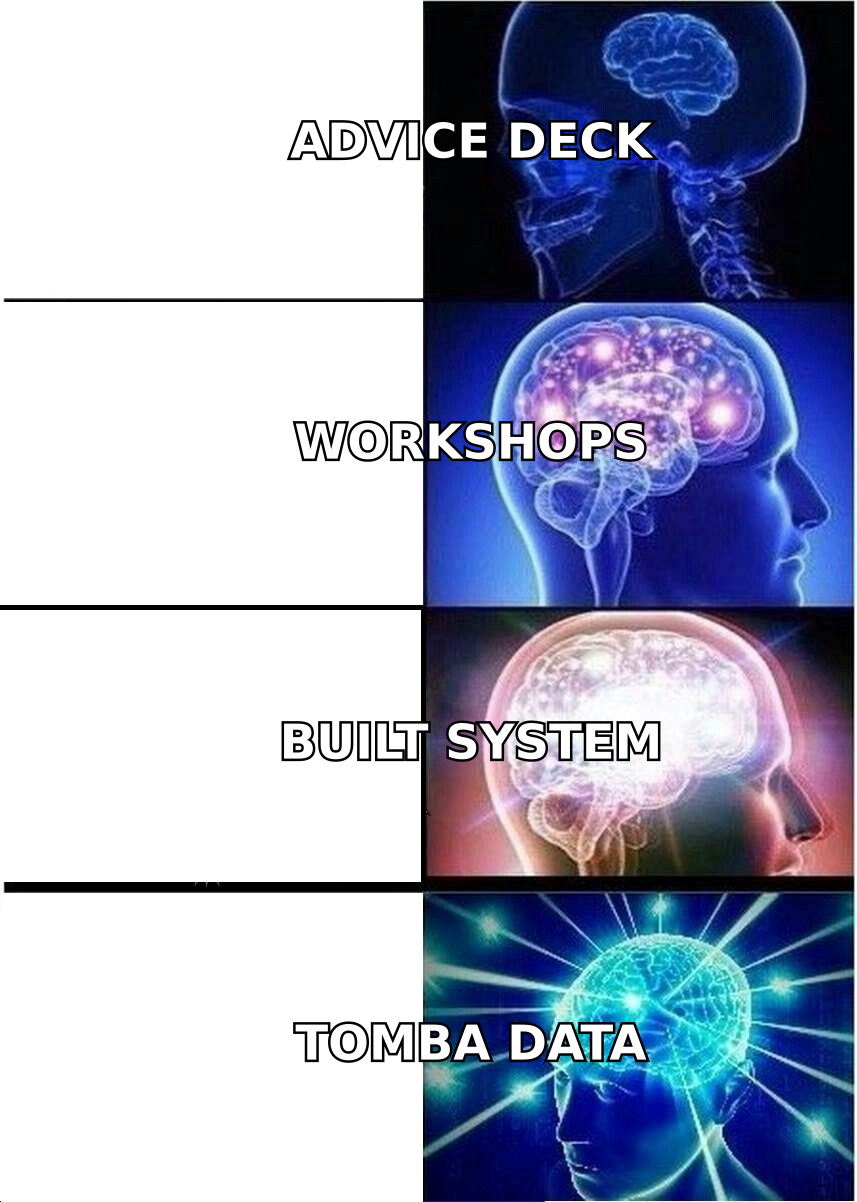
- The engagements that fail share one trait — the consultant leaves a strategy deck and nobody owns execution. Insist on built artifacts (dashboards, sequences, scored lists, data pipelines), not slides.
- Before you sign anything, check whether your problem is strategy or plumbing. A broken contact database, unverified emails, and no enrichment layer are plumbing. Tools fix plumbing for a few hundred dollars a month.
What is GTM consulting, exactly?#
GTM consulting is an outside engagement that redesigns how your company takes a product to market: who you sell to, what you charge, which channels you use, how the sales team is structured, and which systems track it all. The consultant sits above marketing, sales, and customer success and rewires the connections between them.
The category exists because most B2B companies grow past the point where founder intuition works, but not to the point where they can afford a full leadership bench. You have a VP of Sales who owns quota and a demand-gen manager who owns MQLs, and nobody who owns the question "is this the right motion at all?"
A typical GTM consulting engagement covers some subset of:
- ICP and segmentation — narrowing from "B2B SaaS companies" to "Series B fintech with 50–200 employees and a compliance hire in the last 12 months," then proving the narrower segment converts better.
- Pricing and packaging — moving from seat-based to usage-based, adding a land tier, restructuring discounting rules.
- Channel and motion design — deciding whether you are PLG-led, outbound-led, partner-led, or some blend, and what the handoffs look like.
- RevOps and systems — CRM hygiene, lifecycle stage definitions, attribution, forecast modeling, and the data layer that feeds all of it. This is where revenue operations work and GTM consulting overlap most.
- Team design and comp — quota setting, territory carving, SDR-to-AE ratios, and the compensation plans that make the model actually run.
- Enablement and process — discovery frameworks, MEDDPICC or equivalent, call scoring, and the training cadence that makes it stick.
Most firms will claim all six. Very few are good at more than three.

How is GTM consulting different from an agency or a fractional CRO?#
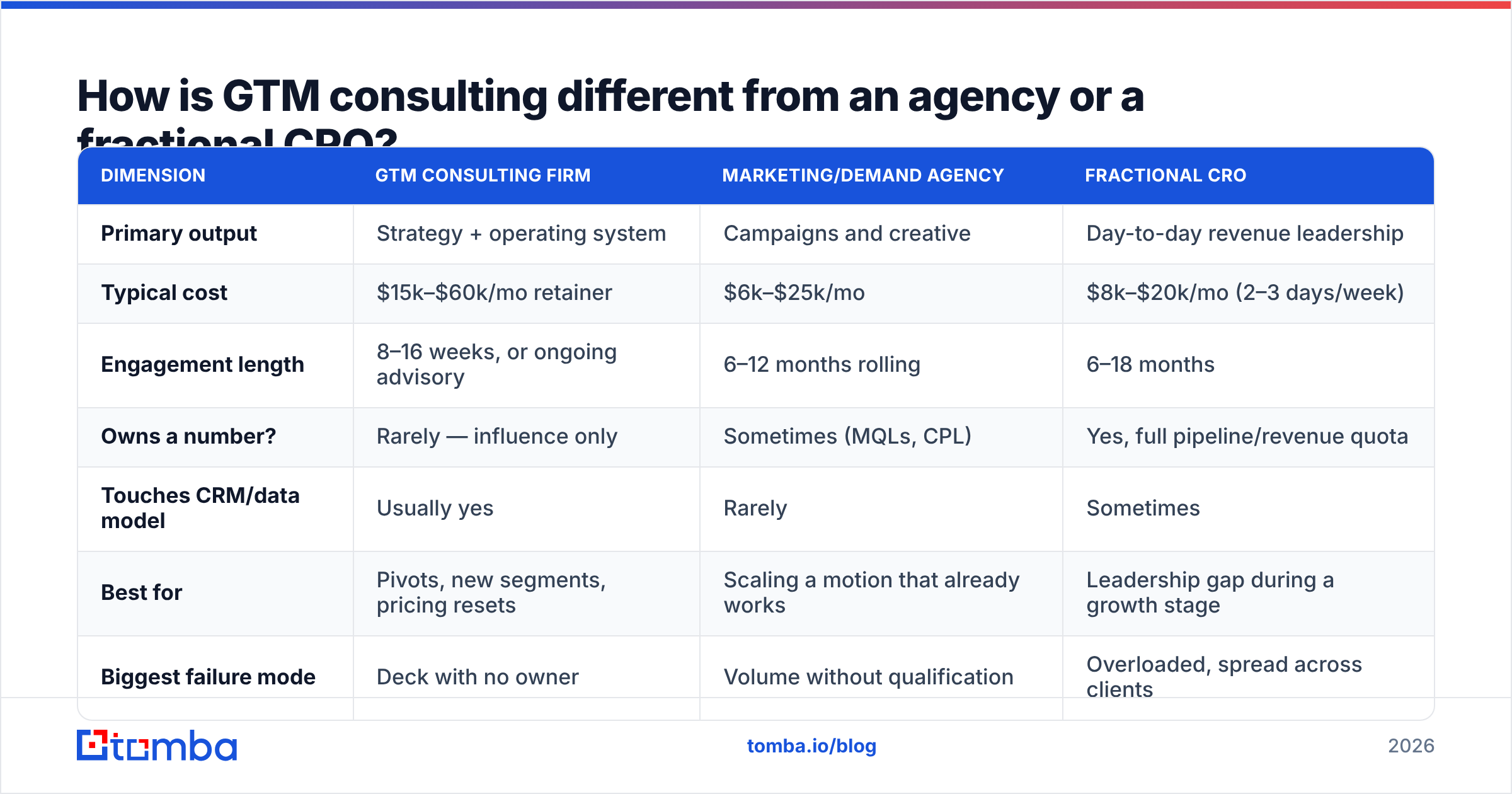
The three get conflated constantly, and the confusion costs money. An agency executes a channel. A fractional CRO carries a number. A GTM consultant designs the system and hands it off.
| Dimension | GTM consulting firm | Marketing/demand agency | Fractional CRO |
|---|---|---|---|
| Primary output | Strategy + operating system | Campaigns and creative | Day-to-day revenue leadership |
| Typical cost | $15k–$60k/mo retainer | $6k–$25k/mo | $8k–$20k/mo (2–3 days/week) |
| Engagement length | 8–16 weeks, or ongoing advisory | 6–12 months rolling | 6–18 months |
| Owns a number? | Rarely — influence only | Sometimes (MQLs, CPL) | Yes, full pipeline/revenue quota |
| Touches CRM/data model | Usually yes | Rarely | Sometimes |
| Best for | Pivots, new segments, pricing resets | Scaling a motion that already works | Leadership gap during a growth stage |
| Biggest failure mode | Deck with no owner | Volume without qualification | Overloaded, spread across clients |
| Ramp time | 2–4 weeks | 3–6 weeks | 4–8 weeks |
The practical rule: if you know what to do and need hands, hire an agency. If you know what to do and need someone accountable, hire fractional leadership. If you genuinely do not know what motion to run, that is when GTM consulting earns its fee.
What does GTM consulting actually cost in 2026?#
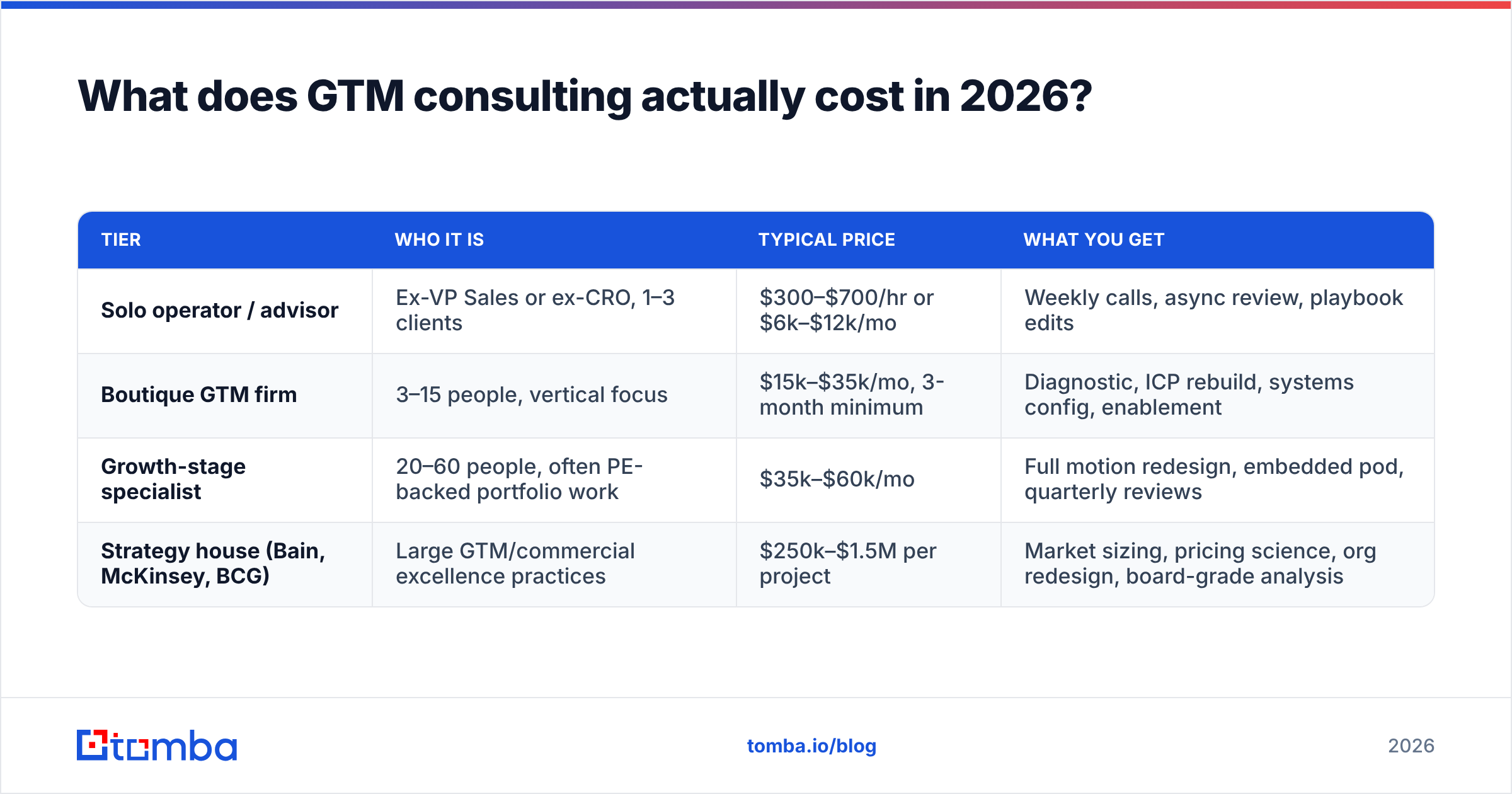
Pricing has stratified into four bands, and the gap between them is mostly brand, not outcome.
| Tier | Who it is | Typical price | What you get |
|---|---|---|---|
| Solo operator / advisor | Ex-VP Sales or ex-CRO, 1–3 clients | $300–$700/hr or $6k–$12k/mo | Weekly calls, async review, playbook edits |
| Boutique GTM firm | 3–15 people, vertical focus | $15k–$35k/mo, 3-month minimum | Diagnostic, ICP rebuild, systems config, enablement |
| Growth-stage specialist | 20–60 people, often PE-backed portfolio work | $35k–$60k/mo | Full motion redesign, embedded pod, quarterly reviews |
| Strategy house (Bain, McKinsey, BCG) | Large GTM/commercial excellence practices | $250k–$1.5M per project | Market sizing, pricing science, org redesign, board-grade analysis |
Two costs buyers routinely underestimate. First, internal time: a serious engagement eats 6–10 hours per week from your VP Sales, marketing lead, and RevOps person. Second, tooling. A consultant who redesigns your outbound motion will hand you a stack recommendation, and that stack is a separate line item — data provider, sequencer, enrichment, call recording. Budget another $1k–$6k/month depending on team size.
According to buyer reviews aggregated on G2, the most common complaint about consulting engagements across categories is not price — it is that deliverables did not translate into operational change. Price the risk, not just the invoice.
When is GTM consulting worth it?#
Worth it when the problem is genuinely a decision problem, not an execution problem. Four situations where the ROI case is strong:
- Post-pivot ICP reset. You changed the product or moved upmarket and your old segmentation no longer predicts anything. An outside operator who has done this in your category compresses six months of guessing into eight weeks.
- Pricing and packaging change. This is the highest-leverage single lever in B2B, and it is genuinely hard to do internally because every stakeholder has a bias. Gartner research on commercial models consistently ranks pricing above headcount as a margin driver.
- A motion you have never run. If you are PLG and about to build an enterprise sales team, you do not have the muscle memory. Buying it for two quarters is cheaper than two bad VP hires.
- Pre-transaction cleanup. Due diligence exposes messy pipeline math. A consultant who can rebuild your funnel model to board standard pays for itself in valuation terms.
And four situations where it is a waste:
- Your pipeline problem is a data problem. If reps spend a third of their week hunting contact details and half your sends bounce, no strategy deck helps. Fix the data layer first with an email verifier and a real enrichment routine.
- You have not run the current playbook long enough to have evidence. Six weeks of outbound is not a test.
- Nobody internally will own the output. If there is no RevOps person or empowered sales lead to implement, the deliverable dies on arrival.
- You are under $1M ARR. At that stage the founder should be doing the discovery calls. There is no system to redesign yet.
What should you demand in the statement of work?#
The difference between a good and bad engagement is almost entirely in the SOW. Push for these specifics before signing:
- Named individuals, not "the team." Boutique firms sell you the founder and staff you with an analyst. Write the names and time allocation into the contract.
- Built artifacts, not recommendations. "Configure lifecycle stages in HubSpot" beats "recommend lifecycle stage framework." Ask for a deliverable list where at least half the items are things that exist in a system afterward.
- A baseline measurement in week one. Current conversion by stage, current response rate, current cycle length, current CAC payback. Without a baseline nobody can claim credit or fault later.
- A knowledge-transfer block. The last two weeks should be documentation and training for whoever inherits this, with recorded sessions.
- A kill clause at 30 days. Any confident firm will accept a short out. Refusal is a signal.
Can you do GTM strategy in-house instead?#
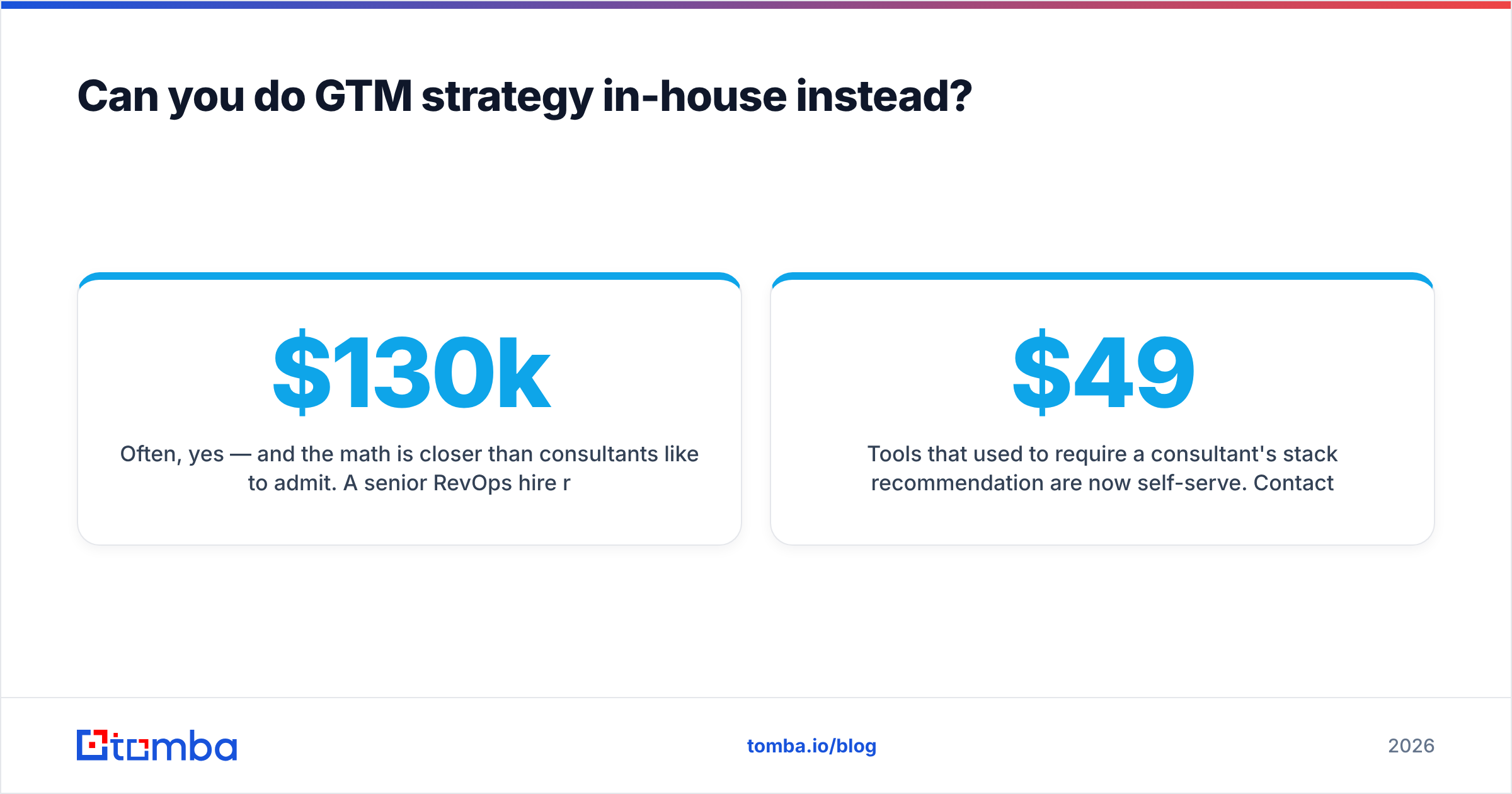
Often, yes — and the math is closer than consultants like to admit. A senior RevOps hire runs $130k–$180k fully loaded in the US, which is roughly what three months of a mid-tier retainer costs. The difference is that the hire compounds and the retainer does not.
The in-house path works when you already have a functioning motion and need it tuned rather than reinvented. The realistic sequence:
- Define the ICP with evidence, not opinion. Pull your closed-won accounts, find the shared attributes, and stop guessing. Data enrichment on your existing CRM records makes this a one-afternoon exercise rather than a quarter-long project.
- Rebuild the target list against that ICP. Use domain search to map contacts at every account in the segment, then verify before anything goes out.
- Instrument the funnel properly. Stage definitions, exit criteria, and a single source of truth. Most companies discover their conversion problem is a definitions problem.
- Run one channel hard for a full quarter. Enough volume to reach statistical relevance, one variable changed at a time.
- Write the playbook as you go. The document that a consultant would have sold you is mostly a record of decisions you already made.
Tools that used to require a consultant's stack recommendation are now self-serve. Contact discovery, verification, and enrichment — the plumbing that determines whether any GTM strategy survives contact with reality — cost less than a single consulting day. Tomba's Tomba pricing starts free at 25 searches per month, with Starter at $49/mo, Growth at $99/mo, and Pro at $249/mo. Compare that to a $35k retainer and the sequencing becomes obvious: fix the plumbing, then decide whether you still have a strategy problem.
How do you measure whether the engagement worked?#
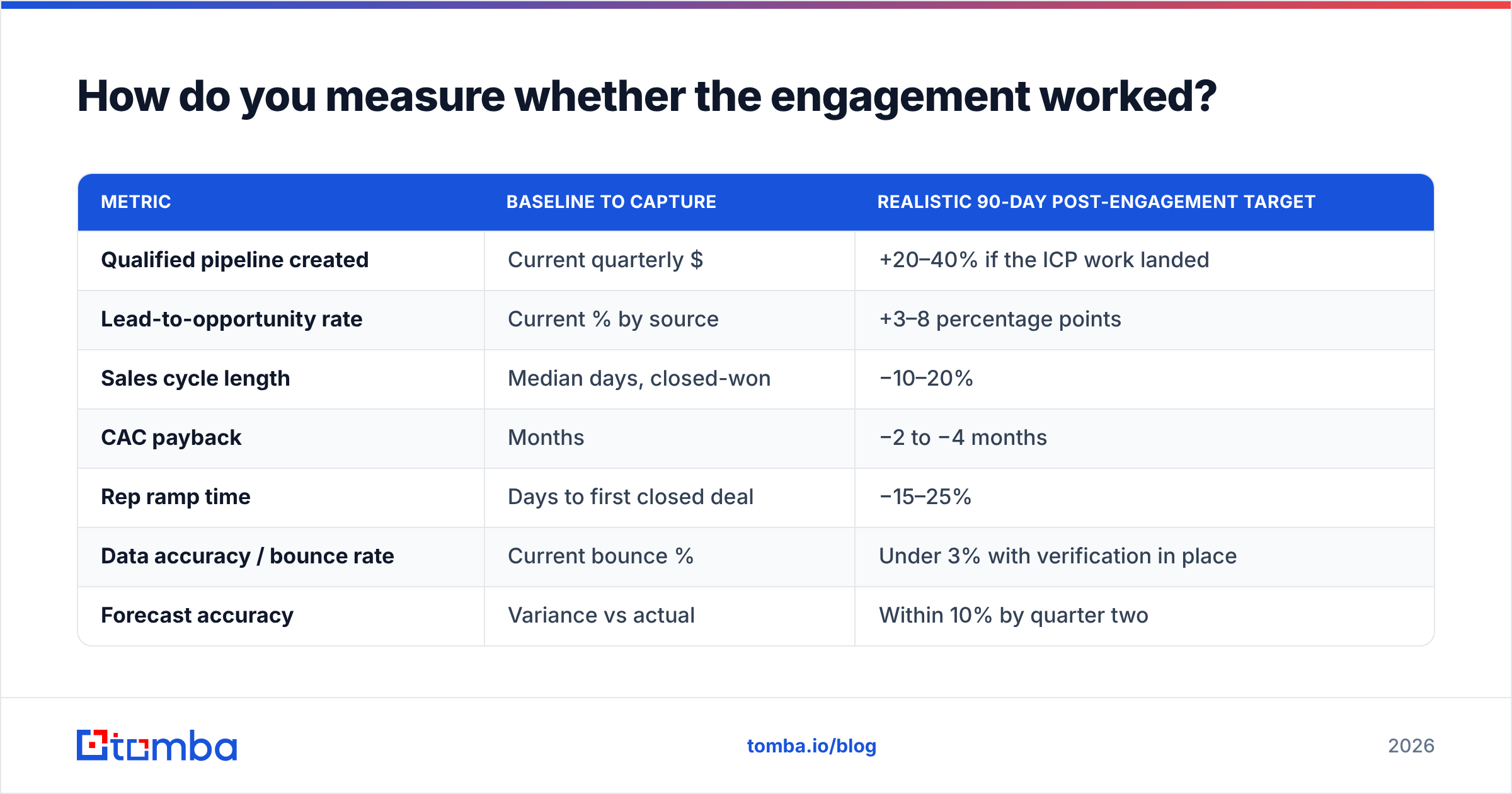
Set these before kickoff, review them 90 days after the engagement ends — not on the last day, when everything still looks good on a slide.
| Metric | Baseline to capture | Realistic 90-day post-engagement target |
|---|---|---|
| Qualified pipeline created | Current quarterly $ | +20–40% if the ICP work landed |
| Lead-to-opportunity rate | Current % by source | +3–8 percentage points |
| Sales cycle length | Median days, closed-won | −10–20% |
| CAC payback | Months | −2 to −4 months |
| Rep ramp time | Days to first closed deal | −15–25% |
| Data accuracy / bounce rate | Current bounce % | Under 3% with verification in place |
| Forecast accuracy | Variance vs actual | Within 10% by quarter two |
If your consultant resists baselining any of these, that tells you what the engagement will be worth.
What are the common failure patterns?#
Four recur often enough to name:
The strategy deck with no owner. Sixty slides, genuinely good analysis, delivered to a team with no capacity to implement. Prevention: name an internal owner in the SOW and give them 20% of their time back.
The tool-stack land grab. Some firms have referral relationships with vendors. Ask directly whether they receive any compensation for tools they recommend, and get the answer in writing.
Over-narrowing the ICP. A consultant tightens your target market to prove focus, the TAM collapses below what your quota needs, and you spend the next two quarters quietly loosening it back. Sanity-check that the redefined segment contains enough accounts to hit next year's number before you commit.
The pilot that never scales. A three-account pilot works because the consultant personally ran it. Nothing about it survives handoff to five SDRs. Insist any pilot is run by your team with the consultant observing, not the reverse.
Which questions should you ask on the sales call?#
Bring these and read the room:
- Show me a client where the engagement failed and tell me why.
- Who specifically will be on this account, and what percentage of their week?
- What does the deliverable list look like — how many are documents versus configured systems?
- What do you need from us, in hours per week, by role?
- What happens in month four when you leave?
- Do you take any vendor compensation for stack recommendations?
Vague answers to the third and sixth questions are the strongest predictors of a disappointing engagement.
The bottom line on GTM consulting#
GTM consulting is a real category that solves real problems, and it is also oversold to companies whose actual constraint is operational. The diagnostic question is simple: if a brilliant strategist handed you the perfect plan tomorrow morning, could your team execute it? If the honest answer is no — because the CRM is a mess, the contact data is stale, and nobody has verified an email list in a year — then the plan is not what you are missing.
Start by making your existing motion work on clean inputs. Build a targeted account list, find the right contacts, verify them before send, and enrich what you already have. The Tomba Email Finder gives you the contact layer any GTM plan depends on — free for the first 25 searches, $49/mo on Starter when you are ready to run volume. Get the plumbing right, run one motion properly for a quarter, and then decide whether you still need a $35k retainer. Most teams find the question answers itself.
Related guides#
Ready to find emails that actually work?
Join 150,000+ professionals who stopped guessing and started sending. Free credits on signup — no credit card required.
Get the Tomba newsletter
Practical outbound tactics and product updates — once every two weeks.
About the author