GTM Marketing in 2026: The Complete Playbook for B2B Teams
GTM marketing stopped being a launch checklist and became an operating system for revenue. Here is how modern B2B teams structure segments, data, channels, and metrics — and where most of them quietly break.
TL;DR
- GTM marketing is the coordinated system — segment, message, channel, data, and metric — that gets a product in front of the right buyer profitably. It is not "marketing plus a launch date."
- Most B2B teams run one of four motions: sales-led, product-led, community-led, or partner-led. Picking two and running them badly is the most common failure mode.
- The bottleneck in 2026 is almost never creative. It is data quality: stale contacts, unverified emails, and a CRM nobody trusts.
- Measure pipeline coverage, CAC payback, and segment win rate. Ignore MQL volume as a headline number.
- Budget roughly 60% of GTM effort to the motions that already convert and 40% to structured experiments. Anything more experimental and forecasting collapses.
What is GTM marketing, exactly?#
GTM marketing is the set of decisions that connect a product to a specific buyer through a repeatable path. Think of it like plumbing a house rather than picking paint colors. Paint — the campaign, the launch video, the LinkedIn thread — is visible and fun. Plumbing is segments, ICP definitions, routing rules, and data hygiene. Houses fail because of plumbing.
A complete GTM motion answers five questions:
- Who exactly buys this? Not "mid-market SaaS" — company size band, tech stack, trigger event, and the specific title that signs.
- What problem do they already know they have? You cannot educate a market and close it in the same quarter with a $49/mo budget.
- Where do they encounter you? Search, peer referral, outbound, marketplace, partner, or community. Pick a primary; treat the rest as assists.
- What proof moves them? Case study, free tool, benchmark data, or a trial that reaches value in under 10 minutes.
- How do you know it worked? One primary metric per motion, reviewed on a fixed cadence, with a stated threshold for kill or scale.
The difference between "marketing" and "GTM marketing" is scope. Marketing owns demand. GTM owns demand plus how that demand is qualified, routed, priced, sold, expanded, and measured. That is why revenue operations and GTM are increasingly the same team in companies under 500 people.

Wait — that image reference should be the placeholder. Use this instead:

Which GTM motion should you actually run?#
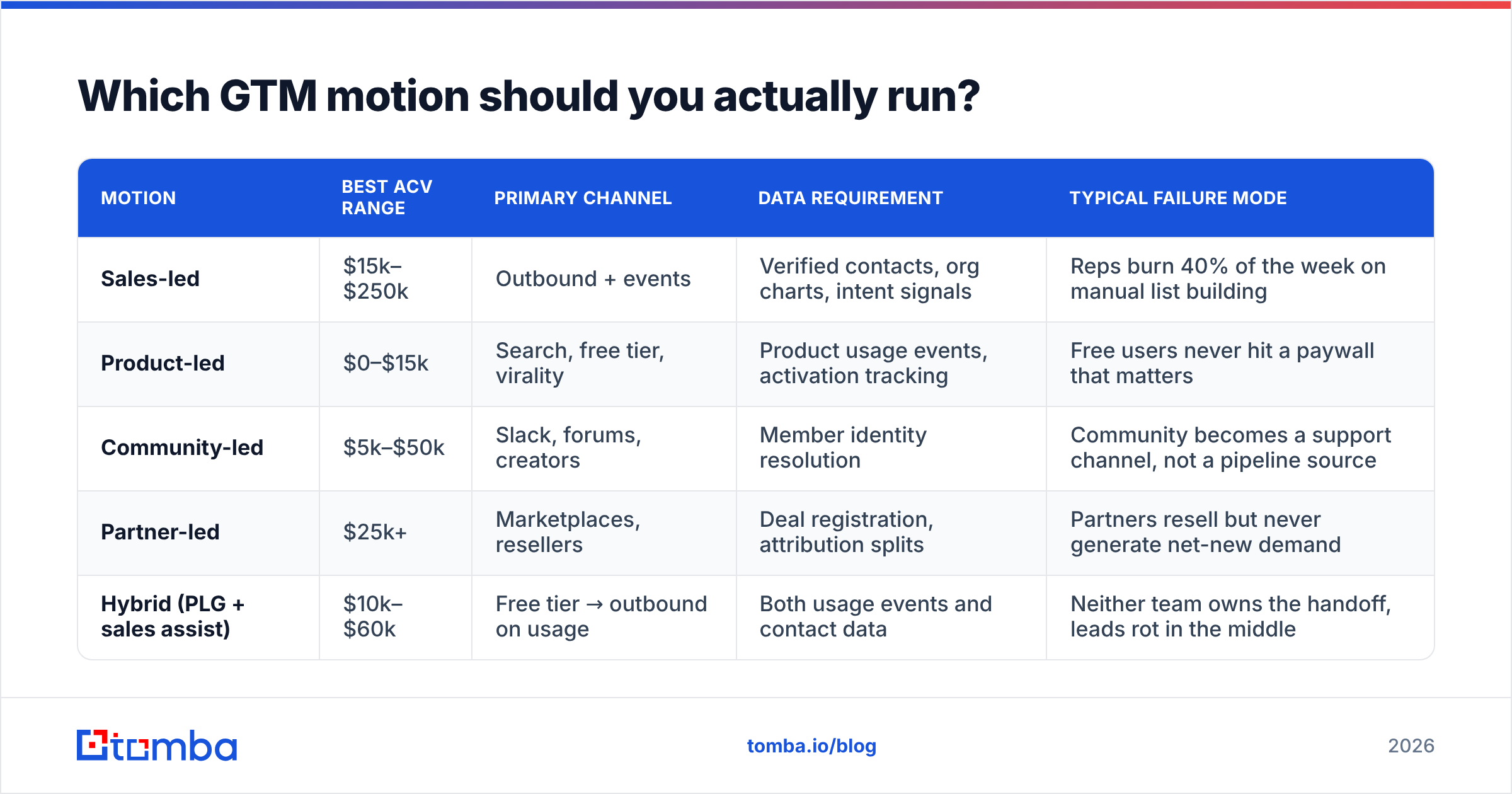
There are four durable motions. Each has a distinct cost structure, a distinct data requirement, and a distinct failure mode. Choose based on your average contract value (ACV) and how long your buyer takes to decide — not based on what worked at a company you admire.
| Motion | Best ACV range | Primary channel | Data requirement | Typical failure mode |
|---|---|---|---|---|
| Sales-led | $15k–$250k | Outbound + events | Verified contacts, org charts, intent signals | Reps burn 40% of the week on manual list building |
| Product-led | $0–$15k | Search, free tier, virality | Product usage events, activation tracking | Free users never hit a paywall that matters |
| Community-led | $5k–$50k | Slack, forums, creators | Member identity resolution | Community becomes a support channel, not a pipeline source |
| Partner-led | $25k+ | Marketplaces, resellers | Deal registration, attribution splits | Partners resell but never generate net-new demand |
| Hybrid (PLG + sales assist) | $10k–$60k | Free tier → outbound on usage | Both usage events and contact data | Neither team owns the handoff, leads rot in the middle |
The hybrid row is where most B2B companies land in 2026, and it is also where GTM programs quietly die. A user signs up with a personal Gmail, the account has no firmographic data attached, and the sales team never learns that four people from a 900-person company are all poking at your free tier. Fixing that is a data problem, not a strategy problem — you need contact enrichment that turns a signup into a company, a role, and a routing decision.
How do you pick between them in practice?#
Run this test. Take your last 20 closed-won deals and write down where the first touch came from. If more than 12 came from one channel, that is your primary motion — resource it properly before adding a second. If the 20 deals are spread evenly across six channels, you do not have a GTM motion. You have noise that occasionally converts.
What does a modern GTM team structure look like?#
Titles vary. The functions do not.
- GTM strategy / product marketing — owns segmentation, positioning, pricing input, and launch sequencing. This role writes the ICP document everyone else executes against.
- Demand generation — owns paid, SEO, and lifecycle. Measured on qualified pipeline, not lead count.
- Sales development — owns outbound sequences and inbound speed-to-lead. Measured on meetings held and their downstream conversion, not activity volume.
- Revenue operations — owns the CRM, routing, attribution model, and data contracts between systems. This is the most underhired role relative to its leverage.
- Customer marketing / lifecycle — owns expansion, references, and churn signals. In a net-revenue-retention world, this function often beats new-logo acquisition on ROI.
A 15-person GTM org that has all five functions covered will consistently outperform a 40-person org with three demand-gen managers and no RevOps. The constraint is coordination, not headcount. HubSpot's research on sales and marketing alignment has made this point for years and it keeps holding.
Why does GTM marketing fail? (It is usually the data)#
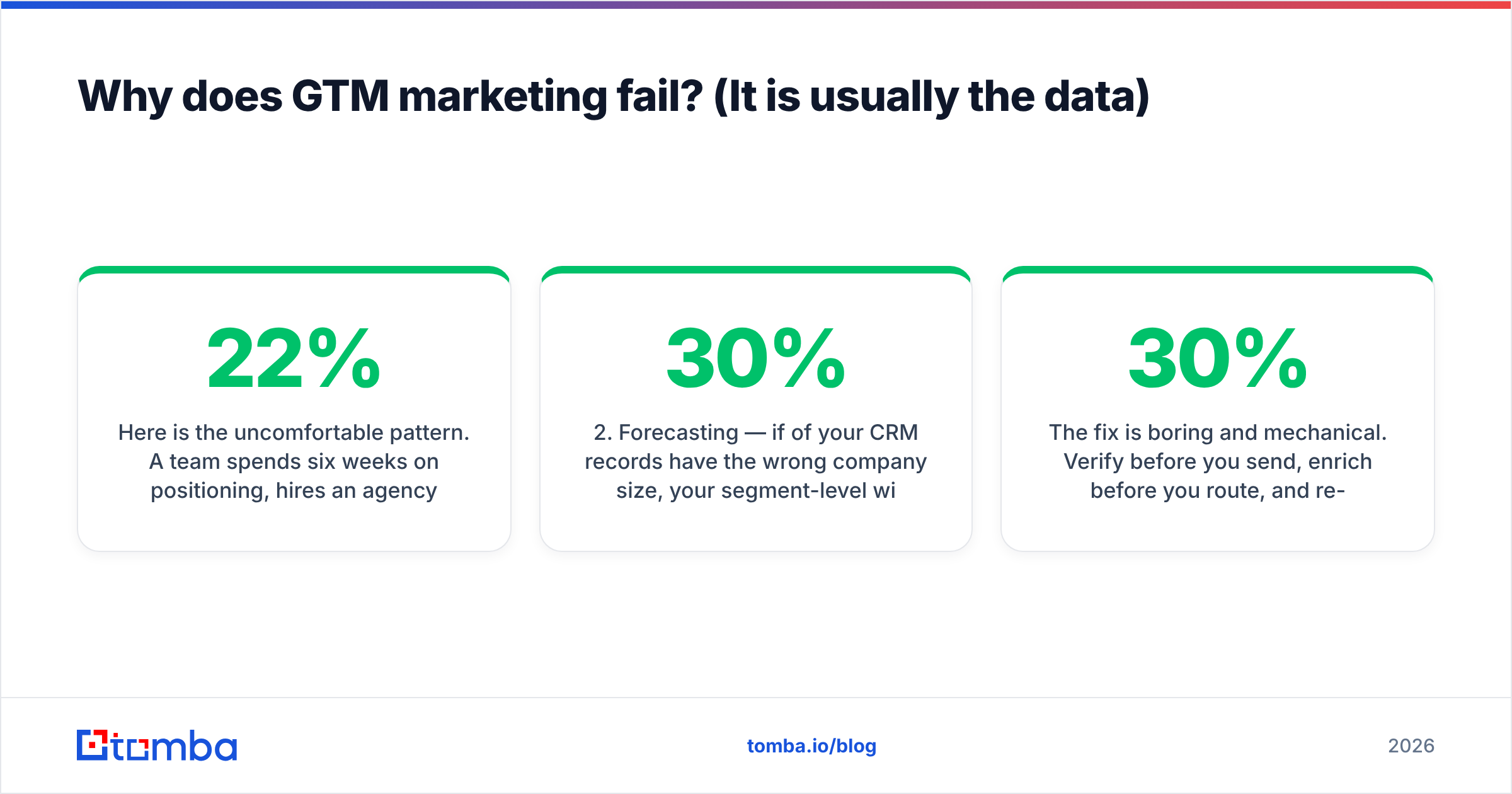
Here is the uncomfortable pattern. A team spends six weeks on positioning, hires an agency, builds a beautiful campaign, and then executes it against a contact list where 22% of the email addresses bounce and 30% of job titles are two years out of date.
Bad data compounds in four places:
- Deliverability — high bounce rates damage your sender reputation, which means even your good contacts stop seeing your email. One bad send can cost you a quarter of recovery.
- Forecasting — if 30% of your CRM records have the wrong company size, your segment-level win rates are fiction and so is your plan.
- Rep time — SDRs who cannot trust a list rebuild it manually. That is the single largest hidden cost in most sales-led motions.
- Attribution — duplicate and malformed records break the join between marketing touch and closed revenue, so you cannot tell which motion to fund.
The fix is boring and mechanical. Verify before you send, enrich before you route, and re-verify on a schedule because roughly 25–30% of B2B contact data decays annually as people change jobs. Running your list through an email verifier before a campaign takes minutes and protects the asset — your domain reputation — that everything else depends on.

What data actually needs to be in a GTM record?#
At minimum, per contact: verified work email, current title, seniority band, department, company domain, employee count, and the source that produced the record. Per account: industry, tech stack signals, funding stage, and existing relationship history. Anything beyond that is nice-to-have until you have proven the basics stay accurate.
Teams that build their own lists via domain search tend to hold accuracy better than teams buying static exports, because the record is generated at the moment of use rather than at the moment of purchase. Curated database providers like BookYourData occupy a useful middle ground — pre-built, human-verified lists that suit teams who want coverage in a specific geography or vertical without building the sourcing workflow themselves. The two approaches complement each other more than they compete: buy for breadth, generate for precision.
Which GTM metrics matter in 2026?#
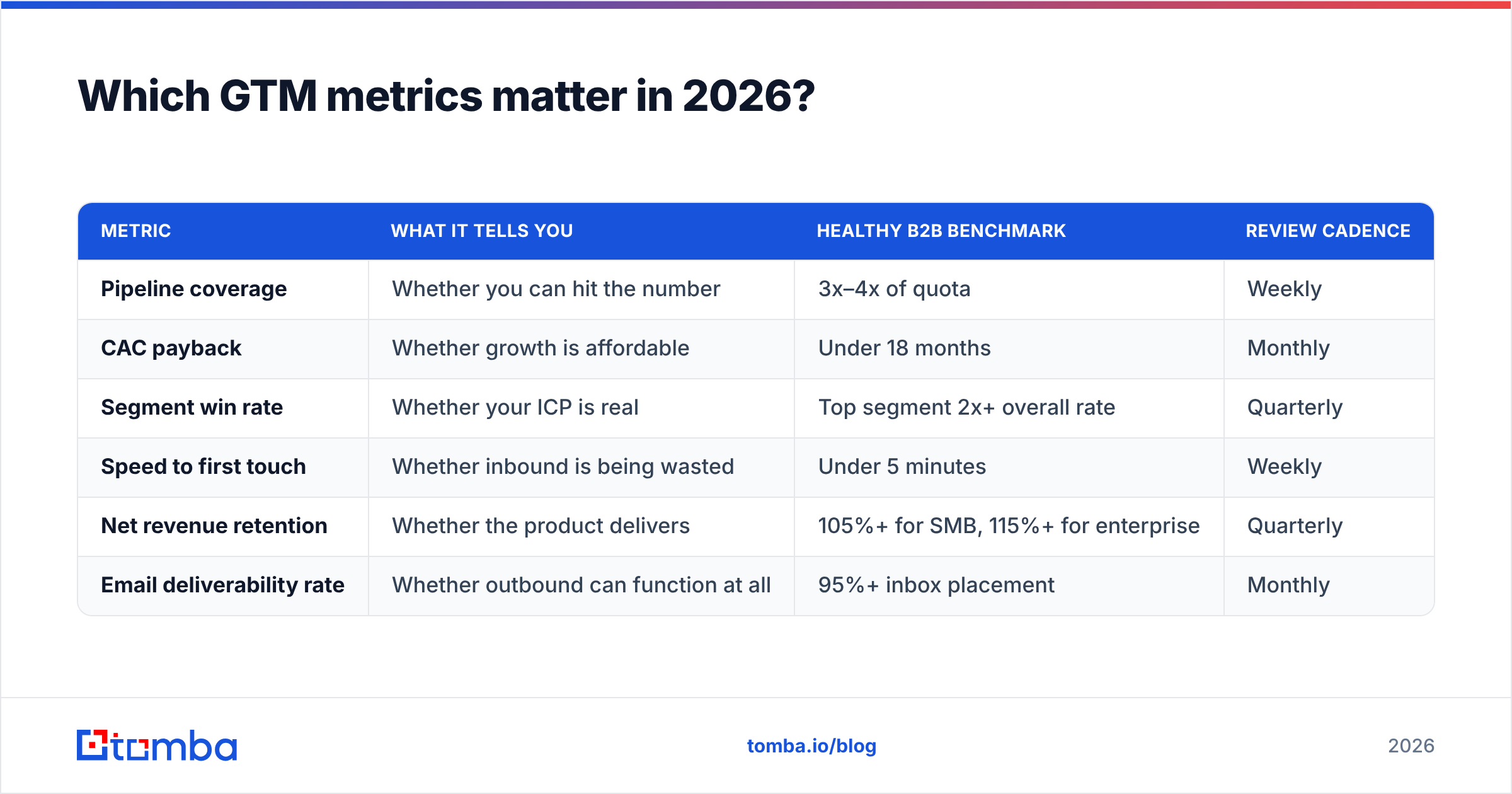
Stop reporting MQLs at the board level. They correlate weakly with revenue and they are trivially gameable. Report these instead.
| Metric | What it tells you | Healthy B2B benchmark | Review cadence |
|---|---|---|---|
| Pipeline coverage | Whether you can hit the number | 3x–4x of quota | Weekly |
| CAC payback | Whether growth is affordable | Under 18 months | Monthly |
| Segment win rate | Whether your ICP is real | Top segment 2x+ overall rate | Quarterly |
| Speed to first touch | Whether inbound is being wasted | Under 5 minutes | Weekly |
| Net revenue retention | Whether the product delivers | 105%+ for SMB, 115%+ for enterprise | Quarterly |
| Email deliverability rate | Whether outbound can function at all | 95%+ inbox placement | Monthly |
Each metric maps to an owner. Pipeline coverage belongs to the CRO. CAC payback belongs to finance and GTM jointly. Deliverability belongs to RevOps, and it is the one most often orphaned — nobody owns it until the day outbound reply rates fall 60% and everyone blames the copy.
For deeper benchmark context, G2's category reports and Gartner's B2B buying research are the two most-cited neutral sources. Use them to sanity-check your numbers, not to set targets — your segment's economics will differ.
How do you build a GTM plan in 30 days?#
A workable sequence that does not require a consulting engagement:
Week 1 — Define the segment. Pull your closed-won list. Cluster by industry, size, and use case. Find the cluster with the highest win rate and shortest cycle. That is your beachhead. Write a one-page ICP with explicit exclusion criteria — who you will not sell to matters as much as who you will.
Week 2 — Build the target list. Translate the ICP into a list of named accounts. For each, identify the two or three titles that matter. Source and verify contact data. If you are doing this manually across hundreds of accounts, use a bulk email finder rather than burning SDR weeks on it. Kill any record you cannot verify — an unverified contact is a liability, not an asset.
Week 3 — Build the message and the offer. One core message per segment, three proof points, one specific offer. The offer is where most plans get vague. "Book a demo" is not an offer. "A 20-minute teardown of your current data coverage against your ICP" is an offer.
Week 4 — Instrument and launch. Set up tracking before the first send, not after. Define what "working" means numerically. Launch to 20% of the list, read the results, then scale or revise. Do not launch to the full list on day one — you lose the ability to learn anything.
Then run it for a full sales cycle before judging it. The single most common GTM error is killing a motion at week six when the average cycle is 90 days.
Is GTM marketing different for AI-native products?#
Somewhat, and less than the discourse suggests. Three real differences:
- Time to value is the whole pitch. AI products get evaluated in minutes. If a prospect cannot see output quality in the first session, positioning does not save you.
- Buyer skepticism is higher. Every category now has vendors overclaiming. Specific, verifiable benchmarks beat adjectives. Show the number, show the methodology.
- The buying committee grew. Security and legal now review AI purchases that would previously have gone on a corporate card. Build the security page before you need it.
What does not change: you still need a defined segment, clean data to reach them, and a metric that tells you whether it worked. The fundamentals of sales automation apply the same way they did before — automation amplifies a working motion and accelerates a broken one into a wall.
What should you do first?#
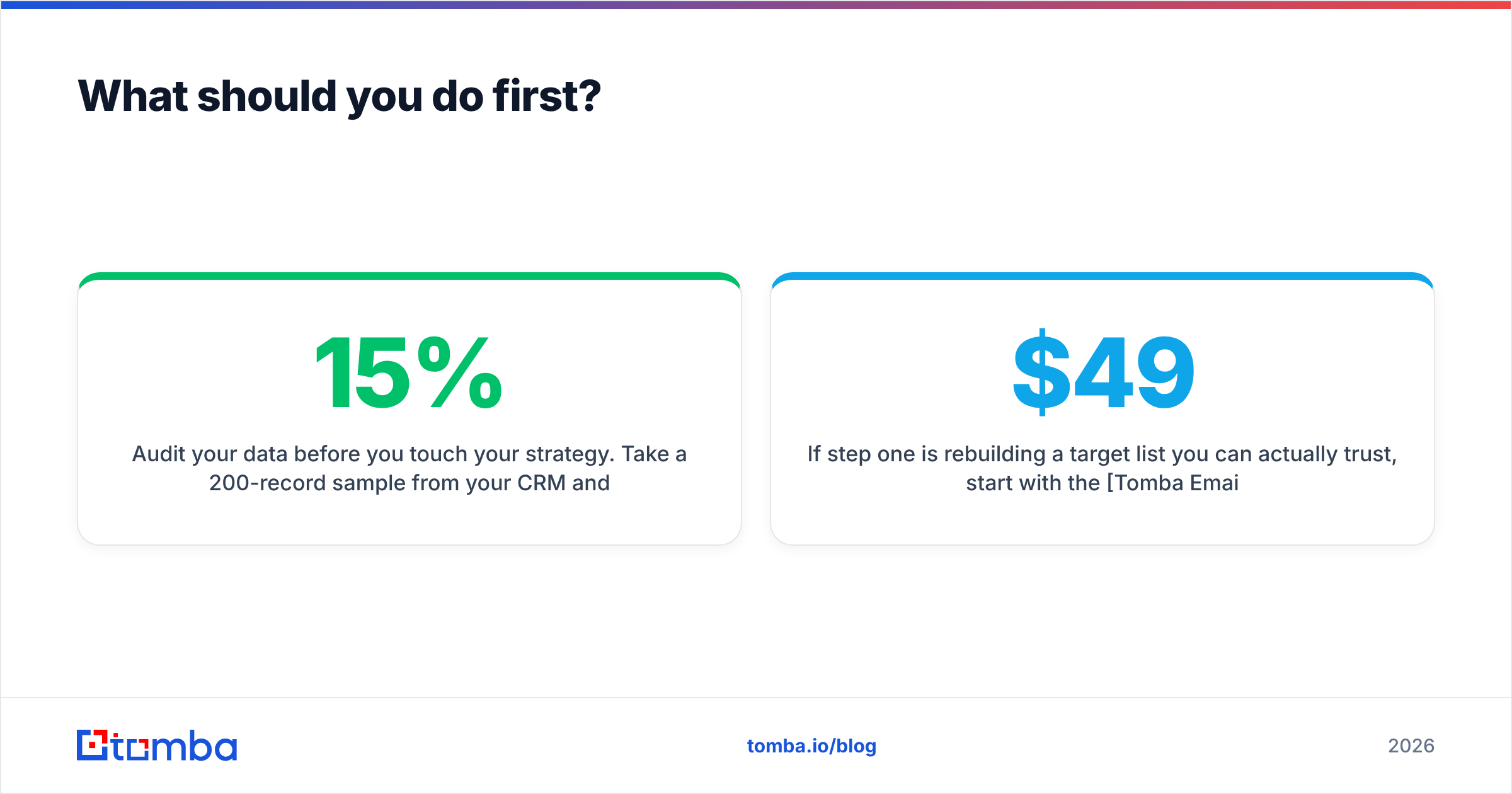
Audit your data before you touch your strategy. Take a 200-record sample from your CRM and check: how many emails are still valid, how many titles are current, how many accounts have a correct employee count. If more than 15% fail, your GTM problem is upstream of anything a new campaign will fix.
Once the data is trustworthy, the rest of the playbook becomes testable. Segments produce real win rates. Channels produce real CAC numbers. Forecasts stop being creative writing.
If step one is rebuilding a target list you can actually trust, start with the Tomba Email Finder. It finds verified professional email addresses by domain, name, or company, so your GTM plan runs on contacts that exist rather than contacts that used to. The free tier gives you 25 searches per month to test coverage against your ICP; Starter is $49/mo and Growth is $99/mo when you are ready to scale — full Tomba pricing is public, no sales call required to see it.
Related guides#
Ready to find emails that actually work?
Join 150,000+ professionals who stopped guessing and started sending. Free credits on signup — no credit card required.
Get the Tomba newsletter
Practical outbound tactics and product updates — once every two weeks.
About the author