GTM Meaning: What Go-To-Market Actually Means in B2B
GTM stands for go-to-market, but the acronym hides a whole system: ICP, positioning, channel, motion, and data. Here is what GTM actually means and how to tell a real strategy from a slide deck.
GTM meaning in one line: GTM stands for go-to-market. It is the plan for how one product reaches one buyer and turns into revenue. Everything below breaks that plan into parts you can act on this quarter.
TL;DR
- GTM means "go-to-market" — the complete plan for how a company gets a specific product in front of a specific buyer and converts them into revenue.
- It is not a synonym for marketing, sales, or a launch date. Marketing and sales are channels inside a GTM strategy, not the strategy itself.
- A real GTM strategy answers five questions: who buys, why they buy, what you say, where you reach them, and who owns the number.
- The four dominant GTM motions are sales-led, product-led, partner-led, and community-led. Most B2B companies run two at once and pretend they run one.
- GTM fails on data quality far more often than on strategy. A perfect ICP definition is worthless if your contact list is 40% bounced addresses.
GTM meaning: what does GTM stand for?#
GTM stands for go-to-market. It is the operating plan that links a product to a buyer. It sets the segment you sell to, the problem you claim to solve, the price, the channels that carry the message, and the team that owns each stage of the funnel.
The short definition people repeat in meetings — "GTM is how we sell it" — is technically true and practically useless. Selling is one output of a go-to-market strategy. The strategy itself is a set of decisions made before anyone sends an email or books a demo.
Here is a cleaner way to hold it. A go-to-market strategy is the business equivalent of a flight plan. The plane (your product) is already built. The flight plan decides the destination (segment), the route (channel), the fuel load (budget and headcount), and who is in the cockpit (ownership). You can have a beautiful aircraft and still fly it into an empty airport.
The term itself predates SaaS by decades — Wikipedia's entry on go to market traces it through consumer packaged goods and industrial distribution, where "route to market" meant literal shelves and literal trucks. B2B software inherited the phrase and stretched it to cover everything from pricing pages to SDR scripts.
What GTM is not#
- Not a launch. A launch is a moment. GTM is a system that keeps running after the Product Hunt post dies.
- Not a marketing plan. Marketing plans cover demand creation. GTM covers demand creation plus pricing, packaging, sales coverage, onboarding, and expansion.
- Not a deck. If your GTM lives entirely in a slide file that nobody has opened since the board meeting, you have a narrative, not a strategy.
- Not the same as GTM-in-crypto or GTM-in-manufacturing. The acronym occasionally collides with other jargon, but in B2B software it always means go-to-market.
What are the five components of a go-to-market strategy?#
Every credible GTM plan — whether it is three pages or three hundred — resolves the same five components. The GTM meaning becomes concrete in these five decisions. Use them as a completeness check on whatever you have written down today.
- Ideal customer profile (ICP). The firmographic and behavioural definition of who you sell to: company size, industry, tech stack, region, trigger events. Not a persona name. A filterable, buildable list definition.
- Value proposition and positioning. What problem you solve, for whom, versus what alternative. Positioning is comparative by nature — if your message works equally well for every competitor's product, you have not positioned anything.
- Pricing and packaging. Tier structure, entry price, expansion levers, free tier or trial. Packaging decisions constrain which segment you can realistically win.
- Channel and motion. How the product actually reaches the buyer: outbound sequences, self-serve signup, resellers, marketplaces, communities, events.
- Ownership and metrics. Who owns pipeline, who owns conversion, who owns retention, and which numbers each of them is judged on. This is where revenue operations lives.
Miss any one of these and the plan leaks. Miss ownership specifically and you get the most common B2B failure mode: everyone agrees on the strategy and nobody is accountable for a number inside it.
How is GTM different from sales and marketing?#
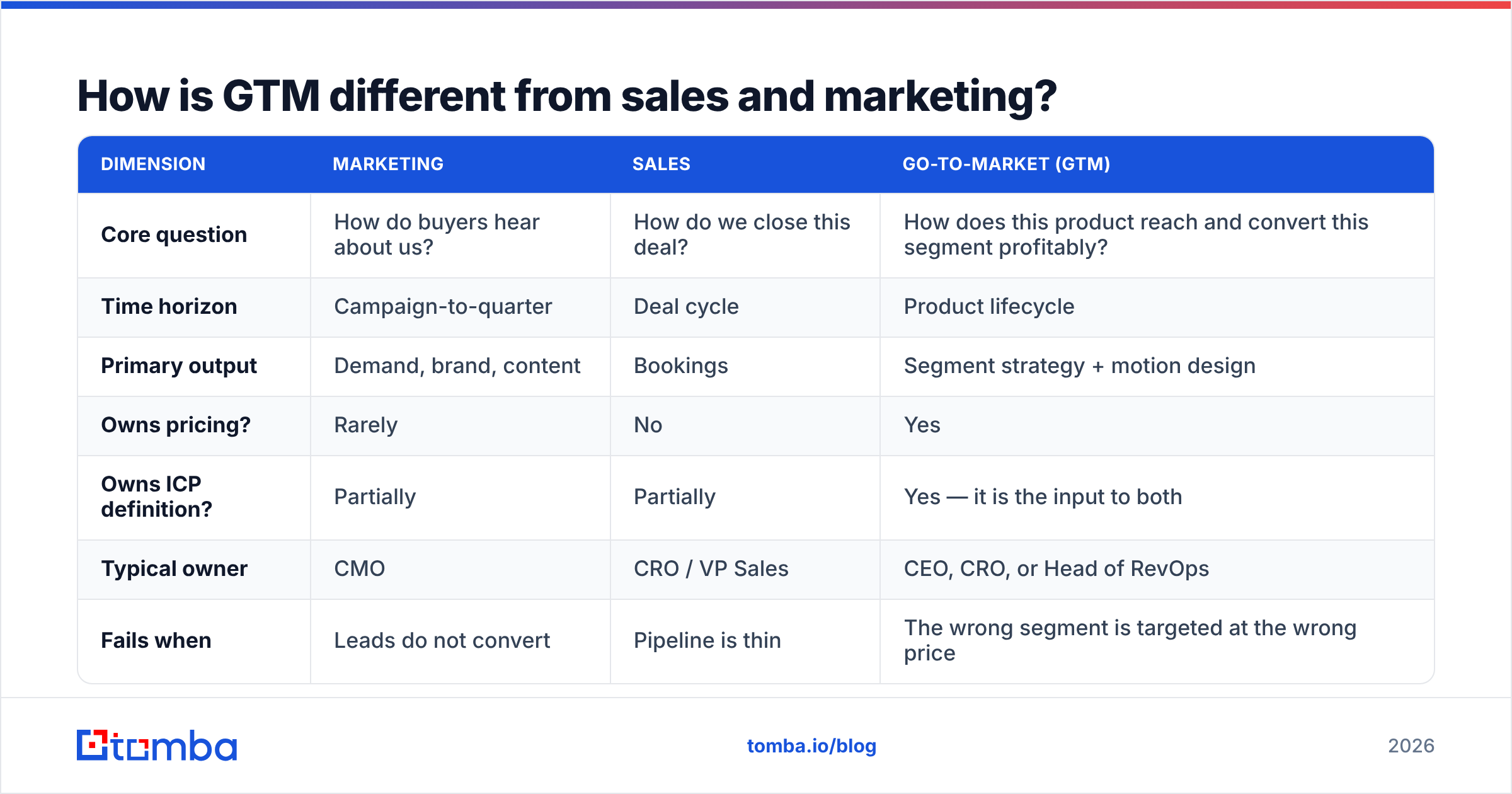
This is the question that generates the most confused meetings, so it deserves a direct answer: sales and marketing are functions; GTM is the coordination layer above them. That is the GTM meaning most decks miss.
| Dimension | Marketing | Sales | Go-to-market (GTM) |
|---|---|---|---|
| Core question | How do buyers hear about us? | How do we close this deal? | How does this product reach and convert this segment profitably? |
| Time horizon | Campaign-to-quarter | Deal cycle | Product lifecycle |
| Primary output | Demand, brand, content | Bookings | Segment strategy + motion design |
| Owns pricing? | Rarely | No | Yes |
| Owns ICP definition? | Partially | Partially | Yes — it is the input to both |
| Typical owner | CMO | CRO / VP Sales | CEO, CRO, or Head of RevOps |
| Fails when | Leads do not convert | Pipeline is thin | The wrong segment is targeted at the wrong price |
The practical test: if your marketing team and your sales team disagree about what a qualified lead is, the problem is almost never in either function. It is a missing GTM decision. A shared, written definition of a marketing qualified lead is a GTM artifact, not a marketing one.
What are the main GTM motions?#
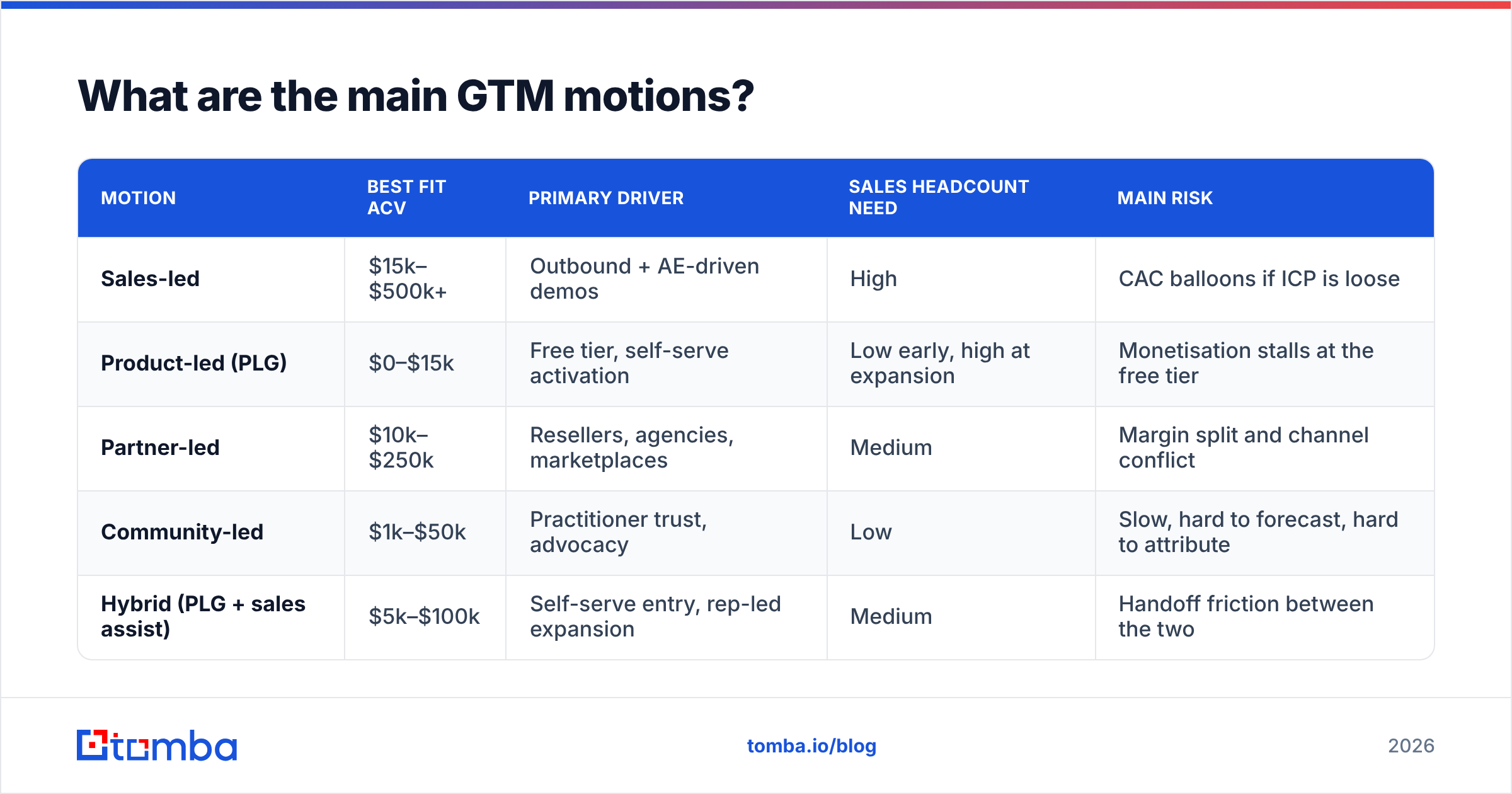
A motion is the repeatable path from stranger to customer. Most companies inherit one by accident and only later discover it does not match their price point. Gartner's sales research has documented the same drift for years: buyers self-educate long before they talk to a rep, which pushes companies toward hybrid motions whether they planned for it or not.
| Motion | Best fit ACV | Primary driver | Sales headcount need | Main risk |
|---|---|---|---|---|
| Sales-led | $15k–$500k+ | Outbound + AE-driven demos | High | CAC balloons if ICP is loose |
| Product-led (PLG) | $0–$15k | Free tier, self-serve activation | Low early, high at expansion | Monetisation stalls at the free tier |
| Partner-led | $10k–$250k | Resellers, agencies, marketplaces | Medium | Margin split and channel conflict |
| Community-led | $1k–$50k | Practitioner trust, advocacy | Low | Slow, hard to forecast, hard to attribute |
| Hybrid (PLG + sales assist) | $5k–$100k | Self-serve entry, rep-led expansion | Medium | Handoff friction between the two |
Three practical notes on choosing:
- Price sets the motion, not the other way round. You cannot run a $200-a-year product through a team of quota-carrying AEs. The math never closes.
- Hybrid is the default now, not the exception. Most B2B tools let a user sign up free and then apply sales pressure at a usage threshold.
- Switching motions is a re-founding event. Moving from PLG to enterprise sales means new pricing, new hiring, new metrics, and usually a new leadership layer. Budget a year, not a quarter.
Why do GTM strategies fail?#
Because the strategy was fine and the execution data was garbage. That is the honest answer from most post-mortems.
The failure sequence is predictable:
- The ICP is written but not buildable. "Mid-market fintech with a compliance pain" is a sentence, not a list. If nobody can turn it into 2,000 named accounts with named contacts, it is decoration.
- The contact data rots faster than the plan updates. B2B contact records decay meaningfully every year through job changes, restructures, and domain migrations. A list built in January is materially wrong by June.
- Deliverability collapses before the message is ever tested. Send to a list full of invalid addresses and your bounce rate spikes, your domain reputation drops, and your carefully written sequence lands in spam. You then conclude the message failed.
- Attribution arguments replace decisions. Two teams spend a quarter arguing whether the demo came from paid or content while the pipeline number stays flat.
- Nobody kills anything. GTM strategies fail slowly because dead channels are never formally shut down; they just quietly consume budget.
The unglamorous fix is upstream. Before you rewrite positioning for the third time, verify that the list you have been sending to is real. Running an email verifier pass over an existing database routinely surfaces 15–30% invalid or risky addresses on lists older than a year. Those invalid sends were quietly taxing every metric you used to judge the strategy.
What does a GTM team look like in 2026?#
Team shape follows motion. But a few structural patterns have stabilised across B2B software.
The four seats that show up in almost every functioning GTM org:
- GTM lead / CRO. Owns the segment bet and the revenue number. Makes the pricing call. Arbitrates when marketing and sales disagree about qualification.
- RevOps. Owns the data model, the CRM hygiene, the routing rules, and the reporting everyone argues over. In small companies this is one person and a lot of spreadsheets.
- Demand / growth. Owns the top of funnel across paid, content, lifecycle, and product-led signup flows.
- Pipeline generation (SDR/BDR or automated equivalent). Owns the outbound motion and the account research that makes it non-generic.
What has changed recently is the collapse of the research layer. Account research that used to take an SDR twenty minutes per prospect — find the company, find the right title, find a verified email, check the tech stack — is now an API call. Teams that used to hire five SDRs to hit a coverage target now hire two and buy data enrichment to fill the rest. That is not a headcount story. It is a GTM design change, because it moves the constraint from "how many people can research" to "how well is our ICP defined."
HubSpot's ongoing sales and GTM research tracks the same shift: reps spend a shrinking share of their week on manual data gathering and a growing share on multi-threaded conversations inside accounts.
How do you build a GTM plan in 30 days?#
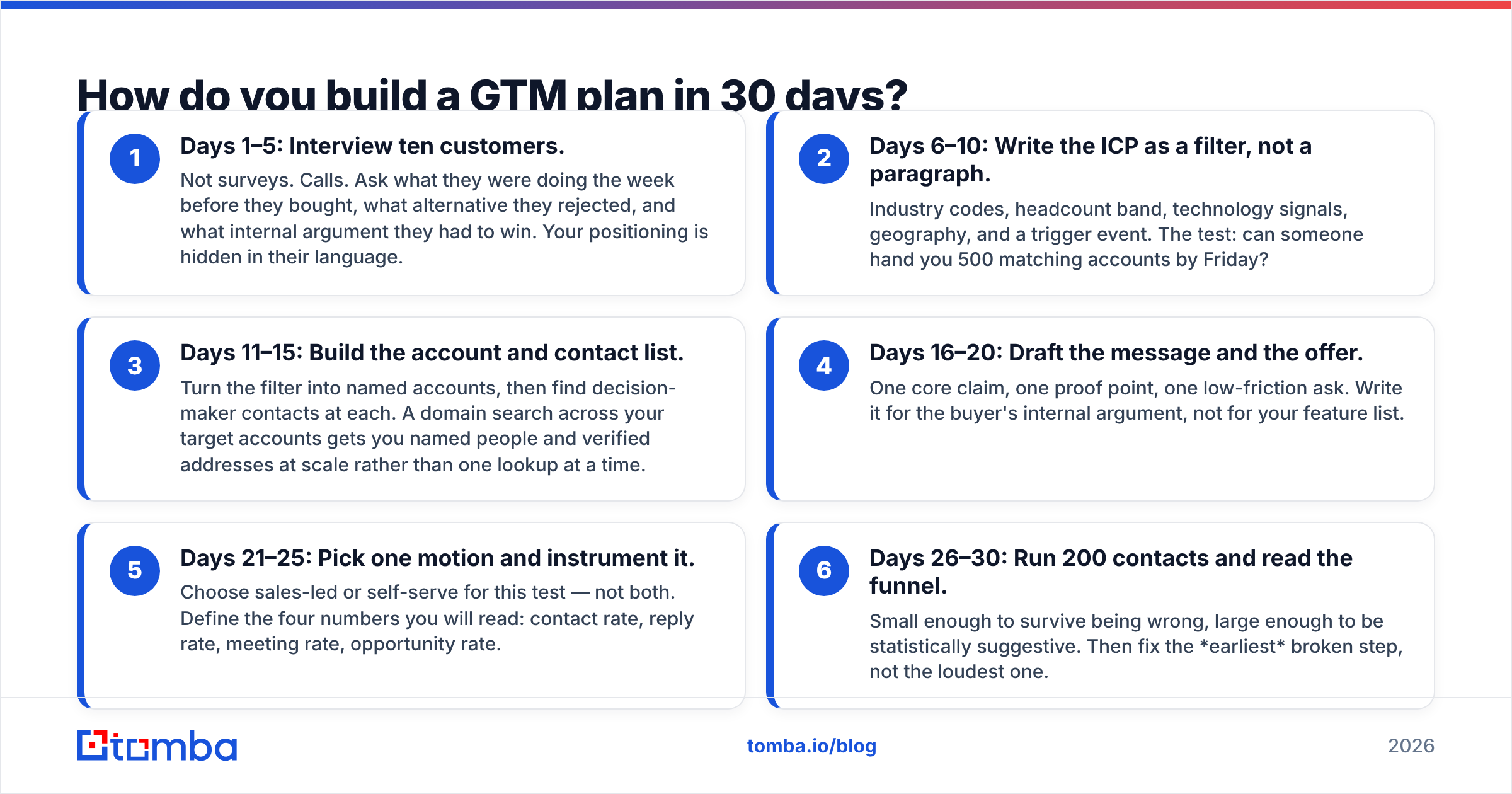
You cannot build a perfect one. You can build a testable one. Here is a sequence that works for a single product and a single segment.
- Days 1–5: Interview ten customers. Not surveys. Calls. Ask what they were doing the week before they bought, what alternative they rejected, and what internal argument they had to win. Your positioning is hidden in their language.
- Days 6–10: Write the ICP as a filter, not a paragraph. Industry codes, headcount band, technology signals, geography, and a trigger event. The test: can someone hand you 500 matching accounts by Friday?
- Days 11–15: Build the account and contact list. Turn the filter into named accounts, then find decision-maker contacts at each. A domain search across your target accounts gets you named people and verified addresses at scale rather than one lookup at a time.
The first three weeks buy you a segment, a filter, and a list. The last two turn that list into evidence.
- Days 16–20: Draft the message and the offer. One core claim, one proof point, one low-friction ask. Write it for the buyer's internal argument, not for your feature list.
- Days 21–25: Pick one motion and instrument it. Choose sales-led or self-serve for this test — not both. Define the four numbers you will read: contact rate, reply rate, meeting rate, opportunity rate.
- Days 26–30: Run 200 contacts and read the funnel. Small enough to survive being wrong, large enough to be statistically suggestive. Then fix the earliest broken step, not the loudest one.
The discipline that matters: fix the funnel from the top down. If your contact rate is 60% because of bad data, improving your subject line changes nothing measurable.
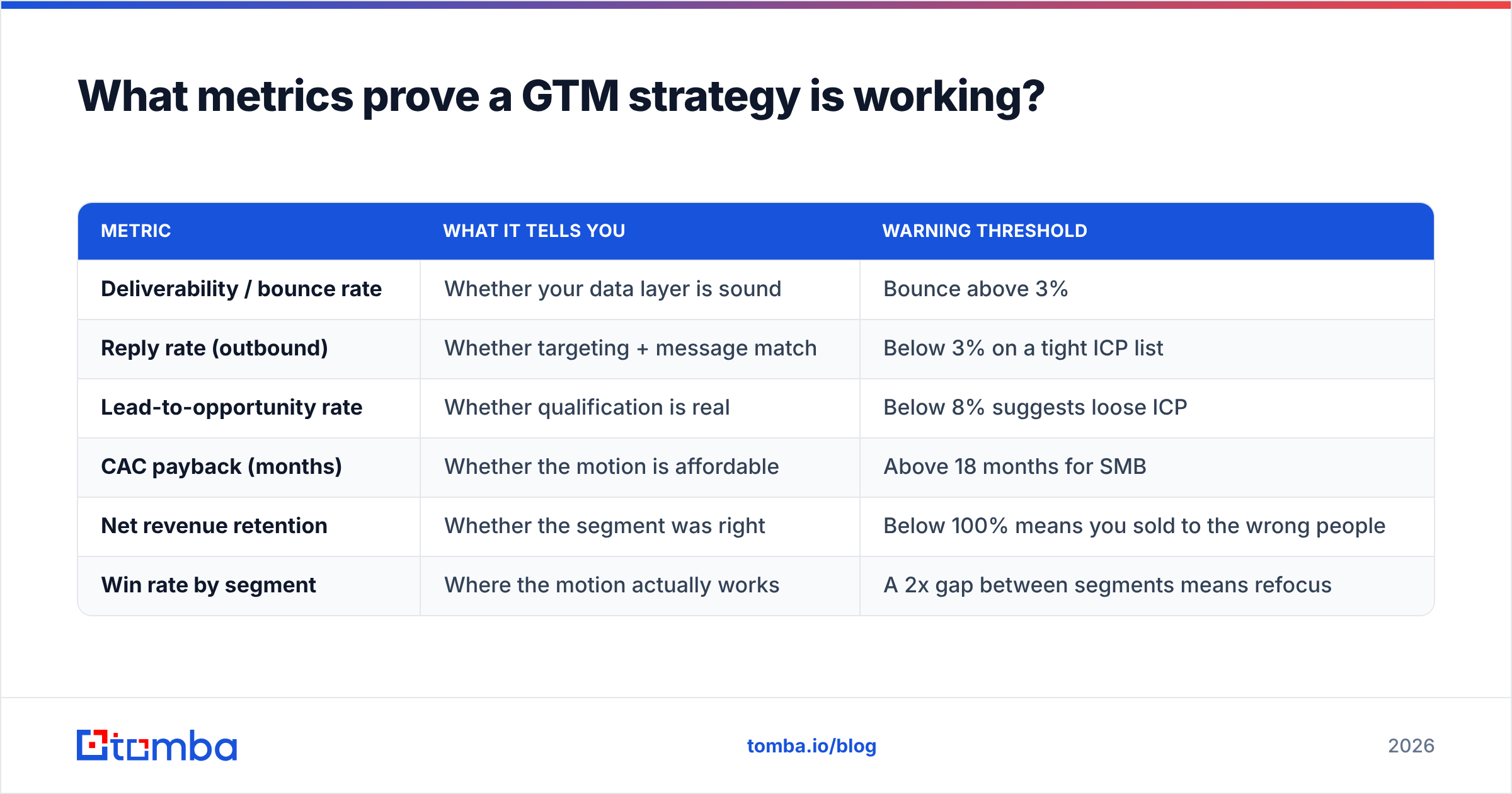
What metrics prove a GTM strategy is working?#
Different motions read different numbers, but the diagnostic set is small.
| Metric | What it tells you | Warning threshold |
|---|---|---|
| Deliverability / bounce rate | Whether your data layer is sound | Bounce above 3% |
| Reply rate (outbound) | Whether targeting + message match | Below 3% on a tight ICP list |
| Lead-to-opportunity rate | Whether qualification is real | Below 8% suggests loose ICP |
| CAC payback (months) | Whether the motion is affordable | Above 18 months for SMB |
| Net revenue retention | Whether the segment was right | Below 100% means you sold to the wrong people |
| Win rate by segment | Where the motion actually works | A 2x gap between segments means refocus |
The last row is the one most teams under-use. Segment-level win rate is the fastest evidence that your ICP is either sharper or broader than your written definition. If one segment closes at 34% and the rest close at 11%, your GTM strategy just wrote itself.
Which GTM decision should you make first?#
Pick the segment before you pick the channel. Everything downstream — pricing, message, motion, hiring — is derived from a segment choice, and every one of those decisions has to be redone if the segment changes.
Then make the segment executable. A go-to-market strategy only becomes real at the moment someone can produce a list of named companies, named decision-makers, and verified contact details for them. That is the working GTM meaning: a segment you can actually reach this week. That step is where most GTM plans stall — not for lack of ambition, but because the list-building work is slow and the data goes stale while you are doing it.
If that is your bottleneck, start there. The Tomba Email Finder turns an ICP definition into contactable people: search by domain or company to surface decision-makers, get verified professional addresses with confidence scores, and push them straight into your CRM or sequencing tool. The free tier covers 25 searches a month, so you can check accuracy on your own account list first. Paid plans start at $49/mo on Starter and $99/mo on Growth as volume grows. Full Tomba pricing is public, with no seat minimums to negotiate.
Define the segment. Build the list. Verify it. Then argue about subject lines.
Related guides#
Ready to find emails that actually work?
Join 150,000+ professionals who stopped guessing and started sending. Free credits on signup — no credit card required.
Get the Tomba newsletter
Practical outbound tactics and product updates — once every two weeks.
About the author