GTM Messaging in 2026: Build a Message That Converts
Most go-to-market messaging fails because it describes the product instead of the buyer's problem. Here's a tested framework, a comparison of messaging models, and how to validate your message with real outbound data.
TL;DR
- GTM messaging is the shared language your whole revenue team uses to explain who you help, what breaks without you, and why you're the safest fix. It is not a tagline, and it is not copywriting.
- Positioning comes first (market frame), messaging second (claims and proof), copy third (words on a page). Skipping straight to copy is why most rewrites fail twice a year.
- The highest-leverage input is not a workshop. It's 30 recorded sales calls, your closed-lost reasons, and 200 cold-email replies from a clean, verified list.
- Pick one framework and stick to it for two quarters. Frameworks differ less than teams think — consistency beats cleverness.
- Test messaging where feedback is fastest and cheapest: outbound email, where reply rate gives you a signal in days instead of quarters.
What is GTM messaging, exactly?#
GTM messaging is the documented set of claims, proof points, and language your company uses across sales, marketing, product, and support to explain the value of what you sell to a specific buyer.
Three things get confused constantly, so let's separate them with a plain analogy. Positioning is deciding which aisle of the supermarket your product sits in. Messaging is what the box says. Copy is the specific words on this week's shelf-talker. If you get the aisle wrong, no amount of box design saves you — shoppers never walk down that aisle.
Concretely, a GTM messaging system contains:
- Segment definition — the exact firmographic and situational profile of who this message is for (not "mid-market", but "Series B SaaS, 40-150 employees, no dedicated RevOps hire yet").
- Problem statement — the pain in the buyer's own words, pulled from call transcripts, not from a whiteboard.
- Value claims — three to five outcome-level statements, each attached to a mechanism ("how") and a proof point ("prove it").
- Differentiation — what you do that the two realistic alternatives (including "do nothing") cannot.
- Objection handling — the five objections that actually kill deals, with the counter-evidence for each.
- Language bank — approved verbs and nouns, plus banned terms. If your buyers say "pipeline coverage" and you say "funnel velocity", you lose.
If you cannot hand a new SDR that document and have them write a credible cold email on day two, it isn't messaging yet. It's a mood board.
Why does most GTM messaging fail?#
It fails for a boring reason: it's written from the inside out. The team knows the product intimately, so it writes about the product. The buyer knows their problem intimately, and doesn't care about the product yet.
Here are the failure modes that show up in nearly every audit:
- Feature listing as value. "AI-powered enrichment with 50+ data sources" is a spec sheet. "You stop paying for leads that bounce" is a value claim. One is verifiable by the buyer's own experience; the other is background noise.
- Category vagueness. If your one-liner could describe eleven other vendors, buyers file you under "another one of those" and default to the incumbent. Gartner's research on B2B buying has consistently shown that the hardest competitor is buyer indecision, not a rival logo.
- Persona drift. Marketing writes for the VP, sales sells to the manager, product demos to the end user. Three messages, one company, zero coherence.
- No proof ladder. Every claim needs an escalating stack: a number, a mechanism, a customer, a demo. Claims without ladders get discounted to zero.
- Untested language. A message that was never exposed to a cold audience is a hypothesis wearing a suit.
The last one matters most, and it's the one you can fix this month.
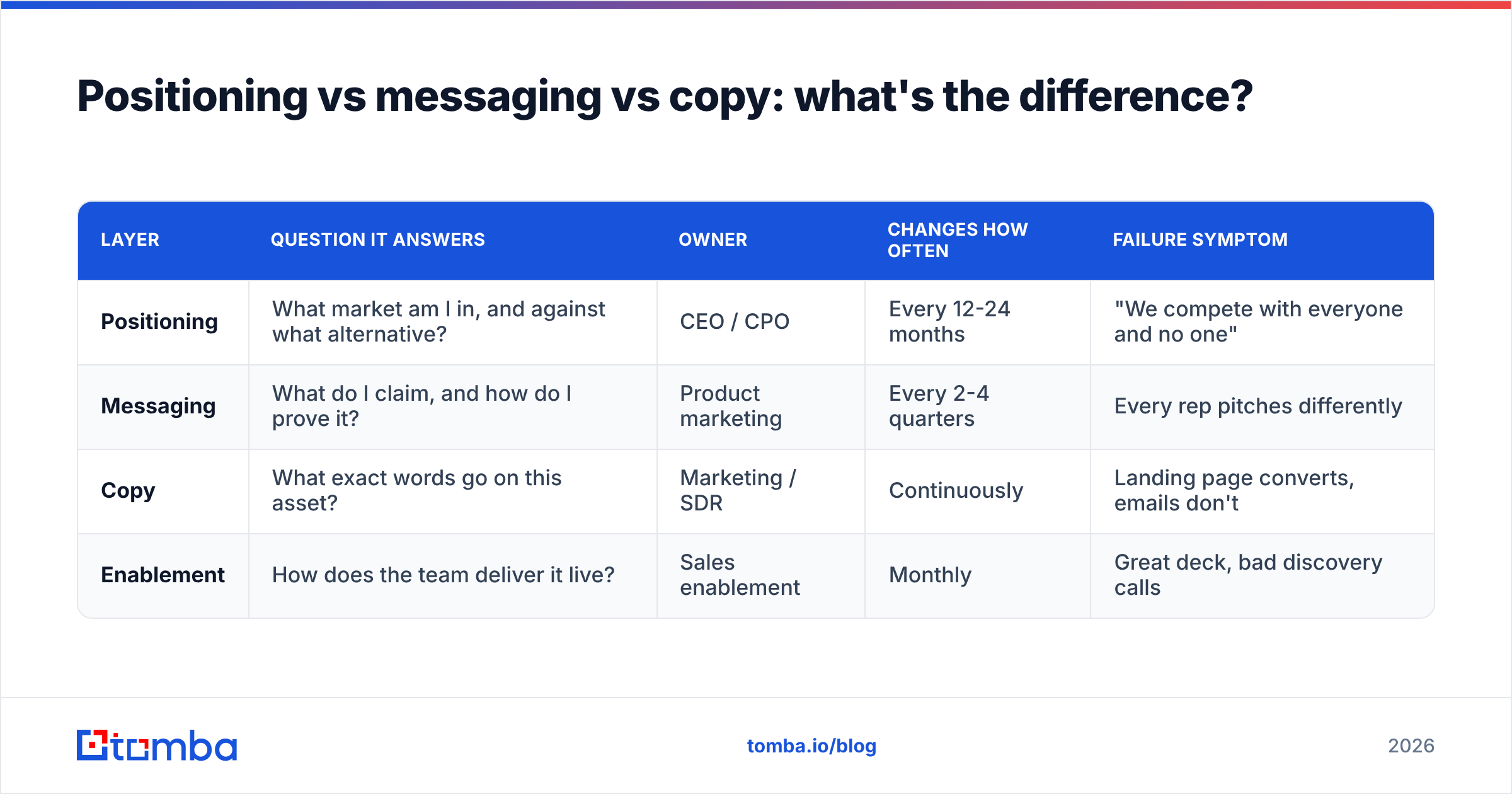
Positioning vs messaging vs copy: what's the difference?#
| Layer | Question it answers | Owner | Changes how often | Failure symptom |
|---|---|---|---|---|
| Positioning | What market am I in, and against what alternative? | CEO / CPO | Every 12-24 months | "We compete with everyone and no one" |
| Messaging | What do I claim, and how do I prove it? | Product marketing | Every 2-4 quarters | Every rep pitches differently |
| Copy | What exact words go on this asset? | Marketing / SDR | Continuously | Landing page converts, emails don't |
| Enablement | How does the team deliver it live? | Sales enablement | Monthly | Great deck, bad discovery calls |
Most "we need new messaging" requests are actually one of the other three problems. Diagnose before you rewrite: if reps pitch differently from each other, that's an enablement gap. If every channel underperforms uniformly, that's positioning. If one channel underperforms, that's copy.
Which GTM messaging framework should you use?#
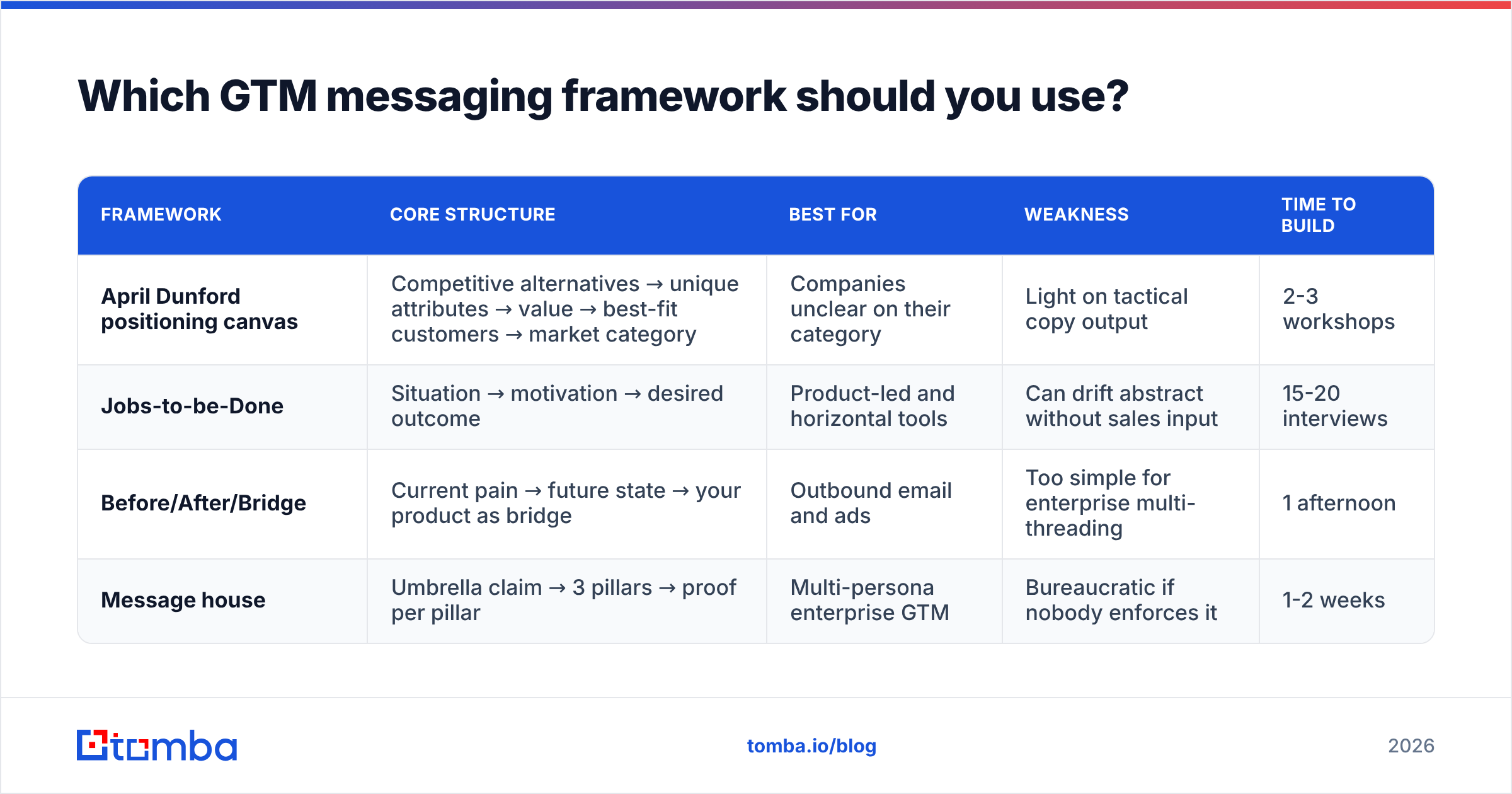
There are four frameworks worth knowing. They overlap heavily. The right answer is usually "the one your team will actually maintain".
| Framework | Core structure | Best for | Weakness | Time to build |
|---|---|---|---|---|
| April Dunford positioning canvas | Competitive alternatives → unique attributes → value → best-fit customers → market category | Companies unclear on their category | Light on tactical copy output | 2-3 workshops |
| Jobs-to-be-Done | Situation → motivation → desired outcome | Product-led and horizontal tools | Can drift abstract without sales input | 15-20 interviews |
| Before/After/Bridge | Current pain → future state → your product as bridge | Outbound email and ads | Too simple for enterprise multi-threading | 1 afternoon |
| Message house | Umbrella claim → 3 pillars → proof per pillar | Multi-persona enterprise GTM | Bureaucratic if nobody enforces it | 1-2 weeks |
A practical hybrid works for most B2B teams under $50M ARR: use Dunford to fix positioning once, a message house to organize claims by persona, and Before/After/Bridge to compress each pillar into outbound-ready copy. That gives you one document that feeds both the website and the sequence builder.
Whatever you pick, write it down in a place the SDR team opens weekly. A messaging doc that lives in a slide deck nobody reopens is decoration. Pair it with the vocabulary in a shared B2B glossary so "MQL" and "opportunity" mean the same thing to marketing and sales.
How do you build GTM messaging that survives contact with buyers?#
Six steps, in order. Do not reorder them.
Step 1 — Mine the raw material. Pull 30 recorded sales calls (15 won, 15 lost), the last 100 closed-lost reasons from your CRM, and every support ticket tagged "confused". Highlight the exact nouns and verbs buyers use. You're building a language bank, not a summary.
Step 2 — Define the alternative, honestly. For each segment, name the two realistic alternatives, one of which is almost always a spreadsheet or "keep doing it manually". If you can't beat the spreadsheet on a specific dimension, your messaging has a product problem hiding inside it.
Step 3 — Write claims as outcomes with mechanisms. Format: [Outcome] because [mechanism], proven by [evidence]. Example: "Reps stop wasting a day a week on list building because enrichment runs on a schedule, proven by a customer who cut list prep from 6 hours to 40 minutes."
Step 4 — Build the proof ladder. For each claim, stack four rungs: a metric, a mechanism explanation, a named customer, and a live demo moment. Deals stall at whichever rung is missing.
Step 5 — Compress to three lengths. Every claim needs a 10-word version (email subject / ad), a 30-word version (opener / homepage sub-head), and a 90-word version (deck slide / discovery framing). If a claim can't survive compression to 10 words, it isn't a claim — it's a paragraph.
Step 6 — Ship it into one channel and measure. Don't roll out everywhere at once. Pick outbound email, run two variants, and read reply rate at 400 sends per variant.
How do you test GTM messaging without waiting two quarters?#
Use cold outbound as your wind tunnel. It's the only channel where you control the audience precisely, get feedback within days, and can attribute a response to a specific sentence.
The mechanics matter more than the cleverness:
- Hold the list constant. If variant A goes to Series B fintech and variant B goes to enterprise retail, you learned nothing. Build both lists from the same firmographic filter using a domain search so segment composition is identical.
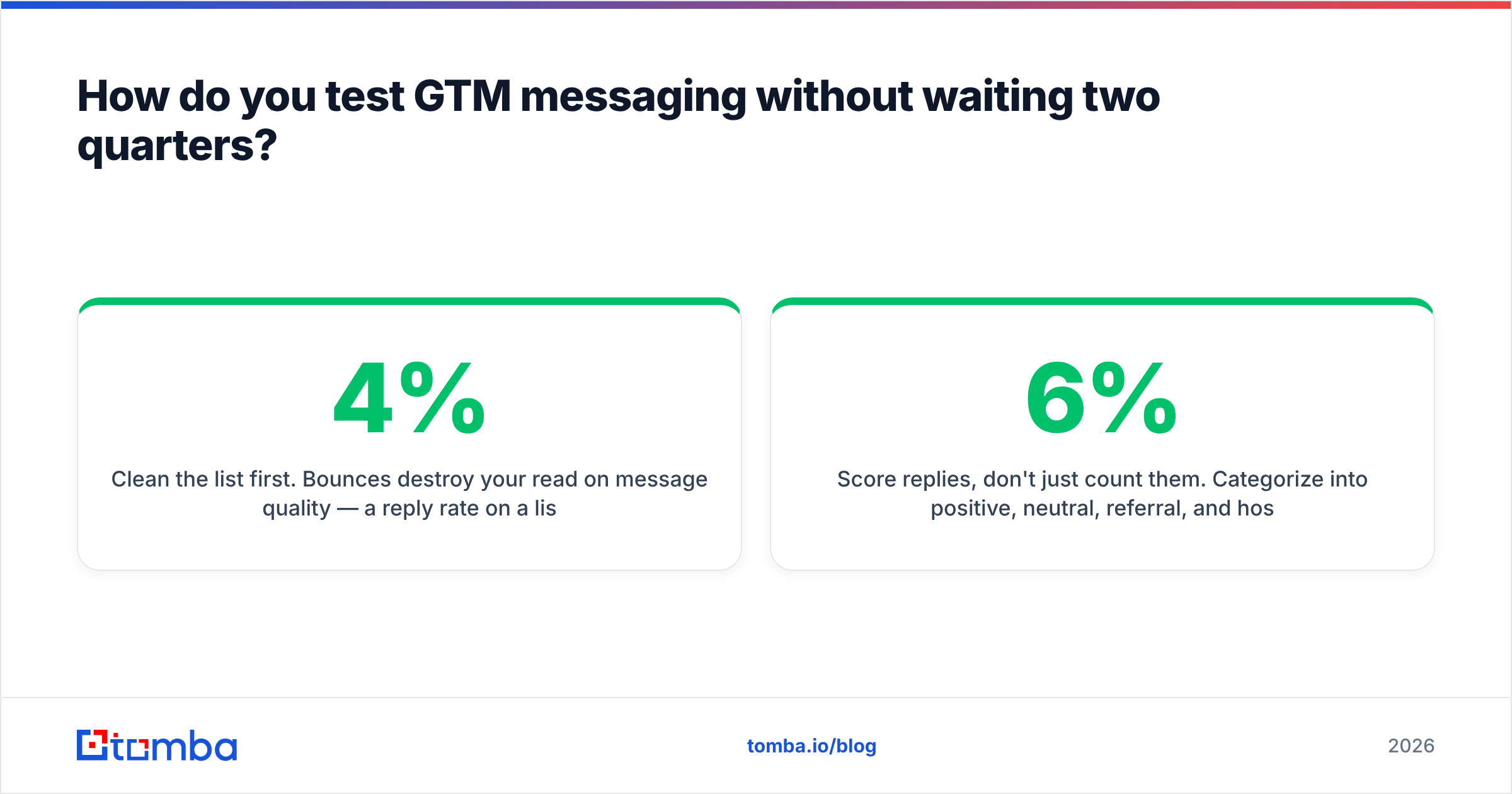
- Clean the list first. Bounces destroy your read on message quality — a 4% reply rate on a list with 18% invalids is a completely different number once you correct for deliverability. Run the file through an email verifier before you split it.
- Change one variable. Same subject line, different opener. Or same opener, different proof point. Two changes at once means no learning.
- Sample size before significance. Roughly 400 delivered sends per variant gets you a readable difference on reply rate for most B2B ICPs. Below 150, you're reading noise.
- Score replies, don't just count them. Categorize into positive, neutral, referral, and hostile. A variant with 6% replies that are 80% hostile is worse than 3% replies that are 60% positive.
Track your response rate per variant per segment, not in aggregate. Aggregate reply rate hides the fact that your message crushes it with ops leaders and dies with finance.
What does good GTM messaging look like in practice?#
Here's the same value proposition written three ways, so you can see the difference between the layers.
Product-out (weak): "Our platform offers multi-source B2B contact enrichment with a 99.9% uptime SLA and native integrations across 40+ tools."
Buyer-in, no proof (better): "Stop losing a quarter of your outbound to bad contact data."
Buyer-in with proof ladder (strong): "Your SDRs are burning a day a week rebuilding lists because half your CRM contacts have gone stale. Teams that automate enrichment on a 90-day cycle cut that to under an hour — one 12-rep team recovered roughly 40 selling hours a month. Want the two-page teardown of how they set it up?"
The third version works because it names a measurable waste, explains the mechanism, offers proof, and asks for a low-commitment next step. It also passes the SDR test: a new rep can send it on day two without improvising.
Note what it doesn't do. It doesn't claim to be "the leading platform". Buyers discount superlatives automatically, and review sites like G2 already tell them who the leaders are. Your job is to be specific, not to be biggest.
How do you keep messaging consistent across the GTM team?#
Consistency, not brilliance, is what compounds. A mediocre message delivered identically by 20 reps outperforms a brilliant message delivered 20 different ways, because the market only learns from repetition.
Three mechanisms make it stick:
- A single source of truth with a version number. Messaging v3.2, with a changelog. When it changes, the changelog says what and why. This alone kills the "which deck is current?" problem.
- Enforcement at the point of work. Put approved language directly into sequence templates, call scripts, and CRM snippet fields. Nobody reads a doc; everybody uses a template. Pushing the language bank into your HubSpot integration or sequence tool means reps get the right words without opening anything extra.
- A quarterly message review with real data. Bring reply-rate-by-variant, win-rate-by-claim, and the top three closed-lost reasons. Change messaging only when data says to. HubSpot's own sales enablement research has long pointed at the same pattern: alignment problems are process problems, not talent problems.
For teams running revenue operations as a formal function, make the messaging doc a RevOps-owned artifact rather than a marketing one. RevOps sits at the intersection of the data and the delivery, which is exactly where messaging decays.
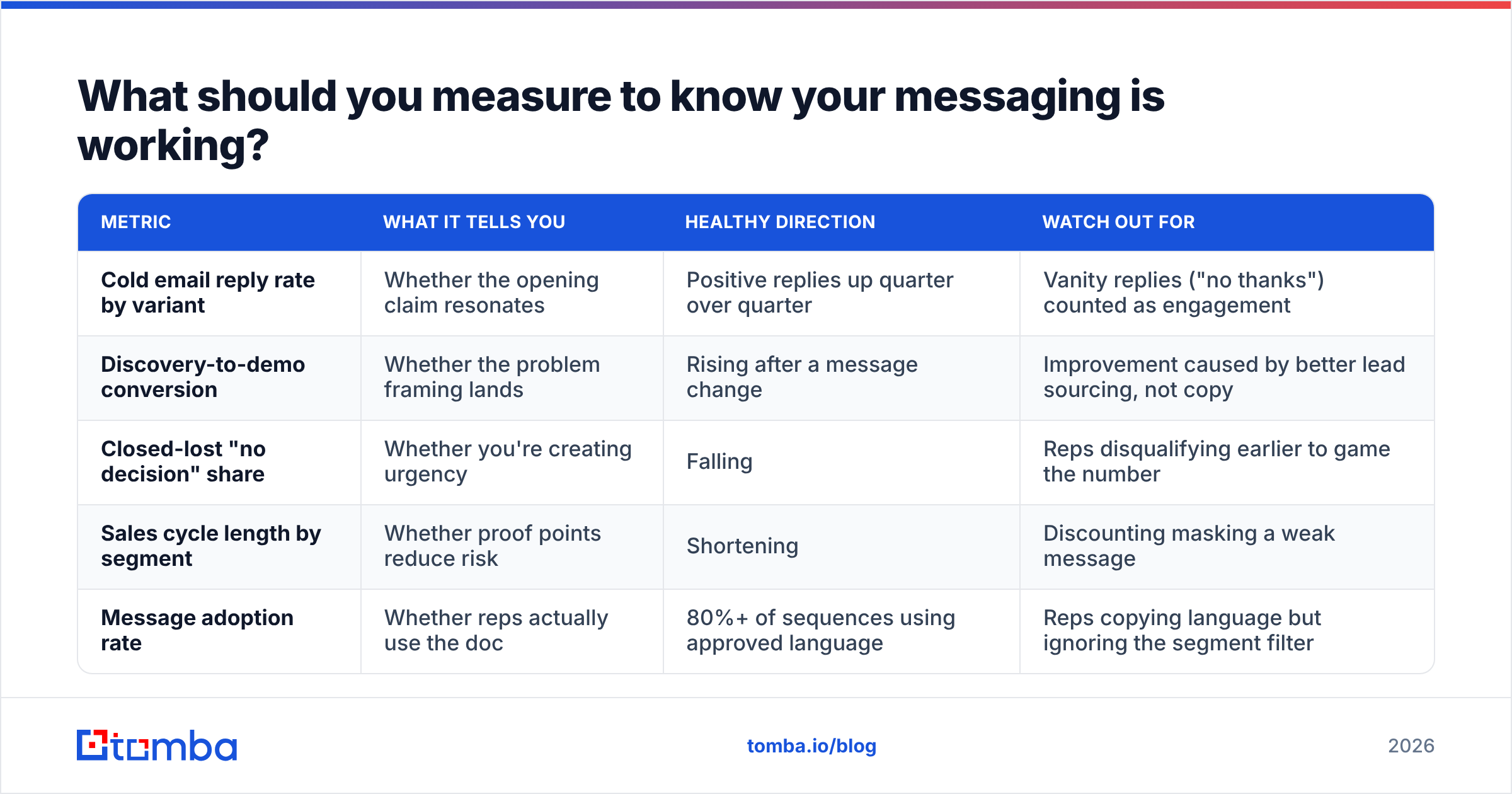
What should you measure to know your messaging is working?#
| Metric | What it tells you | Healthy direction | Watch out for |
|---|---|---|---|
| Cold email reply rate by variant | Whether the opening claim resonates | Positive replies up quarter over quarter | Vanity replies ("no thanks") counted as engagement |
| Discovery-to-demo conversion | Whether the problem framing lands | Rising after a message change | Improvement caused by better lead sourcing, not copy |
| Closed-lost "no decision" share | Whether you're creating urgency | Falling | Reps disqualifying earlier to game the number |
| Sales cycle length by segment | Whether proof points reduce risk | Shortening | Discounting masking a weak message |
| Message adoption rate | Whether reps actually use the doc | 80%+ of sequences using approved language | Reps copying language but ignoring the segment filter |
Pair these with a simple qualitative check: ask five customers who bought in the last 90 days to describe what you do in their own words. If their description matches your messaging doc, you're done. If it doesn't, their version is usually better — steal it.
Where do most teams go wrong when they rewrite?#
They rewrite too often, and they rewrite in isolation. A messaging refresh every quarter means the market never hears the same thing twice, which is functionally the same as saying nothing. Twice a year is the practical ceiling for anything above the copy layer.
They also rewrite without the data layer underneath. If your outbound list is 30% invalid addresses, no message change will move your numbers, and you'll conclude the message was the problem when it was the data. Fix the list quality first, then test the words. A clean list turns messaging testing from guesswork into an experiment.
Finally, they treat messaging as a marketing deliverable rather than a revenue system. The people closest to the buyer — SDRs and AEs — should be in the room when claims get written, and they should be the first to test them.
Ready to test your GTM messaging on real buyers?#
Good messaging is validated messaging, and validation requires a clean, precisely-targeted list of the people you claim to help. Start by building two identical-firmographic lists with the Tomba Email Finder, verify them so bounces don't distort your read, and send one variant to each. You'll know within two weeks which claim your market actually responds to — which is faster than any workshop will ever tell you. The free tier includes 25 searches a month if you want to run a small pilot first; see Tomba pricing for volume plans starting at $49/mo.
Related guides#
Ready to find emails that actually work?
Join 150,000+ professionals who stopped guessing and started sending. Free credits on signup — no credit card required.
Get the Tomba newsletter
Practical outbound tactics and product updates — once every two weeks.
About the author