GTM Models in 2026: How to Pick the Right One
Product-led, sales-led, PLG-plus-sales, community-led, partner-led: five GTM models, what each actually costs to run, and how to tell which one your company is already in.

TL;DR
- A GTM model is the repeatable machine that turns budget into pipeline. There are five that actually work at scale: sales-led, product-led, hybrid (PLG + sales assist), community-led, and partner-led.
- Pick by average contract value and buying-committee size, not by what's fashionable. Under ~$5K ACV, sales-led math almost never closes. Over ~$50K ACV, pure self-serve almost never closes either.
- Most companies are running a hybrid model badly rather than one clean model well. The tell: your AEs spend more time triaging free signups than working named accounts.
- Every model needs the same data spine — accurate contact data, clean firmographics, and one shared definition of a qualified account.
- Switching models costs 2-3 quarters of pipeline. Budget for it or don't start.
What is a GTM model, exactly?#
A go-to-market (GTM) model is the answer to one question: who does the work of getting a customer, and in what order?
Think of it like a restaurant. A fine-dining place seats you, a server walks you through the menu, and the check is $400. A fast-casual place has you order at a counter and the check is $14. Neither is "better" — they're matched to a price point and a volume. The kitchen equipment, the staffing ratio, and the rent are all downstream of that one choice. Pick the wrong one and you go under, no matter how good the food is.
Same in B2B. Your GTM model determines your headcount ratio (AEs to engineers to marketers), your CAC payback target, your pricing page, and whether you need a 40-person SDR floor or a 3-person growth team. It is not a marketing tactic. It's the operating shape of the company.
Technically: a GTM model is the combination of (1) your primary demand source, (2) your primary conversion mechanism, and (3) your primary expansion motion. Everything else is tactics.
What are the five GTM models that actually work?#
Here they are stripped of vendor spin, with the honest failure mode of each.
- Sales-led — Outbound and inbound leads route to humans who run a discovery-to-close process. Demand from SDR prospecting, events, and paid. Failure mode: CAC balloons faster than ACV, and you discover it two quarters late because pipeline coverage looked fine.
- Product-led (PLG) — Users self-serve into a free tier or trial, hit a value moment, and upgrade with a credit card. Demand from SEO, integrations, and word of mouth. Failure mode: you acquire thousands of users who never touch the paid boundary, and net revenue retention stalls under 100%.
- Hybrid (PLG + sales assist) — Self-serve for the long tail, humans for accounts above a usage or firmographic threshold. Failure mode: nobody agrees on the threshold, so AEs cherry-pick and self-serve conversion quietly degrades.
- Community-led — A owned audience (Slack group, forum, newsletter, open-source repo) generates trust and intent before any sales conversation. Failure mode: the community is real but attribution is invisible, so finance cuts the budget in the first bad quarter.
- Partner-led / channel — Resellers, agencies, marketplaces, and tech partners source and sometimes close. Failure mode: margin gets shared before you've proven you can sell direct, and you never learn your own buyer.
Most durable companies run one primary model and one secondary. Running three at once is how you get a 14-person GTM team with four different definitions of "qualified."
How do the GTM models compare on cost and fit?#
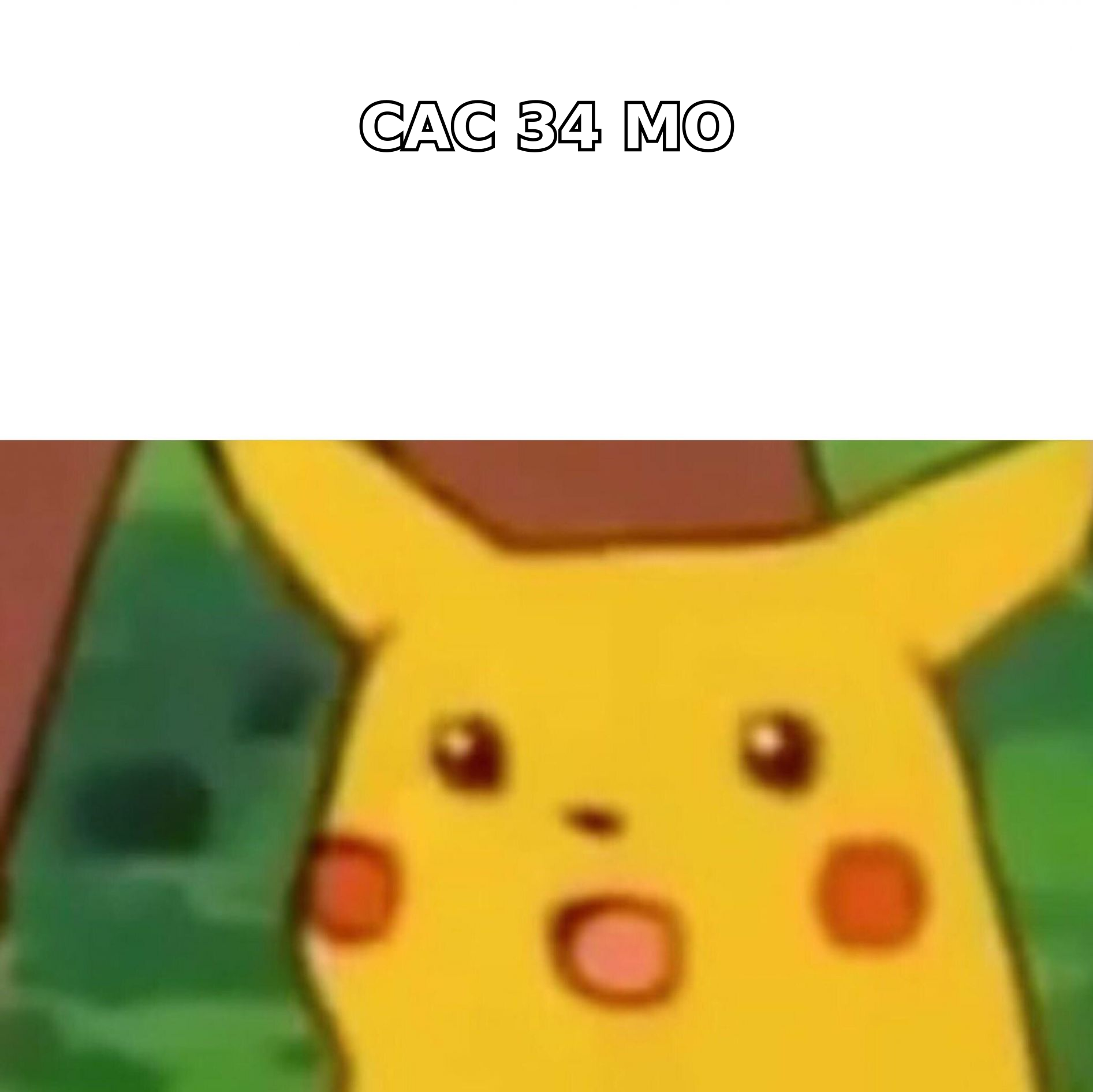
This is the table to argue about in your next planning meeting. Numbers are directional benchmarks from public SaaS reporting and vendor benchmarks — treat them as ranges, not laws.
| Dimension | Sales-led | Product-led | Hybrid (PLG + sales) | Community-led | Partner-led |
|---|---|---|---|---|---|
| Typical ACV sweet spot | $25K–$250K+ | $200–$8K | $5K–$60K | $1K–$30K | $10K–$100K |
| CAC payback target | 18–24 months | 6–12 months | 12–18 months | 9–15 months | 12–20 months |
| Time to first revenue | 6–9 months | 2–4 months | 4–7 months | 9–18 months | 6–12 months |
| Headcount to launch | 4–8 (SDR+AE+leader) | 2–4 (growth+eng) | 6–10 | 1–3 (+ founder time) | 2–4 (partner managers) |
| Primary bottleneck | Rep ramp time | Activation rate | Threshold definition | Trust compounding | Partner enablement |
| Gross margin impact | Neutral | Positive | Neutral | Positive | −15% to −30% (rev share) |
| Data dependency | Very high | Medium | Very high | Low | Medium |
| Works for a 3-person team? | No | Yes | No | Yes | Rarely |
Two things jump out of that table every time I run this exercise with a team.
First: partner-led looks cheap and isn't. You pay in margin instead of salary, which flatters your headcount plan and quietly destroys your unit economics if your ACV is thin. Twenty to thirty points of revenue share on a $12K deal is fine when the partner sources it. It's not fine when they merely referred someone who was already on your pricing page.
Second: sales-led has the highest data dependency of any model. That's the part teams underestimate. A product-led motion gets contact data for free — the user typed their email in. A sales-led motion has to go find it, and the quality of that find determines whether the whole model works.
Why does data quality decide whether a GTM model survives?#
Because every model except community-led has a step where you must reach a specific human at a specific company, and a bad address kills the entire chain.
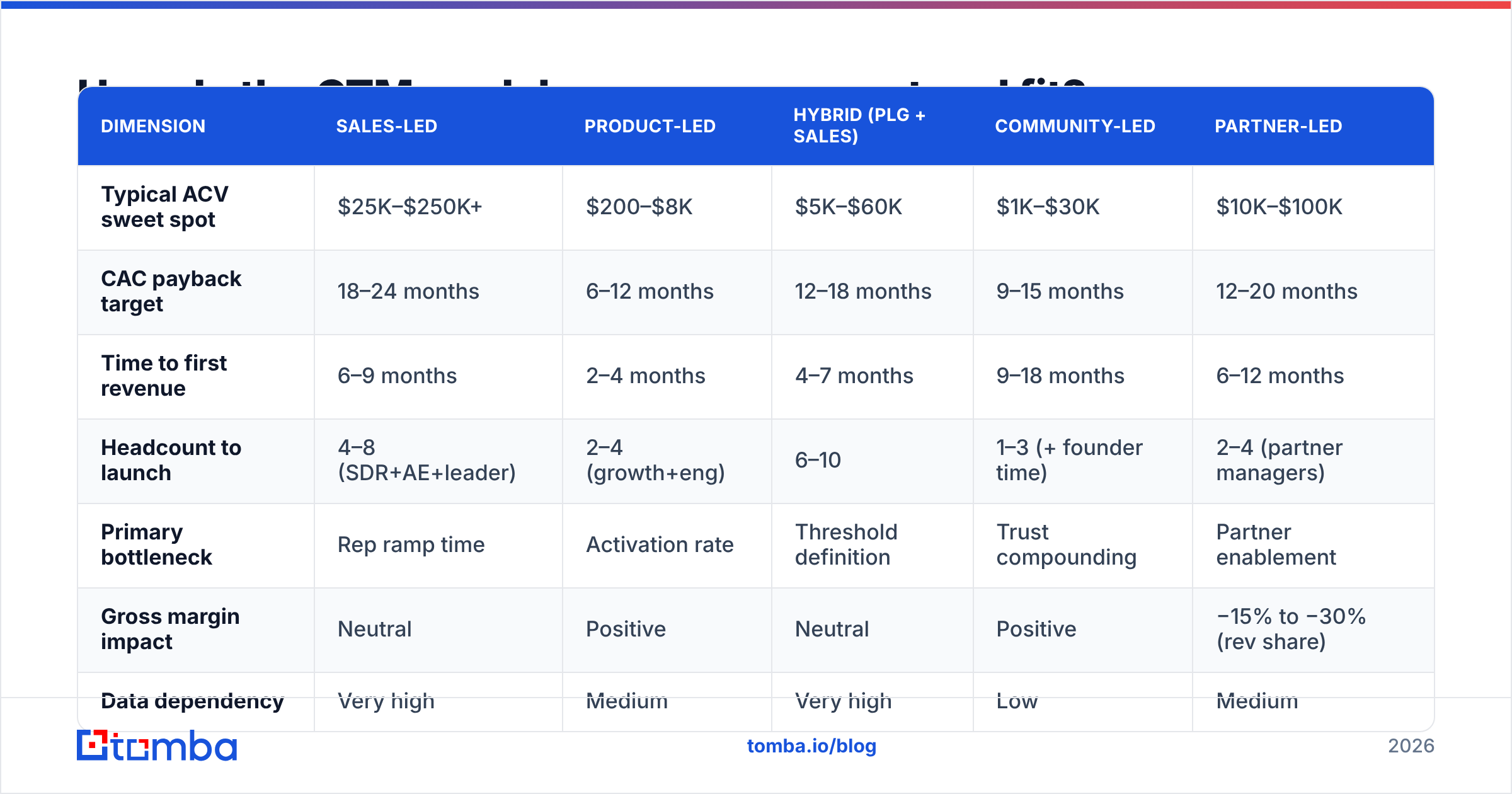
Run the arithmetic. If your outbound list is 70% deliverable, and your reply rate on delivered mail is 6%, and your meeting rate on replies is 30%, then 1,000 contacts produces about 13 meetings. Lift deliverability to 95% and the same 1,000 contacts produces 17 meetings — a 31% increase in pipeline from zero additional headcount, zero additional spend, and no change to your copy.
That's the highest-leverage lever most GTM teams never pull. It's also why a data spine is not a "sales tools" line item — it's infrastructure for whichever model you pick.
Three practical requirements:
- Verified contact data at the point of use. Not a quarterly list refresh — verification at send time. A 12-month-old B2B list decays roughly 25–30% per year through job changes alone. Run an email verifier as a pipeline step, not a spring-cleaning project.
- Firmographics that match your ICP definition. Employee count, tech stack, funding stage, and industry need to live in the same place your reps and your scoring model read from. If marketing scores on one dataset and sales works from another, you don't have a GTM model — you have two.
- Coverage across the buying committee. Gartner's B2B buying research puts the typical enterprise buying group at six to ten stakeholders. Single-threading a $60K deal is how forecasts die in Q4.
For teams building account lists from scratch, domain search gets you the full contact map for a target company in one call rather than one contact at a time — which matters enormously when your model requires multithreading.
Which GTM model fits your company right now?#
Skip the framework theater. Answer four questions honestly.
1. What's your realistic ACV in 12 months? Under $2K: product-led or community-led. Nothing else has math that works. Between $2K and $25K: hybrid, and the interesting design problem is where the threshold sits. Above $25K: sales-led primary, with product-led as a lead source if your product allows a meaningful free experience.
2. Can a user get real value alone, in under 20 minutes? If yes, product-led is available to you. If it requires data migration, an implementation call, or an admin's permission — it isn't, no matter how much your board likes the phrase. Forcing PLG onto a product that needs onboarding produces a graveyard of dormant free accounts and a support burden.
3. How many people sign off? One person with a credit card → self-serve. Three or more with a procurement review → you need humans, and you need them early. This is the single most reliable predictor in the list.
4. Do you already have distribution? An existing newsletter, an open-source project with real stars, a founder with a genuine audience — community-led is dramatically cheaper for you than for a company starting cold. If you don't have it, community-led is an 18-month bet, not a Q1 plan.
What does a hybrid GTM model look like in practice?#
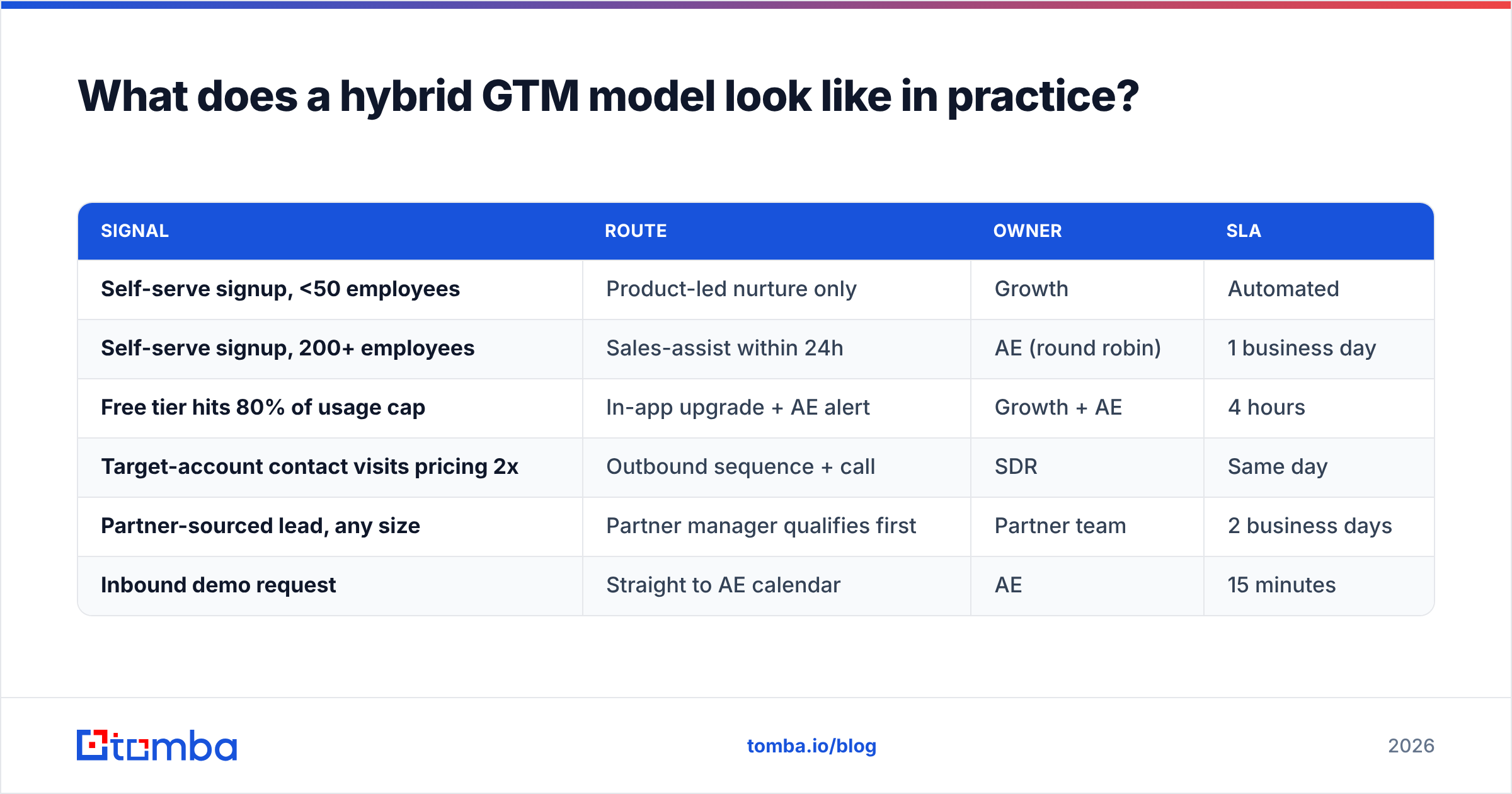
Hybrid is where most B2B SaaS companies between $2M and $50M ARR end up, and it's the model most often executed badly. The fix is boring: define the threshold in writing, in advance, with a number.
A working hybrid rulebook looks like this:
| Signal | Route | Owner | SLA |
|---|---|---|---|
| Self-serve signup, <50 employees | Product-led nurture only | Growth | Automated |
| Self-serve signup, 200+ employees | Sales-assist within 24h | AE (round robin) | 1 business day |
| Free tier hits 80% of usage cap | In-app upgrade + AE alert | Growth + AE | 4 hours |
| Target-account contact visits pricing 2x | Outbound sequence + call | SDR | Same day |
| Partner-sourced lead, any size | Partner manager qualifies first | Partner team | 2 business days |
| Inbound demo request | Straight to AE calendar | AE | 15 minutes |
Note what this table is really doing: it's removing judgment calls from the routing layer. Reps aren't deciding what to work; the rulebook decides, and the rulebook gets revised quarterly based on close rates by segment.
The enrichment step is what makes this work. "200+ employees" is only actionable if you know the employee count at signup — which means data enrichment has to run on the signup event, not in a weekly batch. If enrichment lags routing, high-fit accounts sit in the self-serve bucket for six days and convert at self-serve rates.
Worth reading alongside this: HubSpot's research on sales and marketing alignment consistently finds that documented handoff criteria — not more meetings — is what moves conversion between teams.
How do you switch GTM models without torching a quarter?#
Assume 2-3 quarters of degraded output. Every company that says "we'll transition in six weeks" spends nine months instead, because the transition is really a hiring, comp, and data project wearing a strategy costume.
The sequence that works:
- Instrument the current model first. You cannot tell whether the new model is better if you never measured conversion by stage in the old one. Two weeks of clean measurement saves two quarters of arguing.
- Run the new model on one segment. One vertical, one geography, or one price band. Not the whole book.
- Rewrite comp before you rewrite process. Reps optimize for the comp plan, always. If you ask an AE to nurture self-serve accounts while paying them only on new logos, they will not do it, and they are correct not to.
- Rebuild the data layer in parallel. New model, new ICP definition, new required fields. A sales-led motion needs B2B phone numbers and multithreaded contacts that a product-led motion never collected.
- Kill the old model explicitly. Half-transitions are the worst of both. Set a date, communicate it, and move the headcount.
One caveat on benchmarks: peer review sites like G2's category data are useful for tool selection but terrible for model selection. What worked for a company with a different ACV, a different buyer, and a different funding position tells you almost nothing about your own math. Run your own numbers.
What metrics tell you the model is working?#
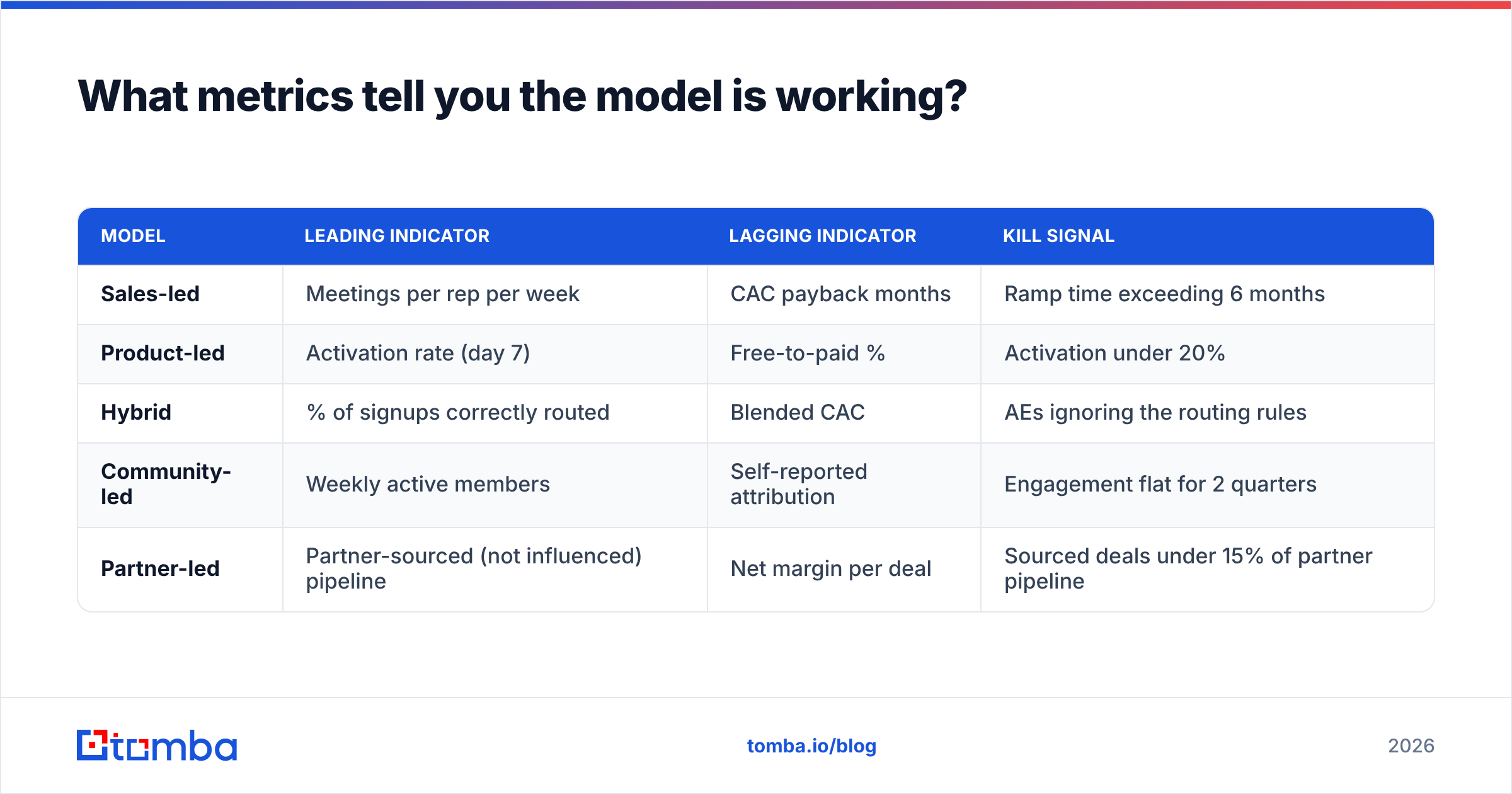
Different models fail differently, so watch different numbers.
| Model | Leading indicator | Lagging indicator | Kill signal |
|---|---|---|---|
| Sales-led | Meetings per rep per week | CAC payback months | Ramp time exceeding 6 months |
| Product-led | Activation rate (day 7) | Free-to-paid % | Activation under 20% |
| Hybrid | % of signups correctly routed | Blended CAC | AEs ignoring the routing rules |
| Community-led | Weekly active members | Self-reported attribution | Engagement flat for 2 quarters |
| Partner-led | Partner-sourced (not influenced) pipeline | Net margin per deal | Sourced deals under 15% of partner pipeline |
The "kill signal" column matters more than the others. Every GTM model has a specific way it dies, and it's almost always visible two quarters before the revenue miss shows up in the board deck. Write your kill signal down now, while you're not defensive about it.
Where do you start?#
Pick the model your ACV and buying committee already dictate, write down the routing rules, and then fix your contact data before you hire anyone — because every model above except community-led breaks the moment your list stops being deliverable.
That last part is the cheapest fix available. Tomba's Email Finder covers the sales-led and hybrid motions directly: find verified professional addresses by name, company, or domain, map an entire buying committee from a single domain lookup, and push clean records into your CRM before a rep ever opens a sequence. The free tier gives you 25 searches a month to test the accuracy on your own target accounts, and paid plans start at $49/mo on the Starter tier — full Tomba pricing if you want to model the cost against your pipeline targets.
Run your ICP list through it, compare the deliverability against whatever you're using now, and decide with a number instead of a preference.
Related guides#
Ready to find emails that actually work?
Join 150,000+ professionals who stopped guessing and started sending. Free credits on signup — no credit card required.
Get the Tomba newsletter
Practical outbound tactics and product updates — once every two weeks.
About the author