GTM Programs in 2026: How to Build, Run, and Measure Them
Most GTM programs die in month two, not because the idea was wrong but because nobody owned the data, the definition of done, or the number. Here is how the ones that survive are scoped, staffed, and scored.
TL;DR
- A GTM program is a repeatable, owned, measured motion — not a campaign, not a quarter-long experiment, not a Slack channel with good intentions.
- Most GTM programs fail on three things: no single owner, no defined "done," and a contact data layer nobody audited before launch.
- The four program archetypes that matter in 2026 are outbound territory programs, product-led expansion, partner/co-sell, and account-based pursuit. Each has a different staffing ratio and payback window.
- Measure programs on pipeline per rep-week and cost per qualified conversation, not on activity or raw MQL counts.
- Budget roughly 15-25% of program cost for data acquisition, verification, and enrichment. Programs that skip this line item spend it later in bounced sends and rep time.
What is a GTM program, exactly?#
A GTM program is a named, funded, owned go-to-market motion with a fixed target segment, a defined play, an operating cadence, and a number it is accountable to.
That definition does real work. Strip out any one clause and you get something else:
- No named owner? That's a campaign.
- No fixed segment? That's a brand initiative.
- No operating cadence? That's a launch.
- No number? That's a pet project.
The distinction matters because "program" is the unit that finance and revenue operations can actually plan against. You can staff a program, fund it, kill it, or double it. You cannot do any of those cleanly to a vague "outbound effort."
Think of it like a restaurant menu item versus a special. A special is whatever the chef felt like making with today's delivery. A menu item has a costed recipe, a prep station, a station owner, and a margin target — which is why you can open a second location around it. GTM programs are menu items.
Why do most GTM programs stall after 60 days?#
Because the first 30 days run on enthusiasm and the second 30 run on infrastructure that was never built.
The pattern is consistent across mid-market and enterprise teams:
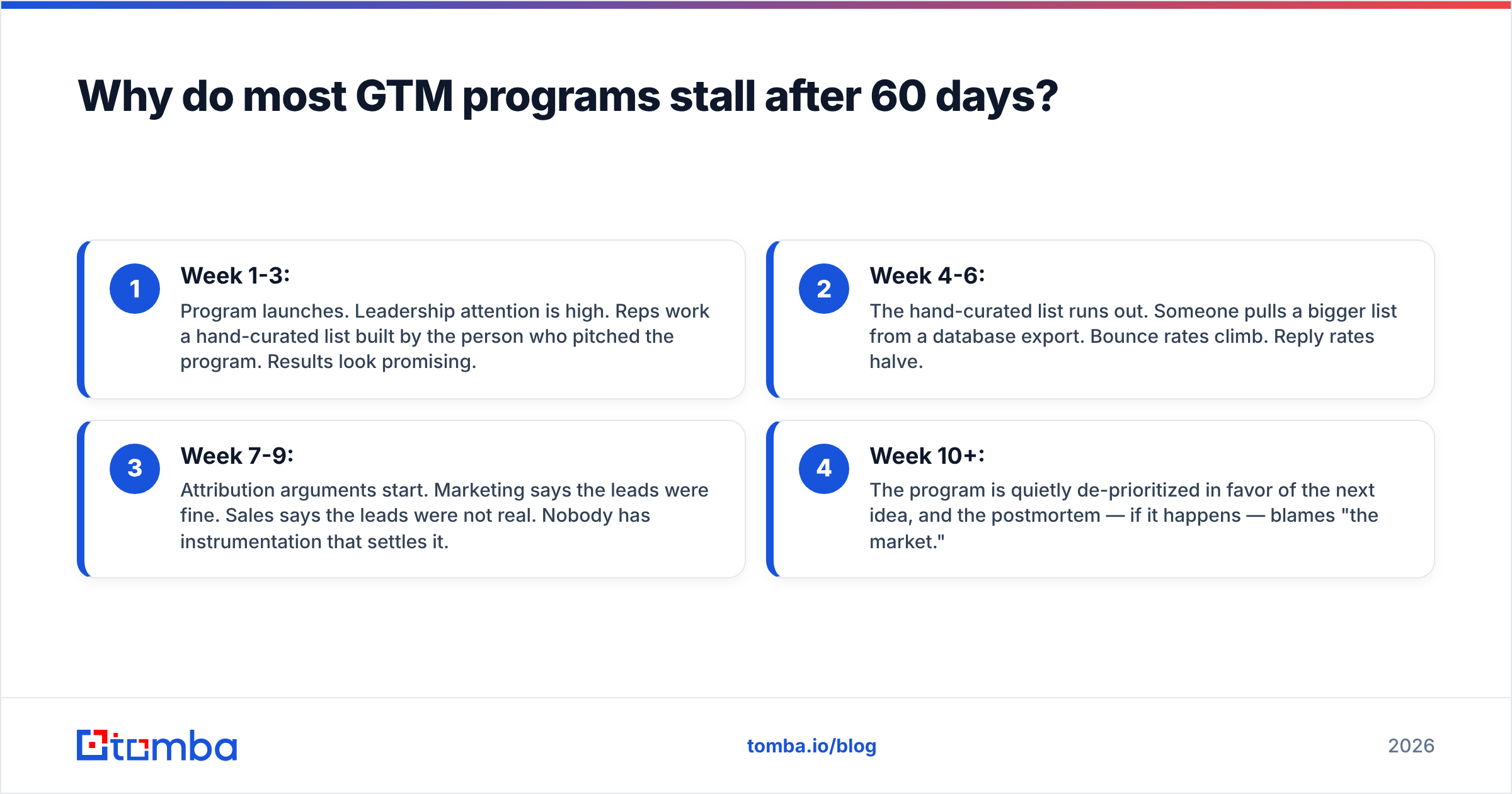
- Week 1-3: Program launches. Leadership attention is high. Reps work a hand-curated list built by the person who pitched the program. Results look promising.
- Week 4-6: The hand-curated list runs out. Someone pulls a bigger list from a database export. Bounce rates climb. Reply rates halve.
- Week 7-9: Attribution arguments start. Marketing says the leads were fine. Sales says the leads were not real. Nobody has instrumentation that settles it.
- Week 10+: The program is quietly de-prioritized in favor of the next idea, and the postmortem — if it happens — blames "the market."
Gartner's research on B2B buying behavior has been consistent for years: buyers spend a small fraction of their journey with any single vendor's sellers, so the cost of reaching the wrong person is not just a wasted email — it is a burned slot in a very short window. (Gartner)
The infrastructure gap almost always shows up as data. A program designed around 500 accounts is fine with a spreadsheet. The same program at 5,000 accounts needs a repeatable way to resolve contacts, verify them, and enrich them before a rep ever sees the record.
What are the main types of GTM programs in 2026?#
Four archetypes cover the vast majority of what B2B teams actually run. Pick deliberately — mixing two in one program is the fastest way to make the number unreadable.
- Outbound territory programs — Reps own a named account list, work it on a fixed cadence, and are measured on meetings sourced. Highest control, highest data dependency, fastest to instrument.
- Product-led expansion programs — Signals from product usage trigger a sales motion into existing free or low-tier accounts. Lowest acquisition cost per conversation, but requires a working event pipeline before day one.
- Partner and co-sell programs — Pipeline is sourced through resellers, agencies, or platform ecosystems. Longest ramp (two to three quarters before meaningful volume) and highest ceiling.
- Account-based pursuit programs — A small set of named accounts gets coordinated multi-threaded attention from sales, marketing, and executives. Lowest volume, highest average contract value, hardest to attribute cleanly.
- Reactivation programs — Closed-lost and dormant accounts re-worked on a trigger (new champion, funding round, tech-stack change). Cheapest pipeline per dollar when the CRM history is clean, and near-worthless when it is not.
Each archetype has a different physics. Comparing an ABM pursuit program's meeting count to an outbound territory program's is a category error — one is optimizing for depth, the other for coverage.
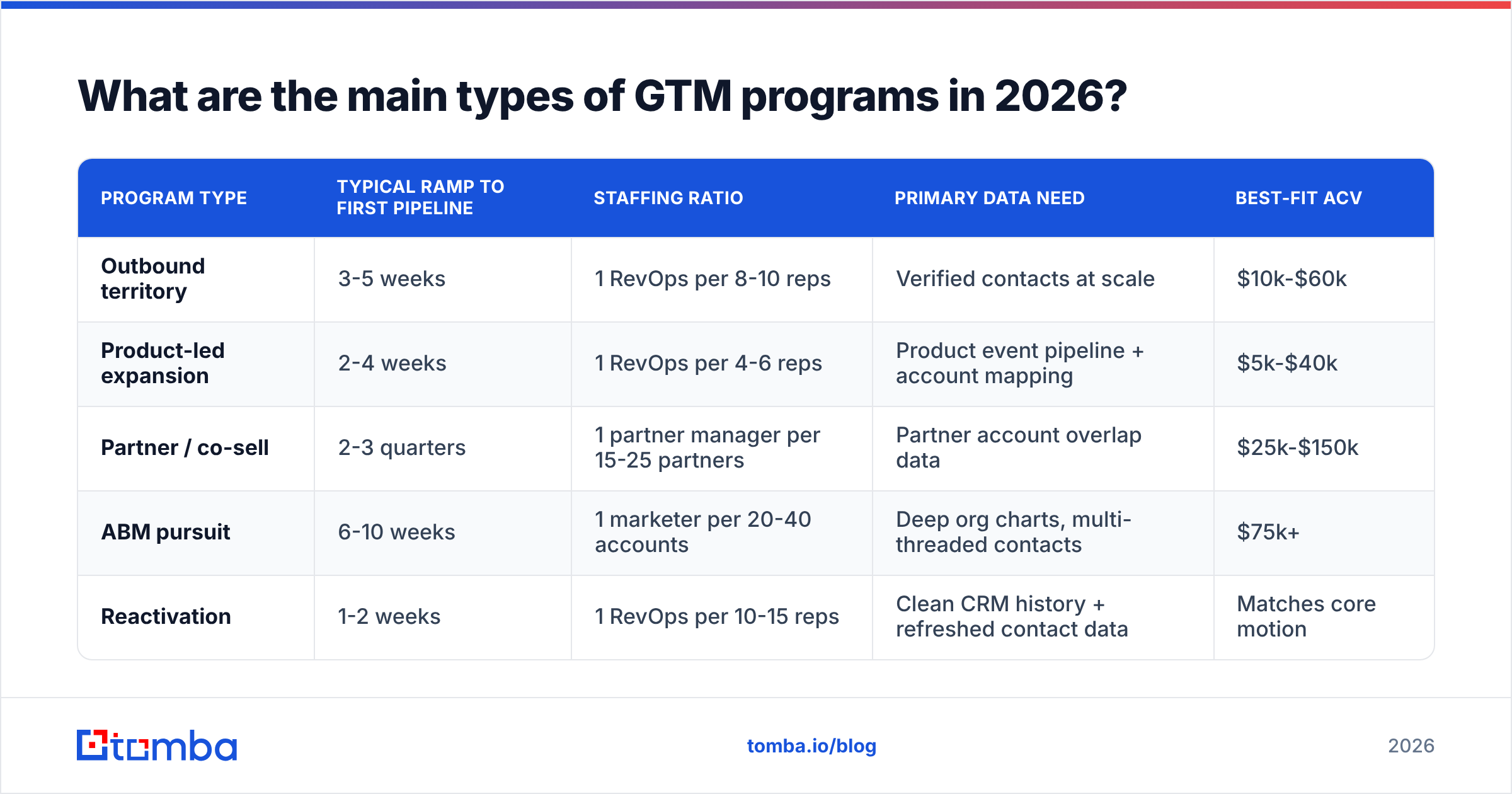
| Program type | Typical ramp to first pipeline | Staffing ratio | Primary data need | Best-fit ACV |
|---|---|---|---|---|
| Outbound territory | 3-5 weeks | 1 RevOps per 8-10 reps | Verified contacts at scale | $10k-$60k |
| Product-led expansion | 2-4 weeks | 1 RevOps per 4-6 reps | Product event pipeline + account mapping | $5k-$40k |
| Partner / co-sell | 2-3 quarters | 1 partner manager per 15-25 partners | Partner account overlap data | $25k-$150k |
| ABM pursuit | 6-10 weeks | 1 marketer per 20-40 accounts | Deep org charts, multi-threaded contacts | $75k+ |
| Reactivation | 1-2 weeks | 1 RevOps per 10-15 reps | Clean CRM history + refreshed contact data | Matches core motion |
How do you scope a GTM program before you fund it?#
Write the program on one page and refuse to fund it until every line is filled. The six lines that matter:
- Segment definition — Firmographic and behavioral criteria that a system can execute, not a paragraph of adjectives. "US SaaS companies, 50-500 employees, using Salesforce, hiring for RevOps" is a scope. "Growth-stage tech companies with modern stacks" is not.
- Play — The specific sequence of touches, in order, with owner per touch. Include the channel mix and the fallback path when a touch fails.
- Owner — One name. Not a committee, not a "working group." The owner has budget authority and can stop the program.
- Data plan — Where contact records come from, who verifies them, at what refresh interval, and what the acceptable bounce threshold is before the program pauses.
- Success metric and kill metric — Both. The kill metric is the one most teams skip, and it is why dead programs consume budget for three extra quarters.
- Review cadence — Weekly operational review, monthly business review. Fixed calendar slots that exist before launch.
If the data plan line is empty, the program will fail on schedule around week five. That is not pessimism, it is arithmetic: a 12% invalid rate on a 20,000-record list is 2,400 sends that damage domain reputation and burn rep hours on records that were never real.
What does the operating model look like week to week?#
The operating model is where programs either become durable or stay heroic. Heroic programs depend on one person caring a lot. Durable programs run on a calendar.
A working weekly cadence for a mid-sized outbound territory program:
- Monday: List hygiene. New accounts enter the program, stale records exit, verification runs on the incoming batch.
- Tuesday-Thursday: Execution windows. Reps work the cadence. No list-building during execution windows — that is the single most common leak of rep time.
- Friday: Program review. Three numbers only: qualified conversations created, cost per conversation, and data quality rate (valid contacts / total contacts attempted).
Monthly, the owner reviews segment performance and rebalances. Quarterly, the program is re-funded, re-scoped, or killed against its kill metric.
HubSpot's research on sales productivity has repeatedly landed on the same finding: sellers spend well under half their time actually selling, with the remainder going to admin and data work. (HubSpot) A program that pushes list-building into the rep's execution window is choosing, by design, to make that ratio worse.
How should you measure GTM programs?#
Measure three tiers, and never let tier three become the headline number.
Tier 1 — Outcome metrics (report these to the business)
- Qualified pipeline created, dated to program entry
- Cost per qualified conversation (fully loaded: tooling, data, rep time)
- Program win rate versus baseline
Tier 2 — Efficiency metrics (report these to the program owner)
- Pipeline per rep-week
- Contact-to-conversation rate
- Data validity rate at send time
Tier 3 — Activity metrics (use for diagnosis only)
- Sends, calls, connects, opens
Tier three is diagnostic. When pipeline per rep-week drops, activity metrics tell you where — but an activity metric as a program's headline number reliably produces the behavior you would expect: more activity, less pipeline.
One measurement rule worth enforcing: date pipeline to program entry, not to close. A program that generated its pipeline in March gets credit in March, even if the deal closes in Q3. Otherwise you will kill working programs during their payback window.
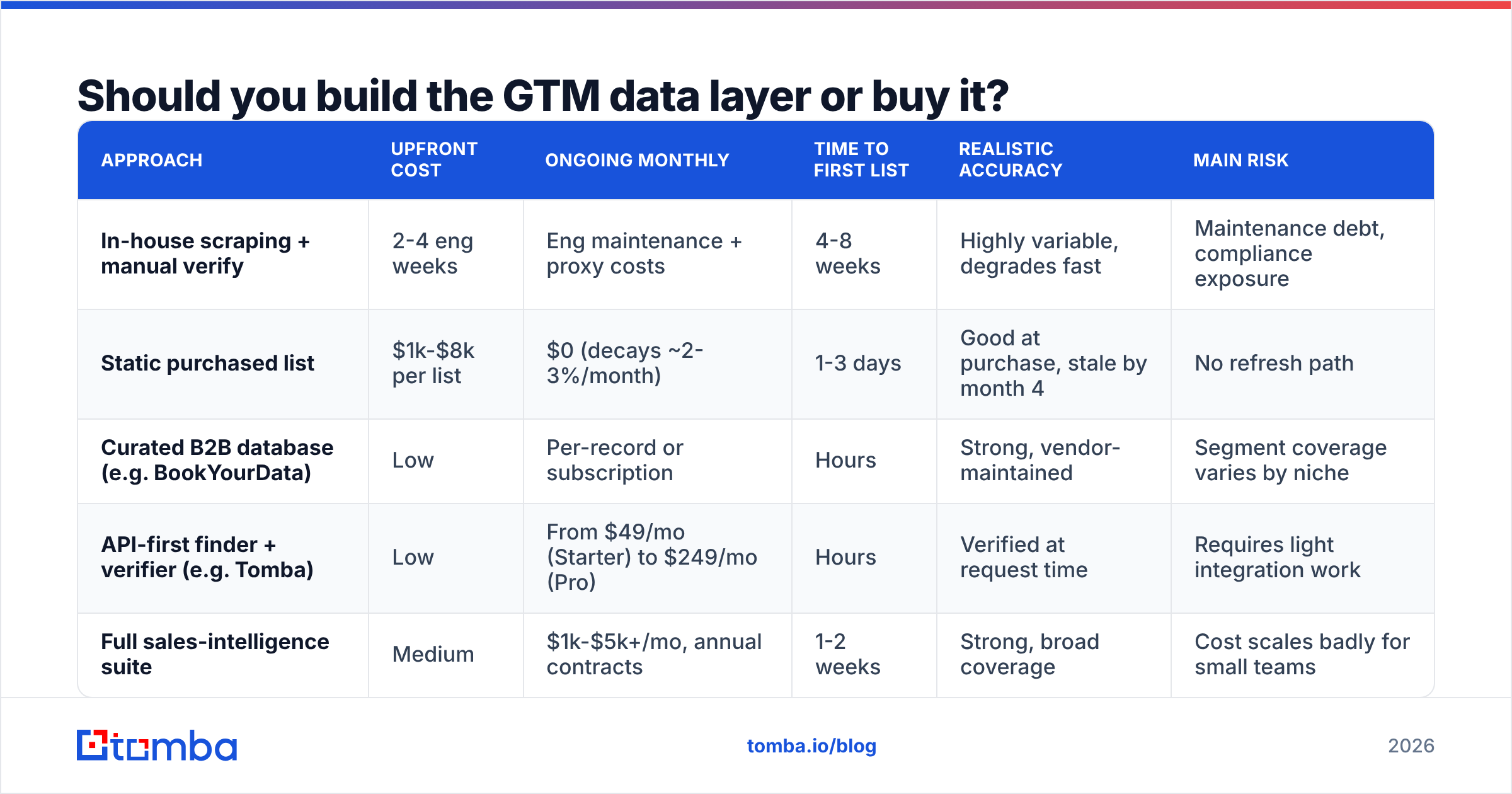
Should you build the GTM data layer or buy it?#
Build the logic, buy the data. Almost nobody wins by scraping and maintaining their own contact graph, and almost nobody wins by outsourcing their scoring and routing logic to a vendor's black box.
Here is the honest cost comparison for a program touching roughly 10,000 new contacts per quarter:
| Approach | Upfront cost | Ongoing monthly | Time to first list | Realistic accuracy | Main risk |
|---|---|---|---|---|---|
| In-house scraping + manual verify | 2-4 eng weeks | Eng maintenance + proxy costs | 4-8 weeks | Highly variable, degrades fast | Maintenance debt, compliance exposure |
| Static purchased list | $1k-$8k per list | $0 (decays ~2-3%/month) | 1-3 days | Good at purchase, stale by month 4 | No refresh path |
| Curated B2B database (e.g. BookYourData) | Low | Per-record or subscription | Hours | Strong, vendor-maintained | Segment coverage varies by niche |
| API-first finder + verifier (e.g. Tomba) | Low | From $49/mo (Starter) to $249/mo (Pro) | Hours | Verified at request time | Requires light integration work |
| Full sales-intelligence suite | Medium | $1k-$5k+/mo, annual contracts | 1-2 weeks | Strong, broad coverage | Cost scales badly for small teams |
The pragmatic answer for most teams running two or three concurrent programs is a hybrid: a curated database for bulk segment coverage plus an API-first finder and verifier in the pipeline for just-in-time resolution and refresh. Buying a static list and never refreshing it is the option that looks cheapest on the invoice and most expensive in the pipeline report.
For a sense of where different vendors land on coverage and pricing model, G2's category listings are a reasonable neutral starting point — with the usual caveat that review-site rankings skew toward vendors with the largest review-solicitation budgets.

What data hygiene does a GTM program actually require?#
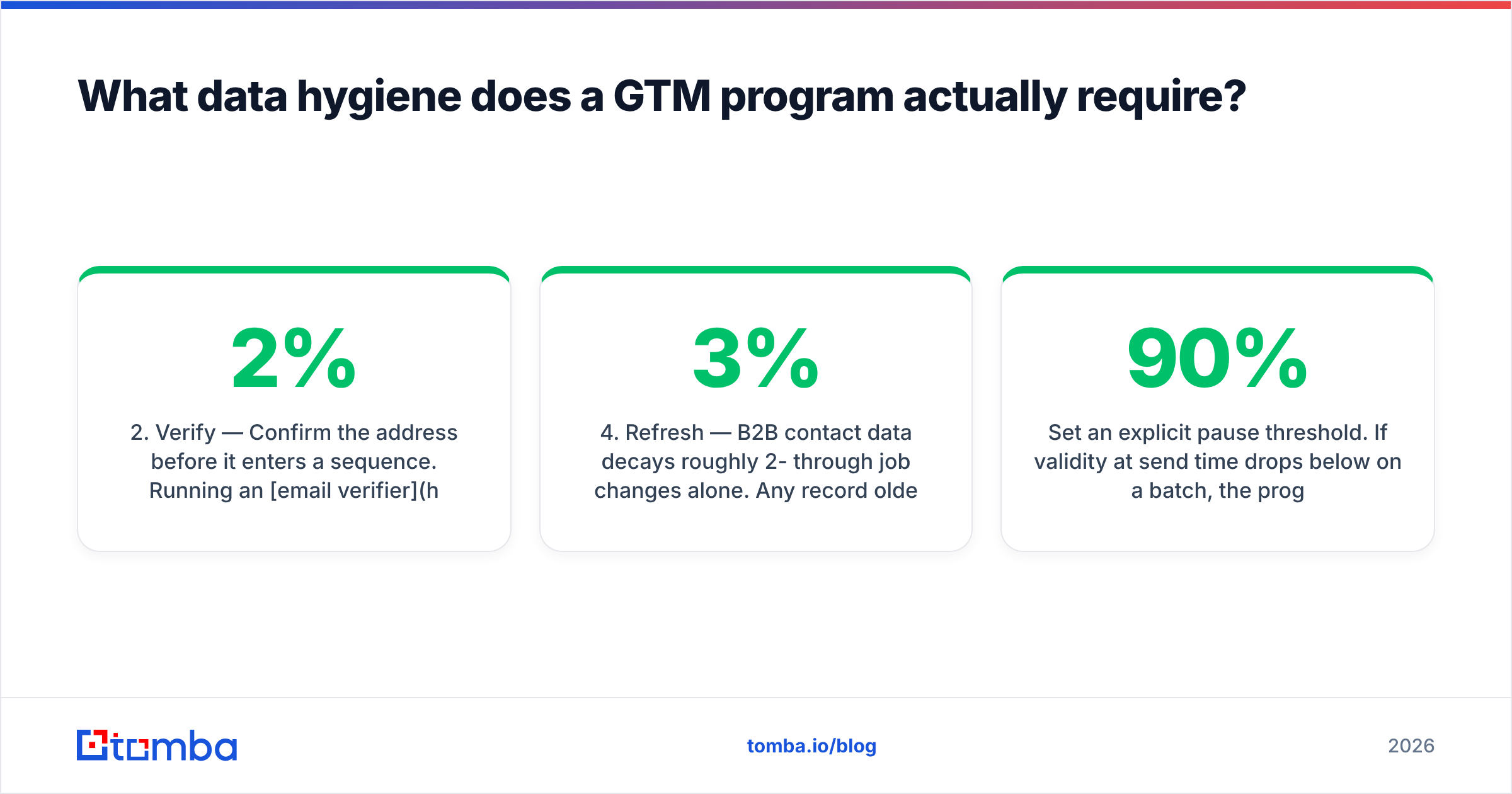
Four things, in this order, run on a schedule rather than on panic:
- Resolve — Turn a company plus a name into a deliverable address. An email finder that works from domain and name patterns handles the bulk of this without manual research.
- Verify — Confirm the address before it enters a sequence. Running an email verifier on every batch, not just the first one, is the difference between a 2% bounce rate and a 12% one.
- Enrich — Add the firmographic and role fields your routing and scoring rules depend on. Contact enrichment at the point of entry beats a quarterly backfill project.
- Refresh — B2B contact data decays roughly 2-3% per month through job changes alone. Any record older than two quarters should be re-verified before reuse.
Set an explicit pause threshold. If validity at send time drops below 90% on a batch, the program pauses and the batch goes back through verification. Programs without a pause threshold discover the problem through their email service provider's warning email, which is a considerably more expensive way to find out.
What kills GTM programs that look healthy on paper?#
- Segment drift. The program was scoped for 200-person SaaS companies and is now emailing 20-person agencies because that is what was left in the list. Audit the actual sends against the scope monthly.
- Owner dilution. The owner gets a second program, then a third. Two programs per owner is the practical ceiling.
- Metric substitution. Activity becomes the reported number because it is the number that is going up.
- Untracked data cost. Data spend gets absorbed into a general tooling line, so cost per conversation is understated and the program looks more efficient than it is.
- No kill metric. Nothing gets shut down, so nothing gets properly funded.
None of these are exotic. They are all detectable in a 20-minute monthly review — which is precisely why the review cadence belongs in the scoping document rather than in someone's good intentions.
Where should you start if you have no programs today?#
Run one. Pick the archetype that matches your ACV from the table above, scope it on one page, fund it for a single quarter, and instrument the three tier-one metrics from day one. A single well-instrumented program teaches you more about your market in twelve weeks than four half-measured ones teach you in a year.
Then build the second program on the first one's infrastructure — the same data pipeline, the same review cadence, the same definitions. That reuse is the entire point of thinking in programs instead of campaigns.
Getting the contact layer right before you launch: every program on this page depends on reaching a real person at a real company. Tomba's Email Finder resolves professional addresses from a domain and a name, verifies them at request time, and runs through an API, CRM integrations, or a spreadsheet add-in — so list-building stays out of your reps' execution windows. Start on the free tier (25 searches/month) to test coverage against your actual segment, and check Tomba pricing when you're ready to scale a program past the pilot list.
Related guides#
Ready to find emails that actually work?
Join 150,000+ professionals who stopped guessing and started sending. Free credits on signup — no credit card required.
Get the Tomba newsletter
Practical outbound tactics and product updates — once every two weeks.
About the author