GTM Roles in 2026: Who Does What on a Modern Revenue Team
AE, SDR, RevOps, GTM engineer, PMM, CS — the titles multiplied faster than the headcount. Here is what each GTM role actually owns in 2026, which ones overlap, and how to staff a team without duplicating work.

TL;DR
- A modern GTM org has six functional seats: demand/PMM, SDR/BDR, AE, RevOps, GTM engineering, and post-sale CS/AM. Titles vary wildly; the ownership boundaries do not.
- The fastest-growing seat is the GTM engineer — part RevOps, part data plumber, part automation builder. It did not exist as a standard title in 2020.
- Most seed-to-Series-A teams over-hire AEs and under-hire RevOps. The result is six reps sharing one broken list and blaming the market.
- Overlap is where GTM teams bleed money: SDR vs. GTM engineer on list building, RevOps vs. Marketing Ops on attribution, AE vs. CSM on expansion.
- The cheapest fix is not a new hire — it's clean contact data and one owner for the data layer.
What are GTM roles, exactly?#
GTM roles are the seats on a revenue team that take a product from "built" to "bought and renewed." They span marketing, sales, operations, and customer success, and they are defined by ownership of a stage in the revenue motion — not by which department they report into.
That distinction matters because reporting lines lie. A "Growth Marketer" at one company builds paid landing pages; at another, they write Clay enrichment waterfalls and push contacts into HubSpot. Same title, entirely different job. When you hire against a title instead of an ownership boundary, you end up with two people building lists and nobody maintaining the CRM.
The useful mental model: think of a GTM team like a restaurant. Marketing writes the menu and gets people through the door. SDRs greet and seat. AEs take the order and close the check. RevOps designs the kitchen workflow so nothing gets dropped. GTM engineering builds the ticket printer and the inventory system. CS makes sure the diner comes back. Every one of those jobs exists in every restaurant — big kitchens just split them across more people.
What does each GTM role own in 2026?#
Here is the ownership map most B2B teams converge on once they cross roughly $3M ARR. Use it as a boundary document, not a hierarchy.
- Product Marketing (PMM) — Owns positioning, ICP definition, messaging, competitive intel, and launch coordination. Deliverable: the one-page ICP doc every other seat reads. If your SDRs are inventing their own value props, PMM is missing or ignored.
- Demand Gen / Growth Marketing — Owns pipeline sourced from marketing: paid, SEO, events, webinars, lifecycle email. Measured on qualified pipeline dollars, not MQL count. If they're still reporting raw marketing qualified lead volume, the scoring model needs a rebuild.
- SDR / BDR — Owns first-touch outbound and inbound response speed. Measured on meetings held and pipeline created, not activity counts. In 2026, the best SDRs spend under 20% of their time list-building because tooling handles it.
- Account Executive (AE) — Owns the deal from discovery to signature: multithreading, business case, procurement, close. Measured on win rate, cycle length, and ACV.
- RevOps — Owns the system of record, forecasting, territory and quota design, and the definitions everyone argues about. Measured on forecast accuracy and data hygiene. This is the seat companies delay hiring and then regret.
- GTM Engineering — Owns the data and automation layer: enrichment pipelines, API integrations, signal ingestion, AI agent workflows, and routing logic. Measured on coverage rate, data freshness, and hours of manual work eliminated.
- Customer Success / Account Management — Owns onboarding, adoption, renewal, and expansion. Measured on net revenue retention. The AE/CSM expansion boundary is the single most common source of comp disputes.
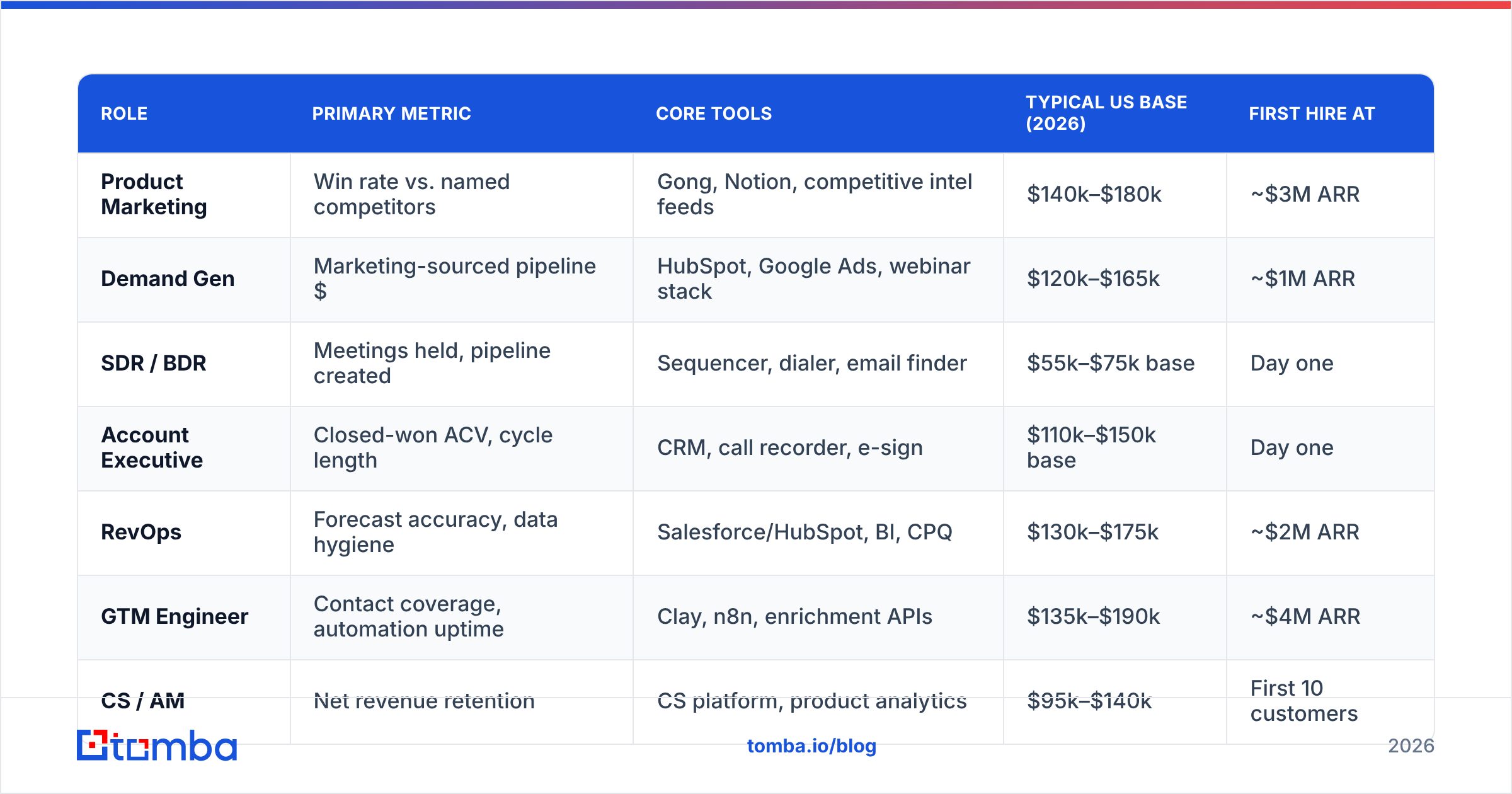
How do GTM roles compare on scope, tooling, and cost?#
| Role | Primary metric | Core tools | Typical US base (2026) | First hire at |
|---|---|---|---|---|
| Product Marketing | Win rate vs. named competitors | Gong, Notion, competitive intel feeds | $140k–$180k | ~$3M ARR |
| Demand Gen | Marketing-sourced pipeline $ | HubSpot, Google Ads, webinar stack | $120k–$165k | ~$1M ARR |
| SDR / BDR | Meetings held, pipeline created | Sequencer, dialer, email finder | $55k–$75k base | Day one |
| Account Executive | Closed-won ACV, cycle length | CRM, call recorder, e-sign | $110k–$150k base | Day one |
| RevOps | Forecast accuracy, data hygiene | Salesforce/HubSpot, BI, CPQ | $130k–$175k | ~$2M ARR |
| GTM Engineer | Contact coverage, automation uptime | Clay, n8n, enrichment APIs | $135k–$190k | ~$4M ARR |
| CS / AM | Net revenue retention | CS platform, product analytics | $95k–$140k | First 10 customers |
Two caveats. First, base salary ranges compress hard outside major US metros — a remote-first team in Eastern Europe or LATAM runs 40–60% below these numbers for equivalent skill. Second, "first hire at" assumes a mid-ACV B2B SaaS motion. If you sell $200k enterprise deals, RevOps and PMM come earlier; if you sell $99/month self-serve, half this table collapses into two generalists.
Why did GTM engineering become a real role?#
Because the data layer stopped being a spreadsheet problem and became an infrastructure problem.
Five years ago, an SDR built a list by exporting from a database, pasting into a sheet, and hand-checking a few rows. In 2026, the same list involves scraping a signal source, enriching against three providers in a waterfall, verifying deliverability, deduplicating against CRM, scoring against ICP fit, and routing to the right sequence — all triggered automatically. That is an engineering job, and asking a quota-carrying SDR to do it is how you get 30% bounce rates.
The GTM engineer sits between RevOps and the reps. RevOps decides what the process should be; GTM engineering builds the thing that runs it. Practically, that means owning API keys, enrichment budgets, and the contact enrichment pipeline that feeds every downstream seat. A good one will also own the verification step — running lists through an email verifier before they hit a sequencer is the highest-ROI 10 minutes in the whole stack.
The role has a clear failure mode: automation for its own sake. If your GTM engineer has shipped eleven workflows and none of them map to a metric on the table above, they are building a hobby, not a pipeline.

Where do GTM roles overlap and cause damage?#
Three collisions account for most of the wasted spend I see on B2B teams.
List building: SDR vs. GTM engineer. When both build lists, you get two conflicting definitions of ICP and duplicate credits burned on the same accounts. Fix: GTM engineering owns list generation; SDRs own list qualification and personalization. The handoff artifact is a CRM view, not a spreadsheet.
Attribution: RevOps vs. Marketing Ops. Two teams reporting two pipeline numbers to the same board meeting is a governance failure, not a tooling failure. Fix: RevOps owns the single definition of a qualified opportunity. Marketing Ops owns channel-level measurement inside that definition.
Expansion: AE vs. CSM. If both are comped on upsell, they will both call the same buyer in the same week. Fix: pick a threshold — new logos and net-new business units to the AE, in-account seat and tier expansion to the CSM — and write it into both comp plans before the quarter starts.
The pattern is identical each time: the problem is never that the people are bad, it's that nobody wrote down who owns the boundary. Revenue operations exists precisely to be the function that writes it down.
What GTM roles should you hire first?#
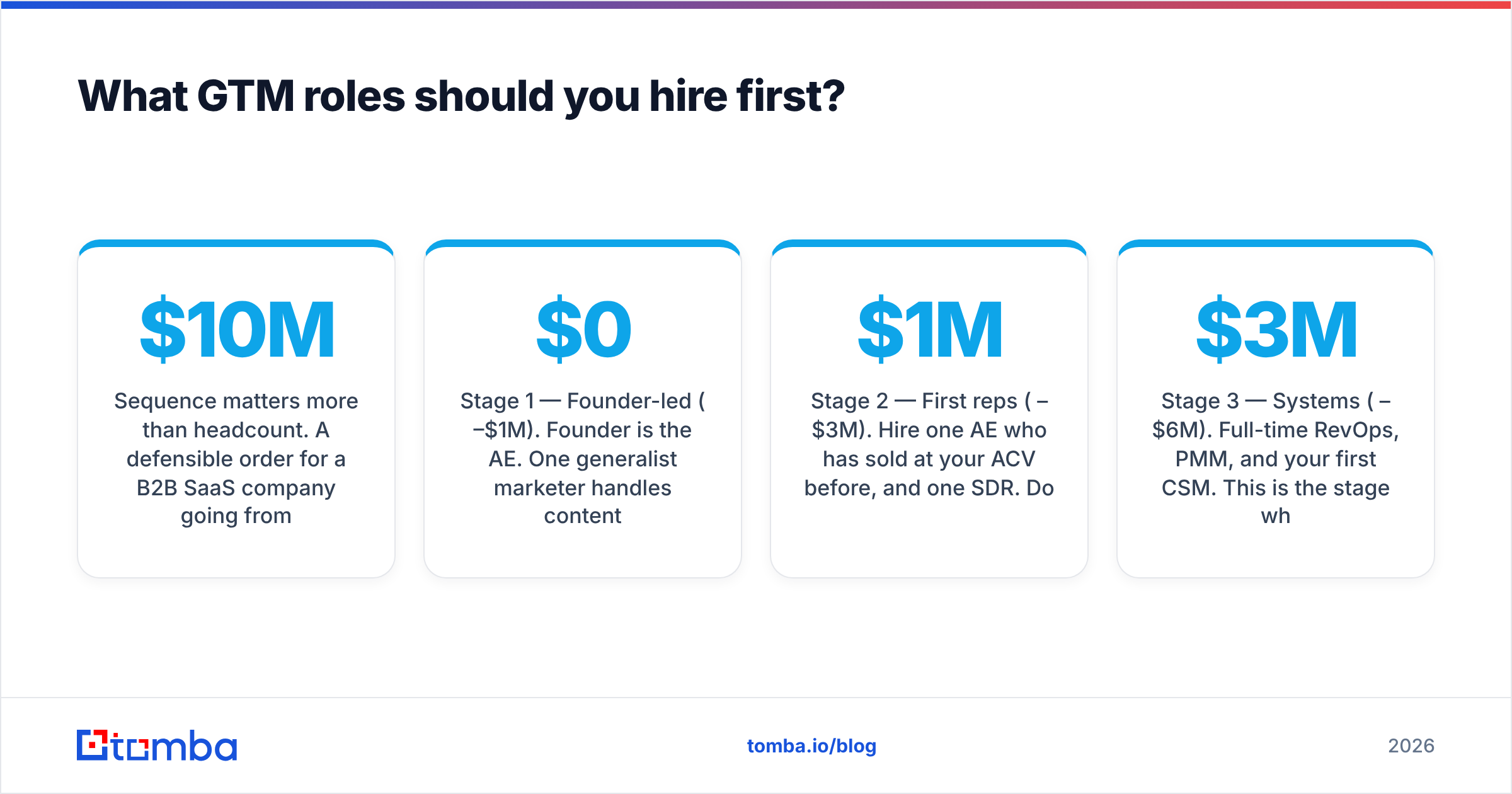
Sequence matters more than headcount. A defensible order for a B2B SaaS company going from zero to $10M:
Stage 1 — Founder-led ($0–$1M). Founder is the AE. One generalist marketer handles content and demand. No SDRs — founders should feel the objections directly. Tooling: a CRM and an email finder. That's it.
Stage 2 — First reps ($1M–$3M). Hire one AE who has sold at your ACV before, and one SDR. Do not hire three SDRs to "test outbound" — one good SDR with clean data outperforms three with a scraped list. Add a fractional RevOps contractor before you add the second AE.
Stage 3 — Systems ($3M–$6M). Full-time RevOps, PMM, and your first CSM. This is the stage where forecast accuracy either becomes a discipline or becomes a joke. According to HubSpot's sales research, data quality and process consistency separate teams that scale from teams that plateau — and neither is a rep problem.
Stage 4 — Leverage ($6M–$10M+). GTM engineering, sales enablement, and specialization inside AE (new business vs. expansion). By now enrichment is a budget line, not a credit card expense, and you're likely running bulk workflows through a bulk email finder or an API rather than one-off lookups.
The single most common mistake: hiring stage-4 roles at stage 2. A GTM engineer with no process to automate will spend six months building infrastructure for a motion you haven't validated.
How do you measure whether your GTM roles are working?#
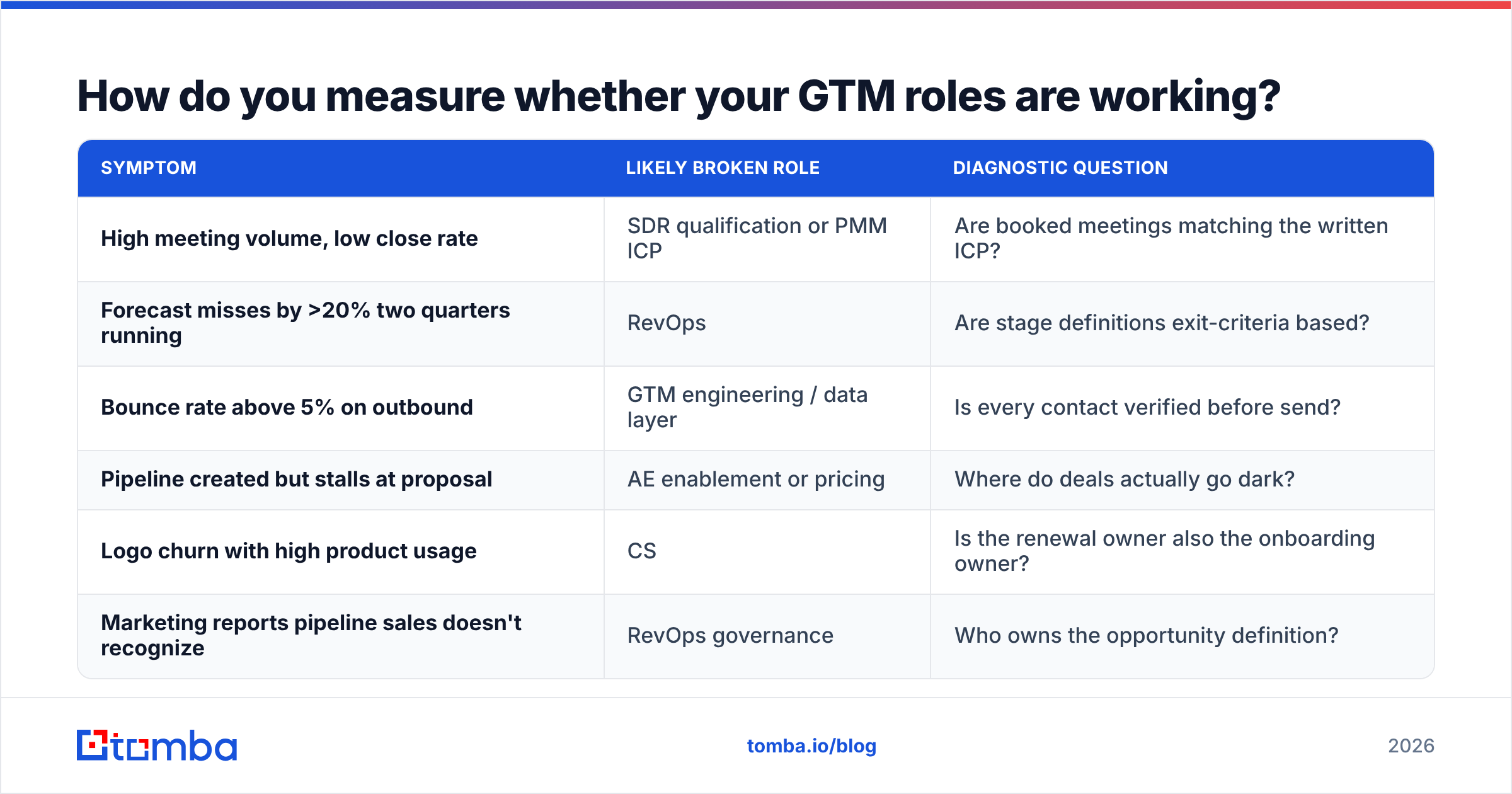
Assign one primary metric per seat and refuse to let it be shared. Shared metrics create shared excuses.
| Symptom | Likely broken role | Diagnostic question |
|---|---|---|
| High meeting volume, low close rate | SDR qualification or PMM ICP | Are booked meetings matching the written ICP? |
| Forecast misses by >20% two quarters running | RevOps | Are stage definitions exit-criteria based? |
| Bounce rate above 5% on outbound | GTM engineering / data layer | Is every contact verified before send? |
| Pipeline created but stalls at proposal | AE enablement or pricing | Where do deals actually go dark? |
| Logo churn with high product usage | CS | Is the renewal owner also the onboarding owner? |
| Marketing reports pipeline sales doesn't recognize | RevOps governance | Who owns the opportunity definition? |
Note the third row. Deliverability problems are almost never a copywriting problem first — they are a data problem. If you're seeing bounces, the issue sits upstream in whoever owns enrichment, and no amount of subject-line testing fixes it. Peer benchmarking sources like G2's category data are useful for pressure-testing which part of the stack your team is actually underserving.
How is AI changing GTM roles in 2026?#
AI has compressed the bottom of each role, not eliminated the role.
- SDR: research and first-draft personalization are automated. What remains — and what now defines a good SDR — is judgment about which accounts deserve a human touch and how to handle a live objection.
- AE: call summaries, CRM updates, and follow-up drafting are automated. Multithreading and commercial negotiation are not.
- RevOps: report building is automated. Deciding what to measure is not.
- GTM engineering: this role grew because of AI. Someone has to own the agents, the prompts, the eval loops, and the cost per enriched record.
- PMM and CS: least disrupted. Both depend on synthesizing messy human signal, which models still do unevenly.
The honest read: teams that replaced SDRs entirely with AI sequencers in 2024–2025 mostly saw a short spike then a hard decline, because volume without data quality just accelerates domain burn. The teams that won used AI to raise per-rep leverage and spent the savings on better data, not more sends. If you want to sanity-check your own sending health before scaling, start with a sender reputation check rather than a headcount plan.
What does a lean 2026 GTM org actually look like?#
For a $5M ARR B2B SaaS company with a $25k ACV, a defensible structure is roughly: 1 VP Revenue, 3 AEs, 2 SDRs, 1 RevOps, 1 PMM, 1 Demand Gen, 2 CSMs, and a fractional or shared GTM engineer. Eleven people covering seven functions.
What that org does not have is a dedicated data-entry seat, three overlapping enrichment vendors, or two people arguing about attribution. It has one owner per boundary and one source of contact truth.
That last part is where most teams under-invest. Every seat on the list above depends on the same input: accurate, verified contact records. The SDR can't book without them, the AE can't multithread without them, RevOps can't forecast on a CRM full of bounced addresses, and the GTM engineer's entire pipeline is garbage-in-garbage-out. Buying a $190k GTM engineer to enrich a decayed database is an expensive way to move bad data faster.
Where should you start?#
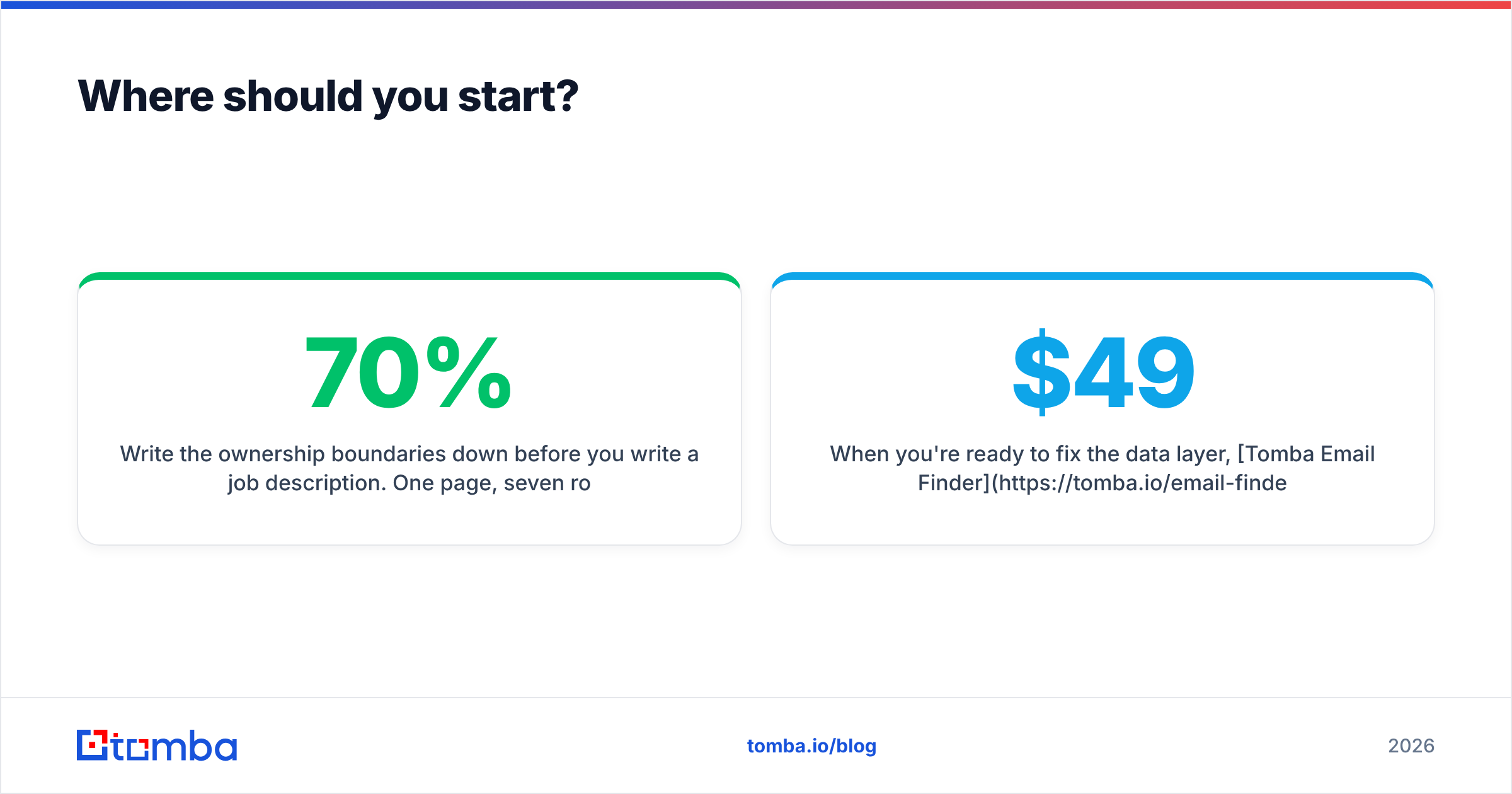
Write the ownership boundaries down before you write a job description. One page, seven rows, one metric each. Then audit your contact data — if coverage is under 70% or bounce rate is over 3%, fix that before you add headcount, because every new hire will inherit the same broken input.
When you're ready to fix the data layer, Tomba Email Finder is the practical starting point: search by domain, name, or company, verify before you send, and push clean records into your CRM through the Tomba API or a HubSpot integration. The free tier gives you 25 searches a month to test coverage against your actual ICP; Starter runs $49/mo, Growth $99/mo, and Pro $249/mo when you're ready to scale — full Tomba pricing is public, no sales call required. Fix the input, then hire the seats.
Related guides#
Ready to find emails that actually work?
Join 150,000+ professionals who stopped guessing and started sending. Free credits on signup — no credit card required.
Get the Tomba newsletter
Practical outbound tactics and product updates — once every two weeks.
About the author