GTM Strategies in 2026: A Practical Playbook for B2B Teams
Most GTM strategies fail on execution, not vision. Here is how product-led, sales-led, and hybrid motions actually compare in 2026 — with the data layer, metrics, and cost math behind each one.
TL;DR
- A go-to-market strategy is not a deck. It is four decisions locked together: who you sell to, how they buy, who touches them, and what you charge.
- The three viable motions in 2026 are product-led, sales-led, and hybrid. Hybrid wins most mid-market B2B cases because pure PLG stalls above $25K ACV and pure sales-led breaks below $10K.
- Your GTM strategy is only as good as the contact data feeding it. Bad emails silently kill outbound before messaging ever gets tested.
- Pick one primary motion, one primary channel, and one primary metric per quarter. Teams running four motions at once run none of them well.
- Measure CAC payback and pipeline coverage, not activity volume. Activity metrics reward busywork.
What Is a GTM Strategy, Actually?#
A go-to-market strategy is the specific plan for how a company turns a product into revenue: which segment it targets, which channels reach that segment, which humans or systems do the selling, and how pricing and packaging convert interest into a contract.
Think of it like a restaurant deciding between a takeaway window, table service, and a delivery-only ghost kitchen. Same food. Completely different staffing, pricing, real estate, and marketing. Pick the wrong format for your neighborhood and the food quality never gets a chance to matter.
Most teams confuse GTM strategy with GTM tactics. Running LinkedIn ads is a tactic. Deciding that 40-person engineering teams in fintech buy through a bottom-up trial and a security review is a strategy. Tactics change monthly. Strategy should hold for at least two or three quarters.
The four decisions that make up a real GTM strategy:
- Segment — the narrowest group of buyers who share a problem, a budget, and a trigger event. "Mid-market SaaS" is not a segment. "Series B SaaS companies that just hired their first RevOps lead" is.
- Motion — product-led, sales-led, partner-led, community-led, or a hybrid. This determines your entire cost structure.
- Channel — outbound email, paid search, content, marketplaces, events, or partner co-sell. One primary, one secondary, everything else off.
- Pricing and packaging — self-serve tiers, annual contracts, usage-based, or seat-based. This has to match the motion. Self-serve pricing with a 90-day enterprise sales cycle is a contradiction.
Get those four aligned and mediocre execution still produces revenue. Get them misaligned and world-class execution produces churn.

Which GTM Motion Should You Choose in 2026?#
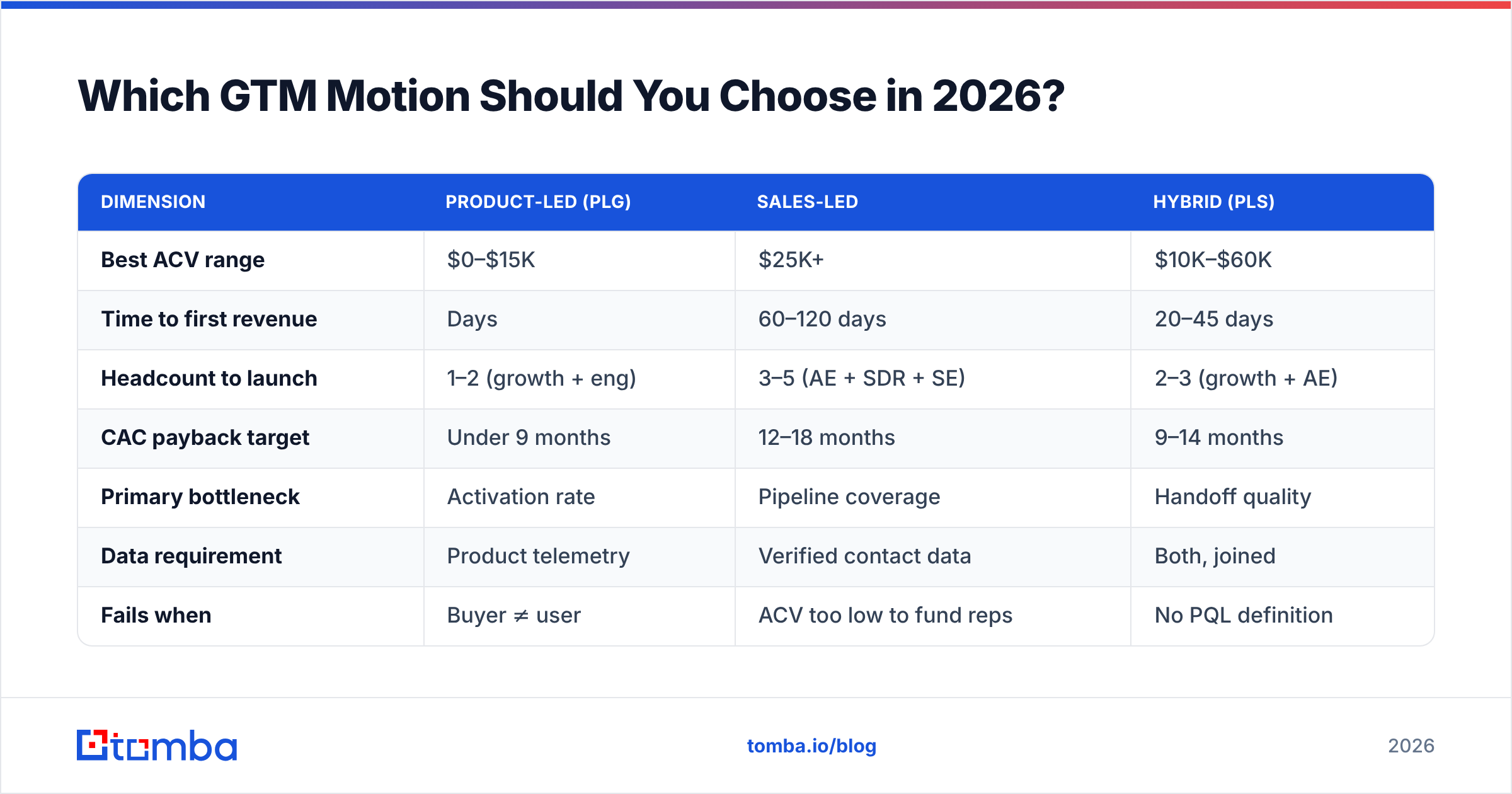
The honest answer depends on your average contract value and how much your buyer needs to be taught. Here is the comparison most founders need before they commit headcount.
| Dimension | Product-Led (PLG) | Sales-Led | Hybrid (PLS) |
|---|---|---|---|
| Best ACV range | $0–$15K | $25K+ | $10K–$60K |
| Time to first revenue | Days | 60–120 days | 20–45 days |
| Headcount to launch | 1–2 (growth + eng) | 3–5 (AE + SDR + SE) | 2–3 (growth + AE) |
| CAC payback target | Under 9 months | 12–18 months | 9–14 months |
| Primary bottleneck | Activation rate | Pipeline coverage | Handoff quality |
| Data requirement | Product telemetry | Verified contact data | Both, joined |
| Fails when | Buyer ≠ user | ACV too low to fund reps | No PQL definition |
| Typical win rate | 3–7% visitor→paid | 18–25% opp→closed | 25–35% PQL→closed |
Three practical readings of that table:
If your ACV is under $15K, sales-led will bankrupt you. A fully loaded AE in North America costs $180K–$250K. At $12K ACV with a 20% win rate, that rep needs to close roughly 20 deals a year just to cover themselves before you count marketing, tooling, or management. The math only works if the deal size grows or the human cost disappears.
If your buyer is not your user, PLG stalls. Security software, compliance tooling, and most finance products are bought by someone who will never open the app daily. A free trial does not reach the person with the budget. You need outbound to the buyer while the user champions internally.
Hybrid is the default for a reason, and it is also the hardest to run. Product-led sales means the product generates qualified signals and a human closes. The failure mode is always the handoff: nobody defines what a product-qualified lead actually is, so reps chase every signup and the motion degrades into bad outbound with extra steps.
The 2026 shift worth planning around#
Two things changed materially in the last 24 months. First, buying committees grew — Gartner's B2B buying research has tracked committees of six to ten people for enterprise deals, and mid-market has followed the same direction. That means single-threaded deals die more often than they used to.
Second, reply rates on generic outbound collapsed. Inbox providers tightened bulk-sender enforcement, and buyers got faster at pattern-matching AI-written cold email. The response is not more volume. It is fewer, better-targeted sends to verified addresses — which pushes data quality from a back-office concern to a GTM strategy decision.
How Do You Build the Data Layer Under a GTM Strategy?#
Every GTM motion runs on a contact and account dataset. If that layer is wrong, everything above it — targeting, sequencing, attribution, forecasting — is measuring noise.
Here is the practical build order most teams should follow:
- Define the account list before you buy any data. Write the firmographic filters explicitly: employee count, funding stage, tech stack, geography, and trigger event. If you cannot write it in one sentence, your segment is too broad.
- Source contacts, then verify them separately. These are two different jobs. A domain search gives you the people at a target account; an email verifier tells you which of those addresses will actually accept mail. Skipping the second step is the single most common cause of a burned sending domain.
- Enrich for routing, not for vanity. You need enough attributes to route the lead and personalize the first line. Title, seniority, department, and one recent trigger beat 40 empty columns. Contact enrichment should feed your scoring model, not your slide deck.
- Deduplicate before the CRM, not after. Two records for the same human means two sequences, two reps, and one very annoyed prospect. Clean at ingestion.
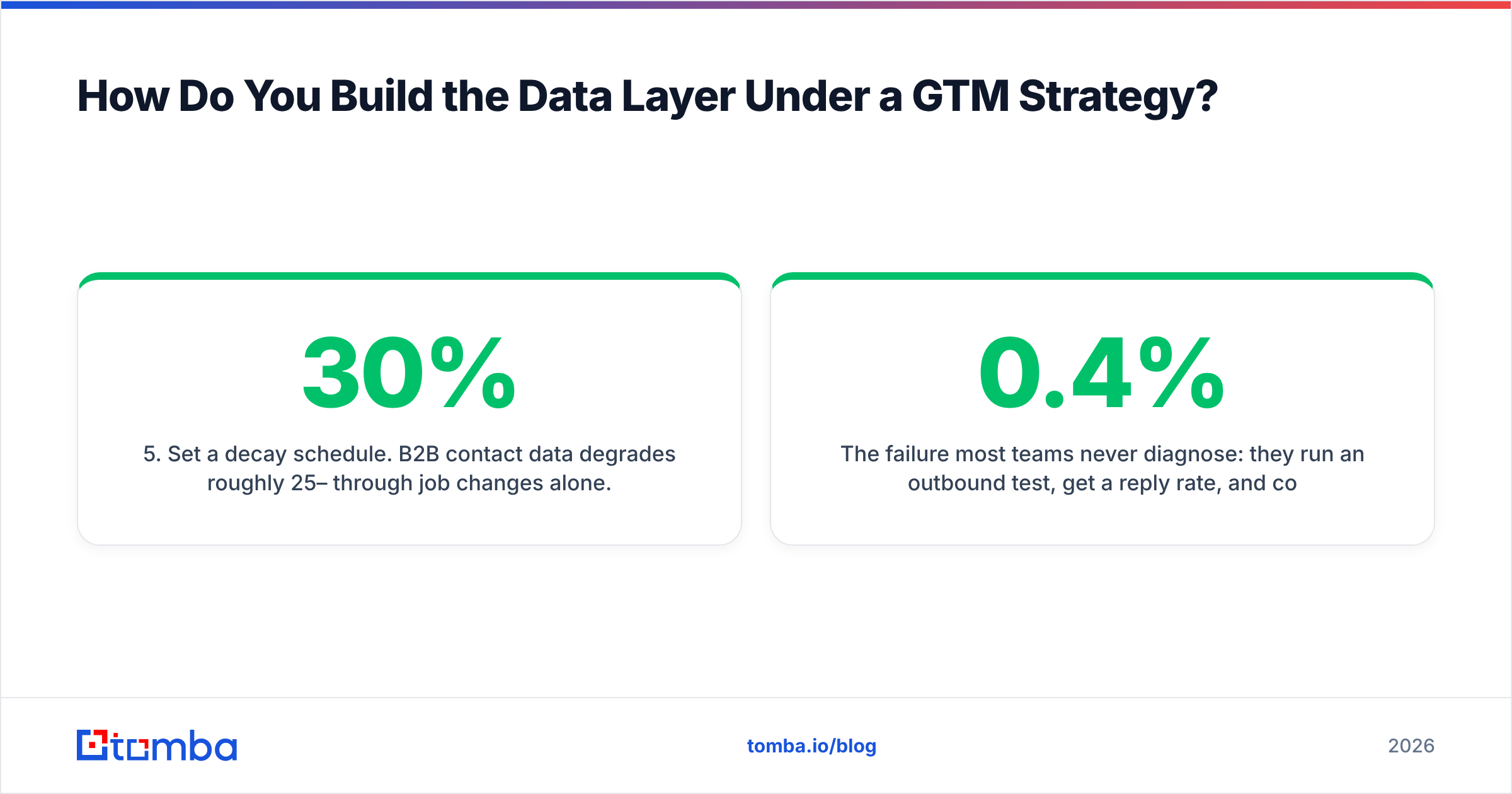
- Set a decay schedule. B2B contact data degrades roughly 25–30% per year through job changes alone. Re-verify your active list quarterly, and your dormant list before every reactivation campaign.
The failure most teams never diagnose: they run an outbound test, get a 0.4% reply rate, and conclude the message or the segment is wrong. Then they rewrite the copy four times. The actual problem was that 31% of the list bounced or never reached an inbox, so the sample size on the real test was a third of what they thought.
Verification is not a deliverability nicety. It is a prerequisite for learning anything from your GTM experiments. If you want the mechanics behind bounce handling and sender health, the email deliverability fundamentals matter more than any subject-line trick.
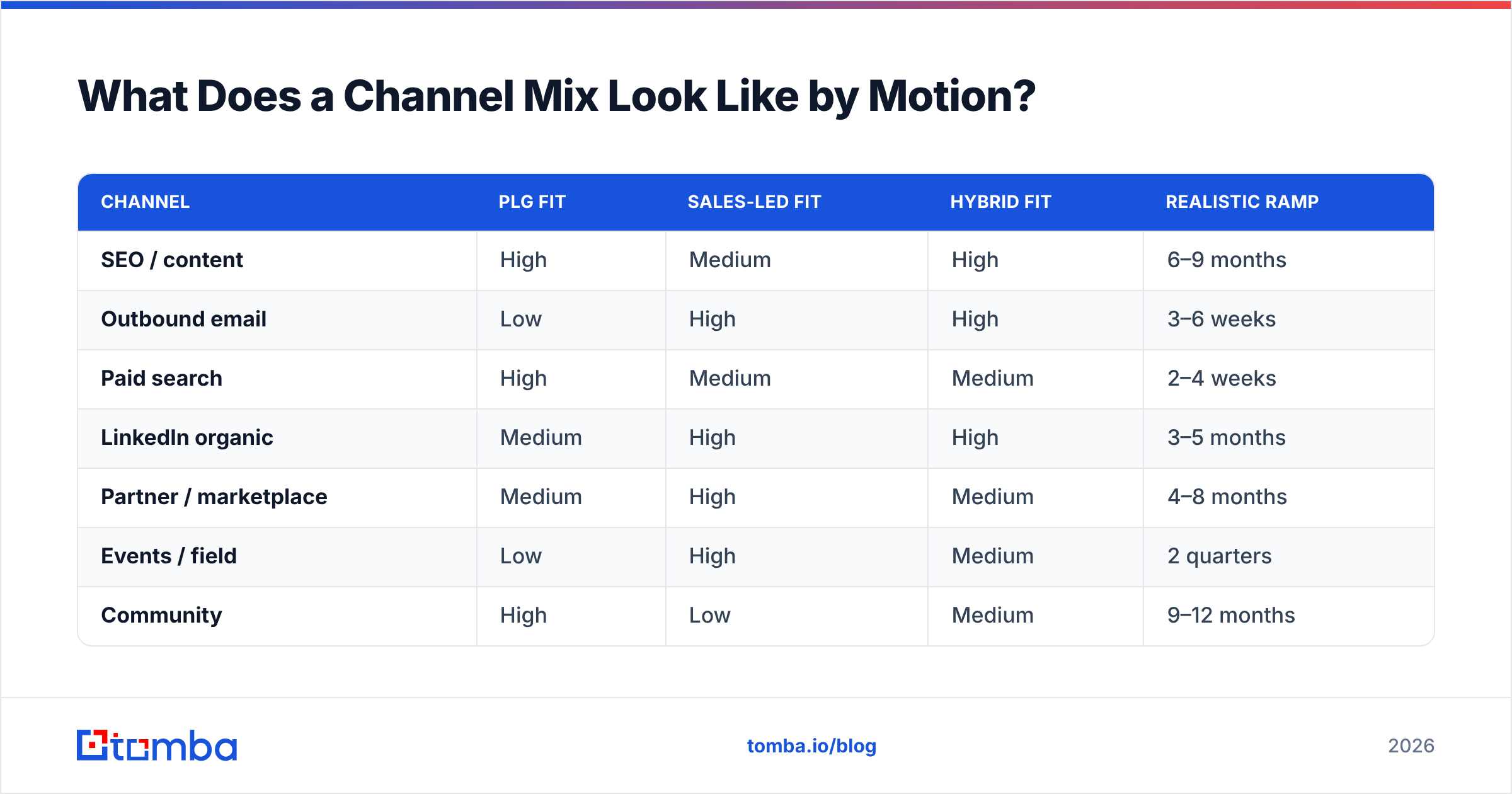
What Does a Channel Mix Look Like by Motion?#
Channel selection should follow from motion, not from what your competitor posted about on LinkedIn last week.
| Channel | PLG fit | Sales-led fit | Hybrid fit | Realistic ramp |
|---|---|---|---|---|
| SEO / content | High | Medium | High | 6–9 months |
| Outbound email | Low | High | High | 3–6 weeks |
| Paid search | High | Medium | Medium | 2–4 weeks |
| LinkedIn organic | Medium | High | High | 3–5 months |
| Partner / marketplace | Medium | High | Medium | 4–8 months |
| Events / field | Low | High | Medium | 2 quarters |
| Community | High | Low | Medium | 9–12 months |
Two rules that save quarters:
Do not start a channel with a ramp longer than your runway. Content and community compound beautifully and pay nothing for the first two quarters. If you need pipeline in six weeks, outbound and paid are the only honest answers.
One primary channel until it is boring. A channel is working when you can predict next month's output within 20%. Until then, adding a second channel just splits attention and makes attribution unreadable.
Outbound deserves a specific note because it is the fastest channel to stand up and the fastest to ruin. The sequence that works in 2026 is small batches to verified contacts, one clear trigger-based reason for the email, and a genuine opt-down. The sequence that fails is 3,000 sends a week to a purchased list on a domain you also use for billing.
If you are building outbound lists, a bulk email finder run against a defined account list beats a generic database export every time, because you control the account selection instead of inheriting someone else's.
How Do You Measure Whether a GTM Strategy Is Working?#
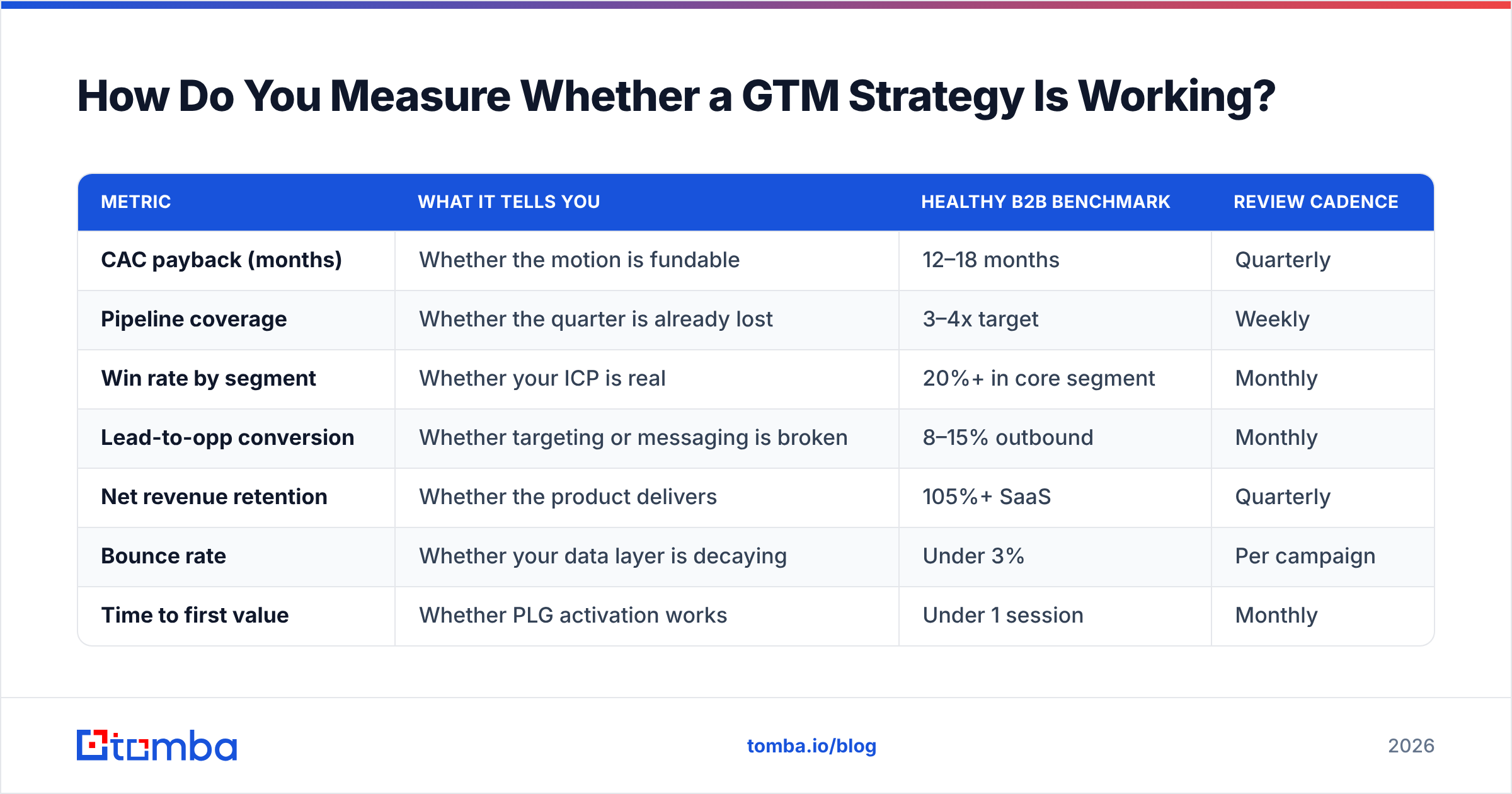
Pick metrics that force a decision. If a number goes up and nobody changes what they do, it is a vanity metric.
| Metric | What it tells you | Healthy B2B benchmark | Review cadence |
|---|---|---|---|
| CAC payback (months) | Whether the motion is fundable | 12–18 months | Quarterly |
| Pipeline coverage | Whether the quarter is already lost | 3–4x target | Weekly |
| Win rate by segment | Whether your ICP is real | 20%+ in core segment | Monthly |
| Lead-to-opp conversion | Whether targeting or messaging is broken | 8–15% outbound | Monthly |
| Net revenue retention | Whether the product delivers | 105%+ SaaS | Quarterly |
| Bounce rate | Whether your data layer is decaying | Under 3% | Per campaign |
| Time to first value | Whether PLG activation works | Under 1 session | Monthly |
Two diagnostic pairs to watch together, because either one alone lies:
- Win rate + lead-to-opp. High lead-to-opp with a low win rate means you are qualifying too loosely. Low lead-to-opp with a high win rate means your targeting is too narrow — you are leaving volume on the table.
- CAC payback + NRR. Long payback is survivable at 120% NRR and fatal at 90%. Never look at acquisition cost without looking at what happens after the sale.
For the definitions your whole team should share, the revenue operations discipline exists precisely to stop marketing, sales, and finance from computing the same metric three different ways. Standardize the definitions in writing before you standardize the dashboard.
What Are the Most Common GTM Strategy Mistakes?#
Running four motions at 25% effort. The most common pattern in Series A companies: a self-serve tier nobody optimizes, an outbound team with no list strategy, a partner program with one signed partner, and a content calendar that publishes twice a month. Four half-motions produce less than one full one.
Treating the ICP as permanent. Your ideal customer profile is a hypothesis with an expiration date. Re-derive it every two quarters from actual closed-won data — not from the persona doc written before you had customers. Look at which accounts renewed and expanded, not which ones signed.
Optimizing copy before fixing the list. Covered above, worth repeating: message testing on an unverified list is not a test.
Confusing intent data with intent. Third-party intent signals are directionally useful and frequently wrong at the account level. Use them to prioritize an existing list, never to build one from scratch.
No definition of a qualified lead. If marketing and sales disagree on what a marketing qualified lead means, every pipeline meeting becomes a negotiation instead of a review. Write the definition, put a number on each criterion, and revisit quarterly.
Under-resourcing the handoff. In hybrid motions, the moment a product signal becomes a sales conversation is where most revenue leaks. Instrument it: measure time-to-first-touch on PQLs, and treat anything over four hours as a defect.
How Do You Sequence a GTM Launch Over 90 Days?#
A workable structure for a new motion or a new segment:
Days 1–30 — Define and instrument. Write the segment in one sentence. Build the account list (200–500 accounts, not 5,000). Source and verify contacts. Set up tracking so you can attribute a reply to a list, a message, and a trigger. Write three message variants against one hypothesis, not twelve against none.
Days 31–60 — Run at small volume. Send to 30–50 accounts per week per rep. You are looking for signal on positioning, not for pipeline. Log every objection verbatim. Any account that replies negatively still tells you something about the segment.
Days 61–90 — Decide and scale or kill. You need enough conversations to see a pattern. If reply rate on verified sends is under 2% and no meeting produced a second call, the segment or the offer is wrong — do not scale volume to fix it. If the pattern holds, double volume and hire against it.
The discipline that matters is killing on schedule. Teams that let a failing motion run for three quarters because someone is emotionally invested lose more than teams that cut in 90 days and redeploy.
Which Tools Support Each Part of the GTM Stack?#
You need fewer tools than the vendor category maps suggest. A functional stack has four layers: data, engagement, CRM, and analytics. Everything else is optional.
For the data layer specifically, the choice is between broad databases and precision finders. Broad databases like the ones reviewed on G2's sales intelligence category give you volume and firmographic filters — useful when you need to build a list from scratch. Precision tools give you verified contacts at accounts you have already identified — useful when your ICP is tight and your sending reputation matters more than list size. BookYourData and similar providers sit closer to the database end and work well for teams that want a pre-built list with coverage guarantees.
Most mid-market teams end up using both: a database to build the account universe, then a finder plus verifier to get accurate, current contacts at the accounts that survived filtering. That combination costs less than it sounds — Tomba pricing starts with a free tier at 25 searches a month, Starter at $49/mo, and Growth at $99/mo, which covers list-building for a two-to-three-rep outbound team.
On the CRM side, whether you standardize on HubSpot or Salesforce matters far less than whether your data flows into it cleanly and consistently. A CRM full of unverified, duplicated records produces confident forecasts about nothing.
Where Should You Start This Week?#
Pick one segment, write it in a single sentence, and build a 250-account list against it. Verify every contact before the first send. Run two message variants for four weeks and measure lead-to-opportunity conversion, not opens. That single loop, run honestly, teaches you more about your GTM strategy than a quarter of planning.
The part teams most often skip is the verification step, and it is the cheapest insurance in the whole stack. If you want your first list to be accurate before you spend a rep's month on it, start with the Tomba Email Finder — free tier covers 25 searches so you can validate your account list quality before committing budget, and the Starter plan at $49/mo handles a full quarter of targeted outbound for a small team. Build the list right once, and every experiment you run on top of it means something.
Related guides#
Ready to find emails that actually work?
Join 150,000+ professionals who stopped guessing and started sending. Free credits on signup — no credit card required.
Get the Tomba newsletter
Practical outbound tactics and product updates — once every two weeks.
About the author