GTM Strategy and Operations: The 2026 Operator's Playbook
Most GTM plans die in the gap between strategy decks and daily execution. Here is how strategy, operations, data, and tooling actually connect in 2026 — with a model you can run this quarter.
TL;DR
- GTM strategy answers who you sell to and why they buy. GTM operations answers what happens Tuesday at 9am when a lead hits the queue. Most companies over-invest in the first and under-invest in the second.
- The most common failure mode is not a bad strategy — it is a correct strategy running on contact data that is 20-40% stale, so ICP targeting silently degrades into spray-and-pray.
- A working GTM operating model has four layers: segmentation, data and enrichment, routing and process, and measurement. Skip any one and the other three under-perform.
- Budget rule of thumb for a Series A-to-B team: roughly 60% of GTM tooling spend on execution surfaces (sequencer, CRM), 25% on data and enrichment, 15% on analytics. Data is where teams cut first and regret fastest.
- You can stand up a credible GTM ops foundation for under $500/month in tooling. The expensive part is the operating cadence, not the software.
What is GTM strategy and operations?#
Go-to-market strategy and operations is the discipline of deciding which customers you pursue, then building the repeatable machinery that gets your team in front of them. Strategy is the choice. Operations is the system that survives contact with reality.
Think of it like a restaurant. Strategy is the menu and the concept — farm-to-table bistro, $60 average ticket, downtown professionals. Operations is the kitchen: prep lists, ticket routing, supplier contracts, and what happens when the fish delivery is late. A brilliant menu run by a broken kitchen produces angry customers. A mediocre menu run by a great kitchen at least produces a profitable restaurant.
The same asymmetry holds in B2B. According to Gartner's research on B2B buying behavior, buying groups now involve 6 to 10 stakeholders, each arriving with independently gathered information. That means your strategy has to name not just an account but a set of humans inside it — and your operations has to reliably find, contact, and track all of them.
Here is the split most teams get wrong:
- Strategy owns the hypothesis — ICP definition, segmentation, pricing and packaging, channel mix, competitive positioning. Reviewed quarterly.
- Operations owns the throughput — data acquisition, list building, enrichment, routing rules, sequence hygiene, CRM field discipline. Reviewed weekly.
- Enablement owns the human layer — messaging, objection handling, call frameworks, ramp plans. Reviewed monthly.
- Analytics owns the feedback loop — conversion by segment, stage velocity, source attribution, cost per opportunity. Reviewed continuously, acted on quarterly.
- Leadership owns the tradeoff — where to reallocate when a segment underperforms, and when to kill a channel instead of "optimizing" it for another two quarters.
When people say "our GTM isn't working," they almost always mean layer 2 is broken while everyone is arguing about layer 1.
Why do most GTM strategies fail in execution?#
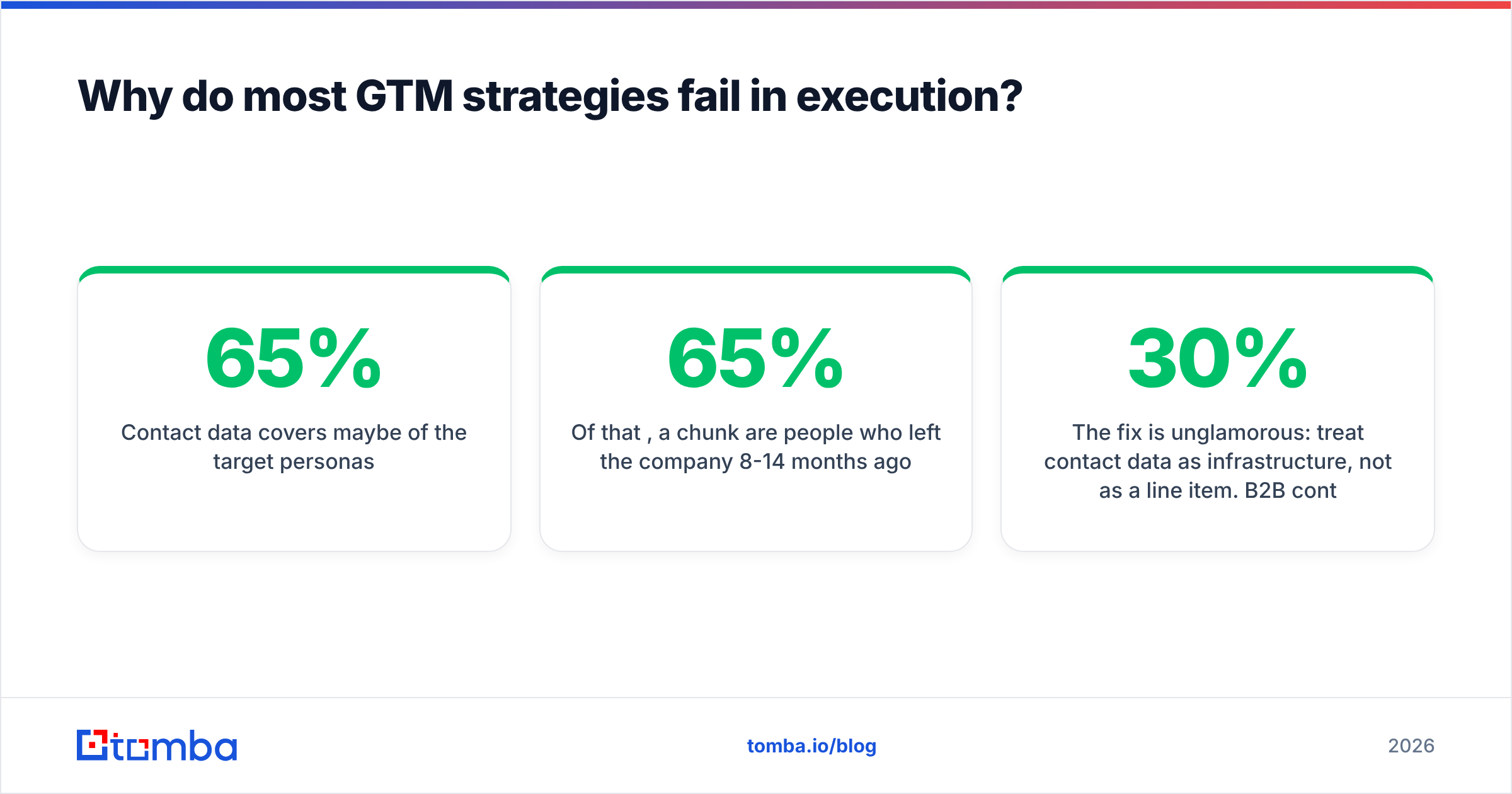
They fail because the strategy assumes clean inputs and the operation runs on dirty ones.
Say your ICP is "Head of RevOps at 200-1000 employee SaaS companies in North America." That is a good, specific hypothesis. Now trace what actually happens:
- Your list builder pulls 3,000 accounts matching firmographics.
- Contact data covers maybe 65% of the target personas.
- Of that 65%, a chunk are people who left the company 8-14 months ago.
- Reps, staring at empty pipeline targets, expand the filters. "Head of RevOps" quietly becomes "anyone in Ops." "200-1000 employees" becomes "50-5000."
- Six weeks later, reply rates are down, the ICP hypothesis is declared wrong, and the strategy gets rewritten.
The strategy was never tested. What got tested was a degraded proxy of it. This is the single most expensive pattern in B2B go-to-market, and it is an operations problem wearing a strategy costume.
The fix is unglamorous: treat contact data as infrastructure, not as a line item. B2B contact data decays at roughly 25-30% per year through job changes alone — a figure HubSpot has documented repeatedly in its own database research. If you build a target list in January and run it unrefreshed through Q4, a quarter of it is fiction.
Second failure mode: no one owns the handoff. Marketing generates a marketing qualified lead, sales says the leads are bad, marketing says sales doesn't work them. Without routing SLAs and enrichment at the point of capture, this argument recurs every quarter forever.
Third: measuring activity instead of segment economics. Dials and emails sent are inputs. What you need is conversion rate, deal size, and sales cycle by segment, so you can tell whether the strategy is wrong or the execution is.
What does a GTM operating model actually look like?#
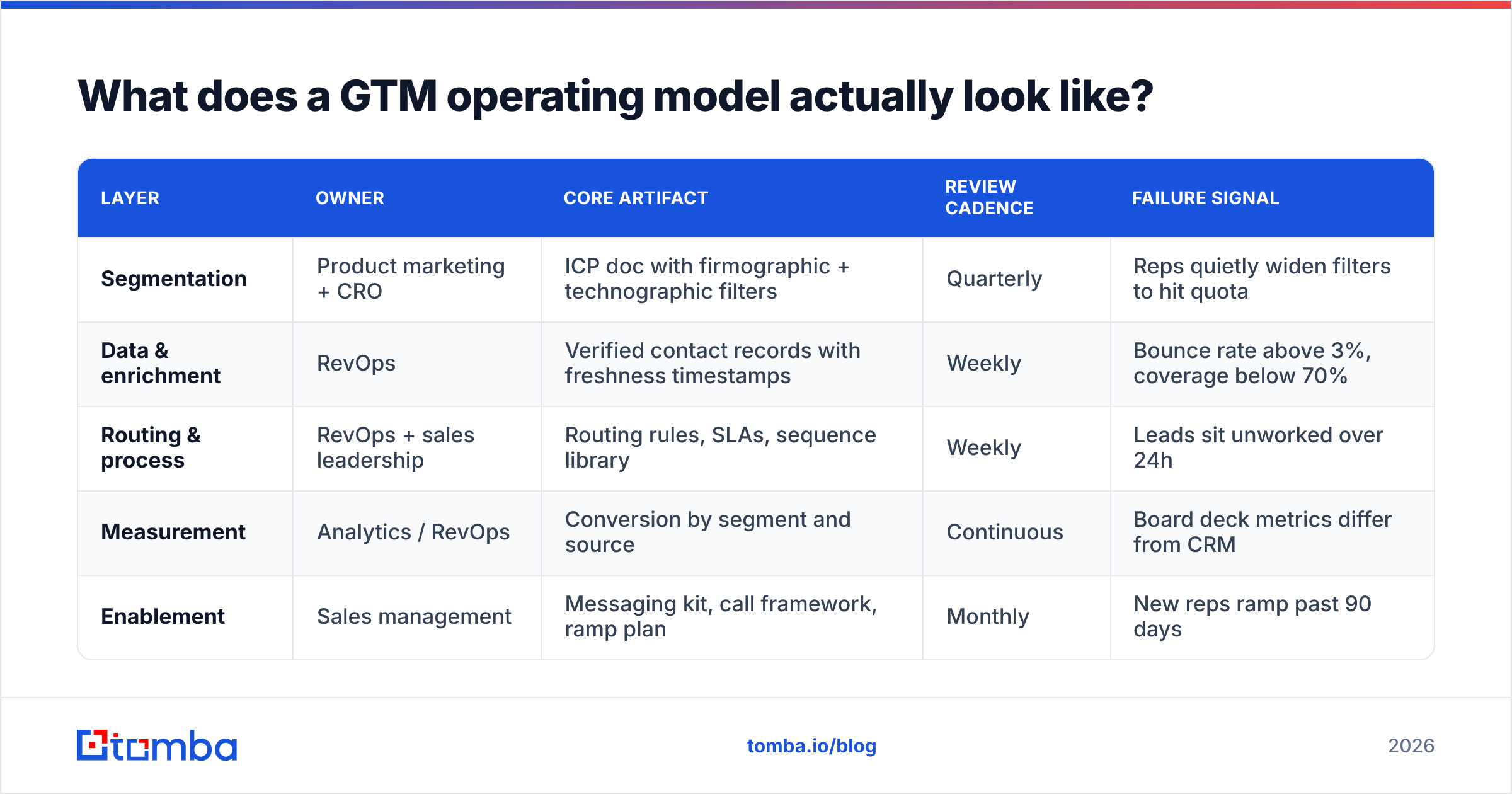
Four layers, each with a clear owner and a clear artifact.
| Layer | Owner | Core artifact | Review cadence | Failure signal |
|---|---|---|---|---|
| Segmentation | Product marketing + CRO | ICP doc with firmographic + technographic filters | Quarterly | Reps quietly widen filters to hit quota |
| Data & enrichment | RevOps | Verified contact records with freshness timestamps | Weekly | Bounce rate above 3%, coverage below 70% |
| Routing & process | RevOps + sales leadership | Routing rules, SLAs, sequence library | Weekly | Leads sit unworked over 24h |
| Measurement | Analytics / RevOps | Conversion by segment and source | Continuous | Board deck metrics differ from CRM |
| Enablement | Sales management | Messaging kit, call framework, ramp plan | Monthly | New reps ramp past 90 days |
The artifact column matters more than the cadence column. If a layer has no artifact — no document, no dashboard, no rule set someone can point at — it is not being operated. It is being improvised.
Segmentation: get specific enough to be falsifiable#
A good ICP definition is one you can be wrong about. "Mid-market B2B companies" is not falsifiable. "SaaS companies, 200-1000 employees, using Salesforce, with a named RevOps leader hired in the last 18 months" is. You can build a list against it, run 300 touches, and get a clear read within six weeks.
Technographic and hiring signals are what make modern segmentation work. A company that just posted a RevOps req is telling you something a firmographic filter never will.
Data and enrichment: the layer that quietly decides everything#
This is where your strategy becomes an actual list of humans. Three jobs sit here:
- Discovery — finding the right people at target accounts. A domain search that returns every known contact at a company, with roles, is faster than manually reconstructing an org chart from LinkedIn.
- Verification — confirming the address is deliverable before you send. Running a list through an email verifier ahead of a campaign is the difference between a 1% bounce rate and a 9% one that damages your sending domain.
- Enrichment — filling in the fields your routing and scoring rules depend on: seniority, department, company size, tech stack, phone. Data enrichment at the point of form capture is how you avoid the "which of these 400 inbound leads is real" problem.
Automate all three. Any process where a human manually copies contact details into a CRM will decay within a quarter — not because people are lazy, but because it is the first thing dropped when the quarter gets tight.
Routing and process: the boring layer that compounds#
Routing rules are where most of your realized value hides. Speed-to-lead research consistently shows response within five minutes dramatically outperforms response within an hour. That is not a strategy insight. It is a workflow you either built or didn't.
Minimum viable routing:
- Inbound demo requests — enriched on submission, routed by territory and segment, SLA under 15 minutes during business hours.
- Content downloads — scored, enriched, nurtured; only routed to sales above a threshold.
- Outbound-sourced — assigned at list-build time, never round-robined mid-sequence.
- Product-qualified — routed on usage trigger, not on form fill.
- Reactivation — old closed-lost accounts re-verified before any touch, since contact turnover is highest exactly here.
Measurement: segment economics, not vanity throughput#
Track four numbers per segment: reply rate, meeting-to-opportunity rate, average contract value, and sales cycle length. Those four tell you whether to double down, reposition, or exit. Aggregate pipeline numbers hide everything that matters — a healthy total can conceal one segment carrying three dead ones.
How do you build a GTM data foundation on a real budget?#
You do not need a $50,000 annual data contract to run a disciplined go-to-market motion. You need coverage on your actual target list, verification before send, and an API so enrichment happens automatically instead of manually.
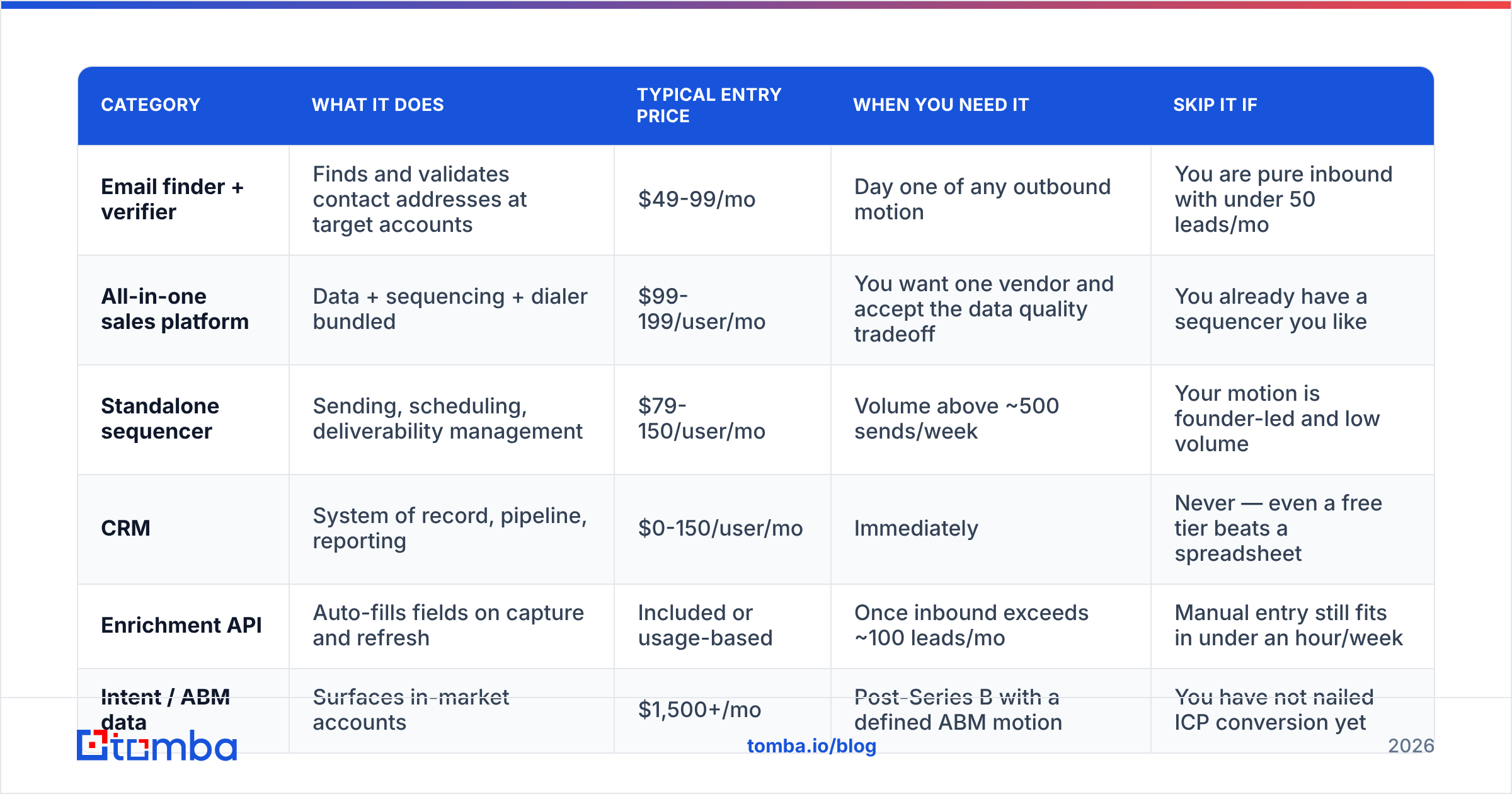
Here is how the common tooling categories stack up for a team of 5-20 in the GTM function:
| Category | What it does | Typical entry price | When you need it | Skip it if |
|---|---|---|---|---|
| Email finder + verifier | Finds and validates contact addresses at target accounts | $49-99/mo | Day one of any outbound motion | You are pure inbound with under 50 leads/mo |
| All-in-one sales platform | Data + sequencing + dialer bundled | $99-199/user/mo | You want one vendor and accept the data quality tradeoff | You already have a sequencer you like |
| Standalone sequencer | Sending, scheduling, deliverability management | $79-150/user/mo | Volume above ~500 sends/week | Your motion is founder-led and low volume |
| CRM | System of record, pipeline, reporting | $0-150/user/mo | Immediately | Never — even a free tier beats a spreadsheet |
| Enrichment API | Auto-fills fields on capture and refresh | Included or usage-based | Once inbound exceeds ~100 leads/mo | Manual entry still fits in under an hour/week |
| Intent / ABM data | Surfaces in-market accounts | $1,500+/mo | Post-Series B with a defined ABM motion | You have not nailed ICP conversion yet |
Two notes on this table. First, intent data is the most commonly over-bought category in B2B — it is genuinely useful, but only after your basic ICP conversion math works. Buying intent signals to fix a targeting problem is like buying a telescope to find your car keys.
Second, the data layer is where mixing vendors pays off. A dedicated provider like Tomba or a database-first vendor like BookYourData will typically beat the bundled data inside an all-in-one platform on coverage for specific niches — and the two approaches complement each other. BookYourData's prepaid, download-a-list model suits teams that want a bulk list once a quarter; a credit-based finder plus API suits teams enriching continuously inside a workflow. Plenty of GTM teams run both.
On pricing specifically: Tomba's plans start with a free tier at 25 searches per month, then Starter at $49/mo, Growth at $99/mo, and Pro at $249/mo, with Enterprise custom. For most seed-to-Series-A teams, Growth covers the whole outbound motion, and the Tomba API handles the enrichment-on-capture workflow without an extra vendor.
How do you sequence the build in the first 90 days?#
Do not try to stand up all four layers at once. Order matters, because each layer's output is the next layer's input.
Days 1-15 — define and freeze the ICP. Write it down with specific filters. Get sales leadership to sign it. Freeze it for one full quarter so you actually get a clean read. Every mid-quarter ICP change resets your learning to zero.
Days 16-30 — build the data pipeline. Pick your finder and verifier. Build the target account list against the frozen ICP. Verify everything before it enters the CRM. Set a refresh cadence — monthly for active segments, quarterly for the long tail. Instrument bounce rate as a leading indicator of data decay.
Days 31-45 — wire routing and SLAs. Every lead source gets a rule. Every rule gets an owner and a response SLA. Publish it where reps can see it. Audit compliance weekly for the first month, then monthly.
Days 46-70 — run the motion and instrument it. Now you send. Track the four segment metrics. Resist the urge to change messaging weekly; you need enough volume per variant to learn anything real.
Days 71-90 — review segment economics and reallocate. This is the first honest read on whether the strategy hypothesis holds. Kill what is clearly dead. Double the budget on what is clearly working. Leave ambiguous segments alone for one more quarter.
One caution: teams love to compress this into 30 days. The compression always comes out of the data layer, because it is the least visible. Then you spend the following quarter debugging why conversion looks random.
Who should own GTM operations?#
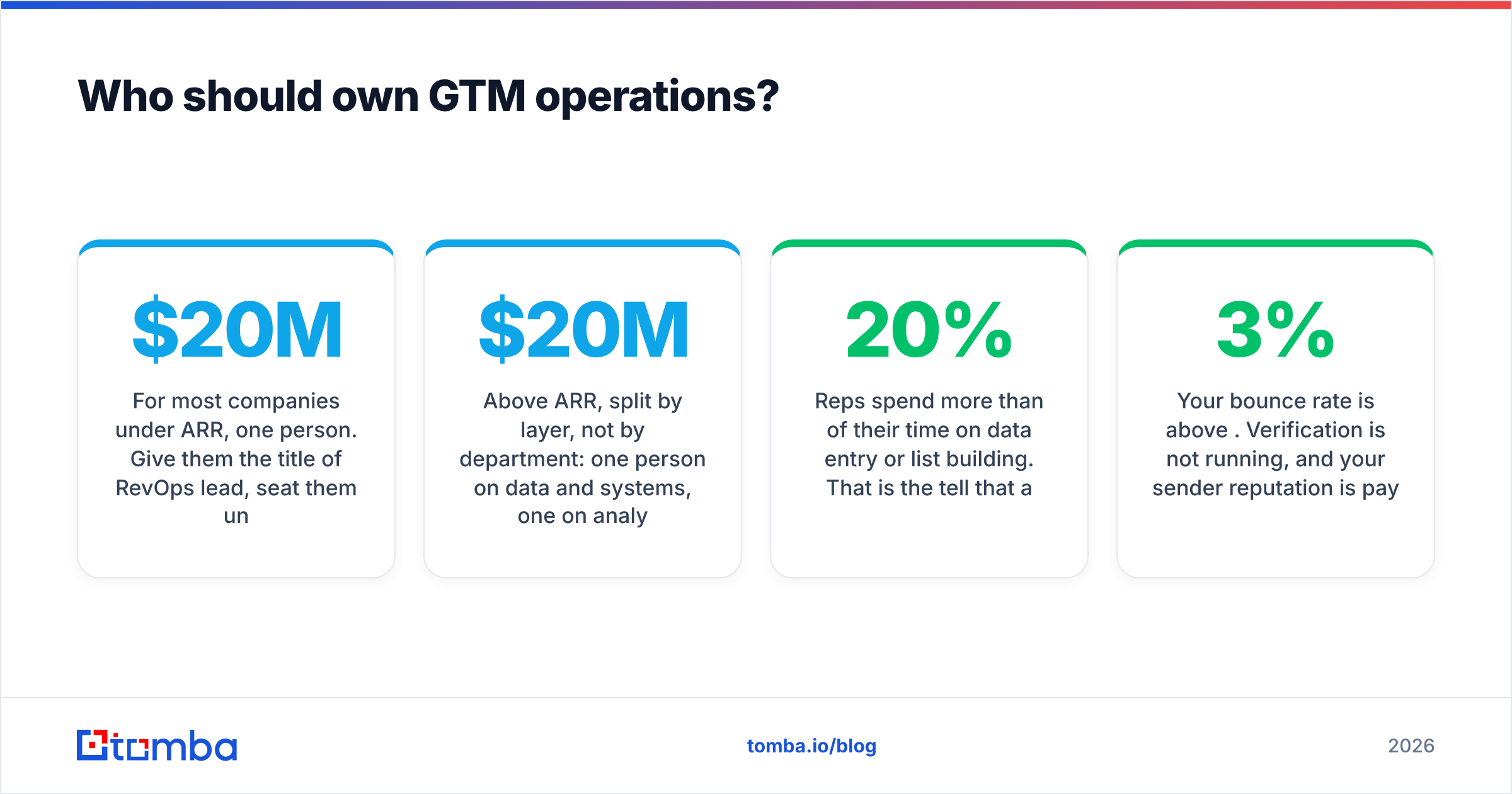
For most companies under $20M ARR, one person. Give them the title of RevOps lead, seat them under the CRO, and make them accountable for the data and routing layers end to end.
The alternative — splitting ownership between marketing ops, sales ops, and a BI analyst — creates exactly the handoff seams where GTM breaks. If three people own the pipeline, no one owns the leak. Revenue operations as a discipline exists mostly to eliminate those seams.
Above $20M ARR, split by layer, not by department: one person on data and systems, one on analytics and forecasting, one on enablement. Keep them on the same team with the same manager. The moment GTM ops reports into three different VPs, you are back to arguing about lead quality in the Monday meeting.
Signs you need a dedicated owner right now:
- Reps spend more than 20% of their time on data entry or list building. That is the tell that automation is missing.
- Your bounce rate is above 3%. Verification is not running, and your sender reputation is paying for it.
- Board metrics and CRM metrics disagree. Definitions are not centrally owned.
- New rep ramp exceeds 90 days. Process is tribal knowledge, not documented.
- Nobody can tell you conversion rate by segment in under five minutes. Measurement layer does not exist.
What should you do next?#
Start with the layer that gates everything else: your data. Freeze your ICP, build a verified target list against it, and instrument bounce rate and coverage before you touch messaging or sequencing. Strategy debates get much shorter when everyone is looking at the same clean list.
If you need the contact layer to run that motion, the Tomba Email Finder is built for exactly this job — find verified professional addresses by domain, name, or company, verify them before send, and push them straight into your CRM through the API. The free tier gives you 25 searches a month to test coverage against your own ICP before you spend anything, and Growth at $99/mo covers a full outbound team's volume. Test it against your real target list, not a sample one — your ICP is the only benchmark that matters.
Related guides#
Ready to find emails that actually work?
Join 150,000+ professionals who stopped guessing and started sending. Free credits on signup — no credit card required.
Get the Tomba newsletter
Practical outbound tactics and product updates — once every two weeks.
About the author