GTM Strategy Framework: How to Build One That Actually Works
Most go-to-market plans die in a slide deck by week six. Here's a five-layer GTM strategy framework, a motion-by-motion comparison, and the metrics that tell you whether it's actually working.
TL;DR
- A GTM strategy framework is not a positioning deck. It's a chain of five decisions — market, motion, message, machine, metrics — where each layer constrains the next.
- Most frameworks fail at layer four. Teams agree on the ICP, then hand reps a list nobody verified, and the whole thing collapses into activity theater.
- Pick one primary motion for the next two quarters. Sales-led, product-led, and partner-led each demand different headcount, different data, and different payback math.
- Your data layer is the load-bearing wall. Bad contact data caps every downstream metric no matter how good the messaging is.
- Measure four things quarterly: ICP win rate, pipeline coverage from the target segment, CAC payback, and net revenue retention. Everything else is a diagnostic, not a goal.
What is a GTM strategy framework?#
A GTM strategy framework is a repeatable decision structure that connects who you sell to, how you reach them, what you say, what systems execute it, and how you know it worked. Think of it like the framing of a house: the ICP is the foundation, the motion is the load-bearing structure, and the messaging is drywall. You can repaint drywall in a week. You cannot move a foundation without tearing everything down.
That analogy explains why so many GTM "resets" fail. A team notices flat pipeline, so they rewrite the value prop — drywall work — when the real problem is that they're selling a mid-market product using an enterprise motion into a segment that buys through self-serve.
The framework matters more in 2026 than it did five years ago for one blunt reason: outbound volume stopped working. Google and Yahoo's bulk-sender rules, near-universal spam filtering on cold sequences, and buyer fatigue mean the "send 10,000 emails and see what sticks" era is over. Gartner's sales research has been flagging the shift toward fewer, better-targeted touches for several cycles now. Precision beats volume, and precision requires a framework.
Why do most GTM frameworks fail in the first 90 days?#
Because they're written as documents instead of as constraints.
A document says "our ICP is B2B SaaS companies with 50-500 employees in North America." A constraint says "reps may not add an account to the pipeline unless it matches the ICP filter, and any exception requires VP approval." One of those changes behavior on Monday morning.
The four failure patterns worth naming:
- The ICP that includes everyone. If your ICP definition doesn't exclude at least 80% of your addressable market, it isn't an ICP — it's a description of the economy. Real ICPs hurt to write because they cut off revenue you're currently taking.
- Two motions running at half strength. A team runs outbound and a self-serve funnel simultaneously with the same headcount. Neither gets enough investment to clear its own activation threshold, and both underperform against a single well-funded motion.
- The data gap nobody owns. Marketing owns the ICP. Sales owns the calls. Nobody owns whether the contact records are real, current, and reachable. Bounce rates climb, domain reputation drops, and the team blames the messaging.
- Metrics that measure effort. Dials, emails sent, demos booked. All useful for coaching, all useless for strategy. If your quarterly review leads with activity numbers, you don't have a framework — you have a dashboard.
The fix for all four is the same: make each layer produce an artifact that the next layer can't proceed without.
What are the five layers of a GTM strategy framework?#
Work these in order. Skipping ahead is the most common and most expensive mistake.
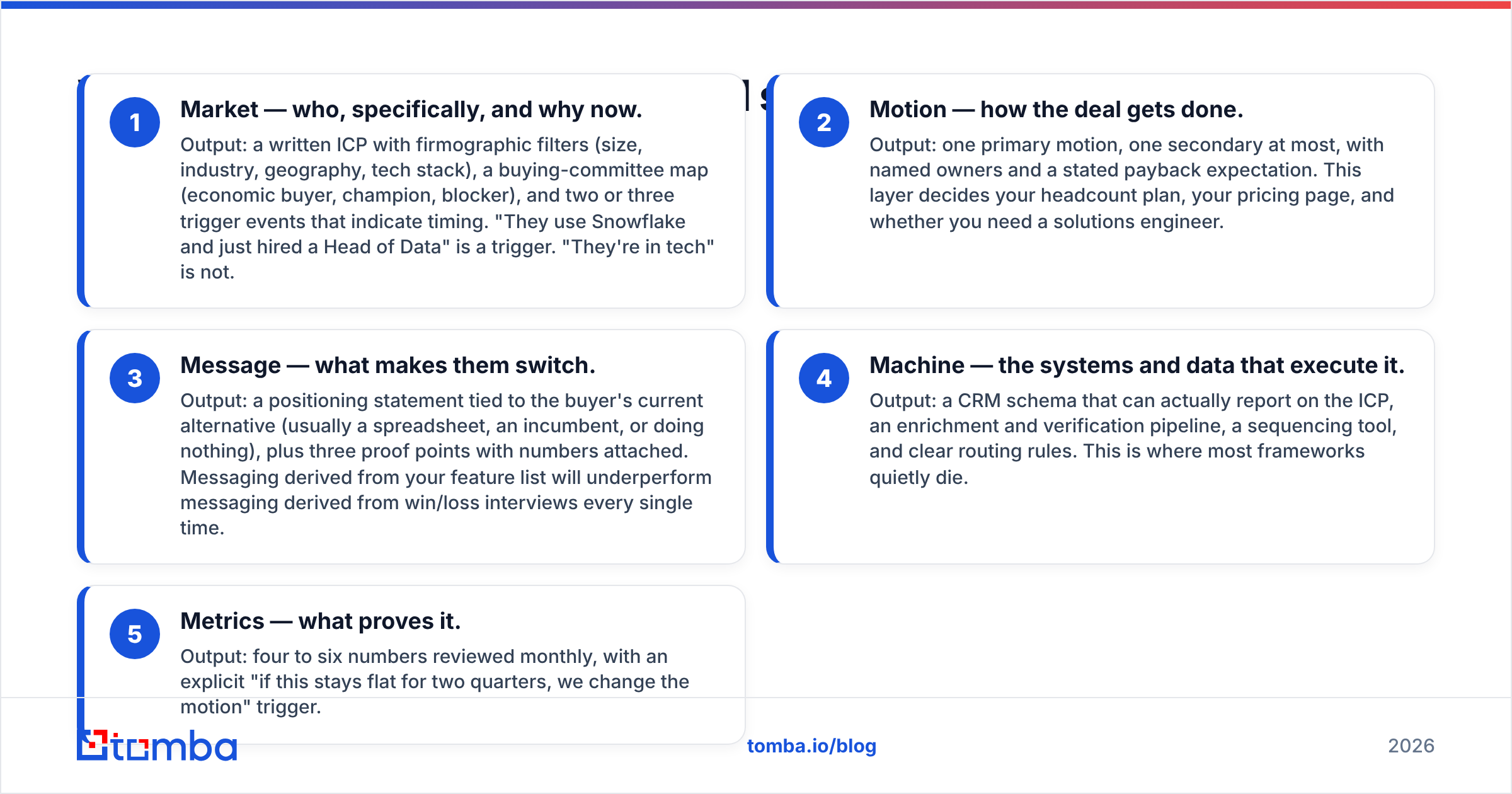
- Market — who, specifically, and why now. Output: a written ICP with firmographic filters (size, industry, geography, tech stack), a buying-committee map (economic buyer, champion, blocker), and two or three trigger events that indicate timing. "They use Snowflake and just hired a Head of Data" is a trigger. "They're in tech" is not.
- Motion — how the deal gets done. Output: one primary motion, one secondary at most, with named owners and a stated payback expectation. This layer decides your headcount plan, your pricing page, and whether you need a solutions engineer.
- Message — what makes them switch. Output: a positioning statement tied to the buyer's current alternative (usually a spreadsheet, an incumbent, or doing nothing), plus three proof points with numbers attached. Messaging derived from your feature list will underperform messaging derived from win/loss interviews every single time.
- Machine — the systems and data that execute it. Output: a CRM schema that can actually report on the ICP, an enrichment and verification pipeline, a sequencing tool, and clear routing rules. This is where most frameworks quietly die.
- Metrics — what proves it. Output: four to six numbers reviewed monthly, with an explicit "if this stays flat for two quarters, we change the motion" trigger.
Notice that layers one through three are strategy and layers four and five are operations. Teams love the first three because they're fun to argue about in a workshop. The compounding returns live in four and five, which is also where revenue operations earns its keep.
Which GTM motion should you pick?#
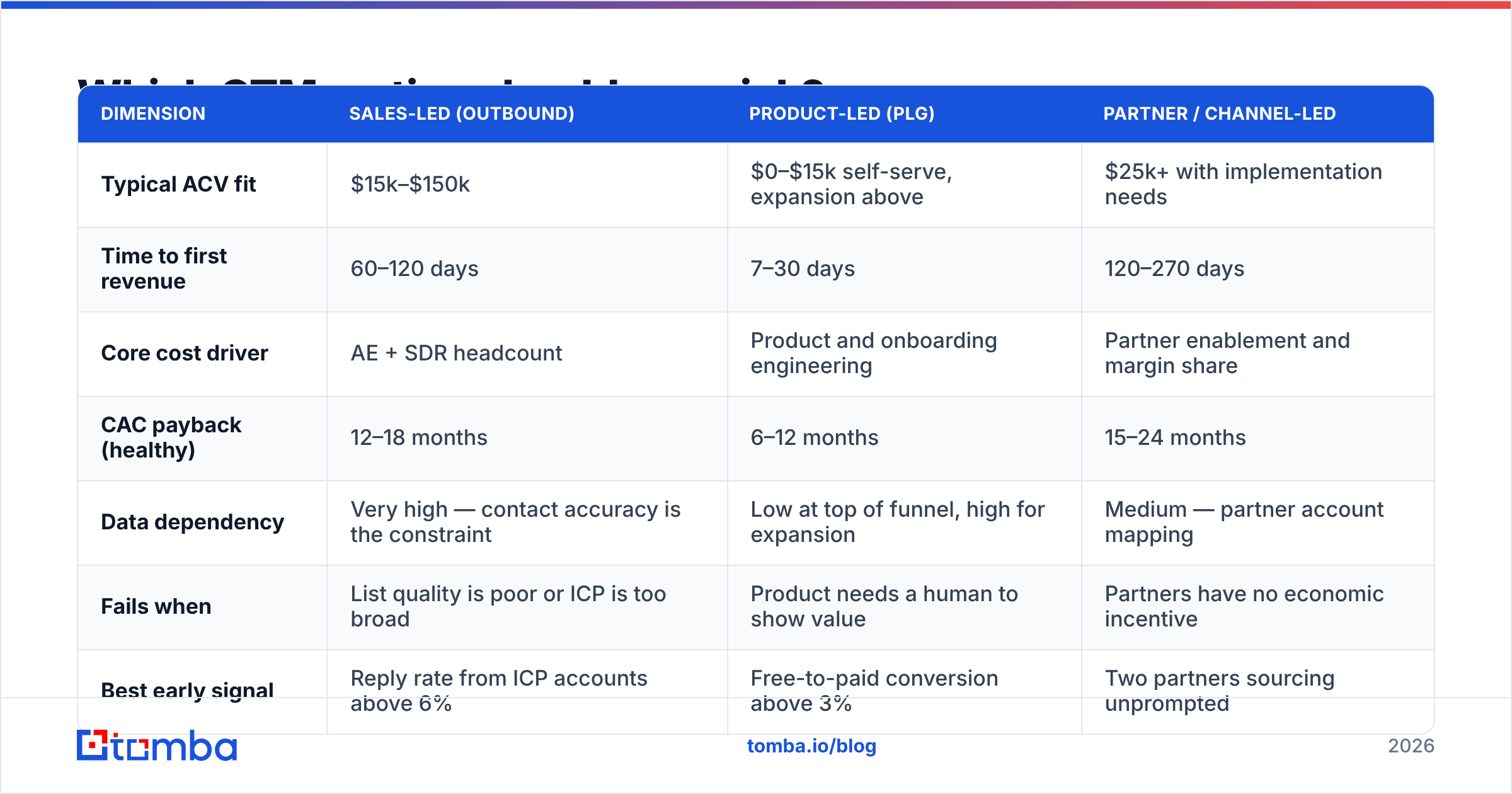
This is the single highest-leverage decision in the framework. Here's how the three dominant motions compare on the dimensions that actually determine whether you can afford them.
| Dimension | Sales-led (outbound) | Product-led (PLG) | Partner / channel-led |
|---|---|---|---|
| Typical ACV fit | $15k–$150k | $0–$15k self-serve, expansion above | $25k+ with implementation needs |
| Time to first revenue | 60–120 days | 7–30 days | 120–270 days |
| Core cost driver | AE + SDR headcount | Product and onboarding engineering | Partner enablement and margin share |
| CAC payback (healthy) | 12–18 months | 6–12 months | 15–24 months |
| Data dependency | Very high — contact accuracy is the constraint | Low at top of funnel, high for expansion | Medium — partner account mapping |
| Fails when | List quality is poor or ICP is too broad | Product needs a human to show value | Partners have no economic incentive |
| Best early signal | Reply rate from ICP accounts above 6% | Free-to-paid conversion above 3% | Two partners sourcing unprompted |
Two rules for reading this table. First, pick the motion that matches your ACV and your product's time-to-value, not the one your last company ran. Second, a motion that fails its "best early signal" for two consecutive quarters is a motion you should stop funding, not one you should push harder.
Hybrid motions do work — PLG for acquisition with a sales-assist layer above a usage threshold is the most reliable combination in 2026 — but hybrids are what you earn after one motion is repeatable, not what you start with.
How do you build the data layer the framework depends on?#
Here's the uncomfortable arithmetic. Suppose your outbound motion targets 1,000 ICP accounts per quarter with three contacts each. That's 3,000 contacts. If 25% of your email addresses are wrong or stale — a realistic figure for scraped or aging list data — you've lost 750 touches before writing a word of copy. Worse, the bounces degrade your sender reputation, which suppresses delivery to the 2,250 addresses that were correct.
Bad data doesn't reduce your results proportionally. It compounds downward.
A working data layer for a GTM framework has four components:
- Account sourcing. Firmographic filters applied against a database or an enrichment API, producing a target account list that matches the layer-one ICP. Providers here range from broad B2B databases to specialist regional sets — BookYourData is a solid option when you need pre-built lists by geography and title, while API-first tools suit teams that want to enrich accounts already in the CRM.
- Contact discovery. Turning a company and a role into a named person with a reachable address. This is where an email finder or a domain search does the work — you give it a company domain and a target title, you get a verified contact back.
- Verification before send. Every address passes through an email verifier before it enters a sequence. Non-negotiable. This is a five-minute step that protects a six-figure channel.
- Continuous refresh. B2B contact data decays roughly 2–3% per month through job changes alone. A quarterly re-verification job on your active pipeline contacts is the cheapest insurance in the stack.
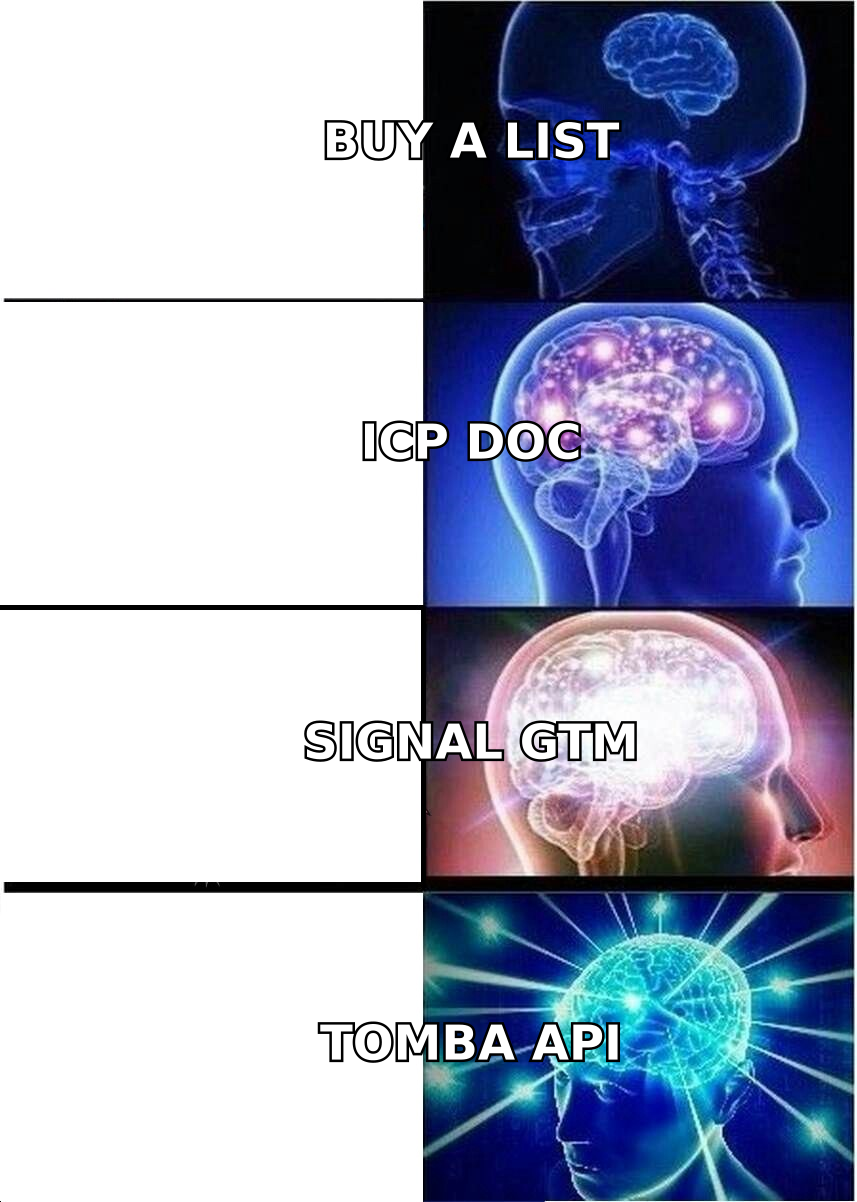
The teams that get this right treat data as infrastructure with an owner and an SLA, not as a purchase order that renews once a year. If your framework has a RevOps function, the data layer is their primary deliverable.
What does a 90-day GTM rollout look like?#
Frameworks fail when they arrive as a 40-page document on day one. Sequence them instead.
| Phase | Weeks | Primary output | Owner | Go/no-go gate |
|---|---|---|---|---|
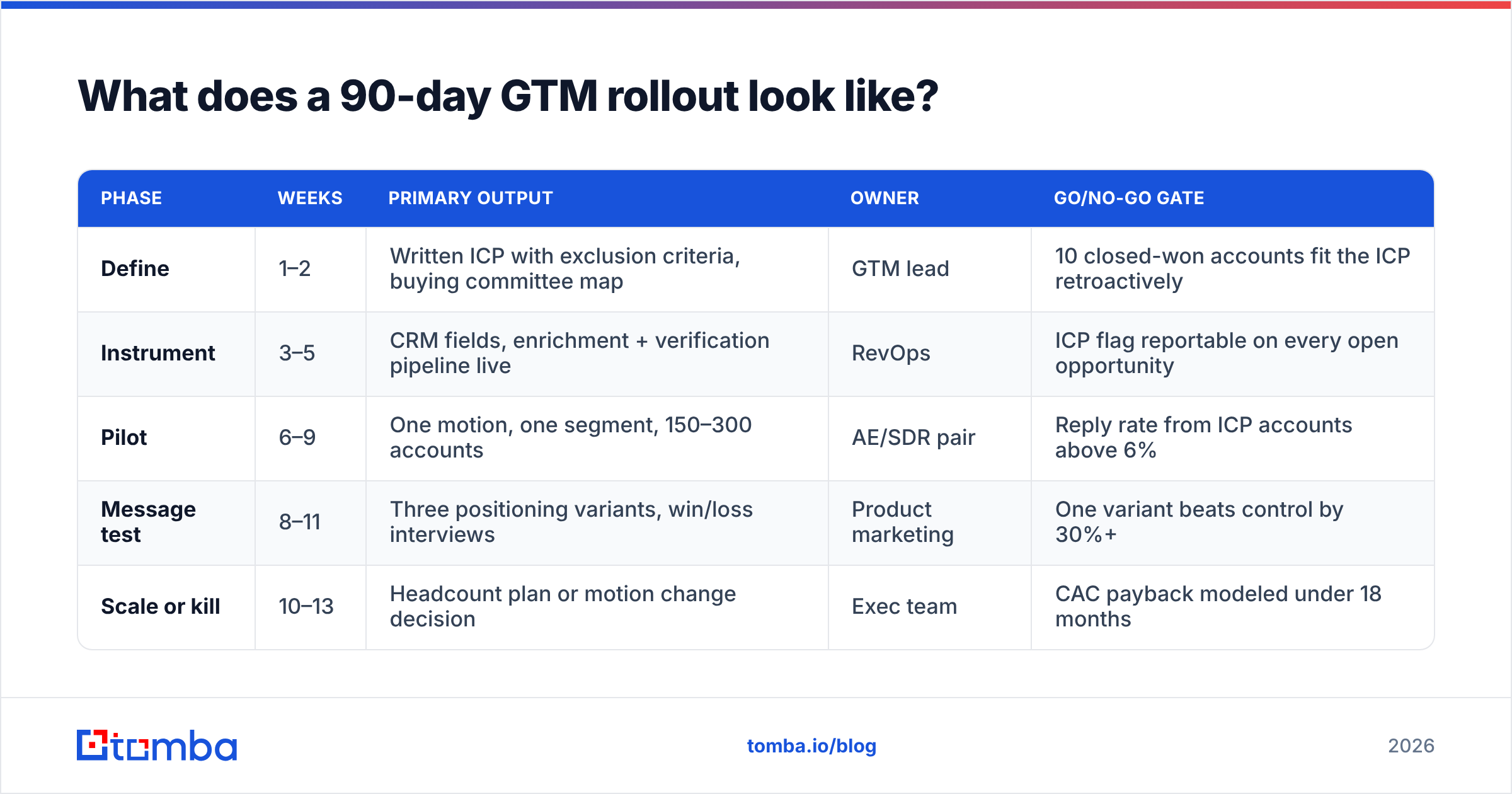
| Define | 1–2 | Written ICP with exclusion criteria, buying committee map | GTM lead | 10 closed-won accounts fit the ICP retroactively |
| Instrument | 3–5 | CRM fields, enrichment + verification pipeline live | RevOps | ICP flag reportable on every open opportunity |
| Pilot | 6–9 | One motion, one segment, 150–300 accounts | AE/SDR pair | Reply rate from ICP accounts above 6% |
| Message test | 8–11 | Three positioning variants, win/loss interviews | Product marketing | One variant beats control by 30%+ |
| Scale or kill | 10–13 | Headcount plan or motion change decision | Exec team | CAC payback modeled under 18 months |
The pilot phase is where the framework earns credibility. Run it narrow — one segment, one motion, one message — because a narrow pilot produces a readable signal. A broad pilot produces noise you'll spend a quarter arguing about.
One practical note: do the instrument phase before the pilot, not during it. Teams that pilot first and instrument later can never answer "did this work?" because they have no clean baseline. The CRM work is boring and it is the reason the next 12 months are legible.
Which metrics prove the GTM strategy framework is working?#
Four core numbers, reviewed monthly, with a stated threshold for action.
ICP win rate versus non-ICP win rate. If accounts matching your ICP don't close at a meaningfully higher rate — say 1.5x — than accounts outside it, your ICP definition is wrong. This is the single fastest test of layer one.
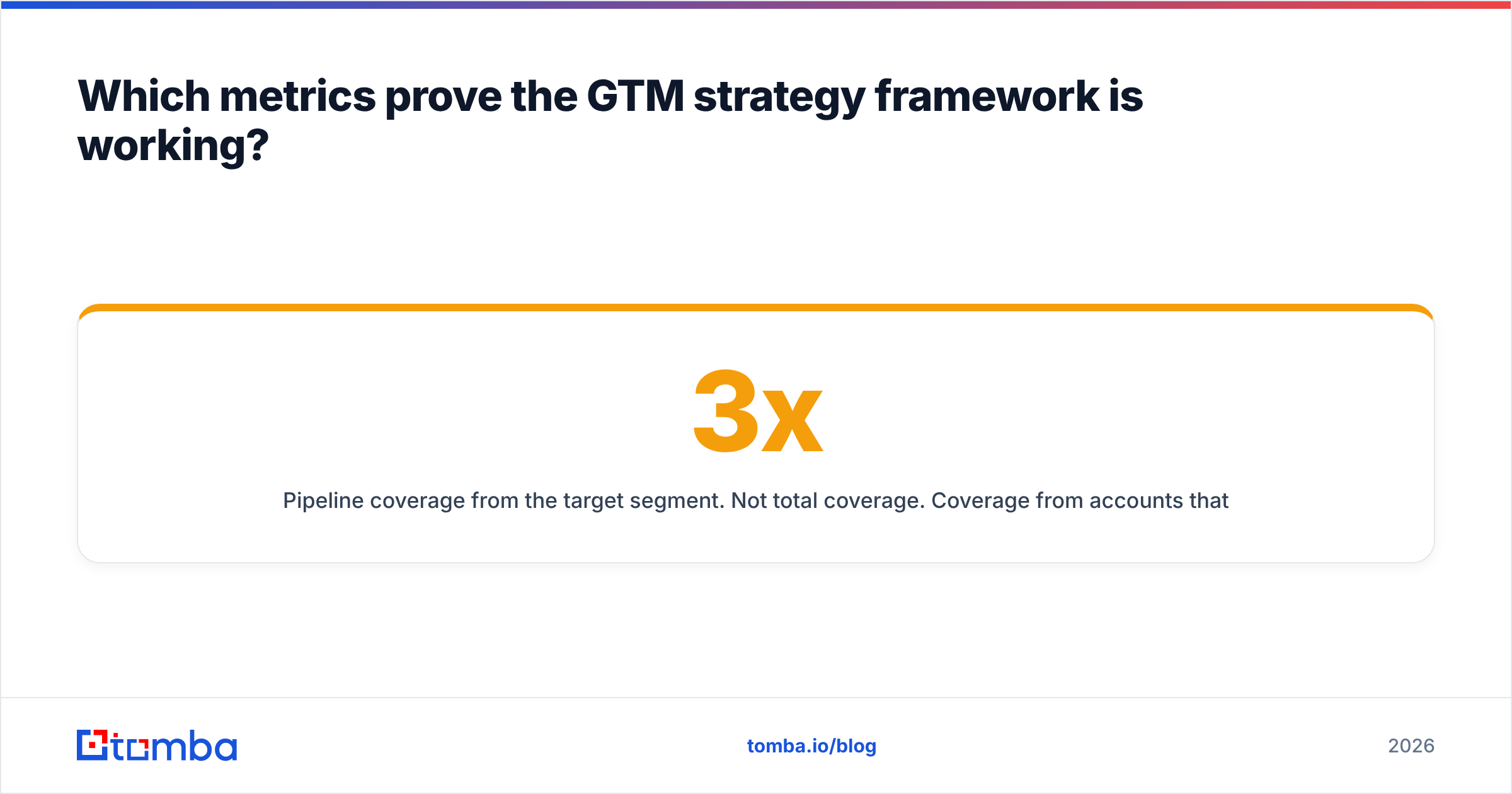
Pipeline coverage from the target segment. Not total coverage. Coverage from accounts that match the ICP. Many teams hit 3x coverage on paper while 60% of it comes from accounts they'd never renew.
CAC payback by motion. Track it per motion, not blended. Blended payback hides the fact that one motion is subsidizing another that should be shut down.
Net revenue retention on ICP accounts. The lagging indicator that validates everything upstream. Strong NRR in your ICP means you picked the right market. Weak NRR in your ICP means the framework needs to go back to layer one, regardless of how good acquisition looks.
Supporting diagnostics — response rate, meeting-to-opportunity conversion, bounce rate, sales cycle length — are for troubleshooting. They tell you where a problem is. They don't tell you whether the strategy is right. Keep them on a second tab.
For benchmarking against peers, G2's category data and HubSpot's sales research are useful reference points, though treat any published benchmark as a rough range rather than a target — segment and ACV variance swamps most cross-company comparisons.
What are the most common GTM framework mistakes?#
- Rewriting the framework every quarter. A framework needs two to three quarters to produce a signal. Changing it every 90 days guarantees you never learn anything.
- Confusing a channel with a motion. LinkedIn is a channel. Cold email is a channel. "Sales-led enterprise with a two-call close" is a motion. Adding channels without a motion is how teams end up busy and flat.
- Letting the framework live outside the CRM. If your ICP definition isn't a queryable field on the account object, it will be ignored within a month.
- Skipping win/loss interviews. Twelve conversations with recent wins and losses will beat any amount of internal messaging workshop time. Do them yourself; don't outsource them.
- Treating data quality as a procurement problem. It's an operating problem with a monthly cadence.
Where should you start if you're building this from scratch?#
Start with a retroactive ICP audit. Pull your last 20 closed-won accounts and your last 20 closed-lost, and look for the firmographic and behavioral attributes that separate them. That exercise takes an afternoon and will tell you more than a month of market sizing.
Then instrument before you scale. Get the account list built, get the contacts found, get every address verified, and get the ICP flag into your CRM so that every future report can answer the only question that matters: are we winning in the market we said we'd win in?
If contact discovery and verification are the bottleneck in your data layer — and for most outbound-led teams, they are — start there. Tomba's Email Finder turns a company domain and a target role into a verified, reachable contact, with a free tier at 25 searches per month to test on your pilot list before committing. Paid plans start at $49/mo for Starter and $99/mo for Growth, and the same lookups run through the Tomba API when you're ready to wire enrichment directly into your CRM instead of exporting CSVs. See full Tomba pricing for the tier that matches your account volume.
A GTM strategy framework is only as good as the contacts it can actually reach. Fix that layer first, and the other four get a lot easier to evaluate honestly.
Related guides#
Ready to find emails that actually work?
Join 150,000+ professionals who stopped guessing and started sending. Free credits on signup — no credit card required.
Get the Tomba newsletter
Practical outbound tactics and product updates — once every two weeks.
About the author