GTM Teams in 2026: How Modern Go-To-Market Orgs Work
GTM teams replaced the old sales-marketing-CS handoff with one shared revenue motion. Here's how the roles, data stack, and metrics actually fit together in 2026 — plus what breaks first.
TL;DR
- A GTM team is not "sales plus marketing in a Slack channel." It is a single revenue unit — marketing, sales, RevOps, customer success, and product marketing — operating off one ICP definition, one data layer, and one set of metrics.
- The three structures that actually work in 2026: pod-based (per-segment), functional-with-RevOps-spine, and product-led-with-overlay. Everything else is a reorg waiting to happen.
- The most common failure is not strategy. It is data: stale contacts, duplicate accounts, and three different definitions of "qualified" living in three different tools.
- Budget roughly 15–25% of GTM tooling spend on data quality and enrichment. It is the layer everything else compounds on.
- Measure pipeline coverage, segment-level CAC payback, and net revenue retention. Vanity metrics like MQL volume tell you almost nothing about whether the machine works.
What is a GTM team, exactly?#
A GTM (go-to-market) team is the group of people jointly accountable for turning a product into revenue in a specific market — not just the ones who carry a quota.
Think of it like a restaurant kitchen. The old model was a relay race: marketing plated the appetizer, threw it over the pass, sales cooked the main, and customer success did dessert while nobody talked. The GTM model is a brigade — one head chef, one ticket rail, shared timing. If the fish is late, everyone knows, because everyone is reading the same rail.
Concretely, a modern GTM team includes:
- Demand generation / growth marketing — owns top-of-funnel volume and channel efficiency.
- Product marketing — owns positioning, ICP definition, competitive narrative, and enablement content.
- Sales development (SDR/BDR) — owns outbound conversation creation against the defined ICP.
- Account executives — own opportunity progression and close.
- Revenue operations — owns the data layer, routing, forecasting, and tooling. This is the spine.
- Customer success / post-sales — owns retention, expansion, and the feedback loop back into positioning.
The thing that makes it a team rather than a list of departments is a shared operating cadence: one weekly pipeline review, one shared ICP document, and one source of truth for account and contact data. Remove any of those three and you have re-created the relay race with a new org chart.
Why did GTM teams replace the old funnel model?#
Because the funnel model assumed the buyer moved in one direction, and buyers stopped doing that.
Gartner's research on B2B buying has documented for years that buyers spend the majority of their journey doing independent research, looping back through the same stages repeatedly, and involving 6–10 stakeholders. A linear handoff structure cannot serve a non-linear buyer. When a prospect reads a comparison page, talks to a peer, disappears for five weeks, and comes back asking about SOC 2, the question "is this a marketing lead or a sales lead?" is meaningless.
Three forces pushed the shift:
- Buying committees got larger. One champion is no longer enough. GTM teams have to run multithreaded outreach, which means contact data for five people at an account, not one.
- Efficiency replaced growth-at-all-costs. Post-2023 budget discipline made CAC payback a board-level metric. Siloed teams optimizing separate metrics produce a worse blended number.
- The tooling consolidated. When enrichment, sequencing, and CRM data live in the same pipeline, there is no technical reason for teams to hold separate contact lists.

How should you structure a GTM team in 2026?#
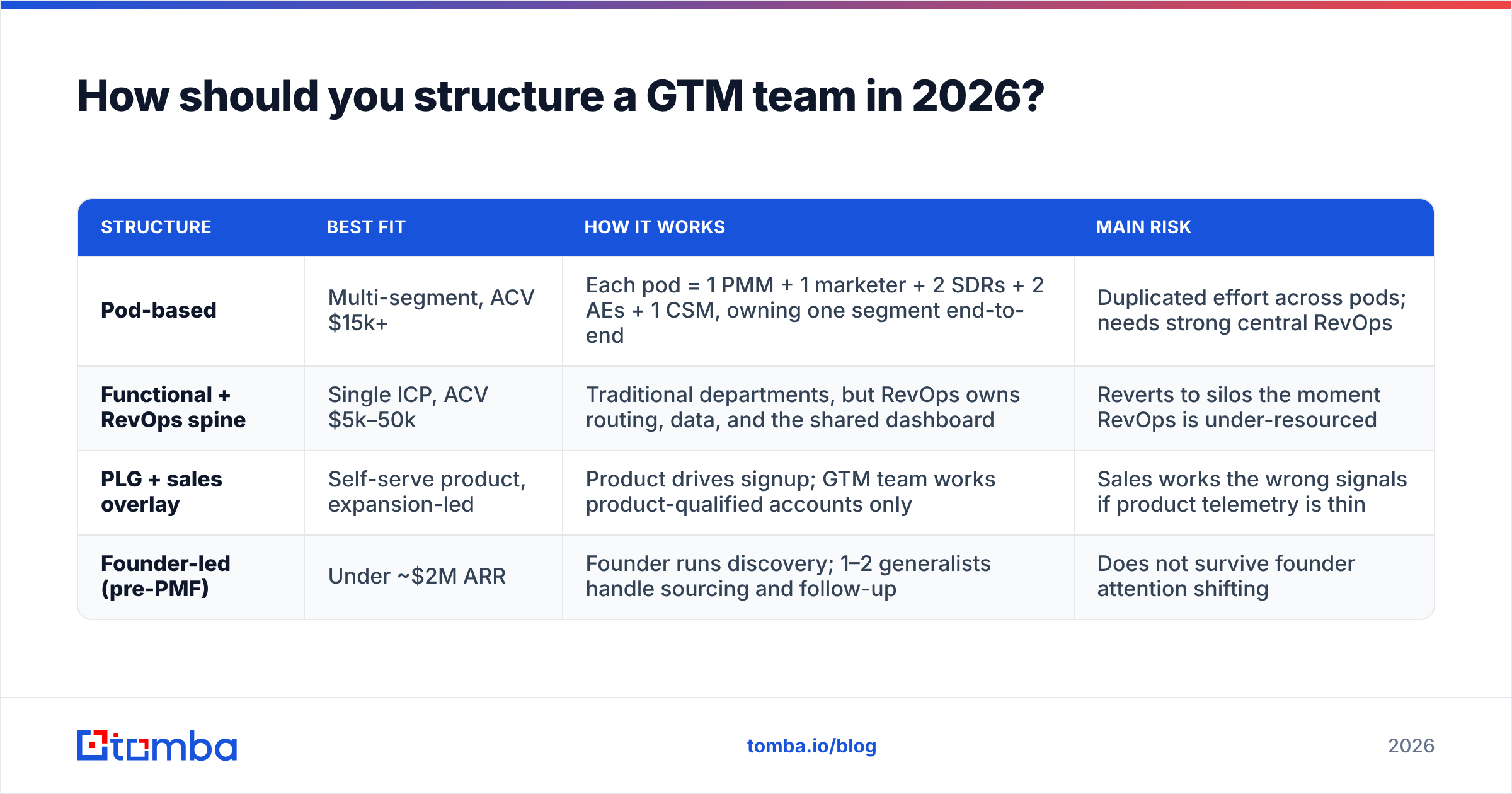
There are three structures worth considering. Pick based on your ACV and segment count, not on what a bigger company does.
| Structure | Best fit | How it works | Main risk |
|---|---|---|---|
| Pod-based | Multi-segment, ACV $15k+ | Each pod = 1 PMM + 1 marketer + 2 SDRs + 2 AEs + 1 CSM, owning one segment end-to-end | Duplicated effort across pods; needs strong central RevOps |
| Functional + RevOps spine | Single ICP, ACV $5k–50k | Traditional departments, but RevOps owns routing, data, and the shared dashboard | Reverts to silos the moment RevOps is under-resourced |
| PLG + sales overlay | Self-serve product, expansion-led | Product drives signup; GTM team works product-qualified accounts only | Sales works the wrong signals if product telemetry is thin |
| Founder-led (pre-PMF) | Under ~$2M ARR | Founder runs discovery; 1–2 generalists handle sourcing and follow-up | Does not survive founder attention shifting |
Pod-based structures win on accountability. When one group owns a segment from first touch to renewal, you can actually attribute outcomes. The tradeoff is overhead — you need enough volume in each segment to justify the headcount, which in practice means at least $3–5M ARR before pods stop feeling wasteful.
The functional-plus-RevOps-spine model is the default for most companies between $2M and $20M ARR. It works as long as RevOps is treated as a first-class function with its own headcount and roadmap, not as "the person who fixes Salesforce fields." If you are staffing revenue operations as an afterthought, the structure will not hold.
What does the GTM data stack look like?#
Every GTM stack has four layers, and most teams overspend on the top two while starving the bottom one.
- Layer 1 — Identity and contact data. Who are the accounts, who are the people, what are their verified emails and phone numbers. This is where enrichment tools, email finders, and B2B databases sit.
- Layer 2 — System of record. The CRM. One account object, one contact object, no duplicates.
- Layer 3 — Engagement. Sequencers, dialers, LinkedIn tooling, marketing automation, deliverability infrastructure.
- Layer 4 — Intelligence. Attribution, forecasting, conversation intelligence, dashboards.
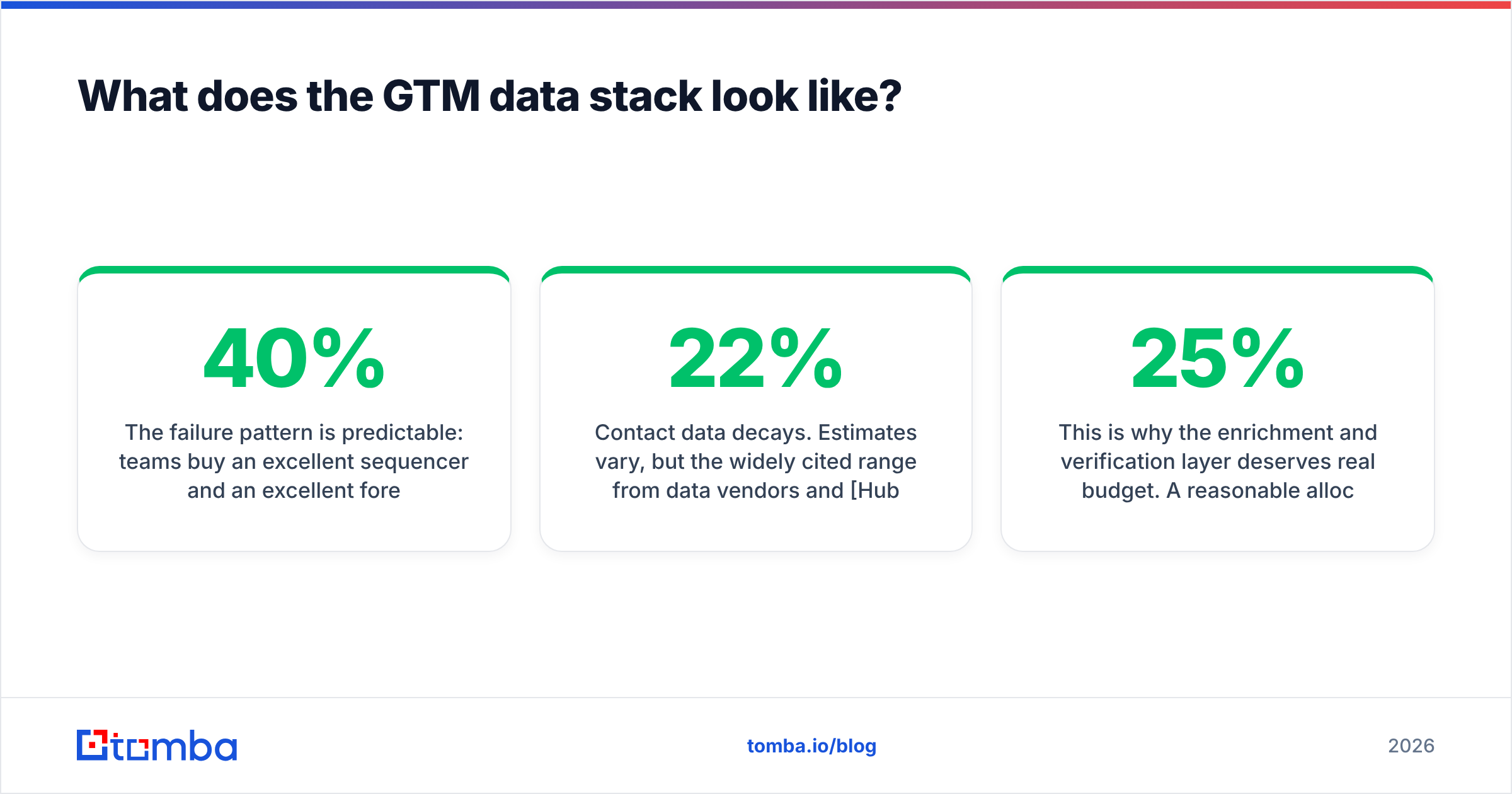
The failure pattern is predictable: teams buy an excellent sequencer and an excellent forecasting tool, then feed both from a contact list where 30–40% of the emails are stale. Everything downstream inherits that error rate. Your sequencer's reply rate looks broken, your forecast is built on accounts that no longer employ your champion, and someone concludes the messaging is wrong.
Contact data decays. Estimates vary, but the widely cited range from data vendors and HubSpot's own research puts B2B database decay somewhere between 22% and 30% annually — job changes, domain migrations, company shutdowns. On a 20,000-contact database, that is roughly 5,000 records going bad every year without anyone touching them.
This is why the enrichment and verification layer deserves real budget. A reasonable allocation is 15–25% of total GTM tooling spend on data quality — verification, enrichment, and deduplication combined. It is unglamorous, and it is the only line item that improves the ROI of every other line item.
How do GTM data tools compare?#
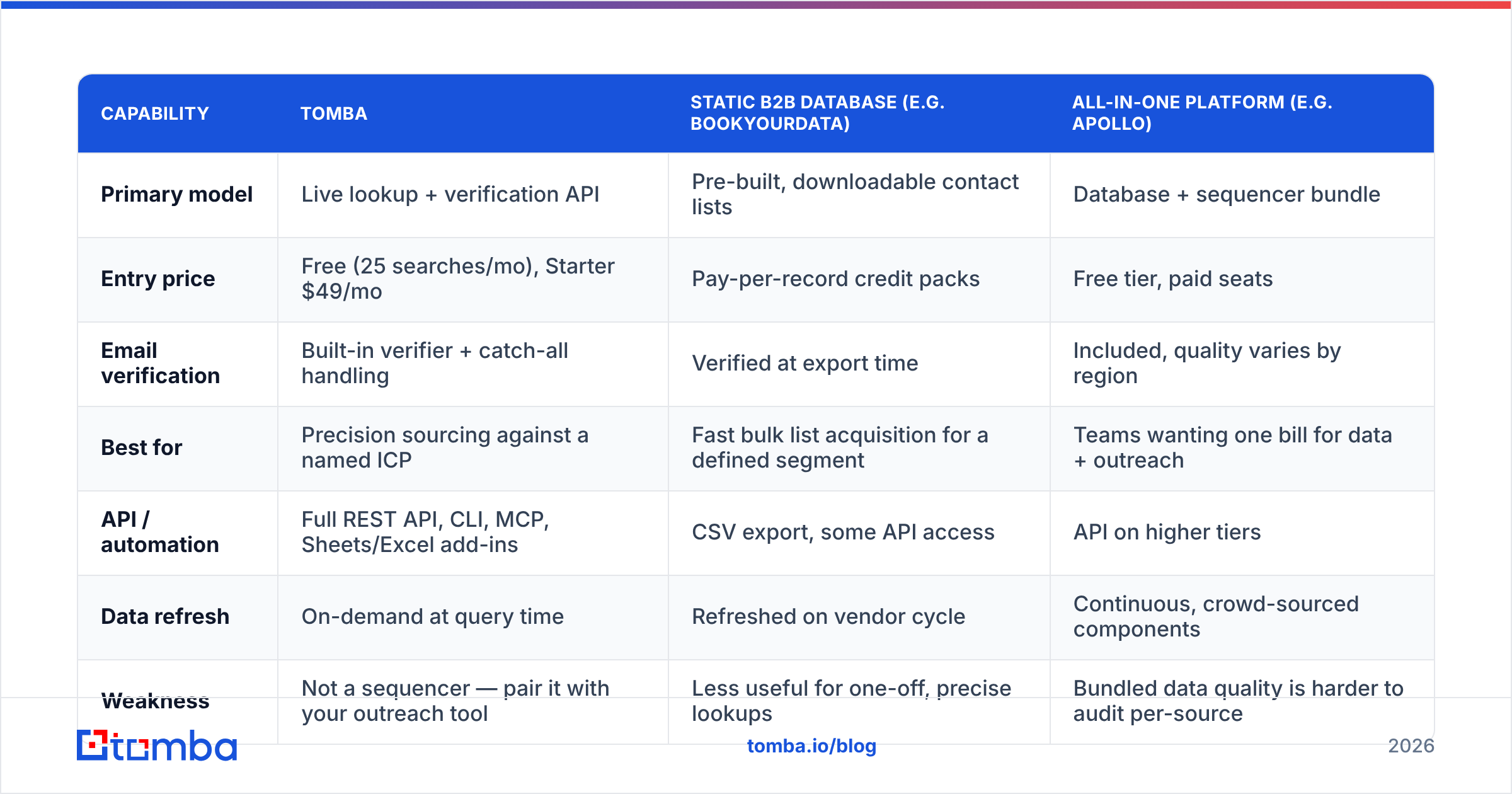
Data vendors are not interchangeable. They differ on coverage geography, verification method, pricing model, and whether they sell you a static database or a live lookup.
| Capability | Tomba | Static B2B database (e.g. BookYourData) | All-in-one platform (e.g. Apollo) |
|---|---|---|---|
| Primary model | Live lookup + verification API | Pre-built, downloadable contact lists | Database + sequencer bundle |
| Entry price | Free (25 searches/mo), Starter $49/mo | Pay-per-record credit packs | Free tier, paid seats |
| Email verification | Built-in verifier + catch-all handling | Verified at export time | Included, quality varies by region |
| Best for | Precision sourcing against a named ICP | Fast bulk list acquisition for a defined segment | Teams wanting one bill for data + outreach |
| API / automation | Full REST API, CLI, MCP, Sheets/Excel add-ins | CSV export, some API access | API on higher tiers |
| Data refresh | On-demand at query time | Refreshed on vendor cycle | Continuous, crowd-sourced components |
| Weakness | Not a sequencer — pair it with your outreach tool | Less useful for one-off, precise lookups | Bundled data quality is harder to audit per-source |
There is no single winner here, and treating it as a bake-off misses the point. Most mature GTM teams run two data sources, not one: a bulk source for building segment coverage, and a precision source for named-account and multithreading work where you need a specific person's verified email today. BookYourData is genuinely strong at the first job — clean, segment-filtered lists you can buy and load. Tomba's domain search and verification stack is built for the second — you have an account name, you need the four people on the buying committee, verified, right now.
Check both against your actual ICP before committing. Coverage varies wildly by geography and company size; a vendor with excellent US mid-market data may be thin on EMEA sub-100-employee accounts. Run a 200-record sample through each and measure the bounce rate yourself rather than trusting published accuracy claims — including ours. G2's category listings are a reasonable starting point for the shortlist, but sample testing is the only thing that settles it.

What metrics should a GTM team actually track?#
Track the metrics that change decisions. Everything else belongs in an appendix.
- Pipeline coverage by segment. Target 3–4x of quota for the current quarter, measured per segment rather than blended. A healthy blended number frequently hides one segment at 6x and another at 1.2x.
- CAC payback period. Fully loaded acquisition cost divided by gross-margin-adjusted monthly revenue. Under 18 months is healthy for mid-market B2B SaaS; under 12 is strong.
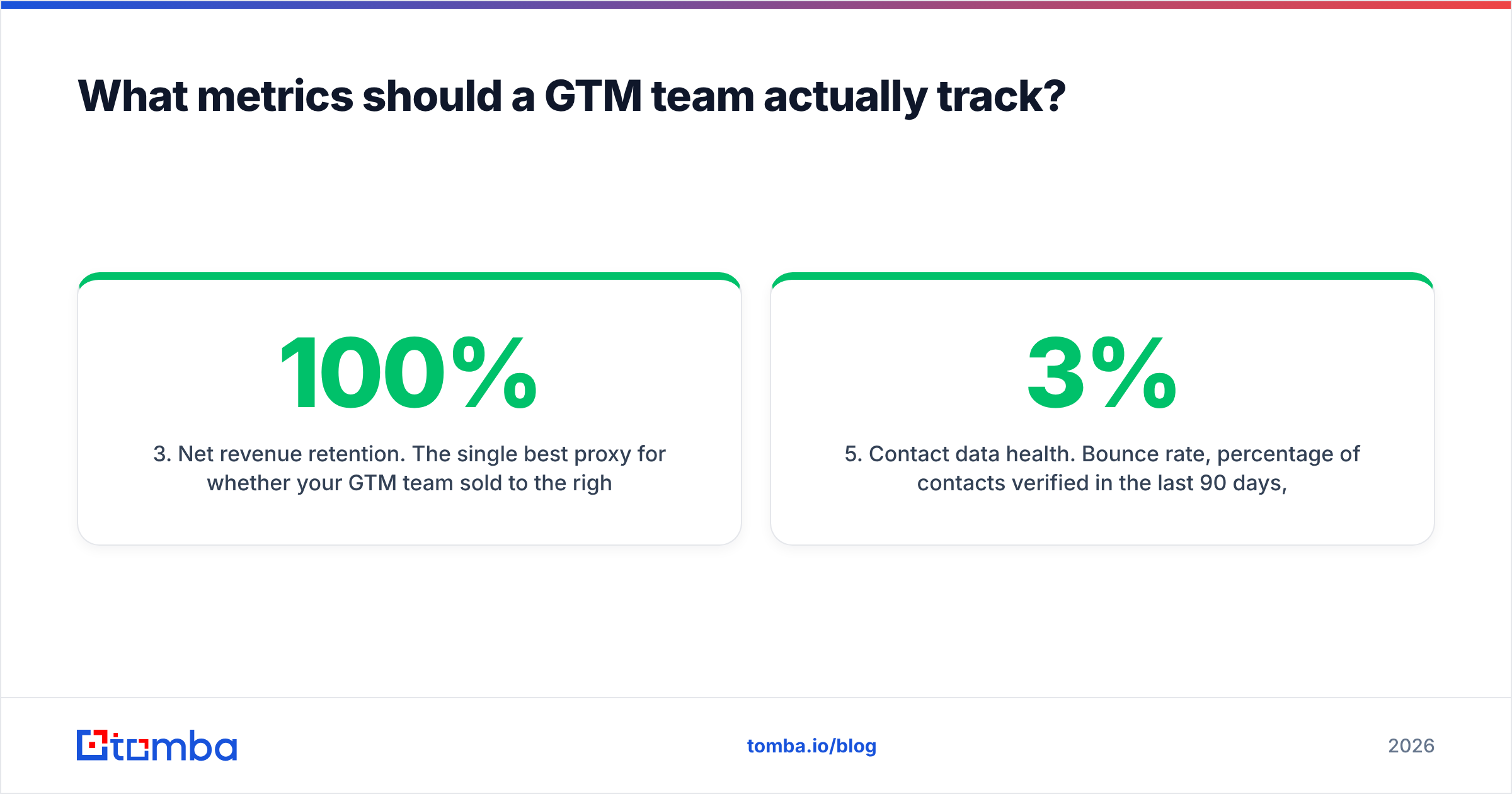
- Net revenue retention. The single best proxy for whether your GTM team sold to the right people. Below 100% means you are acquiring customers your product does not keep.
- Stage-to-stage conversion, not just win rate. Aggregate win rate tells you something is wrong. Stage conversion tells you where.
- Contact data health. Bounce rate, percentage of contacts verified in the last 90 days, and duplicate account rate. If bounce rate exceeds 3%, your sender reputation is degrading and every other metric is being measured through a broken instrument.
- Time from account identified to first verified contact. This is a pure GTM velocity metric and almost nobody tracks it. If it takes an SDR 20 minutes of manual research per account, your data layer is the bottleneck, not your rep's work ethic.
The last two matter more than their reputation suggests. A GTM team can execute perfect messaging against bad data and produce nothing. The reverse — mediocre messaging against clean, well-targeted data — usually still produces meetings.
How do you fix a broken GTM team?#
Diagnose in this order, because fixing step four before step one wastes a quarter.
First, check ICP alignment. Ask five people across marketing, sales, and CS to write down your ICP independently. If the answers differ materially, nothing downstream can work. This is the single most common root cause and it is free to check.
Second, audit the data layer. Pull 500 random contacts from your CRM. Run them through an email verifier and count what comes back invalid, catch-all, or unknown. Anything above 15% invalid means your outbound numbers are meaningless and your deliverability is at risk.
Third, map the handoffs. Write down every point where a record changes owner — MQL to SDR, SDR to AE, AE to CSM. For each, define the entry criteria in writing and check whether the CRM actually enforces them. Undefined handoffs are where pipeline evaporates silently.
Fourth, then look at messaging and channels. Only after the first three. Messaging tests run on top of bad data and undefined handoffs produce noise you will misread as signal.
Fifth, review the cadence. One weekly forum where marketing, sales, and CS look at the same dashboard. Not three separate reviews with three separate spreadsheets.
Most teams skip to step four because it is the most interesting one. It is also the one with the least leverage when the foundation is broken.
What is the biggest GTM mistake in 2026?#
Buying AI tooling to paper over a data problem.
AI SDRs, AI research agents, and automated personalization all amplify whatever you feed them. Point an AI agent at a contact database with a 35% decay rate and you get personalized emails sent very efficiently to people who left the company eight months ago — at higher volume than a human would have managed, which is worse, not better.
The sequencing that works: fix the ICP definition, clean and verify the data layer, define the handoffs, then automate. Teams that do it in that order see AI tooling produce real leverage. Teams that do it backwards spend a year debugging outputs and blaming the model.
The second-biggest mistake is treating GTM alignment as a culture problem solvable with offsites. It is an operations problem. Shared metrics, shared data, shared cadence — those are systems, and systems beat sentiment.
Where should you start?#
If your GTM team is under 20 people, start with the data layer, because it is the cheapest fix with the widest blast radius. Verify what you have, identify the coverage gaps against your ICP, and build a repeatable process for turning a target account list into verified, multithreaded contacts.
That is exactly what the Tomba Email Finder is built for: give it a domain and a name, get back a verified professional email with a confidence score, at scale or one at a time via the API, CLI, or Sheets add-in. The free tier gives you 25 searches a month to test coverage against your own ICP before spending anything; Starter runs $49/mo and Growth $99/mo when you are ready to scale — full Tomba pricing is public, no sales call required.
Run 200 of your own target accounts through it, measure the bounce rate, and compare against whatever you use now. That test takes an afternoon and will tell you more about your GTM machine's ceiling than another quarter of messaging experiments.
Related guides#
Ready to find emails that actually work?
Join 150,000+ professionals who stopped guessing and started sending. Free credits on signup — no credit card required.
Get the Tomba newsletter
Practical outbound tactics and product updates — once every two weeks.
About the author