Guided Selling Platform: How It Works and Who Needs One
Guided selling promises to tell reps what to do next. Here is what a guided selling platform actually does, where it breaks, and how to tell if you need one in 2026.
TL;DR
- A guided selling platform sits on top of your CRM and tells reps what to do next — which deal to touch, which question to ask, which collateral to send — based on rules, deal data, and increasingly AI models.
- It works when your sales motion is repeatable and your data is clean. It fails loudly when either of those is missing, because bad inputs turn "next best action" into confident nonsense.
- Three flavors exist: CRM-native guidance (Salesforce, HubSpot), revenue-intelligence guidance (Gong, Clari), and configure-price-quote style product guidance. They solve different problems and are frequently confused in buying committees.
- Expect $60–$200+ per user per month on top of your CRM. The ROI case rests almost entirely on ramp time and win-rate lift for the middle 60% of your reps.
- Before you buy, fix contact data. Guidance built on stale or missing contacts produces tasks reps can't execute.
What is a guided selling platform?#
A guided selling platform is software that turns your sales process from a document nobody reads into prompts that appear inside the seller's workflow. Instead of a 40-page playbook in Confluence, the rep opens an opportunity and sees: "This deal has no economic buyer identified after 21 days. Add one or downgrade the stage."
Think of it like a GPS instead of a paper map. The paper map (your playbook) is technically complete and always available. The GPS knows where you are right now, what the traffic looks like, and says "turn left in 200 meters." Same information, radically different adoption rate.
Technically, most platforms combine four layers:
- A process model — stages, exit criteria, required fields, and qualification frameworks (MEDDICC, BANT, SPICED) encoded as structured data rather than prose.
- A signal layer — CRM activity, email and call metadata, product usage, intent data, and conversation-intelligence transcripts.
- A decision engine — rules, scoring, or ML that maps signals to recommendations. This is where vendors differentiate and where marketing claims outrun reality.
- A delivery surface — the recommendation shown in Salesforce, in Slack, in the email client, or in a mobile app. Delivery is not a detail; guidance nobody sees changes nothing.
The category overlaps heavily with sales automation and revenue intelligence. The distinguishing feature is prescription. Analytics tells you win rate dropped. Guided selling tells this rep, on this deal, today, to do a specific thing.
Why do sales teams buy guided selling software?#
Four buying triggers show up again and again, and only two of them are good reasons.
Trigger 1: Ramp time is too long. New reps take 5–7 months to reach quota in most B2B orgs. Guided selling compresses that by encoding what top performers do into the interface. This is the strongest ROI case, and it's measurable: track time-to-first-deal before and after.
Trigger 2: Performance is bimodal. Two reps hit 140% of quota, eight sit at 60%. Coaching doesn't scale because your managers are also selling. Guidance is a scale mechanism for the middle of the distribution — it rarely improves your top reps and won't rescue your bottom two.
Trigger 3: Forecast accuracy is bad. This is a partially good reason. Guided selling improves data hygiene as a side effect (reps fill required fields to clear prompts), which improves the forecast. But if you're buying guidance solely to fix a forecast, you probably want a forecasting tool.
Trigger 4: A VP saw a demo. This is not a reason. The demo always looks incredible because the demo data is perfect.
According to Gartner's research on B2B buying, buyers now spend the majority of their purchase journey away from sellers, which raises the cost of every wasted interaction. That's the real argument: when you only get four conversations instead of twelve, each one needs to be the right one.
What types of guided selling platforms exist?#
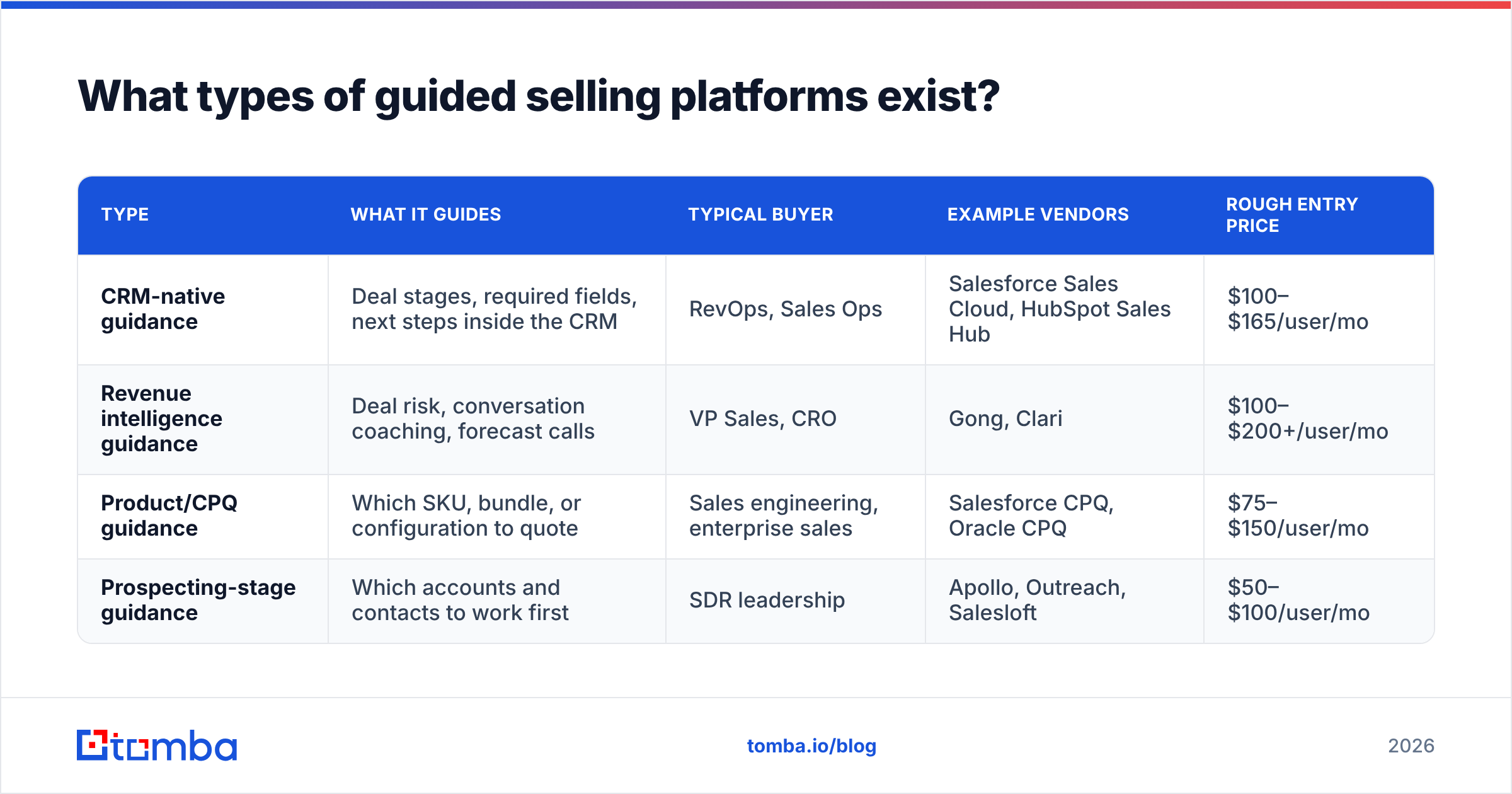
The word "guided selling" is used for three genuinely different products. Buying the wrong category is the most common expensive mistake here.
| Type | What it guides | Typical buyer | Example vendors | Rough entry price |
|---|---|---|---|---|
| CRM-native guidance | Deal stages, required fields, next steps inside the CRM | RevOps, Sales Ops | Salesforce Sales Cloud, HubSpot Sales Hub | $100–$165/user/mo |
| Revenue intelligence guidance | Deal risk, conversation coaching, forecast calls | VP Sales, CRO | Gong, Clari | $100–$200+/user/mo |
| Product/CPQ guidance | Which SKU, bundle, or configuration to quote | Sales engineering, enterprise sales | Salesforce CPQ, Oracle CPQ | $75–$150/user/mo |
| Prospecting-stage guidance | Which accounts and contacts to work first | SDR leadership | Apollo, Outreach, Salesloft | $50–$100/user/mo |
If your problem is "reps don't know which account to call," a CPQ tool is useless. If your problem is "reps quote the wrong bundle and margins leak," conversation intelligence won't help. Write down the exact failure you're fixing before you take a single demo. And if the failure is upstream — reps burning hours hunting for contact details — the answer is a data layer, not a guidance layer. Tools like Tomba's email finder and data enrichment solve that class of problem far more cheaply.
How does a guided selling platform actually work?#
Here's the honest mechanics, stripped of vendor language.
Step 1 — Encode the process. Someone (usually RevOps, sometimes an implementation consultant) translates your sales methodology into structured rules. "Stage 3 requires: identified champion, confirmed budget range, technical validation scheduled." This takes 2–6 weeks and is the single biggest determinant of whether the rollout succeeds.
Step 2 — Wire the signals. The platform ingests CRM objects, email and calendar via OAuth, call recordings, and often product telemetry. Coverage gaps here become guidance gaps. If your reps use WhatsApp for a third of their conversations, a third of your signal is invisible.
Step 3 — Score and rank. Rules-based engines are transparent and predictable. ML-based engines find patterns humans miss but require volume — realistically several thousand closed opportunities before the model beats a decent rule set. Vendors selling AI guidance to a team with 200 closed deals a year are selling you a rules engine with better marketing.
Step 4 — Deliver and measure. The recommendation appears. The rep accepts, dismisses, or ignores it. Acceptance rate is the metric that matters most in month one — if reps dismiss more than half of recommendations, your rules are wrong, not your reps.
Step 5 — Close the loop. Outcomes feed back. A recommendation that correlates with won deals gets weighted up. This only works if you're honestly attributing outcomes, which most implementations aren't in year one.
What does guided selling cost in 2026?#
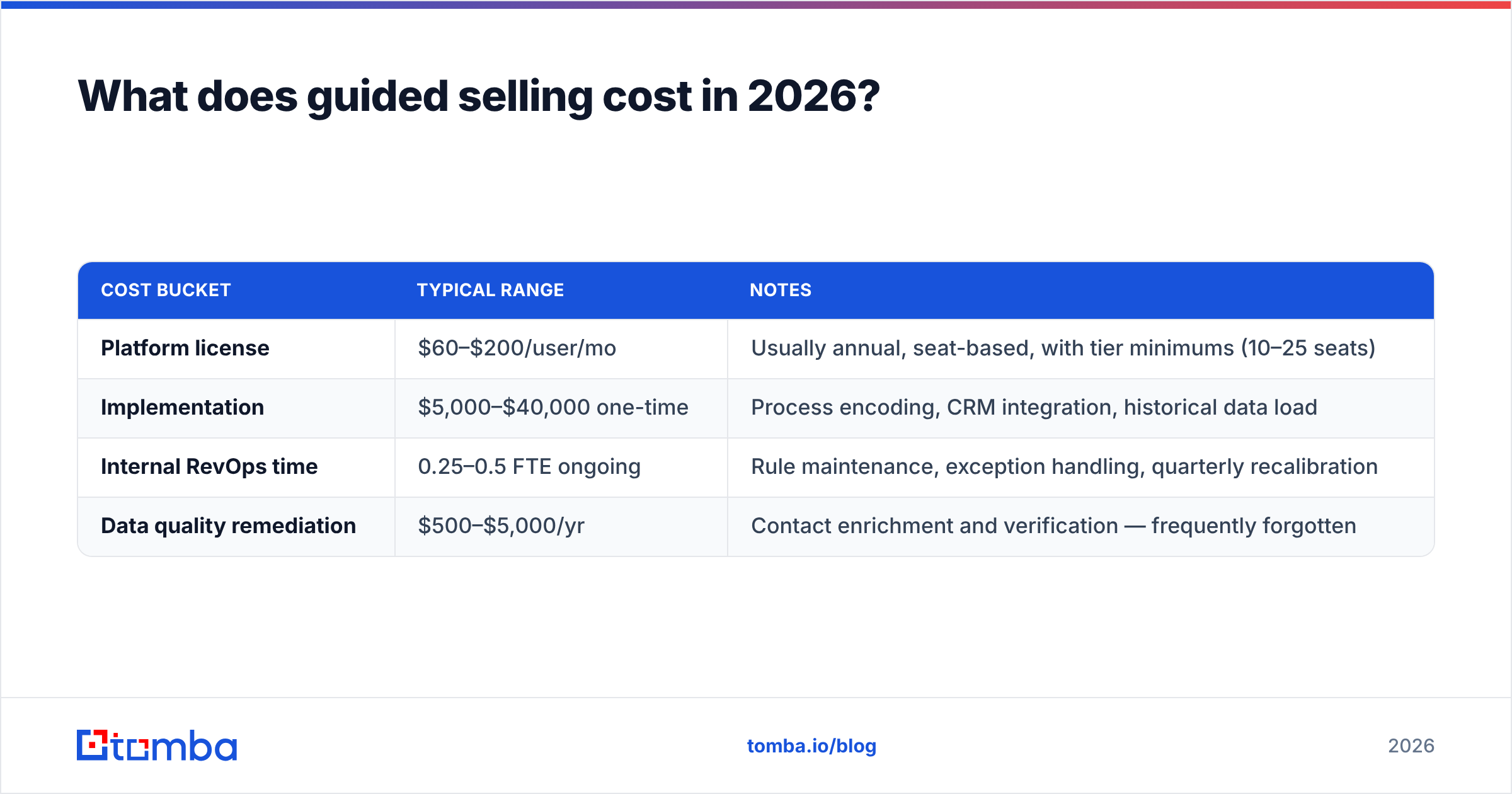
Budget in three buckets, not one.
| Cost bucket | Typical range | Notes |
|---|---|---|
| Platform license | $60–$200/user/mo | Usually annual, seat-based, with tier minimums (10–25 seats) |
| Implementation | $5,000–$40,000 one-time | Process encoding, CRM integration, historical data load |
| Internal RevOps time | 0.25–0.5 FTE ongoing | Rule maintenance, exception handling, quarterly recalibration |
| Data quality remediation | $500–$5,000/yr | Contact enrichment and verification — frequently forgotten |
A 20-rep team should plan for roughly $40,000–$60,000 in year one all-in for a mid-market deployment. To clear that hurdle at a $30,000 average deal size, you need about two extra closed deals — plus the ramp-time savings. That's achievable, but it's not the 10x the case studies imply.
The data-quality line is the one buyers skip. Compare it to the platform line: verified contact data through something like Tomba pricing starts at a free tier of 25 searches per month and runs $49/mo for Starter, $99/mo for Growth, and $249/mo for Pro. Against a $2,000/month guidance platform, that's rounding error — and it determines whether half your recommendations are executable.
Can guided selling work without clean data?#
No, and this is where most deployments quietly fail.
Every recommendation a guided selling platform makes assumes the underlying record is real. "Follow up with the VP of Engineering" assumes there is a VP of Engineering on the account, that the email address works, and that the last activity date is accurate. Break any of those and the rep gets a task they cannot complete. Two weeks of impossible tasks teaches reps to ignore the panel permanently. Adoption never recovers.
The failure modes are boring and predictable:
- Stale contacts. B2B contact data decays roughly 25–30% per year through job changes. A two-year-old CRM has a third of its contacts pointing at people who left.
- Missing decision-makers. The account has one contact — the person who filled out a form in 2024. Guidance about multi-threading is meaningless with a single thread.
- Unverified emails. Recommendations to send sequences into a list with a 20% bounce rate damage sender reputation faster than any guidance improves win rate.
- Duplicate accounts. The engine scores the same company three times and ranks all three differently.
The fix is unglamorous: run enrichment and verification as a scheduled job before you turn guidance on. Use a bulk email finder to fill contact gaps across your account list, then push everything through an email verifier so the sequences your platform recommends actually land. Sequence matters — enrich first, verify second, then let the guidance engine rank.
Which guided selling platform should you choose?#
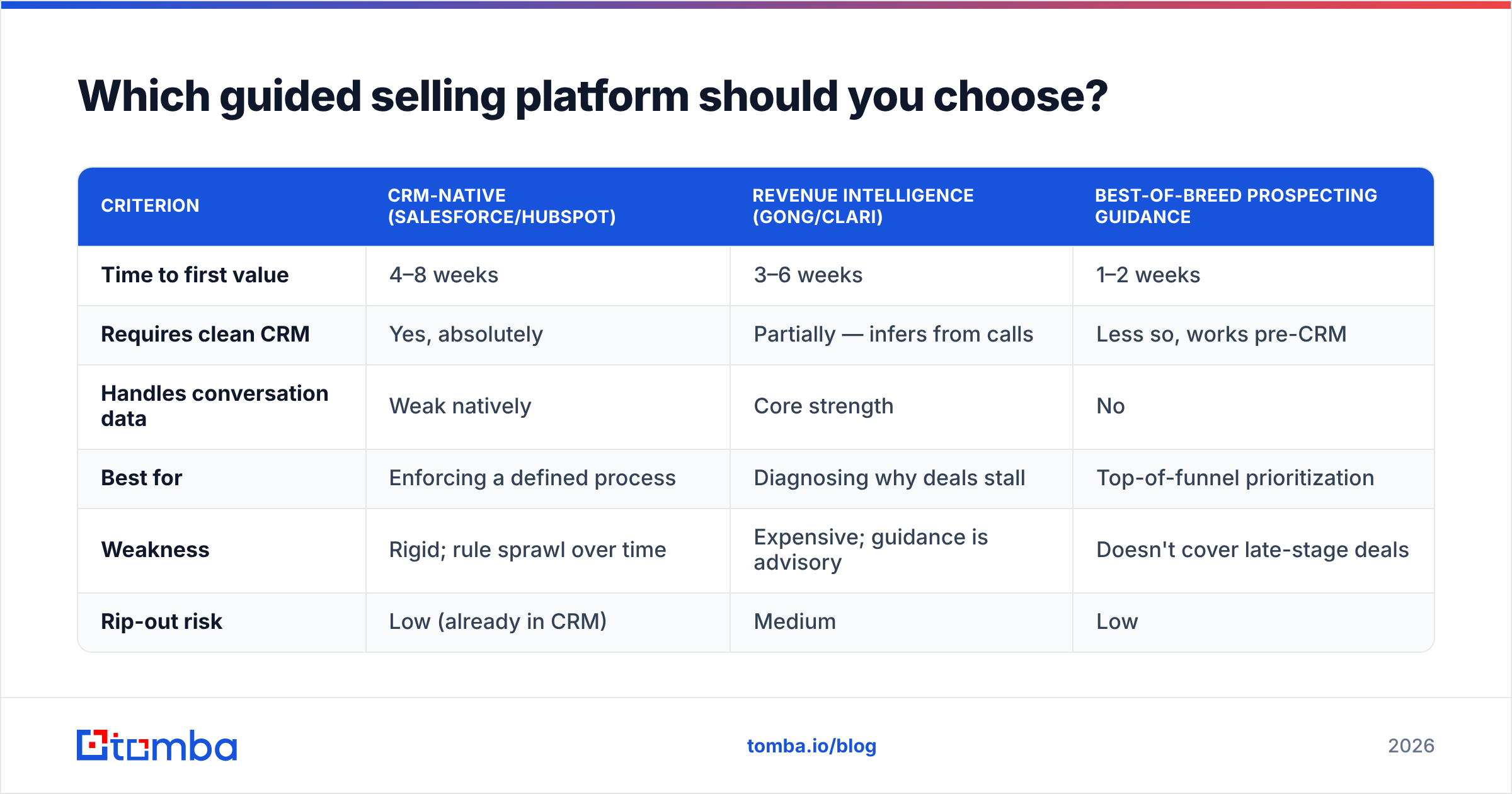
Match the tool to your actual constraint. Here's how the main options compare on the dimensions that decide deployments.
| Criterion | CRM-native (Salesforce/HubSpot) | Revenue intelligence (Gong/Clari) | Best-of-breed prospecting guidance |
|---|---|---|---|
| Time to first value | 4–8 weeks | 3–6 weeks | 1–2 weeks |
| Requires clean CRM | Yes, absolutely | Partially — infers from calls | Less so, works pre-CRM |
| Handles conversation data | Weak natively | Core strength | No |
| Best for | Enforcing a defined process | Diagnosing why deals stall | Top-of-funnel prioritization |
| Weakness | Rigid; rule sprawl over time | Expensive; guidance is advisory | Doesn't cover late-stage deals |
| Rip-out risk | Low (already in CRM) | Medium | Low |
Practical guidance by team size:
- Under 10 reps. Don't buy a platform. Write exit criteria into your CRM's required fields and run a weekly pipeline review. You are the guidance engine, and you're cheaper.
- 10–40 reps. Start CRM-native. HubSpot's sales tools and Salesforce both ship usable guidance in tiers you likely already pay for. Layer a data enrichment routine underneath it.
- 40–150 reps. This is the sweet spot for revenue intelligence. You have enough call volume for patterns to be real and enough reps that manager coaching has stopped scaling.
- 150+ reps. You'll likely run two: CRM-native for process enforcement, revenue intelligence for coaching and forecast. Budget for the integration work between them.
- Any size with a heavy outbound motion. Solve contact data before guidance. Check G2's category listings for current user-reported data accuracy scores rather than trusting vendor claims.
How do you measure whether guided selling is working?#
Pick metrics before rollout, because after rollout everyone will retroactively define success as whatever happened.
- Recommendation acceptance rate. Target above 50% by week six. Below 30% means your encoded process doesn't match how deals actually close.
- Time to first closed deal for new hires. The cleanest ROI signal. Compare cohorts, not individuals.
- Stage conversion rate for the middle 60% of reps. Guidance should lift the middle. If only top reps improve, you bought a reporting tool.
- Field completeness on won vs. lost deals. A proxy for whether reps are working the process or gaming the prompts.
- Win rate delta at 2 quarters. Anything shorter is noise. Anything attributed at 30 days is a vendor slide.
Track a control group if you can. Roll out to two of four teams first. Almost nobody does this, and almost everybody wishes they had when the renewal conversation arrives.
What are the honest limitations?#
Guidance encodes the past. If your market shifts, the engine keeps recommending what worked last year. Recalibrate quarterly, and treat any recommendation set older than 12 months as suspect.
It can produce process theater. Reps learn to clear prompts rather than advance deals. Watch for opportunities with perfect field completion and no meetings booked.
AI claims outpace AI reality. Many "AI next-best-action" features are decision trees with a language model writing the explanation. That's not worthless — the explanation genuinely improves adoption — but price it as a rules engine.
It won't fix a broken ICP. If you're selling to the wrong companies, better sequencing of the wrong conversations doesn't help. Guided selling optimizes execution, never targeting.
Integration debt compounds. Every additional signal source is another OAuth connection to maintain, another permissions review, another thing that silently stops syncing on a Tuesday.
Where should you start?#
Start where the leverage is highest and the cost is lowest: the data your guidance will run on.
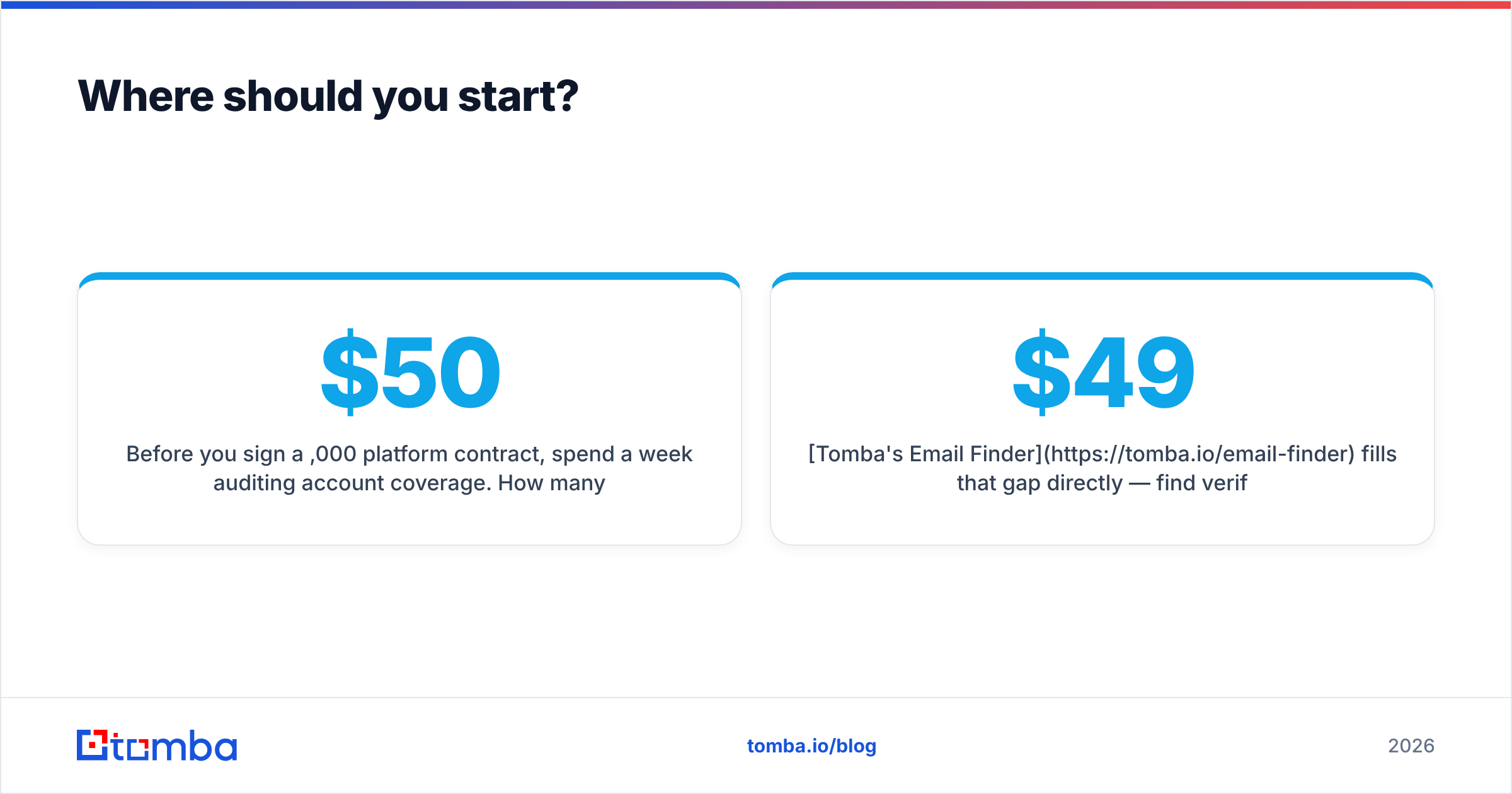
Before you sign a $50,000 platform contract, spend a week auditing account coverage. How many of your target accounts have a verified email for the actual decision-maker? If the answer is under 60%, no guidance engine will produce executable recommendations, and you'll blame the platform for a data problem.
Tomba's Email Finder fills that gap directly — find verified professional email addresses by domain, name, or company, then push them into your CRM through the HubSpot integration or the Tomba API before your guided selling rollout begins. Start on the free tier at 25 searches per month to audit a sample of your accounts, then scale to Starter at $49/mo once you know the size of the gap. Fix the inputs first; the guidance gets dramatically smarter for free.
Related guides#
Ready to find emails that actually work?
Join 150,000+ professionals who stopped guessing and started sending. Free credits on signup — no credit card required.
Get the Tomba newsletter
Practical outbound tactics and product updates — once every two weeks.
About the author