Gumbamail vs LeadEngineAI: Which Fits Your 2026 Outbound?
One tool sends campaigns to people who already know you. The other tries to find people who don't. Here's an honest breakdown of Gumbamail vs LeadEngineAI — where each wins, where each stops, and what you still need to buy separately.
TL;DR
- Gumbamail and LeadEngineAI are not really competitors. Gumbamail is an email marketing platform (newsletters, campaigns, lists, automations). LeadEngineAI sits in the AI lead-generation category — surfacing and scoring prospects you don't have yet.
- If you have a list and need to mail it, Gumbamail is the relevant tool. If you have no list and need names, an AI lead engine is the relevant tool. Buying the wrong one wastes a quarter.
- Neither category is a substitute for a dedicated contact-data layer. Marketing platforms assume the address already exists; AI lead engines are frequently vague about where addresses came from and how fresh they are.
- The cheapest failure mode in 2026 is deliverability. Sending unverified addresses through any platform burns your domain reputation faster than the platform can compensate.
- Practical stack: a lead source + a verified email finder + a sending tool. Most teams need all three, and most tools only honestly cover one.
What are Gumbamail and LeadEngineAI, exactly?#
Start here, because the naming makes them sound like rivals and they aren't.
Gumbamail is an email marketing platform. You import or collect subscribers, build campaigns in a drag-and-drop editor, segment lists, schedule sends, and read open/click reports. It's aimed at small and mid-sized businesses, newsletters, ecommerce stores, and marketing teams who want a simpler, cheaper alternative to the big ESPs. You can see the current feature set and plans on the Gumbamail site. The core assumption never changes: you already have permission-based contacts.
LeadEngineAI belongs to the newer wave of AI lead-generation products — tools that promise to identify companies matching an ideal customer profile, enrich them with contacts, score intent, and hand you a ready-to-work list. This category exploded between 2024 and 2026, and the products in it vary wildly in quality. Some are genuine data companies with an AI layer on top. Others are thin wrappers around third-party APIs and public scrapes with a chat interface bolted on.
That distinction matters more than any feature list. Before you sign anything in the AI lead-gen category, ask one question: where does the underlying data come from, and how often is it re-checked? If the answer is a marketing page rather than a documentation page, treat the accuracy claims as unverified.
A useful mental model: Gumbamail is the delivery van. An AI lead engine is the map of addresses to visit. Neither one is the warehouse where the goods are actually stored — that's your contact-data layer, and it's the part teams most often forget to buy.
How do Gumbamail and LeadEngineAI compare head-to-head?#
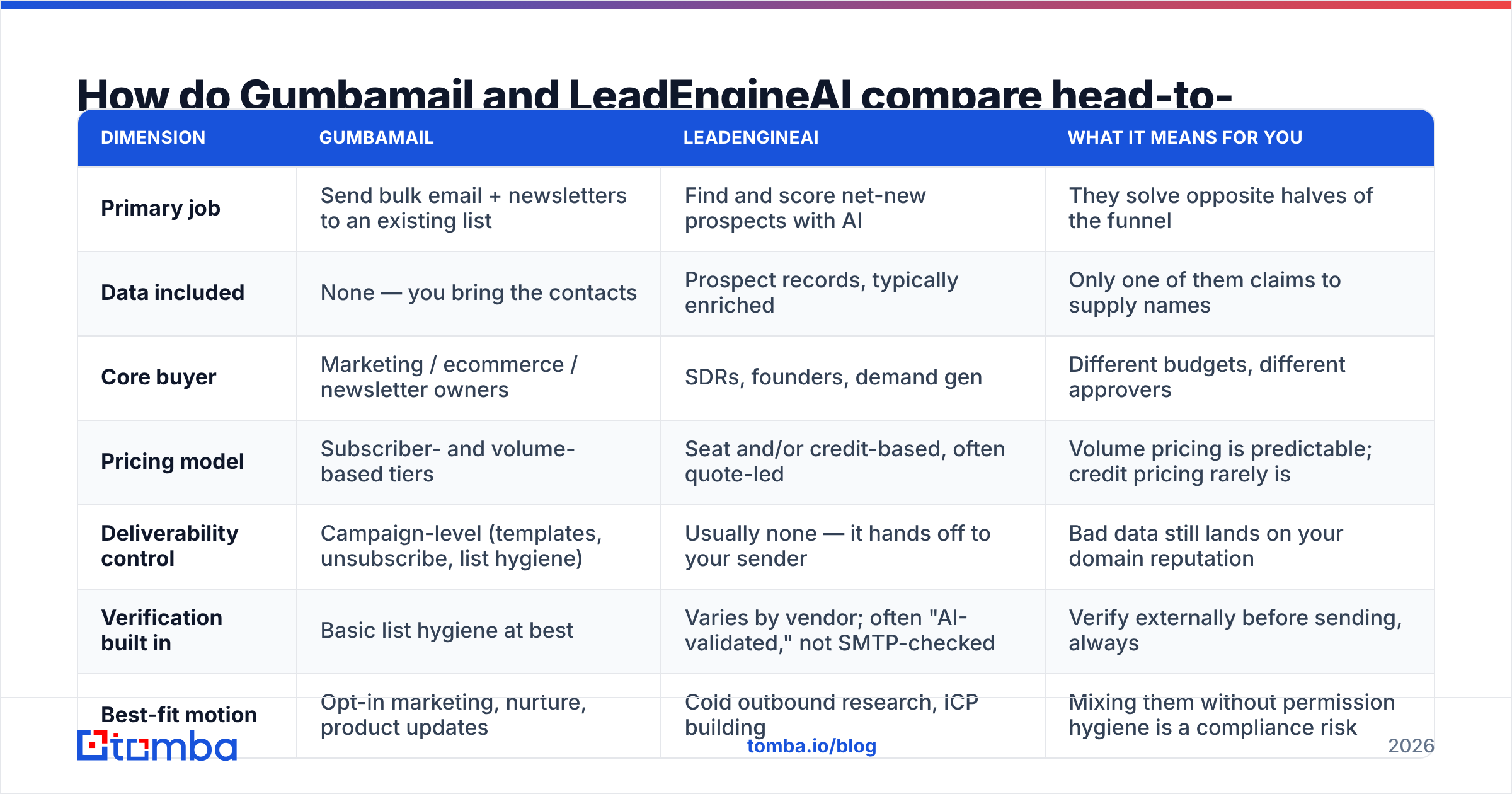
| Dimension | Gumbamail | LeadEngineAI | What it means for you |
|---|---|---|---|
| Primary job | Send bulk email + newsletters to an existing list | Find and score net-new prospects with AI | They solve opposite halves of the funnel |
| Data included | None — you bring the contacts | Prospect records, typically enriched | Only one of them claims to supply names |
| Core buyer | Marketing / ecommerce / newsletter owners | SDRs, founders, demand gen | Different budgets, different approvers |
| Pricing model | Subscriber- and volume-based tiers | Seat and/or credit-based, often quote-led | Volume pricing is predictable; credit pricing rarely is |
| Deliverability control | Campaign-level (templates, unsubscribe, list hygiene) | Usually none — it hands off to your sender | Bad data still lands on your domain reputation |
| Verification built in | Basic list hygiene at best | Varies by vendor; often "AI-validated," not SMTP-checked | Verify externally before sending, always |
| Best-fit motion | Opt-in marketing, nurture, product updates | Cold outbound research, ICP building | Mixing them without permission hygiene is a compliance risk |
| Where it stops | Cannot find new contacts | Cannot send compliant campaigns at scale | You will need a third tool either way |
Two things fall out of that table.
First, comparing them on price is close to meaningless. A per-subscriber marketing plan and a per-credit prospecting plan measure different units. The honest comparison is total cost of the stack you actually end up with.
Second, both leave the same gap: contact accuracy at the moment of send. Gumbamail assumes it. AI lead engines assert it. Neither one lets you off the hook.
Which tool matches which job?#
Pick by the job you're hiring the tool for, not by the feature grid:
- You have 8,000 opted-in subscribers and need a monthly newsletter. Gumbamail. An AI lead engine adds nothing here — you already have the audience, you need reliable sending and reporting.
- You have zero pipeline and need 500 target accounts by Friday. An AI lead-gen tool like LeadEngineAI, paired with a verification step before anything gets emailed.
- You have a list of company domains but no contacts inside them. Neither, really. This is a domain search job — resolve the domains into named people with role-level filtering, then decide how to reach them.
- You have contacts but a bounce rate above 5%. Stop everything and clean the list with an email verifier. No sending platform and no AI scoring model can rescue a decayed list; B2B contact data decays roughly 2–3% per month as people change jobs.
- You're running both marketing and outbound from one seat. You need three layers — data, verification, sending — and you should budget for them separately instead of hoping one vendor covers all three well.

What does Gumbamail do well — and where does it stop?#
Gumbamail's strength is that it's unpretentious. Template editor, lists, segments, scheduled campaigns, automation basics, reporting. For a small marketing team or a solo newsletter operator, the value is in not paying enterprise ESP prices for features you don't touch. Reviews across G2 and similar directories consistently praise this category of tool for simplicity and price rather than for depth.
Where it stops:
- It has no opinion about your data. Import a bad list and it will happily send to it. Your domain absorbs the damage.
- It is not a cold-outbound tool. Bulk marketing platforms are built around opt-in audiences and unsubscribe compliance. Pushing cold prospects through a marketing ESP is a good way to get your account reviewed and your reputation dented.
- It doesn't build your audience. Forms and imports, yes. Discovery of net-new buyers, no.
That last point is the whole reason someone types "Gumbamail vs LeadEngineAI" into Google in the first place. They've realised the sending tool isn't producing pipeline — because sending was never the constraint.
What does LeadEngineAI do well — and where does it stop?#
The promise of the AI lead-gen category is compression: describe your ICP in plain language, get back scored accounts and contacts, skip three hours of manual research. When it works, that's real time saved, particularly for founder-led sales and small SDR teams without a research function.
Where this category — not just one vendor — tends to stop:
- Opaque sourcing. "AI-enriched" often means aggregated from partner databases, public profiles, and pattern inference. Pattern inference is legitimate; presenting it as verified is not. Ask whether addresses are SMTP-validated at delivery time or only pattern-generated.
- Credit math. Credit-based pricing hides the true unit cost. If 30% of delivered contacts are stale, your effective cost per usable contact is 43% higher than the sticker rate. Model that before you commit annually.
- No sending layer. You still export to a sequencer or ESP, which means you still own deliverability.
- Catch-all blind spots. Many enterprise domains accept all mail, so naive validation reports them as valid. A dedicated catch-all verifier is the only reliable way to separate real mailboxes from accept-all noise.
None of this makes AI lead engines bad. It makes them incomplete — exactly like Gumbamail is incomplete, just at the other end of the funnel.
Is either one a real source of B2B contact data?#
Gumbamail: no, and it doesn't claim to be. LeadEngineAI: partly, and this is where you should apply pressure during a trial.
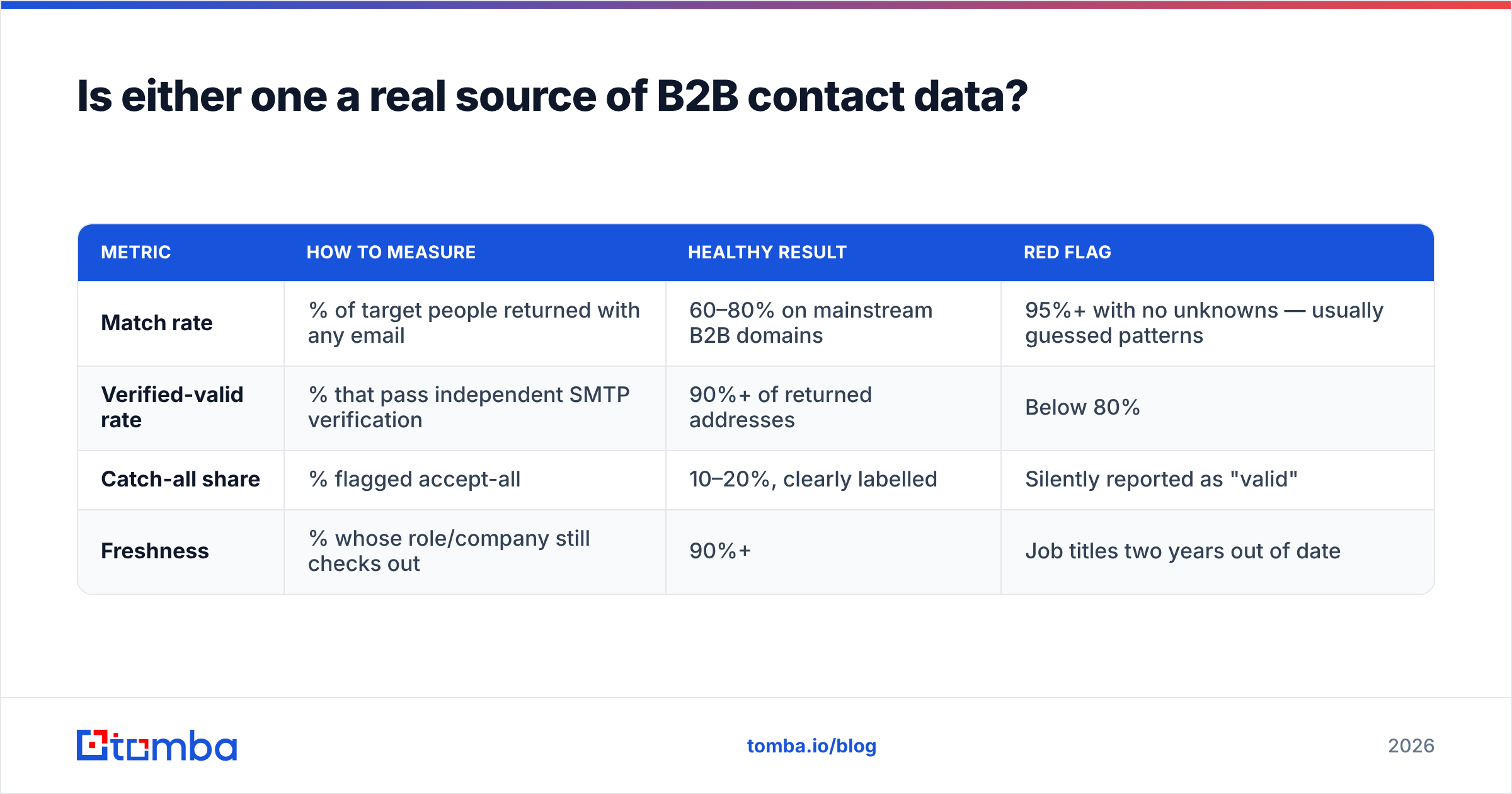
A fair test takes twenty minutes. Pull 100 contacts from any lead source, then run those same 100 through an independent finder and verifier. Compare four numbers:
| Metric | How to measure | Healthy result | Red flag |
|---|---|---|---|
| Match rate | % of target people returned with any email | 60–80% on mainstream B2B domains | 95%+ with no unknowns — usually guessed patterns |
| Verified-valid rate | % that pass independent SMTP verification | 90%+ of returned addresses | Below 80% |
| Catch-all share | % flagged accept-all | 10–20%, clearly labelled | Silently reported as "valid" |
| Freshness | % whose role/company still checks out | 90%+ | Job titles two years out of date |
Run that test against every vendor in the comparison, including the incumbent you already pay for. The results are usually more persuasive than any published accuracy claim — including ours. Tomba publishes where its data comes from precisely so this test is reproducible.

What does each actually cost once the stack is complete?#
Published prices move, so treat vendor pages as the source of truth and this as a shape, not a quote. What's stable is the structure of the bill.
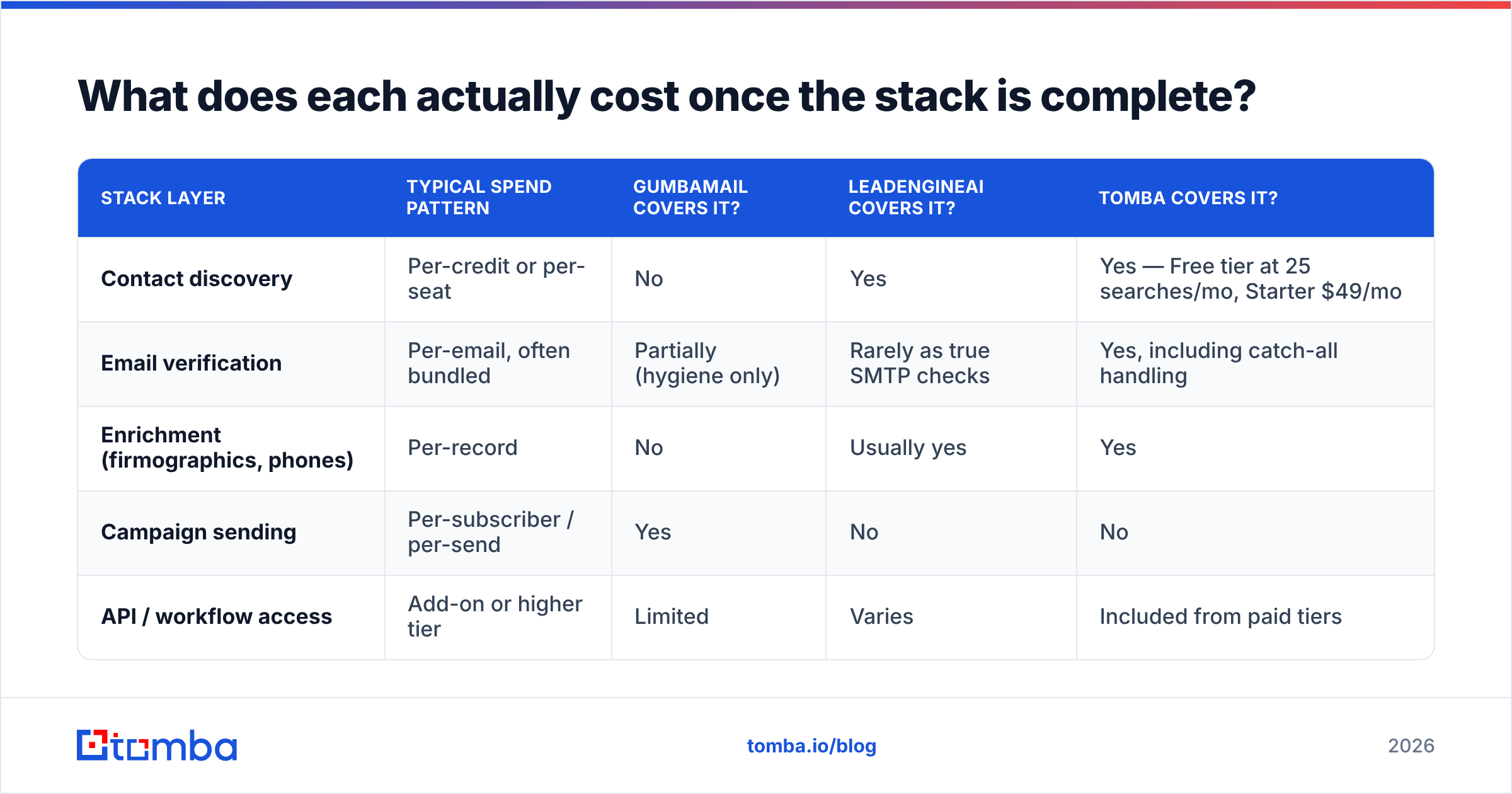
| Stack layer | Typical spend pattern | Gumbamail covers it? | LeadEngineAI covers it? | Tomba covers it? |
|---|---|---|---|---|
| Contact discovery | Per-credit or per-seat | No | Yes | Yes — Free tier at 25 searches/mo, Starter $49/mo |
| Email verification | Per-email, often bundled | Partially (hygiene only) | Rarely as true SMTP checks | Yes, including catch-all handling |
| Enrichment (firmographics, phones) | Per-record | No | Usually yes | Yes |
| Campaign sending | Per-subscriber / per-send | Yes | No | No |
| API / workflow access | Add-on or higher tier | Limited | Varies | Included from paid tiers |
Tomba's own pricing runs Free (25 searches/month), Starter $49/mo, Growth $99/mo, Pro $249/mo, and Enterprise on request — which puts the data layer at a predictable line item rather than a variable credit burn.
The common budgeting mistake: paying for an AI lead engine and an ESP, then discovering you still need verification, and funding it out of a hole in Q3. Price all three layers on day one.
Which should you pick in 2026?#
Choose Gumbamail if your problem is sending — you own a permission-based list, you want a straightforward editor and reporting, and you're trying to leave an over-priced ESP. It's a competent, affordable tool for that job and there's no reason to over-think it.
Choose LeadEngineAI (or a peer in that category) if your problem is discovery — you need net-new accounts and contacts, and manual research is the bottleneck. Trial it against the four-metric test above before you sign anything annual, and insist on seeing how it handles catch-all domains.
Choose neither as your data layer. That's the honest verdict. Both leave contact accuracy as an exercise for the reader, and accuracy is what determines whether your campaigns land in inboxes or in spam folders. Google and Yahoo's bulk-sender requirements set a hard complaint-rate ceiling, and their sender guidelines are explicit that list hygiene is your responsibility, not your platform's. Marketing ops leaders at HubSpot and elsewhere have been saying the same thing for years: the list is the campaign.
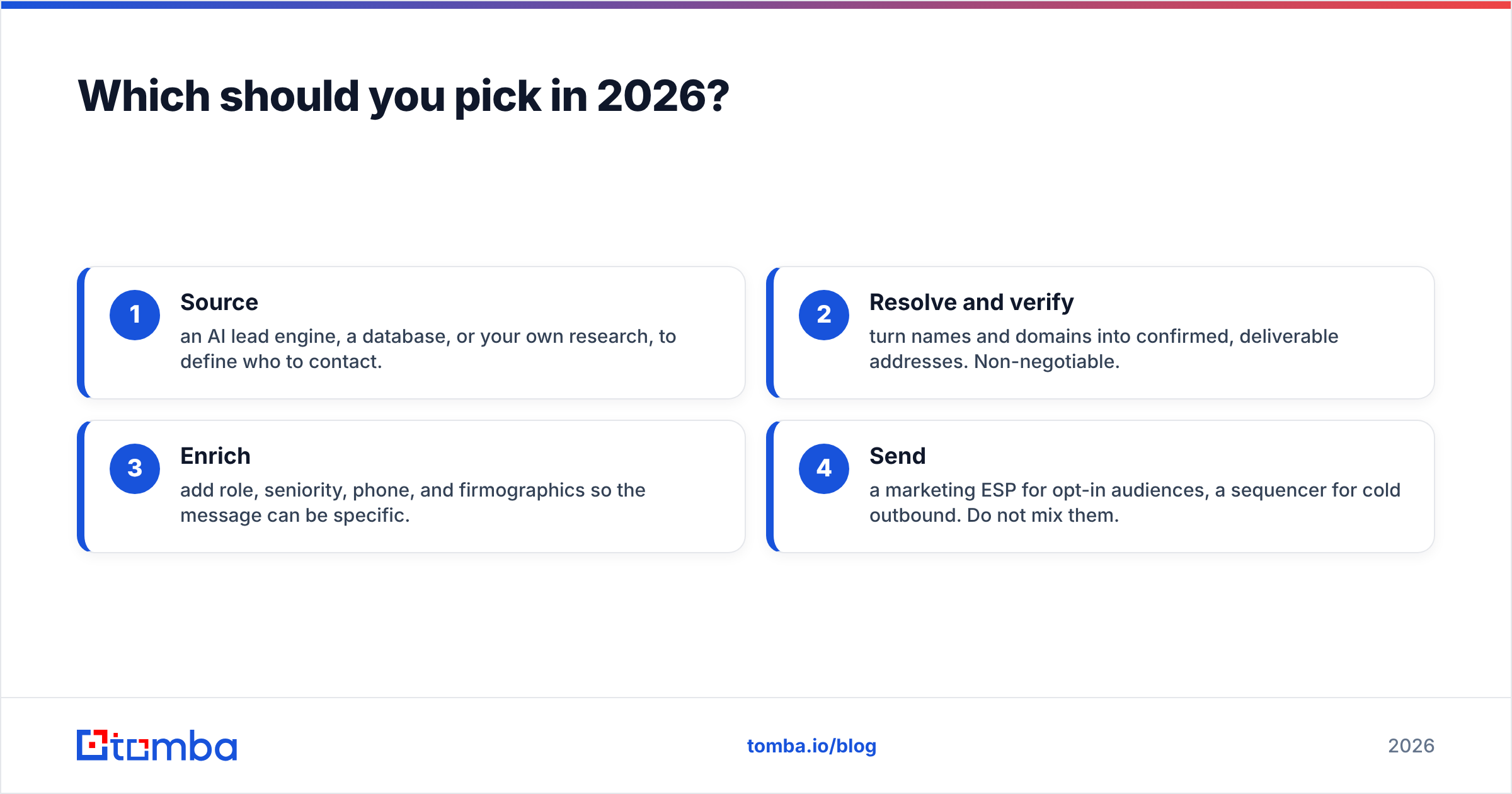
A stack that actually holds up in 2026 looks like this:
- Source — an AI lead engine, a database, or your own research, to define who to contact.
- Resolve and verify — turn names and domains into confirmed, deliverable addresses. Non-negotiable.
- Enrich — add role, seniority, phone, and firmographics so the message can be specific.
- Send — a marketing ESP for opt-in audiences, a sequencer for cold outbound. Do not mix them.
If you're comparing Gumbamail vs LeadEngineAI because outbound isn't producing meetings, step 2 is almost certainly where the leak is.
Ready to fix the layer both tools skip?#
Start with the data. The Tomba Email Finder resolves names and domains into verified professional addresses, flags catch-all domains instead of hiding them, and runs bulk or via API when you're working at list scale. The free tier gives you 25 searches a month — enough to run the four-metric test on whichever vendor you're evaluating and see the real match and verification rates for yourself. Then send through whatever platform you like, knowing the addresses underneath are actually deliverable.
Related guides#
Ready to find emails that actually work?
Join 150,000+ professionals who stopped guessing and started sending. Free credits on signup — no credit card required.
Get the Tomba newsletter
Practical outbound tactics and product updates — once every two weeks.
About the author