Gumbamail vs Ocean.io: Which One Actually Fits Your B2B Stack
Gumbamail sends campaigns. Ocean.io finds accounts. They get compared constantly, but they solve opposite halves of the same problem — here is how to pick, and what neither one gives you.
Gumbamail vs Ocean.io is the wrong fight to pick. One tool sends email. The other finds accounts. Here is what each one does, what it costs, and the gap both leave open.
TL;DR
- Gumbamail vs Ocean.io is not a real head-to-head. Gumbamail (sometimes paired with "Oceanio" in search) is an email marketing and newsletter sender. Ocean.io is a B2B account-data and lookalike platform.
- Pick Gumbamail if you already own a permissioned list. It sends campaigns, automations, and SMS cheaply.
- Pick Ocean.io if your bottleneck is who to target — lookalike accounts, ICP expansion, and territory maps.
- Neither tool hands you verified work emails at scale. That gap is where a dedicated email finder belongs.
- Budget: Gumbamail costs tens of dollars a month. Ocean.io is quote-based, and it usually runs to several thousand a year.
What are Gumbamail and Ocean.io, exactly?#
Start here. The comparison only makes sense once you see that these two products sit at opposite ends of the funnel.
Gumbamail is a European email marketing platform. You get a drag-and-drop newsletter builder, lists, segments, automations, SMS, and landing pages, all hosted in the EU. It is the tool you open after you have permission to email someone. Its peers are Mailchimp, Brevo, and MailerLite — not data vendors.
Ocean.io is a B2B data platform built around account intelligence. You feed it your best customers. It returns lookalike companies, scored on company size, tech stack, web presence, and industry. It is the tool you open before you know who to write to. Its peers are Vainu, Similarweb Sales, and the account-discovery half of ZoomInfo.
So the honest framing of "Gumbamail vs Ocean.io" is not "which is better." It is: which half of your outbound problem is broken right now?
Here is the split in plain terms:
- Audience discovery — Ocean.io territory. Which 400 companies look like your best 40 customers?
- Contact resolution — neither tool's strength. Who do you email, and at what address?
- Verification — neither tool's job. Does that address accept mail?
- Sending and nurture — Gumbamail territory. Campaigns, drips, SMS, unsubscribes, consent.
- Measurement — both do some of it. Ocean.io tracks account coverage. Gumbamail tracks opens, clicks, and list health.
Miss any one of those five and the other four stop mattering. A perfect ICP list with no valid emails is just a spreadsheet. A beautiful campaign sent to a stale list becomes a sender reputation problem.

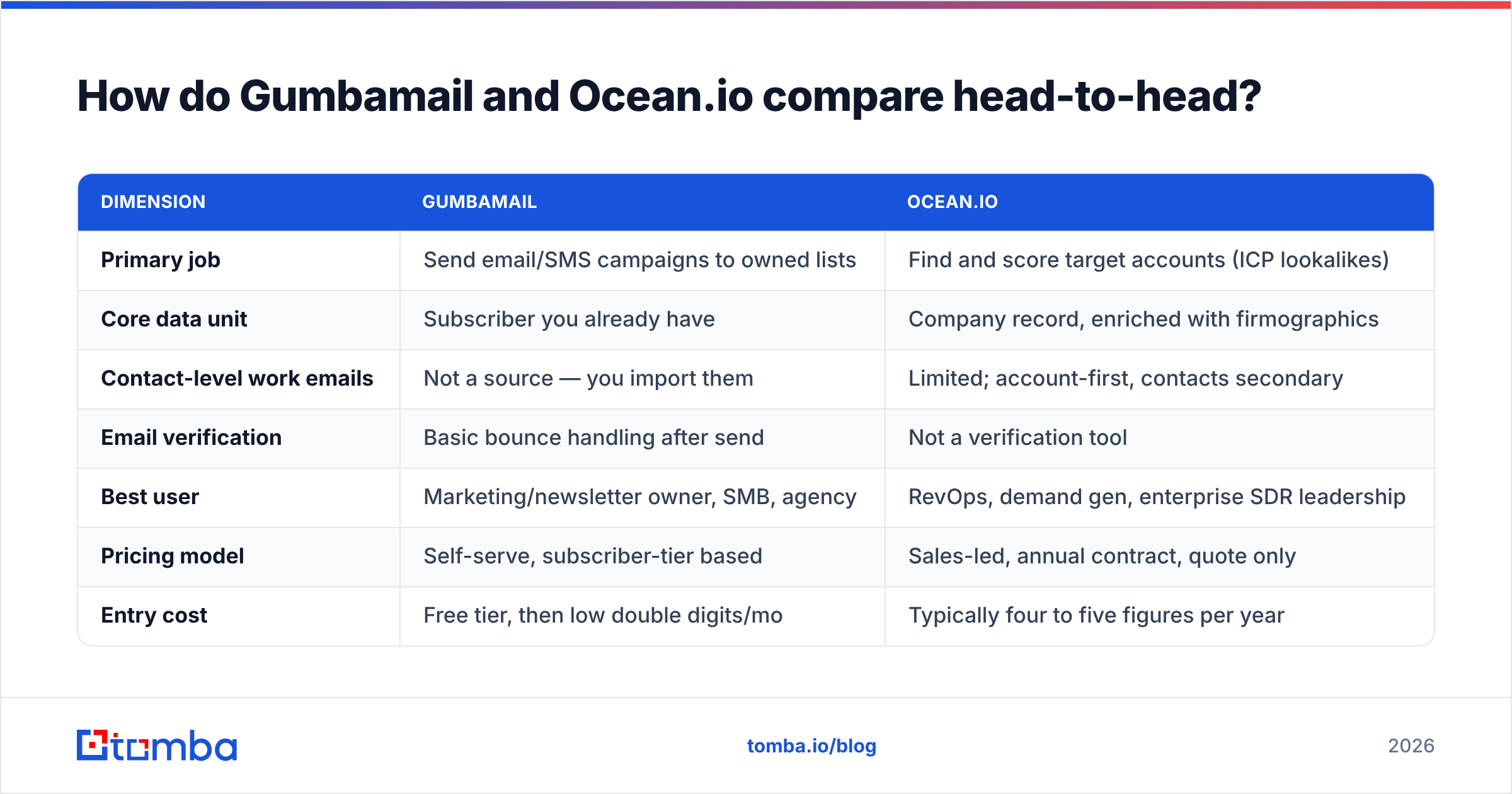
Gumbamail vs Ocean.io: how do they compare head-to-head?#
| Dimension | Gumbamail | Ocean.io |
|---|---|---|
| Primary job | Send email/SMS campaigns to owned lists | Find and score target accounts (ICP lookalikes) |
| Core data unit | Subscriber you already have | Company record, enriched with firmographics |
| Contact-level work emails | Not a source — you import them | Limited; account-first, contacts secondary |
| Email verification | Basic bounce handling after send | Not a verification tool |
| Best user | Marketing/newsletter owner, SMB, agency | RevOps, demand gen, enterprise SDR leadership |
| Pricing model | Self-serve, subscriber-tier based | Sales-led, annual contract, quote only |
| Entry cost | Free tier, then low double digits/mo | Typically four to five figures per year |
| Learning curve | An afternoon | A rollout with onboarding calls |
| GDPR posture | EU hosting, consent-first workflows | Firmographic data, legitimate-interest framing |
| Where it fails you | No prospecting data at all | No sending, no nurture, thin on verified emails |
Read that table twice. Nine of the ten rows show near-zero overlap. The only real collision is that both touch B2B email programs. That is like saying a printing press and a mailbox both touch mail.
What does Gumbamail actually do well?#
Gumbamail's pitch is plain and mostly true. It is cheap, clean, EU-hosted campaign sending without the enterprise tax.
Strengths worth naming:
- Price-to-feature ratio. The free tier works for small lists. Paid tiers stay in Mailchimp territory, not HubSpot territory. Check current tiers on their site, since list-based pricing shifts often.
- Editor speed. Templates load fast, blocks behave, and exports are predictable. If your team ships a weekly newsletter, that beats any AI feature.
- SMS in the same console. Multi-channel, without a second vendor contract.
- Data residency. EU teams get asked where subscriber data lives. An EU-hosted sender removes that meeting from your calendar.
Where it disappoints: it assumes you already have a list. There is no discovery layer and no company filter. You cannot ask it to "show me SaaS companies in DACH with 50–200 staff." Import a bad list and Gumbamail will faithfully deliver your bounce rate to your reputation.
That is the trap on the sending side. Deliverability follows data quality, not template quality. Run a list through an email verifier before it touches a sending platform. Your open rates then improve for reasons that have nothing to do with subject lines.
Where does Ocean.io earn its price tag?#
Ocean.io earns it in one case: you can see a clear pattern in your closed-won data, and you need more of it fast.
Feed it 200 customers. It clusters them and finds the traits you did not know you had. Then it returns a scored universe of similar companies. For a demand-gen team planning next quarter's territories, that is real leverage. For an ABM program picking 500 target accounts, it is hard to match with manual filters in a generic B2B database.
Reviews on G2 tend to land on the same points. Praise goes to the lookalike modeling, the European company coverage, and the ICP work. Complaints go to contact-level depth and to pricing opacity.
That second complaint deserves attention. Ocean.io does not publish list prices. Expect a discovery call, an annual commitment, and a seat-based structure. A three-person startup testing outbound will likely be priced out before the demo ends.
Here is the structural limit. An account list is not a send list. Ocean.io tells you Acme Corp fits your ICP. It does not tell you that the VP of Engineering is first.last@acme.com. It does not tell you the mailbox is live. You still need contact resolution.
What does Gumbamail vs Ocean.io cost in 2026?#
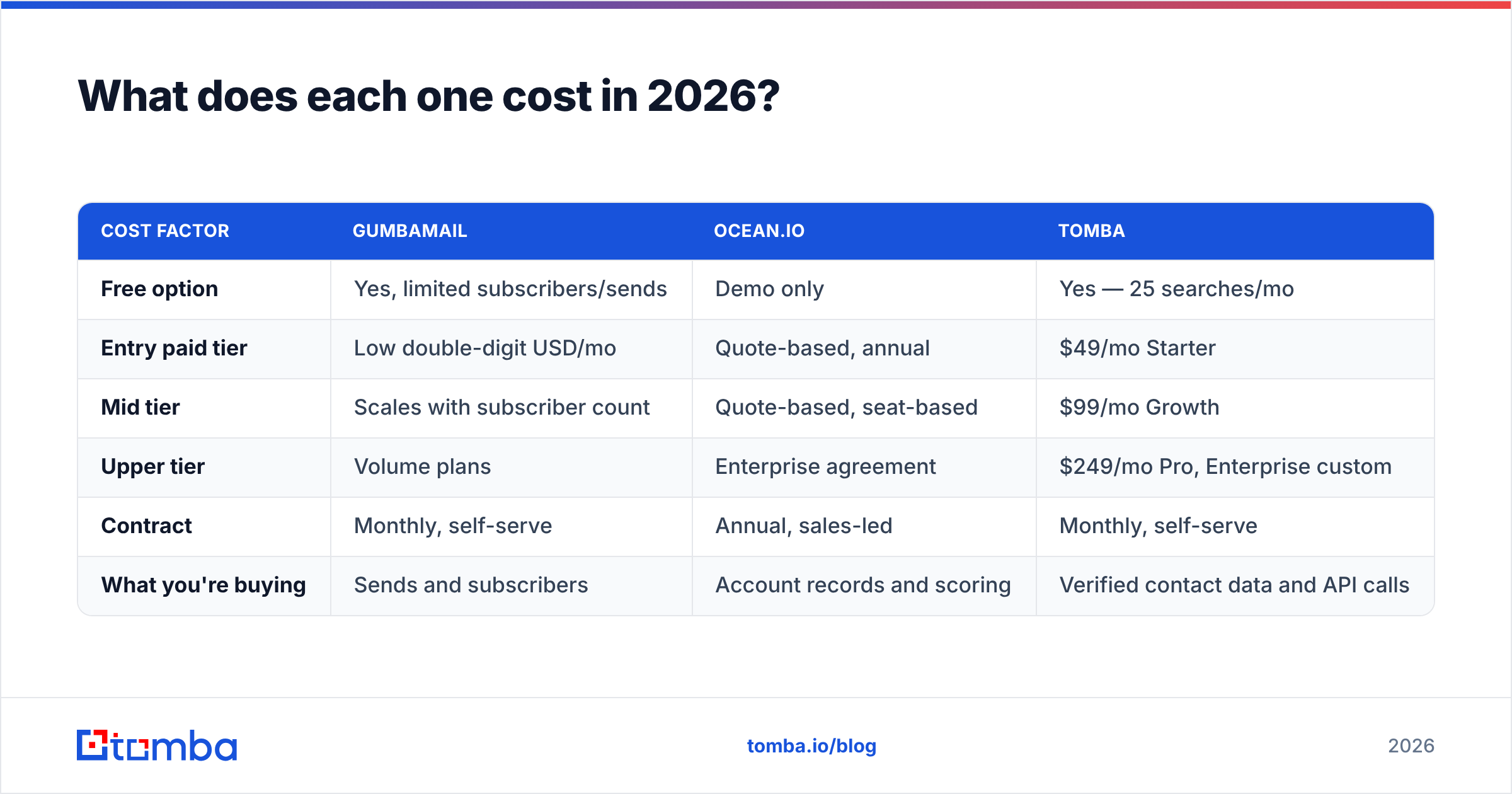
Be careful with any post that quotes exact figures for a sales-led vendor. Those numbers move. They also vary by region and by volume. What follows is the shape of each model, not a promise.
| Cost factor | Gumbamail | Ocean.io | Tomba |
|---|---|---|---|
| Free option | Yes, limited subscribers/sends | Demo only | Yes — 25 searches/mo |
| Entry paid tier | Low double-digit USD/mo | Quote-based, annual | $49/mo Starter |
| Mid tier | Scales with subscriber count | Quote-based, seat-based | $99/mo Growth |
| Upper tier | Volume plans | Enterprise agreement | $249/mo Pro, Enterprise custom |
| Contract | Monthly, self-serve | Annual, sales-led | Monthly, self-serve |
| What you're buying | Sends and subscribers | Account records and scoring | Verified contact data and API calls |
The pattern is clear. Two of these are self-serve. One is an enterprise commitment. If your annual outbound budget is under about $5,000, Ocean.io is probably not the right first buy. You would spend it all on knowing who to email, with nothing left to reach them. See full Tomba pricing for the contact-data side of that equation.
Is either tool enough on its own for cold outbound?#
No. And this is the section most vendor-written comparisons skip.
Cold outbound has four hard requirements. Neither product covers all four:
- A defensible target list. Ocean.io: strong. Gumbamail: absent.
- Named contacts with real job titles. Ocean.io: partial. Gumbamail: absent.
- Verified, deliverable addresses. Ocean.io: weak at contact level. Gumbamail: not its job.
- A compliant sender with suppression handling. Gumbamail: strong. Ocean.io: absent.
The middle two are the expensive gap in any Gumbamail vs Ocean.io setup. A dedicated finder-plus-verifier fills that layer. Run domain search against every account Ocean.io surfaces. Resolve the decision-makers. Verify each address. Then push the survivors into Gumbamail, or whatever sender you use.

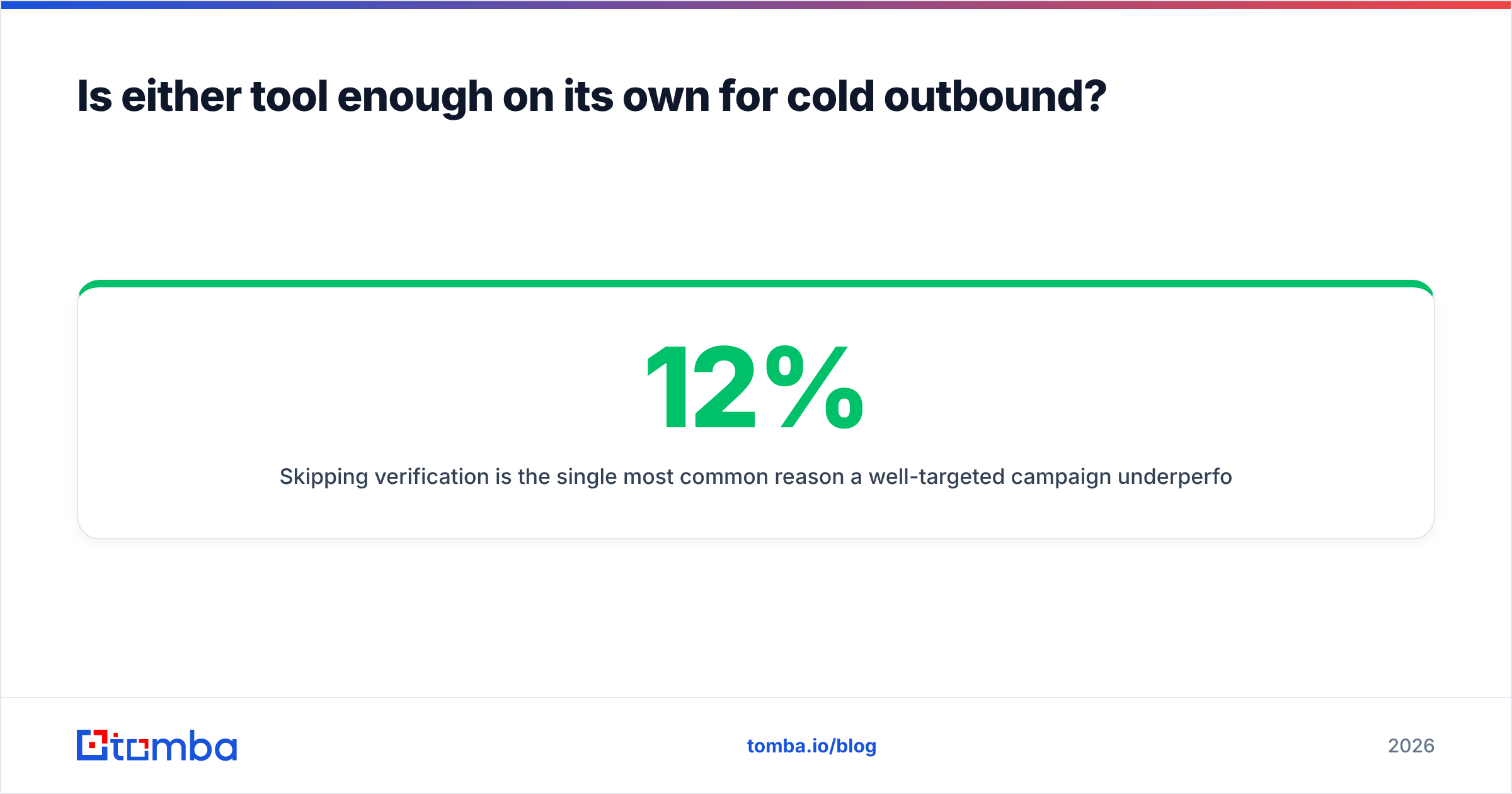
Skipping verification is the top reason a well-targeted campaign flops. A 12% bounce rate does not just cost you 12% of your sends. It damages the domain reputation that decides whether the other 88% land at all. Mailbox providers read bounces as an intent signal. Once you are throttled, no amount of copywriting fixes it. The email deliverability primer covers that feedback loop in detail.
How would a working stack combine them?#
A realistic 2026 setup runs in six steps. The first three build the list:
- Define the ICP in Ocean.io (or by hand, if the budget is not there). Output: 300–800 accounts, with a reason for each.
- Resolve contacts per account. Pull only the roles you sell to. Two to four named contacts beat forty generic ones.
- Verify everything. Catch-all domains, role accounts, and dead mailboxes get quarantined, not sent. Handle catch-alls with a catch-all verifier instead of guessing.
The last three turn that list into pipeline:
- Enrich for personalization. Title, seniority, company size, tech signals. Thin data makes thin first lines, and thin first lines make a 0.4% reply rate.
- Load into the sender. Use Gumbamail for permissioned nurture and newsletters. Use a dedicated sequencer for true cold email, since the two have different compliance profiles.
- Feed results backward. Which accounts replied? That signal goes back into the ICP model. Closed-won data is the best input Ocean.io will ever get from you.
Steps 2 through 4 are where most teams overpay or under-deliver. They are also the steps you can automate end to end. The Tomba API exists so this middle layer does not need a human copying cells between spreadsheets.
Which alternatives should you shortlist instead?#
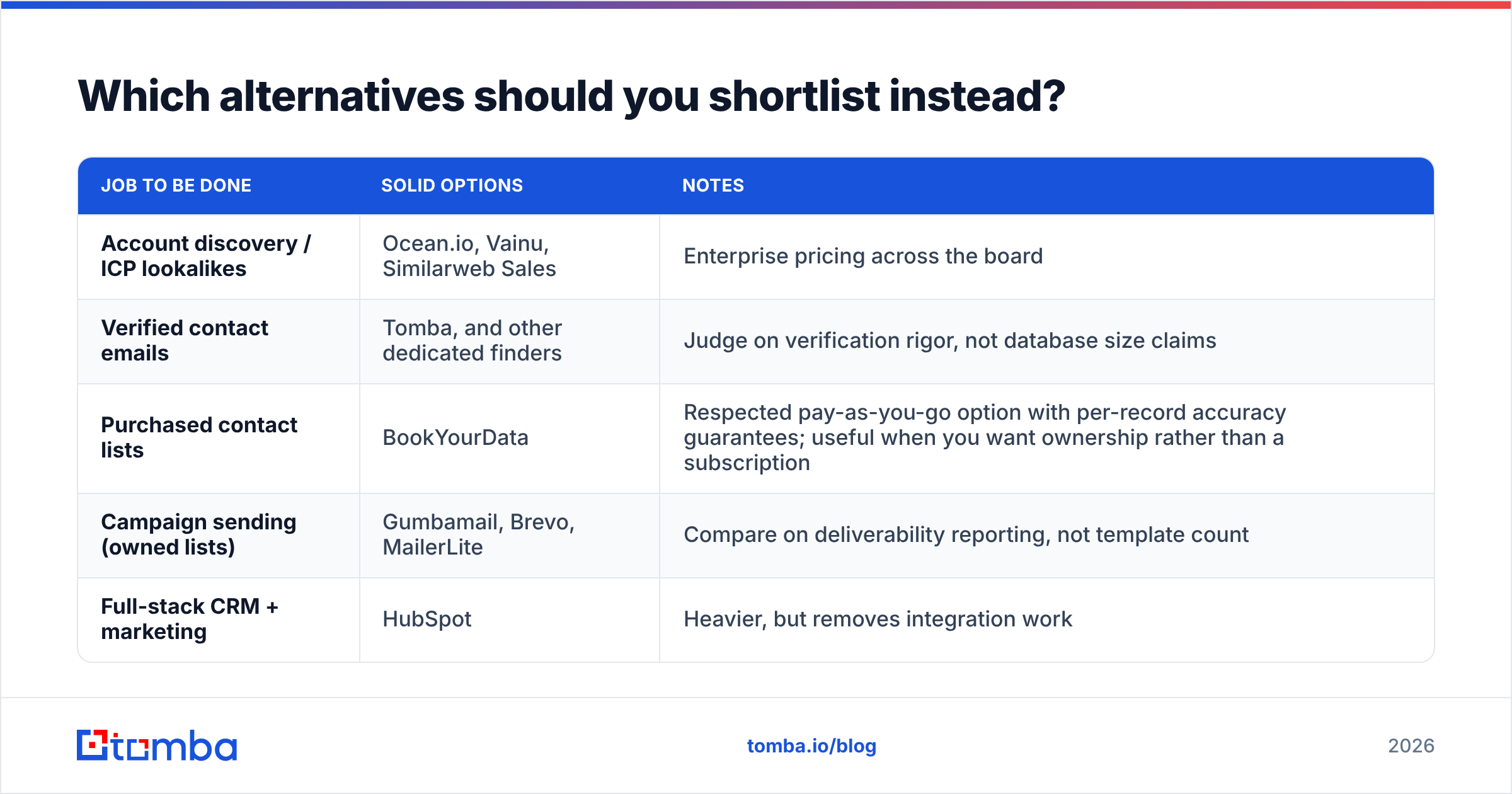
If Gumbamail vs Ocean.io now looks like the wrong axis, here are the tools that map to each real job.
| Job to be done | Solid options | Notes |
|---|---|---|
| Account discovery / ICP lookalikes | Ocean.io, Vainu, Similarweb Sales | Enterprise pricing across the board |
| Verified contact emails | Tomba, and other dedicated finders | Judge on verification rigor, not database size claims |
| Purchased contact lists | BookYourData | Respected pay-as-you-go option with per-record accuracy guarantees; useful when you want ownership rather than a subscription |
| Campaign sending (owned lists) | Gumbamail, Brevo, MailerLite | Compare on deliverability reporting, not template count |
| Full-stack CRM + marketing | HubSpot | Heavier, but removes integration work |
One filtering rule saves money. Ask every vendor what share of their emails were verified in the last 90 days. Do not ask how many records they hold. Total database size is a vanity metric. A 400-million-record database with 60% decay is worse than a smaller, fresh one, and you pay for the gap in bounces.
Gumbamail vs Ocean.io: so which one wins?#
Neither. That is not a cop-out. It is the finding.
- You have a list and need to mail it: Gumbamail. Cheap, competent, EU-hosted, no reason to overthink it.
- You have budget and need to know who to target: Ocean.io. The lookalike modeling is good, if you can absorb an annual contract.
- You have neither, which describes most teams: buy the contact layer first. It is the cheapest of the three. It unblocks every tool downstream, and you cannot fake it with a spreadsheet.
We see the same failure mode again and again. A team spends four figures a month on account intelligence. They export a beautiful company list. Then they guess at email formats and burn their domain in six weeks. Data at the top of the funnel is only as good as the verification at the bottom.
Start where your funnel actually leaks. If the leak is "we know the accounts but not the people," fix that first. Tomba's Email Finder resolves named contacts at your target domains. It verifies them before they ever reach your sender. You get 25 free searches a month to test the accuracy on your own account list first.
Related guides#
Ready to find emails that actually work?
Join 150,000+ professionals who stopped guessing and started sending. Free credits on signup — no credit card required.
Get the Tomba newsletter
Practical outbound tactics and product updates — once every two weeks.
About the author