Guru vs Spekit (2026): Which Enablement Tool Wins?
Guru and Spekit both promise to put the right answer in front of reps at the moment they need it. They solve different problems. Here is the honest breakdown of pricing, adoption, AI search, and which one fits your team.
TL;DR
- Guru is a knowledge management platform with an AI answer layer. It is the better pick if you need one searchable source of truth across sales, support, and the rest of the company.
- Spekit is a just-in-time enablement tool built around contextual "Speks" that surface inside Salesforce, Gmail, LinkedIn, and Chrome. It wins when reps refuse to leave their workflow to look anything up.
- Pricing is close at the entry level — both land in the $12–$20 per user per month range for standard tiers, with AI features and enterprise controls pushing costs higher.
- Guru's verification workflow is stronger for content that must stay accurate. Spekit's overlay is stronger for CRM field definitions, process nudges, and new-hire ramp.
- Neither tool fixes bad contact data. If your reps are emailing the wrong people, an enablement platform will just help them do it faster.
What are Guru and Spekit, really?#
Both tools live in the same budget line — sales enablement — but they attack the problem from opposite ends.
Guru started as a knowledge base that lives where you work. You write "Cards" (atomic knowledge units), organize them into Collections, assign each one a verifier and a verification interval, and then search them from Slack, Chrome, or the web app. Recent versions lean hard on AI: an enterprise search layer that indexes connected apps and answers questions in natural language. Think of it as a company wiki that nags someone every 90 days to confirm the page is still true.
Spekit starts from the opposite direction. Instead of asking reps to search, it pushes bite-sized content — "Speks" — into the interface they already have open. Hover over a Salesforce field, get the definition. Open Gmail, get the objection-handling snippet for the deal stage. Land on a LinkedIn profile, get the talk track. It is less an encyclopedia and more a set of sticky notes that follow your reps around.
That difference drives almost every other tradeoff below. Guru assumes people will look things up. Spekit assumes they won't.

How do Guru and Spekit compare feature by feature?#
Here is the head-to-head on the attributes that actually change your rollout.
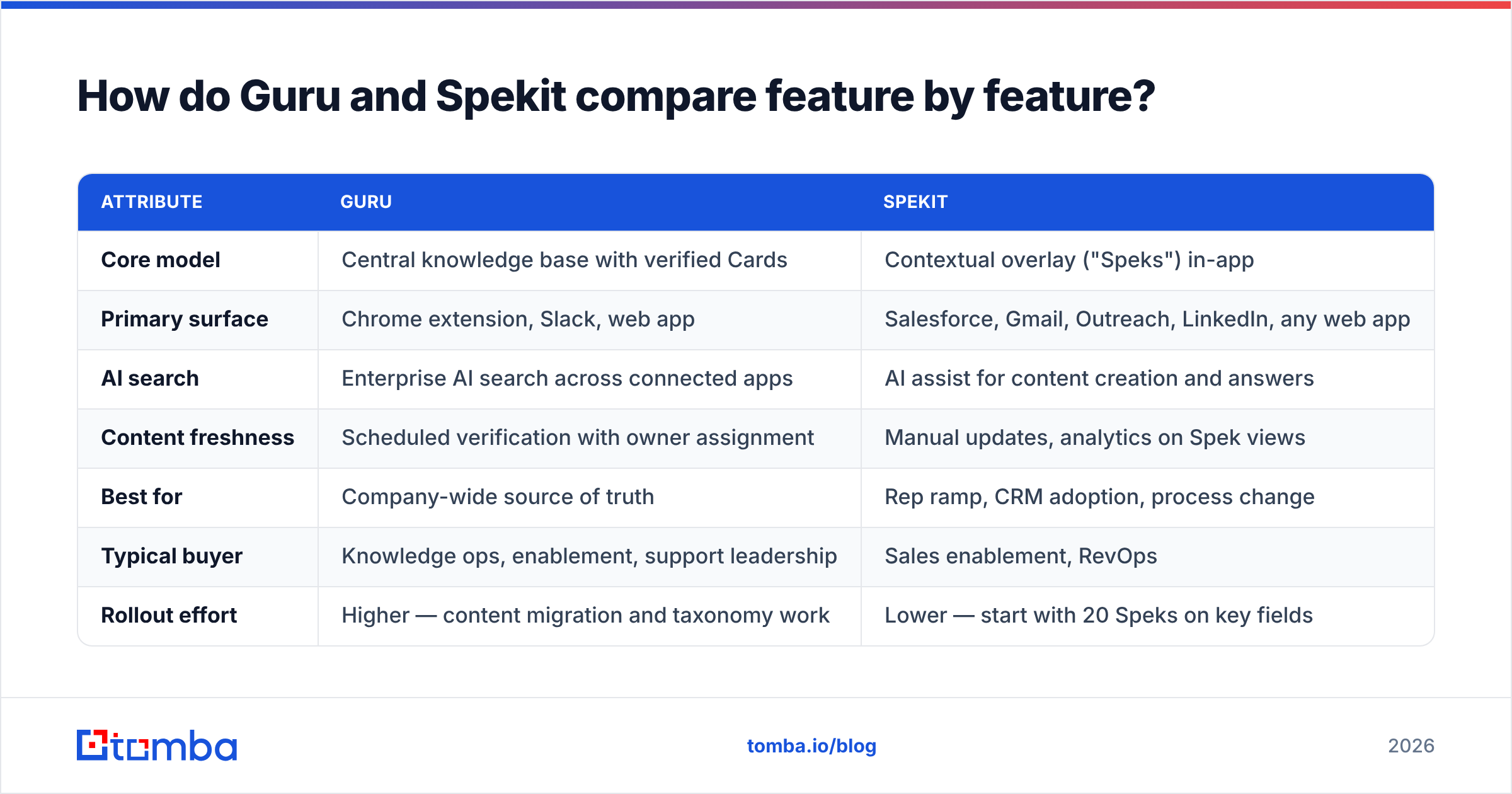
| Attribute | Guru | Spekit |
|---|---|---|
| Core model | Central knowledge base with verified Cards | Contextual overlay ("Speks") in-app |
| Primary surface | Chrome extension, Slack, web app | Salesforce, Gmail, Outreach, LinkedIn, any web app |
| AI search | Enterprise AI search across connected apps | AI assist for content creation and answers |
| Content freshness | Scheduled verification with owner assignment | Manual updates, analytics on Spek views |
| Best for | Company-wide source of truth | Rep ramp, CRM adoption, process change |
| Typical buyer | Knowledge ops, enablement, support leadership | Sales enablement, RevOps |
| Rollout effort | Higher — content migration and taxonomy work | Lower — start with 20 Speks on key fields |
| Analytics depth | Card views, search gaps, verification status | Spek engagement by rep, adoption tracking |
| Standard tier price | Roughly $18–$20/user/mo billed annually | Roughly $12–$20/user/mo depending on tier |
| Free plan | Limited free tier for small teams | No public free tier; trial available |
Prices move. Check Guru's pricing page and Spekit's site before you budget, and treat any number in a comparison post — including this one — as a starting point for negotiation rather than a quote.
Which one is better for onboarding new reps?#
Spekit, in most cases.
New reps fail for a boring reason: they don't know what they don't know. A rep three weeks into the job staring at a Salesforce opportunity page has no idea that "Deal Source" means something specific at your company, and they will not open a knowledge base to find out. They will guess. Spekit's whole design targets that moment — the definition appears on hover, the rep fills the field correctly, and your pipeline data stays clean.
Guru can support onboarding too, especially with its Slack integration and announcement features, but it requires a behavior your new hire has not built yet: the habit of searching before acting.
Where Guru pulls ahead on ramp is depth. A 2,000-word competitive battlecard, a pricing approval matrix, a security questionnaire response library — these belong in Cards, not in tooltips. Spekit content is intentionally short. Try to cram a full objection-handling framework into a Spek and you lose the thing that makes Speks work.
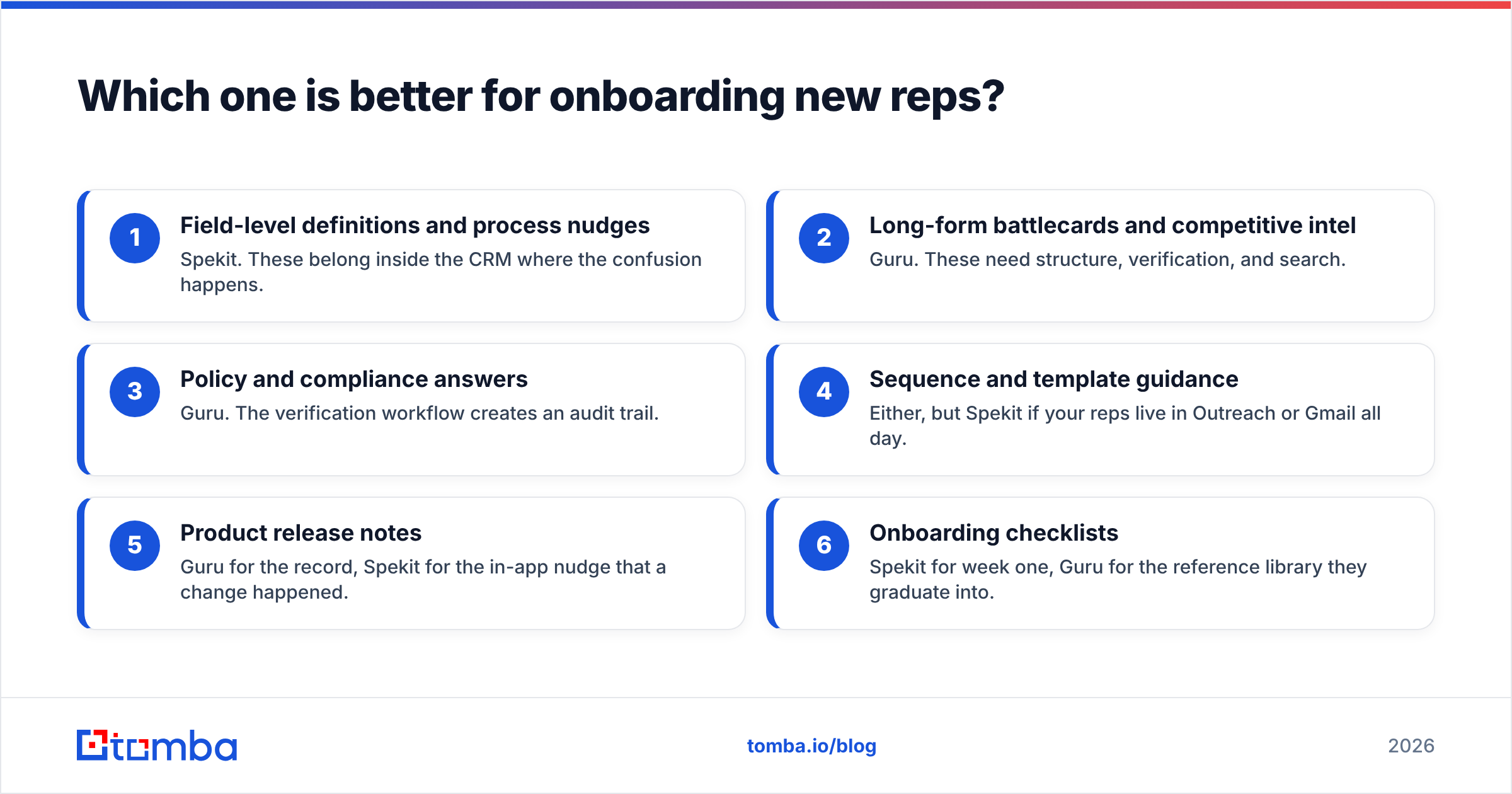
A practical split many teams land on:
- Field-level definitions and process nudges — Spekit. These belong inside the CRM where the confusion happens.
- Long-form battlecards and competitive intel — Guru. These need structure, verification, and search.
- Policy and compliance answers — Guru. The verification workflow creates an audit trail.
- Sequence and template guidance — Either, but Spekit if your reps live in Outreach or Gmail all day.
- Product release notes — Guru for the record, Spekit for the in-app nudge that a change happened.
- Onboarding checklists — Spekit for week one, Guru for the reference library they graduate into.
How does AI change the Guru vs Spekit decision in 2026?#
Every enablement vendor shipped an AI answer layer between 2024 and 2026, so "has AI" is no longer a differentiator. What matters is what the AI is indexing.
Guru's bet is enterprise search: connect Google Drive, Slack, Confluence, Salesforce, Zendesk, and let the assistant answer from everything at once. That is genuinely useful when knowledge is scattered across a decade of documents nobody will ever migrate. The risk is the same one every RAG system has — if the underlying documents contradict each other, the AI will confidently pick one. Guru's verification system partly mitigates this by letting you weight verified Cards, which is a real advantage over a raw vector search over your Drive.
Spekit's AI focuses on content creation and surfacing: generate Speks from existing documents, then serve the right one contextually. Narrower scope, less to go wrong, less to gain.
The honest read: if your knowledge problem is "we have too much scattered content and nobody can find anything," Guru's AI is the more direct answer. If your problem is "we have decent content and nobody reads it," Spekit's delivery model matters more than any model upgrade.
Analyst coverage from Gartner and user reviews on G2 are useful sanity checks here, though be aware that review-site scores skew toward whoever ran the most recent review campaign.
What do Guru and Spekit actually cost?#
Both vendors gate pricing behind sales conversations above the entry tier, which makes clean comparison hard. Here is the structure as of 2026.
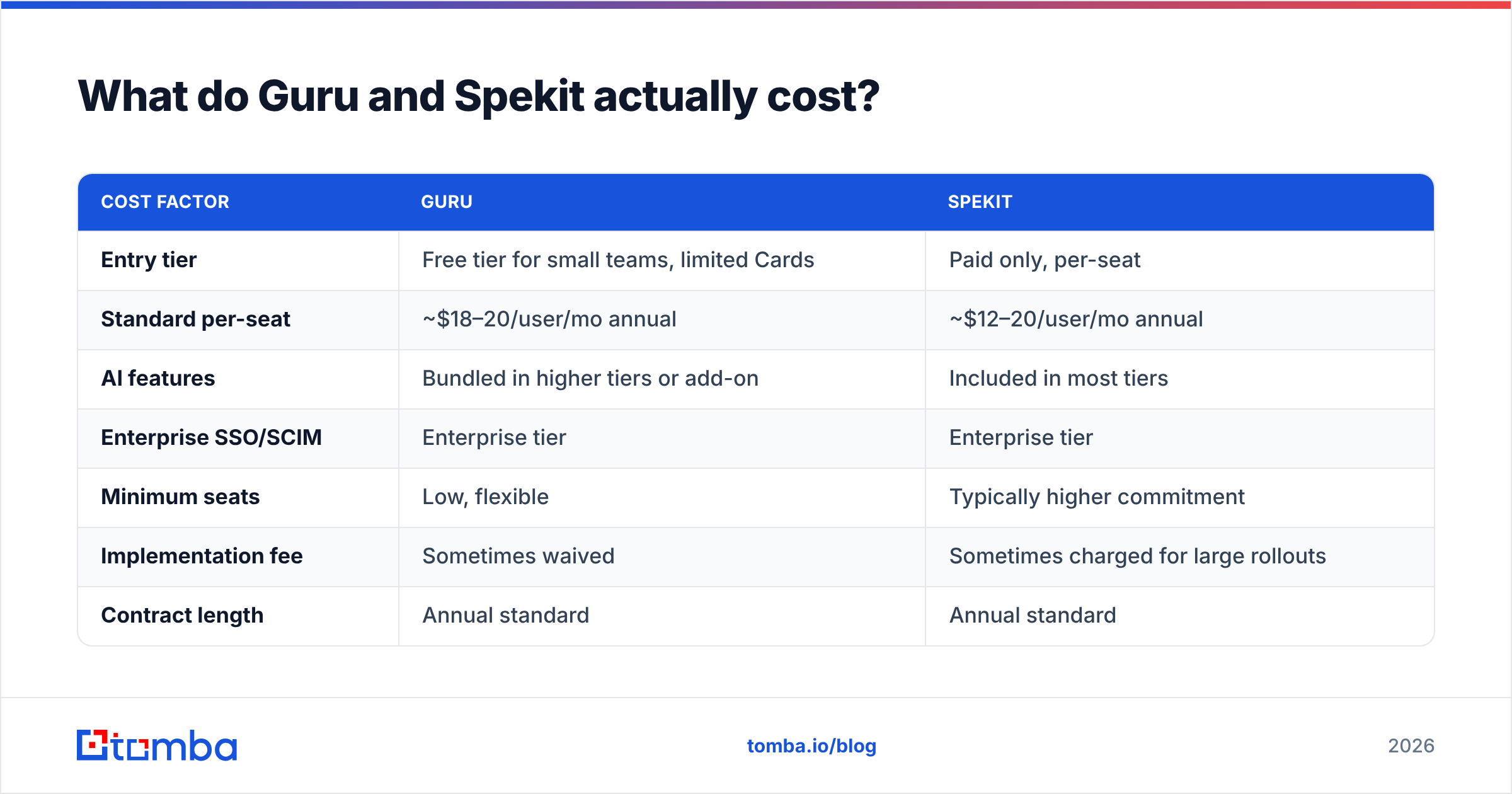
| Cost factor | Guru | Spekit |
|---|---|---|
| Entry tier | Free tier for small teams, limited Cards | Paid only, per-seat |
| Standard per-seat | ~$18–20/user/mo annual | ~$12–20/user/mo annual |
| AI features | Bundled in higher tiers or add-on | Included in most tiers |
| Enterprise SSO/SCIM | Enterprise tier | Enterprise tier |
| Minimum seats | Low, flexible | Typically higher commitment |
| Implementation fee | Sometimes waived | Sometimes charged for large rollouts |
| Contract length | Annual standard | Annual standard |
Two budget traps to watch:
Seat inflation. Both tools get sold "for sales" and then spread to support, CS, and marketing. That is fine — arguably the point — but model the 18-month seat count, not the launch count. A $15/user tool at 40 seats is $7,200/year. At 180 seats it is $32,400.
The content tax. Neither price includes the person who maintains the content. Budget for at least a quarter-time owner, or you will be paying for a knowledge base that goes stale in six months and a set of Speks describing a sales process you abandoned last quarter.
Is either tool a substitute for good prospect data?#
No, and this is where enablement budgets quietly get wasted.
Guru and Spekit both optimize the quality of the conversation once a rep is talking to someone. Neither improves who the rep is talking to. If your outbound list is built from stale exports and guessed email patterns, the best battlecard in the world is being sent to an address that bounces.
The order of operations matters:
- Get the right contacts. Accurate, verified email addresses and direct dials for people who actually hold the job title you think they hold.
- Get them into the CRM cleanly. Enriched records with correct company, role, and firmographic fields.
- Then layer enablement on top. Now Spekit's field definitions and Guru's battlecards have something real to work with.
Teams that invert this order end up with beautifully documented processes wrapped around a broken top of funnel. A verified email finder and a real email verifier step before your sequence launches will do more for reply rates in the first month than any content library. And if your enrichment gaps are in phone coverage, a dedicated phone finder closes that side.

When should you choose Guru?#
Pick Guru when:
- You have more than one department that needs the same answers. Support and sales asking the same product questions is the classic Guru use case.
- Content accuracy is a compliance issue. The verification workflow with named owners and intervals gives you something to point at during an audit.
- Your knowledge is already scattered across Drive, Confluence, Notion, and Slack, and migration is politically impossible. Guru's search layer indexes rather than demands migration.
- You want a searchable record, not just nudges. Long-form content that people return to deliberately.
- You need Slack-native answers. Guru's Slack integration is mature and reps genuinely use it.
Skip Guru if your reps have never voluntarily opened an internal wiki. The tool is good; the behavior change is the hard part, and Guru requires more of it.
When should you choose Spekit?#
Pick Spekit when:
- You are rolling out a CRM change — new fields, new stages, new required data — and adoption is the whole problem.
- Rep tenure is short and you are constantly onboarding. Contextual guidance shortens the "where do I even look" phase dramatically.
- Your team lives in a handful of tools (Salesforce, Gmail, Outreach, LinkedIn) rather than roaming widely.
- Your content is already short-form — talk tracks, one-liners, field definitions — and does not need a taxonomy.
- You want fast time-to-value. Twenty well-placed Speks can ship in a week. A full Guru migration cannot.
Skip Spekit if your primary need is a long-form reference library, or if a meaningful share of your team works outside the browser tools Spekit overlays.
Can you run both, and should you?#
Some larger organizations do. Guru holds the canonical library; Spekit surfaces the ten things reps need at the exact click. It works, and it costs roughly double per seat.
The honest test: if you cannot name the specific piece of content that belongs in each tool and would be worse off in the other, you do not need both. Most teams under 100 reps should pick one, run it hard for two quarters, and revisit.
If you do run both, assign a single content owner across the two systems. The failure mode of a two-tool stack is not cost — it is a Spek that says one thing and a Guru Card that says another, and a rep who now trusts neither.
What about the alternatives?#
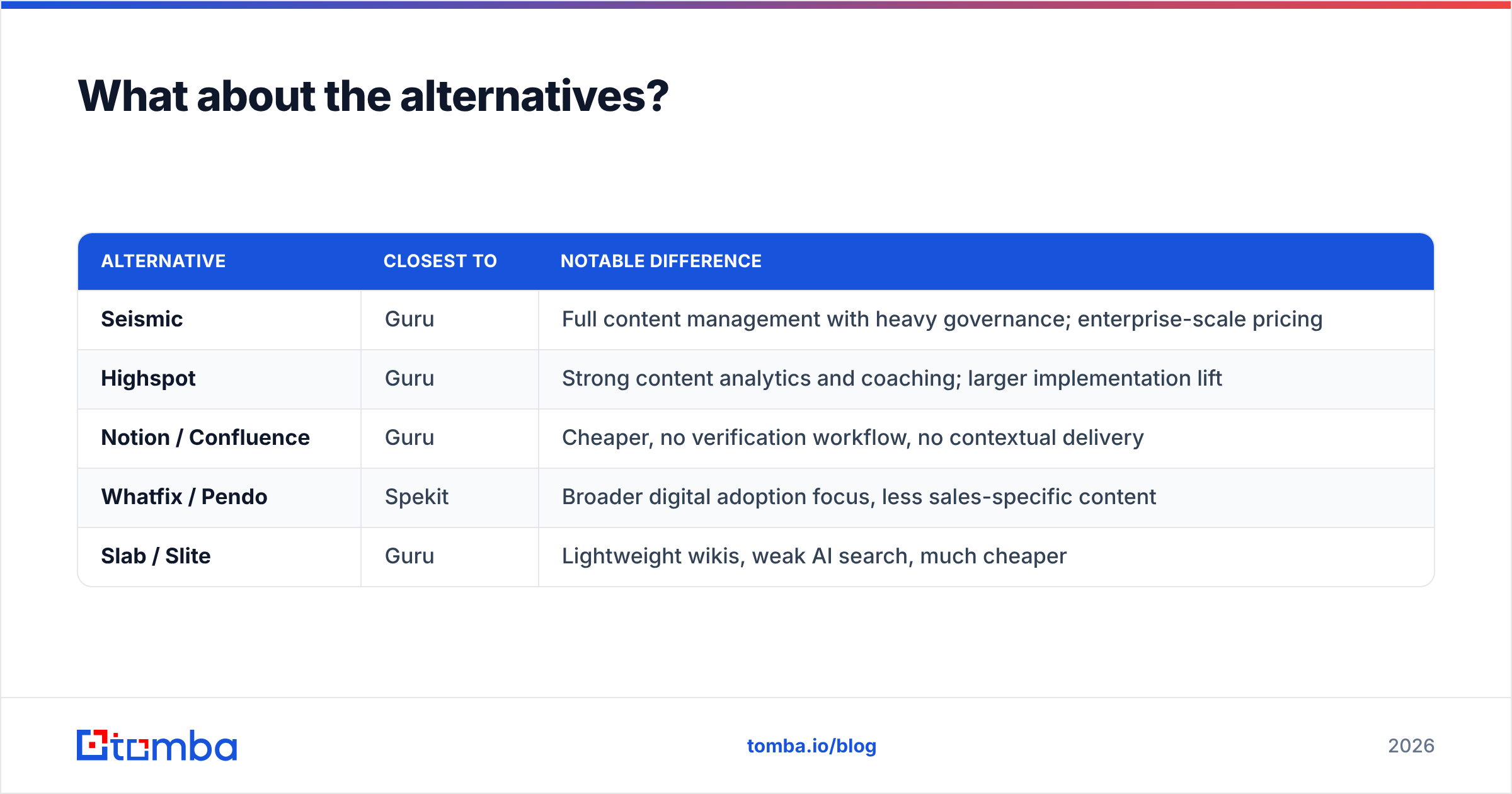
The Guru vs Spekit choice sits inside a broader category. Worth a look before you commit:
| Alternative | Closest to | Notable difference |
|---|---|---|
| Seismic | Guru | Full content management with heavy governance; enterprise-scale pricing |
| Highspot | Guru | Strong content analytics and coaching; larger implementation lift |
| Notion / Confluence | Guru | Cheaper, no verification workflow, no contextual delivery |
| Whatfix / Pendo | Spekit | Broader digital adoption focus, less sales-specific content |
| Slab / Slite | Guru | Lightweight wikis, weak AI search, much cheaper |
None of these are drop-in replacements. Seismic and Highspot solve a bigger problem (content lifecycle plus coaching plus analytics) at a bigger price. Notion is cheaper but you will rebuild verification yourself and it will not survive contact with a growing team.
How should you run the evaluation?#
Do not run a feature bake-off. Run a use-case test.
- Pick three real questions your reps asked in Slack last week. Not hypotheticals — actual questions.
- Load each into both trials as the vendor would recommend.
- Give five reps two weeks with no training beyond a 10-minute intro.
- Measure whether they used it unprompted. Not satisfaction scores — usage without a manager reminding them.
- Check the answer quality on those three questions at the end.
The tool that reps used without being told wins. That metric predicts 18-month renewal better than any feature matrix, including this one.
While you are running that pilot, audit the data flowing into the CRM those tools sit on top of. Pull a sample of 200 recent leads and check bounce rate and title accuracy. If more than 5% bounce, your enablement problem is downstream of a data problem. Tools like data enrichment workflows and bulk verification fix that layer before you spend on content delivery. For a quick sanity check on how sources differ, review where the data comes from for any vendor you consider.
The verdict#
Choose Spekit if adoption is your bottleneck — new reps, new CRM fields, a sales process nobody follows. Its contextual model beats search for behavior change, and it ships faster.
Choose Guru if findability is your bottleneck — knowledge scattered across too many tools, multiple departments asking the same questions, content that must stay verifiably accurate.
Choose neither yet if your reps are working a list you cannot vouch for. Enablement multiplies whatever is already in your funnel. Multiply a bad list and you get a bigger bad list.
Before you sign either contract, make sure the contacts feeding your pipeline are real. Tomba's Email Finder finds and verifies professional email addresses by domain, name, or company — start on the free tier with 25 searches a month, or move to Starter at $49/mo when you are ready to run volume. Check the full Tomba pricing breakdown, then go pick your enablement tool knowing the data underneath it holds up.
Related guides#
Ready to find emails that actually work?
Join 150,000+ professionals who stopped guessing and started sending. Free credits on signup — no credit card required.
Get the Tomba newsletter
Practical outbound tactics and product updates — once every two weeks.
About the author