Handling Objections in Selling Process: A 2026 Playbook
Most objections are not rejections — they are missing information, missing urgency, or missing authority. Here is a stage-by-stage framework for handling objections in the selling process, with scripts, a comparison table, and the data hygiene that prevents half of them.
Handling objections in selling process stages — cold call to contract — comes down to one habit: diagnose before you answer. This guide gives you the loop, the scripts, and the stage-by-stage map.
TL;DR
- An objection is data, not a verdict. It tells you which of four things is missing: information, urgency, authority, or trust.
- Stop memorizing rebuttals. Learn one loop — clarify, isolate, reframe, confirm. It works on objections you have never heard.
- Objection type matters more than objection wording. "Too expensive" from a champion and "too expensive" from a procurement gatekeeper need opposite responses.
- Half of your early-stage objections are self-inflicted: wrong contact, wrong company size, wrong timing. Better targeting data removes them before the call.
- Track objections in your CRM as structured fields, not free-text notes. Patterns across 200 deals beat instinct on any single one.
Handling objections in selling process: what it actually means#
It means responding to a buyer's stated resistance in a way that surfaces the real concern underneath. Then you move the deal to its next legitimate step — including "no."
That last part gets skipped in most training. A rep who "handles" an objection by talking a bad-fit prospect into a demo has not handled anything. They have moved a loss from week two to week nine. Good objection handling is diagnostic first and persuasive second.
Think of it like a doctor hearing "my back hurts." The complaint is real, but it is a symptom, not a diagnosis. A bad doctor prescribes painkillers for the sentence. A good one asks three more questions first. Technically, an objection is a compressed signal. The buyer packs a messy internal state — "I do not see how this beats what we run now, my budget closes in April, and my boss hates new vendors" — into four words: "it's too expensive."
Your job is decompression.

The four things every objection is really telling you#
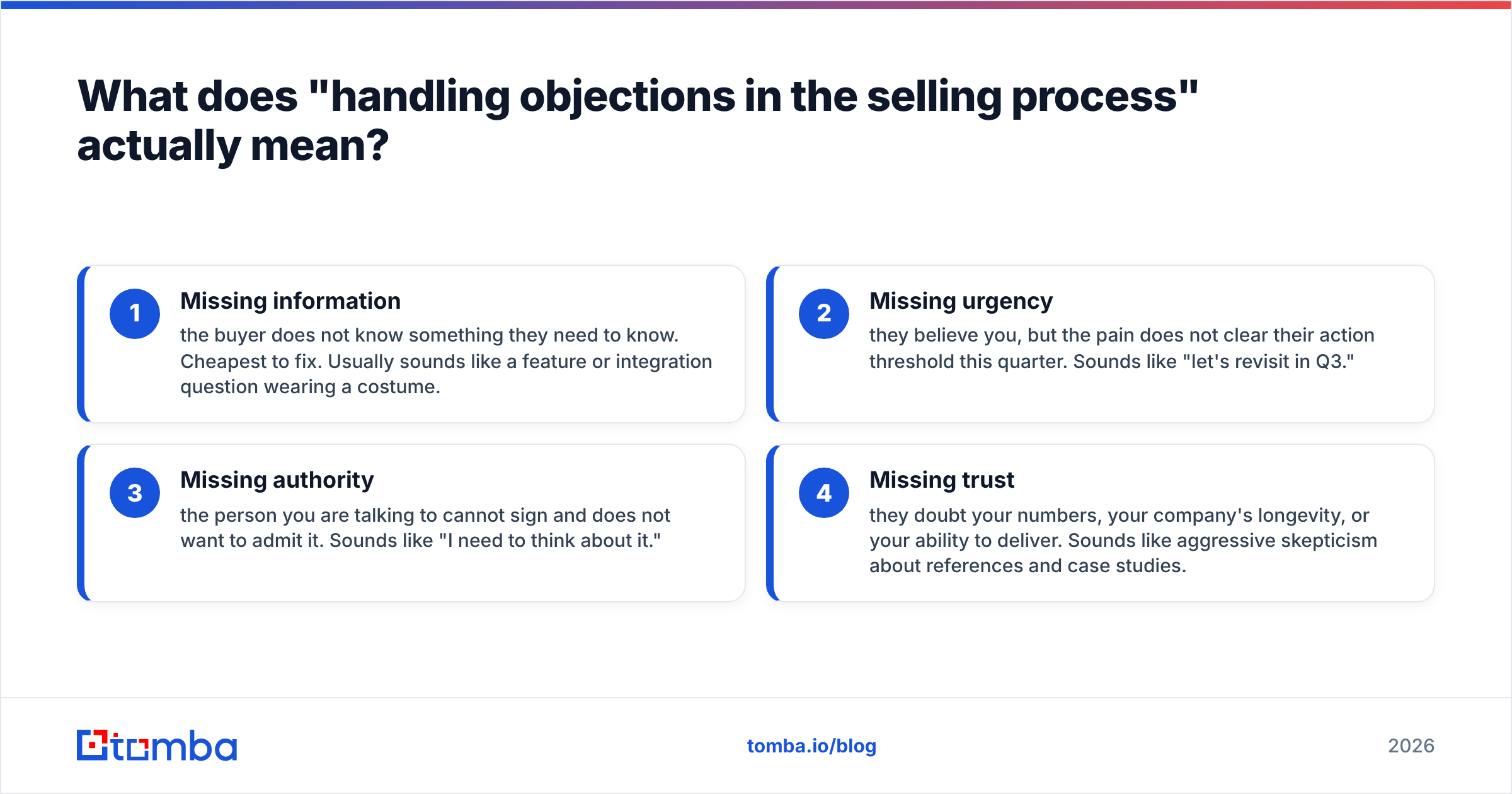
- Missing information — the buyer does not know something they need to know. Cheapest to fix. It usually sounds like a feature or integration question wearing a costume.
- Missing urgency — they believe you, but the pain does not clear their action threshold this quarter. Sounds like "let's revisit in Q3."
- Missing authority — the person you are talking to cannot sign and does not want to admit it. Sounds like "I need to think about it."
- Missing trust — they doubt your numbers, your company's longevity, or your ability to deliver. Sounds like hard skepticism about references and case studies.
Diagnose which one you face before you say anything substantive. Answer a missing-authority objection with an ROI argument and you hand a non-decision-maker a spreadsheet. They will re-present it badly to their boss.
Which objections show up at which stage of the sales process?#
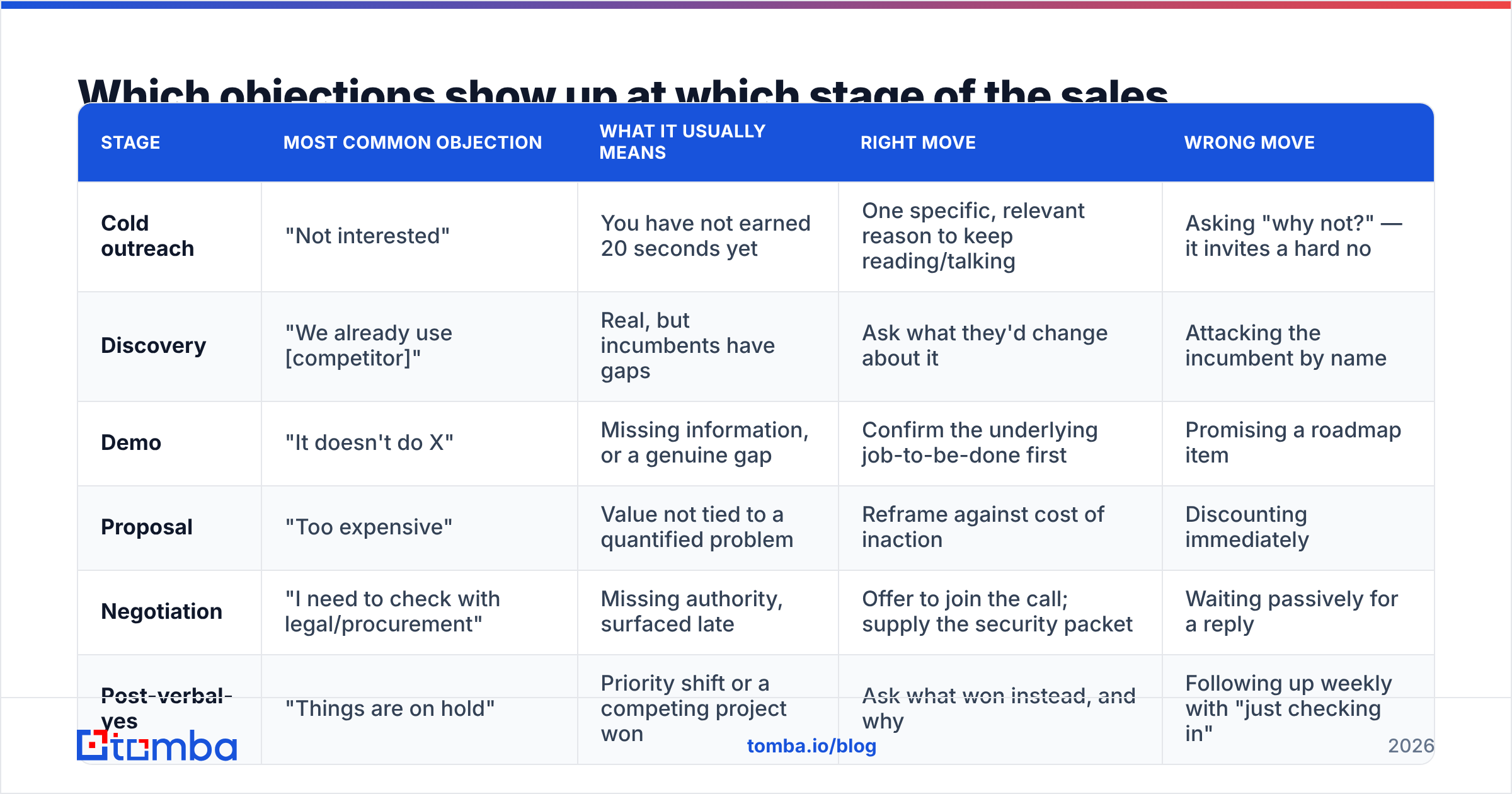
Objections are not randomly distributed. They cluster by stage. The same words mean different things depending on where in the pipeline you hear them.
| Stage | Most common objection | What it usually means | Right move | Wrong move |
|---|---|---|---|---|
| Cold outreach | "Not interested" | You have not earned 20 seconds yet | One specific, relevant reason to keep reading/talking | Asking "why not?" — it invites a hard no |
| Discovery | "We already use [competitor]" | Real, but incumbents have gaps | Ask what they'd change about it | Attacking the incumbent by name |
| Demo | "It doesn't do X" | Missing information, or a genuine gap | Confirm the underlying job-to-be-done first | Promising a roadmap item |
| Proposal | "Too expensive" | Value not tied to a quantified problem | Reframe against cost of inaction | Discounting immediately |
| Negotiation | "I need to check with legal/procurement" | Missing authority, surfaced late | Offer to join the call; supply the security packet | Waiting passively for a reply |
| Post-verbal-yes | "Things are on hold" | Priority shift or a competing project won | Ask what won instead, and why | Following up weekly with "just checking in" |
The most valuable row in that table is the last one in the wrong move column. Repeated no-context follow-ups kill stalled deals faster than anything else. They usually stand in for a hard question you skipped earlier.
How do you actually respond? The four-step loop#
Skip the scripted rebuttal libraries. They fail the moment a buyer phrases something in an unfamiliar way. Learn the loop instead.
Step 1 — Clarify. Repeat the objection back with a question attached. "When you say it's too expensive — expensive compared to what you're paying now, or expensive relative to the budget you've been allocated?" Those are two different conversations. Buyers rarely volunteer which one they mean.
Step 2 — Isolate. Confirm this is the only thing standing in the way. "If we solved the pricing structure, is there anything else that would keep you from moving forward this quarter?" Isolation stops the whack-a-mole pattern, where you fix one concern and a new one pops up. If a second objection surfaces here, the first one was never the real one.
Step 3 — Reframe. Change the axis of comparison. Price gets compared to the cost of the status quo. Risk gets compared to the risk of doing nothing. Effort gets compared to the effort already spent on the manual workaround. Use the buyer's own numbers from discovery, not generic vendor stats.
Step 4 — Confirm and advance. "Does that address it?" Then propose a concrete next step with a date attached. An objection resolved without a scheduled next action was not resolved. It was postponed.
Reps who run this loop beat reps with bigger script libraries. The loop transfers across every objection type. Conversation-intelligence vendors have published versions of this finding for years. Read Gong's public research library directly rather than through third-hand summaries.
Is objection prevention better than objection handling?#
Yes, for early-stage objections. No, for late-stage ones.
Early-stage objections — "who are you," "we're not in market," "wrong person" — are mostly targeting failures. You cannot rebut your way out of emailing a 12-person startup about an enterprise-tier platform. That objection was created by your list, not your talk track.
Late-stage objections are different. A buyer at proposal stage raising security or procurement concerns is doing their job. Prevention there looks like proactive disclosure. Send the security packet before they ask. Name the implementation timeline before they probe it. Mention the two customer types who churned, and why. Preemptive honesty builds trust faster than any rebuttal.
The prevention work that pays best is unglamorous:
- Verify the contact is real and current. Bounces and "that person left in 2024" replies are objections you manufactured. Run lists through an email verifier before send.
- Confirm you have the right role, not just the right company. A domain search returns the whole org chart. Pick the person who owns the problem, not the one whose email you happened to find.
- Match message to firmographics. Data enrichment appends headcount, tech stack, and funding stage. That kills the pitch that triggers "we're too small for this."
- Log the objection as structured data. A free-text CRM note is invisible at scale. A picklist field is a report.

How do the popular objection-handling frameworks compare?#
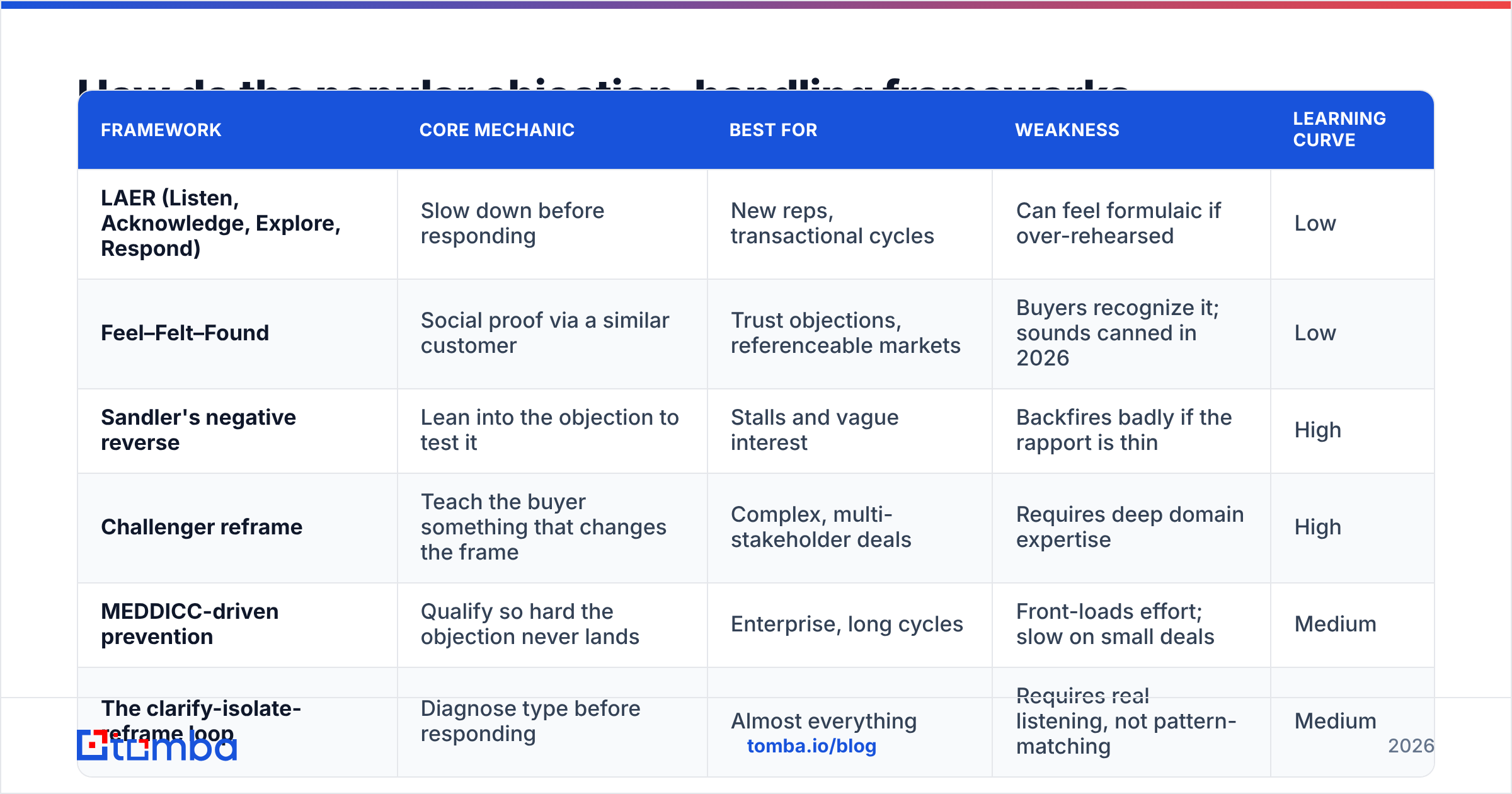
Several named methodologies circulate in sales training. They overlap more than their trademarks suggest, but they emphasize different things.
| Framework | Core mechanic | Best for | Weakness | Learning curve |
|---|---|---|---|---|
| LAER (Listen, Acknowledge, Explore, Respond) | Slow down before responding | New reps, transactional cycles | Can feel formulaic if over-rehearsed | Low |
| Feel–Felt–Found | Social proof via a similar customer | Trust objections, referenceable markets | Buyers recognize it; sounds canned in 2026 | Low |
| Sandler's negative reverse | Lean into the objection to test it | Stalls and vague interest | Backfires badly if the rapport is thin | High |
| Challenger reframe | Teach the buyer something that changes the frame | Complex, multi-stakeholder deals | Requires deep domain expertise | High |
| MEDDICC-driven prevention | Qualify so hard the objection never lands | Enterprise, long cycles | Front-loads effort; slow on small deals | Medium |
| The clarify-isolate-reframe loop | Diagnose type before responding | Almost everything | Requires real listening, not pattern-matching | Medium |
Pick one primary and one backup. Reps who try to run all six turn into a hesitant mess in live conversation. Sell mid-market SaaS with two to four stakeholders? The loop plus MEDDICC-style qualification covers most ground. Sell into deeply entrenched incumbents? Challenger-style reframing earns its complexity.
Buyer reviews are a decent sanity check on which methodology a vendor's own team actually uses. The sales-training category on G2 is more candid than most vendor sites.
What do the highest-leverage objection scripts look like?#
Scripts are training wheels, not the bike. Use these as a shape, then rewrite them in your own voice with your own customer numbers.
"It's too expensive."
"Fair. Help me understand the comparison — are we expensive against your current spend, or against the number finance gave you? Because if it's the second one, I'd rather talk about what the approval path looks like than shave features off to hit an arbitrary line."
"We already use [incumbent]."
"Good — that means you've already solved the budget and the internal buy-in. What's the one thing you'd change about it if you could? I'm not going to pretend we replace everything; I want to know if the gap you'd name is one we actually close."
"Send me some information."
"Happy to. So I don't send you a 40-page PDF you won't read — what specifically would you need to see to know whether this is worth a real conversation? I'll send that one thing."
"I need to talk to my team."
"Makes sense. Who else is in that conversation, and what's the objection you expect them to raise? I'd rather arm you for that than have you defend a product you've seen once."
"Now isn't a good time."
"Understood. Is it a bad time because the problem isn't urgent, or because the calendar is full? If it's the calendar, I'll come back in six weeks. If it's the priority, I'd rather hear that now and stop bothering you."
Notice the shared trait: each one ends in a question that forces a real answer. A response that ends in a statement invites a polite "thanks, I'll get back to you." That is where deals go to die. For more on structuring the surrounding message, our library of cold email templates shows how the same principle applies in writing.
How should you measure objection handling?#
Most teams measure this badly, if at all. Three metrics carry the weight:
- Objection-to-advance rate. Of deals where objection type X was raised, what percentage reached the next stage? This is the only metric that tells you whether handling is working.
- Objection frequency by source. If "wrong person" spikes on one list segment, that is a data problem, not a coaching problem.
- Time-to-resolution. How many days between the objection being raised and the deal advancing or dying? Long tails are usually unresolved authority problems.
Report these against your overall win rate monthly. Look for a specific objection type with a suspiciously low advance rate. That is where a talk-track fix pays immediately.
One organizational note. Objection data belongs in the CRM as fields, and CRM hygiene depends on clean inbound contact records. If reps hand-type contact details, the data will be too dirty to trust for this analysis. Vendors like HubSpot document the field-level structure well. Enforcement is the harder part.
What does a 30-day improvement plan look like?#
- Week 1 — Inventory. Pull the last 50 lost deals. Tag the stated reason and the real reason. They will disagree more often than you expect.
- Week 2 — Cluster. Group into the four categories (information, urgency, authority, trust). Whichever category dominates is your team's actual weakness.
- Week 3 — Rewrite. Build three responses per dominant objection, in the rep's own words. Role-play them until they stop sounding recited.
- Week 4 — Instrument. Add the CRM picklist field. Make logging the objection type required on stage change. Review the first report in 30 days.
Then repeat quarterly. Objection patterns shift as your market, pricing, and competitors change. A talk track that worked in 2024 may be arguing against a concern nobody has anymore.
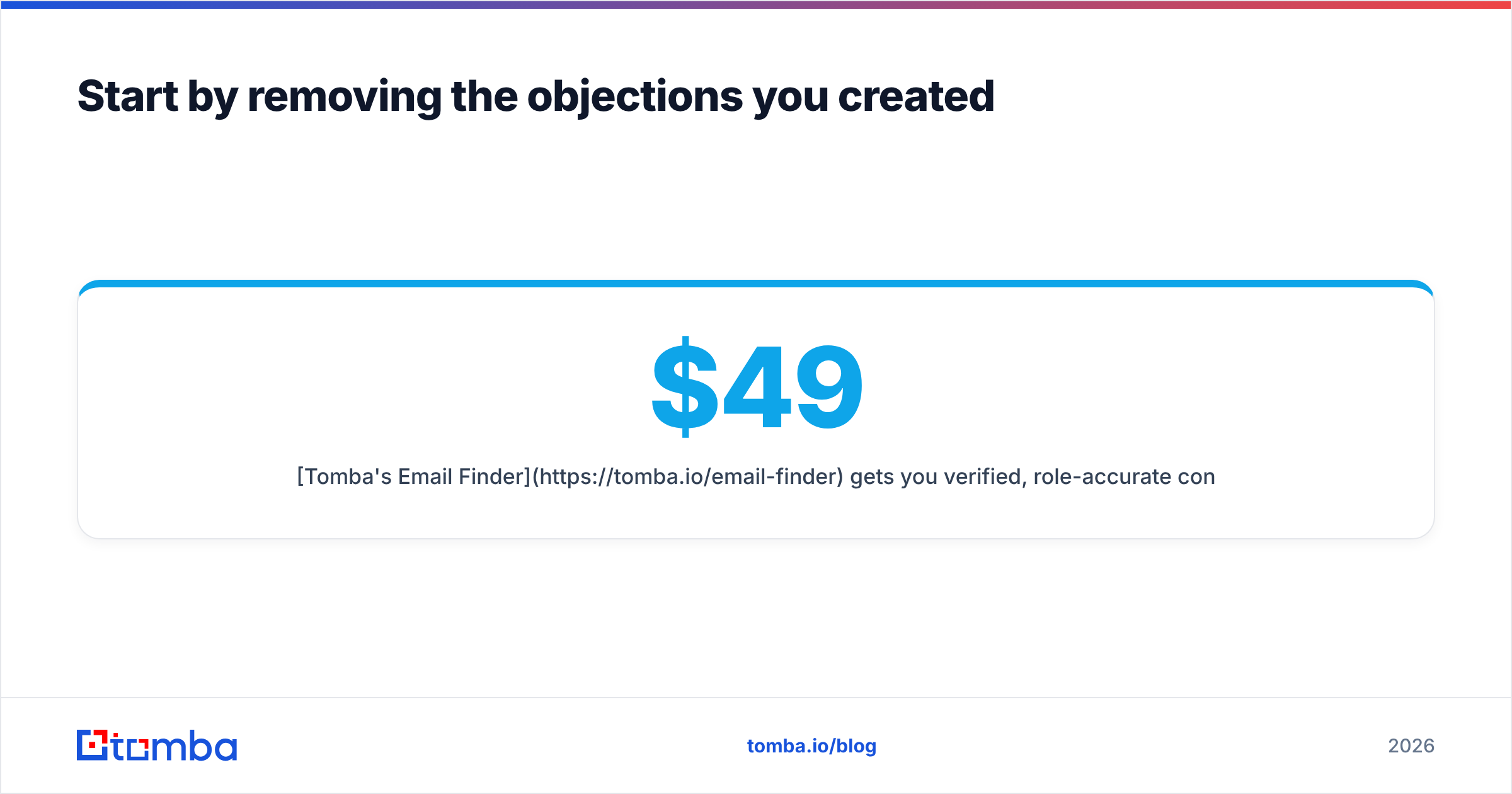
Start by removing the objections you created#
The fastest win in handling objections in selling process work is not a better rebuttal. It is a cleaner list. Every bounced send, every "wrong department," and every pitch aimed at a company three sizes off is an objection you generated before the conversation started.
Tomba's Email Finder gets you verified, role-accurate contacts by domain, name, or company. Your reps then spend their energy on real concerns instead of routing errors. The free tier includes 25 searches a month; paid plans start at $49/mo for Starter, $99/mo for Growth, and $249/mo for Pro — full details on Tomba pricing. Fix the input, and a surprising share of your objections never get raised.
Related guides#
Ready to find emails that actually work?
Join 150,000+ professionals who stopped guessing and started sending. Free credits on signup — no credit card required.
Get the Tomba newsletter
Practical outbound tactics and product updates — once every two weeks.
About the author