Handling Objections PPT: Build a Sales Deck That Closes
Most objection-handling decks are 40 slides of theory nobody uses. Here is the slide-by-slide structure, the frameworks worth teaching, and the free templates that actually hold up in live calls.
TL;DR
- A handling objections PPT fails when it teaches taxonomy instead of behavior. Reps do not need 12 objection categories; they need 5 responses they can say out loud under pressure.
- The structure that works: 1 framework slide, 4-6 objection slides with verbatim language, 1 roleplay slide, 1 scorecard. Six to ten slides total, not forty.
- Use one framework per deck. LAER, the Sandler reverse, or Objection-Prevention. Mixing three frameworks in one deck guarantees none get used.
- Free templates from SlideModel, Slidesgo, and HubSpot are fine skeletons, but every one of them ships with generic filler you must replace with your own call recordings.
- Half the objections in your deck should not exist. "We already have a vendor" and "wrong person" are targeting failures, fixable upstream with better contact data — not rebuttal scripts.
What is a handling objections PPT actually for?#
A handling objections PPT is a sales enablement deck used to train reps on responding to prospect pushback — price, timing, authority, competition, and trust. It is a training artifact, not a reference manual.
That distinction decides everything about how you build it. A reference manual can be exhaustive. A training artifact has to be memorable, because it is competing against a live human on the other end of the phone who just said "send me some information." Nobody scrolls to slide 27 mid-call.
The most common failure mode: someone builds a 40-slide deck with a matrix of every conceivable objection, presents it once at a Monday kickoff, drops it in a shared drive, and it is never opened again. The deck was thorough. It was also useless, because thoroughness is the opposite of what a rep needs in the four seconds after a prospect pushes back.
Good objection decks do three jobs:
- Teach one framework — a repeatable shape for any objection, so reps are not memorizing 30 scripts.
- Supply verbatim language — actual sentences, in quotes, that reps can say word-for-word until they internalize them.
- Force practice — a roleplay slide and a scoring rubric, so the deck ends in reps talking rather than nodding.
Everything else is decoration.
What should go on each slide?#
Here is the slide-by-slide structure that survives contact with a real sales floor. Adapt the count, keep the sequence.
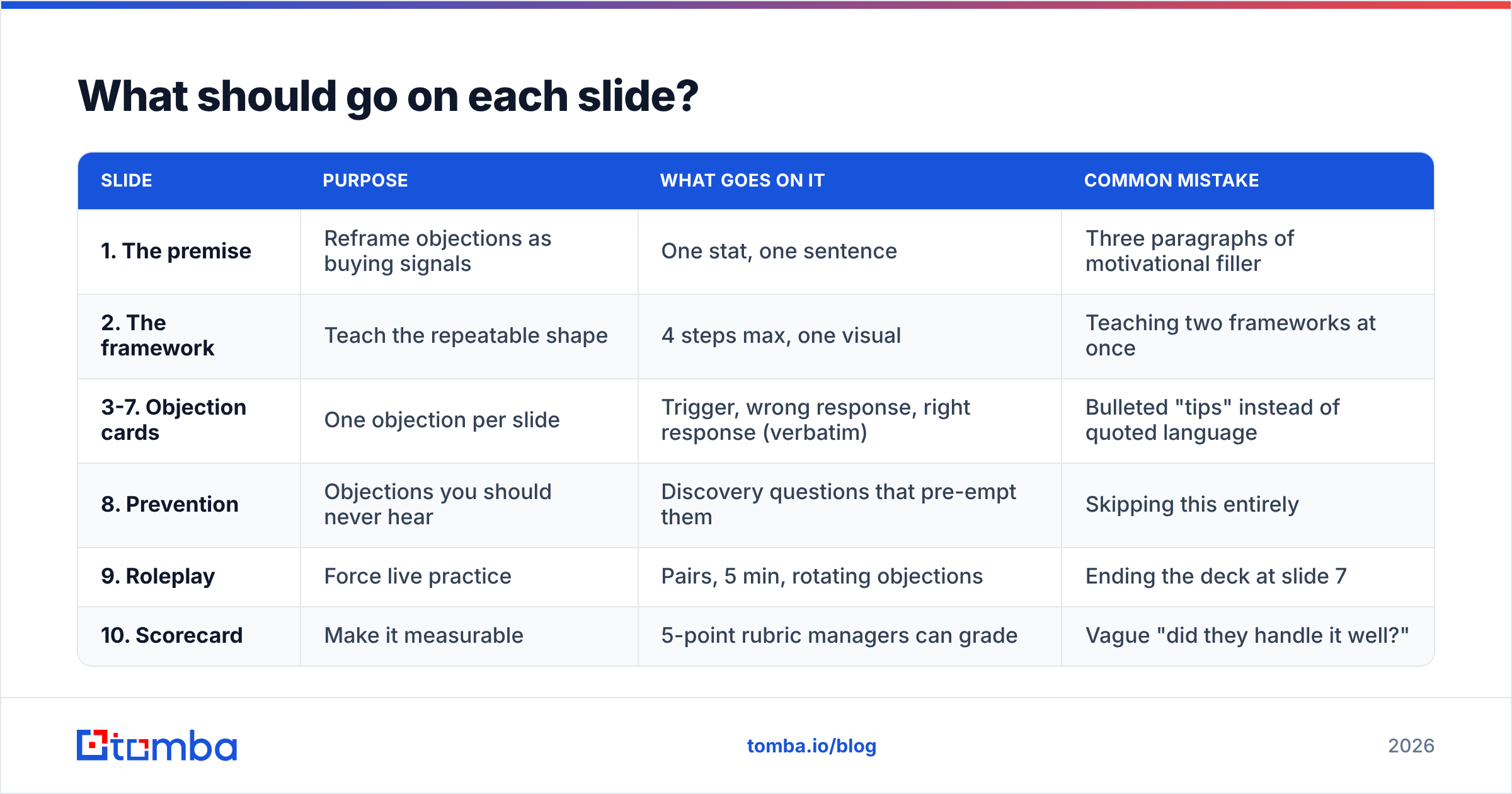
| Slide | Purpose | What goes on it | Common mistake |
|---|---|---|---|
| 1. The premise | Reframe objections as buying signals | One stat, one sentence | Three paragraphs of motivational filler |
| 2. The framework | Teach the repeatable shape | 4 steps max, one visual | Teaching two frameworks at once |
| 3-7. Objection cards | One objection per slide | Trigger, wrong response, right response (verbatim) | Bulleted "tips" instead of quoted language |
| 8. Prevention | Objections you should never hear | Discovery questions that pre-empt them | Skipping this entirely |
| 9. Roleplay | Force live practice | Pairs, 5 min, rotating objections | Ending the deck at slide 7 |
| 10. Scorecard | Make it measurable | 5-point rubric managers can grade | Vague "did they handle it well?" |
The objection cards are where most decks go soft. A weak card says "Acknowledge the concern and pivot to value." A strong card says:
Prospect: "It's too expensive."
Do not say: "We can look at discounting."
Say: "Compared to what? I want to make sure we're pricing against the right alternative."
The second version is usable at 3pm on a Thursday. The first one is a fortune cookie.
Which objection-handling framework should the deck teach?#
Pick one. The most durable options, and where each fits:
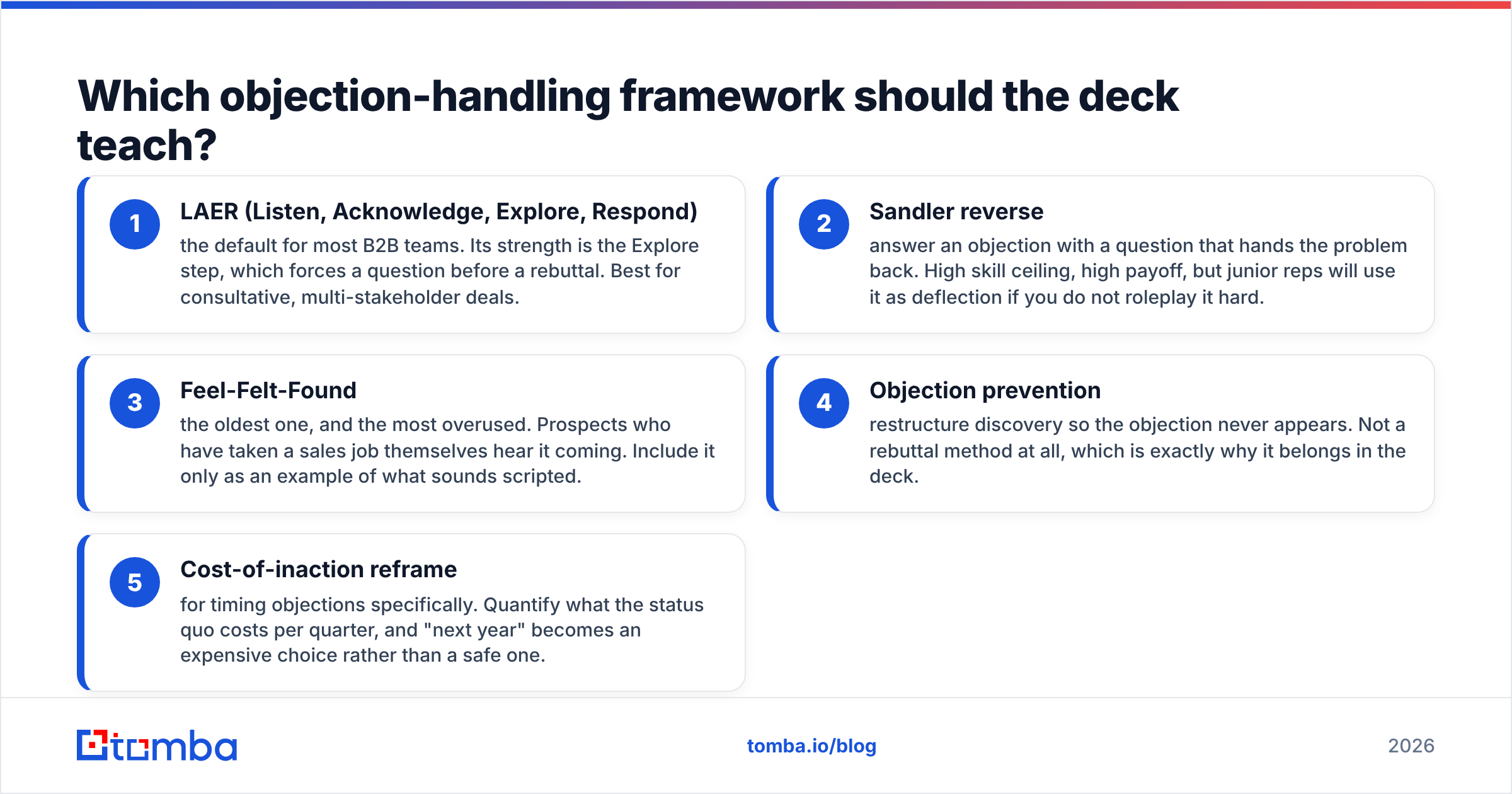
- LAER (Listen, Acknowledge, Explore, Respond) — the default for most B2B teams. Its strength is the Explore step, which forces a question before a rebuttal. Best for consultative, multi-stakeholder deals.
- Sandler reverse — answer an objection with a question that hands the problem back. High skill ceiling, high payoff, but junior reps will use it as deflection if you do not roleplay it hard.
- Feel-Felt-Found — the oldest one, and the most overused. Prospects who have taken a sales job themselves hear it coming. Include it only as an example of what sounds scripted.
- Objection prevention — restructure discovery so the objection never appears. Not a rebuttal method at all, which is exactly why it belongs in the deck.
- Cost-of-inaction reframe — for timing objections specifically. Quantify what the status quo costs per quarter, and "next year" becomes an expensive choice rather than a safe one.
Two frameworks in one deck means reps use neither. If your team already has a methodology — MEDDIC, Challenger, whatever the last consultant left behind — build the objection deck inside it rather than beside it. HubSpot's sales objection resources are a reasonable neutral reference if you need to sanity-check your framing before you commit a deck to it.
Which free handling objections PPT templates are worth using?#
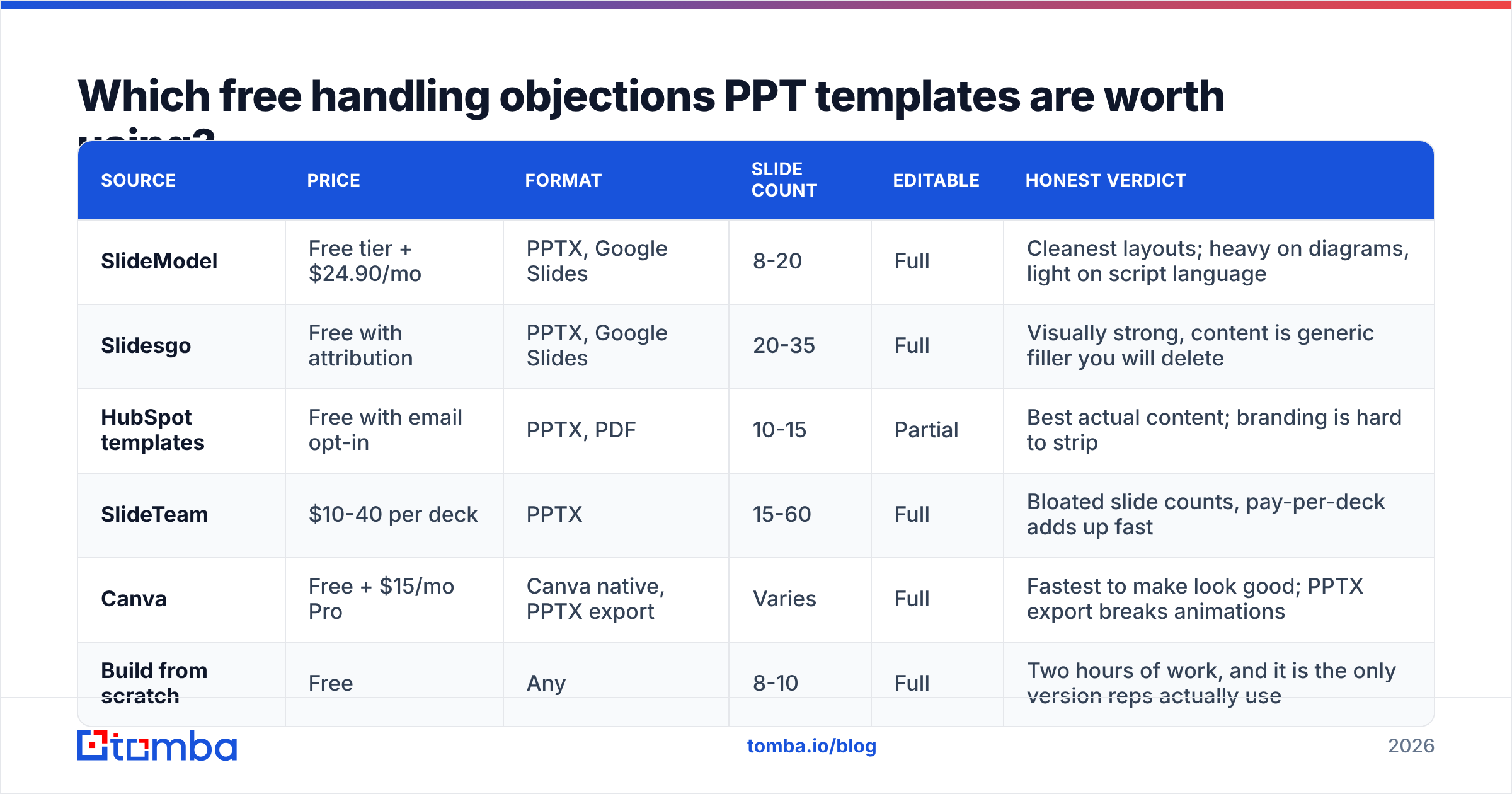
Template quality varies wildly. Here is an honest read on the main sources, judged on whether the file saves you real time versus whether you end up rebuilding it anyway.
| Source | Price | Format | Slide count | Editable | Honest verdict |
|---|---|---|---|---|---|
| SlideModel | Free tier + $24.90/mo | PPTX, Google Slides | 8-20 | Full | Cleanest layouts; heavy on diagrams, light on script language |
| Slidesgo | Free with attribution | PPTX, Google Slides | 20-35 | Full | Visually strong, content is generic filler you will delete |
| HubSpot templates | Free with email opt-in | PPTX, PDF | 10-15 | Partial | Best actual content; branding is hard to strip |
| SlideTeam | $10-40 per deck | PPTX | 15-60 | Full | Bloated slide counts, pay-per-deck adds up fast |
| Canva | Free + $15/mo Pro | Canva native, PPTX export | Varies | Full | Fastest to make look good; PPTX export breaks animations |
| Build from scratch | Free | Any | 8-10 | Full | Two hours of work, and it is the only version reps actually use |
The pattern across all of them: templates solve layout, not content. Every one of these decks ships with placeholder objections like "The price is too high" and a generic three-bullet answer. Your reps do not need a generic answer. They need the answer that worked on the call your top AE ran last Tuesday.
Practical workflow: grab a Slidesgo or SlideModel skeleton for the visual system, then fill it entirely from call recordings. Pull five real objections from Gong, Chorus, or whatever your team records with, transcribe the exact words the prospect used, and paste those into the objection cards. Verbatim prospect language outperforms invented objections every time, because reps recognize it.
Are you handling objections, or fixing bad targeting?#
This is the section most objection decks refuse to include, and it is the one that moves numbers.
Not every objection is an objection. Several of the most common ones are diagnostic signals that the contact should never have been called:
- "We already use a competitor" — sometimes a real objection, often a research gap. Their stack was visible before the call.
- "I'm not the right person" — never an objection. That is a data problem wearing an objection costume.
- "How did you get my email?" — usually means the address came from a scraped list of unknown provenance.
- "We're too small for this" — firmographic mismatch. No rebuttal fixes a company that genuinely does not fit.
Teams routinely spend an entire training session drilling rebuttals for problems that a cleaner list would have deleted. If a quarter of your call objections are authority or fit objections, the deck is not the constraint — the list is.
Concretely, that means verifying you are reaching the decision-maker before the dial. Running contacts through a domain search to map who actually holds the role, and a pass through an email verifier to strip dead addresses, removes a meaningful chunk of the objections your deck would otherwise have to cover. Add a slide to your deck titled "Objections we should never hear" and list them. It reframes the training from rebuttal drills to upstream quality, and it earns credibility with senior reps who already know half these objections are self-inflicted.
The response rate lift from better targeting typically beats the lift from better rebuttals, and it compounds — a rep who talks to the right person three times a day gets more reps at real objections than one who spends the morning being told they called the wrong department.
How do you make the deck stick after the training session?#
Decks decay. Here is what keeps them alive past week two.
Ship it as a one-pager too. Export slides 3-7 as a single PDF card that fits on a monitor bezel. Reps will use the card, not the deck. That is fine — the deck exists to teach the card.
Rotate one slide per month. Replace the least-used objection card with a fresh one pulled from that month's recordings. A living deck signals the training is real; a static deck signals it was a compliance exercise.
Score it in 1:1s. The scorecard slide only matters if a manager grades against it. Five criteria, binary each: Did they pause? Did they ask a question before answering? Did they use the prospect's own words? Did they get a next step? Did they avoid discounting unprompted?
Run 10-minute roleplays weekly, not 90-minute quarterly workshops. Objection handling is a motor skill. Spaced repetition beats a single long session, which is well documented in learning research and holds equally on sales floors. G2's sales enablement category is a decent place to compare tools if you want to formalize the practice loop, though a shared doc and a calendar invite covers most teams.
Tie it to pipeline data. If timing objections are 40% of your losses, the deck needs two timing slides, not one price slide. Let your CRM loss reasons drive the slide order rather than intuition. Most teams discover their deck is over-indexed on price because price objections are the loudest, not the most frequent.
What does a finished objection deck look like in practice?#
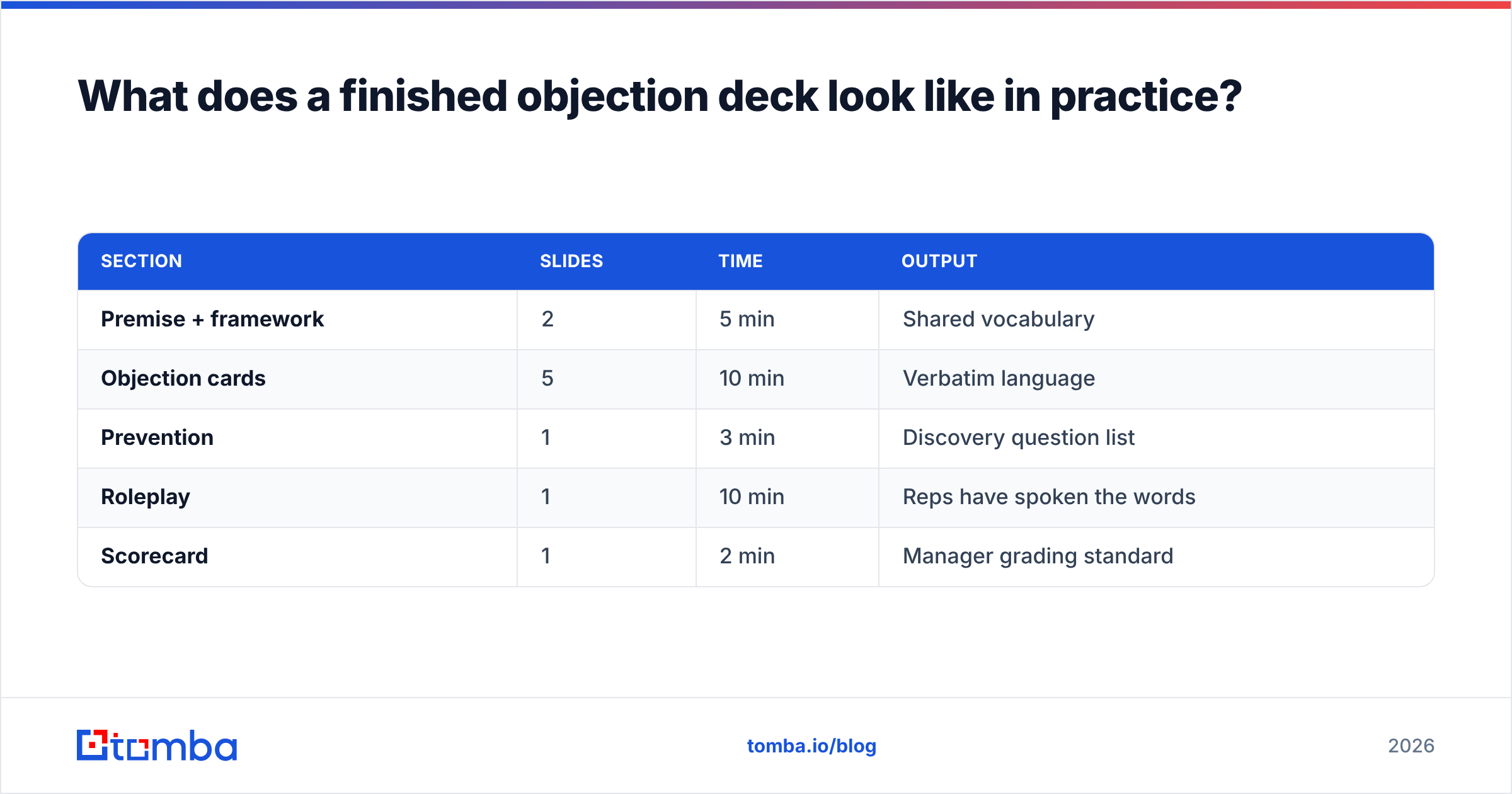
A working example, sized for a 30-minute session:
| Section | Slides | Time | Output |
|---|---|---|---|
| Premise + framework | 2 | 5 min | Shared vocabulary |
| Objection cards | 5 | 10 min | Verbatim language |
| Prevention | 1 | 3 min | Discovery question list |
| Roleplay | 1 | 10 min | Reps have spoken the words |
| Scorecard | 1 | 2 min | Manager grading standard |
Ten slides. Thirty minutes. Every rep leaves having said the actual sentences out loud at least twice.
Compare that to the 40-slide deck: 30 minutes of a manager reading bullets, zero reps speaking, and no artifact anyone can use on a call. The shorter deck wins on every measure that matters, and it takes less time to build.
One last structural note: end the deck on the roleplay and scorecard, never on a summary slide. A summary slide invites the session to end in agreement rather than in practice. If reps have not said the words in the room, they will improvise them on the call, and improvisation under pressure produces the discount you did not authorize.
Where should you start?#
Build the six-slide version this week. One framework, four objection cards pulled from real recordings, one roleplay, one scorecard. Ship it, run it, and rotate a card monthly. That beats a polished 40-slide deck that gets opened once.
Then go fix the upstream half. Before the next training cycle, audit which objections in your deck are actually targeting failures — wrong person, wrong company size, dead address. Those slides should not exist, and the fastest way to delete them is to reach the right contact in the first place. The Tomba Email Finder locates verified professional addresses by name, domain, or company, so your reps spend their calls on real objections from real decision-makers instead of rebutting "I'm not the right person" all morning. The free tier runs 25 searches a month, and paid plans start at $49/mo — check Tomba pricing for the full breakdown.
Related guides#
Ready to find emails that actually work?
Join 150,000+ professionals who stopped guessing and started sending. Free credits on signup — no credit card required.
Get the Tomba newsletter
Practical outbound tactics and product updates — once every two weeks.
About the author