Hire an AI BDR in 2026: What It Costs and Where It Breaks
AI BDRs promise a full pipeline for a fraction of a human rep's salary. Here is what they actually deliver in 2026, what they cost per meeting, and the three jobs they still cannot do.
TL;DR
- An AI BDR is not a replacement for a sales development rep. It is a replacement for the 60% of an SDR's week spent on list building, research, sequencing, and follow-up admin.
- Realistic 2026 pricing runs $500–$3,000/month for AI BDR platforms versus $85,000–$110,000 fully loaded for a human SDR in North America.
- The failure mode is almost never the AI writing. It is the data layer: bad emails, stale titles, and unverified contacts that torch your domain before the copy ever gets read.
- AI BDRs do well on high-volume, low-consideration outbound. They do badly on enterprise, multi-threaded, relationship-led deals.
- The pragmatic 2026 setup is a hybrid: AI handles sourcing, enrichment, and first touch; a human owns objection handling, discovery, and anything over $25K ACV.
What is an AI BDR, exactly?#
An AI BDR (sometimes marketed as an "AI SDR" or "digital rep") is software that automates the top of the sales funnel: it builds a target list, researches each account, writes personalized outreach, sends it across email and LinkedIn, and handles the first few rounds of reply classification before routing an interested prospect to a human.
The category exploded in 2024–2025 and has since split into three distinct product shapes, which most buyers still conflate:
- Sequencer-plus-AI — an existing outbound platform (Outreach, Salesloft, Instantly) with AI copy generation bolted on. You still supply the list. Cheapest, least autonomous.
- Data-plus-agent — the platform owns a contact database and runs the whole loop from ICP definition to reply. This is what most vendors mean by "AI BDR." Most expensive, most opaque about data quality.
- Composable stack — you assemble your own: a data source, an enrichment/verification layer, a sending tool, and an LLM for copy. Cheapest at scale, requires someone technical to own it.
The third option is where most sophisticated teams landed in 2026, because the second option's biggest weakness turned out to be exactly the thing it advertised: the data.
How much does it cost to hire an AI BDR versus a human?#
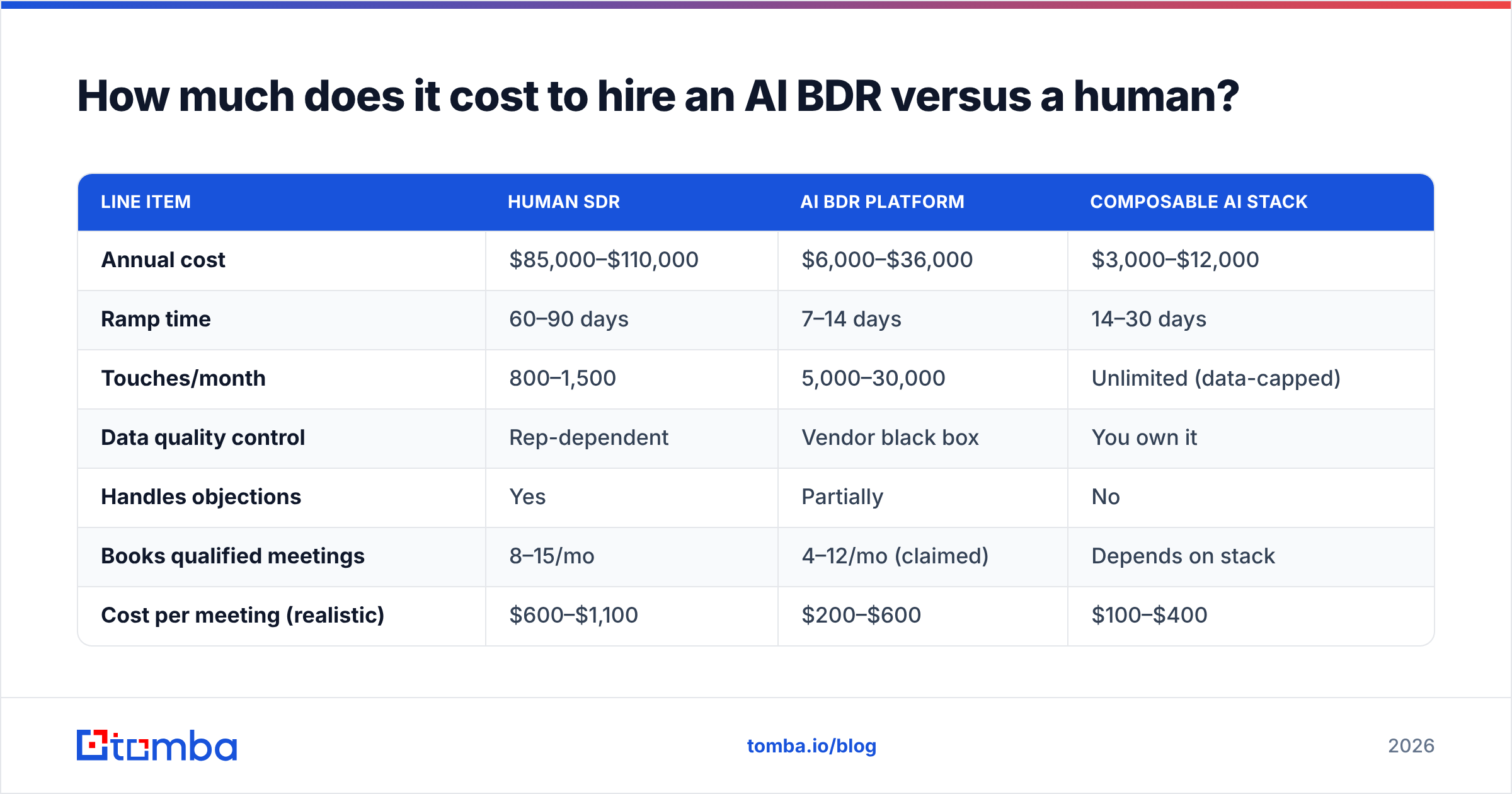
Here is the honest comparison. Human SDR figures assume a North American mid-market rep at $60K base / $80K OTE plus 30–40% loaded cost for benefits, tooling, management overhead, and ramp.
| Line item | Human SDR | AI BDR platform | Composable AI stack |
|---|---|---|---|
| Annual cost | $85,000–$110,000 | $6,000–$36,000 | $3,000–$12,000 |
| Ramp time | 60–90 days | 7–14 days | 14–30 days |
| Touches/month | 800–1,500 | 5,000–30,000 | Unlimited (data-capped) |
| Data quality control | Rep-dependent | Vendor black box | You own it |
| Handles objections | Yes | Partially | No |
| Books qualified meetings | 8–15/mo | 4–12/mo (claimed) | Depends on stack |
| Cost per meeting (realistic) | $600–$1,100 | $200–$600 | $100–$400 |
| Scales down cleanly | No | Yes | Yes |
The "cost per meeting" row is where the sales pitch usually stops. It should not. A meeting sourced by a human who already qualified budget and timing is not the same asset as a meeting an AI booked because someone clicked "sure, send info." Track meeting-to-opportunity conversion, not raw meeting count. In most benchmarks we have seen, AI-booked meetings convert to opportunity at roughly half to two-thirds the rate of human-booked ones — which quietly erases part of the cost advantage.
Why do most AI BDR deployments fail?#
Because teams buy the agent and ignore the fuel. Four failure patterns account for nearly every disappointed AI BDR postmortem:
- Unverified contact data. The agent sends to a list it did not verify. Bounce rate climbs past 4%, mailbox providers throttle you, and the domain that took a year to warm is now landing in spam. This is the single most common cause of a failed rollout.
- Stale job titles. B2B contact churn runs roughly 25–30% annually. An AI BDR working from a 12-month-old snapshot is writing beautiful, personalized emails to people who left. Refresh cadence matters more than database size.
- Personalization theater. "I saw your company recently posted about hiring" is not personalization — it is a merge tag with better grammar. Buyers pattern-matched these within months. If your AI's "personal" line could apply to 400 companies, it is noise.
- No human handoff design. The AI books the meeting, a human shows up cold with no context, and the prospect repeats themselves. Conversion dies in the seam between the two.
Notice that three of the four are data problems, not AI problems. That is the core insight of the category in 2026.
Which sales motions should you hand to an AI BDR?#
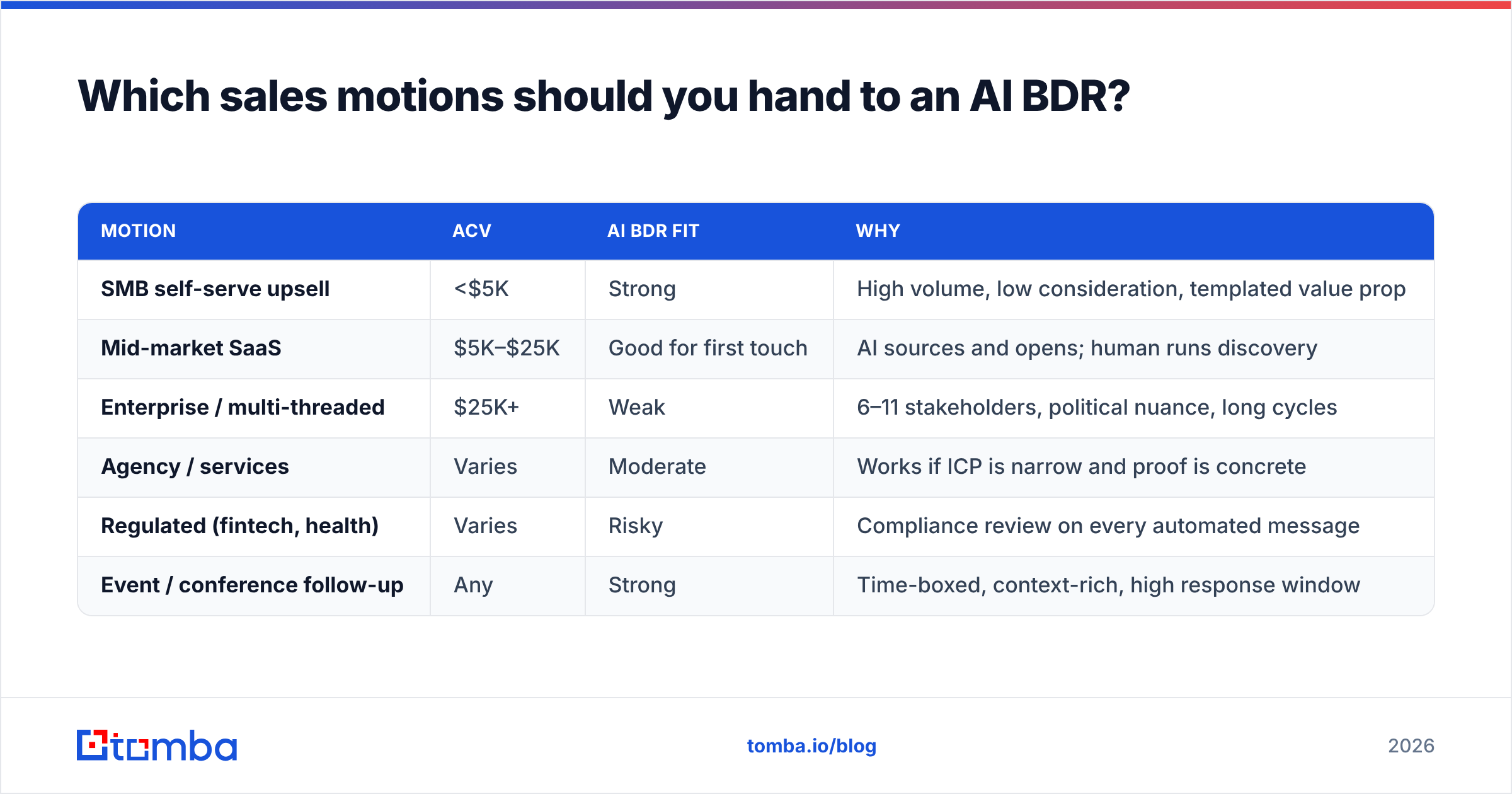
Not all outbound is equally automatable. Use this as a filter before you sign anything:
| Motion | ACV | AI BDR fit | Why |
|---|---|---|---|
| SMB self-serve upsell | <$5K | Strong | High volume, low consideration, templated value prop |
| Mid-market SaaS | $5K–$25K | Good for first touch | AI sources and opens; human runs discovery |
| Enterprise / multi-threaded | $25K+ | Weak | 6–11 stakeholders, political nuance, long cycles |
| Agency / services | Varies | Moderate | Works if ICP is narrow and proof is concrete |
| Regulated (fintech, health) | Varies | Risky | Compliance review on every automated message |
| Event / conference follow-up | Any | Strong | Time-boxed, context-rich, high response window |
The pattern: AI BDRs earn their keep where the value proposition is stable across prospects and the buying committee is one or two people. The moment you need someone to read a room, you need a human.
What should you actually check before you buy?#
Vendors will happily show you a demo where the AI writes a charming email. That demo proves nothing you care about. Ask these instead:
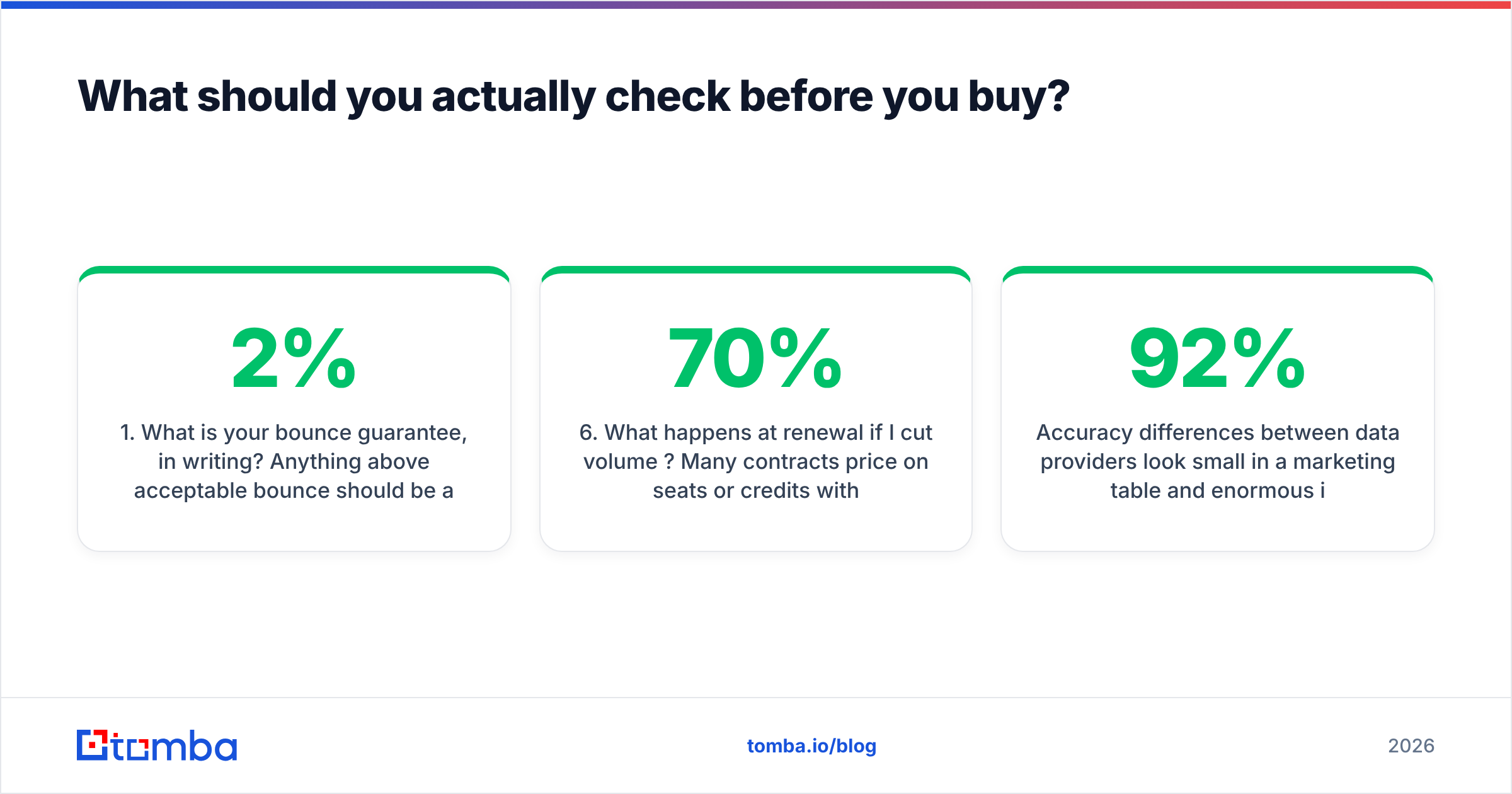
- What is your bounce guarantee, in writing? Anything above 2% acceptable bounce should be a red flag. Ask what happens to your bill if they exceed it.
- How is your contact data sourced and refreshed? "Proprietary" is not an answer. Ask for refresh frequency and whether they re-verify at send time or at import time. Send-time verification is the only one that protects you.
- Can I export my data? Some platforms make your enriched contacts hostage to the subscription. Check the export terms before, not after.
- What is the actual reply classification accuracy? Ask for the false-positive rate on "interested." An AI that routes polite brush-offs as hot leads wastes more AE time than it saves.
- Who owns deliverability? If the vendor sends from shared infrastructure, your reputation is coupled to their worst customer.
- What happens at renewal if I cut volume 70%? Many contracts price on seats or credits with no downgrade path mid-term.
On point 2 specifically: the durable fix is to own your verification layer regardless of which agent you use. Running every contact through a dedicated email verifier before it enters a sequence costs pennies and prevents the one failure mode that cannot be undone — a burned sending domain. If a meaningful share of your ICP sits behind accept-all servers, a catch-all verifier is the difference between a usable list and a guess.

Accuracy differences between data providers look small in a marketing table and enormous in a bounce report. A 92% accurate source and a 97% accurate source, run at 5,000 sends a month, are the difference between 400 bounces and 150 — and the first number gets your domain throttled.
Is a composable AI BDR stack better than an all-in-one platform?#
For most teams under 20 reps, yes — and the gap widened in 2026 as data providers opened their APIs.
An all-in-one platform bundles data, enrichment, copy, sending, and reply handling. Convenient, but you inherit the weakest component. If their database is thin in your vertical, no amount of clever prompting fixes it, and you cannot swap that one piece out.
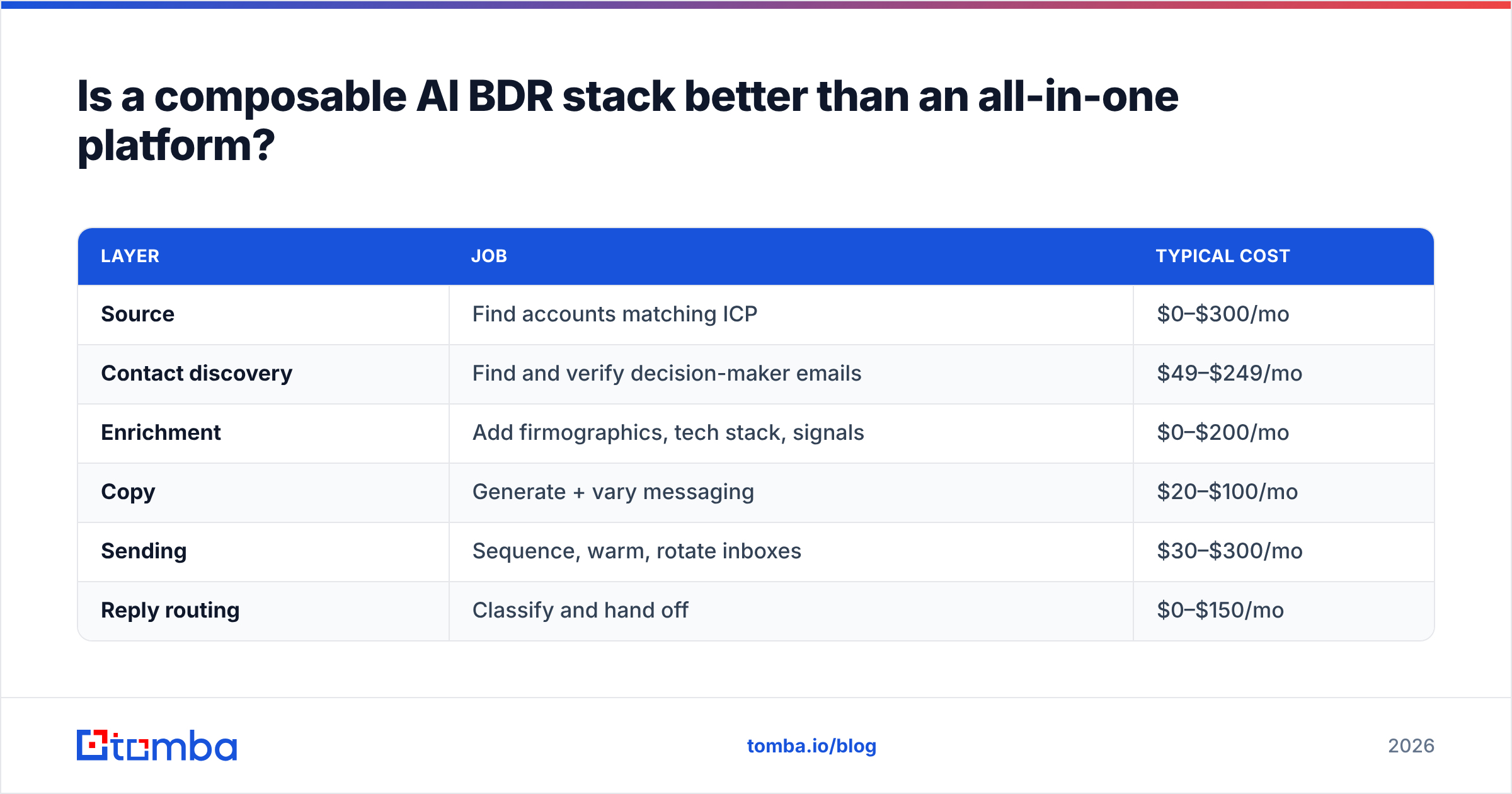
A composable stack looks like this:
| Layer | Job | Typical cost |
|---|---|---|
| Source | Find accounts matching ICP | $0–$300/mo |
| Contact discovery | Find and verify decision-maker emails | $49–$249/mo |
| Enrichment | Add firmographics, tech stack, signals | $0–$200/mo |
| Copy | Generate + vary messaging | $20–$100/mo |
| Sending | Sequence, warm, rotate inboxes | $30–$300/mo |
| Reply routing | Classify and hand off | $0–$150/mo |
Total: often under $1,000/month for the same throughput a $2,500/month all-in-one delivers — with the ability to replace any single layer when it underperforms.
The contact discovery layer is where quality compounds. A domain search that returns every verified address at a target company plus the pattern the company uses is more useful than a static database row, because it stays current. Tomba pricing starts free at 25 searches per month, then $49/mo Starter, $99/mo Growth, and $249/mo Pro — which means the data layer of a full AI BDR stack costs less than two days of a human SDR's loaded salary.
How do you build the hybrid model that actually works?#
The teams getting real ROI in 2026 are not choosing between AI and humans. They are re-cutting the job description.
Give the AI:
- ICP list construction and refresh
- Contact discovery and verification
- Account research summarization
- First-touch email and LinkedIn connection
- Follow-up cadence management
- Reply triage into interested / not now / never
Keep with the human:
- Any reply with a question in it
- Discovery calls and qualification
- Multi-threading into a buying committee
- Pricing and objection conversations
- Anything above your median deal size
Measure both on:
- Meeting-to-opportunity rate (not meetings)
- Cost per opportunity (not cost per touch)
- Domain health: bounce rate, spam complaint rate, reply sentiment
- Time-to-first-touch after a trigger event fires
That last metric is underrated. The single biggest advantage an AI BDR has over a human is latency. A human sees a funding announcement the next morning. An agent with a Tomba API call in the pipeline can have a verified contact and a relevant first touch out in under four minutes. Speed on trigger events is a real edge; volume for its own sake is not.
For a sanity check on how the sending side interacts with all of this, email deliverability is the constraint that caps every AI BDR's ceiling. You can generate infinite messages. You cannot deliver infinite messages from one domain.
What are the real limitations nobody puts in the deck?#
Three, and they have not gone away:
Reply quality degrades past the second turn. AI handles "what does your product do" fine. It handles "we tried something like this in 2023 and it failed for reason X, why would this be different" badly, because the answer requires knowing what actually happened at that company. Cap autonomous replies at two turns.
Personalization has a half-life. Whatever pattern your AI uses becomes recognizable within roughly six months as more tools converge on similar prompts. Budget for messaging refreshes the way you budget for creative refresh in paid ads.
Compliance is your problem, not the vendor's. GDPR, CAN-SPAM, and the growing set of state-level rules apply to the sender. An agent sending 20,000 messages a month is 20,000 chances to be non-compliant at scale. Review the G2 category reviews for the specific vendors you shortlist — buyers there are considerably more candid about compliance friction than case studies are.
Also worth reading before you commit: HubSpot's sales research publishes ongoing benchmark data on response rates and rep productivity, and it is one of the few sources not selling an AI BDR while reporting on them.
So should you hire an AI BDR in 2026?#
Hire one if: your ACV is under $25K, your ICP is well defined, your value proposition does not require education, and you have someone who will own the data layer. In that profile, an AI BDR reliably outperforms a junior human rep on cost per opportunity.
Skip it if: you sell enterprise, your buying committee has more than three people, your category requires evangelism, or nobody on your team will own list hygiene. In those cases you will spend $2,000/month to generate a burned domain and a pile of unqualified meetings.
And whichever way you go, do not let the agent be the thing that decides which email addresses to trust. That decision belongs to a verification layer you control.
Start with the data layer before you buy the agent. Run your target accounts through the Tomba Email Finder to see what your real contactable coverage looks like — verified addresses, current titles, actual company patterns — before you commit budget to an AI BDR that will only be as good as the list you feed it. The free tier gives you 25 searches to test coverage on your own ICP, which is enough to know whether the automation problem you think you have is actually a data problem.
Related guides#
Ready to find emails that actually work?
Join 150,000+ professionals who stopped guessing and started sending. Free credits on signup — no credit card required.
Get the Tomba newsletter
Practical outbound tactics and product updates — once every two weeks.
About the author