HitHorizons vs Leadzen.ai: Which B2B Data Tool Wins in 2026?
One pulls company records straight from European business registers. The other hunts contact details for sales teams. Here is where each one actually earns its budget in 2026, and where both leave you stranded.
HitHorizons vs Leadzen.ai looks like a head-to-head. It is not. One tool maps registered companies. The other finds people to email. This guide shows what each one does well, what each costs, and where both leave you stuck.
TL;DR
- These two are not really competitors. HitHorizons is a company-registry database: firmographics, legal entities, financials. Leadzen.ai is a contact-intelligence platform: people, emails, phone numbers. The comparison only helps if you are deciding what your outbound stack is missing.
- Pick HitHorizons if you need register-sourced company records across Europe — legal names, registration IDs, NACE codes, entity hierarchies, and compliance-grade identifiers.
- Pick Leadzen.ai if you need people-level data. Names, titles, work emails, and mobile numbers, with a LinkedIn extension and strong coverage of the Indian market.
- Neither is a deliverability tool. HitHorizons rarely gives you an inbox at all. And any contact vendor's emails still need independent verification before you send.
- Most teams end up running two layers. A firmographic source defines the account list. A separate email finder and verifier make that list contactable.
What is HitHorizons and who is it for?#
HitHorizons is a company-data platform built on official business registers. It does not scrape websites or collect user-submitted profiles. Instead, it merges filings from national registries across Europe into one searchable structure. Each entity gets a stable identifier, so you can track it over time.
Think of it as the land registry of B2B data. It won't tell you who to call. It will tell you, with a paper trail, that the entity exists, what it's legally called, which industry code it filed under, and roughly how big it is.
That makes it useful for:
- Market sizing and TAM work — counting real registered entities in a country and sector rather than guessing from a scraped list.
- KYC, compliance, and risk teams — matching a customer or supplier to an official record.
- Data hygiene — deduplicating your CRM against canonical legal entities instead of 14 spellings of the same GmbH.
- European coverage specifically — this is where the platform is strongest, and where most US-centric databases go thin.
What it is not: a prospecting tool. If your SDR opens HitHorizons hoping to find the VP of Engineering's mobile number, they'll leave disappointed.
What is Leadzen.ai and who is it for?#
Leadzen.ai sits at the opposite end of the stack. It is a lead-intelligence platform for sales and marketing teams. You search for people by role, company, industry, or location. Then you reveal contact details and push them into a sequence or CRM. It also ships a LinkedIn browser extension and supports bulk lookups alongside single real-time searches.
Its edge is geographic. Coverage of Indian companies and professionals is much better than what most Western prospecting databases offer. That matters if your ICP includes APAC or India-headquartered mid-market firms.
Where it gets uncomfortable is the same place every contact database gets uncomfortable: freshness. People change jobs. Company email patterns change after a rebrand or an acquisition. A record that was correct nine months ago is a bounce today. And no vendor's marketing page tells you the age of the records you just exported.

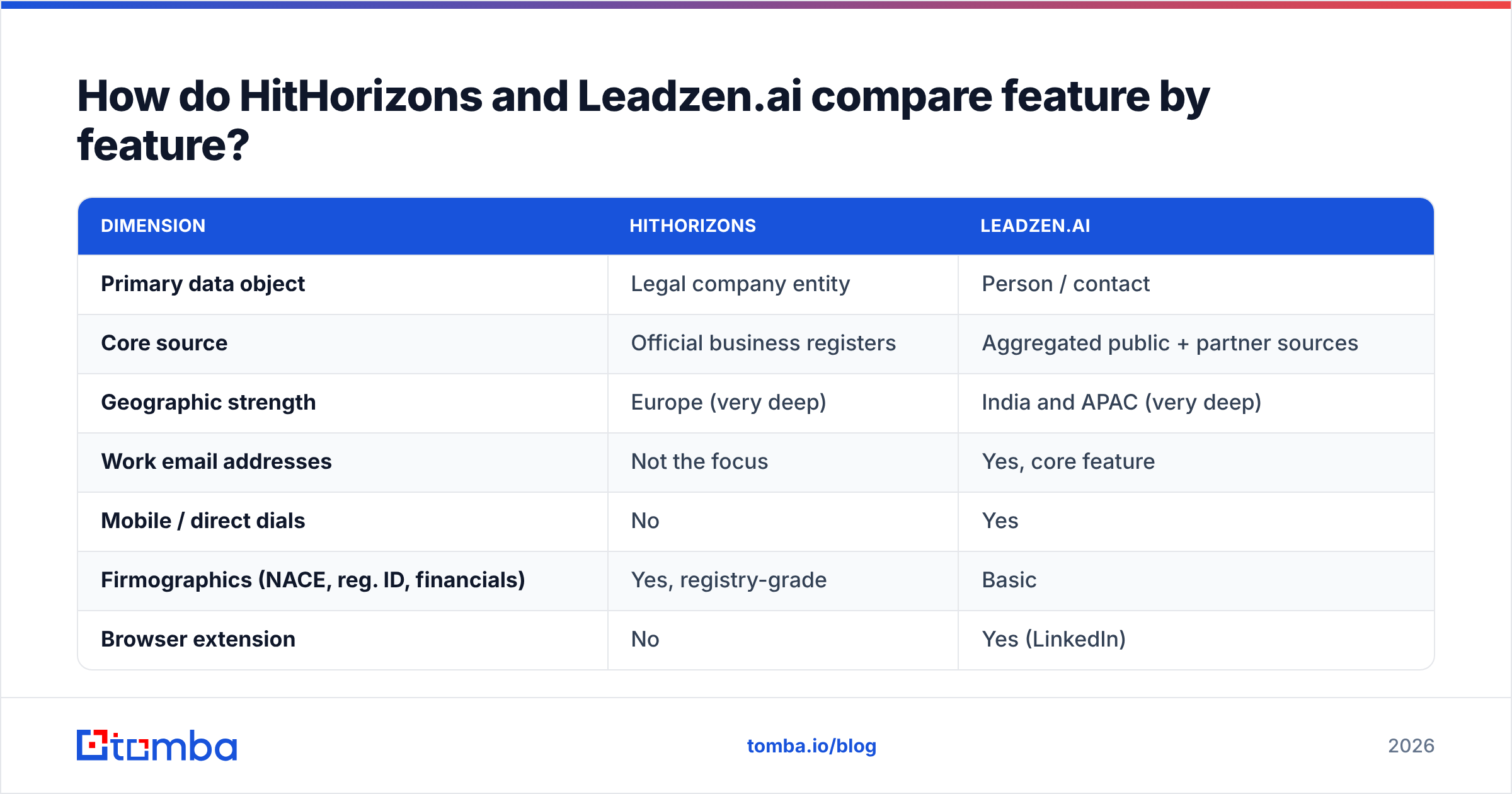
HitHorizons vs Leadzen.ai: how do they compare feature by feature?#
| Dimension | HitHorizons | Leadzen.ai |
|---|---|---|
| Primary data object | Legal company entity | Person / contact |
| Core source | Official business registers | Aggregated public + partner sources |
| Geographic strength | Europe (very deep) | India and APAC (very deep) |
| Work email addresses | Not the focus | Yes, core feature |
| Mobile / direct dials | No | Yes |
| Firmographics (NACE, reg. ID, financials) | Yes, registry-grade | Basic |
| Browser extension | No | Yes (LinkedIn) |
| Bulk enrichment | Via API / exports | Yes |
| API access | Yes | Yes |
| Best-fit user | RevOps, compliance, market research | SDRs, growth, recruiters |
| Typical failure mode | No one to contact | Stale or unverifiable contacts |
The table makes the real decision obvious: you are not choosing between two versions of the same product. You are choosing which half of the problem to solve first.
Which one gives you better data accuracy?#
Accuracy means two different things here, and conflating them is how teams waste a quarter's budget.
HitHorizons accuracy is provenance accuracy. A record is "correct" because a government registry says so. The failure mode isn't wrongness, it's latency and granularity. A registry updates when a filing happens, not when a company quietly moves offices or triples headcount. So you get high confidence about legal facts and low resolution on daily reality.
Leadzen.ai accuracy is contactability accuracy. A record is "correct" if the email lands and the phone rings. That degrades continuously. Industry benchmarks put B2B contact-data decay at roughly 25–30% per year, and job-change churn sped up after 2023. No aggregated database escapes this. The honest question is not "is it accurate?" but "how do I check before I send?"
This is why serious outbound teams treat any exported list as unverified input, not truth. Run that list through an email verifier before it touches a sequence. That single step is the difference between a 2% bounce rate and a suspended sending domain.
Catch-all domains make it worse. Roughly a fifth of B2B domains are catch-all, so you also need a catch-all verifier that does more than shrug and mark everything "risky".
Neither HitHorizons nor Leadzen.ai is designed to be that safety net. HitHorizons doesn't need to be. Leadzen.ai does the finding but, like most contact platforms, its internal validation is a black box you can't audit.
HitHorizons vs Leadzen.ai: how does pricing compare?#
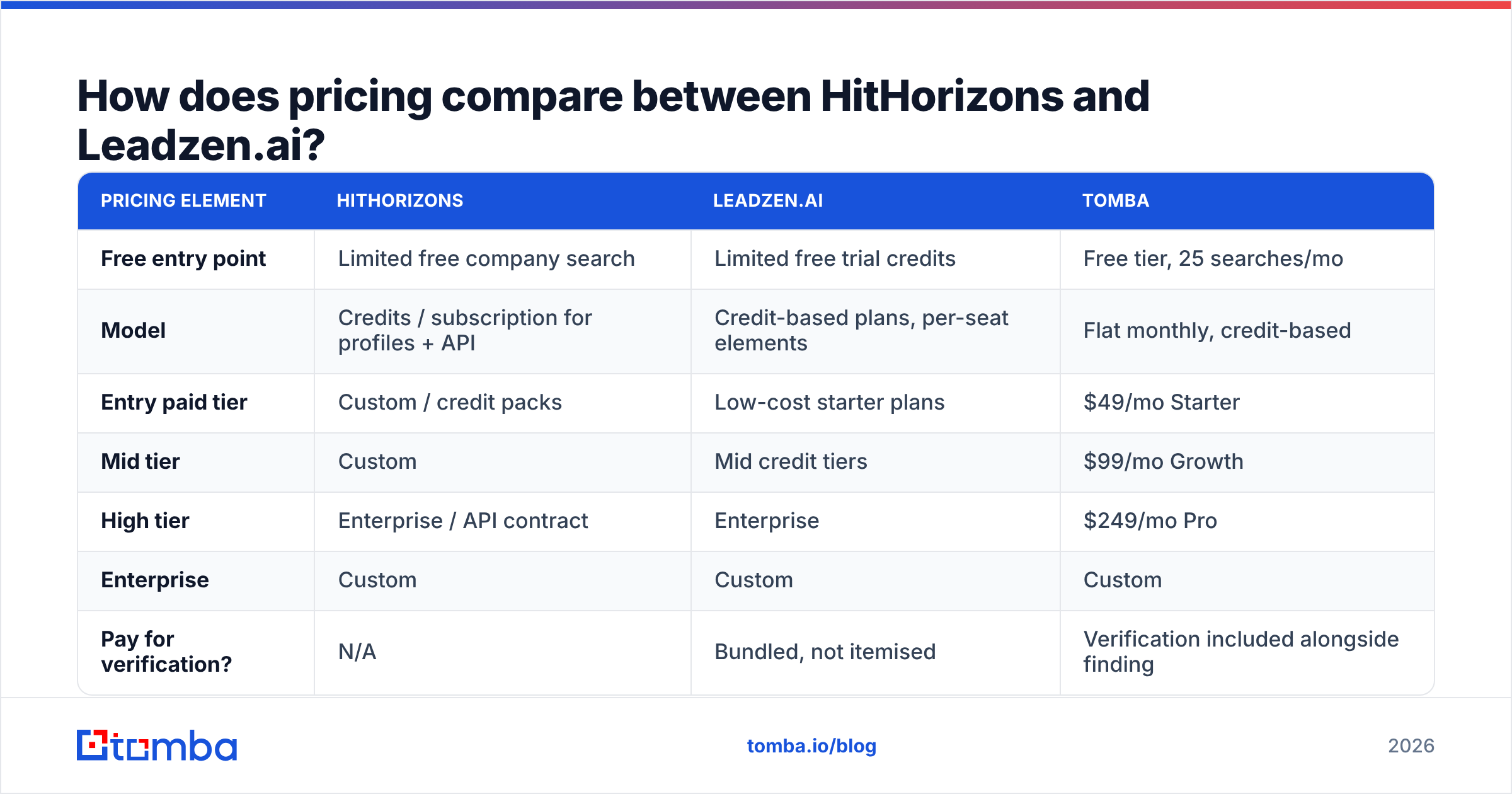
Both vendors move their pricing around, and both push larger buyers to custom quotes. Treat this as a shape comparison rather than a price sheet, and confirm current numbers on their own pages before you commit.
| Pricing element | HitHorizons | Leadzen.ai | Tomba |
|---|---|---|---|
| Free entry point | Limited free company search | Limited free trial credits | Free tier, 25 searches/mo |
| Model | Credits / subscription for profiles + API | Credit-based plans, per-seat elements | Flat monthly, credit-based |
| Entry paid tier | Custom / credit packs | Low-cost starter plans | $49/mo Starter |
| Mid tier | Custom | Mid credit tiers | $99/mo Growth |
| High tier | Enterprise / API contract | Enterprise | $249/mo Pro |
| Enterprise | Custom | Custom | Custom |
| Pay for verification? | N/A | Bundled, not itemised | Verification included alongside finding |
Two things worth flagging.
First, credit models hide the real cost per usable contact. If 30% of what you export bounces, your effective cost per deliverable contact is 43% higher than the sticker price. Always divide by your verified-deliverable rate, not by raw credits.
Second, seat-based components punish growing teams. A five-person SDR pod that doubles hits a pricing cliff that has nothing to do with data volume. Flat, credit-first plans like Tomba pricing avoid that cliff. That matters more than a $10/month gap on the entry tier.

What does a complete stack actually look like?#
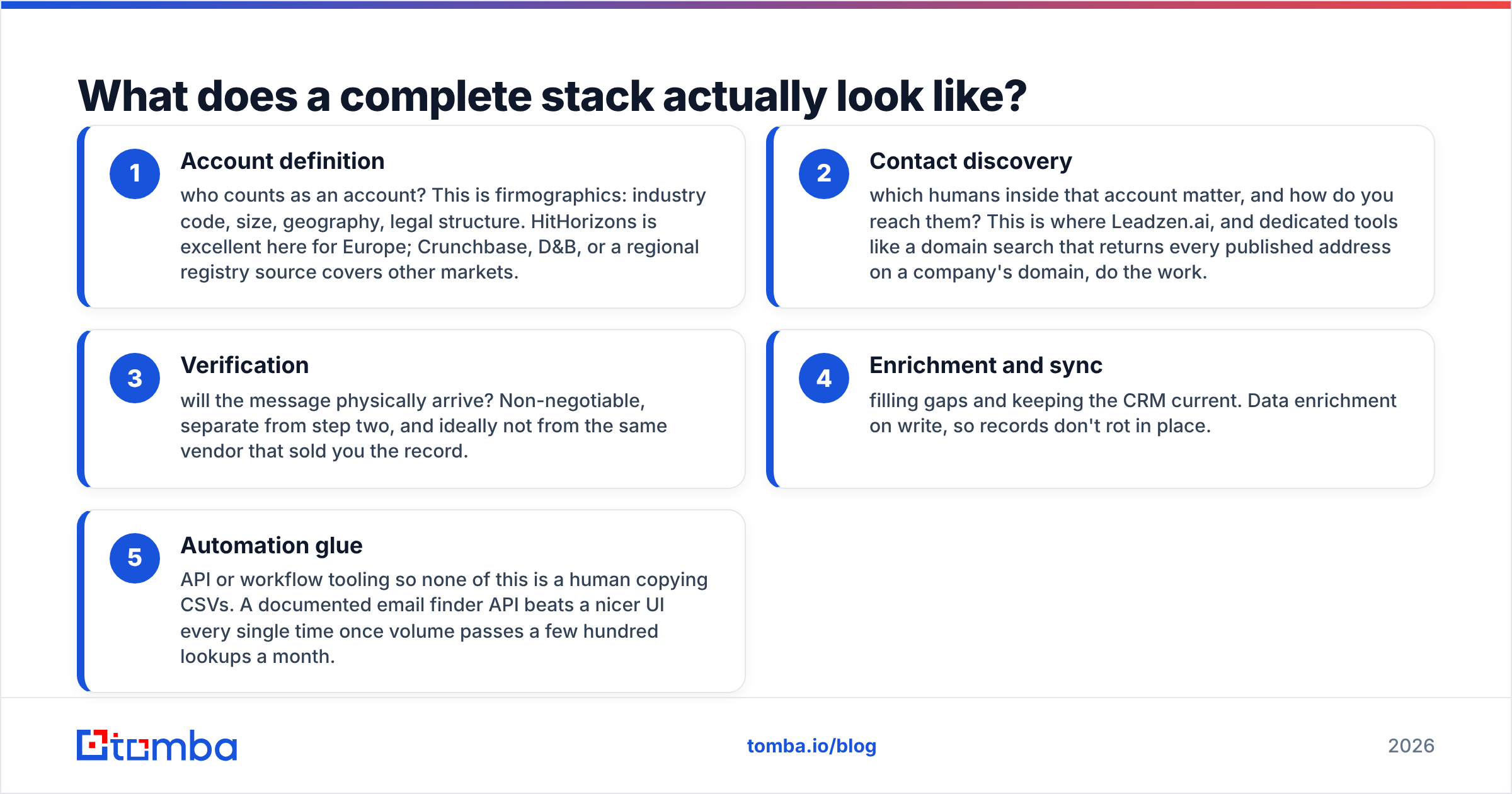
Here's the uncomfortable part. If you buy either tool expecting it to be your whole data layer, you'll be back shopping in two quarters. A working 2026 outbound data stack has five distinct jobs, and most vendors do one or two well.
- Account definition — who counts as an account? This is firmographics: industry code, size, geography, legal structure. HitHorizons is excellent here for Europe. Crunchbase, D&B, or a regional registry source covers other markets.
- Contact discovery — which humans inside that account matter, and how do you reach them? Leadzen.ai works here. So does a dedicated domain search that returns every published address on a company's domain.
- Verification — will the message physically arrive? Non-negotiable, separate from step two, and ideally not from the same vendor that sold you the record.
- Enrichment and sync — filling gaps and keeping the CRM current. Data enrichment on write, so records don't rot in place.
- Automation glue — API or workflow tooling so none of this is a human copying CSVs. A documented email finder API beats a nicer UI once volume passes a few hundred lookups a month.
Teams that map their spend against those five jobs usually discover they're paying twice for step two and nothing for step three. That's the bounce-rate problem in one sentence.
Is HitHorizons better than Leadzen.ai for cold outreach?#
No — and that's not a criticism of HitHorizons, it's a category mismatch.
For cold outreach specifically, ranked by what actually drives replies:
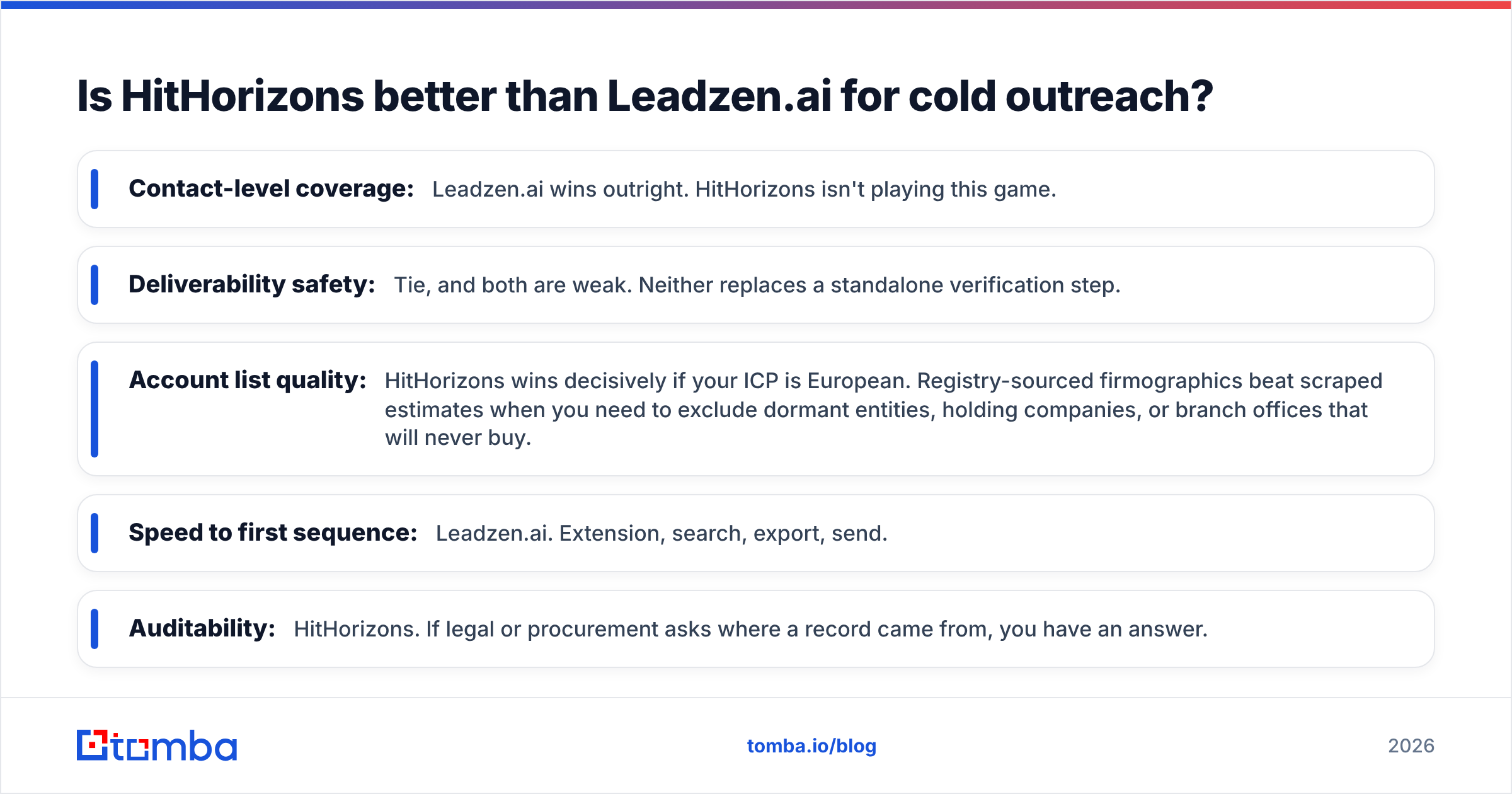
- Contact-level coverage: Leadzen.ai wins outright. HitHorizons isn't playing this game.
- Deliverability safety: Tie, and both are weak. Neither replaces a standalone verification step.
- Account list quality: HitHorizons wins decisively if your ICP is European. Registry-sourced firmographics beat scraped estimates when you need to exclude dormant entities, holding companies, or branch offices.
- Speed to first sequence: Leadzen.ai. Extension, search, export, send.
- Auditability: HitHorizons. If legal or procurement asks where a record came from, you have an answer.
If you're an SDR with a quota this month, Leadzen.ai is the tool that touches your day. If you're the RevOps lead deciding which 4,000 accounts the team may touch, HitHorizons shapes that call more than any prospecting tool will.
Independent review sites are useful sanity checks here. The review distributions on G2 show the same split for both categories. Company-data platforms score high on accuracy and low on ease of prospecting. Contact platforms score the inverse.
What are the honest weaknesses of each?#
HitHorizons weaknesses
- Outside Europe, coverage thins fast. If your market is North America-first, the value proposition mostly evaporates.
- No people data means no direct path from "this account fits" to "here's who to email".
- Registry lag: fast-moving startups look smaller and quieter on paper than they are in reality.
- Pricing opacity makes it hard to budget without a sales conversation.
Leadzen.ai weaknesses
- Coverage outside India and APAC is uneven. Test your specific ICP before committing to an annual plan.
- Contact freshness is the standard aggregated-database problem, and there's limited transparency into record age.
- Verification is bundled and opaque. You can't score confidence per record the way a dedicated verifier lets you.
- Firmographic depth is shallow next to a registry-backed source, so account-level filtering is coarser.
Shared weakness: neither vendor's job ends where your deliverability problem begins. Sender reputation, warmup, SPF/DKIM alignment, and bounce management sit entirely outside both products.
Which should you choose in 2026?#
The HitHorizons vs Leadzen.ai decision comes down to the question you're actually stuck on:
- "I don't know which companies to target in Europe." HitHorizons, plus a contact layer bolted on.
- "I have my account list but no way to reach anyone." Leadzen.ai if your market is India/APAC. A dedicated email finder if it's Europe or North America.
- "My bounce rate is destroying my domain." Neither. You need verification, and you need it as a separate, auditable step.
- "I need one tool and one invoice." Neither fully covers it. A finder-plus-verifier platform gets you closer to end-to-end than a firmographics database can.
- "I'm building this into a product or workflow." Compare API documentation quality first. It predicts your integration cost better than any feature grid.
The pragmatic setup for most mid-market teams: use registry-grade firmographics to define the list once per quarter. Then run contact discovery and verification against it every week. The first layer changes slowly. The second layer decays fast.
Ready to make your account list contactable?#
So you've got your target accounts — from HitHorizons, Leadzen.ai, a CRM export, or a spreadsheet someone built in 2024. The missing piece is turning those companies into verified, deliverable inboxes.
The Tomba Email Finder does exactly that. Give it a domain and a name, or just a domain. You get back professional email addresses with confidence scoring and verification in the same workflow. Start free with 25 searches a month, then move to Starter at $49/mo when it proves out. No per-seat maths. Your account list is only worth what you can actually deliver to.
Related guides#
Ready to find emails that actually work?
Join 150,000+ professionals who stopped guessing and started sending. Free credits on signup — no credit card required.
Get the Tomba newsletter
Practical outbound tactics and product updates — once every two weeks.
About the author