HitHorizons vs Smarte: B2B Data Comparison for 2026
One is a company registry database, the other is a GTM contact platform. Here is how HitHorizons and Smarte differ on coverage, contact-level data, pricing transparency, and what you should pair either with.
TL;DR
HitHorizons vs Smarte is not a like-for-like fight. HitHorizons is a company database built on official business-register filings. Smarte is a go-to-market platform built around accounts, contacts and buying signals.
Pick HitHorizons for legal company data: registered names, IDs, addresses, industry codes and group structure. Europe is its strong suit.
Pick Smarte for prospecting: ICP filters, contact records, tech stack data and CRM enrichment a rep can use today.
Neither one is a strong email layer. Registry data holds no work emails. Any bundled contact list decays 25–30% a year. Verify before you send.
The common stack is company data for targeting, a contact source for people, and a finder such as Tomba for addresses that land.
You are here to settle the HitHorizons vs Smarte question. Most likely you want to know if one can replace the other. The short answer is no. Each tool solves a different half of the same job. The better question is which half you are short on right now.
What is HitHorizons?#
HitHorizons is a company database. It pulls from official business registers, not from web scraping or user uploads. So every record ties back to a filing.
You get the legal name, the registration number, the registered address, the start date, the legal form and the industry code. Where a company files them, you also get turnover or staff bands.
The data leans European. If you sell into DACH, the Nordics, Benelux, CEE or the UK, HitHorizons shows firms that US-first tools miss. Other tools list them under a trade name your CRM does not hold.
That gap costs more than it looks. Say a German firm files as "Muster Handels GmbH". Your CRM says "Muster". Now your dedupe rules break. So do territory splits and compliance checks.
What HitHorizons does not give you is people. No work emails. No job titles. No direct dials. It is an account-layer tool. The official HitHorizons site lists current coverage, which shifts as new registry deals land.
Typical buyers: RevOps teams that map account trees, compliance and KYC staff, market sizing analysts, and outbound teams working European mid-market.
What is Smarte?#
Smarte sits on the other side of the line. It is a B2B data and go-to-market platform for sales and marketing teams. You build an ICP. You filter accounts by size, sector and tech stack. You pull contacts at those accounts. Then you push them to your CRM or sequencer, with intent signals where they exist.
The idea is simple: data a rep can use in the next hour. The unit of value is a contact record, not a filing. Smarte also leans on privacy and data governance. That matters in a market where a lot of contact data has a murky source. Their official site is the best guide to module names, since these platforms rename features often.
Typical buyers: SDR teams, demand gen, and RevOps groups who want one vendor for targeting and contacts.
HitHorizons vs Smarte: how do they compare on what matters?#
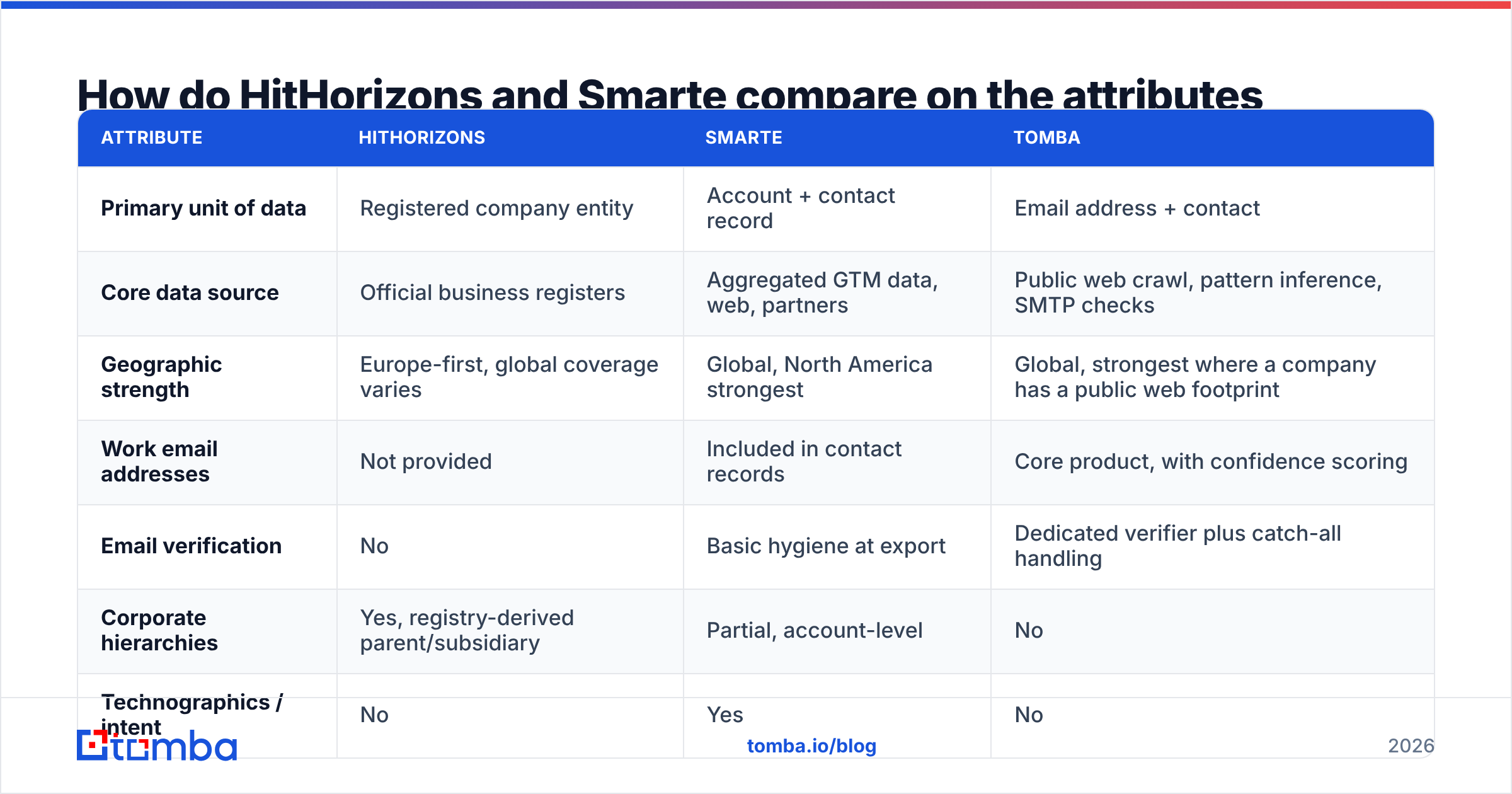
Here is the side-by-side. Tomba sits in a third column because most teams on either platform still need an email layer.
| Attribute | HitHorizons | Smarte | Tomba |
|---|---|---|---|
| Primary unit of data | Registered company entity | Account + contact record | Email address + contact |
| Core data source | Official business registers | Aggregated GTM data, web, partners | Public web crawl, pattern inference, SMTP checks |
| Geographic strength | Europe-first, global coverage varies | Global, North America strongest | Global, strongest where a company has a public web footprint |
| Work email addresses | Not provided | Included in contact records | Core product, with confidence scoring |
| Email verification | No | Basic hygiene at export | Dedicated verifier plus catch-all handling |
| Corporate hierarchies | Yes, registry-derived parent/subsidiary | Partial, account-level | No |
| Technographics / intent | No | Yes | No |
| Public self-serve pricing | Credit packs, limited public detail | Quote-based | Yes: free tier, $49, $99, $249/mo |
| API access | Yes | Yes | Yes, plus CLI, MCP, Sheets, Excel |
| Best for | Entity resolution, compliance, market sizing | ICP building and rep-ready prospecting | Turning a company or name into a deliverable address |
The row that settles most HitHorizons vs Smarte deals is the pricing row. It splits the two camps better than any feature does. Registry and GTM vendors sell by annual contract and quote. That means two to four weeks of buying process before you learn if the data is good. Published Tomba pricing lets you test in an afternoon. Neither model is wrong. They just suit different buyers.
HitHorizons vs Smarte: which one has better data?#
That is the wrong question, and it burns the most time. "Accuracy" means a different thing in each tool.
For HitHorizons, accuracy means the record matches the register. A record is right if it matches the filing. The risk is lag. A firm moves in March, files in June, and the register updates in August. That is a delay, not an error, and it has a ceiling.
For Smarte, accuracy means the person still holds that role, at that firm, with that email. That problem has no ceiling. Every contact database loses about 25 to 30 percent of its accuracy each year, through job moves alone. Gartner and other analysts have priced the fallout. Reps burn hours on stale records. Bad addresses hurt your sender reputation long after the campaign ends.
So judge HitHorizons on filing coverage and freshness in your countries. Judge Smarte on how recent its contacts are, and on how openly it shares record age. Either way, do not treat an export as send-ready. Run it through an email verifier first. Past a 4% bounce rate, inbox providers start to throttle you. Raw bulk exports often sit above that line.
How to test HitHorizons vs Smarte in one week#
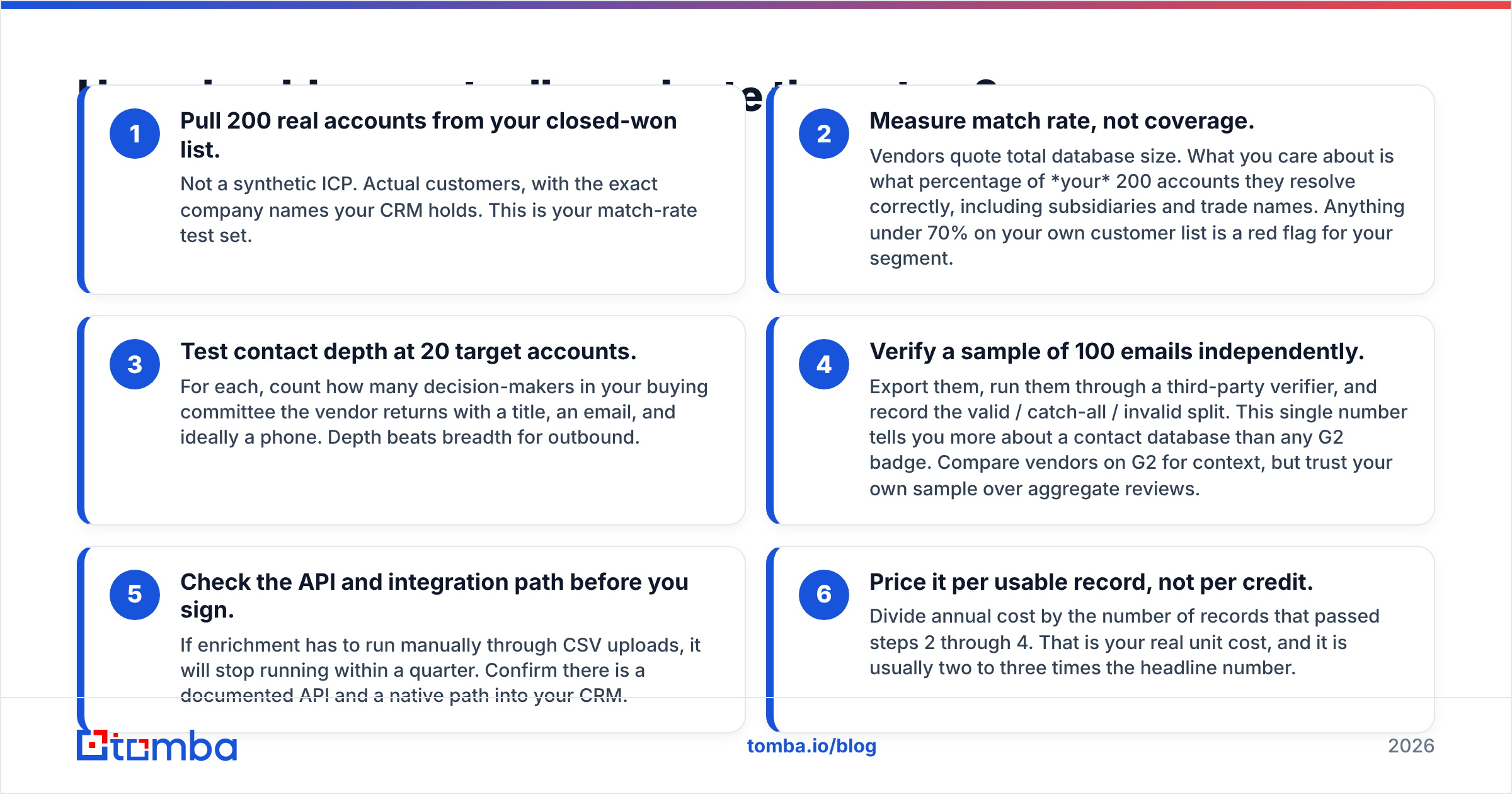
Run this instead of reading feature grids. It takes about a week. It settles the HitHorizons vs Smarte call with evidence, not vendor claims.
Pull 200 closed-won accounts. Not a made-up ICP. Real customers, with the exact names your CRM holds. This is your test set.
Measure match rate, not coverage. Vendors quote database size. You care about how many of your 200 accounts they resolve, subsidiaries and trade names included. Under 70% on your own customers is a red flag.
Test contact depth at 20 accounts. Count how many buying-committee members come back with a title, an email and ideally a phone. Depth beats breadth for outbound.
Verify 100 emails yourself. Export them. Run them through an outside verifier. Record the valid, catch-all and invalid split. That one number tells you more than any badge. Use G2 for context, but trust your own sample first.
Check the API before you sign. If enrichment needs manual CSV uploads, it will stop within a quarter. Ask for a documented API and a native CRM path.
Price it per usable record. Divide the annual cost by the records that passed steps 2 to 4. That is your real unit cost. It is often two to three times the sticker price.
HitHorizons vs Smarte for outbound: which one wins?#
For pure outbound, Smarte fits better. Outbound needs people, and HitHorizons does not supply them. No rep can email a registration number.
The answer flips in one case: European mid-market and enterprise outbound, where entity confusion is the bottleneck. Maybe your team mails the wrong subsidiary. Maybe one group shows up as five accounts. Maybe a deal stalls because the legal name on your quote does not match the register. Then your problem is account data, not contact data. HitHorizons plus a dedicated email finder beats a full GTM suite here, and it costs less.
Notice the pattern behind the HitHorizons vs Smarte choice. Company data and contact data are separate buys. Buying them apart is often cheaper and better. A registry source for firms. A finder for emails. A verifier before you send. A domain search bridges the gap: give it a domain from your account list, and it returns the people and email patterns at that firm. That is the join HitHorizons leaves open.
What about the alternatives on either side?#
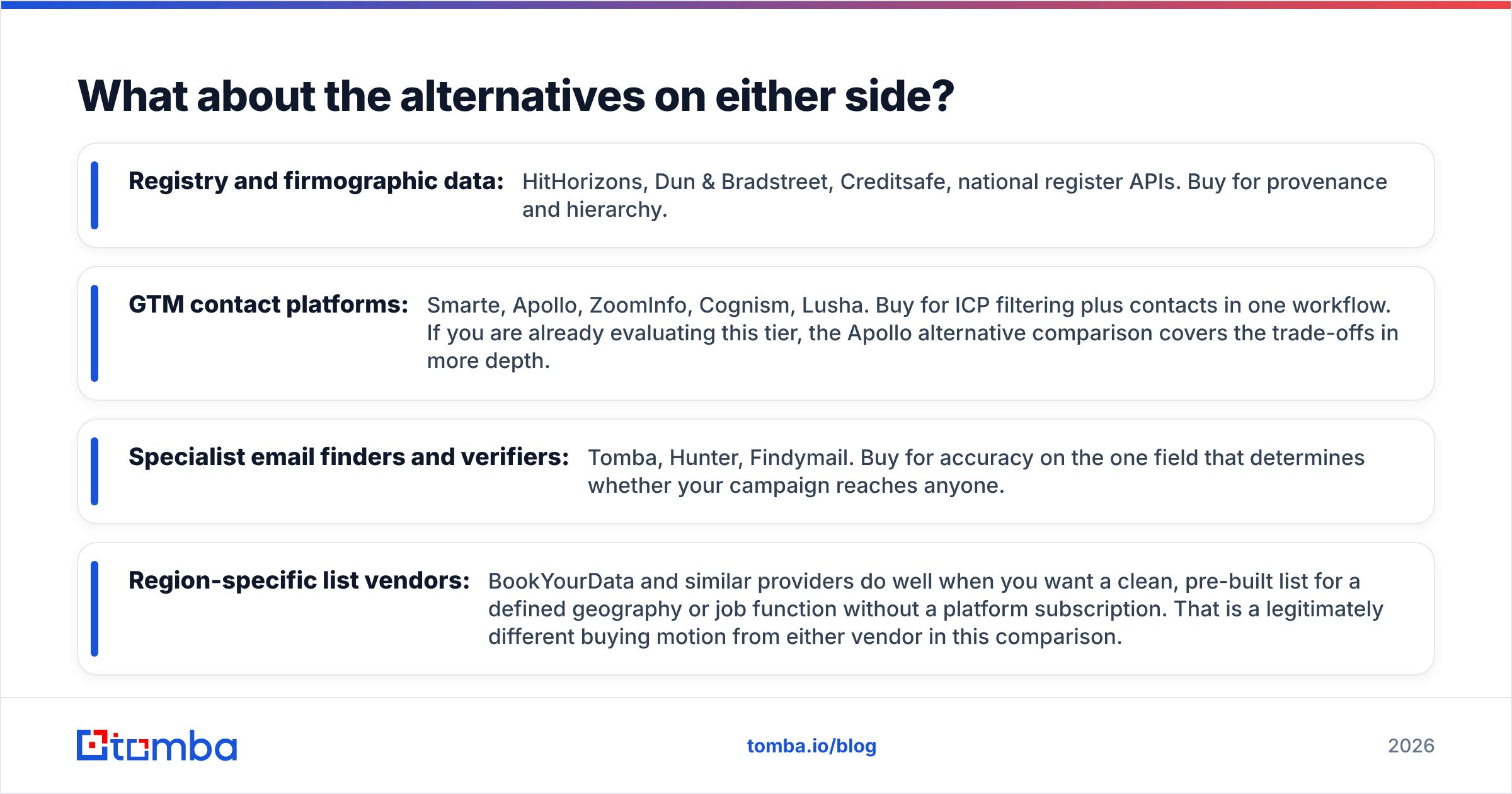
The market splits more cleanly than most category pages admit:
Registry and company data: HitHorizons, Dun & Bradstreet, Creditsafe, national register APIs. Buy these for source quality and group structure.
GTM contact platforms: Smarte, Apollo, ZoomInfo, Cognism, Lusha. Buy these for ICP filters plus contacts in one flow. If you are shopping this tier, the Apollo alternative guide digs into the trade-offs.
Email finders and verifiers: Tomba, Hunter, Findymail. Buy these for accuracy on the one field that decides if your campaign lands.
Region-specific list vendors: BookYourData and its peers work well when you want a clean, pre-built list for one country or job title, with no platform fee. That is a different buying motion.
Most teams over-buy in tier two and under-buy in tier three. They pay platform rates for contacts, send them unverified, then wonder why replies dried up. The fix costs a slice of the licence.
What is the right stack for most teams in 2026?#
Three layers, bought on their own.
Layer one, accounts. Whatever resolves company records in your markets. HitHorizons if you are Europe-heavy and group structure matters. Your CRM plus a light enrichment source if you sell to US SMBs.
Layer two, people. Smarte or a peer, if you want ICP filters and contacts in one place. Skip it if your target list is set and you only need addresses.
Layer three, deliverability. A finder and verifier you control, run on every record before it enters a sequence. This layer is the cheapest of the three, and it is not optional. Pair it with data enrichment to fill the fields your main vendor left blank. Keep a bulk verify step for list refreshes.
Good teams treat layers one and two as yearly calls, and layer three as always-on plumbing. Weak teams buy one big platform, assume it covers all three, and find the gap once their domain is already burned.
Ready to close the gap between account data and deliverable emails?#
However the HitHorizons vs Smarte call goes, you still need addresses that land. The Tomba Email Finder takes a domain, or a name plus a company, and returns verified work emails. You get confidence scores, catch-all checks and a documented API. Start free with 25 searches a month. Or run a real batch on Starter at $49/mo before you sign an annual data contract. Test it against the same 200 accounts you use to judge everything else, and let the match rate decide.
Related guides#
Ready to find emails that actually work?
Join 150,000+ professionals who stopped guessing and started sending. Free credits on signup — no credit card required.
Get the Tomba newsletter
Practical outbound tactics and product updates — once every two weeks.
About the author