9 Best HockeyStack Alternatives in 2026 (Free & Paid)
HockeyStack is strong at B2B attribution, but it is not the only option and not always the right price. Here are nine alternatives compared on cost, data depth, and setup effort.
TL;DR
- HockeyStack is a warehouse-friendly B2B revenue attribution and GTM analytics platform. It is genuinely good, but it is priced and scoped for teams with a real demand-gen budget and someone to own the model.
- The strongest HockeyStack alternatives in 2026 are Dreamdata, Factors.ai, Adobe Marketo Measure, Ruler Analytics, Cometly, Attribution, HubSpot's native attribution reporting, product analytics tools like Amplitude, and a warehouse-native DIY stack.
- Almost every switch is triggered by one of three things: annual contract size, time-to-first-insight, or the tool not matching how your pipeline actually converts.
- Attribution accuracy is capped by contact data quality. If 20% of your CRM records are wrong or unresolvable, no model fixes it.
- Pick by team profile, not by feature count. A 6-person GTM team and a 60-person one should not buy the same tool.
What does HockeyStack actually do?#
HockeyStack sits in the B2B revenue analytics category: it stitches website behavior, ad spend, CRM opportunities, and marketing automation activity into one view so you can answer "which campaigns produced pipeline, not clicks." It leans heavily on account-level attribution rather than lead-level, supports multi-touch models, and markets itself to mid-market and enterprise demand-gen teams. You can see the current positioning on hockeystack.com.
The core promise is not a dashboard. It is a resolved data model that connects an anonymous session on Tuesday to a closed-won deal nine months later. That is hard, which is why the category exists at all, and why the tools in it cost what they cost.
Think of it like a security camera system for your funnel. Google Analytics tells you someone walked into the building. Your CRM tells you a sale happened at the register. Attribution software is the footage that connects the two people and proves they were the same person.
Why do teams look for HockeyStack alternatives?#
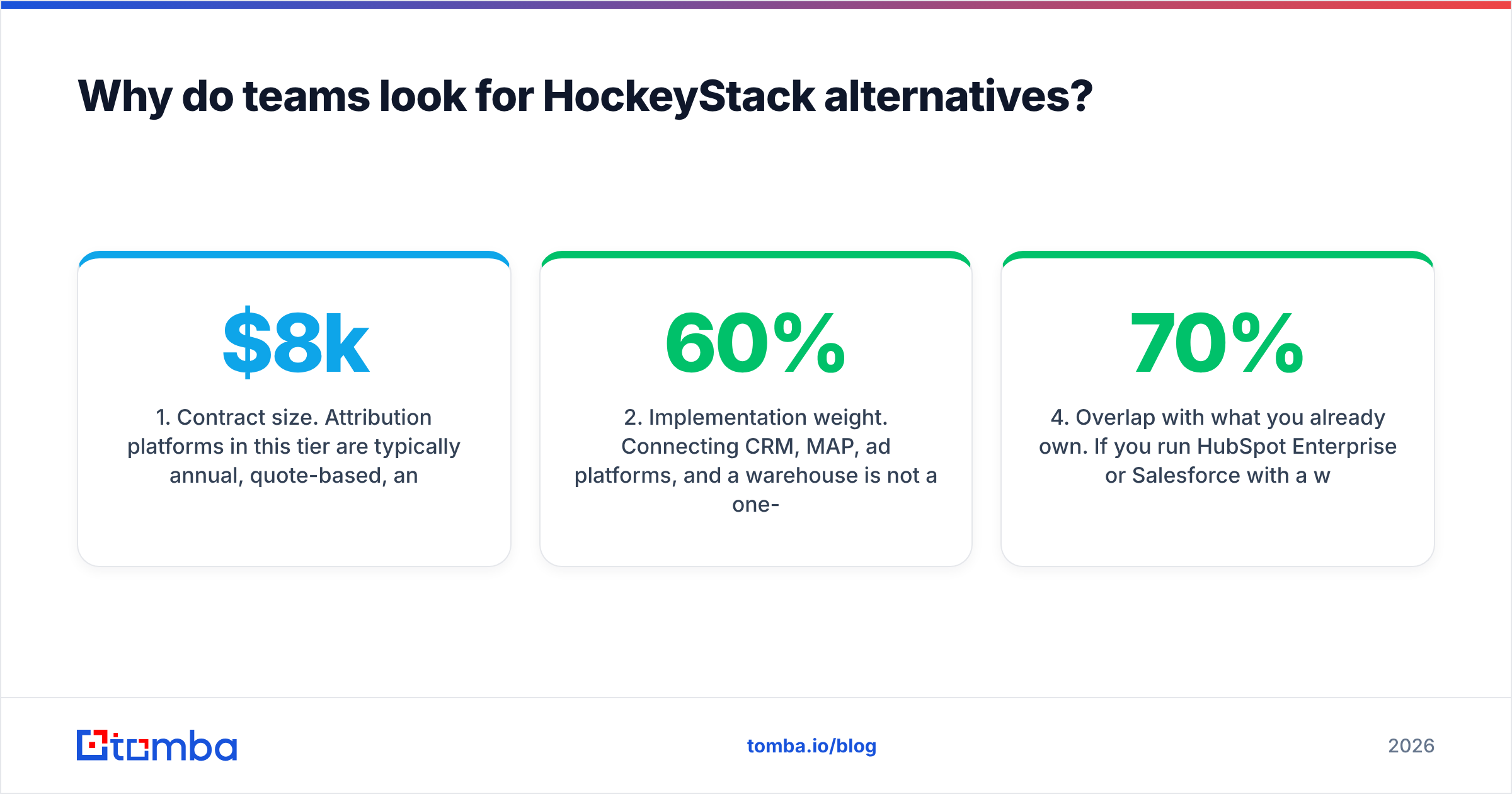
Four recurring reasons show up in G2 reviews and in the conversations we hear from RevOps leads:
- Contract size. Attribution platforms in this tier are typically annual, quote-based, and land in the four-to-five-figure-per-year range. If your paid budget is $8k/month, an attribution tool that costs a meaningful chunk of that is hard to defend to a CFO.
- Implementation weight. Connecting CRM, MAP, ad platforms, and a warehouse is not a one-afternoon job. Teams without a dedicated RevOps owner stall out at 60% configured and never trust the numbers.
- Model mismatch. Self-serve and PLG motions, long enterprise cycles, and channel/partner-led sales all need different attribution logic. A tool tuned for one can look wrong for another.
- Overlap with what you already own. If you run HubSpot Enterprise or Salesforce with a warehouse behind it, you may already be paying for 70% of the functionality.
None of those are indictments of the product. They are just fit problems, and fit problems are what alternatives lists exist to solve.
What should you compare before switching?#
Before you look at a single vendor page, write down where you land on these five dimensions. It will cut your shortlist in half.
- Attribution grain — Do you need account-level roll-up (classic B2B, buying committees, ABM) or contact-level touch tracking (PLG, self-serve, high-volume inbound)? Tools are rarely equally good at both.
- Data destination — Is the tool the source of truth, or does it write back into a warehouse you already run (BigQuery, Snowflake, Databricks)? Warehouse-native buyers should filter hard on this.
- Time to first credible number — Ask every vendor for a realistic implementation timeline in weeks, not the marketing answer. Two weeks versus twelve weeks changes the ROI math entirely.
- Identity resolution quality — How does the tool turn an anonymous visitor into a known account, and what does it do with the 90%+ that stay anonymous? This is where most of the real differentiation lives.
- Total cost including people — A cheaper tool that needs 0.5 FTE of maintenance is not cheaper. Add the salary line before you compare price tags.
Which HockeyStack alternatives are worth shortlisting in 2026?#
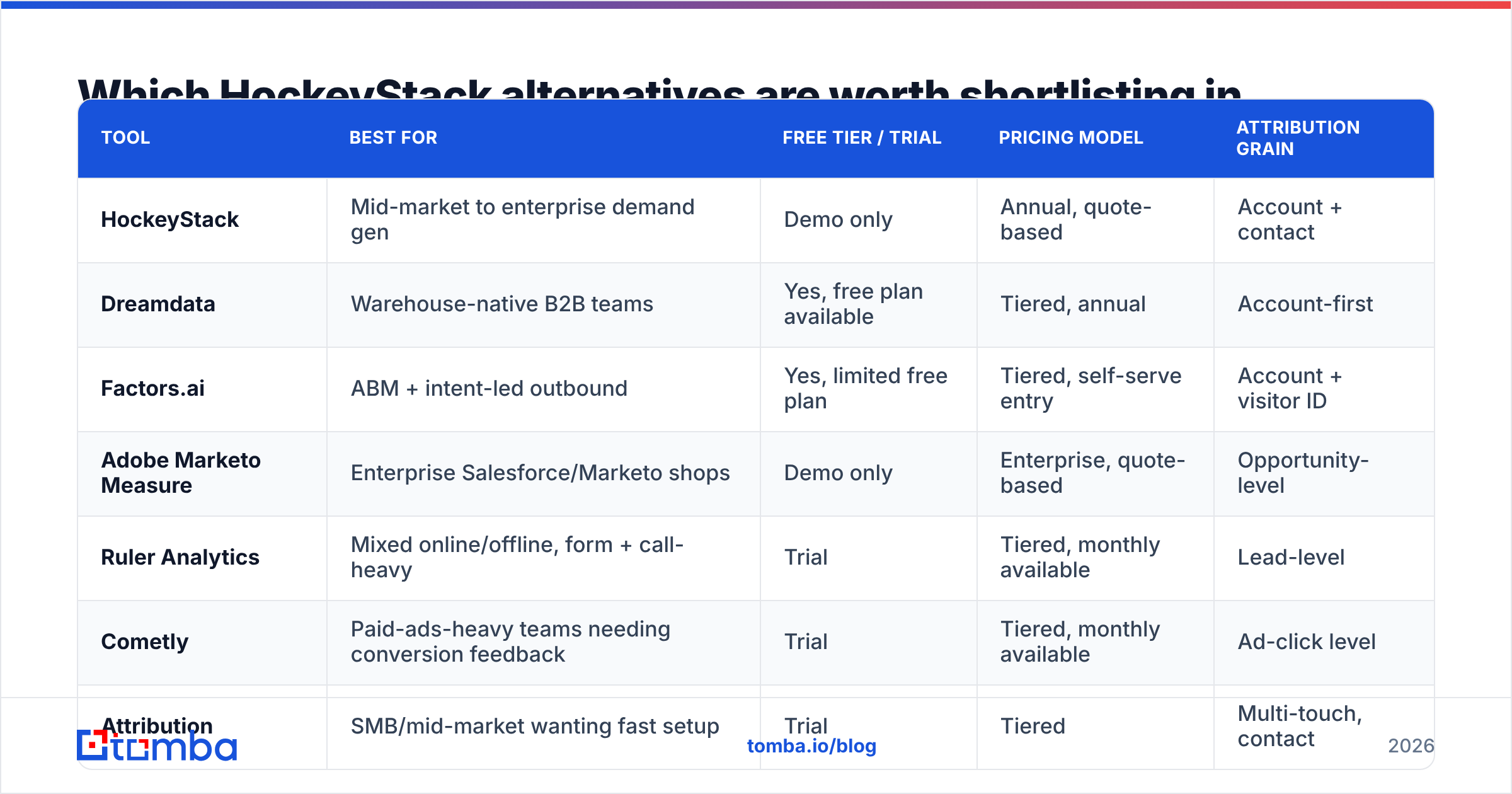
Here is the shortlist, compared on the attributes that actually drive the buying decision. Pricing for this category is overwhelmingly quote-based, so treat published figures as directional and confirm with the vendor.
| Tool | Best for | Free tier / trial | Pricing model | Attribution grain |
|---|---|---|---|---|
| HockeyStack | Mid-market to enterprise demand gen | Demo only | Annual, quote-based | Account + contact |
| Dreamdata | Warehouse-native B2B teams | Yes, free plan available | Tiered, annual | Account-first |
| Factors.ai | ABM + intent-led outbound | Yes, limited free plan | Tiered, self-serve entry | Account + visitor ID |
| Adobe Marketo Measure | Enterprise Salesforce/Marketo shops | Demo only | Enterprise, quote-based | Opportunity-level |
| Ruler Analytics | Mixed online/offline, form + call-heavy | Trial | Tiered, monthly available | Lead-level |
| Cometly | Paid-ads-heavy teams needing conversion feedback | Trial | Tiered, monthly available | Ad-click level |
| Attribution | SMB/mid-market wanting fast setup | Trial | Tiered | Multi-touch, contact |
| HubSpot attribution reporting | Teams already on HubSpot Enterprise | Included in tier | Bundled | Contact + deal |
| Warehouse DIY (GA4 + BigQuery + dbt) | Teams with a data engineer | Free tooling | Infra cost only | Whatever you build |
Is Dreamdata the closest like-for-like swap?#
For most buyers, yes. Dreamdata targets the same B2B account-based attribution problem, publishes a free tier that lets you validate the data model before you commit, and is explicitly warehouse-friendly. Teams that want to own their data in Snowflake or BigQuery and run their own BI on top tend to land here. The trade-off is that the free and low tiers are genuinely limited on data volume and history, so the "try before you buy" path can under-represent what the paid product does.
When is Factors.ai the better call?#
When attribution is only half the job and the other half is outbound activation. Factors.ai blends account identification, intent signals, and attribution reporting, which suits teams running ABM plays where the point of knowing an account visited your pricing page is to have an SDR act on it within the hour. If your reporting exists to trigger outreach rather than to justify budget in a QBR, this is the closer fit.
Should enterprises just use Adobe Marketo Measure?#
If you are a Salesforce plus Marketo shop with a full RevOps function, Adobe Marketo Measure (formerly Bizible) remains the default enterprise answer, largely because it is native to the stack your finance team already reconciles against. It is heavier, slower to implement, and priced accordingly. Nobody buys it because it is elegant. They buy it because it agrees with Salesforce, which ends arguments.
What about the budget end?#
Ruler Analytics, Cometly, and Attribution occupy the tier below the enterprise platforms. They are faster to deploy, offer monthly billing more often, and cover the common case well: multi-channel spend, form fills, and closed-won revenue tied back to source. What you give up is depth of identity resolution and warehouse portability. For a team spending under $20k/month on paid, that trade is usually correct.
Is the DIY warehouse stack a real option?#
It is, and it is underrated for exactly one profile: you already employ a data engineer and already pipe CRM plus ad data into a warehouse. GA4's free BigQuery export, dbt for modeling, and any BI layer gets you a defensible first-touch and last-touch model in a few weeks. Where DIY breaks down is the messy middle — deduplicating accounts, resolving anonymous traffic, and maintaining the model when someone renames a campaign. Check current buyer sentiment on G2's attribution category before assuming you can beat commercial tooling on total cost.
Why does attribution accuracy depend on your contact data?#
Here is the part most alternatives lists skip. Every tool in the table above is a model sitting on top of your data. The model is only as honest as the records feeding it.
Three failure modes account for most "our attribution numbers are wrong" complaints:
- Unresolvable contacts. A form fill with a personal Gmail address cannot be joined to an account domain. That touchpoint silently falls out of your account-level model.
- Stale records. Contacts who changed jobs 14 months ago still sit in your CRM. Their engagement history gets attributed to a company they no longer work at.
- Duplicate accounts. Acme Inc, Acme Incorporated, and acme.com become three accounts, and the pipeline for a single deal is split across all three.
None of that is fixed by switching attribution vendors. It is fixed upstream, at the point where contacts enter the system. That means verified work email addresses instead of free-mail catch-alls, data enrichment on inbound records so every contact carries a resolvable company domain, and firmographic fields consistent enough to dedupe against. Teams that buy list data from sources like BookYourData or build lists in-house both face the same requirement: normalize and verify before the record hits the CRM, not after.
There is also a genuine overlap between attribution tooling and visitor identification. If a large share of your traffic never fills a form, website visitor reveal covers ground that attribution platforms charge a premium for, and it feeds the same account-level picture.
Which HockeyStack alternative fits your team?#
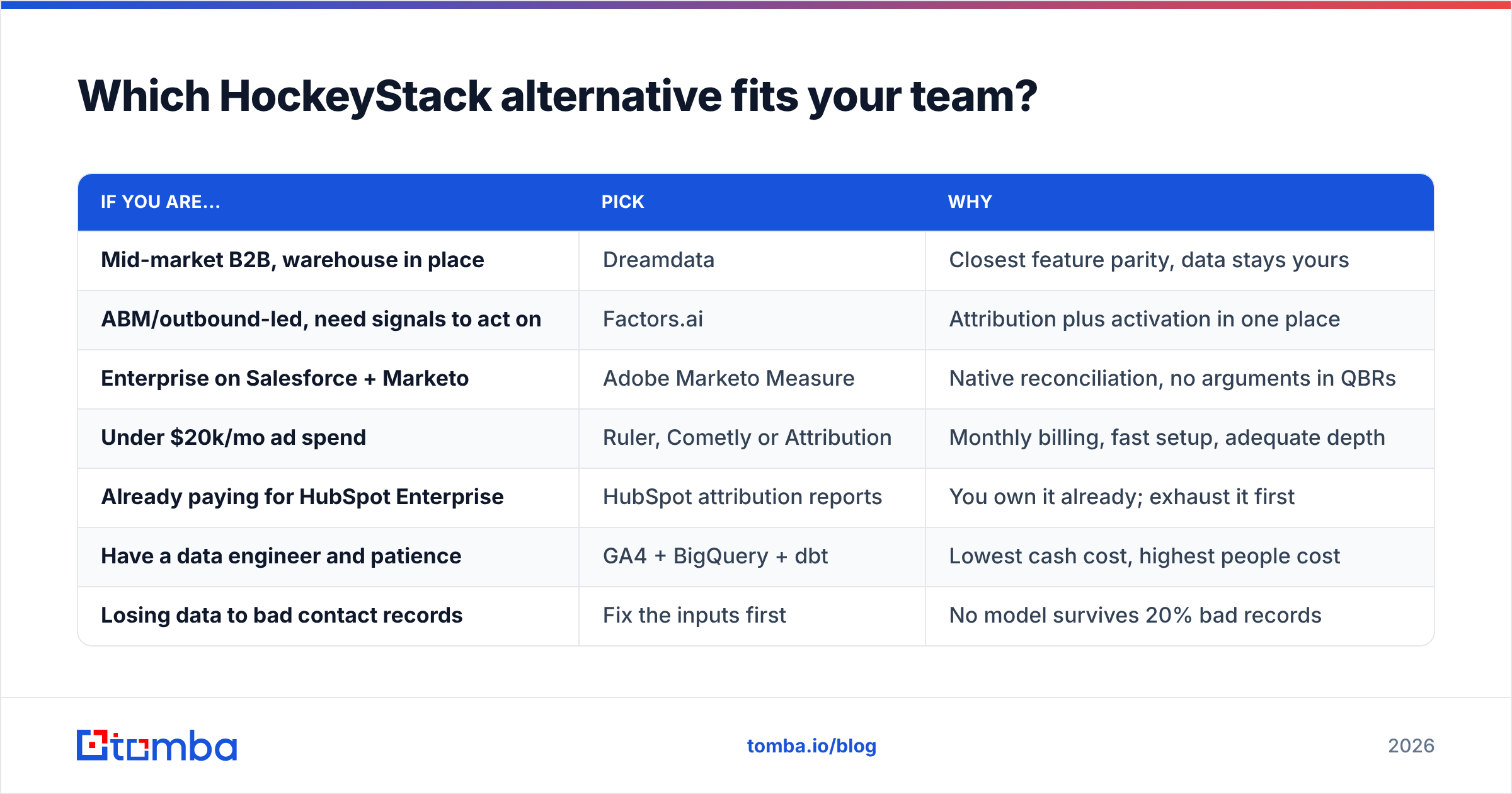
| If you are... | Pick | Why |
|---|---|---|
| Mid-market B2B, warehouse in place | Dreamdata | Closest feature parity, data stays yours |
| ABM/outbound-led, need signals to act on | Factors.ai | Attribution plus activation in one place |
| Enterprise on Salesforce + Marketo | Adobe Marketo Measure | Native reconciliation, no arguments in QBRs |
| Under $20k/mo ad spend | Ruler, Cometly or Attribution | Monthly billing, fast setup, adequate depth |
| Already paying for HubSpot Enterprise | HubSpot attribution reports | You own it already; exhaust it first |
| Have a data engineer and patience | GA4 + BigQuery + dbt | Lowest cash cost, highest people cost |
| Losing data to bad contact records | Fix the inputs first | No model survives 20% bad records |
How should you run the evaluation?#
Give yourself four weeks and treat it like a data project, not a software demo.
- Week one: baseline. Pull last quarter's closed-won deals and hand-attribute 20 of them. This is your answer key. Any tool that disagrees wildly with your manual read is either wrong or teaching you something — you need to know which.
- Week two: data hygiene. Run your CRM contact list through an email verifier and enrich missing company domains. Note the percentage that comes back invalid or unresolvable. That number is your accuracy ceiling.
- Week three: parallel trials. Run two vendors against the same date range. Free tiers from Dreamdata and Factors make this cheap. Compare against your answer key.
- Week four: cost of ownership. Ask each vendor who maintains the model after go-live and what happens when your CRM schema changes. The answer tells you the real price.
If you want to automate step two rather than repeat it every quarter, the Tomba API handles verification and enrichment at the point of record creation, which is where it belongs. Full Tomba pricing starts free at 25 searches per month, then $49/mo for Starter, $99/mo for Growth, and $249/mo for Pro.
What is the honest verdict?#
HockeyStack is not a product people leave because it is bad. They leave because the contract renews at a number that no longer matches their team size, or because they realized the reporting was answering a question they had stopped asking.
If you want the same job done with more data ownership, look at Dreamdata. If you want attribution that feeds outbound rather than reporting, look at Factors.ai. If you are enterprise and Salesforce-native, Adobe Marketo Measure is the safe answer. If you are spending less than $20k a month on paid, the lighter tier will genuinely do the job and you should not overbuy.
And before you sign anything, audit your contact data. The most expensive attribution platform in the world will still tell you confident lies if a fifth of your records point at the wrong company.
Start with the inputs. Use the Tomba Email Finder to attach verified, domain-resolvable work emails to every inbound and outbound contact before it reaches your CRM. Clean identity data is what makes any attribution model — HockeyStack or otherwise — worth reading. The free tier gives you 25 searches a month to test it against your own list.
Related guides#
Ready to find emails that actually work?
Join 150,000+ professionals who stopped guessing and started sending. Free credits on signup — no credit card required.
Get the Tomba newsletter
Practical outbound tactics and product updates — once every two weeks.
About the author