HockeyStack Pricing, Reviews, Pros and Cons (2026 Guide)
HockeyStack doesn't publish a price list, which makes budgeting guesswork. Here's what buyers actually pay in 2026, what reviewers praise, where the platform frustrates teams, and when a leaner attribution stack is the smarter call.
TL;DR
- HockeyStack does not publish pricing. Every deal is quote-based, annual, and negotiated — buyers report entry points in the low four figures per month and mid-market contracts landing roughly in the $18,000–$40,000/year band.
- Reviewers consistently praise the multi-touch attribution model, the Odin AI layer, and the speed of the implementation team. The recurring complaints are cost, contract rigidity, and a steep learning curve for non-analysts.
- The platform earns its keep when you have enough pipeline volume for attribution math to be statistically meaningful — generally $5M+ ARR, a real demand-gen budget, and clean CRM hygiene.
- Below that threshold, you are usually paying premium prices to visualize dirty data. Fix the contact and account data layer first.
- The honest verdict: HockeyStack is a strong product at an enterprise price. Budget for the data quality work it assumes you have already done.
What is HockeyStack, and who is it actually for?#
HockeyStack is a B2B revenue attribution and analytics platform. It stitches together website behavior, ad spend, CRM records, and marketing automation data into a single account-level timeline, then tells you which touchpoints influenced pipeline and closed revenue. Its AI layer, Odin, sits on top of that warehouse and answers plain-language questions like "which channel drove enterprise pipeline last quarter?"
The core promise is straightforward: stop arguing about whether the last-touch demo request or the six months of LinkedIn ads deserve credit, and start measuring marketing attribution at the account level the way B2B buying committees actually behave.
The fit profile is narrower than the marketing suggests. HockeyStack is built for teams that already have:
- Meaningful pipeline volume — attribution modeling on 30 deals a year is noise, not signal. You need enough closed-won and closed-lost data for patterns to stabilize.
- A real paid media budget — the ROI story depends on reallocating spend. If you spend $8k/month across two channels, a spreadsheet answers the same question.
- Clean CRM data — HockeyStack inherits whatever your Salesforce or HubSpot instance contains. Duplicate accounts and missing contact records produce confidently wrong dashboards.
- A dedicated owner — someone in revenue operations who lives in the tool weekly. Set-and-forget deployments quietly rot.
- Executive demand for the data — attribution tools die when nobody upstream asks for the report.
If three or more of those are missing, the pricing conversation below is academic.

How does HockeyStack pricing actually work in 2026?#
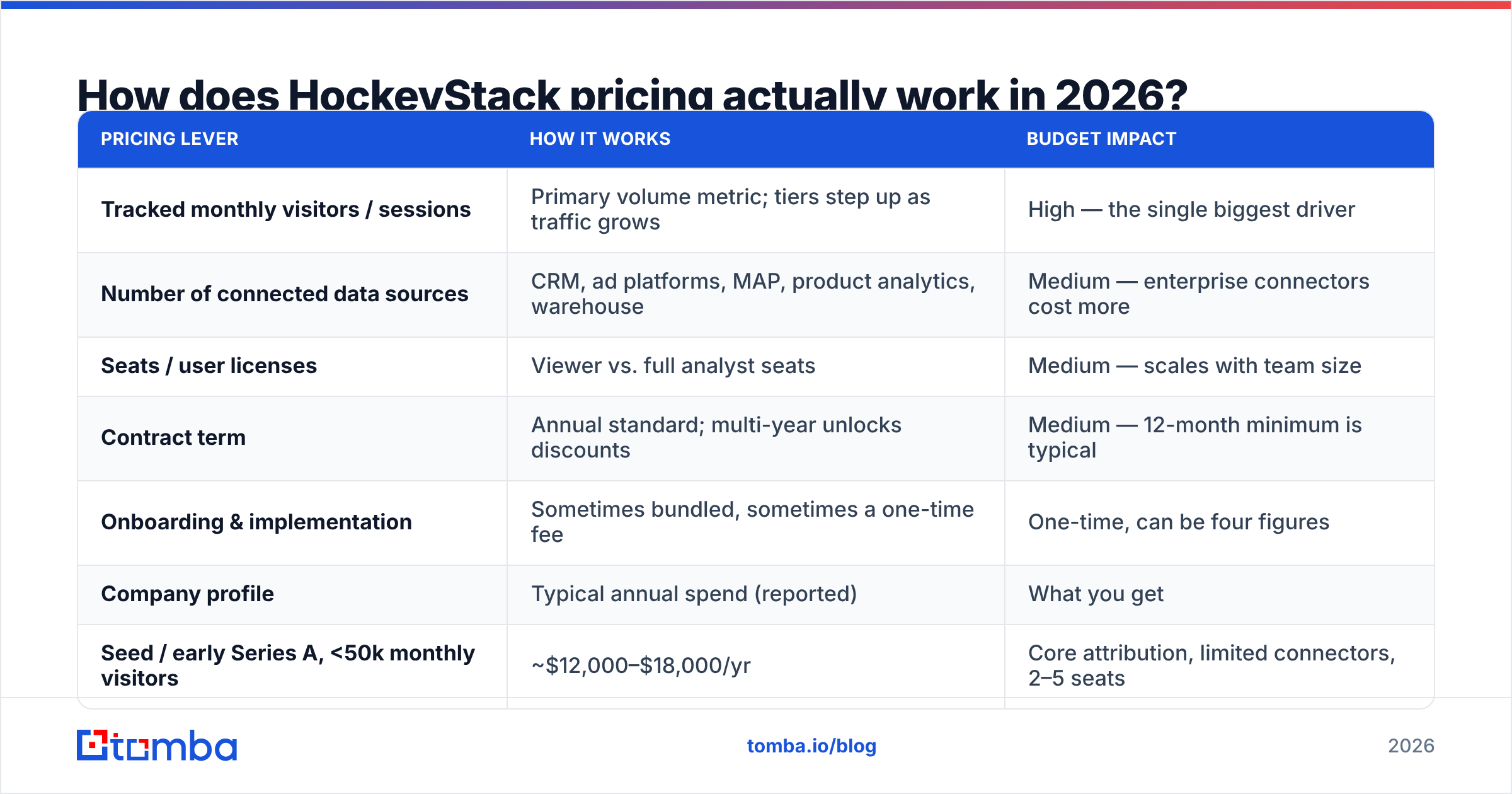
HockeyStack pricing is quote-only. There is no self-serve checkout, no published tier table, and no free plan. You book a demo, they scope your data volume and seat count, and a proposal follows. That is standard for the attribution category — Dreamdata, Factors, and Demandbase all operate the same way — but it makes budgeting genuinely difficult before you have spent 45 minutes on a sales call.
From publicly discussed buyer experiences and G2 reviews, the pricing structure breaks down along four levers:
| Pricing lever | How it works | Budget impact |
|---|---|---|
| Tracked monthly visitors / sessions | Primary volume metric; tiers step up as traffic grows | High — the single biggest driver |
| Number of connected data sources | CRM, ad platforms, MAP, product analytics, warehouse | Medium — enterprise connectors cost more |
| Seats / user licenses | Viewer vs. full analyst seats | Medium — scales with team size |
| Contract term | Annual standard; multi-year unlocks discounts | Medium — 12-month minimum is typical |
| Onboarding & implementation | Sometimes bundled, sometimes a one-time fee | One-time, can be four figures |
Reported cost bands, treated as estimates rather than a price sheet:
| Company profile | Typical annual spend (reported) | What you get |
|---|---|---|
| Seed / early Series A, <50k monthly visitors | ~$12,000–$18,000/yr | Core attribution, limited connectors, 2–5 seats |
| Series B mid-market, 50k–250k visitors | ~$20,000–$40,000/yr | Full multi-touch models, Odin AI, more seats |
| Late-stage / enterprise, 250k+ visitors | $50,000/yr and up | Custom models, warehouse sync, dedicated CSM |
| Multi-brand or agency deployments | Custom | Per-workspace pricing, negotiated |
Two things to verify before you sign. First, ask exactly what happens when you exceed your visitor tier mid-contract — some vendors auto-upgrade, some throttle, some invoice retroactively. Second, ask whether historical data backfill is included; importing two years of CRM history is often where surprise implementation fees appear. Always confirm current numbers directly on the HockeyStack website rather than trusting any third-party figure, including this one.
What do HockeyStack reviews say?#
Review sentiment across G2 and peer communities is genuinely positive — this is not a tool people regret buying because it doesn't work. The complaints cluster around price and complexity, not capability.
What reviewers praise most:
- Account-level attribution that reflects B2B reality. Reviewers repeatedly say it's the first tool that showed them how dark social, review sites, and community influenced deals they had been crediting to branded search.
- Odin, the AI analyst layer. Asking questions in natural language and getting a chart back removes a real bottleneck for teams without a dedicated data analyst.
- Implementation support. The onboarding team gets named in reviews far more often than is typical for this category. Time-to-first-insight is commonly reported in weeks, not quarters.
- Willingness to build. Multiple reviewers mention requested features shipping within a release cycle or two.
What reviewers complain about:
- Price relative to team size. The most frequent criticism. Smaller teams describe the cost as hard to justify against the number of decisions it actually changed.
- Learning curve. Non-analysts find the model configuration and custom report builder intimidating. Adoption often concentrates in one or two power users.
- Annual lock-in. No monthly option means a bad fit is a 12-month bad fit.
- Data quality in, data quality out. Several reviews note that messy CRM records surfaced as confusing attribution paths, and the cleanup work was theirs to do.
That last point is the one to sit with. Attribution platforms are mirrors. If your contact records are half-empty, your account matching will be too.
What are the real pros and cons of HockeyStack?#
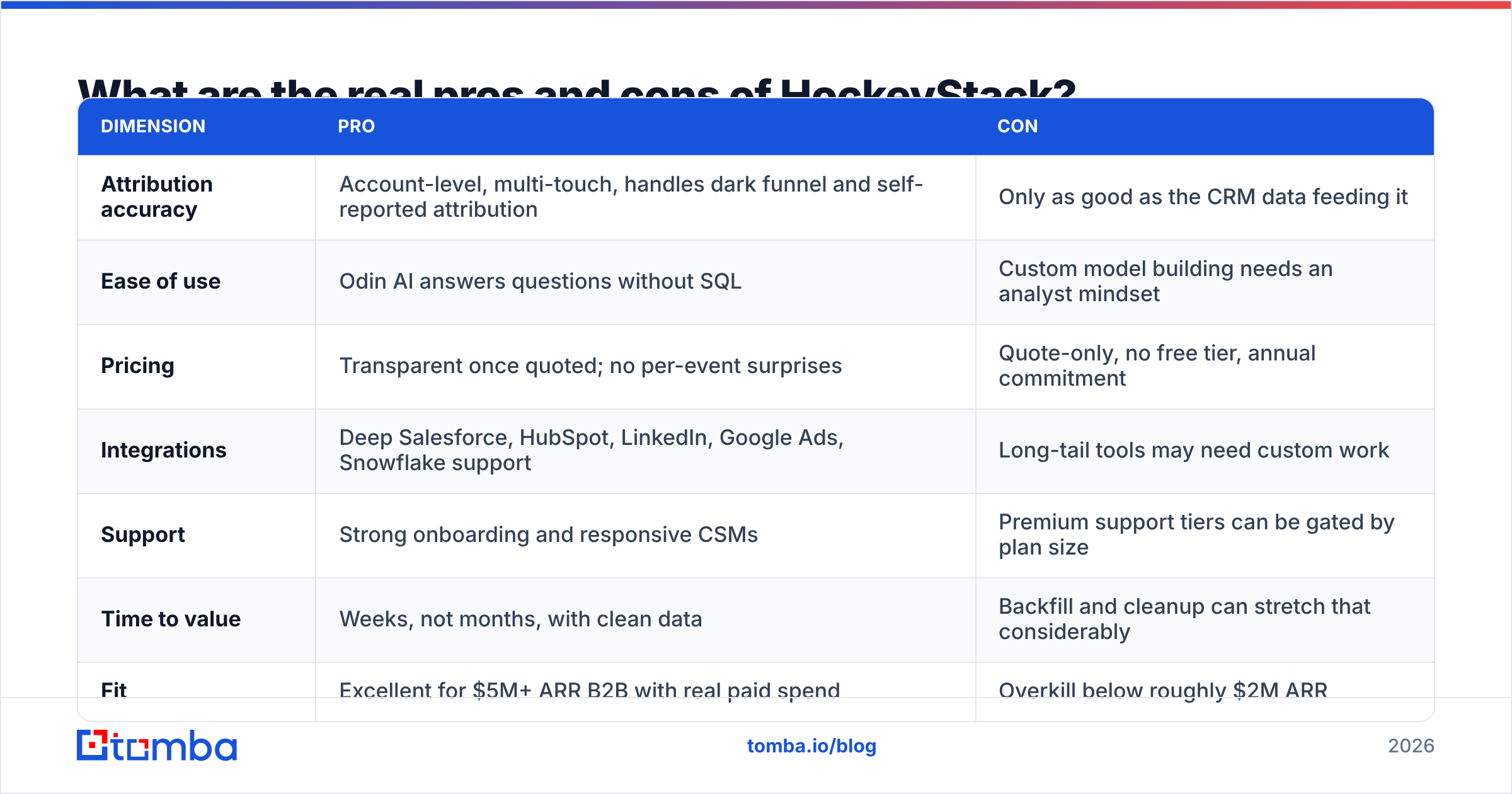
| Dimension | Pro | Con |
|---|---|---|
| Attribution accuracy | Account-level, multi-touch, handles dark funnel and self-reported attribution | Only as good as the CRM data feeding it |
| Ease of use | Odin AI answers questions without SQL | Custom model building needs an analyst mindset |
| Pricing | Transparent once quoted; no per-event surprises | Quote-only, no free tier, annual commitment |
| Integrations | Deep Salesforce, HubSpot, LinkedIn, Google Ads, Snowflake support | Long-tail tools may need custom work |
| Support | Strong onboarding and responsive CSMs | Premium support tiers can be gated by plan size |
| Time to value | Weeks, not months, with clean data | Backfill and cleanup can stretch that considerably |
| Fit | Excellent for $5M+ ARR B2B with real paid spend | Overkill below roughly $2M ARR |
How does HockeyStack compare to the alternatives?#
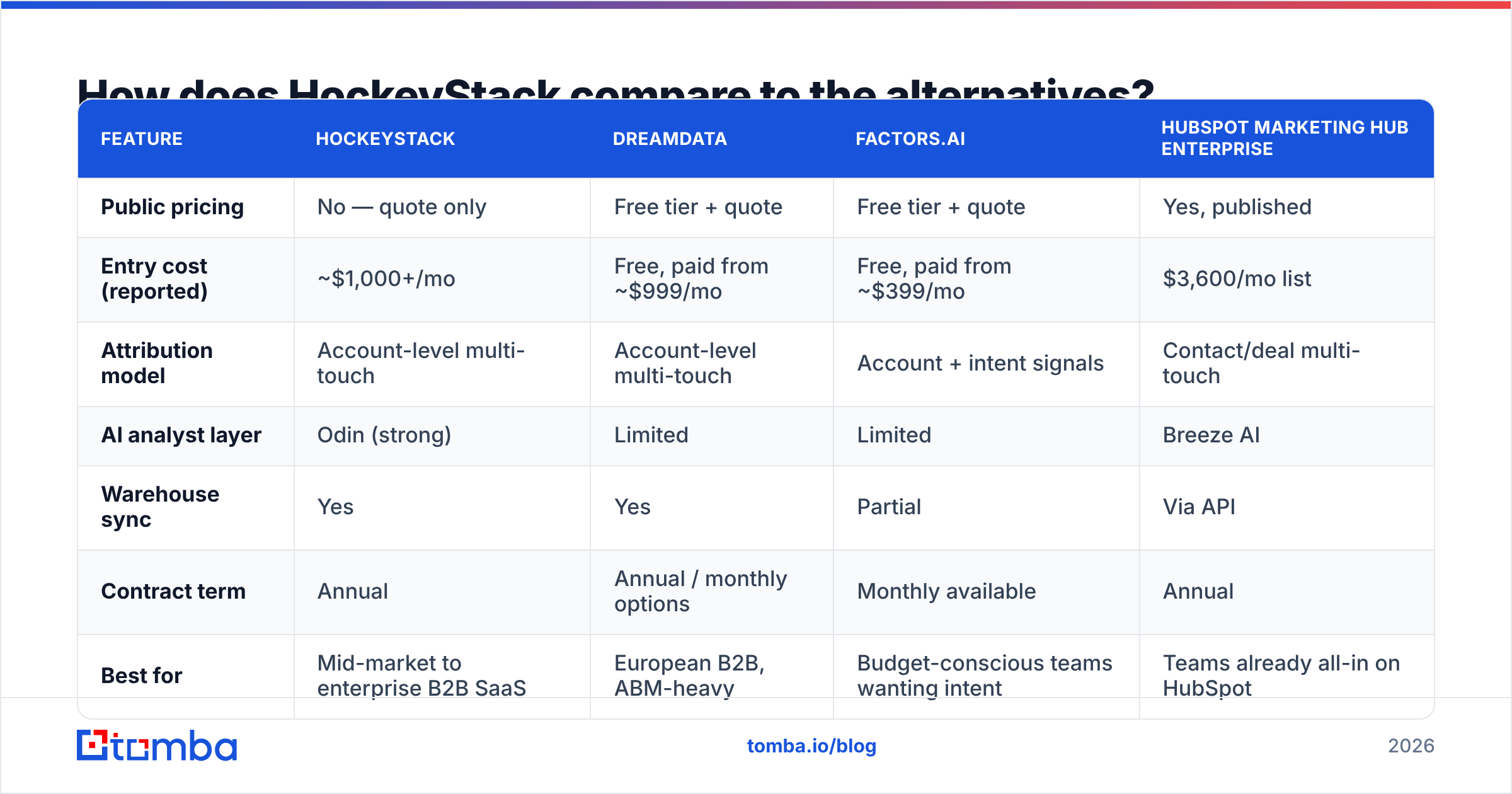
The attribution market has consolidated into a handful of serious options. None of them publish full pricing, which tells you something about the category.
| Feature | HockeyStack | Dreamdata | Factors.ai | HubSpot Marketing Hub Enterprise |
|---|---|---|---|---|
| Public pricing | No — quote only | Free tier + quote | Free tier + quote | Yes, published |
| Entry cost (reported) | ~$1,000+/mo | Free, paid from ~$999/mo | Free, paid from ~$399/mo | $3,600/mo list |
| Attribution model | Account-level multi-touch | Account-level multi-touch | Account + intent signals | Contact/deal multi-touch |
| AI analyst layer | Odin (strong) | Limited | Limited | Breeze AI |
| Warehouse sync | Yes | Yes | Partial | Via API |
| Contract term | Annual | Annual / monthly options | Monthly available | Annual |
| Best for | Mid-market to enterprise B2B SaaS | European B2B, ABM-heavy | Budget-conscious teams wanting intent | Teams already all-in on HubSpot |
If you already run HubSpot's marketing analytics on the Enterprise tier, run its native attribution reports for a quarter before buying a specialist tool. Plenty of teams discover that the incremental insight from a dedicated platform is real but smaller than the invoice.
If budget is the binding constraint, Factors.ai's free tier is the lowest-risk way to see whether attribution reporting changes any decisions at your company. If it doesn't, you have saved $25,000.
Is HockeyStack worth it for your team?#
Here is the test that cuts through the demo enthusiasm: name the specific budget decision you will make differently once you have this data, and estimate what that decision is worth.
If the answer is "we'd reallocate $40k/month of paid spend away from a channel we suspect is underperforming," a $30k/year contract pays for itself in the first reallocation. If the answer is "we'd have better board slides," you are buying reporting theater.
Four scenarios where the spend is clearly justified:
- You spend more than $50k/month on paid acquisition. A 10% efficiency gain covers the contract several times over.
- Your sales cycle exceeds 90 days with 5+ stakeholders. Last-touch attribution is actively lying to you at that complexity.
- You run ABM and need account-level, not lead-level, measurement. This is HockeyStack's home turf.
- Finance is challenging marketing's numbers. A defensible, auditable model ends that argument permanently.
Two scenarios where it isn't:
- Under $2M ARR with a single primary channel. You already know what's working. Spend the money on more of it.
- CRM data below roughly 70% field completeness. You will spend the first six months debugging your own data through an expensive interface.

What should you budget alongside HockeyStack?#
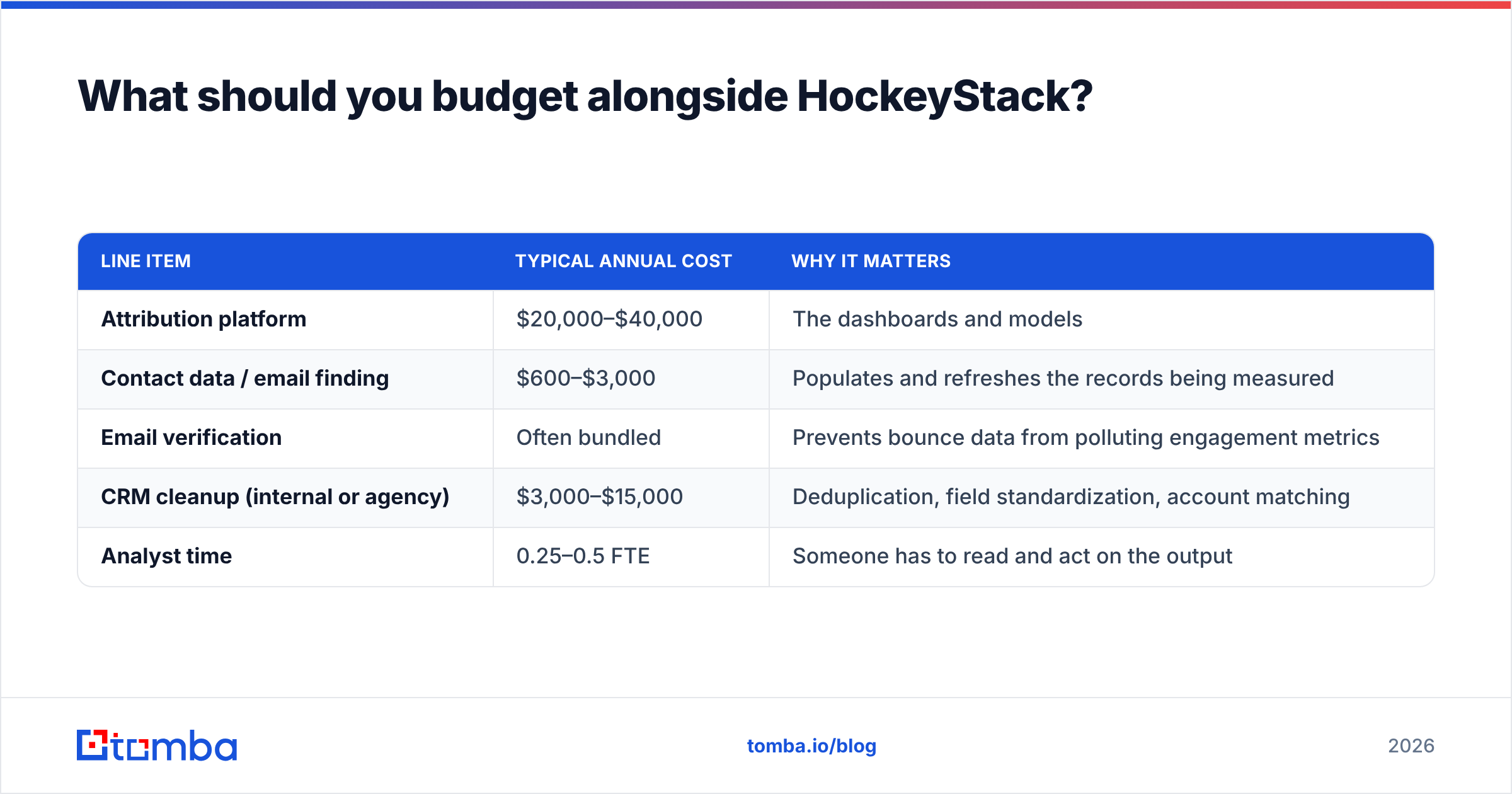
This is the line item most teams forget. Attribution platforms measure the accounts and contacts already in your CRM. They do not create them, verify them, or fill in the gaps.
A realistic annual budget for an attribution program looks like this:
| Line item | Typical annual cost | Why it matters |
|---|---|---|
| Attribution platform | $20,000–$40,000 | The dashboards and models |
| Contact data / email finding | $600–$3,000 | Populates and refreshes the records being measured |
| Email verification | Often bundled | Prevents bounce data from polluting engagement metrics |
| CRM cleanup (internal or agency) | $3,000–$15,000 | Deduplication, field standardization, account matching |
| Analyst time | 0.25–0.5 FTE | Someone has to read and act on the output |
The data layer is the cheapest line on that list and the one with the highest leverage. If your CRM is missing work emails for 30% of the contacts at your target accounts, your attribution model is measuring a partial funnel and reporting it as complete.
Tools like the Tomba Email Finder close that gap for a rounding error relative to attribution spend — Tomba pricing starts free at 25 searches per month, with the Starter plan at $49/mo and Growth at $99/mo. Pairing that with data enrichment to fill firmographic fields means the accounts flowing into HockeyStack are complete before the model touches them.
The sequencing matters more than the tooling choice: clean and complete the data, then measure it. Doing it in the other order is how companies end up with a $30,000 dashboard nobody trusts.
What questions should you ask on the HockeyStack sales call?#
Go in with these written down:
- What visitor tier does your quote assume, and what is the overage policy?
- Is historical data backfill included, and how far back?
- What is the one-time implementation fee, if any?
- Which of my integrations are native versus custom-built?
- What does the renewal uplift typically look like in year two?
- Can I get a 30-day pilot on a subset of data before committing to 12 months?
- What percentage of your customers at my ARR band renew?
That last one is uncomfortable to ask and revealing to hear answered.
The verdict#
HockeyStack is a well-built attribution platform with genuinely strong AI-assisted reporting and an implementation team that reviewers actually like. The price reflects that. It is not overpriced for what it does — it is simply priced for companies with enough pipeline that better measurement changes six-figure decisions.
If that's you, get the quote and negotiate the term. If it isn't yet, use a free-tier alternative to prove the value of attribution reporting internally, and spend the difference on the data quality work that every attribution tool silently assumes you have already finished.
Start with the layer underneath the dashboards. Before you commit to a five-figure attribution contract, make sure the contacts and accounts in your CRM are complete and verified. Tomba's Email Finder finds professional email addresses by domain, name, or company — free for your first 25 searches per month, $49/mo on Starter — so the pipeline you eventually measure is the whole pipeline, not the half you happened to capture.
Related guides#
Ready to find emails that actually work?
Join 150,000+ professionals who stopped guessing and started sending. Free credits on signup — no credit card required.
Get the Tomba newsletter
Practical outbound tactics and product updates — once every two weeks.
About the author