8 Best Hodusoft Alternatives in 2026: Pricing, Features, and Fit
Hodusoft is strong on white-label PBX and reseller economics, but it is not the right fit for every contact center. Here are eight alternatives compared on pricing, deployment, dialer depth, and migration risk.
TL;DR
- Hodusoft's real strength is white-label, self-hosted VoIP infrastructure — HoduPBX and HoduCC are built for ITSPs and resellers who want to own the stack, not for a 12-rep SaaS sales team.
- Most teams shopping for Hodusoft alternatives want one of three things: public pricing, faster onboarding, or native CRM integrations that already exist instead of being built.
- Five9, Genesys Cloud CX, and Talkdesk are the enterprise-grade swaps. Aircall, CloudTalk, JustCall, and Kixie are the fast-to-deploy SMB swaps. 3CX and VICIdial are the self-hosted swaps if cost control is the whole point.
- Twilio Flex is the only genuinely programmable option — cheapest at low concurrency, expensive in engineering hours.
- Switching platforms fixes routing and reporting. It does not fix bad numbers. Connect rate is a data problem before it's a dialer problem.
What is Hodusoft, and who actually uses it?#
Hodusoft is an India-based VoIP software vendor whose product line covers contact center software (HoduCC), multi-tenant IP PBX (HoduPBX), voice and SMS broadcasting (HoduBlast), and conferencing (HoduConf). You can see the full lineup on hodusoft.com.
The defining characteristic is deployment flexibility. Hodusoft sells on-premise, private cloud, and hosted versions, and it sells white-label licenses to internet telephony service providers who resell the platform under their own brand. That is a genuinely different business model from Five9 or Aircall, which sell per-seat SaaS and nothing else.
That model shapes who Hodusoft fits well:
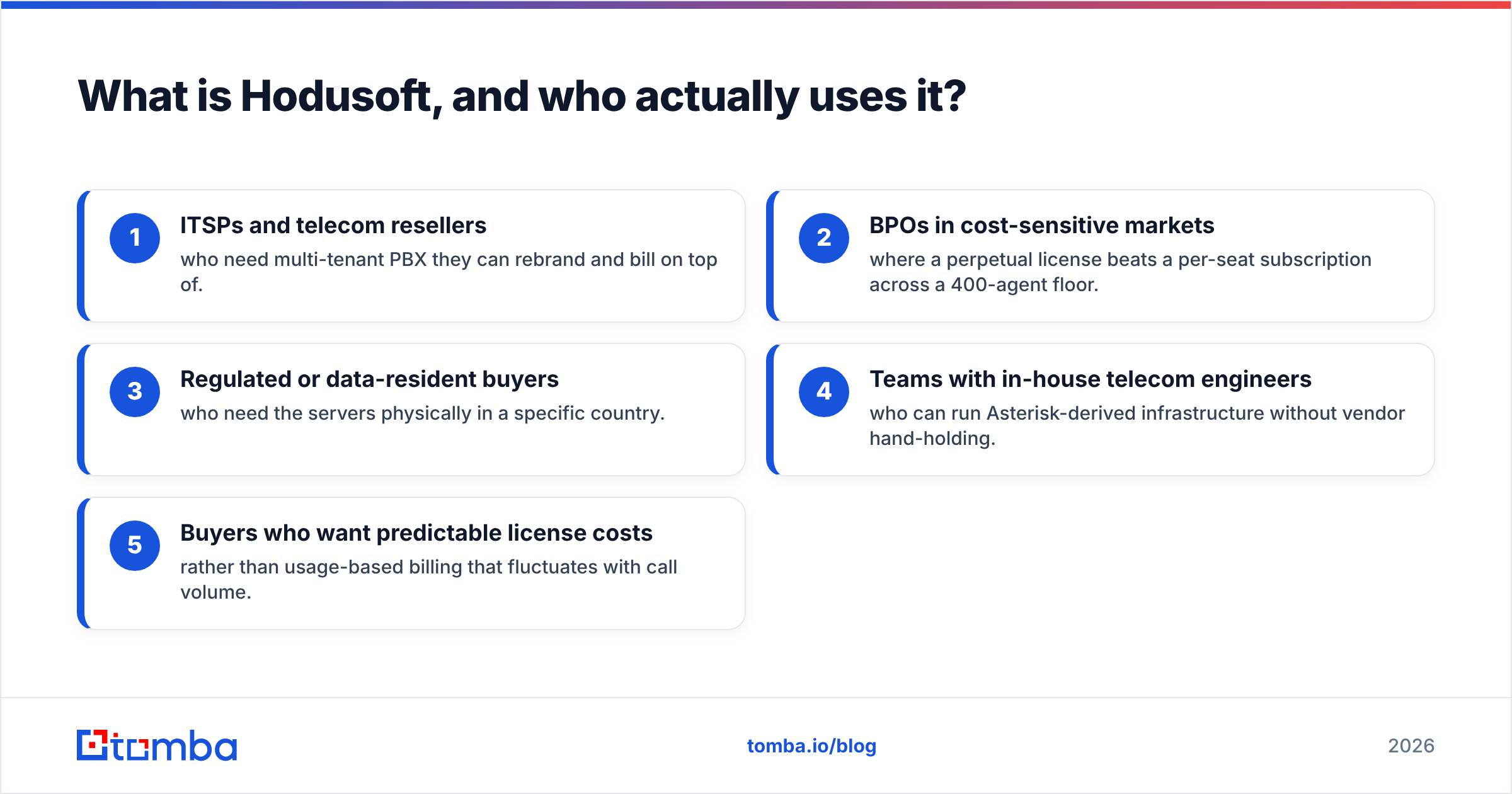
- ITSPs and telecom resellers who need multi-tenant PBX they can rebrand and bill on top of.
- BPOs in cost-sensitive markets where a perpetual license beats a per-seat subscription across a 400-agent floor.
- Regulated or data-resident buyers who need the servers physically in a specific country.
- Teams with in-house telecom engineers who can run Asterisk-derived infrastructure without vendor hand-holding.
- Buyers who want predictable license costs rather than usage-based billing that fluctuates with call volume.
If you are none of those, you are probably the reason this article exists.
Why do teams look for Hodusoft alternatives?#
Four complaints show up consistently in buyer reviews on sites like G2 and in RFP shortlists:
Pricing is quote-only. Hodusoft does not publish per-seat list prices. For a 20-agent team that wants to buy this quarter, a sales-cycle-gated quote is friction. Competitors that publish a number win the evaluation by default.
Implementation is a project, not a signup. Self-hosted and white-label deployments require provisioning, SIP trunk configuration, and testing. That is correct for a telecom operator and painful for a startup that wanted to be dialing on Thursday.
Native integrations are thinner. Salesforce, HubSpot, and Zendesk integrations exist across the market as certified, one-click apps. If your revenue team lives in a CRM and expects click-to-call, auto-logged activities, and screen pops with zero config, a platform with deep marketplace presence is less work.
Support timezone and responsiveness. This is a recurring theme for buyers in North America and Western Europe evaluating vendors headquartered elsewhere. It is not universal, and it is worth testing with a real support ticket during your trial rather than taking anyone's word for it.
None of these make Hodusoft a bad product. They make it a specific product. The question is whether your specificity matches theirs.
Sorry — that renders as:
How do the top Hodusoft alternatives compare?#
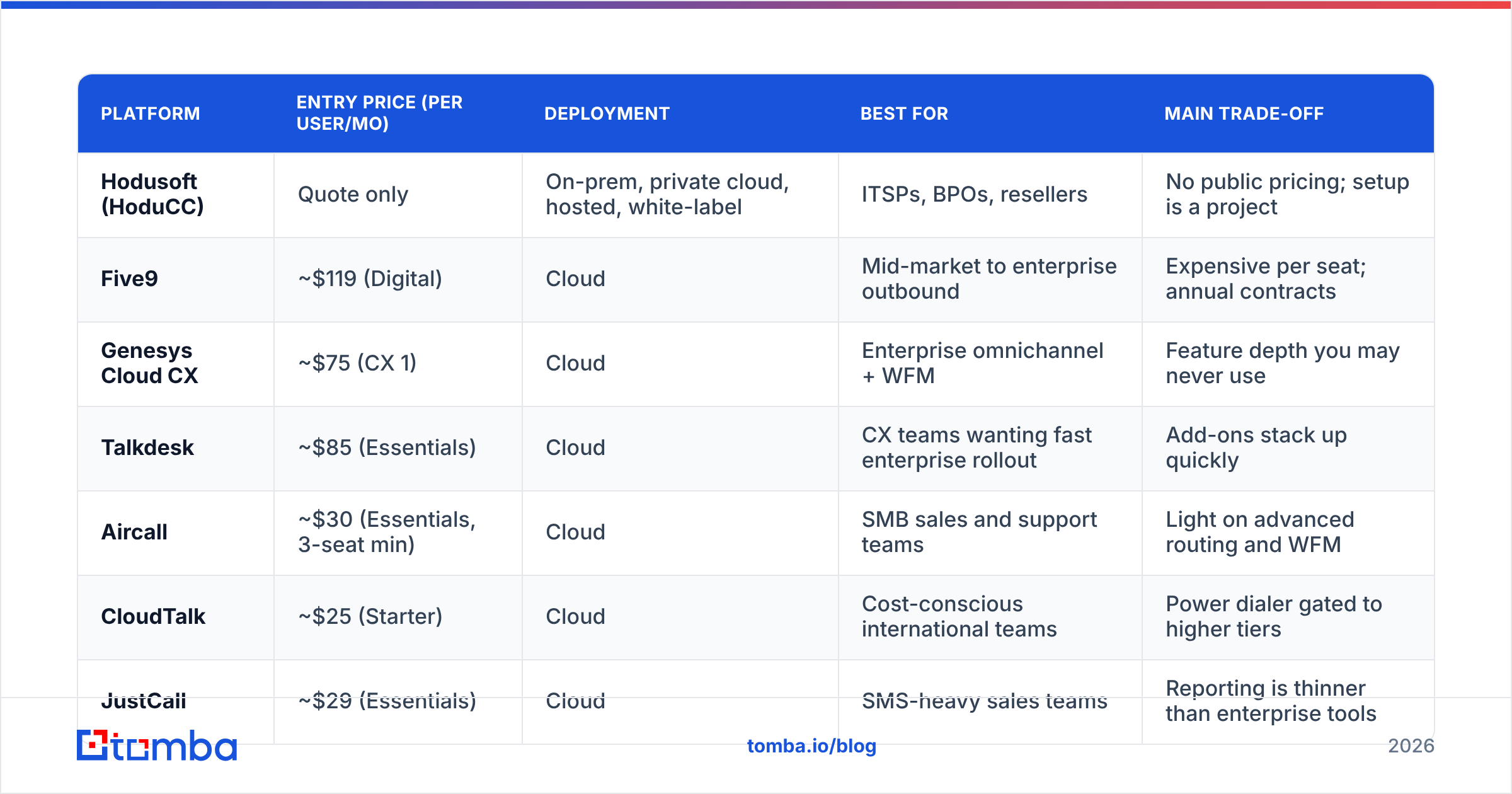
Prices below are published list entry points as of early 2026. Verify on the vendor's own pricing page before you budget — contact center vendors change packaging often, and most enterprise deals close below list.
| Platform | Entry price (per user/mo) | Deployment | Best for | Main trade-off |
|---|---|---|---|---|
| Hodusoft (HoduCC) | Quote only | On-prem, private cloud, hosted, white-label | ITSPs, BPOs, resellers | No public pricing; setup is a project |
| Five9 | ~$119 (Digital) | Cloud | Mid-market to enterprise outbound | Expensive per seat; annual contracts |
| Genesys Cloud CX | ~$75 (CX 1) | Cloud | Enterprise omnichannel + WFM | Feature depth you may never use |
| Talkdesk | ~$85 (Essentials) | Cloud | CX teams wanting fast enterprise rollout | Add-ons stack up quickly |
| Aircall | ~$30 (Essentials, 3-seat min) | Cloud | SMB sales and support teams | Light on advanced routing and WFM |
| CloudTalk | ~$25 (Starter) | Cloud | Cost-conscious international teams | Power dialer gated to higher tiers |
| JustCall | ~$29 (Essentials) | Cloud | SMS-heavy sales teams | Reporting is thinner than enterprise tools |
| 3CX | From free / low annual system license | Self-hosted or 3CX-hosted | PBX replacement on a budget | Contact center features are basic |
| VICIdial | $0 (open source) | Self-hosted | High-volume outbound with in-house ops | You are the support team |
| Twilio Flex | Usage-based (per active-user hour) or ~$150 flat | Cloud, fully programmable | Teams with engineers | You build the UI you wanted to buy |
Which enterprise platforms replace HoduCC directly?#
Five9 is the most common upgrade path for outbound-heavy floors. Predictive, progressive, and preview dialing are mature, compliance tooling around TCPA is real, and the Salesforce integration is one of the deepest in the category. You pay for it: entry packages sit around $119/user/month and full omnichannel tiers run higher, usually on annual commitments.
Genesys Cloud CX is the choice when you need workforce management, quality monitoring, and omnichannel routing in one contract rather than three. CX 1 starts around $75/user/month. The risk is scope — teams buy CX 3 for the WFM and then use 40% of the platform.
Talkdesk sits between the two on price and ahead of both on speed of deployment. Essentials runs around $85/user/month. Watch the add-on line items: Copilot, WEM, and industry clouds are separate SKUs, and the quote you sign rarely matches the price on the page.
Which lightweight platforms fit a 5–50 seat team?#
Aircall is the easiest to live with. Around $30/user/month at Essentials with a three-seat minimum, it does click-to-call, IVR, shared inboxes for numbers, and clean CRM logging without a services engagement. It is not a replacement for a predictive dialer floor.
CloudTalk competes on price and international number coverage — Starter is roughly $25/user/month. The catch is that the power dialer and smart routing features you probably came for live in higher tiers, so model the real cost at the tier you'd actually buy.
JustCall wins when SMS is half of your outbound motion. Around $29/user/month at entry, with sales dialer and messaging in the same workspace. Reporting is serviceable but shallower than Five9 or Genesys.
Kixie is the tightest fit for HubSpot- and Pipedrive-native sales teams that want local presence dialing and automatic logging without touching a phone system admin panel.
What about self-hosted and open-source options?#
If Hodusoft appealed to you because it was self-hosted, do not switch to a per-seat SaaS tool and then complain about the bill.
3CX is the pragmatic middle. You can run it on your own VPS or let 3CX host it, license by system rather than by seat, and keep costs flat as headcount grows. Contact center features — queues, call recording, basic reporting — are adequate, not deep. See 3cx.com for current packaging.
VICIdial is free, battle-tested at high outbound volume, and completely unforgiving. It is the right answer if you have a Linux admin who already knows Asterisk and a floor big enough that license savings pay for that admin twice over. It is the wrong answer for everyone else.
Asterisk or FreeSWITCH direct is a build, not a buy. Only sensible if telephony is your product.
Does the platform actually fix your connect rate?#
Here is the part most vendor comparisons skip: the dialer is downstream of the list.
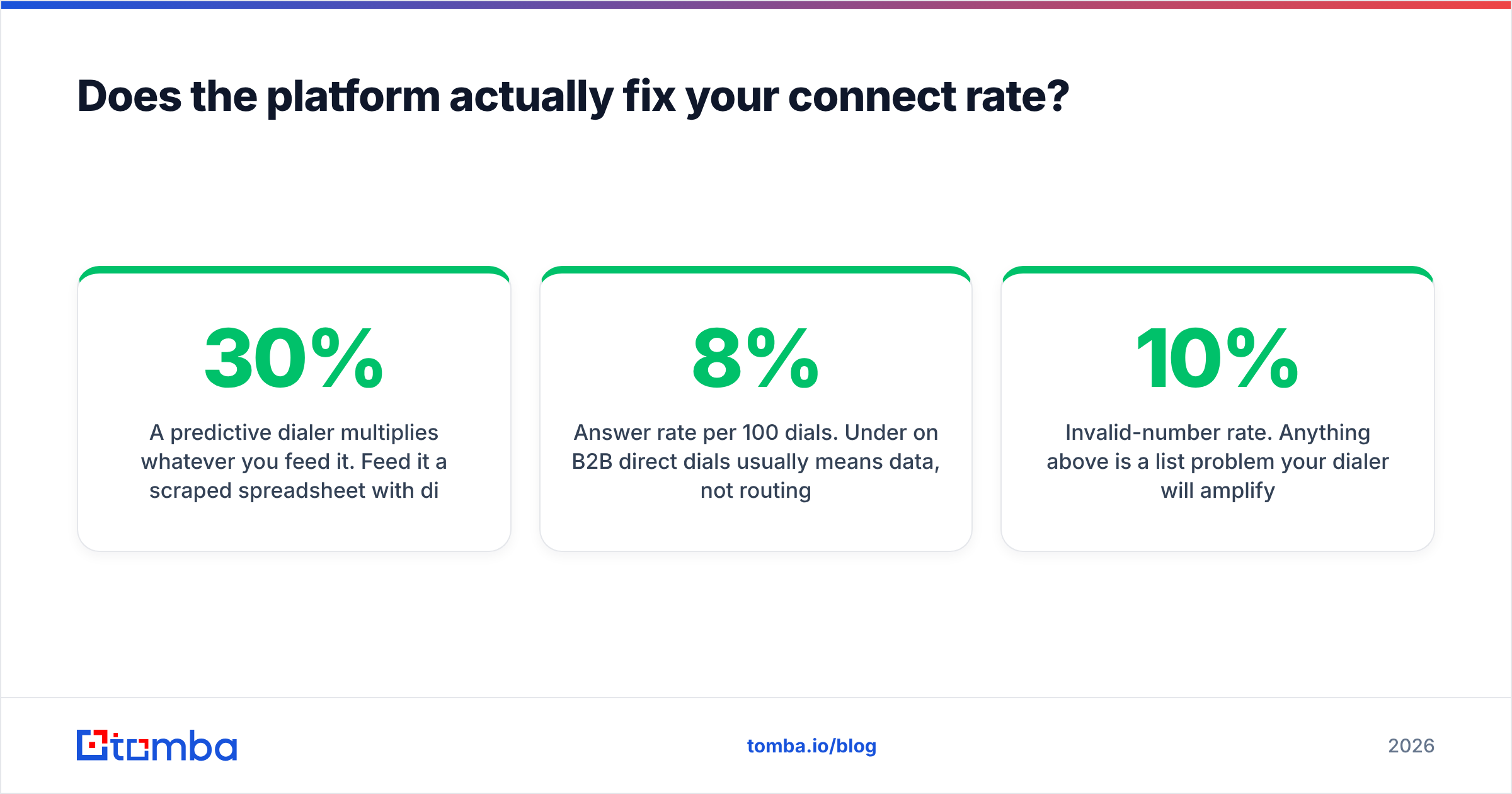
A predictive dialer multiplies whatever you feed it. Feed it a scraped spreadsheet with 30% disconnected numbers and you have bought an expensive way to hear tri-tone intercepts faster. Teams routinely blame the platform for a connect rate that was set by data quality three steps earlier.
Rendered:

Before you sign a new contact center contract, audit three numbers:
- Answer rate per 100 dials. Under 8% on B2B direct dials usually means data, not routing.
- Invalid-number rate. Anything above 10% is a list problem your dialer will amplify.
- Right-party contact rate. Reaching a switchboard is not reaching a buyer.
That's where the enrichment layer sits, independent of which platform you pick. Tomba's phone finder surfaces B2B phone numbers tied to a verified work identity, the phone validator screens out dead and unroutable lines before they hit the queue, and data enrichment fills in the title, company, and email so reps know who they're calling before the connect. If you'd rather push clean records into whichever platform you choose, the Tomba API handles the pipe.
Vendors like BookYourData occupy a similar and respected niche on the prebuilt-list side — if you want a purchased, verified B2B dataset rather than on-demand lookup, it is a legitimate route worth pricing alongside enrichment.
How do you migrate without breaking your dialer?#
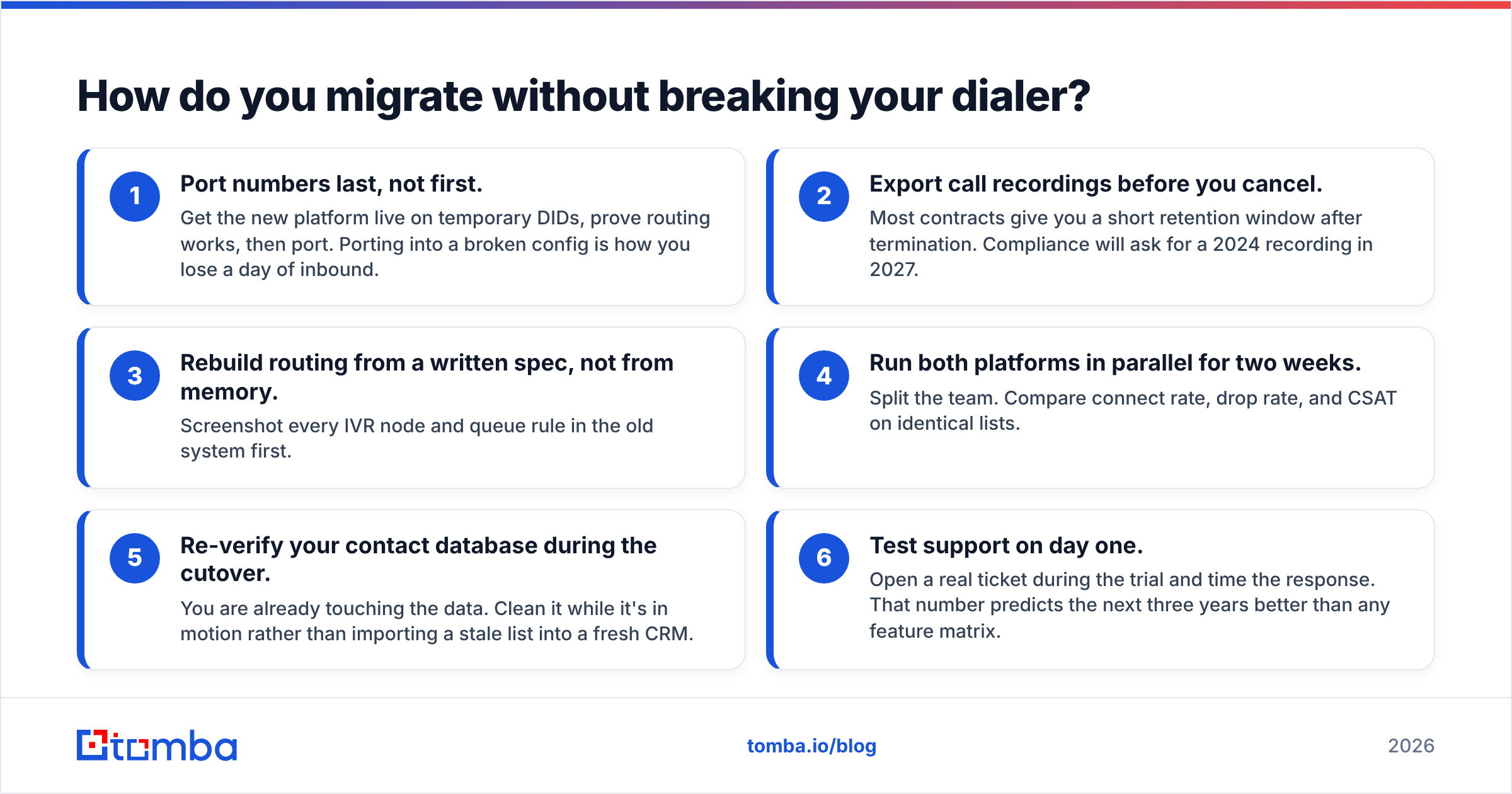
Migrations fail in predictable places. Run this sequence:
- Port numbers last, not first. Get the new platform live on temporary DIDs, prove routing works, then port. Porting into a broken config is how you lose a day of inbound.
- Export call recordings before you cancel. Most contracts give you a short retention window after termination. Compliance will ask for a 2024 recording in 2027.
- Rebuild routing from a written spec, not from memory. Screenshot every IVR node and queue rule in the old system first.
- Run both platforms in parallel for two weeks. Split the team. Compare connect rate, drop rate, and CSAT on identical lists.
- Re-verify your contact database during the cutover. You are already touching the data. Clean it while it's in motion rather than importing a stale list into a fresh CRM.
- Test support on day one. Open a real ticket during the trial and time the response. That number predicts the next three years better than any feature matrix.
Which Hodusoft alternative should you pick?#
Match the tool to the constraint that actually binds you:
- You need public pricing and a fast rollout, under 50 seats: Aircall or CloudTalk.
- SMS is half your outbound motion: JustCall or Kixie.
- High-volume outbound with compliance exposure: Five9.
- Omnichannel plus workforce management under one contract: Genesys Cloud CX or Talkdesk.
- You liked Hodusoft's self-hosting and want to keep it: 3CX for simplicity, VICIdial for raw volume economics.
- You have engineers and unusual requirements: Twilio Flex.
- You are a reseller or ITSP needing white-label multi-tenancy: honestly, stay on Hodusoft. Very few competitors serve that model as directly.
That last line matters. The most useful outcome of a comparison exercise is sometimes discovering your incumbent was correctly chosen and the actual problem lives elsewhere — in the list, the script, or the follow-up cadence.
What should you do next?#
Shortlist two platforms, not five. Run both against the same 500 records for two weeks and compare right-party contact rate — the only metric that survives contact with a CFO.
Then fix the input. Before your reps dial anything on the new system, run the list through Tomba's phone finder to pull verified B2B direct numbers, and pair it with the email finder so every no-answer has a same-day follow-up channel instead of a redial. Tomba's free tier gives you 25 searches a month to test the match rate on your own accounts, with paid plans starting at $49/month — full Tomba pricing is public, which is more than most contact center vendors will say for themselves.
Related guides#
Ready to find emails that actually work?
Join 150,000+ professionals who stopped guessing and started sending. Free credits on signup — no credit card required.
Get the Tomba newsletter
Practical outbound tactics and product updates — once every two weeks.
About the author