Hodusoft Pricing, Reviews, Pros and Cons: A 2026 Buyer's Guide
Hodusoft doesn't publish a price list, which makes budgeting hard. Here's how its quote-based pricing actually works in 2026, what buyers praise, where the hidden costs sit, and who should look elsewhere.
TL;DR
- Hodusoft pricing is not public. Every number comes from a sales call, so two firms can buy the same product and pay very different prices.
- The core products are HoduCC (contact center and dialer), HoduPBX (multi-tenant IP PBX), HoduBlast (voice and SMS broadcasting) and HoduConf (conferencing).
- What you pay depends on seat count, how you deploy, and whether you buy a license outright or pay monthly.
Here is what buyers report once they are live:
- Reviewers praise the features you get per dollar. They also like the white-label options for resellers, and fast support.
- The common gripes: setup takes work, the UI looks dated next to US rivals, and you need telecom know-how in house.
- The big budget risk is not the license. It is setup, carrier fees, custom work, and the dial time you waste on bad contact data.
- Buy it if you are an ITSP, a BPO, or a cost-sensitive team that wants control. Skip it if you want self-serve signup and a plug-and-play SaaS app.
What is Hodusoft, and what are you actually buying?#
Hodusoft is a VoIP software vendor. It builds communication systems, not a small sales tool. That matters for price. You are not buying a per-seat SaaS app in the Salesforce sense. You are buying phone software that gets installed, set up, and often tailored to your stack.
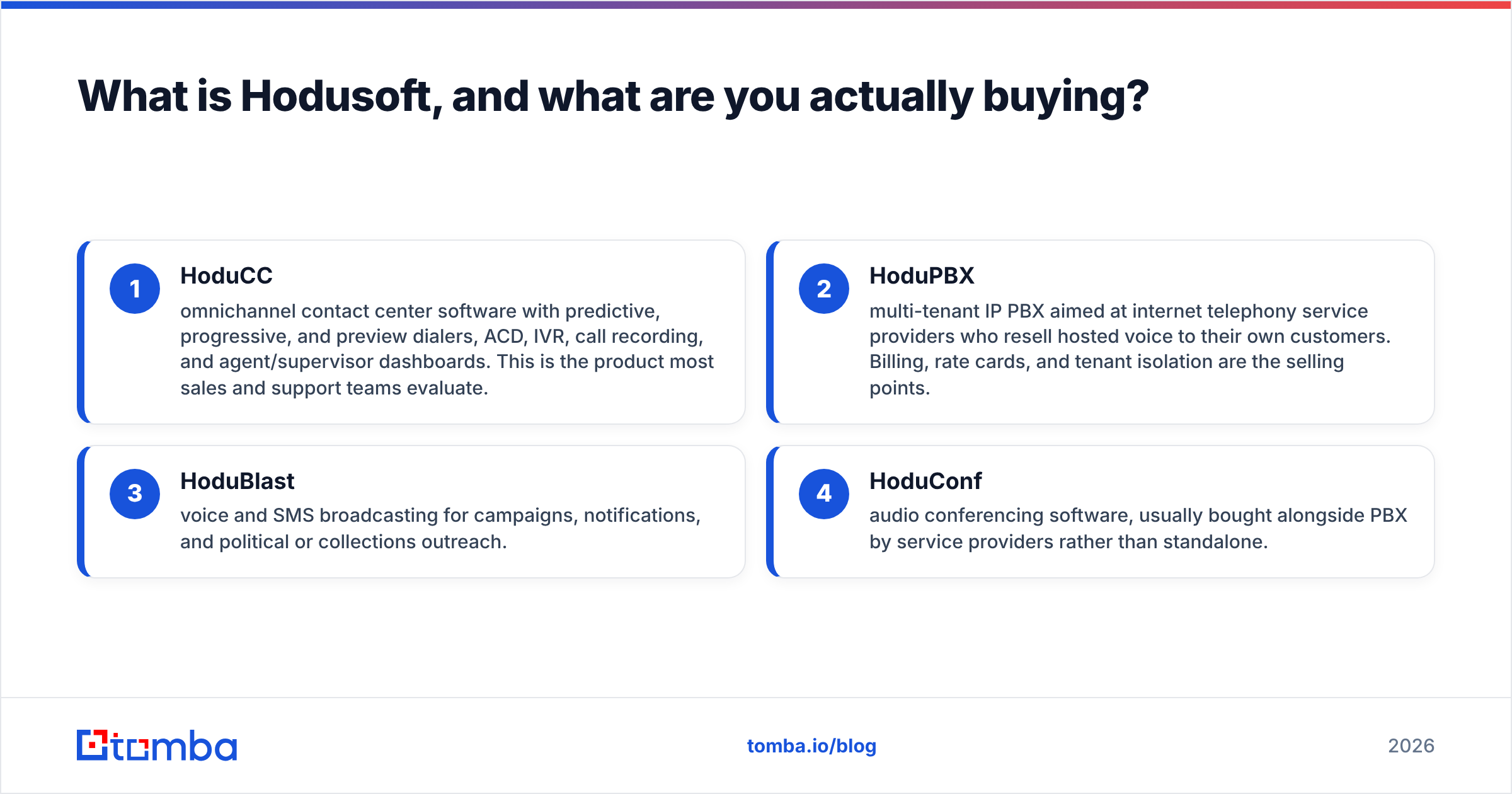
The product line breaks into four things buyers shop for:
- HoduCC — contact center software with predictive, progressive, and preview dialers. It also covers ACD, IVR, call recording, and agent dashboards. Most sales and support teams look at this one.
- HoduPBX — multi-tenant IP PBX for phone service providers who resell hosted voice. Billing, rate cards, and tenant separation are the selling points.
- HoduBlast — voice and SMS blasts for campaigns, alerts, and collections outreach.
- HoduConf — audio conferencing. Service providers usually buy it with the PBX rather than on its own.
Most confusion about Hodusoft pricing starts here. Buyers hold a HoduCC quote next to a SaaS dialer's per-seat sticker price. They are not the same purchase. One is a platform you run. The other is a service you rent.
How does Hodusoft pricing work in 2026?#
Short answer: Hodusoft pricing is quote-based, and there is no free tier. You book a demo, share your seat count and hosting choice, and get a proposal.
That model has three effects.
First, the price can move. Quote-based vendors leave room to haggle. Buyers who bring a rival proposal to the table tend to land better terms.
Second, the license is only part of the bill. Setup, integration work, training, and custom work are usually priced on their own lines.
Third, you can often pick how you pay. Hodusoft has offered both a one-time license (more upfront, less later) and a subscription (less upfront, paid every month). Your choice hinges on how long you plan to stay. A one-time license tends to win past the two- or three-year mark. A subscription wins if you are not sure.

You will not find a hard budget number on the website. Build your model around a range, then test it in the quote.
What actually drives your Hodusoft quote up or down?#
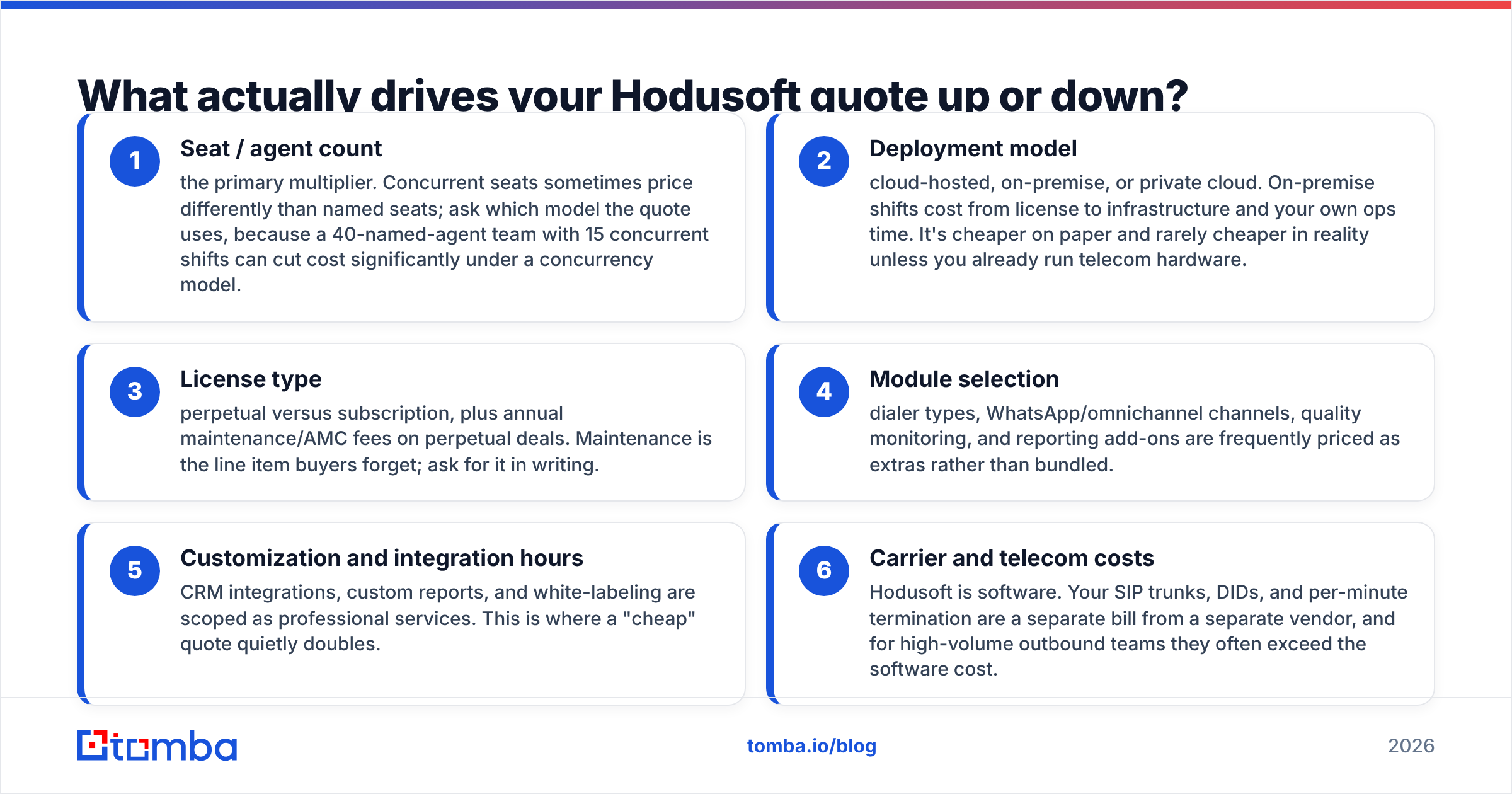
Know which levers move Hodusoft pricing before you take the demo. These variables show up in most contact center proposals:
- Seat / agent count — the main multiplier. Concurrent seats often price differently than named seats. Ask which model the quote uses. A team of 40 named agents with 15 on shift can save a lot under a concurrency model.
- Deployment model — cloud, on-premise, or private cloud. On-premise moves cost from the license to hardware and your own ops time. It looks cheaper on paper. It rarely is, unless you already run telecom gear.
- License type — one-time versus subscription, plus yearly maintenance (AMC) fees on one-time deals. Maintenance is the line buyers forget. Ask for it in writing.
Three more levers shape the final number:
- Module selection — dialer types, WhatsApp channels, quality monitoring, and reporting add-ons are often priced as extras.
- Custom work and integration hours — CRM links, custom reports, and white-labeling are billed as services. This is where a cheap quote quietly doubles.
- Carrier and telecom costs — Hodusoft sells software. Your SIP trunks, DIDs, and per-minute rates come on a separate bill from another vendor. For high-volume outbound teams, that bill often beats the software cost.
That last point trips up first-time buyers. Dial 20,000 numbers a month and your minutes bill shapes unit economics more than the license does.
How does Hodusoft pricing compare to other contact center platforms?#
Here is the honest structural comparison. Plenty of enterprise vendors also hide their prices. Quote-only is the norm in this category, not a Hodusoft quirk.
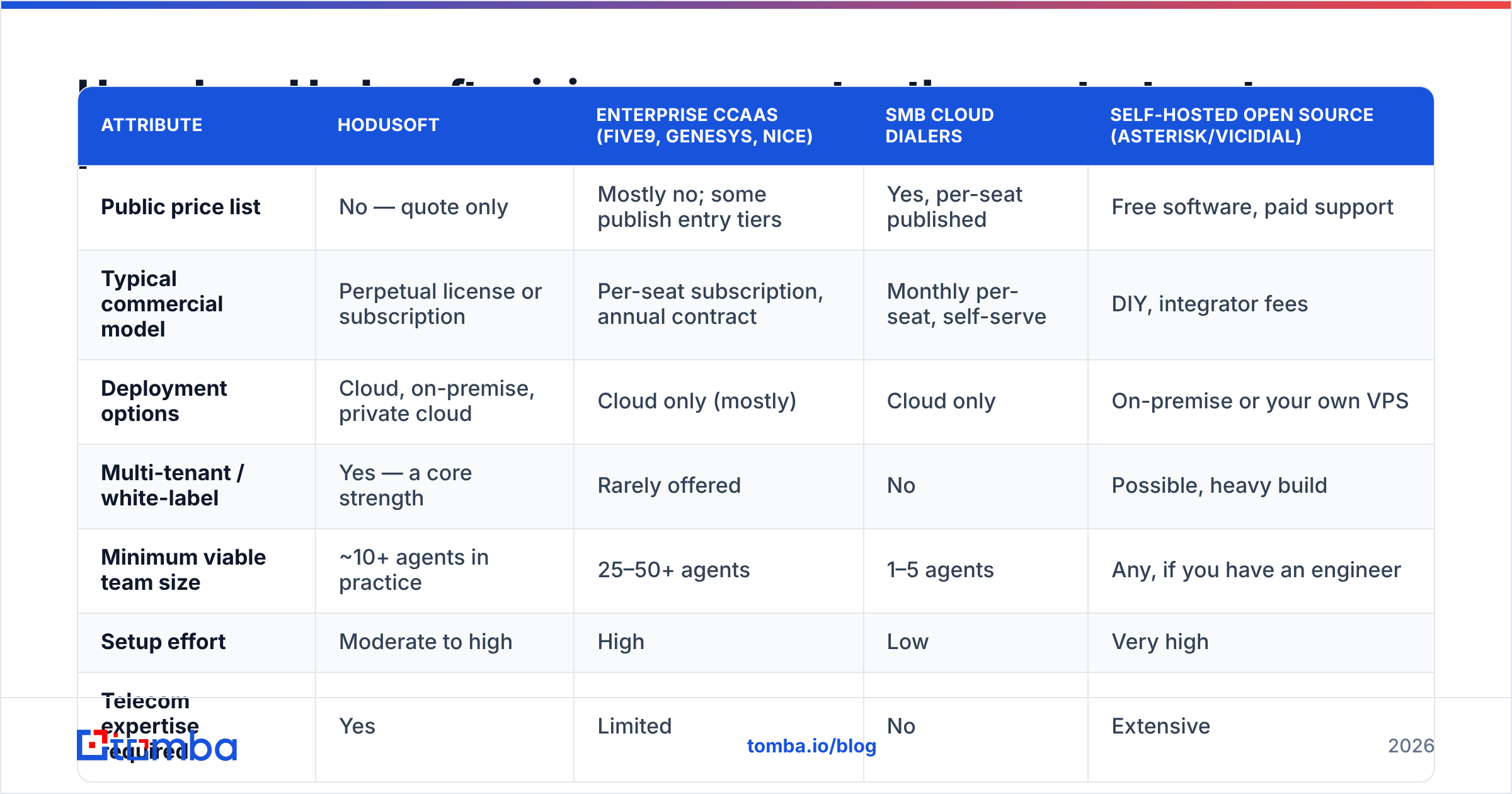
| Attribute | Hodusoft | Enterprise CCaaS (Five9, Genesys, NICE) | SMB cloud dialers | Self-hosted open source (Asterisk/VICIdial) |
|---|---|---|---|---|
| Public price list | No — quote only | Mostly no; some publish entry tiers | Yes, per-seat published | Free software, paid support |
| Typical commercial model | Perpetual license or subscription | Per-seat subscription, annual contract | Monthly per-seat, self-serve | DIY, integrator fees |
| Deployment options | Cloud, on-premise, private cloud | Cloud only (mostly) | Cloud only | On-premise or your own VPS |
| Multi-tenant / white-label | Yes — a core strength | Rarely offered | No | Possible, heavy build |
| Minimum viable team size | ~10+ agents in practice | 25–50+ agents | 1–5 agents | Any, if you have an engineer |
| Setup effort | Moderate to high | High | Low | Very high |
| Telecom expertise required | Yes | Limited | No | Extensive |
| Best fit | ITSPs, BPOs, cost-sensitive scale-ups | Large regulated enterprises | Small sales teams | Teams with in-house VoIP skills |
The takeaway: Hodusoft sits in a middle lane that few vendors occupy. It gives you more control than SMB SaaS dialers. It costs far less than enterprise CCaaS. And it is much less work than building your own Asterisk stack. If that middle lane is where you live, the pricing model makes sense. If not, the quote process is friction you do not need.
What do Hodusoft reviews actually say?#
Check the sources yourself on G2 and Capterra. Do not trust any single roundup, this one included. Hodusoft has fewer reviews than the big US CCaaS vendors. That means each review carries more weight and outliers skew the average. Read the three-star reviews first. They are the most useful.
The same themes repeat across public reviews and buyer forums.
What reviewers consistently like:
- Features per dollar. The most common compliment. Teams leaving enterprise CCaaS contracts often report a real drop in cost for the same dialer work.
- Support responsiveness. Named engineers, live help during setup, and a willingness to build small custom pieces come up again and again.
- Multi-tenancy and white-labeling. For resellers and ITSPs, this is the reason they picked Hodusoft over cheaper SaaS tools that lack it.
- Deployment flexibility. The on-premise option is a real edge for teams with data residency rules.
What reviewers consistently flag:
- Onboarding takes real work. This is not sign-up-and-dial software. Plan for a setup project measured in weeks, not hours.
- The interface feels plain. It is dense and it works, but it is less polished than US rivals. Agents adjust. Buyers who judge on looks will not like it.
- Documentation gaps. Several reviewers lean on support for things they would rather look up in docs.
- Timezone friction. The team sits in India. For US and EU buyers that is usually fine, and it can help overnight cover, but it can slow escalations.
What are the hidden costs buyers miss?#
Four line items show up after the quote is signed:
- Yearly maintenance (AMC) on one-time licenses. Budget for it from year two.
- Professional services for CRM links and custom reports. Scope them in the contract as deliverables, not hours.
- Infrastructure for on-premise or private cloud: servers, backups, monitoring, and the staff to keep them alive.
- Telecom spend: trunks, DIDs, per-minute rates, and the work of keeping your caller ID clean.
A fifth cost never lands on a quote: dialing bad numbers. A predictive dialer lives or dies on connect rate. If 30% of your list is dead, wrong, or stale, you pay agents to wait. You also burn your caller ID on nothing. No dialer setting fixes a bad list.

Validate the data before you add seats. A phone validator pass costs a fraction of the agent hours it saves. Running data enrichment on your accounts fills in direct dials and decision-maker detail, which turns a connect into a real conversation.
Is Hodusoft worth it in 2026?#
It depends on which list you are on.
Strong fit:
- ITSPs and telecom resellers who need multi-tenant PBX with white-labeling and billing built in.
- BPOs and call centers with high outbound volume, where per-seat SaaS pricing gets painful fast.
- Teams with data residency rules that force on-premise or regional hosting.
- Cost-aware teams of 15 to 200 agents that have, or can hire, someone at ease with VoIP.
Poor fit:
- Small sales teams under ten reps who want to dial this afternoon.
- Buyers who need published prices for procurement sign-off without a sales cycle.
- Teams with no telecom skills and no wish to build any.
- Teams that mainly need email sequencing rather than call volume. That is a different tool.
Be honest about your list before you book the demo. The quote process costs you a week either way.
How should you run the buying process?#
Here is a practical sequence that gets you a number you can defend:
- Fix your seat model first. Named versus concurrent moves the quote a lot. Know your shift pattern before the call.
- Ask for an itemized quote. License, maintenance, setup, integration, and training should each be a line. One blended number weakens your position.
- Ask for a reference customer in your industry and region, then actually call them.
Three more steps keep Hodusoft pricing honest once the quotes arrive:
- Run a paid pilot if one is offered. Two weeks with ten seats tells you more than any demo.
- Model three-year cost, not month one. One-time and subscription cross over in year two or three. Know where.
- Price the data layer on its own so it does not vanish inside the platform decision.
Sales leaders skip that last step. Dialer platforms are becoming a commodity. Contact data quality is not. Two teams on the same Hodusoft setup will build very different pipeline if one dials verified direct lines and the other works a scraped list from 2023.
What about the data side of your outbound stack?#
Contact center software answers how you reach people. It says nothing about who you reach, or whether the number and email on file are real.
That is a separate buy. It is usually the cheaper half of the stack and the higher-leverage one. For most outbound teams the order looks like this: build the target account list, find verified contact details, check them, then load them into the dialer. Skipping the middle two steps is why so many dialer rollouts miss their business case.
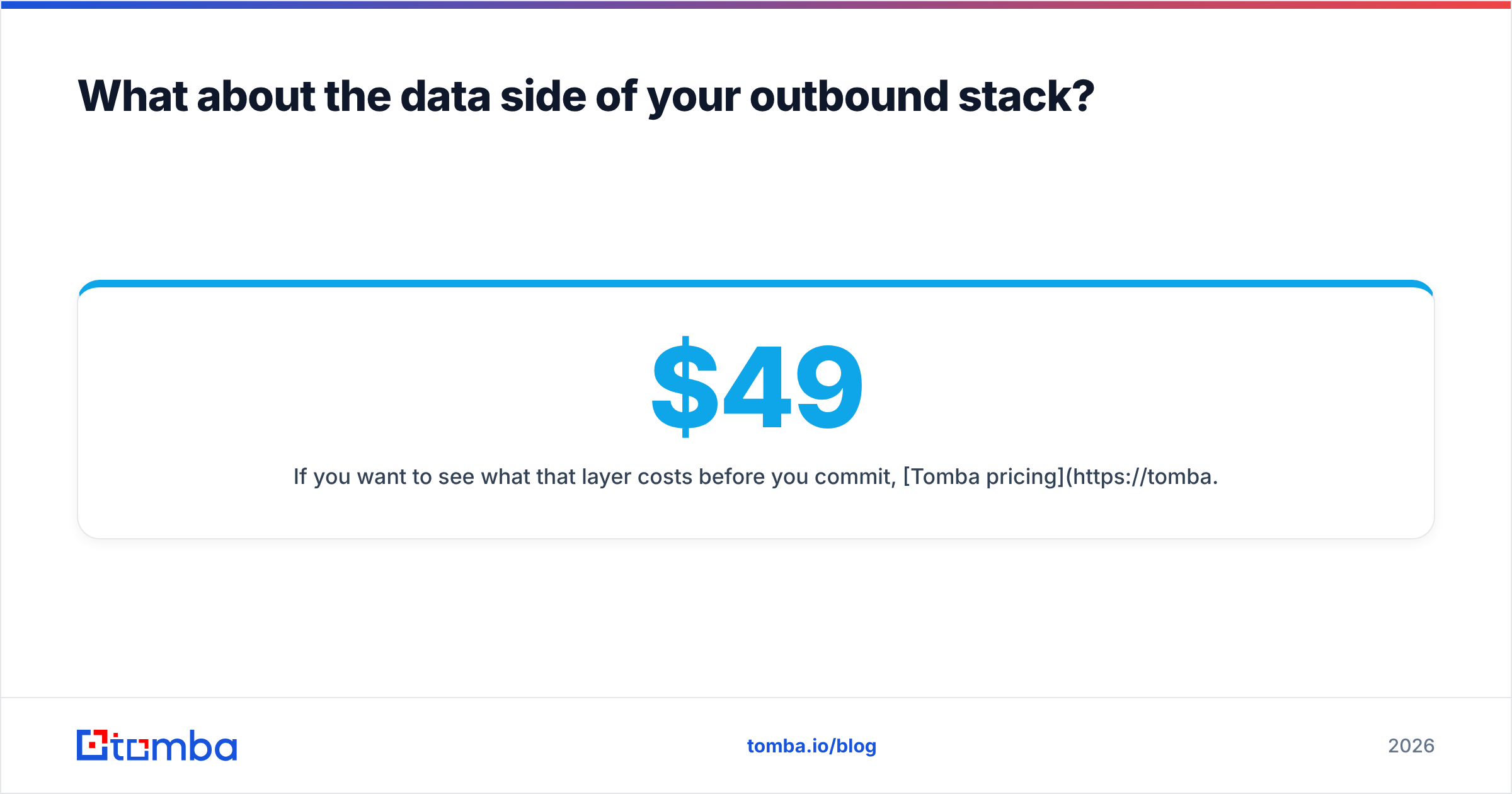
Want to see what that layer costs first? Tomba pricing is public. There is a free tier with 25 searches a month, Starter at $49/mo, Growth at $99/mo, and Pro at $249/mo, with Enterprise quoted. The contrast with Hodusoft pricing is useful. You can budget the data layer in five minutes, which makes it easier to justify inside a bigger contact center case. For bulk list work before a launch, the bulk email finder takes CSV uploads with no engineering time.
The bottom line on Hodusoft pricing, reviews, pros and cons#
Hodusoft is a real option in a category where most vendors either overcharge or oversimplify. Hidden Hodusoft pricing is a genuine friction point, and setup is heavier than SaaS buyers expect. But the feature depth per dollar is real. The multi-tenant and on-premise options are things most rivals do not offer at any price.
Get an itemized quote. Model three years. Then test it against one enterprise CCaaS proposal and one SMB dialer. That triangulation tells you more than any review site.
Whatever platform you pick, do not let the dialer be your first buy. Fill it with contacts worth calling. Start with the Tomba Email Finder to build a verified list of decision-makers by domain, name, or company. Then let your contact center software do what it is good at.
Related guides#
Ready to find emails that actually work?
Join 150,000+ professionals who stopped guessing and started sending. Free credits on signup — no credit card required.
Get the Tomba newsletter
Practical outbound tactics and product updates — once every two weeks.
About the author