High Ticket Sales in 2026: How to Close $25k+ B2B Deals
High ticket sales reward precision, not volume. Here is the deal math, the stage-by-stage process, and the prospecting stack that makes $25k+ contracts repeatable instead of lucky.
TL;DR
- High ticket sales means fewer opportunities, more stakeholders, and longer cycles — a $50,000 contract is not a $500 deal with more zeros.
- The economics flip: you can afford 45 minutes of research per prospect because one closed deal covers a quarter of pipeline cost.
- Deals die in the middle, not at the close. Multi-threading across 4-8 buyers is the single biggest predictor of a signature.
- Volume prospecting actively hurts you here. A 40-account list with verified contacts beats a 5,000-record blast every time.
- Track pipeline coverage, stage conversion, and average cycle length — not activity counts.
What counts as a high ticket sale?#
There is no universal dollar threshold, and anyone who gives you one is selling a course. A practical definition: a high ticket sale is any deal where the buyer cannot approve it alone.
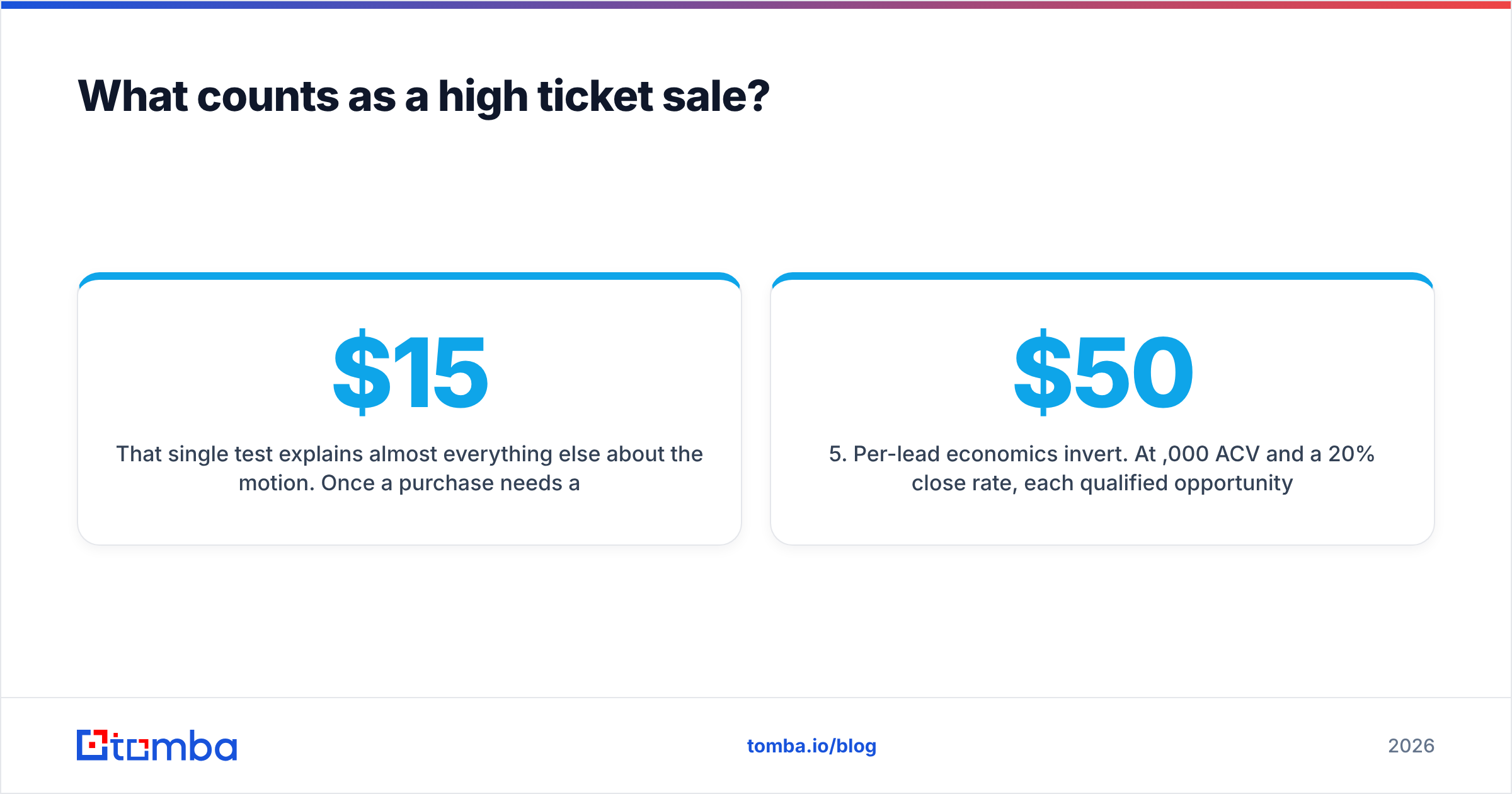
That single test explains almost everything else about the motion. Once a purchase needs a second signature, you inherit procurement, security review, legal redlines, a budget cycle, and at least one internal skeptic who was not in your first call. For most B2B software and services, that line sits somewhere between $15,000 and $30,000 in annual contract value. For agencies and consultancies, it can start at $10,000. For enterprise platforms, it starts at $150,000.
What matters is not the number but the consequences of the number:
- Buying committees replace buyers. Gartner's research on B2B buying consistently finds that enterprise purchases involve six to ten decision-makers, each arriving with their own conflicting priorities.
- Cycles stretch to quarters, not days. A 90-to-180-day cycle is normal. Your forecast has to survive a reorg, a budget freeze, and a champion changing jobs.
- Risk beats price as the main objection. Nobody gets fired for not buying. Your competition is inaction, not the other vendor.
- Discovery becomes the product. The quality of your diagnosis is what the buyer is actually evaluating in the first three calls.
- Per-lead economics invert. At $50,000 ACV and a 20% close rate, each qualified opportunity is worth $10,000. Spending an hour researching one account is cheap.
That last point is the one most teams get wrong. They import a high-ticket price into a low-ticket process and wonder why the pipeline stalls.
How is high ticket selling different from transactional selling?#
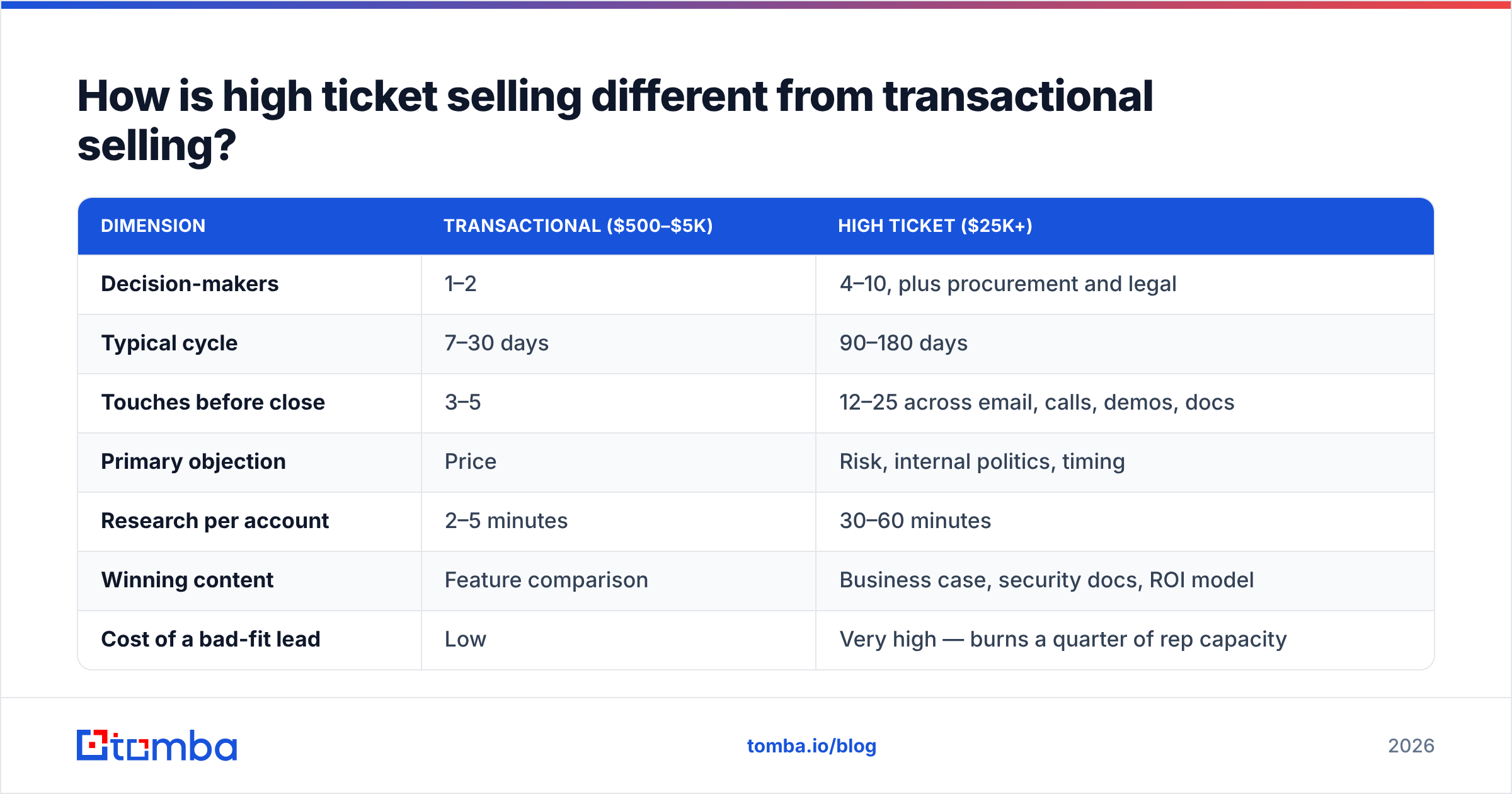
The differences are structural, not stylistic. Here is what actually changes when average deal size moves from $2,000 to $50,000.
| Dimension | Transactional ($500–$5k) | High ticket ($25k+) |
|---|---|---|
| Decision-makers | 1–2 | 4–10, plus procurement and legal |
| Typical cycle | 7–30 days | 90–180 days |
| Touches before close | 3–5 | 12–25 across email, calls, demos, docs |
| Primary objection | Price | Risk, internal politics, timing |
| Research per account | 2–5 minutes | 30–60 minutes |
| Winning content | Feature comparison | Business case, security docs, ROI model |
| Cost of a bad-fit lead | Low | Very high — burns a quarter of rep capacity |
| Right prospecting motion | Volume + automation | Precision list + multi-threading |
| Comp structure | Monthly quota, high velocity | Quarterly/annual quota, ramp of 6+ months |
Read the last two rows together. In transactional selling, a bad-fit lead costs you five minutes. In high ticket sales, a rep can spend eleven weeks on a deal that was never going to close because the buyer had no budget authority and no timeline. Qualification discipline is not bureaucracy — it is capacity protection.
What does a high ticket sales process look like stage by stage?#
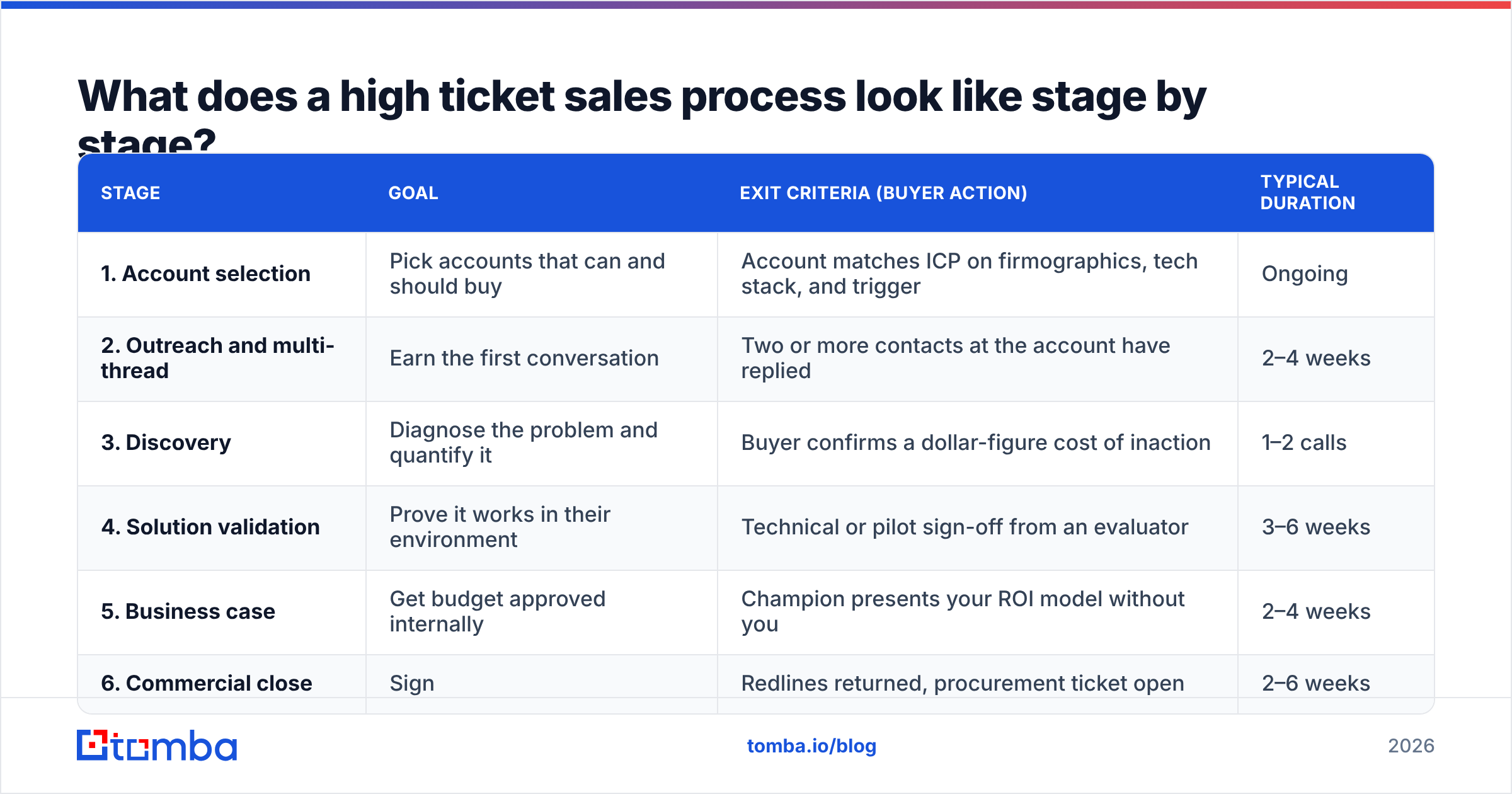
A workable high-ticket process has six stages. The exit criteria matter more than the names — every stage should have a verifiable buyer action, not a rep opinion.
| Stage | Goal | Exit criteria (buyer action) | Typical duration |
|---|---|---|---|
| 1. Account selection | Pick accounts that can and should buy | Account matches ICP on firmographics, tech stack, and trigger | Ongoing |
| 2. Outreach and multi-thread | Earn the first conversation | Two or more contacts at the account have replied | 2–4 weeks |
| 3. Discovery | Diagnose the problem and quantify it | Buyer confirms a dollar-figure cost of inaction | 1–2 calls |
| 4. Solution validation | Prove it works in their environment | Technical or pilot sign-off from an evaluator | 3–6 weeks |
| 5. Business case | Get budget approved internally | Champion presents your ROI model without you | 2–4 weeks |
| 6. Commercial close | Sign | Redlines returned, procurement ticket open | 2–6 weeks |
Two notes from teams that run this well.
First, stage 2 is not "sent an email." It is "two or more contacts replied." Single-threaded deals fail at roughly twice the rate of multi-threaded ones, because one job change ends the whole opportunity. Build the second and third thread before you need them, not after your champion goes quiet.
Second, stage 5 is the one most reps skip. If your champion cannot explain the business case in a meeting you are not invited to, you do not have a deal — you have a fan. Hand them a one-page model with their own numbers in it, and rehearse the objections their CFO will raise.
How do you build a high ticket prospect list?#
Precision, not volume. A high-ticket list is built account-first, then contact-first inside each account.
Step 1 — Define the account, not the persona. Start with firmographics you can verify: employee count band, revenue band, industry, geography, and a technology or funding trigger. If you cannot name the trigger that makes this quarter different from last quarter, the account belongs in a nurture list, not an active one.
Step 2 — Map the committee before you write a word. For each target account, identify the economic buyer, the champion, the technical evaluator, and at least one likely blocker. Four names per account, minimum. This is the step that makes multi-threading possible later.
Step 3 — Get verified contact data. Guessing at firstname.lastname@company.com and hoping is how you land in spam and burn a domain. Use a domain search to pull the confirmed email pattern and existing addresses for the company, then run every address through an email verifier before it enters a sequence. On high-value accounts, add a direct dial through a phone finder — at $50,000 ACV, a call is worth the effort that would be irrational at $500.
Step 4 — Enrich for context, not for fields. Recent funding, headcount changes in the relevant department, job postings that reveal a project, a new executive with a mandate. Two specific facts beat twenty generic ones. Contact data enrichment is useful here precisely because it turns a name into a reason to reach out.
Step 5 — Cap the list. Forty to eighty accounts per rep per quarter is a realistic working set for a genuine high-ticket motion. If your list has 3,000 accounts on it, you are running a transactional motion with high-ticket pricing.

For teams that want a starting universe to filter from, licensed B2B contact databases are a legitimate input — providers like BookYourData and Tomba's own B2B database both let you pull filtered account sets before you begin manual research. The value is in the filtering and verification you do afterward, not in the raw record count.
Does cold email still work for high ticket sales?#
Yes, but the shape of it changes completely.
Transactional cold email optimizes for reply rate across thousands of sends. High-ticket cold email optimizes for one thing: getting a specific named person at a specific named account to take a first call. The math justifies a hand-written message. If your opportunity value is $10,000, a fifteen-minute email that lands a meeting has an extraordinary hourly return.
What actually works at this deal size:
- Reference a trigger, not a benefit. "Saw you opened a Frankfurt office in March" outperforms "we help companies scale" every time.
- Lead with a hypothesis, not a question. Tell them what you think is breaking and why. Being usefully wrong starts more conversations than being vaguely polite.
- Ask for a smaller yes. A 20-minute diagnostic beats a "demo" for a buyer who does not yet know they have a problem.
- Send from a clean domain. Verify every address, keep bounce rate under 2%, and check your SPF, DKIM, and DMARC records before the first send. High-ticket lists are small and irreplaceable — one deliverability incident can cost you a quarter. HubSpot's sales resources are a solid, vendor-neutral starting point on sequencing basics.
- Follow up on the same thread, four to six times, over three weeks. Then stop and switch channels.
The failure mode to avoid: running a 5,000-contact volume sequence against 60 accounts you actually care about. You will burn your best-fit prospects with generic copy and have nothing left to warm up.
What metrics should you track in a high ticket pipeline?#
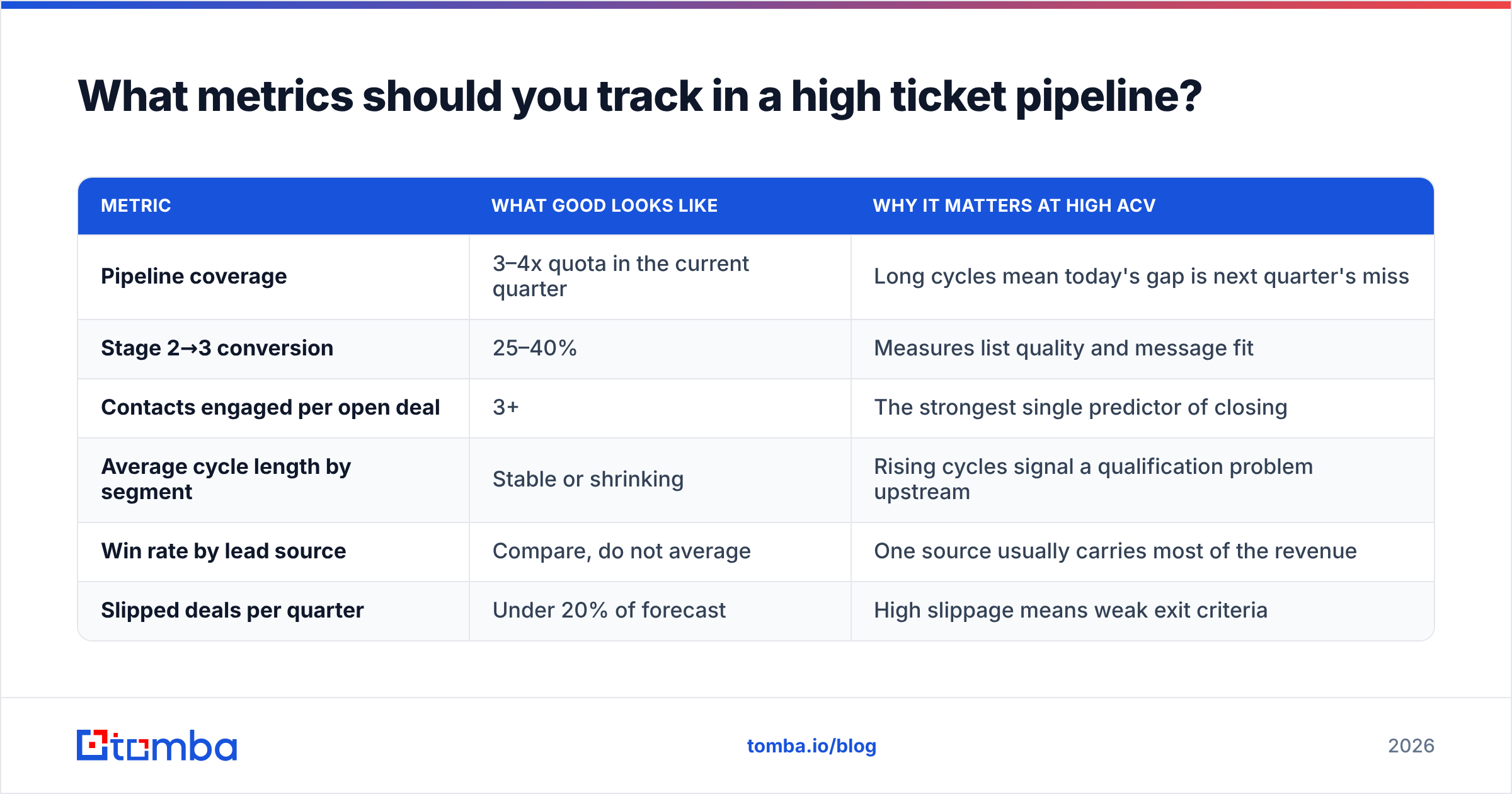
Activity metrics lie at this deal size. A rep who sent 400 emails and booked nothing may have done worse than a rep who sent 40 and booked three. Track outcomes and stage health instead.
| Metric | What good looks like | Why it matters at high ACV |
|---|---|---|
| Pipeline coverage | 3–4x quota in the current quarter | Long cycles mean today's gap is next quarter's miss |
| Stage 2→3 conversion | 25–40% | Measures list quality and message fit |
| Contacts engaged per open deal | 3+ | The strongest single predictor of closing |
| Average cycle length by segment | Stable or shrinking | Rising cycles signal a qualification problem upstream |
| Win rate by lead source | Compare, do not average | One source usually carries most of the revenue |
| Slipped deals per quarter | Under 20% of forecast | High slippage means weak exit criteria |
Two of these deserve a hard rule. If contacts engaged per open deal drops below two, that deal is not forecastable at any probability above 20% — treat it as single-threaded and at risk. And if your win rate by source varies more than 3x, stop funding the weak sources this quarter rather than next.
What are the most common high ticket sales mistakes?#
Discounting to close. A 20% discount on a $50,000 deal costs $10,000 in pure margin and teaches the buyer that your first number was fiction. Trade concessions for something — a longer term, a case study, a faster start date — or hold.
Pitching before diagnosing. Reps trained on transactional deals demo in call one. At high ACV, the demo is a closing tool, not an opening one. Show the product after the buyer has said out loud what it needs to fix.
Confusing a champion with a buyer. The person who loves you is rarely the person who signs. Ask directly: "Who else needs to be comfortable with this before it can move?" Then get to them.
Ignoring procurement until week ten. Security questionnaires, vendor onboarding, and legal review are predictable and slow. Start them in parallel with the business case, not after it.
Buying leads instead of building lists. A purchased list of 10,000 contacts is not a high-ticket pipeline. Sixty researched accounts with four verified contacts each is. Peer review sites like G2 are useful for validating which data vendors actually maintain accuracy, and comparing that against your own bounce and connect rates over a quarter.
Forecasting on optimism. If the exit criteria are not met, the stage does not advance. Make that non-negotiable and your forecast becomes usable within two quarters.
Where should you start if you are moving upmarket?#
Sequence matters. Do not redesign compensation before you have fixed the list.
- Rewrite your ICP with verifiable criteria and cut your target account list by 80%.
- Map the buying committee for the top 40 accounts and get verified contact data for four people at each.
- Add exit criteria to every pipeline stage and audit the current pipeline against them — expect to disqualify a third of it.
- Build a one-page ROI model your champion can present without you.
- Only then adjust quota, ramp, and comp to match the longer cycle.
Steps one and two are where most of the compounding lives, and they are the cheapest to fix. Bad data at the top of a 120-day cycle does not show up as a bounce — it shows up as a missed quarter four months later.
If you are building that 40-account committee map, start with the contact layer. Tomba's Email Finder returns verified professional addresses by name and domain with a confidence score and the sources behind it, so you can multi-thread into an account without guessing at formats or risking your sender reputation. The free tier covers 25 searches a month, and paid plans start at $49/mo with bulk and API access as your account list grows — see Tomba pricing for the full breakdown. At high-ticket deal sizes, the cost of finding the right four people is rounding error against the cost of missing one.
Related guides#
Ready to find emails that actually work?
Join 150,000+ professionals who stopped guessing and started sending. Free credits on signup — no credit card required.
Get the Tomba newsletter
Practical outbound tactics and product updates — once every two weeks.
About the author