Hoovers Database in 2026: What It Is, Costs & Alternatives
Hoovers is now D&B Hoovers, and the pricing, data model, and contract terms have changed. Here's what the database actually contains, what it costs, and when a lighter tool wins.
TL;DR
- The "Hoovers database" is now D&B Hoovers, a Dun & Bradstreet sales-intelligence product built on the D-U-N-S company graph — roughly 500M+ business records with firmographics, corporate family trees, and financial risk signals.
- Its real strength is company data, not contact data. Hierarchies, credit signals, and industry codes are best-in-class. Individual work emails are the weaker half.
- Pricing is annual, seat-based, quote-only. Expect low four figures per seat per year at the small end, and mid-five figures for a team with API or CRM sync.
- If you need account-level intelligence for enterprise ABM or credit decisions, Hoovers earns its price. If you need verified emails for outbound, you are paying enterprise rates for the part it does least well.
- A common 2026 stack: keep a lean company-data source, then layer a dedicated finder like Tomba Email Finder at $49/mo for the contact layer.
What is the Hoovers database?#
Hoovers started in 1990 as Hoover's Handbook, a print reference of company profiles. Dun & Bradstreet acquired it in 2003, and in 2017 relaunched the product as D&B Hoovers — the name you will see on every invoice today. The standalone hoovers.com experience is gone; it redirects into the Dun & Bradstreet product family.
Think of it like a credit bureau that also sells prospect lists. The same infrastructure that tells a bank whether a supplier is solvent tells a sales rep which accounts to call. That shared origin explains both the strengths and the quirks.
The database is anchored on the D-U-N-S Number — a nine-digit identifier D&B assigns to individual business locations worldwide. Every record hangs off that ID, which is why the corporate family tree data is unusually good: you can see that a 40-person subsidiary in Lyon rolls up to a global ultimate parent in Chicago, and that the parent has 212 other branches.
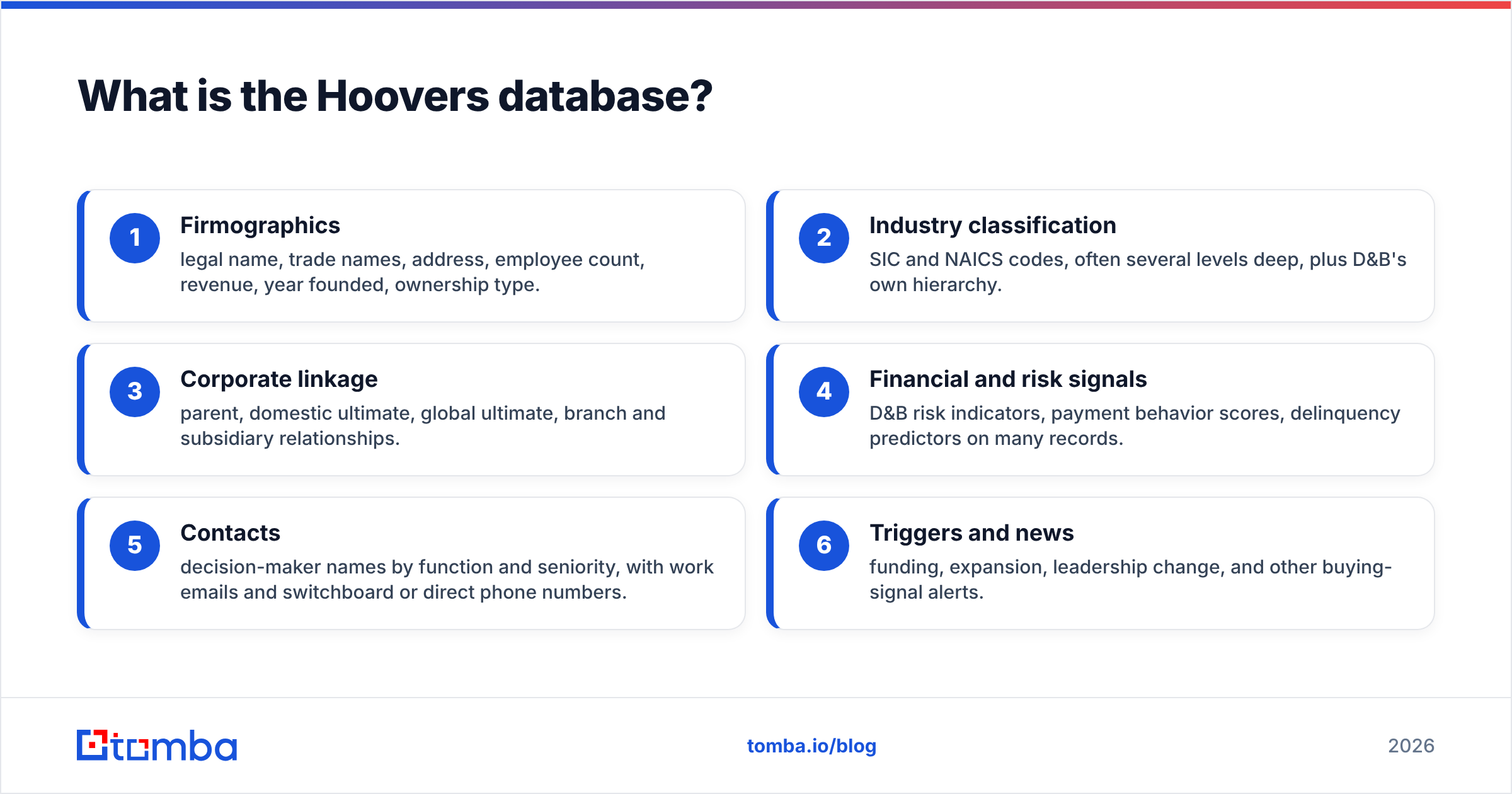
What a typical D&B Hoovers company record includes:
- Firmographics — legal name, trade names, address, employee count, revenue, year founded, ownership type.
- Industry classification — SIC and NAICS codes, often several levels deep, plus D&B's own hierarchy.
- Corporate linkage — parent, domestic ultimate, global ultimate, branch and subsidiary relationships.
- Financial and risk signals — D&B risk indicators, payment behavior scores, delinquency predictors on many records.
- Contacts — decision-maker names by function and seniority, with work emails and switchboard or direct phone numbers.
- Triggers and news — funding, expansion, leadership change, and other buying-signal alerts.

How big is the Hoovers database, really?#
D&B publicly cites more than 500 million business records across its Data Cloud, with tens of millions of contacts layered on top. Those numbers are accurate but easy to misread.
The 500M+ figure counts every registered business entity D&B tracks globally — including sole traders, dormant shells, single-location franchises, and branches counted separately from their parents. The subset that matters to a B2B seller (companies with 10+ employees, a website, and an identifiable buying committee) is far smaller. That is not a criticism; it is how business registries work. But if you are comparing "500M records" against a competitor's "275M contacts," you are comparing two different units.
The contact layer is where buyers push back most. Reviews on G2 and Capterra consistently praise the company intelligence and flag stale contact records — people who left two roles ago, generic info@ addresses standing in for a named buyer, or direct dials that route to a shut-down office line.
That pattern is structural. Company registration data changes slowly and gets refreshed from authoritative filings. Job changes happen constantly and get refreshed from far messier sources. Any provider that treats both with one update cycle will look strong on one axis and weak on the other.
What does D&B Hoovers cost in 2026?#
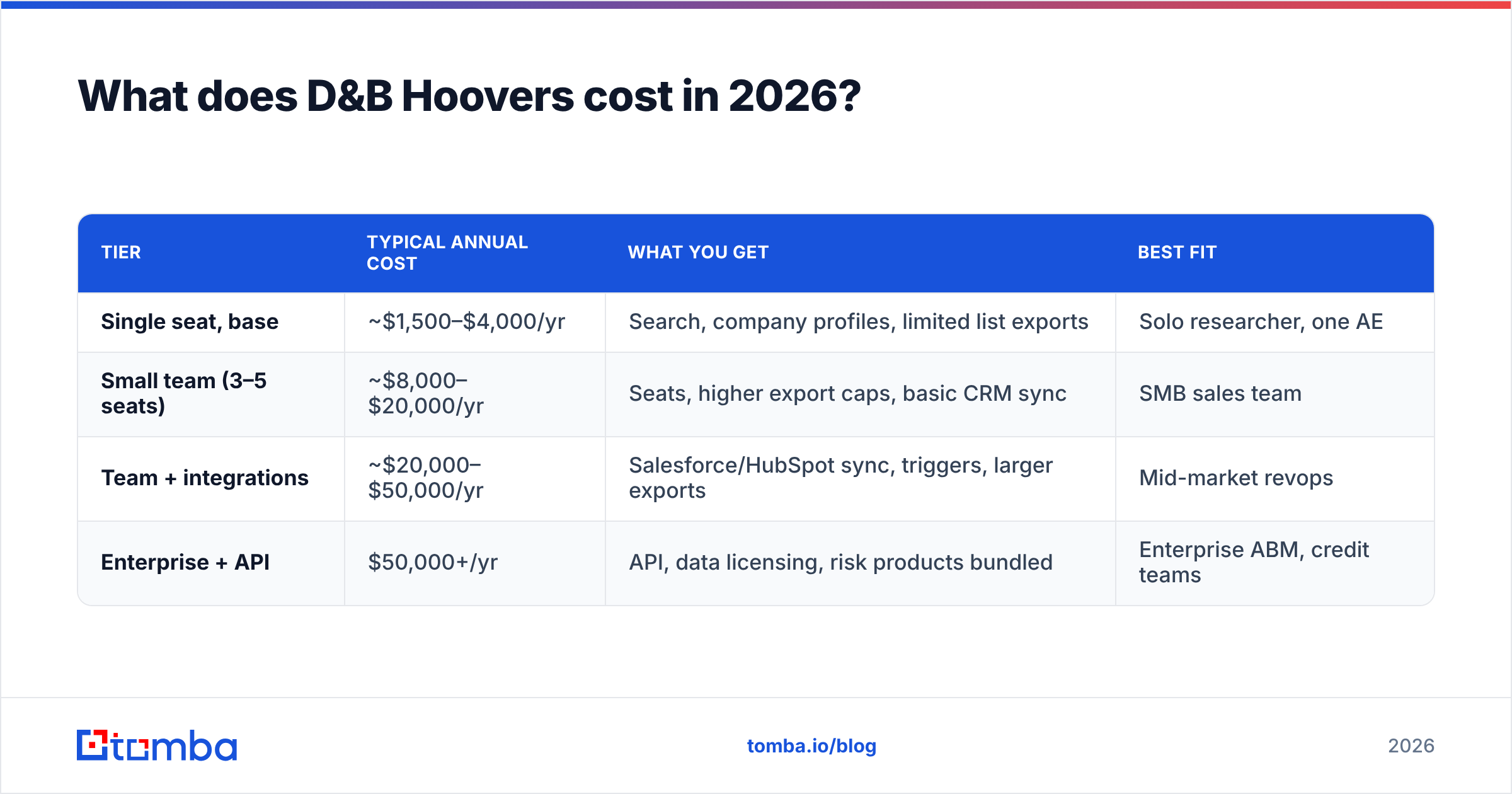
There is no public price list. D&B Hoovers is sold on annual contracts with per-seat licensing, quoted after a discovery call, and the number varies with seat count, record-view limits, CRM integration, and API access.
From publicly reported buyer figures and reseller listings, the ranges look roughly like this:
| Tier | Typical annual cost | What you get | Best fit |
|---|---|---|---|
| Single seat, base | ~$1,500–$4,000/yr | Search, company profiles, limited list exports | Solo researcher, one AE |
| Small team (3–5 seats) | ~$8,000–$20,000/yr | Seats, higher export caps, basic CRM sync | SMB sales team |
| Team + integrations | ~$20,000–$50,000/yr | Salesforce/HubSpot sync, triggers, larger exports | Mid-market revops |
| Enterprise + API | $50,000+/yr | API, data licensing, risk products bundled | Enterprise ABM, credit teams |
Three cost mechanics catch buyers off guard:
- Record view caps. Many contracts meter how many full company profiles a seat can open per year. Blow through the cap and you renegotiate mid-term.
- Export limits separate from views. Viewing a record and exporting it are billed as different actions on some plans.
- Annual-only terms. There is no monthly plan. A team that needed data for one quarterly campaign still pays for twelve months.
Compare that to the transactional model most modern data tools use — you buy credits, you spend credits, you stop when you stop. Tomba pricing runs Free (25 searches/mo), Starter $49/mo, Growth $99/mo, Pro $249/mo, and Enterprise custom, with no annual lock-in on the self-serve tiers. Different product, different unit — but the contrast in commitment is the point.
How does Hoovers compare to other B2B data providers?#
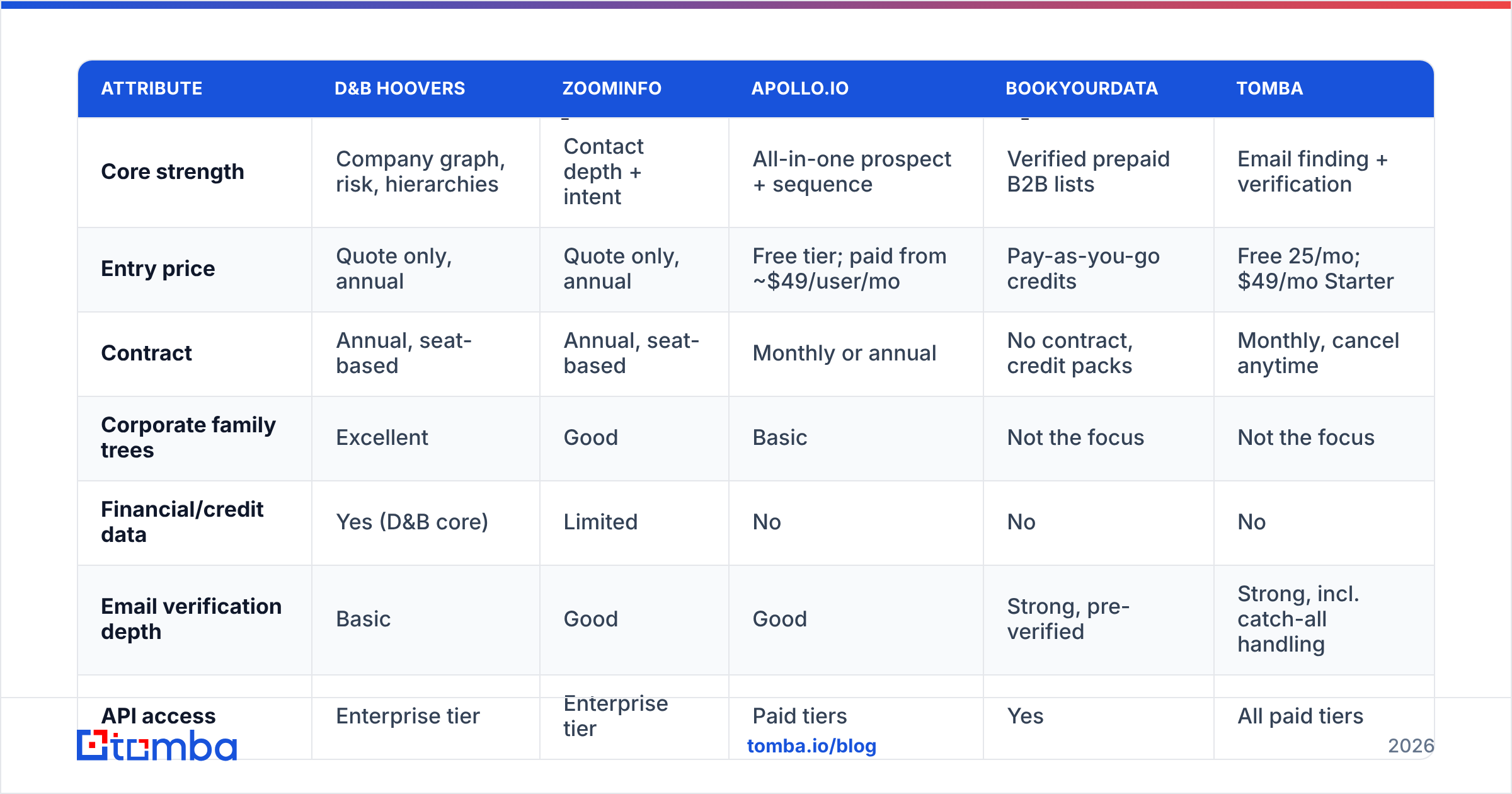
The honest framing: Hoovers is a company-intelligence platform that includes contacts, while most of its perceived competitors are contact platforms that include company data. Buyers who mix those categories end up disappointed by whichever half they didn't actually buy.
| Attribute | D&B Hoovers | ZoomInfo | Apollo.io | BookYourData | Tomba |
|---|---|---|---|---|---|
| Core strength | Company graph, risk, hierarchies | Contact depth + intent | All-in-one prospect + sequence | Verified prepaid B2B lists | Email finding + verification |
| Entry price | Quote only, annual | Quote only, annual | Free tier; paid from ~$49/user/mo | Pay-as-you-go credits | Free 25/mo; $49/mo Starter |
| Contract | Annual, seat-based | Annual, seat-based | Monthly or annual | No contract, credit packs | Monthly, cancel anytime |
| Corporate family trees | Excellent | Good | Basic | Not the focus | Not the focus |
| Financial/credit data | Yes (D&B core) | Limited | No | No | No |
| Email verification depth | Basic | Good | Good | Strong, pre-verified | Strong, incl. catch-all handling |
| API access | Enterprise tier | Enterprise tier | Paid tiers | Yes | All paid tiers |
| Best for | Enterprise ABM, credit, supply chain | Large SDR orgs with budget | Full-cycle SMB outbound | One-off verified list buys | Precise contact discovery at scale |
A few reads on that table:
Against ZoomInfo. These two overlap most. ZoomInfo generally wins on contact recency and intent signals; Hoovers wins on entity resolution, global coverage of small and non-US firms, and anything touching financial risk. Both cost enterprise money.
Against Apollo.io. Apollo is a workflow product — find, sequence, dial, track — with data bundled in. If your team wants one tool that both sources and sends, Apollo is the closer comparison, and it starts far cheaper. If you're evaluating that direction, the Apollo alternative breakdown covers the tradeoffs.
Against BookYourData. A genuinely different buying motion: prepaid, pre-verified contact lists with no seat licensing. For a team that needs 5,000 verified contacts for a defined campaign and doesn't want a platform relationship at all, that transactional model can be the cleaner fit — and it sidesteps the annual-contract problem entirely.
Against a dedicated finder. Tools like Tomba solve a narrower problem: given a company and a person, return a deliverable work email. No family trees, no risk scores. But when the contact layer is the bottleneck, the narrow tool is usually the cheaper fix.
Who should actually buy the Hoovers database?#
Buy D&B Hoovers if at least two of these describe you:
- You sell to enterprises with complex org structures. Knowing that six mid-size accounts share a global ultimate parent changes your entire territory plan. Nothing else maps that as reliably.
- Credit or supply-chain risk touches your deal. If finance needs to know whether a prospect pays its bills, you're already buying D&B data — bundling sales intelligence into that contract is efficient.
- You need coverage outside the US. D&B's registry-sourced international data, particularly in Europe and APAC, holds up better than most US-centric contact databases.
- Compliance requires documented provenance. Regulated industries need to say where a record came from. D&B's audit trail is a real procurement advantage.
- You already run Salesforce or Dynamics at scale and want a native, governed enrichment feed rather than CSV round-trips.
Skip it if:
- Your motion is volume outbound to SMBs. You will pay for hierarchy data you never open, and get contact records that need re-verification anyway.
- You're a founder or small team testing a market. The annual commitment is a bad match for an unvalidated ICP.
- What you actually need is email addresses. That is a $49/mo problem, not a $20,000/yr one.

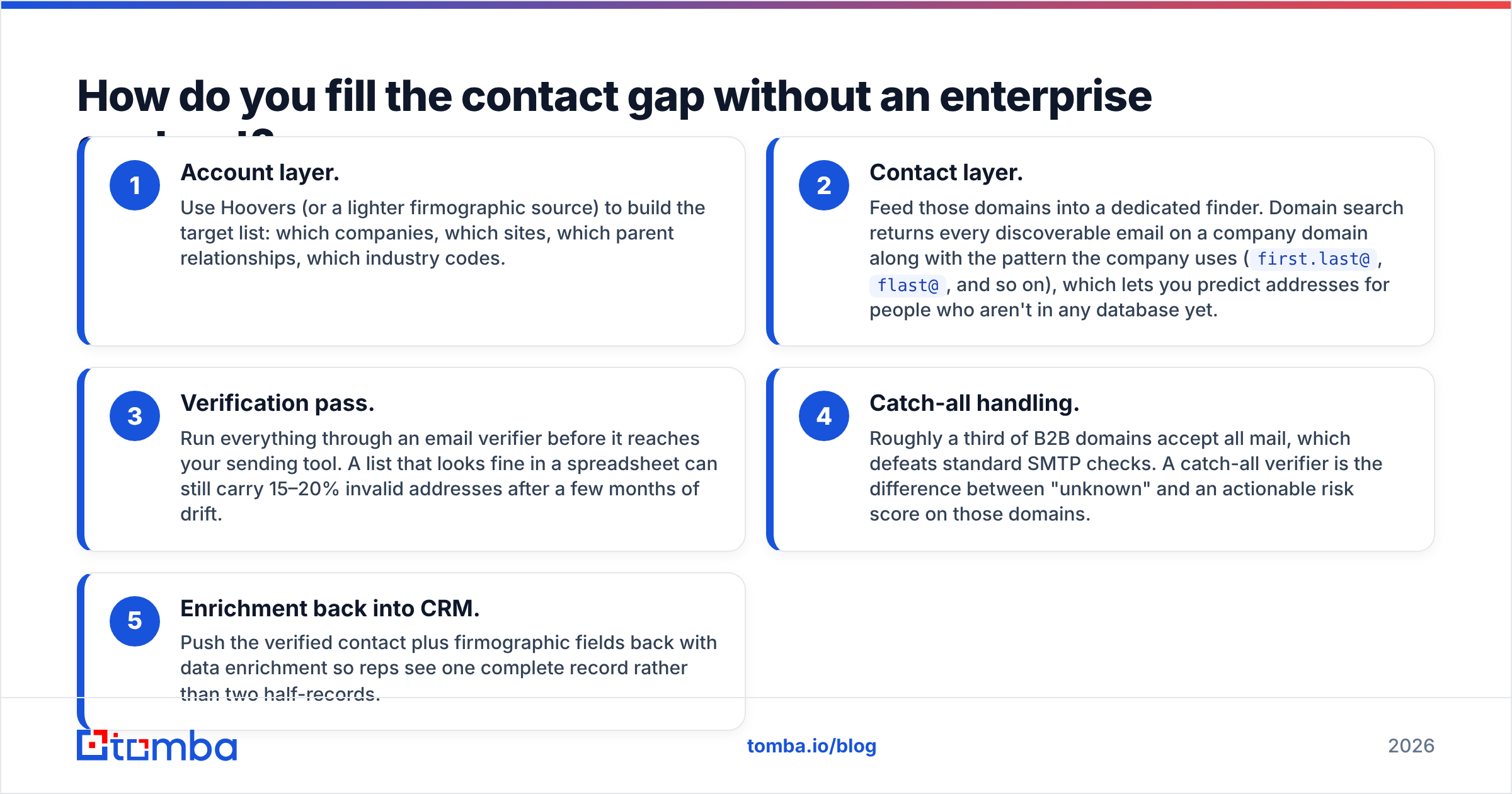
How do you fill the contact gap without an enterprise contract?#
If you like the company intelligence but the contact layer disappoints — a common outcome — split the job across two tools instead of hoping one product does both well.
The two-layer pattern:
- Account layer. Use Hoovers (or a lighter firmographic source) to build the target list: which companies, which sites, which parent relationships, which industry codes.
- Contact layer. Feed those domains into a dedicated finder. Domain search returns every discoverable email on a company domain along with the pattern the company uses (
first.last@,flast@, and so on), which lets you predict addresses for people who aren't in any database yet. - Verification pass. Run everything through an email verifier before it reaches your sending tool. A list that looks fine in a spreadsheet can still carry 15–20% invalid addresses after a few months of drift.
- Catch-all handling. Roughly a third of B2B domains accept all mail, which defeats standard SMTP checks. A catch-all verifier is the difference between "unknown" and an actionable risk score on those domains.
- Enrichment back into CRM. Push the verified contact plus firmographic fields back with data enrichment so reps see one complete record rather than two half-records.
Run at the small end, that stack costs a few hundred dollars a month. It won't give you a global ultimate parent hierarchy. It will give you contacts that actually receive mail — and for most outbound teams, that is the binding constraint.
What are the main complaints about Hoovers?#
Reading across public reviews, four themes repeat:
Contact staleness. The most frequent complaint. Company records stay accurate; the humans attached to them drift. Budget for a verification pass regardless of your source — this is not unique to Hoovers, but the price makes it sting more.
Interface friction. The search builder is powerful and unforgiving. Filters are deeply nested, saved searches behave unexpectedly across seats, and new reps need real onboarding time. Teams that adopted it without training tend to report low seat utilization at renewal.
Contract rigidity. Mid-term seat reductions are difficult. Auto-renewal clauses with notice windows catch teams that decided months earlier not to continue. Read the renewal terms before signing, not in month eleven.
Export limits. The gap between "I can see this record" and "I can put this record in my CRM" is a licensing decision, and it surprises buyers who assumed viewing implied exporting.
None of these make Hoovers a bad product. They make it a specific product: heavyweight, governed, priced for organizations where data provenance is a compliance requirement rather than a convenience.
Is the Hoovers database still worth it in 2026?#
Yes — for a narrower set of buyers than the brand's name recognition suggests.
The company graph is genuinely hard to replicate. Building entity resolution across 500M+ global business records, with verified corporate linkage and financial signals, takes decades and registry relationships that startups can't buy. If that graph is what your business runs on, D&B Hoovers remains a defensible purchase.
But the market has unbundled around it. In 1998, one vendor sold you "business information" and that was the category. In 2026, contact discovery, verification, intent, enrichment, and sequencing are all separately purchasable, often at a fraction of the blended price. Paying enterprise rates for a bundle where you use one component well is the most common way teams overspend on data.
Audit your last quarter honestly. If your reps opened Hoovers mainly to look up an email address, you have a $49/mo problem wearing a $20,000/yr price tag.
Getting the contact layer right#
Start where the bottleneck actually is. If your reps have the account list and just need to reach the right person, run a few target domains through the Tomba Email Finder — the free tier covers 25 searches a month, enough to test accuracy against contacts you can already verify by hand. Compare the hit rate to what your current source returns, then decide whether the enterprise contract is buying you intelligence or just inertia.
Related guides#
Ready to find emails that actually work?
Join 150,000+ professionals who stopped guessing and started sending. Free credits on signup — no credit card required.
Get the Tomba newsletter
Practical outbound tactics and product updates — once every two weeks.
About the author