What Is a Hot Call? The 2026 Guide to Warm-to-Hot Outreach
A hot call is a phone call placed to someone who just showed buying intent. Here is how to spot the signal, reach the right number fast, and open the call without sounding like a cold caller.
TL;DR
- A hot call is a phone call to a prospect who has just taken an action that signals buying intent — a demo request, a pricing-page visit, a trial signup, a reply, a job change, a funding round.
- The difference between a hot call and a cold call is not the script. It is the trigger and the timing. Most of the lift comes from calling within minutes, not days.
- Hot calls only work if you can actually reach the human: a direct dial that rings the right phone, not a switchboard from 2019.
- The failure mode is not "bad opener." It is stale contact data, a 36-hour response lag, and treating a whitepaper download as if it were a demo request.
- Build a tiered signal list, attach a call SLA to each tier, and enrich the record before you dial. That is the whole system.
What is a hot call?#
A hot call is an outbound phone call placed to a prospect who has already shown a concrete signal of interest in you, your category, or a problem you solve — and who you are contacting while that signal is still fresh.
Think of it like a restaurant reservation. A cold call is walking up to strangers on the sidewalk and asking if they are hungry. A warm call is calling someone who once ate at your place two years ago. A hot call is phoning the person who just clicked "book a table for 7pm" and hasn't finished typing their card details yet.
The label matters because it changes everything downstream: how fast you dial, what you open with, how much research you do first, and what you consider a good connect rate. Teams that lump every dial into "cold calling" end up applying a cold-call cadence to hot leads and wondering why their pipeline leaks.
Three components define a hot call:
- A trigger event — something observable happened on the buyer's side.
- A short latency window — you call while the buyer still remembers doing it.
- A verified direct contact — you reach the person, not a gatekeeper or a dead extension.
Miss any one of those and you are back to cold calling with extra steps.
Is a hot call really different from a cold call and a warm call?#
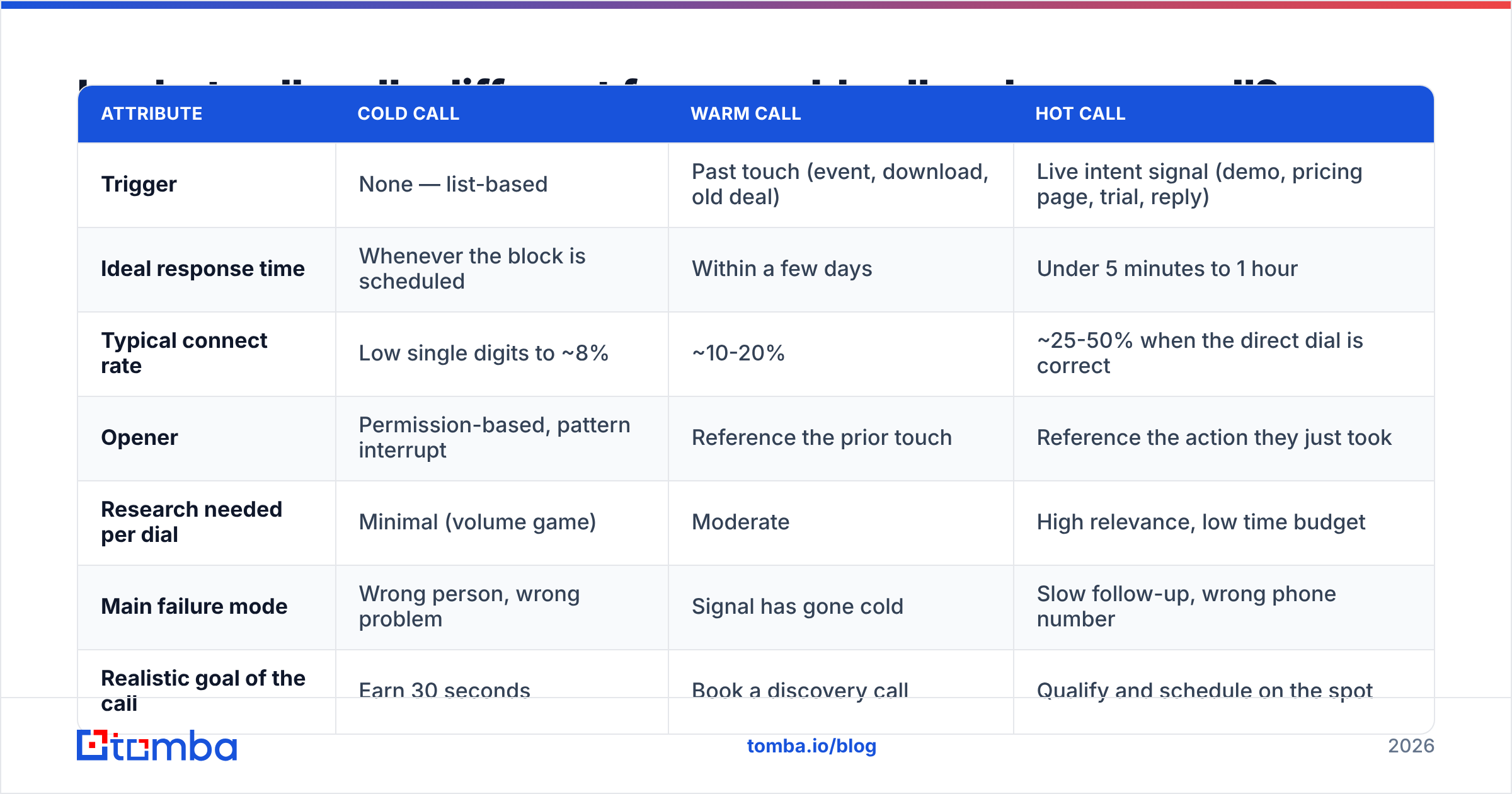
Yes, and the differences are measurable. Here is how the three stack up on the attributes that actually change your day.
| Attribute | Cold call | Warm call | Hot call |
|---|---|---|---|
| Trigger | None — list-based | Past touch (event, download, old deal) | Live intent signal (demo, pricing page, trial, reply) |
| Ideal response time | Whenever the block is scheduled | Within a few days | Under 5 minutes to 1 hour |
| Typical connect rate | Low single digits to ~8% | ~10-20% | ~25-50% when the direct dial is correct |
| Opener | Permission-based, pattern interrupt | Reference the prior touch | Reference the action they just took |
| Research needed per dial | Minimal (volume game) | Moderate | High relevance, low time budget |
| Main failure mode | Wrong person, wrong problem | Signal has gone cold | Slow follow-up, wrong phone number |
| Realistic goal of the call | Earn 30 seconds | Book a discovery call | Qualify and schedule on the spot |
The connect-rate figures above are ranges teams commonly report, not laws of physics — your ICP, region, and mobile-versus-landline mix will move them substantially. What is consistent across teams is the direction: intent-triggered dials convert several times better than list dials, and nearly all of that advantage evaporates if you wait.
Note the row that quietly decides the outcome: wrong phone number. A hot lead you cannot reach is worth exactly the same as a cold lead you never called. This is why the hot-call conversation is really a data conversation wearing a sales hat.
What actually makes a lead hot enough to call?#
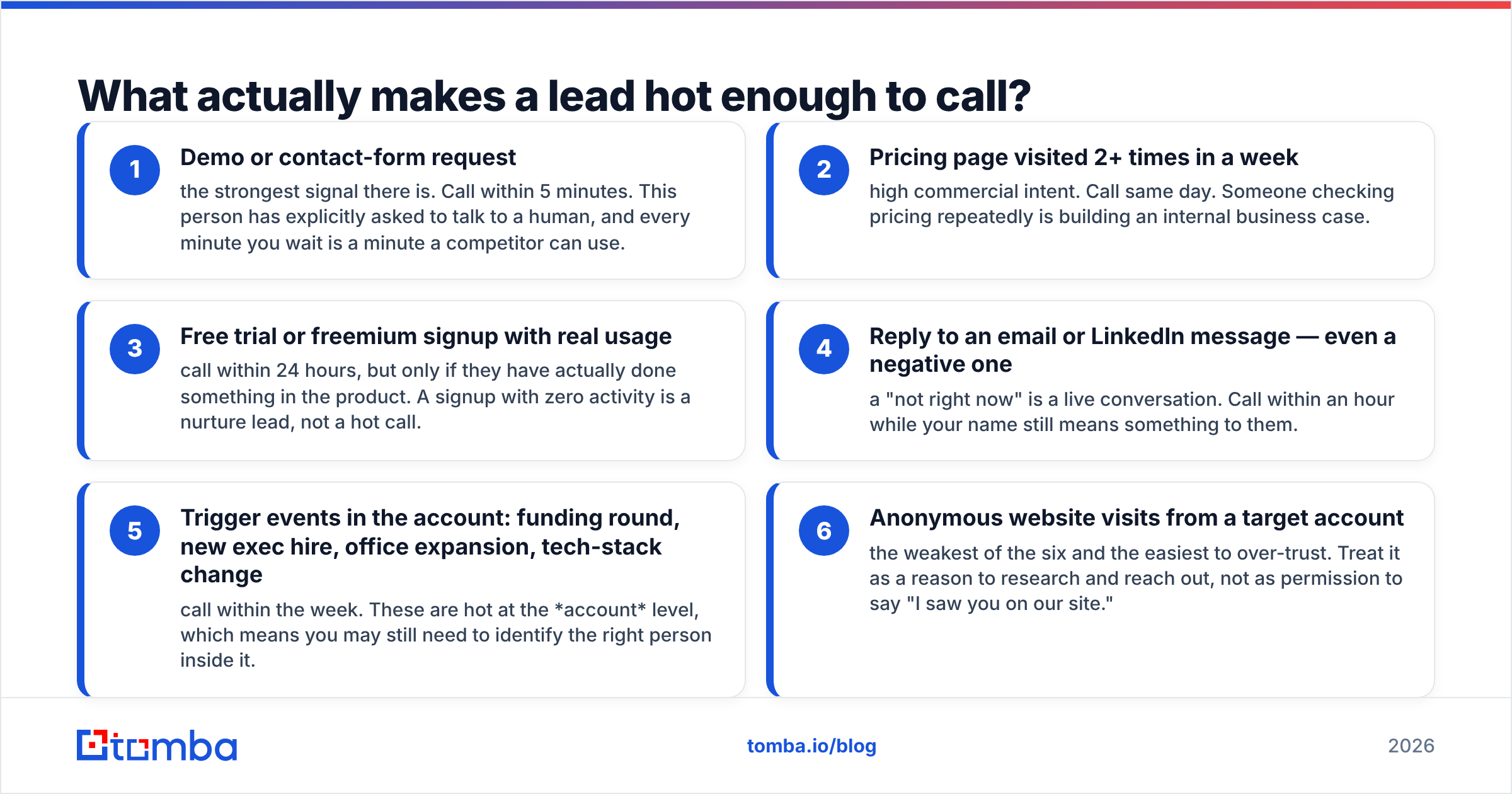
Not every signal deserves a phone call. Dialing a person because they opened an email twice is how you burn a good account. Rank your triggers into tiers and attach a response SLA to each one.
- Demo or contact-form request — the strongest signal there is. Call within 5 minutes. This person has explicitly asked to talk to a human, and every minute you wait is a minute a competitor can use.
- Pricing page visited 2+ times in a week — high commercial intent. Call same day. Someone checking pricing repeatedly is building an internal business case.
- Free trial or freemium signup with real usage — call within 24 hours, but only if they have actually done something in the product. A signup with zero activity is a nurture lead, not a hot call.
- Reply to an email or LinkedIn message — even a negative one — a "not right now" is a live conversation. Call within an hour while your name still means something to them.
- Trigger events in the account: funding round, new exec hire, office expansion, tech-stack change — call within the week. These are hot at the account level, which means you may still need to identify the right person inside it.
- Anonymous website visits from a target account — the weakest of the six and the easiest to over-trust. Treat it as a reason to research and reach out, not as permission to say "I saw you on our site."
That sixth tier is where teams get burned. Website visitor identification tells you a company was on your site, not which of its 400 employees. If you use visitor identification to source hot calls, pair it with a step that maps the company to a plausible buyer and confirms the contact before dialing. Otherwise you are cold calling a random person and calling it intent data.
How do you find the right number fast enough for a hot call?#
This is the operational heart of it. You have a five-minute window and a name. You need a phone number that rings the person's actual pocket.
Three approaches, in ascending order of reliability:
Guess-and-dial the main line. Free, slow, and a good way to talk to a receptionist who has been trained to stop you. Fine for very small companies, useless above 50 headcount.
Use whatever number was on the form. Often the best option — if the field was required. If it was optional, half your leads left it blank or typed 555-0100.
Enrich the record automatically. The moment a lead hits your CRM, look up a direct dial and a verified work email in the same step. A phone finder that returns a direct line, plus a phone validator pass to confirm the line is live and correctly formatted for the country, removes most of the friction. Route the enriched record straight into the dialer so the rep sees a number, not a research task.
The reason to enrich at intake rather than at dial time is simple: enrichment takes seconds, but a rep who has to go hunting takes minutes, and the whole premise of a hot call is that minutes are the currency. Wire it into the flow with a HubSpot integration or a Zapier integration so the lookup fires on form submit, before a human ever sees the record.
Always keep an email fallback. Some buyers will not answer an unknown number no matter how hot they are — screening is the default behavior for a large share of professionals. A voicemail plus an email referencing the same trigger, sent within the same minute, roughly doubles the odds of a response compared to either alone. Run the address through an email verifier first so your fallback does not bounce into a spam folder.
What does a hot call actually sound like?#
Cold-call openers are built to survive hostility. Hot-call openers are built to confirm context and get to the point. Using a cold opener on a hot lead is the single most common self-inflicted wound in this motion — it signals that you did not know why you were calling.
A workable structure:
Name the trigger in the first sentence. "Hi Dana — it's Marcus from Northline. You just requested a demo about two minutes ago, so I figured I'd save you the scheduling link and just call."
Give them the exit. "Is now a terrible time?" Not "do you have a minute" — that reads as a trap. Genuinely offering the out makes people stay.
Ask what prompted it. "What made you look today?" is the highest-yield question in the whole call. The answer gives you the compelling event, the timeline, and usually the budget owner.
Qualify lightly, then book. Do not attempt a full discovery on an inbound hot call. Confirm fit, confirm they are the right person, put 30 minutes on the calendar while you have them.
Confirm on the spot. Send the invite while still on the phone and get verbal confirmation it landed. Calendar invites sent after the call get ignored at a much higher rate.
For the account-level triggers — funding, exec hires — you cannot reference the buyer's own action, so reference the company's. "Saw the Series B closed last month, congratulations. Usually when that happens the RevOps team gets asked to double outbound capacity in a quarter. Is that landing on your desk?" Specific, relevant, and it does not pretend you have a relationship you do not have.
How fast is fast enough?#
Speed-to-lead research has been remarkably stable for two decades: the odds of a meaningful conversation drop off a cliff within the first hour, and the decay is steepest in the first ten minutes. HubSpot's sales statistics roundup and most vendor benchmarks converge on the same shape of curve, even when the exact multipliers differ.
The practical implication is not "call faster" — everyone knows that. It is "remove the humans from the parts that don't need humans."
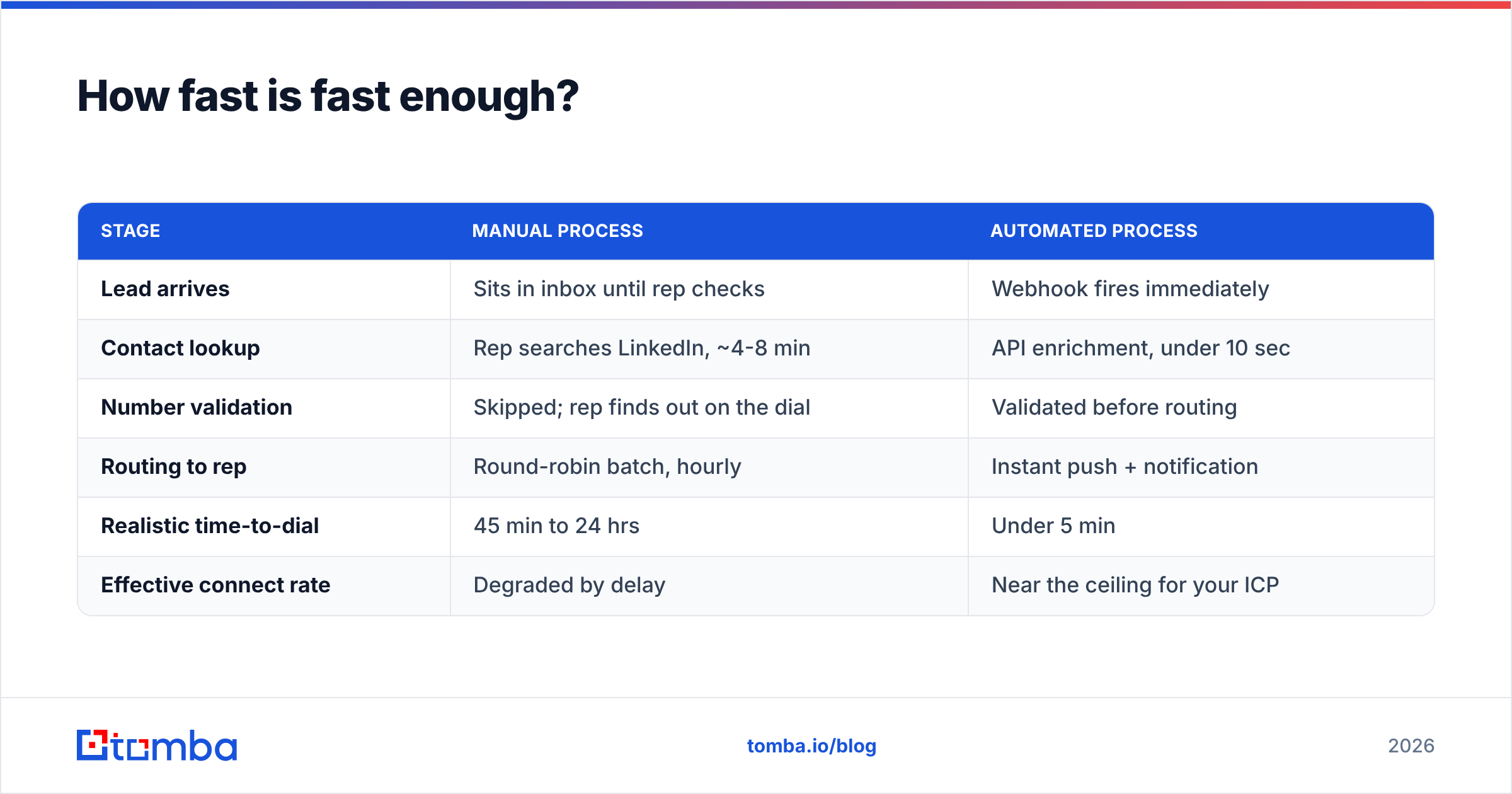
| Stage | Manual process | Automated process |
|---|---|---|
| Lead arrives | Sits in inbox until rep checks | Webhook fires immediately |
| Contact lookup | Rep searches LinkedIn, ~4-8 min | API enrichment, under 10 sec |
| Number validation | Skipped; rep finds out on the dial | Validated before routing |
| Routing to rep | Round-robin batch, hourly | Instant push + notification |
| Realistic time-to-dial | 45 min to 24 hrs | Under 5 min |
| Effective connect rate | Degraded by delay | Near the ceiling for your ICP |
Nothing in the right-hand column is exotic. It is a webhook, an enrichment call, a validation check, and a notification. Most teams already own every piece and have simply never connected them.
Also fix the boring thing: your call SLA should be written down, monitored, and reported. Gartner's research on sales operations has hammered the same point for years — the teams that outperform are the ones that measure process compliance, not just outcomes.
Which metrics tell you your hot calls are working?#
Track four numbers, and track them separately from your cold-call metrics. Mixing them produces averages that describe nothing.
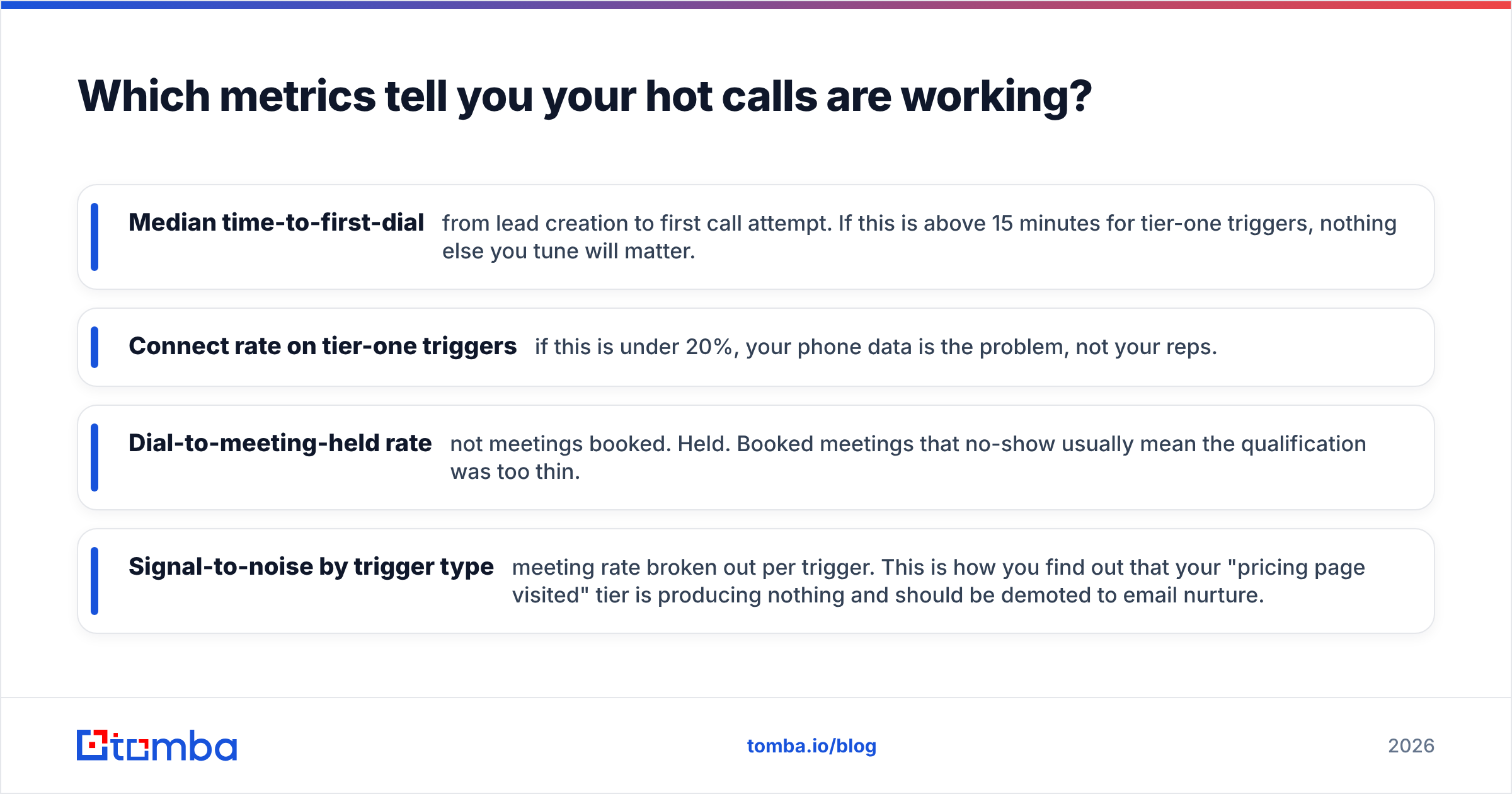
- Median time-to-first-dial — from lead creation to first call attempt. If this is above 15 minutes for tier-one triggers, nothing else you tune will matter.
- Connect rate on tier-one triggers — if this is under 20%, your phone data is the problem, not your reps.
- Dial-to-meeting-held rate — not meetings booked. Held. Booked meetings that no-show usually mean the qualification was too thin.
- Signal-to-noise by trigger type — meeting rate broken out per trigger. This is how you find out that your "pricing page visited" tier is producing nothing and should be demoted to email nurture.
Review the per-trigger breakdown monthly and prune ruthlessly. A tier that produces a sub-2% meeting rate is not a hot signal — it is a list, and it belongs in a different motion. The same discipline applies to your response rate on the email fallback: if it drops, your data quality has drifted before your messaging has.
What are the most common hot call mistakes?#
Treating every download as hot. An ebook download from someone in a non-buying role is not intent. It is curiosity. Calling it hot inflates your numbers and trains reps to distrust the tier system.
Being creepy about the data. "I noticed you spent four minutes on our pricing page" is technically true and socially disqualifying. Reference actions the buyer knowingly took toward you — forms, replies, signups — and use passive signals only to prioritize your own effort.
Calling once and giving up. Hot does not mean available. Three attempts across two days, at different times, with a voicemail and an email on the first attempt, is the floor.
No coverage plan. If your hot leads arrive at 8pm on a Friday and your first dial is Monday at 10am, you do not have a hot-call motion. You have a warm-call motion with better branding.
Dialing before enriching. A rep who dials a switchboard on a five-minute-old demo request has spent the window and gained nothing. Enrich first — it costs seconds and saves the lead.
Reusing the cold-call script. Nothing kills a hot conversation faster than a permission-based cold opener aimed at someone who literally just asked you to call. Peer reviews on G2 are full of teams who blamed their dialer for what was really a script-routing problem.
How do you build the system in a week?#
Start narrow. Pick your single strongest trigger — usually the demo request — and instrument it end to end: webhook on submit, automatic contact enrichment, number validation, instant rep notification, written five-minute SLA, and a dedicated opener. Measure time-to-first-dial for two weeks.
Once that one path is clean, add the next tier. Do not try to instrument six triggers at once; you will end up with six half-built paths and no reliable data about which of them works.
For account-level triggers where you have a company but not a person, work backwards from the domain. A domain search surfaces the people in the relevant function, and enrichment fills in the direct line. For volume work — a funding-round list, a conference attendee list — run the whole batch through a bulk email finder before your reps touch it, so the first thing they see is a clean, dialable record.
Hot calls are a data problem disguised as a phone problem. The script matters, the timing matters more, but neither survives a wrong number. Start every hot lead with a verified contact record: use the Tomba Email Finder to lock down the right work email and direct-dial details in seconds, then let your reps spend their five-minute window talking instead of searching. The free tier includes 25 searches a month if you want to test the workflow on real leads before wiring it into your stack — see Tomba pricing for higher volumes.
Related guides#
Ready to find emails that actually work?
Join 150,000+ professionals who stopped guessing and started sending. Free credits on signup — no credit card required.
Get the Tomba newsletter
Practical outbound tactics and product updates — once every two weeks.
About the author