Hot Call vs Cold Call: Which Actually Books More Meetings
Hot calls convert 3-8x better than cold calls, but they don't scale on their own. Here's the honest breakdown of when each one wins, what the numbers look like, and how to build a call list that gets warm before you dial.
TL;DR
- A cold call targets someone with zero prior relationship or signal. A hot call targets someone who already raised a hand — demo request, pricing-page visit, webinar signup, referral, or an expired-contract trigger.
- Hot calls typically convert to a meeting at 15-30% of connects; cold calls land closer to 2-5%. But hot leads are a tiny fraction of your addressable market, so cold volume still fills the top.
- The real answer is not "pick one." It's temperature-tiering your list: route hot signals to your best rep within minutes, and run cold volume against a researched, verified list with a specific reason to call.
- Bad data destroys both. A wrong number burns a hot lead permanently and wastes 40% of a cold dialing hour.
- Build the bridge: use intent signals plus accurate contact data to turn "cold" into "warm enough" before you dial.
What is a cold call, exactly?#
A cold call is an outbound phone call to a prospect who has had no prior meaningful contact with you or your company. They did not request information, did not download anything, and have never spoken to a rep. You picked them because they fit an ideal customer profile.
The defining trait is not rudeness or randomness — it's the absence of a prior signal. A well-researched cold call to a VP of Ops at a 200-person logistics firm, referencing their new warehouse opening, is still a cold call. It's just a good one.
What cold calls actually cost you:
- Connect rate — roughly 3-8% of dials reach a human on a mobile-heavy B2B list, higher if your numbers are direct dials rather than switchboards.
- Gatekeepers and voicemail — the majority of your dialing hour goes to no-answers, not conversations.
- Rep morale — the rejection rate is the highest of any prospecting channel, which is why cold calling teams churn faster.
- Data decay — B2B contact data goes stale at roughly 25-30% per year as people change jobs, so a list you bought in January is measurably worse by June.
What is a hot call, and what makes it hot?#
A hot call is a phone call to someone who has already produced a buying signal. The temperature comes from the signal, not from the script.
Signals that legitimately make a call hot:
- Inbound request — demo form, "contact sales," pricing inquiry. The strongest signal you'll ever get.
- High-intent product behavior — free-trial signup, repeated pricing-page visits, an integration connected, a seat limit hit.
- Referral or mutual connection — a customer named them, or a shared contact made an intro.
- Trigger event — funding round, new exec hire in your buyer persona, a competitor contract renewal date, a job posting that implies the pain you solve.
- Re-engagement — a closed-lost deal from 9 months ago whose blocker just changed (budget freed, champion promoted).
The distinction that matters commercially: an inbound demo request is hot because of stated intent. A pricing-page visit is warm because of inferred intent. Treating inferred intent like stated intent — "I saw you were on our site!" — is the fastest way to make a warm lead cold again.
Hot call vs cold call: how do the numbers compare?#
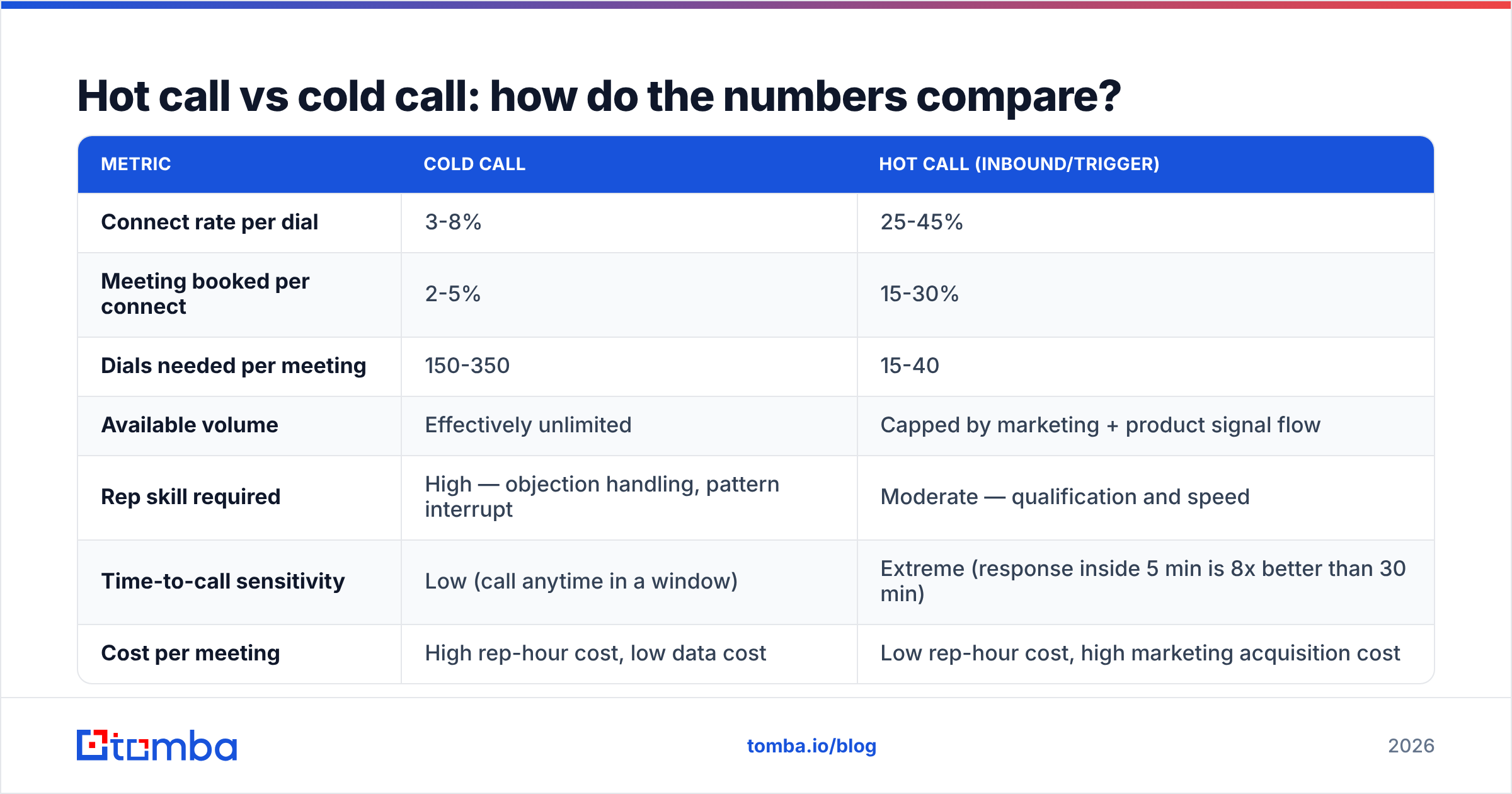
Here's the honest side-by-side. Ranges reflect typical mid-market B2B SaaS teams; your mileage varies by industry and list quality.
| Metric | Cold call | Hot call (inbound/trigger) |
|---|---|---|
| Connect rate per dial | 3-8% | 25-45% |
| Meeting booked per connect | 2-5% | 15-30% |
| Dials needed per meeting | 150-350 | 15-40 |
| Available volume | Effectively unlimited | Capped by marketing + product signal flow |
| Rep skill required | High — objection handling, pattern interrupt | Moderate — qualification and speed |
| Time-to-call sensitivity | Low (call anytime in a window) | Extreme (response inside 5 min is 8x better than 30 min) |
| Cost per meeting | High rep-hour cost, low data cost | Low rep-hour cost, high marketing acquisition cost |
| Typical owner | SDR / BDR outbound pod | AE or inbound SDR |
| Best-fit deal size | Any, especially undifferentiated markets | Mid-to-high ACV where intent is scarce |
Two things jump out of this table.
First, hot calls win on efficiency by roughly an order of magnitude. If you have hot leads sitting unworked in a queue while reps grind cold lists, you're actively destroying pipeline value.
Second, hot calls do not scale on command. You can decide to make 200 cold calls tomorrow. You cannot decide to receive 200 demo requests tomorrow. That asymmetry is why every serious outbound team runs both.
Is speed-to-lead really the deciding factor?#
For hot calls, yes — more than script, more than seniority.
The Harvard Business Review lead response study remains the most-cited data here: firms that contacted a lead within an hour were roughly 7x more likely to have a meaningful conversation with a decision-maker than those who waited even two hours, and 60x more likely than firms waiting 24+ hours. A decade and a half later, buyer patience has not increased.
The practical implication: your routing matters more than your pitch. If a demo request lands at 2:14pm and a rep dials at 4:30pm, you've converted a hot call into a lukewarm one and thrown away most of the advantage. Build the alert into Slack, not into a daily digest.
For cold calls, timing works differently. There's no clock ticking on a lead who doesn't know you exist. What matters instead is cadence density — cold prospects typically need 6-9 touches across phone, email, and LinkedIn before they engage. One cold call with no follow-up is close to wasted effort.
Which one should your team prioritize in 2026?#
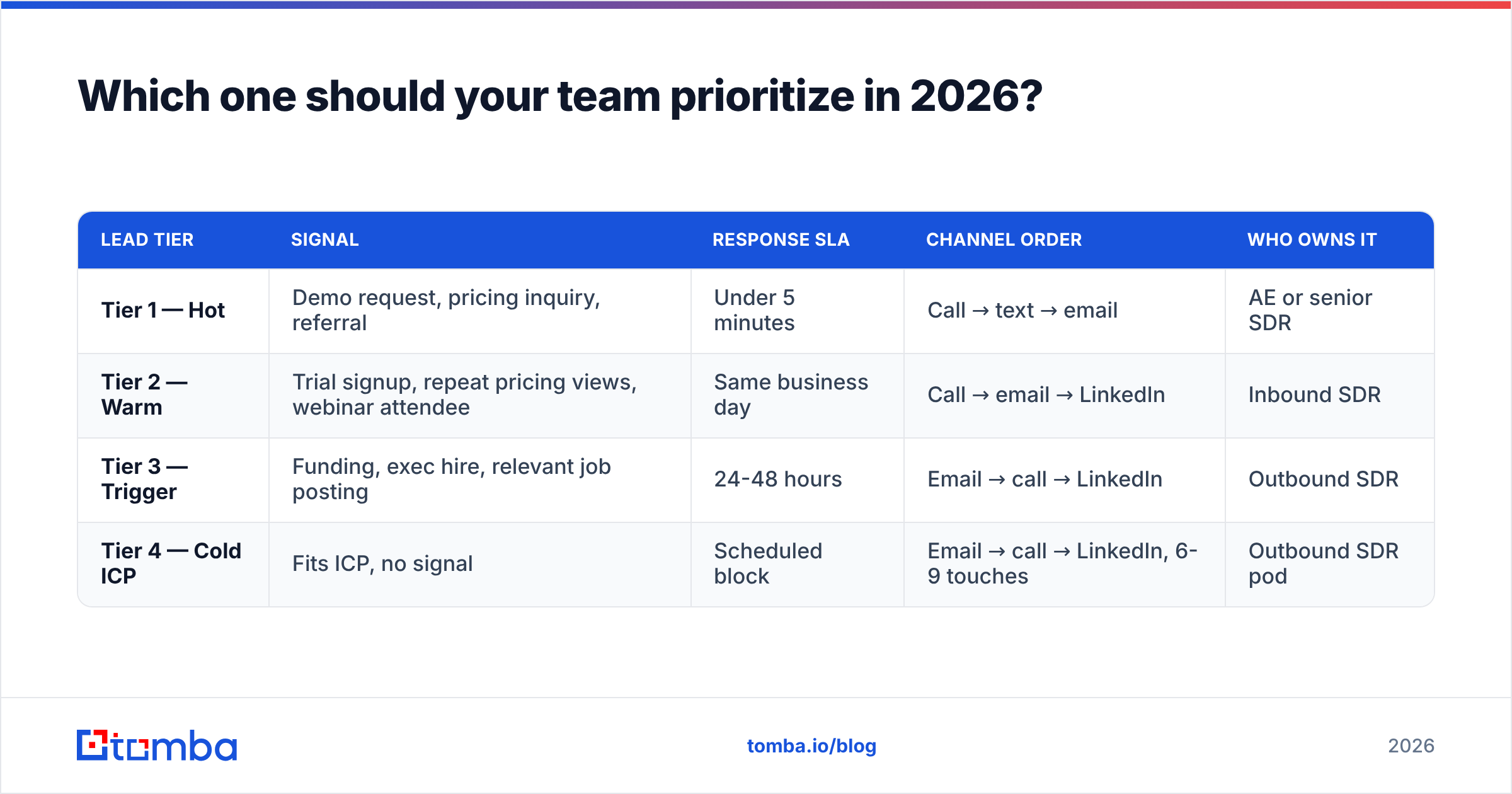
Prioritize by tier, not by preference. Here's the allocation model that holds up across most B2B teams:
| Lead tier | Signal | Response SLA | Channel order | Who owns it |
|---|---|---|---|---|
| Tier 1 — Hot | Demo request, pricing inquiry, referral | Under 5 minutes | Call → text → email | AE or senior SDR |
| Tier 2 — Warm | Trial signup, repeat pricing views, webinar attendee | Same business day | Call → email → LinkedIn | Inbound SDR |
| Tier 3 — Trigger | Funding, exec hire, relevant job posting | 24-48 hours | Email → call → LinkedIn | Outbound SDR |
| Tier 4 — Cold ICP | Fits ICP, no signal | Scheduled block | Email → call → LinkedIn, 6-9 touches | Outbound SDR pod |
A rough time split that works for a full-cycle team: 20% of dialing hours reserved for Tier 1-2 (protected, interrupt-driven), 80% blocked for Tier 3-4 (batched, undisturbed). If Tier 1 volume grows past 20% of your hours, that's a good problem — hire an inbound-dedicated rep.
The mistake most teams make is running one undifferentiated call block. Reps burn their freshest energy on cold dials at 9am, then hit an inbound demo request at 3pm sounding exhausted. Reverse it.
How do you make a cold call less cold?#
This is where the two categories blur, and where most of the upside sits. You cannot manufacture a demo request, but you can manufacture relevance, which does most of the same work.
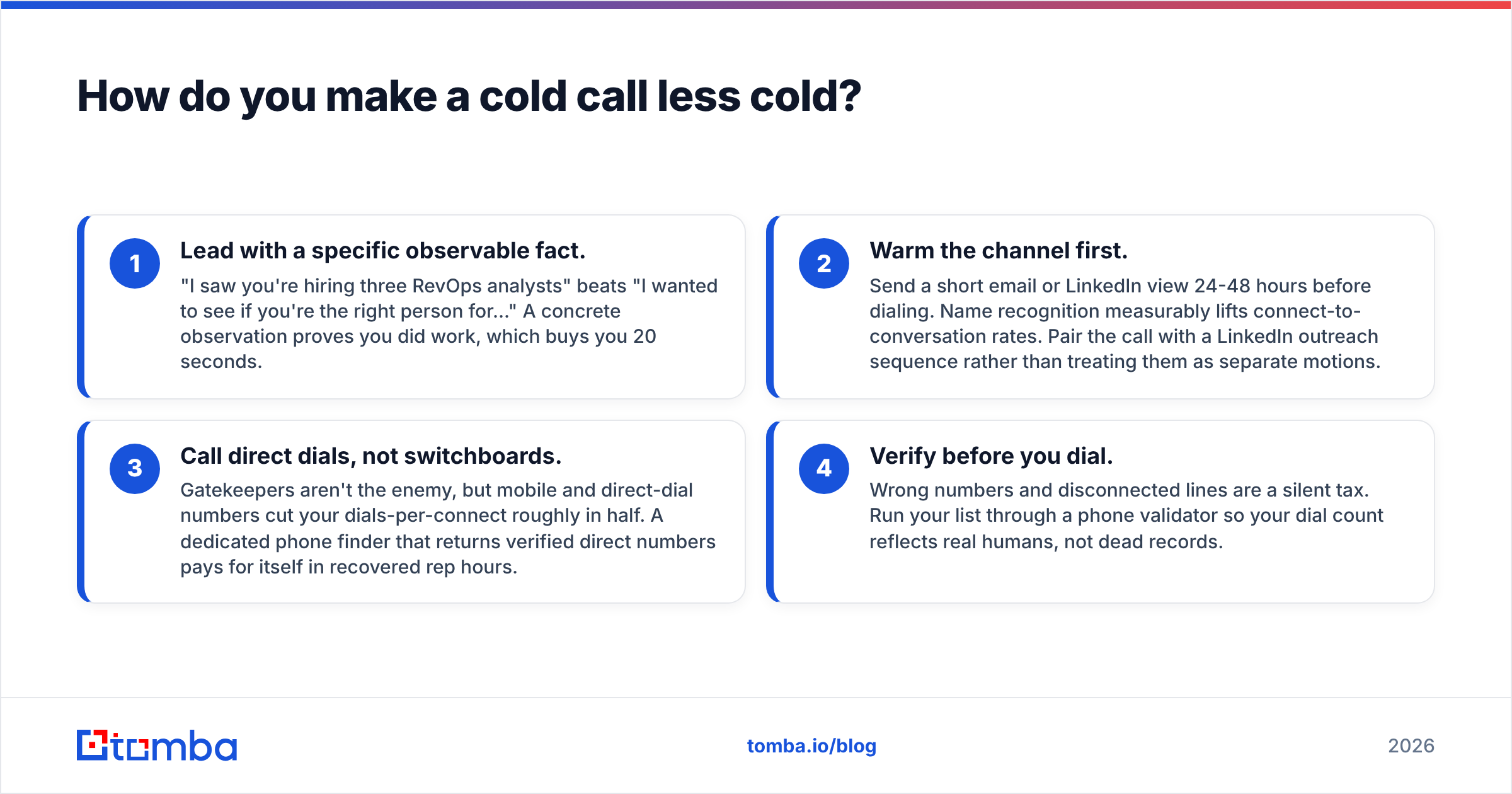
Four moves that reliably raise cold-call performance:
- Lead with a specific observable fact. "I saw you're hiring three RevOps analysts" beats "I wanted to see if you're the right person for..." A concrete observation proves you did work, which buys you 20 seconds.
- Warm the channel first. Send a short email or LinkedIn view 24-48 hours before dialing. Name recognition measurably lifts connect-to-conversation rates. Pair the call with a LinkedIn outreach sequence rather than treating them as separate motions.
- Call direct dials, not switchboards. Gatekeepers aren't the enemy, but mobile and direct-dial numbers cut your dials-per-connect roughly in half. A dedicated phone finder that returns verified direct numbers pays for itself in recovered rep hours.
- Verify before you dial. Wrong numbers and disconnected lines are a silent tax. Run your list through a phone validator so your dial count reflects real humans, not dead records.
Point four deserves emphasis. Industry research from G2 and vendor benchmarks consistently show sales reps spending well under a third of their week actually selling. A meaningful slice of the rest is data cleanup and bad dials. Fixing the list is cheaper than hiring another rep.
What data do you actually need for each call type?#
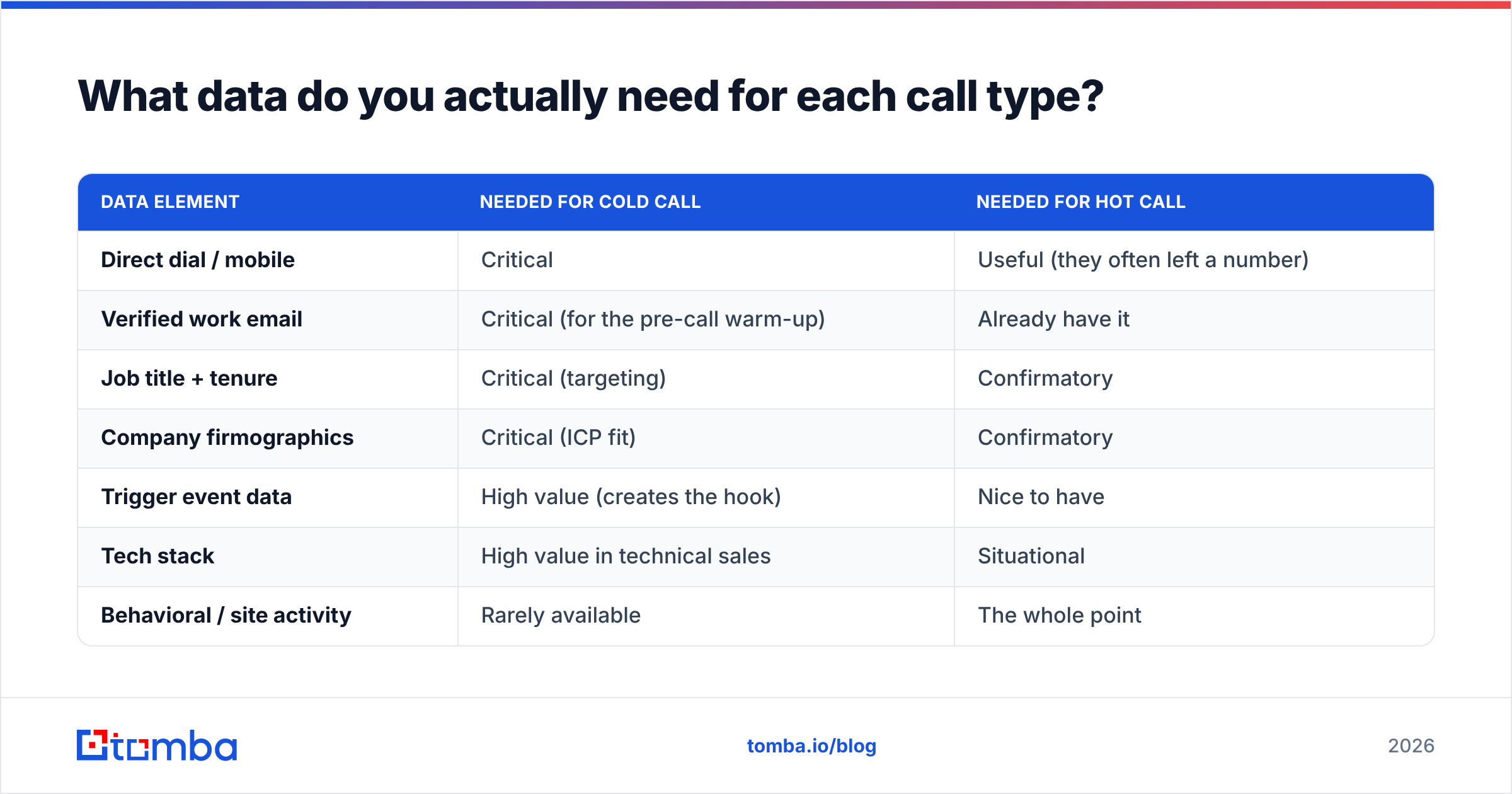
Different temperatures need different data.
| Data element | Needed for cold call | Needed for hot call |
|---|---|---|
| Direct dial / mobile | Critical | Useful (they often left a number) |
| Verified work email | Critical (for the pre-call warm-up) | Already have it |
| Job title + tenure | Critical (targeting) | Confirmatory |
| Company firmographics | Critical (ICP fit) | Confirmatory |
| Trigger event data | High value (creates the hook) | Nice to have |
| Tech stack | High value in technical sales | Situational |
| Behavioral / site activity | Rarely available | The whole point |
For cold motions, the data is what creates the opening. That means firmographics and a working number are table stakes, and a trigger event is the differentiator. Sourcing that at scale usually means a B2B database plus enrichment on top, not manual LinkedIn scrolling.
For hot motions, the data is confirmatory — you're checking who they are so you don't waste the first 90 seconds asking. Data enrichment that fires the moment a form is submitted lets a rep open with context instead of discovery questions.
If your inbound form only captures an email address, reverse email lookup fills in the name, role, and company before the rep picks up the phone. That's a two-second automation that changes the entire tone of the first call.
Can you turn website visitors into hot calls?#
Partially, and it's worth understanding the limits honestly.
Visitor identification resolves anonymous traffic to a company — not usually to a named individual, and generally not for consumer-ISP traffic or privacy-restricted regions. So a "hot call" built on visitor data is really a warm call: you know Acme Corp read your pricing page three times, but you don't know it was the CFO.
That's still valuable. It converts a Tier 4 cold account into a Tier 3 trigger account. You then pick the right persona at that company and call with a relevant hypothesis rather than a generic pitch.
What it isn't: a license to open with "I noticed you were on our website." That reads as surveillance to most buyers and kills more calls than it opens. Use the signal for targeting, and keep the opener about their business problem.
What does each call actually sound like?#
Cold call opener (specific, permission-based):
"Hi Sarah, it's Marc from Tomba. Complete cold call — I saw you posted two SDR roles last month. Can I take 30 seconds to say why I called, and you tell me if it's relevant?"
Direct, names the cold nature, references a fact, asks for a small yes. The pattern-interrupt of admitting it's cold outperforms pretending it isn't.
Hot call opener (fast, contextual, no surveillance vibes):
"Hi Sarah, Marc from Tomba — you just asked about a demo, so I figured I'd call instead of making you wait for an email. Two minutes to hear what prompted it?"
Speed is the message. The subtext is "we're responsive," which is itself a product signal for the buyer.
Two structural differences: cold calls need explicit permission before pitching; hot calls need immediate qualification because the buyer already granted permission by raising a hand. And where cold calls lean on objection handling, hot calls lean on discovery — the buyer's response rate is already proven, so your job is fit, not persuasion.
Which one wins? The honest verdict#
Hot calls win per attempt. Cold calls win per addressable market. A team running only hot calls is capped by marketing spend; a team running only cold calls is paying full price for every meeting.
Choose based on your constraint:
- Inbound volume exceeds rep capacity? Stop cold calling. Fix routing and speed-to-lead first. You're leaving cheap pipeline on the floor.
- Inbound volume is thin and ACV is above ~$15k? Cold calling is still one of the highest-ROI channels available, provided your list and numbers are clean.
- Low ACV, high volume, undifferentiated market? Cold email plus cold calling on the responders. Pure cold dialing rarely pencils out below a few thousand dollars ACV.
- Long sales cycle with named accounts? Trigger-based Tier 3 calling beats both. You're not waiting for inbound and you're not spraying.
The teams that outperform don't debate hot vs cold. They industrialize the middle: they find the accounts worth calling, enrich them until a cold call carries warm-call relevance, and reserve human attention for the signals that deserve it.
Get the contact data that makes every call warmer#
The difference between a cold call and a hot call is information — and most of that information is available before you dial. Verified direct emails, accurate direct-dial numbers, real job titles, and company context turn a generic list into a set of specific, defensible reasons to pick up the phone.
Start with Tomba Email Finder to build a clean, verified contact base for your target accounts, then layer phone and enrichment data on top. The free tier gives you 25 searches a month to test accuracy on your own list before committing; paid plans start at $49/mo, with Growth at $99/mo for teams running real outbound volume. Full Tomba pricing is public — no sales call required to see it, which feels like the right way to open a post about calling.
Related guides#
Ready to find emails that actually work?
Join 150,000+ professionals who stopped guessing and started sending. Free credits on signup — no credit card required.
Get the Tomba newsletter
Practical outbound tactics and product updates — once every two weeks.
About the author