How Do Digital Agencies Get Clients? 9 Channels That Work
Referrals dry up. Cold outreach scales but breaks if your data is bad. Here's how digital agencies actually get clients in 2026 — nine channels ranked by cost, speed, and close rate.
TL;DR
- Most agencies get their first 10 clients from referrals and their next 100 from a repeatable outbound or content engine. Referrals do not scale on demand — they arrive when they arrive.
- The three channels with the best cost-per-client for agencies under $5M: targeted cold email, partner/white-label referrals, and narrow-niche content that ranks.
- Cold email still works in 2026, but only with verified contact data. A 12% bounce rate kills the domain before the offer ever gets tested.
- Marketplaces (Clutch, Upwork, agency directories) buy you volume at the cost of margin. Use them to fill gaps, not to build the business.
- The fastest fix for most agencies is not a new channel — it is niching down so the same outreach converts 3-4x better.
Why is "how do digital agencies get clients" such a hard question?#
Because the honest answer is "it depends on what stage you're at," and nobody wants to hear that.
An agency at $200K/year and an agency at $4M/year are solving different problems. The first needs any repeatable channel at all. The second needs to replace the founder as the primary rainmaker before growth caps out. A tactic that works brilliantly for one is a waste of budget for the other.
There's also survivorship noise. The agency owner on LinkedIn saying "we've never done outbound, it's all inbound" usually built that inbound over eight years, from a personal audience, in a niche that was uncontested in 2018. That's not a playbook you can copy this quarter.
So here's the framing that actually helps: every client-acquisition channel has four properties — cost per client, ramp time, ceiling, and founder dependency. Pick channels whose ramp time matches your runway and whose ceiling matches your target.
What are the nine channels agencies actually use?#
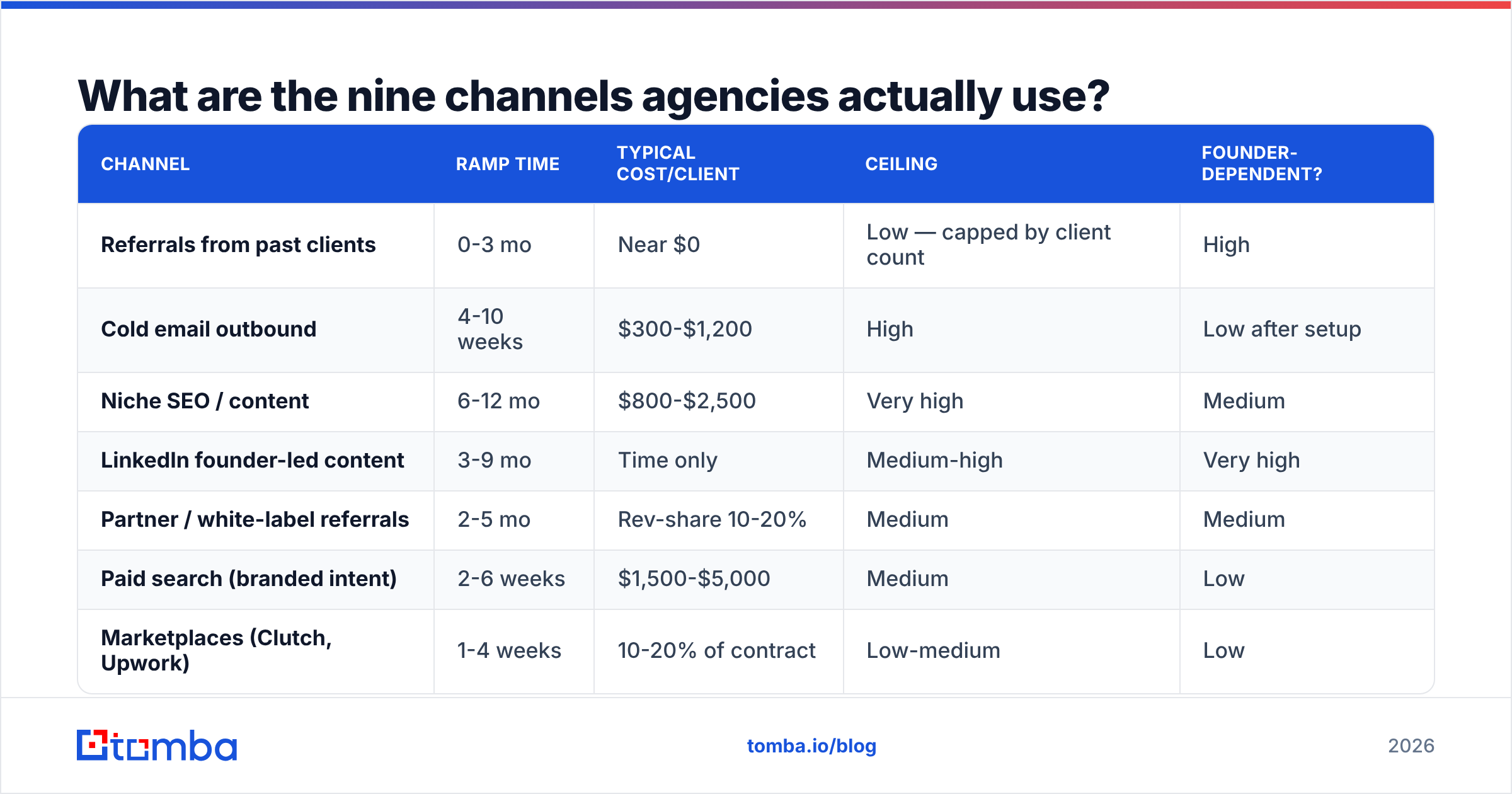
Here's the full landscape, honestly rated. "Ramp time" means how long before the channel produces its first closed client, assuming competent execution.
| Channel | Ramp time | Typical cost/client | Ceiling | Founder-dependent? |
|---|---|---|---|---|
| Referrals from past clients | 0-3 mo | Near $0 | Low — capped by client count | High |
| Cold email outbound | 4-10 weeks | $300-$1,200 | High | Low after setup |
| Niche SEO / content | 6-12 mo | $800-$2,500 | Very high | Medium |
| LinkedIn founder-led content | 3-9 mo | Time only | Medium-high | Very high |
| Partner / white-label referrals | 2-5 mo | Rev-share 10-20% | Medium | Medium |
| Paid search (branded intent) | 2-6 weeks | $1,500-$5,000 | Medium | Low |
| Marketplaces (Clutch, Upwork) | 1-4 weeks | 10-20% of contract | Low-medium | Low |
| Events & conferences | 3-6 mo | $2,000-$8,000 | Low | High |
| Cold calling | 3-8 weeks | $400-$1,500 | Medium | Low |
Two patterns jump out. First, the cheapest channels (referrals, founder content) are the most founder-dependent — they don't survive you taking a month off. Second, the channels that scale cleanly (cold email, paid, marketplaces) all cost real money per client. There is no free scalable channel. Anyone selling you one is selling you something.
Is cold email still worth it for agencies in 2026?#
Yes — with two conditions that most agencies fail.
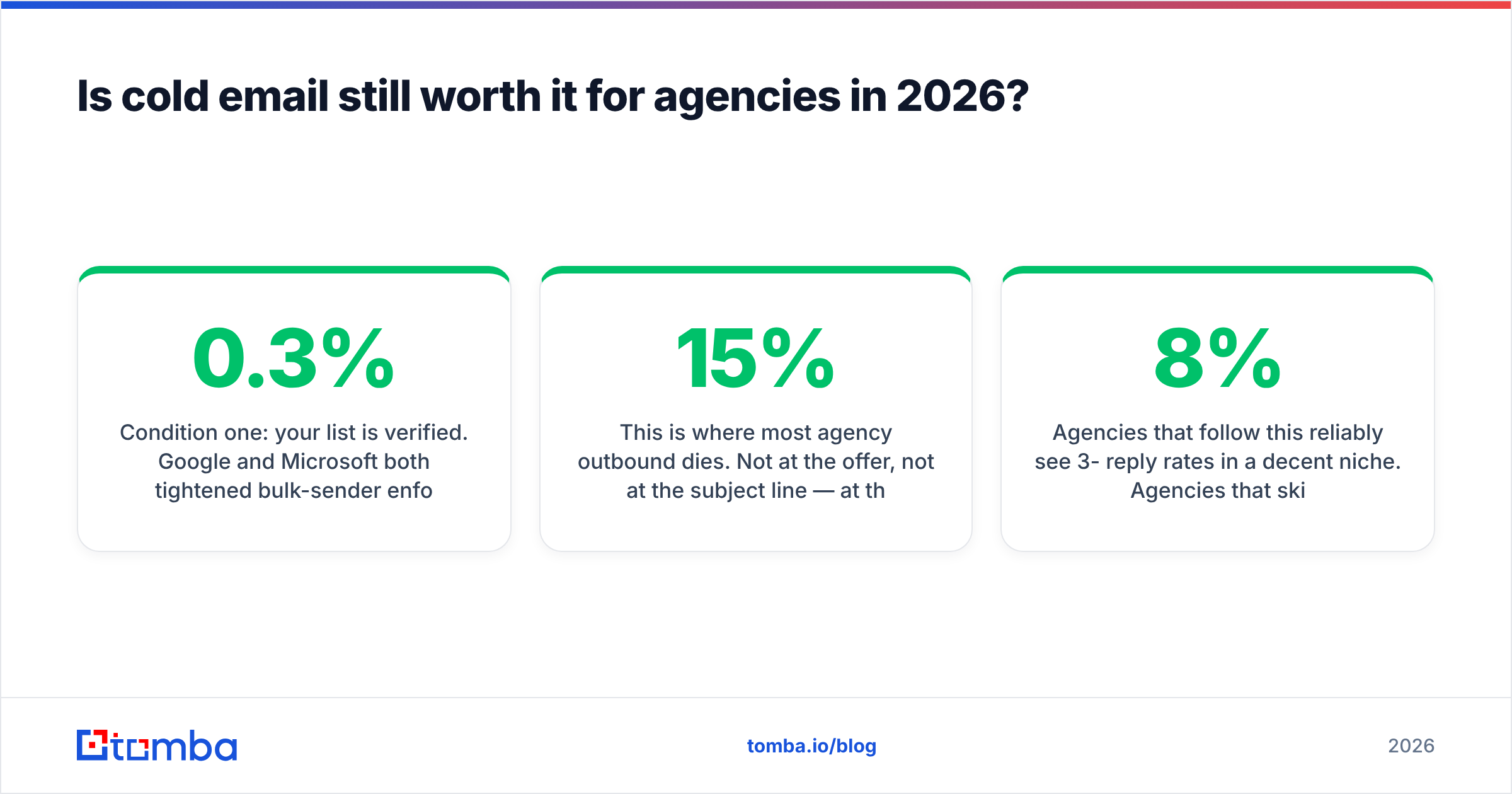
Condition one: your list is verified. Google and Microsoft both tightened bulk-sender enforcement in 2024 and have kept ratcheting since. Google's own sender guidelines set a hard spam-complaint ceiling of 0.3%, and bounce rates above roughly 3-5% start suppressing your inbox placement quietly, before anything visibly breaks. Agencies that scrape a list from a directory and blast it are burning the sending domain in week two.
This is where most agency outbound dies. Not at the offer, not at the subject line — at the data. If 15% of your addresses are stale or guessed, you never learn whether the pitch works, because the pitch never lands. Run every list through an email verifier before the first send, and re-verify anything older than 90 days. B2B contact data decays at roughly 22-30% per year as people change jobs.
Condition two: you're specific about who you're emailing. "Marketing directors at SaaS companies" is not a segment. "Head of demand gen at Series A-B vertical SaaS companies that just hired their first SDR" is a segment, and you can write one email that lands for all of them.
The practical workflow that works:
- Define the trigger, not the persona. New funding round, new VP of Marketing, a job posting for a role your service replaces, a site running a competitor's tech stack. Triggers give you a reason to email today.
- Build the company list first, contacts second. Get 200-400 companies matching the trigger, then use domain search to pull the relevant roles at each one rather than buying a generic list.
- Verify before you import. Every address, every time. Catch-all domains need their own handling — a catch-all verifier tells you which "accept-all" servers are actually safe to send to instead of blindly excluding them.
- Send from a secondary domain. Never your primary. Warm it for 3-4 weeks before volume.
- Write for the reply, not the meeting. "Is this on your roadmap for Q1?" outperforms "Do you have 15 minutes Thursday?" by a wide margin because it costs less to answer.
- Cap volume at 30-50 per inbox per day. More inboxes, not more volume per inbox.
Agencies that follow this reliably see 3-8% reply rates in a decent niche. Agencies that skip step 3 see 0.4% and conclude cold email is dead.

How do you pick the right channel for your agency's stage?#
Match the channel to your constraint, not to what's trendy.
Under $500K revenue — your constraint is cash and time. Referrals plus one outbound channel. Nothing else. You cannot afford a 9-month SEO ramp, and paid search will eat your margin before you've figured out which service line actually sells. Mine your existing network hard: past colleagues, past clients, vendors you've worked alongside. Then layer targeted cold email at low volume — 50-100 contacts a week, heavily researched.
$500K-$2M — your constraint is founder time. You're the salesperson and the delivery lead, and it's capping you. This is the stage to build a channel that runs without you: documented outbound with an SDR or a VA, plus the start of a content asset. Partner referrals also unlock here, because you finally have case studies worth referring.
$2M+ — your constraint is predictability. You need to forecast. That means multiple channels running simultaneously, tracked properly, with known cost-per-client per channel. This is where a real CRM discipline and RevOps ownership stop being optional. It's also where paid search on high-intent terms ("shopify agency," "hubspot implementation partner") starts to pencil out, because your close rate on inbound is high enough to justify $80 clicks.
The mistake at every stage is adding a channel before the current one is working. Three half-built channels produce less than one working one.
What does a niche actually do to your numbers?#
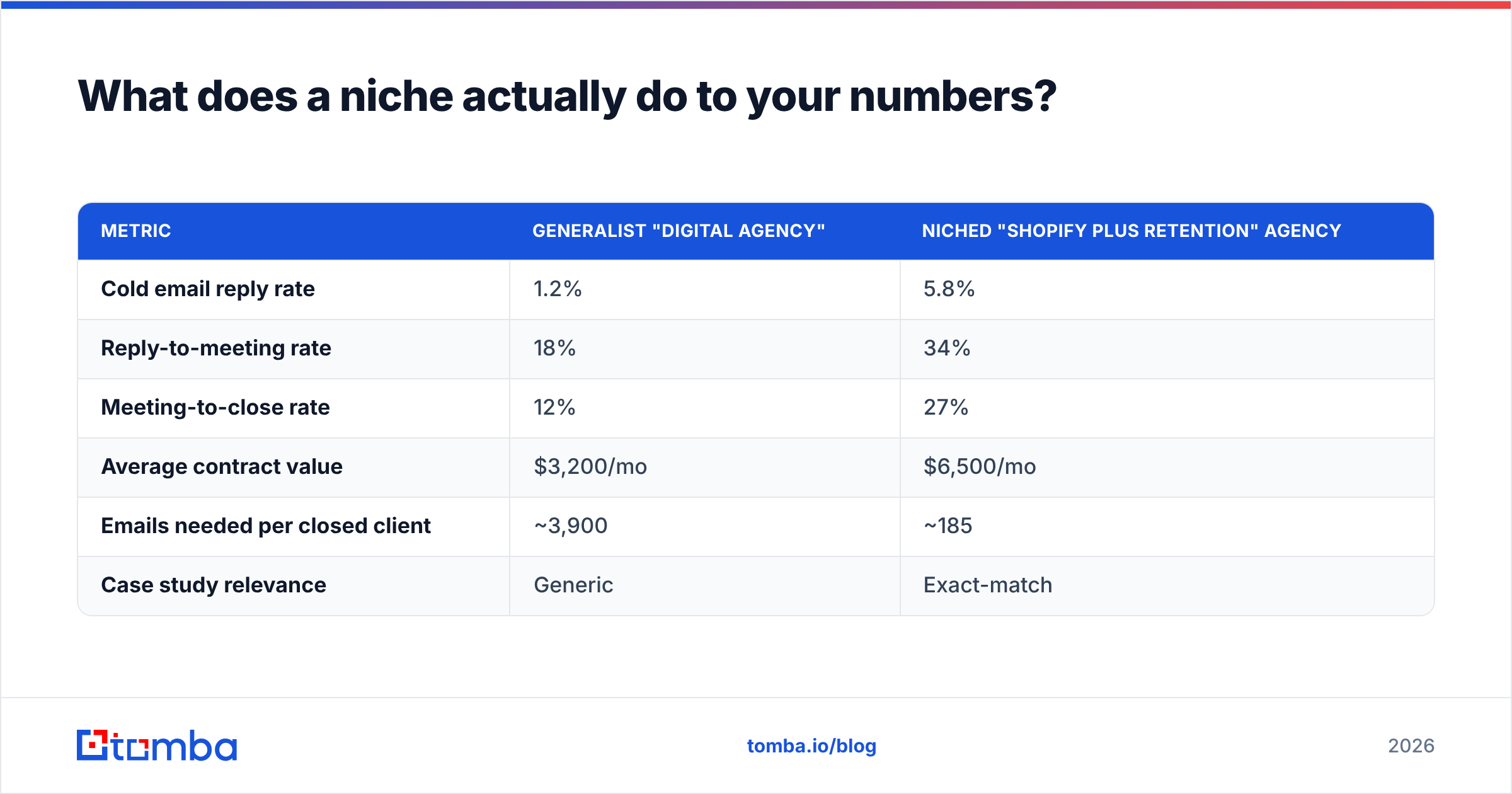
It multiplies everything. This is the single highest-leverage change available to most agencies, and it costs nothing to implement.
Compare two identical agencies running identical outbound:
| Metric | Generalist "digital agency" | Niched "Shopify Plus retention" agency |
|---|---|---|
| Cold email reply rate | 1.2% | 5.8% |
| Reply-to-meeting rate | 18% | 34% |
| Meeting-to-close rate | 12% | 27% |
| Average contract value | $3,200/mo | $6,500/mo |
| Emails needed per closed client | ~3,900 | ~185 |
| Case study relevance | Generic | Exact-match |
Those aren't outlier numbers — they're what happens when the recipient reads the first line and thinks "this is about me." The generalist has to overcome skepticism in every email. The specialist starts from credibility.
Niching also fixes your content problem. "Digital marketing tips" competes with HubSpot and every agency on earth. "Shopify Plus subscription churn benchmarks" competes with maybe four pages, and the people searching it have budget. G2's agency category listings are a useful reality check here — scroll them and count how many agencies describe themselves in words that could describe any of the others.
The objection is always "but we'll turn away work." You won't, at first. You'll just stop marketing to everyone. Existing clients outside the niche stay. New inbound outside the niche still converts. What changes is where your outbound and content point.
How do you build a referral engine instead of waiting for referrals?#
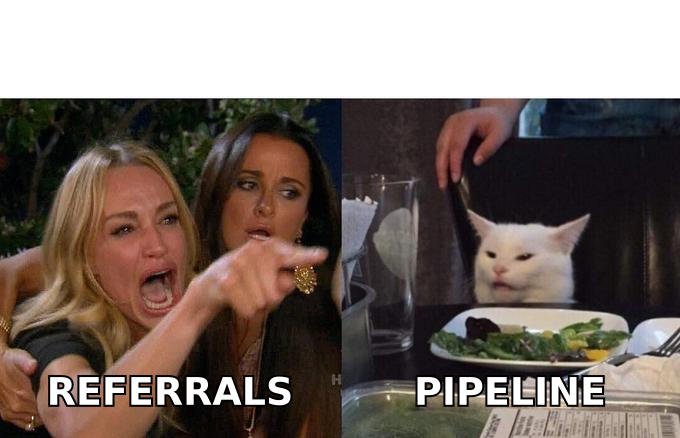
Referrals are the highest-converting channel and the one agencies treat most passively. "We get most of our work from referrals" usually means "we have no acquisition process and we're hoping."
Turn it into a system:
- Ask at the peak, not at the end. The best moment to ask for a referral is right after a win — a good report, a hit target, a renewal — not at the end of a project when everyone's tired.
- Ask for a specific introduction. "Do you know anyone who might need us?" gets nothing. "You mentioned your friend at [company] runs ecommerce — would an intro make sense?" gets a yes or a clean no.
- Build a partner list deliberately. Web dev shops, fractional CMOs, PE operating partners, adjacent agencies with a non-competing service. Ten good partners produce more than a hundred past clients. Find the decision-maker at each with a LinkedIn finder and approach them as a peer, not a prospect.
- Make the referral easy to make. Give partners a one-paragraph description of exactly who you help and what the trigger looks like. People don't refer because they can't remember what you do specifically enough to spot a fit.
- Close the loop, visibly. Tell the referrer what happened. People refer again when they see the referral mattered.
HubSpot's research on agency growth consistently shows referral and word-of-mouth as the top source for agencies under $1M, and it stays a top-three source well past that — but only for agencies that ask on purpose.
Which channels should most agencies skip?#
Some things eat budget and produce almost nothing for the average agency.
Cold DMs on LinkedIn at volume. Connection-request spam has burned this channel for cold prospecting. It still works as warm follow-up after someone engages with your content. It does not work as a primary channel from a cold start.
Broad paid search on generic terms. Bidding on "digital marketing agency" puts you against agencies with 10x your budget and buyers who are price-shopping fifteen tabs. Bid on narrow service+platform terms or don't bid.
Sponsorships without a mechanism. Podcast reads and event booths generate awareness you cannot attribute or convert. If you sponsor, sponsor with a list — get the attendee data, follow up individually, treat the sponsorship as list acquisition rather than branding.
Buying a "verified" 50,000-contact list. These are recycled, resold, and largely dead. You're better off building 400 accurate contacts yourself. Peers like BookYourData do this properly with pay-as-you-go verified B2B data and are worth a look if you'd rather buy than build — but the cheap bulk-list vendors on the fringe of the market will cost you a sending domain.
Content in a category you can't win. If your target keyword's top 10 is all DR 80+ publishers, you're funding a two-year project. Check first.
What does the actual outbound stack cost?#
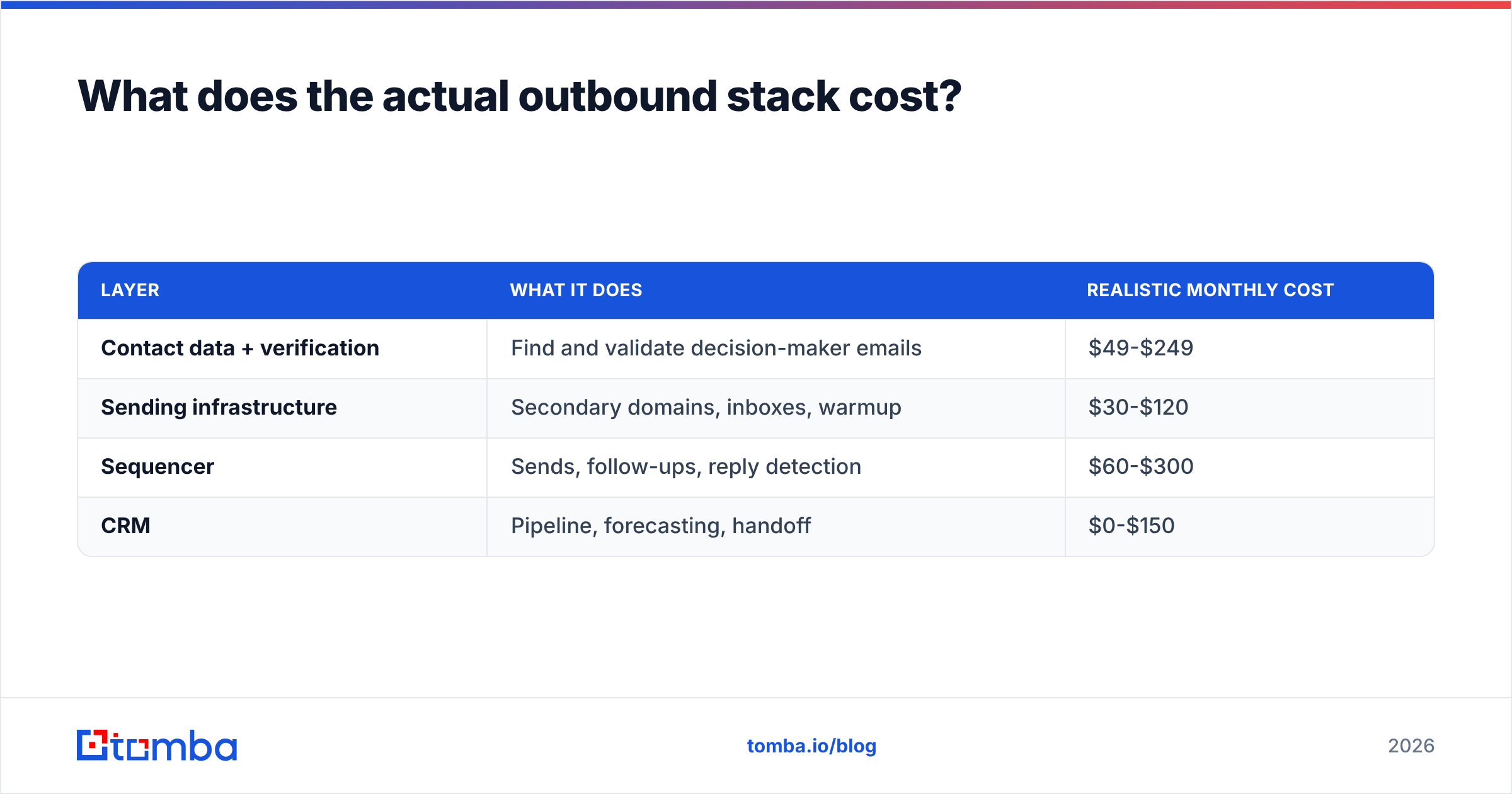
You need less tooling than vendors suggest. Four categories cover it:
| Layer | What it does | Realistic monthly cost |
|---|---|---|
| Contact data + verification | Find and validate decision-maker emails | $49-$249 |
| Sending infrastructure | Secondary domains, inboxes, warmup | $30-$120 |
| Sequencer | Sends, follow-ups, reply detection | $60-$300 |
| CRM | Pipeline, forecasting, handoff | $0-$150 |
For data specifically, Tomba pricing starts free at 25 searches a month, with Starter at $49/mo, Growth at $99/mo, and Pro at $249/mo — enough for most agencies running 400-2,000 verified contacts a month. The math to check before you buy any data tool: divide monthly cost by usable verified contacts, not by credits. A tool at half the price that returns 60% valid addresses is more expensive.
Total realistic outbound stack for a small agency: $150-$400/mo. If you're being quoted $2,000/mo for "AI-powered agency growth software," you're paying for a wrapper.
How do you know a channel is working before you quit it?#
Set the checkpoint before you start, not when you're frustrated.
For cold email, the honest evaluation window is 1,000 verified contacts across at least two distinct offers. Below that, you're reading noise. Kill an offer at 500 sends with under 1% reply. Kill the channel only after two offers have failed at full volume with clean data — and confirm the data was clean by checking your bounce rate, not by assuming.
For content, the window is 10 published pieces and six months. If nothing has broken into the top 20 for a term with commercial intent, your keyword targets are too competitive.
For partnerships, the window is 10 signed partners and 90 days. If none has sent a single lead, your partner brief isn't specific enough.
Track response rate at the channel level, cost per meeting, and cost per closed client. Most agencies track only the last one, which means they can't tell whether a broken channel is broken at the top or the bottom.
Where should you start this week?#
Pick one, do it properly:
- Write down your niche in one sentence that names an industry, a company stage, and a specific problem. If you can't, that's the week's work.
- Build a 200-company list from a trigger, not a persona.
- Find and verify the right contact at each — the person who owns the outcome, not the person with the fanciest title.
- Ask three past clients for one specific introduction each. This costs nothing and often outruns the outbound.
Steps 2 and 3 are where agencies stall, because manually hunting down 200 verified decision-maker emails is a week of work. That's the part to automate. Tomba Email Finder pulls verified professional addresses by domain, name, or company, with verification built into the same lookup — so the list that reaches your sequencer is one you can actually send to. Start on the free tier at 25 searches a month, confirm the workflow closes a meeting, then scale the plan to match the pipeline. The channel doesn't fail because the offer is wrong. It fails because the emails were never real.
Related guides#
Ready to find emails that actually work?
Join 150,000+ professionals who stopped guessing and started sending. Free credits on signup — no credit card required.
Get the Tomba newsletter
Practical outbound tactics and product updates — once every two weeks.
About the author