How Does 6sense Work? Intent Data, Scoring, and Pipeline
6sense promises to tell you which accounts are in-market before they fill out a form. Here is what actually happens under the hood, what it costs, and where it stops short.
TL;DR
- 6sense works by matching anonymous web and third-party research activity back to companies, then scoring each account with a predictive model that estimates where it sits in a buying cycle.
- The three pillars are identity resolution (who is this traffic?), intent aggregation (what are they researching?), and predictive scoring (how close are they to buying?).
- It is an account-level system. It tells you which company is in-market — not reliably which human to email at what address.
- Real-world contracts land in the mid five to low six figures per year, with a hard annual commitment and a real implementation lift. Reported entry points start around $60,000/yr.
- Most teams pair a signal layer with a contact layer. If your budget can't carry both, contact data is the one that produces sends this quarter.
What is 6sense, actually?#
6sense is an account-based orchestration platform built on predictive analytics. Instead of waiting for someone to download a whitepaper, it tries to identify companies that are already researching your category — often before they ever touch your site — and rank them by how likely they are to buy in the next 30 to 90 days.
The pitch is simple: roughly 95% of your addressable market isn't in-market at any given moment. Spraying the whole list wastes budget. 6sense claims to find the 5% that is.
That framing sits squarely in the account-based marketing tradition, but with more machine learning bolted on. The official positioning on 6sense.com calls it "Revenue AI" — a term that covers intent, predictive scoring, advertising, and orchestration in one bundle.
What it is not: a prospecting database you open on Monday to build a list of 400 emails. That distinction matters more than any feature comparison, and we'll come back to it.
How does 6sense work under the hood?#
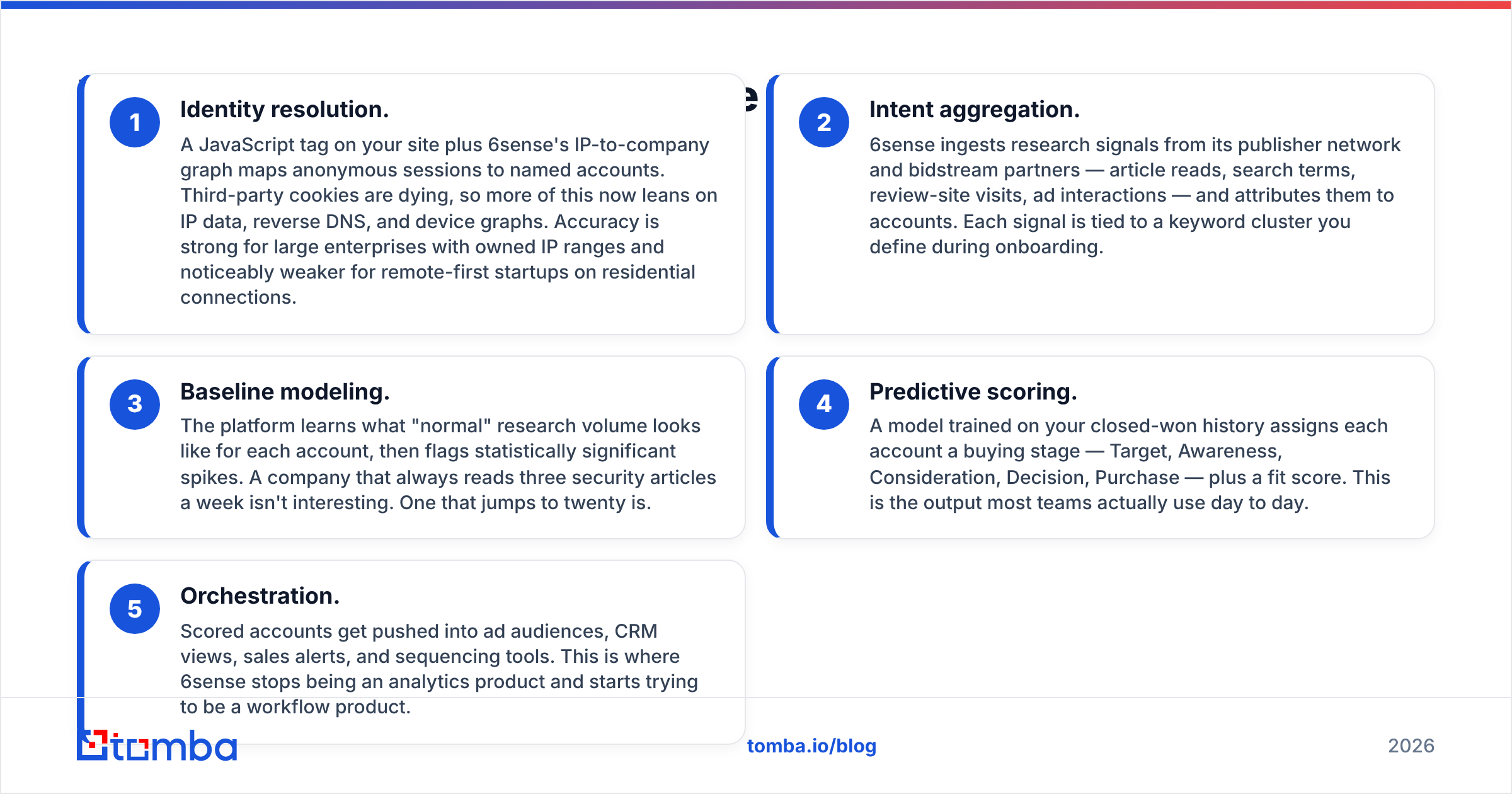
Here is the actual pipeline, stripped of marketing language. Five stages run continuously:
- Identity resolution. A JavaScript tag on your site plus 6sense's IP-to-company graph maps anonymous sessions to named accounts. Third-party cookies are dying, so more of this now leans on IP data, reverse DNS, and device graphs. Accuracy is strong for large enterprises with owned IP ranges and noticeably weaker for remote-first startups on residential connections.
- Intent aggregation. 6sense ingests research signals from its publisher network and bidstream partners — article reads, search terms, review-site visits, ad interactions — and attributes them to accounts. Each signal is tied to a keyword cluster you define during onboarding.
- Baseline modeling. The platform learns what "normal" research volume looks like for each account, then flags statistically significant spikes. A company that always reads three security articles a week isn't interesting. One that jumps to twenty is.
- Predictive scoring. A model trained on your closed-won history assigns each account a buying stage — Target, Awareness, Consideration, Decision, Purchase — plus a fit score. This is the output most teams actually use day to day.
- Orchestration. Scored accounts get pushed into ad audiences, CRM views, sales alerts, and sequencing tools. This is where 6sense stops being an analytics product and starts trying to be a workflow product.
The critical detail buried in step 4: the model is only as good as your closed-won data. Teams with fewer than roughly 100 closed deals in the training window get generic, industry-average predictions dressed up as personalized ones.
What data does 6sense actually collect?#
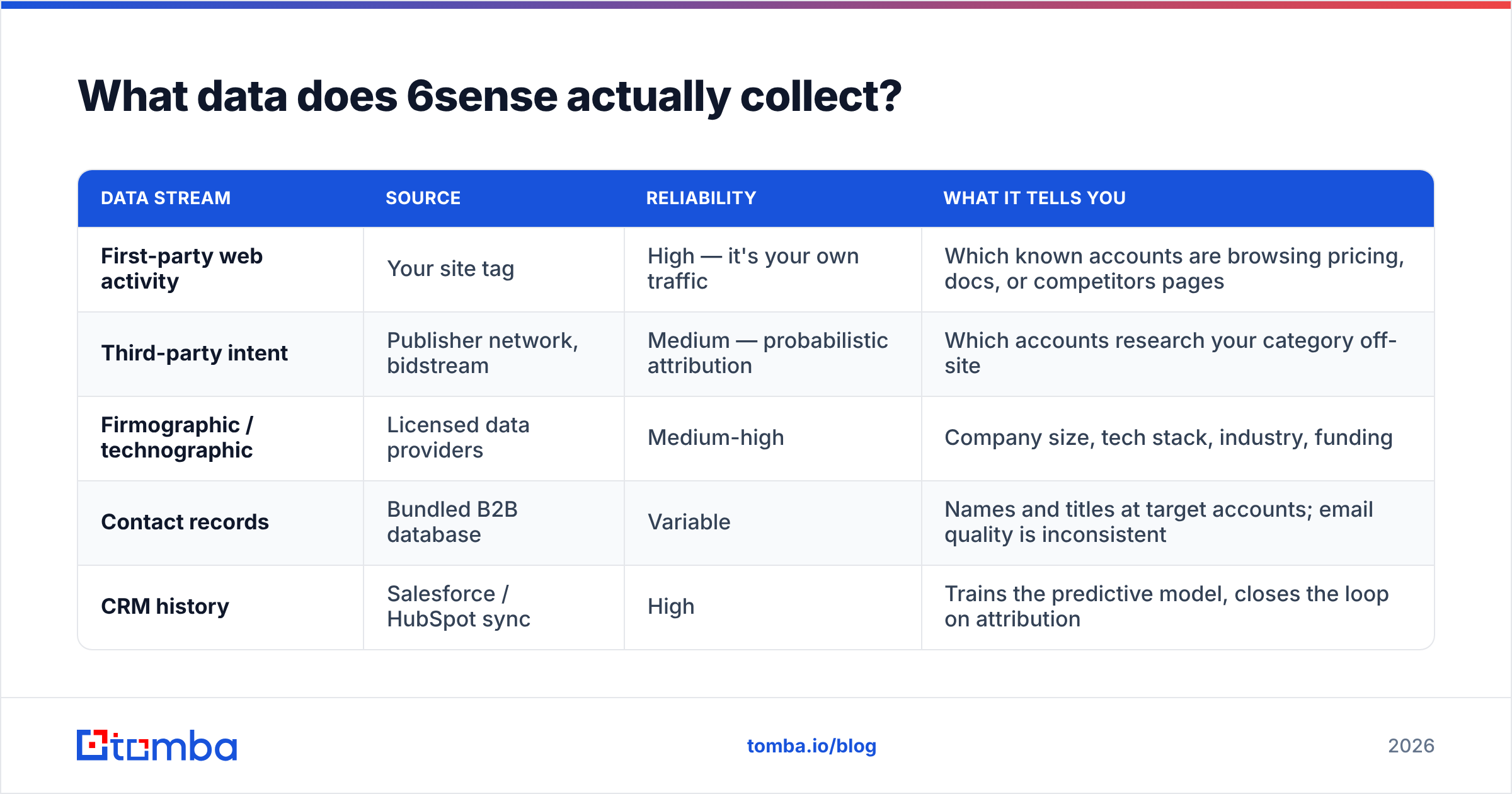
Three streams feed the model, and they behave very differently:
| Data stream | Source | Reliability | What it tells you |
|---|---|---|---|
| First-party web activity | Your site tag | High — it's your own traffic | Which known accounts are browsing pricing, docs, or competitors pages |
| Third-party intent | Publisher network, bidstream | Medium — probabilistic attribution | Which accounts research your category off-site |
| Firmographic / technographic | Licensed data providers | Medium-high | Company size, tech stack, industry, funding |
| Contact records | Bundled B2B database | Variable | Names and titles at target accounts; email quality is inconsistent |
| CRM history | Salesforce / HubSpot sync | High | Trains the predictive model, closes the loop on attribution |
Notice the last row of that stack. Contact records are bundled, but they are not the product's center of gravity. Practitioner reviews on G2 consistently praise the account-level signal and flag contact-level accuracy — especially direct email deliverability — as the weak link. That's not a knock on 6sense's engineering; it's a consequence of building an account graph rather than a contact graph.
How accurate is 6sense intent scoring?#
Honest answer: directionally useful, not deterministic.
Third-party intent is probabilistic by construction. A "surge" on the keyword cluster "email deliverability" at Acme Corp might mean the VP of Demand Gen is scoping vendors. It might also mean a contractor on Acme's guest Wi-Fi was reading a blog post for unrelated reasons. Vendors rarely publish precision and recall numbers, and independent benchmarks are thin — Gartner covers the category but does not publish per-vendor signal accuracy you can audit.
What experienced operators report:
- Account identification on enterprise traffic is genuinely good — often 40-70% of anonymous sessions resolved, heavily dependent on your traffic mix.
- Stage prediction works best as a prioritization sort, not a truth claim. Treat "Decision stage" as "look here first," not "this deal is real."
- Timing windows are wide. A 90-day buying window prediction is not a signal you can build a same-week sequence around without other evidence.
- Contact-level mapping is where most pipelines break. Knowing Acme is in-market doesn't tell you that Priya in Security Ops is the evaluator, or that her address is
p.sharma@and notpriya.sharma@.
That last gap is the operational one. You have a hot account and no verified way to reach the human inside it.
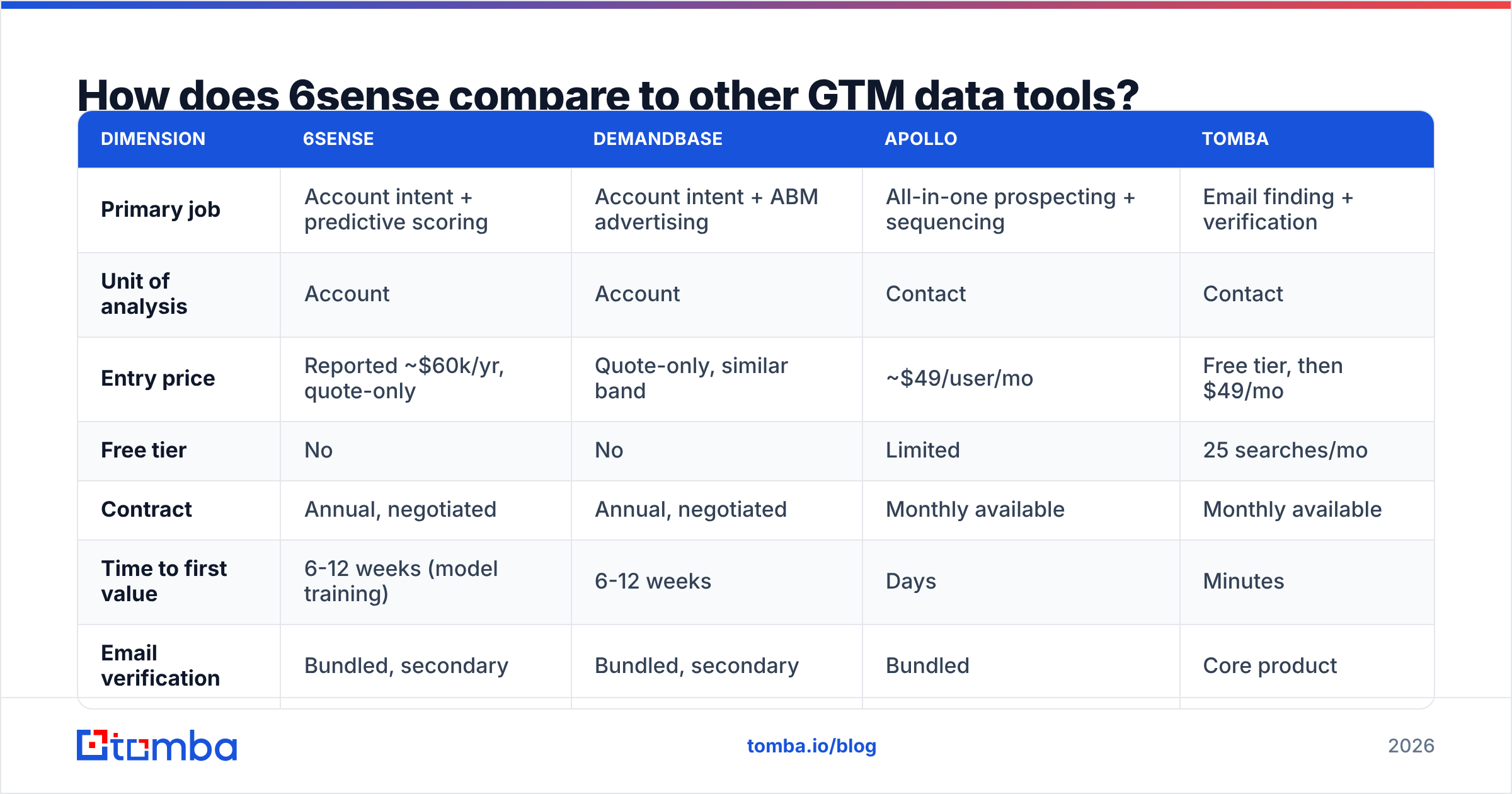
How does 6sense compare to other GTM data tools?#
Different tools solve different halves of the problem. Comparing them on price alone produces bad decisions.
| Dimension | 6sense | Demandbase | Apollo | Tomba |
|---|---|---|---|---|
| Primary job | Account intent + predictive scoring | Account intent + ABM advertising | All-in-one prospecting + sequencing | Email finding + verification |
| Unit of analysis | Account | Account | Contact | Contact |
| Entry price | Reported ~$60k/yr, quote-only | Quote-only, similar band | ~$49/user/mo | Free tier, then $49/mo |
| Free tier | No | No | Limited | 25 searches/mo |
| Contract | Annual, negotiated | Annual, negotiated | Monthly available | Monthly available |
| Time to first value | 6-12 weeks (model training) | 6-12 weeks | Days | Minutes |
| Email verification | Bundled, secondary | Bundled, secondary | Bundled | Core product |
| Best for | 500+ employee GTM orgs with long cycles | Enterprise ABM + display | SMB/mid-market full-funnel | Any team needing accurate addresses |
The honest read: 6sense and Apollo aren't competitors, they're layers. 6sense answers where to aim. A contact layer answers who to hit and at what address. Buying the first without the second gives you a beautiful dashboard of accounts you can't actually email.
If you're evaluating the category seriously, it's worth reading a structured 6sense alternative breakdown alongside the vendor's own materials — the buying-committee framing changes a lot depending on who wrote the page.
What does 6sense cost in 2026?#
6sense does not publish a price list. Every deal is quoted, which means your cost depends on your negotiating leverage, contract length, and how many modules you take.
Reported ranges from buyers and procurement forums:
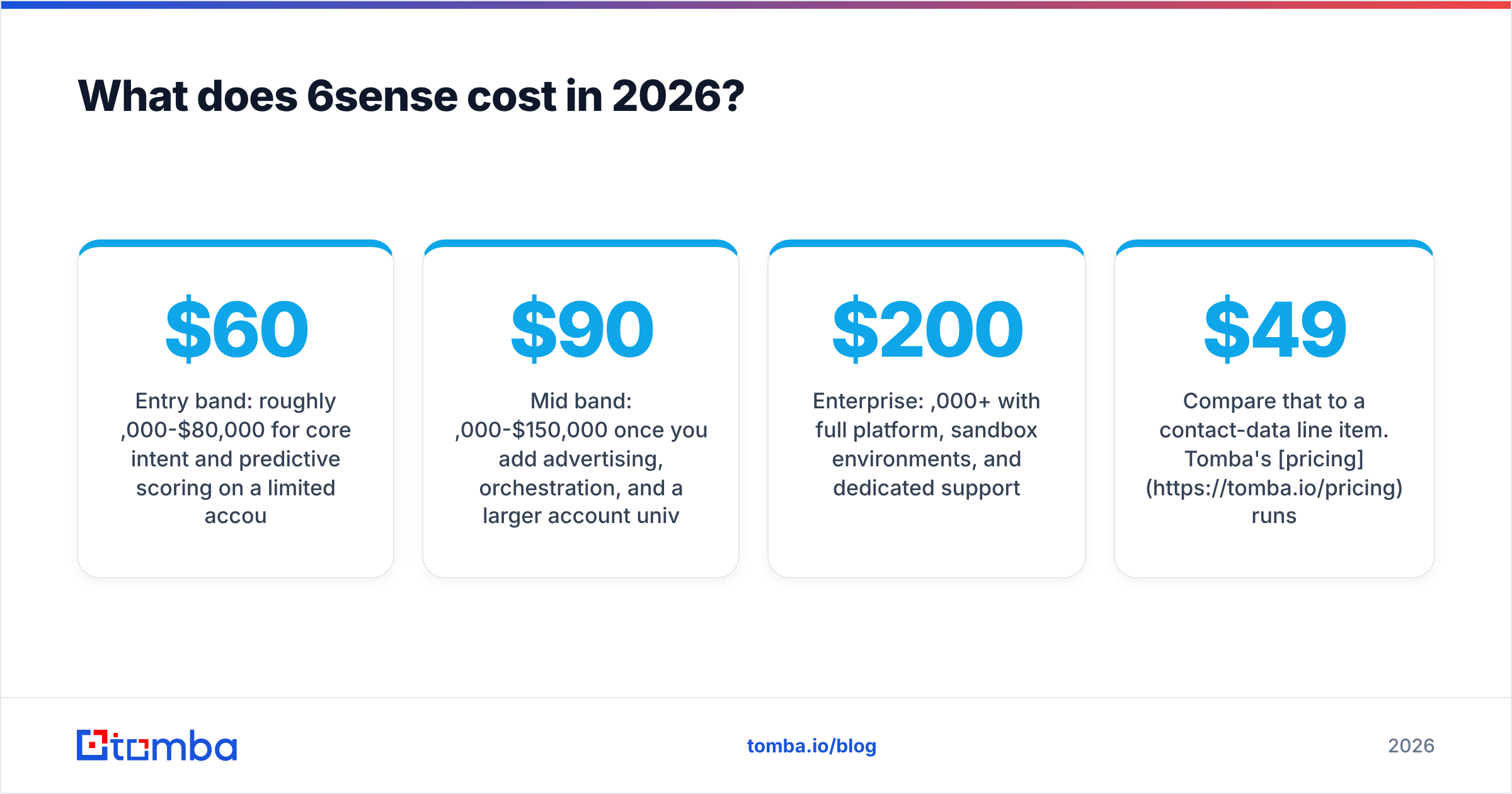
- Entry band: roughly $60,000-$80,000/yr for core intent and predictive scoring on a limited account universe.
- Mid band: $90,000-$150,000/yr once you add advertising, orchestration, and a larger account universe.
- Enterprise: $200,000+/yr with full platform, sandbox environments, and dedicated support.
Add-ons that inflate the number: expanded contact credits, additional keyword clusters, extra CRM seats, and the professional-services fee for implementation. Multi-year commitments buy discounts but reduce your exit options if the model underperforms.
Compare that to a contact-data line item. Tomba's pricing runs a free tier at 25 searches/mo, Starter at $49/mo, Growth at $99/mo, and Pro at $249/mo — the annual cost of the Pro plan is roughly 1-2% of a mid-band 6sense contract. These tools do different jobs, but the ratio explains why so many teams start with contact data and add signal later rather than the reverse.
Who should actually buy 6sense?#
Buy it if most of these are true:
- Deal sizes above $50,000 ACV. The platform cost has to be recoverable inside a handful of influenced deals.
- Sales cycles longer than 90 days. Predictive staging is meaningless when deals close in two weeks.
- A defined target account list of 500-5,000 companies. Too few and you don't need a model. Too many and the signal drowns.
- At least 100 closed-won deals for training. Below that, the predictions are industry priors, not your priors.
- A RevOps person who owns it. Unowned ABM platforms become expensive dashboards nobody opens by month four.
- Marketing and sales alignment that already exists. 6sense surfaces disagreement about account priority; it doesn't resolve it.
Skip it if you're a sub-30-person team, if your ACV is under $15,000, or if your current problem is "we don't have enough accurate contacts" rather than "we have too many accounts and can't prioritize."
What does 6sense not give you?#
The execution layer. Specifically:
Verified, deliverable email addresses at scale. Bundled contact records skew toward large-company records that are already in every database. Verification is not the product's core competency, and bounce rates on bundled contacts are a common complaint.
Coverage of the specific human who matters. Intent tells you a buying committee is active. It rarely tells you the six names on it, or which of them replies.
Fresh data on smaller companies. Account graphs are built on enterprise footprints. A 40-person Series A company generating real intent may resolve poorly or not at all.
Anything actionable without a second tool. Every 6sense workflow ends with "push to your sequencer" — which means you still need clean addresses feeding that sequencer.
This is the practical stack most teams end up running: signal from an intent platform, contacts from a dedicated finder, verification before send. You can build the contact half with an email finder that resolves names and domains into verified addresses, a bulk email finder for processing a scored account list in one pass, and data enrichment to fill in the firmographic fields your CRM is missing.
How do you run account-based outbound without a six-figure budget?#
You can approximate 80% of the workflow for a fraction of the cost. It's less elegant and requires more manual judgment, but it produces sends.
- Define your ICP tightly. Fewer, better-fit accounts beat a broad list. 300 well-chosen companies is a real ABM program.
- Use free intent proxies. Job postings mentioning your category, funding announcements, leadership changes, G2 category traffic, and your own website analytics all signal buying activity without a platform fee.
- Identify visitors on your own site. Website visitor identification narrows anonymous traffic to companies — the same first-party layer 6sense builds on, decoupled from the predictive model.
- Map the buying committee manually. For each surging account, list four to six relevant titles. This is 10 minutes per account and produces better targeting than any automated committee builder.
- Find and verify addresses. Run the mapped names through a finder, then verify before you send. Bounce rate is the number that quietly destroys deliverability on ABM campaigns, because your target list is small and every bad send costs disproportionately.
- Sequence with account context. Reference the actual trigger — the job posting, the funding round, the product launch — instead of a generic intent-derived pain point.
The gap between this and a full platform is speed and scale, not fundamental capability. At 300 accounts, a two-person team can run it manually. At 5,000, you need the platform.
Is 6sense worth it in 2026?#
For the right company, yes — with conditions. It is a genuine improvement over spraying an untargeted list, and the predictive staging does concentrate effort where it converts. Teams with long cycles, large deals, and an ops owner report real pipeline lift.
For everyone else, it's an expensive answer to a question they don't have yet. If your reps are still guessing email formats and watching 15% of sends bounce, buying an intent platform solves the wrong bottleneck. Fix contact accuracy first — it's cheaper, faster, and it makes any signal layer you add later dramatically more effective.
The sequencing that works for most teams: get accurate contacts, get consistent send volume, get enough closed-won data to train a model, then buy the model.
Start with the layer that produces sends. Tomba's Email Finder turns a company domain and a name into a verified, deliverable address in seconds — free for your first 25 searches a month, $49/mo on Starter, with bulk processing and an API when you're ready to run your whole target account list through it. Whether or not you eventually buy an intent platform, every scored account still needs a real inbox to land in.
Related guides#
Ready to find emails that actually work?
Join 150,000+ professionals who stopped guessing and started sending. Free credits on signup — no credit card required.
Get the Tomba newsletter
Practical outbound tactics and product updates — once every two weeks.
About the author