How Long Should a Cold Call Last? Benchmarks for 2026
Short calls feel efficient and convert terribly. Here are the real duration benchmarks for cold calls in 2026, minute-by-minute targets for each phase, and the fixes that stretch a 40-second brush-off into a booked meeting.
TL;DR
- A cold call that ends in a booked meeting runs roughly 5 to 6 minutes. Calls that die average around 3 minutes. The gap is not luck — it is what happens in the first 45 seconds.
- Duration is a lagging indicator, not a target. You cannot force a call to last longer; you earn the minutes by asking a question the prospect actually wants to answer.
- Budget your minutes: ~30 seconds opener, ~60 seconds problem framing, 3+ minutes two-way discovery, ~45 seconds close. Anything that squeezes discovery below two minutes usually kills the meeting.
- Voicemails are the opposite problem: keep them under 30 seconds, ideally 18-22.
- The fastest way to raise average call length is not a new script — it is calling people who should care. Bad phone data caps your ceiling before you say a word.
What does "how long should a cold call last" actually mean?#
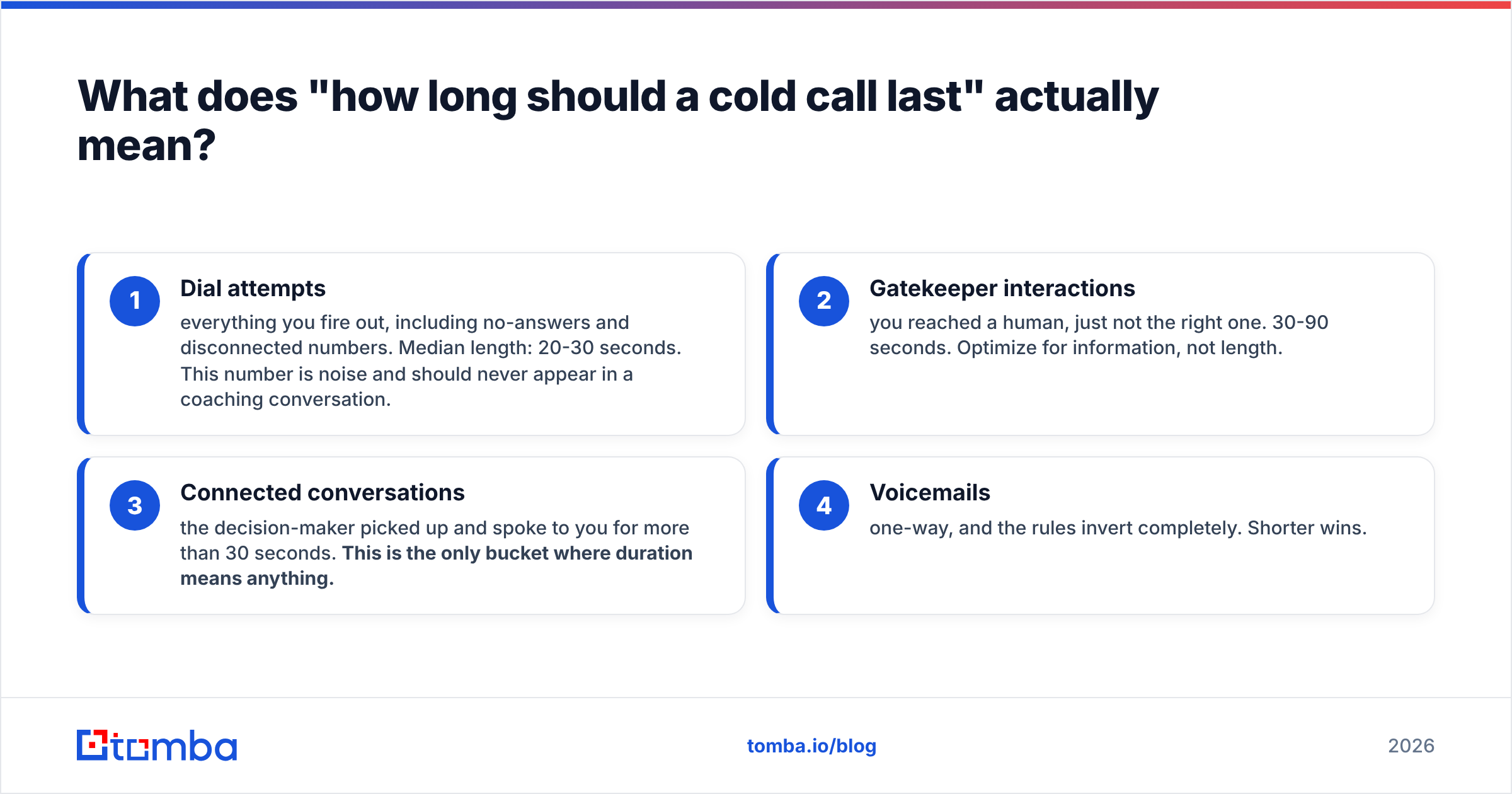
Ask five sales managers how long a cold call should last and you get five different numbers, because they are measuring five different things. Before you benchmark anything, split your call data into four buckets:
- Dial attempts — everything you fire out, including no-answers and disconnected numbers. Median length: 20-30 seconds. This number is noise and should never appear in a coaching conversation.
- Gatekeeper interactions — you reached a human, just not the right one. 30-90 seconds. Optimize for information, not length.
- Connected conversations — the decision-maker picked up and spoke to you for more than 30 seconds. This is the only bucket where duration means anything.
- Voicemails — one-way, and the rules invert completely. Shorter wins.
Most CRM dashboards blend all four into one "average call duration" metric, which is why that metric is useless. A rep with a 1:10 average might be crushing it on connects and simply dialing a lot of dead numbers. A rep with a 4:00 average might be trapped in long, polite, pointless conversations with people who will never buy. Segment first, then benchmark.
How long should a cold call last on average?#
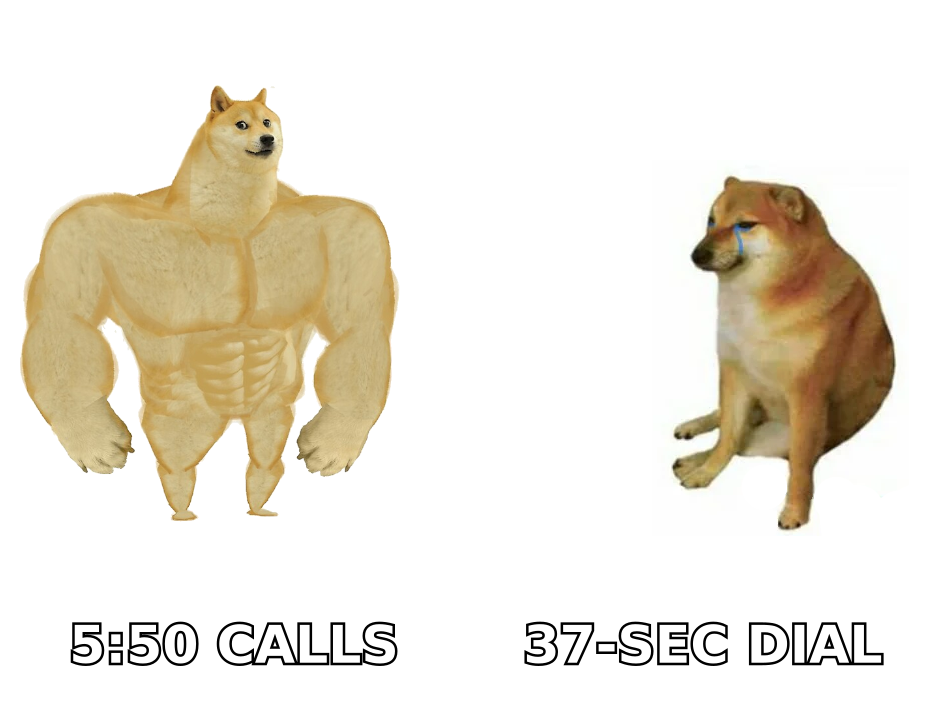
The most-cited public research on this comes from Gong's analysis of recorded cold calls: successful cold calls — meaning the call produced a next step — averaged close to 5 minutes 50 seconds, while unsuccessful calls averaged around 3 minutes 14 seconds. Roughly double the length, and that ratio has held up across most conversation-intelligence datasets published since.
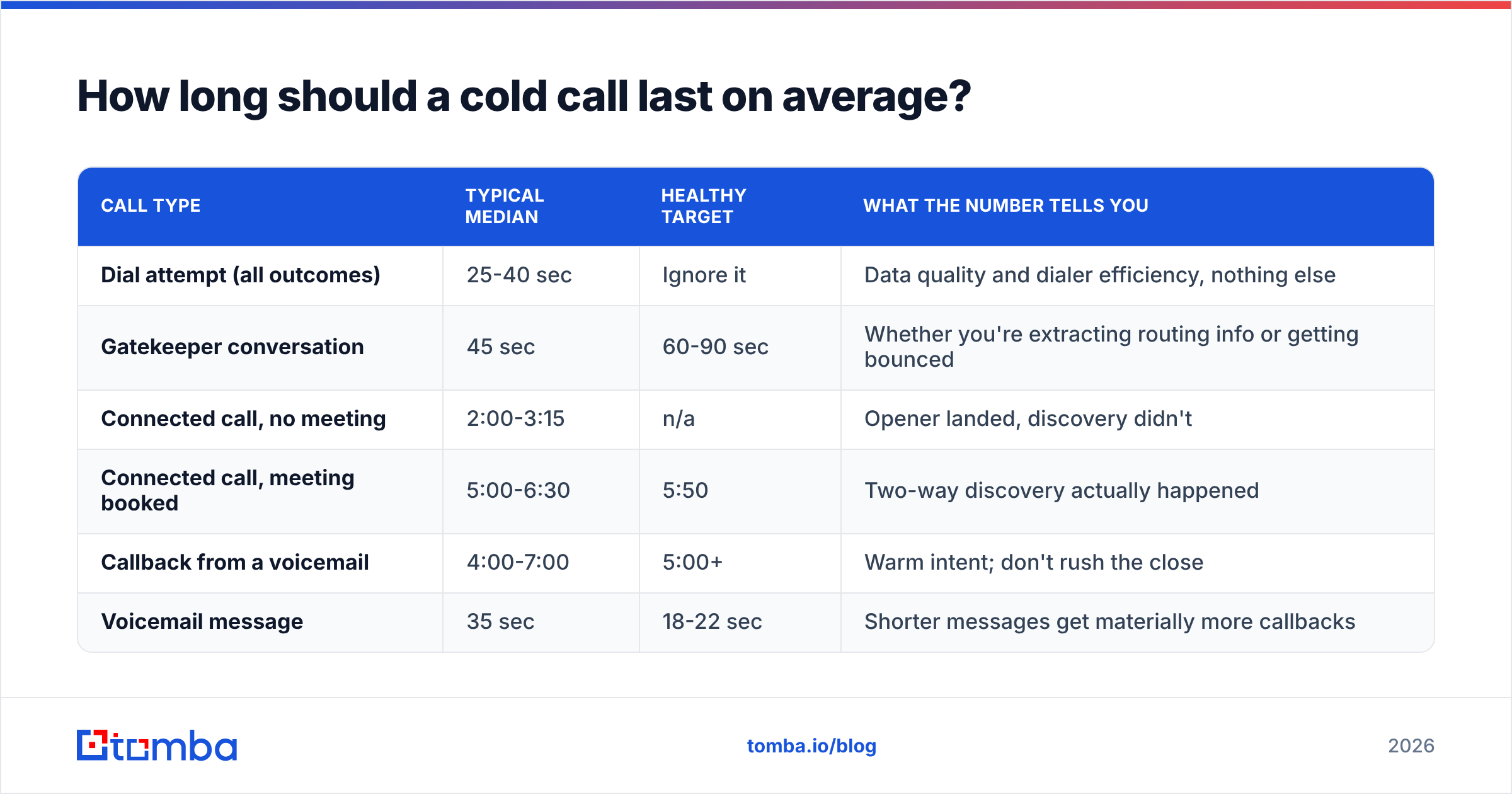
Here is how those benchmarks break down by call type. Use this as a diagnostic table, not a scorecard to beat.
| Call type | Typical median | Healthy target | What the number tells you |
|---|---|---|---|
| Dial attempt (all outcomes) | 25-40 sec | Ignore it | Data quality and dialer efficiency, nothing else |
| Gatekeeper conversation | 45 sec | 60-90 sec | Whether you're extracting routing info or getting bounced |
| Connected call, no meeting | 2:00-3:15 | n/a | Opener landed, discovery didn't |
| Connected call, meeting booked | 5:00-6:30 | 5:50 | Two-way discovery actually happened |
| Callback from a voicemail | 4:00-7:00 | 5:00+ | Warm intent; don't rush the close |
| Voicemail message | 35 sec | 18-22 sec | Shorter messages get materially more callbacks |
Two things jump out. First, the range for a good call is narrow — 5 to 6.5 minutes. Second, there is no bucket where 10+ minutes is the goal on a first call. Past about seven minutes on a cold conversation you are usually either doing unpaid consulting or talking to someone who is being polite. Book the meeting and get off the phone.
Why do longer cold calls convert better?#
Because length is a proxy for engagement, and engagement is what you are actually selling in the first four minutes.
Think of a cold call like a doctor's appointment you didn't book. If the doctor spends 40 seconds listing services and then asks for a follow-up appointment, you decline — not because the services are bad, but because nothing established that you have a problem. If instead the doctor asks two sharp questions about the pain in your shoulder and you spend three minutes describing it, the follow-up appointment books itself. The minutes are not the mechanism. They are the receipt.
That is why "make your calls longer" is terrible coaching. You cannot extend a call from the seller's side without stalling. What you can do is engineer the moments that give the buyer a reason to keep talking:
- A permission-based opener. Naming the interruption ("I know I'm calling out of the blue — can I take thirty seconds and you tell me if it's relevant?") consistently outperforms pretending the call is expected.
- A problem statement, not a product statement. "Most RevOps leads I talk to are re-verifying the same contact list three times a quarter" invites a reaction. "We're a data enrichment platform" invites a hang-up.
- One question, then silence. The single most common length-killer is stacking three questions and answering them yourself.
- No monologue over 40 seconds. Conversation-intelligence data repeatedly shows that the longest uninterrupted seller monologue on successful cold calls sits around 37 seconds. Past a minute, attention collapses.
How should you spend the minutes inside a call?#
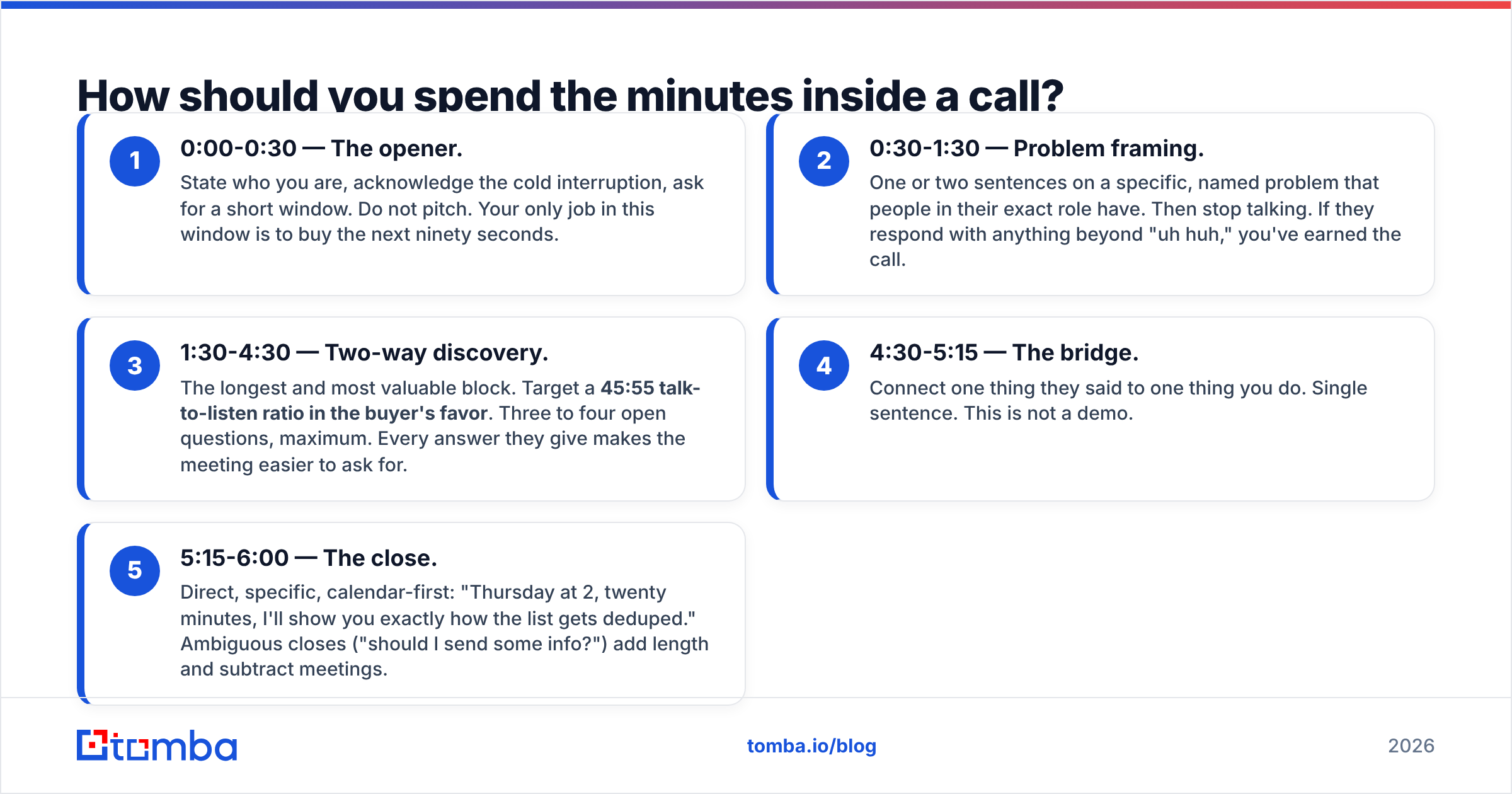
Here is the minute budget that maps to the ~5:50 benchmark. Treat it as a shape, not a stopwatch.
- 0:00-0:30 — The opener. State who you are, acknowledge the cold interruption, ask for a short window. Do not pitch. Your only job in this window is to buy the next ninety seconds.
- 0:30-1:30 — Problem framing. One or two sentences on a specific, named problem that people in their exact role have. Then stop talking. If they respond with anything beyond "uh huh," you've earned the call.
- 1:30-4:30 — Two-way discovery. The longest and most valuable block. Target a 45:55 talk-to-listen ratio in the buyer's favor. Three to four open questions, maximum. Every answer they give makes the meeting easier to ask for.
- 4:30-5:15 — The bridge. Connect one thing they said to one thing you do. Single sentence. This is not a demo.
- 5:15-6:00 — The close. Direct, specific, calendar-first: "Thursday at 2, twenty minutes, I'll show you exactly how the list gets deduped." Ambiguous closes ("should I send some info?") add length and subtract meetings.
If your calls consistently die at the 2-minute mark, the failure is almost always in block 2 — your problem statement isn't specific enough to provoke a response. If they die at 4:30, your bridge is turning into a pitch. Pull the recording and check which block collapsed before you rewrite the whole script.
Is a short cold call ever the right answer?#
Yes, in three situations, and recognizing them fast is a skill in itself.
When it's a hard no. "We signed a three-year contract with a competitor last month" is a gift. Confirm the renewal date, thank them, hang up at 50 seconds. Grinding a dead call to five minutes to protect an average is how reps burn territory.
When you're wrong about the person. If the individual doesn't own the problem and can't route you, a 90-second call that ends with "who does own vendor selection for that?" is a win. That's a routing call, not a sales call, and it should be short.
Voicemail. This one is counterintuitive enough that it deserves its own row in every benchmark table. Voicemails between roughly 18 and 22 seconds get meaningfully more callbacks than 40-second messages. Name, company, one specific reason you called, your number twice, done. HubSpot's sales blog has covered this pattern for years and the guidance hasn't moved: brevity in one-way messages, depth in two-way ones.
The mistake is applying voicemail logic to live conversations. "Respect their time" is real, but the version of it where you rush a connected buyer off the phone in 90 seconds isn't respect — it's avoidance.
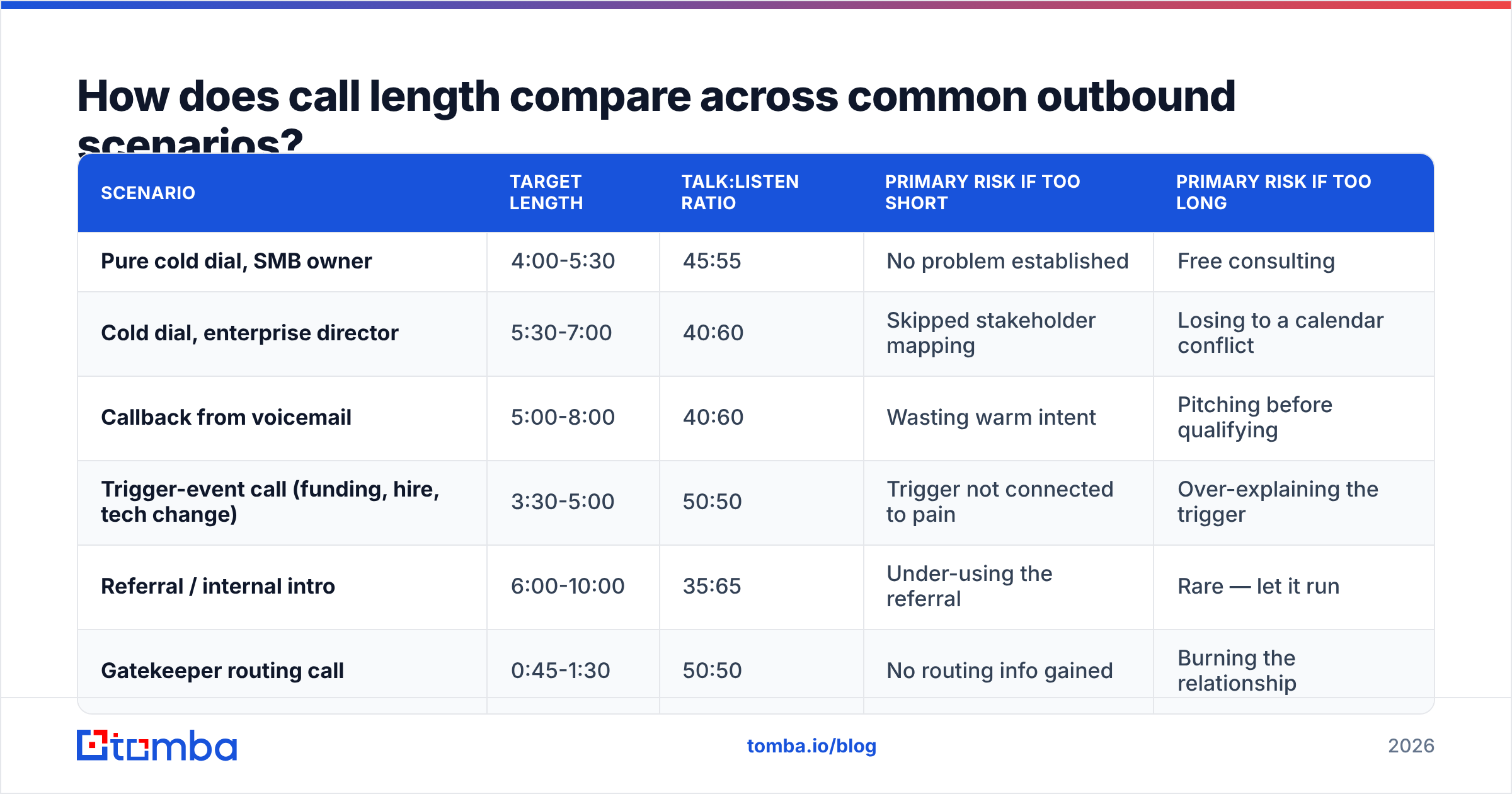
How does call length compare across common outbound scenarios?#
Length expectations shift with context. A call to a warm inbound lead behaves nothing like a pure cold dial into a 5,000-person enterprise.
| Scenario | Target length | Talk:listen ratio | Primary risk if too short | Primary risk if too long |
|---|---|---|---|---|
| Pure cold dial, SMB owner | 4:00-5:30 | 45:55 | No problem established | Free consulting |
| Cold dial, enterprise director | 5:30-7:00 | 40:60 | Skipped stakeholder mapping | Losing to a calendar conflict |
| Callback from voicemail | 5:00-8:00 | 40:60 | Wasting warm intent | Pitching before qualifying |
| Trigger-event call (funding, hire, tech change) | 3:30-5:00 | 50:50 | Trigger not connected to pain | Over-explaining the trigger |
| Referral / internal intro | 6:00-10:00 | 35:65 | Under-using the referral | Rare — let it run |
| Gatekeeper routing call | 0:45-1:30 | 50:50 | No routing info gained | Burning the relationship |
Notice the referral row. When someone inside the account vouched for you, longer is genuinely better and the 6-minute ceiling disappears. That is the clearest evidence that duration follows trust rather than creating it.
How do you actually make cold calls last longer?#
Four levers, roughly in order of impact.
1. Call the right people. This is the unglamorous one, and it's the biggest. A perfect script aimed at a person who doesn't own the problem tops out at 90 seconds. If half your list is mis-titled, out of date, or routed to a switchboard, your average connected-call length is capped by your data, not your delivery. Pulling accurate direct numbers with a phone finder and screening them through a phone validator before the dialer touches them removes the largest single source of sub-two-minute calls. Reps who dial verified direct lines simply have more real conversations per hour.
2. Fix the opener, then leave it alone. Test one variable at a time for at least 100 dials. Permission-based openers, a stated reason for calling this person, and naming the interruption all reliably extend calls. Bounce between five openers a week and you'll learn nothing.
3. Cap your monologues at 40 seconds. Set a literal timer during call reviews. Most reps are shocked at how long their "quick overview" runs.
4. Ask fewer, better questions. Three sharp open questions beat eight qualification checkboxes. Save the checkboxes for the discovery meeting you're trying to book. Salesforce's sales resources make the same point about discovery pacing: the cold call qualifies interest, the meeting qualifies fit.
How should you track call duration on your team?#
Do not put "average call length" on a leaderboard. The moment you do, reps will pad calls, and you'll get longer conversations with worse outcomes. Track it as a diagnostic, alongside outcomes:
- Connected-call length distribution, not average. A bimodal chart — a cluster at 1:30 and a cluster at 5:30 — tells you the opener works sometimes; a flat blob at 2:30 tells you nobody is reaching discovery.
- Length by outcome. If your booked-meeting calls average 4:00 while the benchmark is 5:50, you may be closing too fast and getting soft, high-cancel meetings.
- Time-to-first-buyer-question. How many seconds before the prospect asks you something? Under 60 seconds is an excellent sign. This correlates with response rate across channels, not just phone.
- Length by list source. Compare calls from your scraped list against calls from a verified B2B database. If the verified list averages two minutes longer, you've just quantified the ROI of better data.
Review three recordings a week per rep with these four numbers in hand. That is more useful than any amount of script rewriting.
What's the short answer?#
A cold call to a decision-maker who picked up should last about five to six minutes if it's going well, and you should end it inside two if it isn't. Voicemails stay under 30 seconds. Gatekeeper calls stay under 90. And the number itself is a symptom — chase engagement, and the minutes arrive on their own.
The single highest-leverage change most teams can make isn't the script. It's dialing fewer, better-matched contacts. If your list is stale, you are optimizing a conversation that never starts.
Start there. Build your call list from verified contact data instead of exports of unknown age — use the Tomba Email Finder to identify and confirm the right person at each target account before it hits your dialer, then layer direct numbers on top. The free tier covers 25 searches a month so you can test the difference on a single territory; paid plans start at $49/month on Starter, with Growth at $99/month for higher-volume teams. Full Tomba pricing is public if you want to model it against your current cost-per-meeting. Cleaner list in, longer calls out.
Related guides#
Ready to find emails that actually work?
Join 150,000+ professionals who stopped guessing and started sending. Free credits on signup — no credit card required.
Get the Tomba newsletter
Practical outbound tactics and product updates — once every two weeks.
About the author