How Long Should a Sales Call Be? Data-Backed Answer
Discovery calls that convert run 40-45 minutes. Demos run 35-50. Cold calls close in under 6. Here's what call length actually predicts about your win rate — and when longer stops helping.
TL;DR
- There is no single right number. The right length depends on call type: cold calls convert best around 5-6 minutes, discovery calls at 40-45, demos at 35-50, and closing calls at 20-30.
- Length is a symptom, not a lever. Long calls win because the buyer is talking, not because you booked 60 minutes.
- The strongest predictor across recorded-call research is the talk-to-listen ratio — roughly 43:57 rep-to-prospect on winning discovery calls — not raw duration.
- Book 30 minutes and earn the extension. Calendar-blocking an hour with a stranger lowers your show rate and invites filler.
- Your call length problem is usually a targeting problem. Bad-fit prospects produce short, polite calls; the fix starts before the dial.
What Is the Right Length for a Sales Call?#
Short answer: 30 minutes booked, 40-45 minutes actual, for a first discovery call with a qualified B2B buyer. Everything else scales up or down from there.
But that number is close to useless without context, because "sales call" describes at least five different meetings with different jobs. A cold call that lasts 45 minutes is a disaster — you've either found a lonely prospect or you've talked past three buying signals. A discovery call that lasts 12 minutes is also a disaster, but for the opposite reason: you never got past the surface.
Think of call length like cooking time. Nobody asks "how long should I cook food?" They ask how long for a steak versus a stew. Same logic applies here. The stage determines the clock.
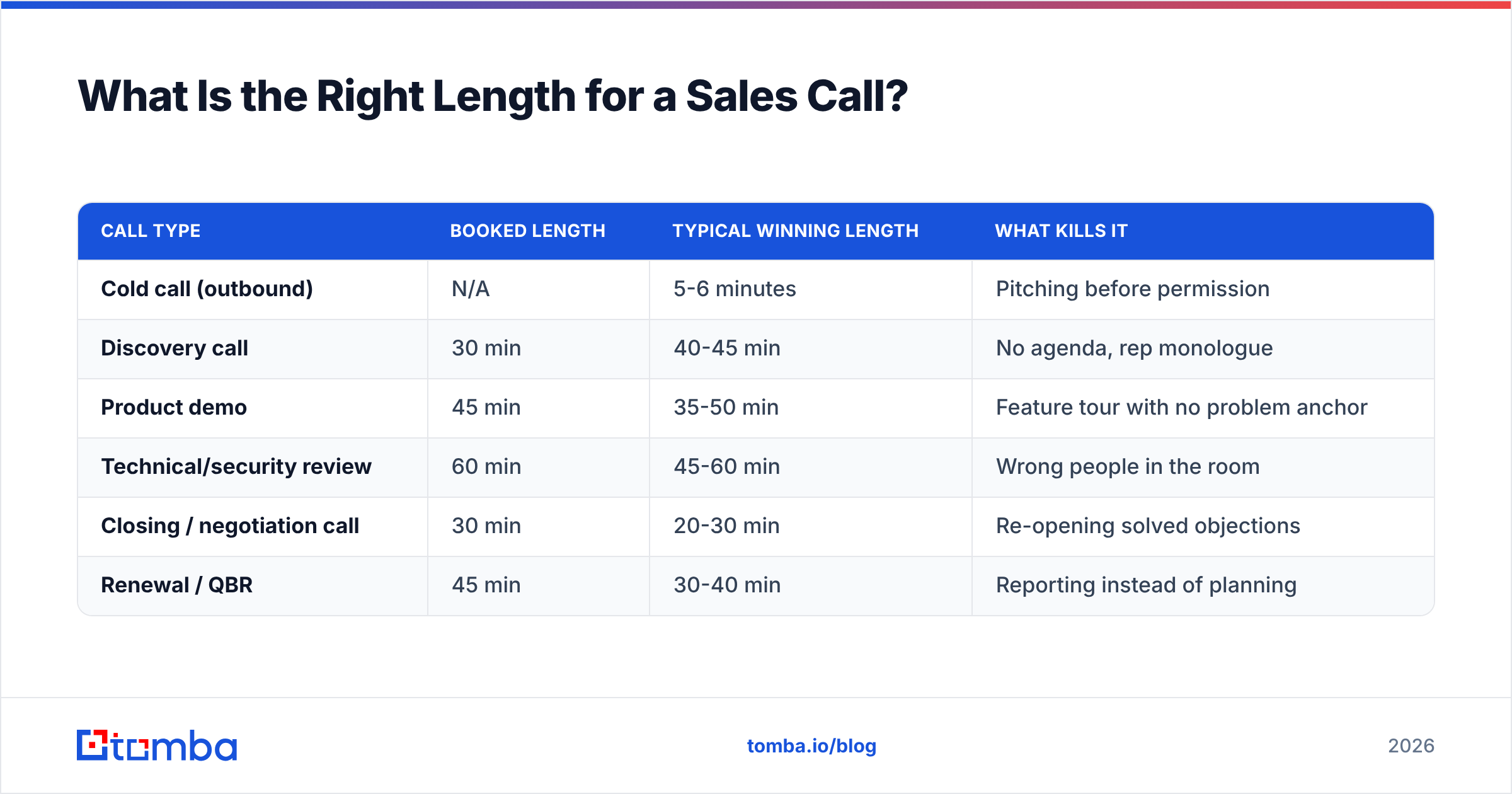
Here's what the data across analyzed sales conversations consistently shows by call type:
| Call type | Booked length | Typical winning length | What kills it |
|---|---|---|---|
| Cold call (outbound) | N/A | 5-6 minutes | Pitching before permission |
| Discovery call | 30 min | 40-45 min | No agenda, rep monologue |
| Product demo | 45 min | 35-50 min | Feature tour with no problem anchor |
| Technical/security review | 60 min | 45-60 min | Wrong people in the room |
| Closing / negotiation call | 30 min | 20-30 min | Re-opening solved objections |
| Renewal / QBR | 45 min | 30-40 min | Reporting instead of planning |
Notice the pattern: the calls that get longer than booked are the early-stage ones, where the buyer is discovering their own problem out loud. The calls that should run shorter than booked are the late-stage ones, where everything is already agreed and you're executing.
Why Do Longer Discovery Calls Correlate With Higher Win Rates?#
Because longer discovery calls are usually calls where the prospect did most of the talking — and prospect talk time is the actual causal variable.
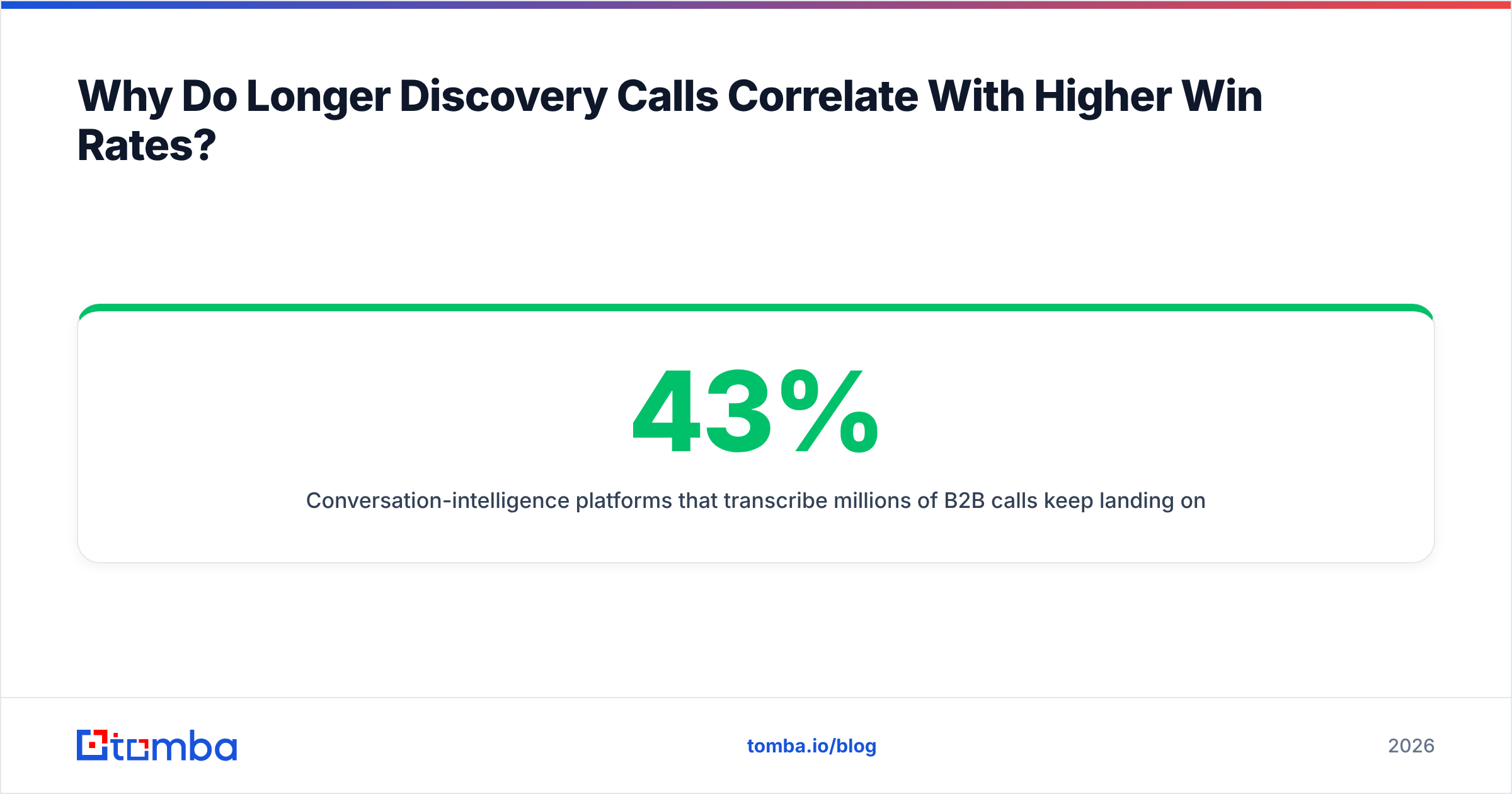
Conversation-intelligence platforms that transcribe millions of B2B calls keep landing on the same finding: on won deals, the rep talks roughly 43% of the time and the buyer 57%. On lost deals, the rep's share climbs toward 65-70%. A 55-minute call where you delivered a 40-minute monologue is worse than a 25-minute call where the buyer described their broken workflow in detail.
So when someone tells you "longer calls close more," what they've actually measured is: engaged buyers stay on the phone. Engagement produces duration. Duration does not produce engagement.
This distinction matters operationally. If you tell a rep "aim for 45 minutes," they will pad. They'll add a company-history slide, a customer-logo wall, a roadmap tangent. The metric goes green and the pipeline gets worse. If you tell a rep "aim for the buyer talking more than half the time," duration takes care of itself.

The four things that actually make a call run long in a good way#
- Multi-threading mid-call — the buyer pulls in a colleague, or names three, because the problem is bigger than they first admitted.
- Quantified pain — they start doing arithmetic out loud ("so that's roughly 12 hours a week across four people").
- Objection surfacing — they raise procurement, security, or a competing vendor unprompted. Objections are engagement.
- Process disclosure — they volunteer the decision path, budget cycle, and who signs.
If none of those four happen, the call should end early. A 22-minute call that produced no quantified pain and no next step doesn't get better at minute 40.
How Long Should a Cold Call Be?#
Five to six minutes, and the first 30 seconds decide everything.
Cold calls are a different animal because you are spending someone's attention that they did not agree to give. Aggregate outbound data puts successful cold calls at roughly double the length of unsuccessful ones — around 5:50 versus under 3:00. But that gap is again a symptom: successful calls got permission early, so they continued.
The structure that works:
- 0:00-0:20 — pattern interrupt and permission ("I know I'm interrupting — can I have 27 seconds to tell you why I called, then you decide?")
- 0:20-1:30 — one specific, researched reason for calling this person at this company
- 1:30-4:00 — two or three diagnostic questions, then shut up
- 4:00-5:30 — book the real meeting, confirm the calendar invite verbally
- Anything past 6:00 — you are now doing discovery on a call the buyer didn't prepare for; book the follow-up instead
The most common cold-call length failure isn't going too long. It's the 90-second call that ends because you pitched features to someone who has no idea who you are. If you're running an outbound motion, the response rate on your emails and the length of your connected calls tend to move together — both are downstream of list quality.
Does Demo Length Change by Deal Size?#
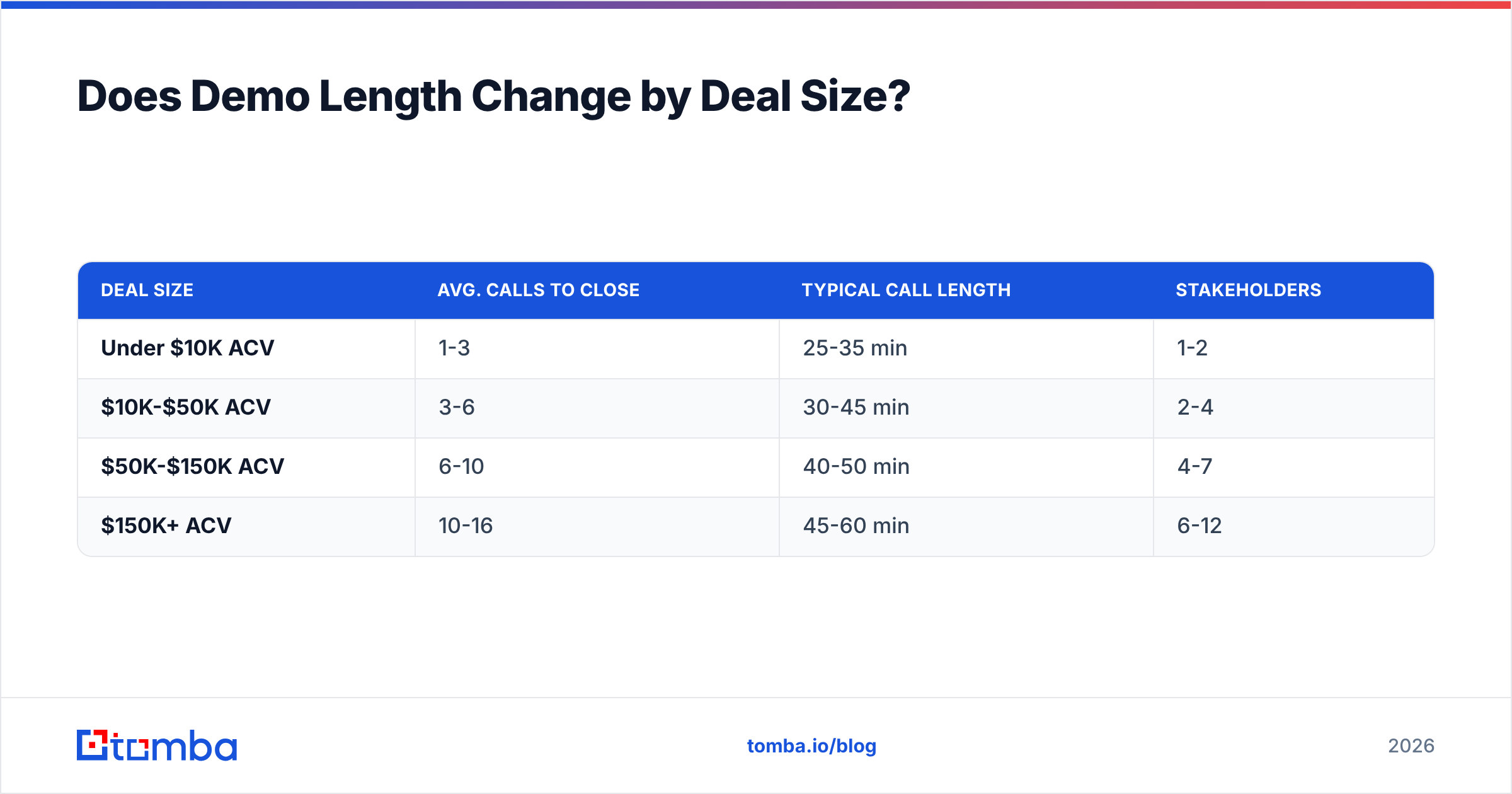
Yes, but less than people assume. The bigger change is the number of calls, not the length of each one.
A $5K annual contract might close in a single 30-minute demo. A $250K enterprise deal doesn't close in one 3-hour call — it closes across eight to fourteen touchpoints of 30-60 minutes each, with different stakeholders. Enterprise buying committees have grown to 6-10 people in most B2B categories, and no single human sits through a three-hour demo willingly.
| Deal size | Avg. calls to close | Typical call length | Stakeholders |
|---|---|---|---|
| Under $10K ACV | 1-3 | 25-35 min | 1-2 |
| $10K-$50K ACV | 3-6 | 30-45 min | 2-4 |
| $50K-$150K ACV | 6-10 | 40-50 min | 4-7 |
| $150K+ ACV | 10-16 | 45-60 min | 6-12 |
The practical rule: when a call needs to run past 60 minutes, split it. Two 45-minute calls with the right people beat one 90-minute call with the wrong ones. Splitting also creates a second commitment, and commitments predict close rates better than any single meeting does.
There's a cost to splitting, and you should name it: every extra meeting is a chance for the deal to stall. So split when the audience changes (economic buyer joins, security team joins), not just because you ran out of slides.
What Should You Book on the Calendar?#
Book 30 minutes. Almost always.
Three reasons, in order of impact:
- Show rate. A 30-minute invite from a stranger gets accepted more often than a 60-minute one. You cannot have a great long call with someone who never showed.
- Discipline. A 30-minute container forces you to write an agenda and cut the company-overview slide. It makes you better.
- Earned extension. "We're at time — I have another 15 if you do" is a soft close that measures interest. If they say yes, you've got a buying signal. If they say no, you learned that too, cheaply.
The exception is a scheduled technical deep-dive or security review with an engaged, late-stage account. Those genuinely need 60 minutes and the buyer knows it. Book the hour, send the agenda 24 hours ahead, and name who should attend.
For inbound demo requests from a well-researched account, 45 minutes is defensible — the buyer already opted in. For everything cold or semi-warm, 30 minutes.
How Do You Cut a Call Short Without Killing the Deal?#
Say it out loud, and give the buyer the reason.
Reps let bad calls run long because ending early feels rude. It isn't. It's the most respectful thing you can do with a prospect who is not a fit. Scripts that work:
- Bad fit, honest exit: "Based on what you've described, I don't think we're the right fit — you'd be paying for capability you won't use. Can I point you at two options that fit better?"
- Wrong person: "This sounds like it really lives with your RevOps team. Rather than me guessing for 20 more minutes, could you introduce me to whoever owns that?"
- No pain found: "It sounds like the current process is working fine. I'd rather not sell you something you don't need — can I check back in two quarters?"
Every one of those ends the call early and increases the odds of a future deal. The rep who disqualifies honestly gets referrals. The rep who fills 45 minutes with a product tour for an unqualified buyer gets ghosted and burns the account.
Disqualifying fast only works if your pipeline can absorb it, which brings us to the real problem.
Is Your Call Length Problem Actually a Targeting Problem?#
Usually, yes. Short, polite, low-energy calls are the signature of a bad list — not a bad rep.
Here's the diagnostic. Pull your last 40 connected calls and sort by duration. If the short ones cluster around specific companies, titles, or lead sources, you don't have a talk-track issue. You have a data issue. The rep can't manufacture urgency in someone who doesn't own the problem.
Three failure modes that show up as short calls:
- Wrong title. You reached an individual contributor who can't buy and won't champion. The call is polite and 11 minutes long.
- Wrong company stage. A 12-person startup doesn't need enterprise governance features. Nothing you say lands.
- Wrong contact entirely. The email or number was stale, so you're talking to someone who left the team eight months ago.
Fixing that starts upstream of the call. Build lists from verified contact data rather than scraped exports, confirm the person still holds the role, and enrich records so the rep opens the call knowing headcount, stack, and recent triggers. A domain search against a target account surfaces the right department contacts before you dial, and running the list through an email verifier keeps your sequences from burning sender reputation on dead addresses. For phone-first teams, validating numbers before a dialer session saves more time than any script tweak.
Vendors like HubSpot and Salesforce publish extensive research on activity metrics, and buyer-side reviews on G2 consistently show the same theme: teams that fix list quality see call duration rise without changing a word of their script.
What Metrics Should You Track Instead of Duration?#
Track four things. Duration is the fifth, and it's diagnostic only.
- Talk-to-listen ratio — target 43:57 rep-to-buyer on discovery. Above 60% rep talk on a first call is a red flag regardless of length.
- Next-step rate — percentage of calls ending with a specific date on both calendars. This is the single best leading indicator of win rate.
- Question count — 11-14 discovery questions correlates with higher conversion than 4-6. More questions naturally extends the call, which is the causality you actually want.
- Longest monologue — if any single rep monologue exceeds 90 seconds on a discovery call, you're presenting, not discovering.
Then look at duration as a distribution, not an average. An average of 34 minutes hides the fact that half your calls are 12 minutes and half are 55. The 12-minute cluster is your qualification leak; the 55-minute cluster is your playbook. Averages tell you nothing about either.
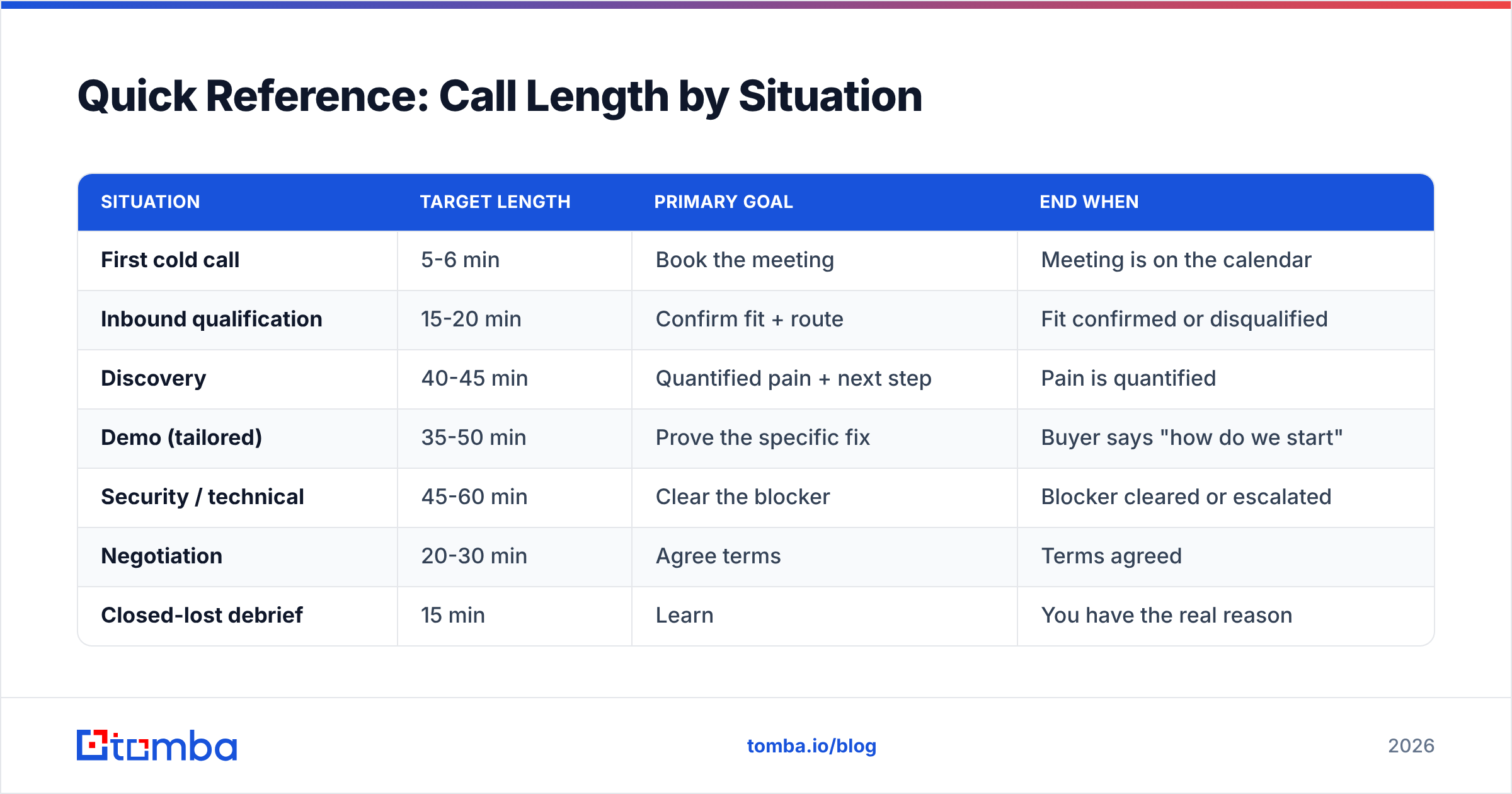
Quick Reference: Call Length by Situation#
| Situation | Target length | Primary goal | End when |
|---|---|---|---|
| First cold call | 5-6 min | Book the meeting | Meeting is on the calendar |
| Inbound qualification | 15-20 min | Confirm fit + route | Fit confirmed or disqualified |
| Discovery | 40-45 min | Quantified pain + next step | Pain is quantified |
| Demo (tailored) | 35-50 min | Prove the specific fix | Buyer says "how do we start" |
| Security / technical | 45-60 min | Clear the blocker | Blocker cleared or escalated |
| Negotiation | 20-30 min | Agree terms | Terms agreed |
| Closed-lost debrief | 15 min | Learn | You have the real reason |
Start Before the Dial Tone#
The fastest way to make your sales calls longer is to talk to better-fit people. That's a data problem, not a coaching problem.
Tomba Email Finder helps you build the list that makes the call worth having — find verified professional email addresses by name, company, or domain, confirm the contact still holds the role, and enrich the record before your rep opens their mouth. The free tier covers 25 searches a month so you can test it against a live target account list; paid plans start at $49/mo, with full Tomba pricing available if you need bulk volume or API access for your CRM.
Stop optimizing the clock. Optimize who's on the other end of it.
Related guides#
Ready to find emails that actually work?
Join 150,000+ professionals who stopped guessing and started sending. Free credits on signup — no credit card required.
Get the Tomba newsletter
Practical outbound tactics and product updates — once every two weeks.
About the author