How Long Should an Email Be? Word Counts That Get Replies
Cold emails, follow-ups, internal updates, and newsletters each have a length that maximizes replies. Here are the word counts, the reasoning behind them, and a five-step trim process you can run on any draft in under two minutes.
TL;DR
- For cold outreach, aim for 50–125 words and five lines or fewer on a phone screen. Past roughly 200 words, reply rates fall off a cliff because the message stops being scannable.
- Length is not the real variable — reading effort is. A 60-word email packed with three asks performs worse than a 140-word email with one obvious next step.
- Different email types have different ceilings: follow-ups are shorter than first touches, internal updates can run longer, and newsletters live by section headers, not word counts.
- The fastest fix is structural: one idea, one ask, one link, sentences under 20 words, and no paragraph longer than three lines.
- Word count only matters if the email lands in the inbox. Bad data and unverified addresses kill more campaigns than long copy ever will.
What is the right length for an email?#
Short answer: 50 to 125 words for cold outreach, under 100 for a follow-up, and 200 to 400 for an internal or expected email. Those are the working ranges most sales teams converge on after testing, and they hold up because they track how people actually read on a screen rather than how writers like to write.
The deeper answer is that "how long should an email be" is the wrong question by itself. Your reader is not counting words. They are making a two-second decision about whether your message is worth a reply, and they make it from the preview pane — subject line, first sentence, and the visual shape of the text block. A wall of prose reads as work. Five short lines with one bolded ask reads as a 20-second task.
Nielsen Norman Group's long-running research on how users read on the web found people scan in an F-shaped pattern and read maybe 20–28% of the words on a page. Email is worse, not better — it arrives uninvited, and the reader is triaging dozens of other messages in the same session. Every word past the point where your ask is clear is a word that raises the chance they defer the email to "later," which in practice means never.
So treat length as a proxy for effort. If you can cut 40 words without losing the ask, the context, or the reason you are credible, those 40 words were costing you replies.
Why does email length affect reply rates?#
Three mechanisms, all of them about friction rather than attention span.
Cognitive load. Every additional claim in an email is something the reader has to evaluate. Three value propositions do not triple your odds; they force a comparison the reader did not sign up for. One claim, stated concretely, is a yes/no decision.
Mobile rendering. Well over half of first-touch emails get opened on a phone. A 250-word email that looks tight in a desktop composer becomes eight scroll-flicks on an iPhone. The reader never reaches your call to action because it is below three screens of context-setting.
Perceived ask size. Length signals commitment. A long email implies a long conversation, a long meeting, and a long evaluation. A short email implies a quick reply. When your actual ask is "is this worth 15 minutes?", writing 300 words to get there contradicts the ask itself.
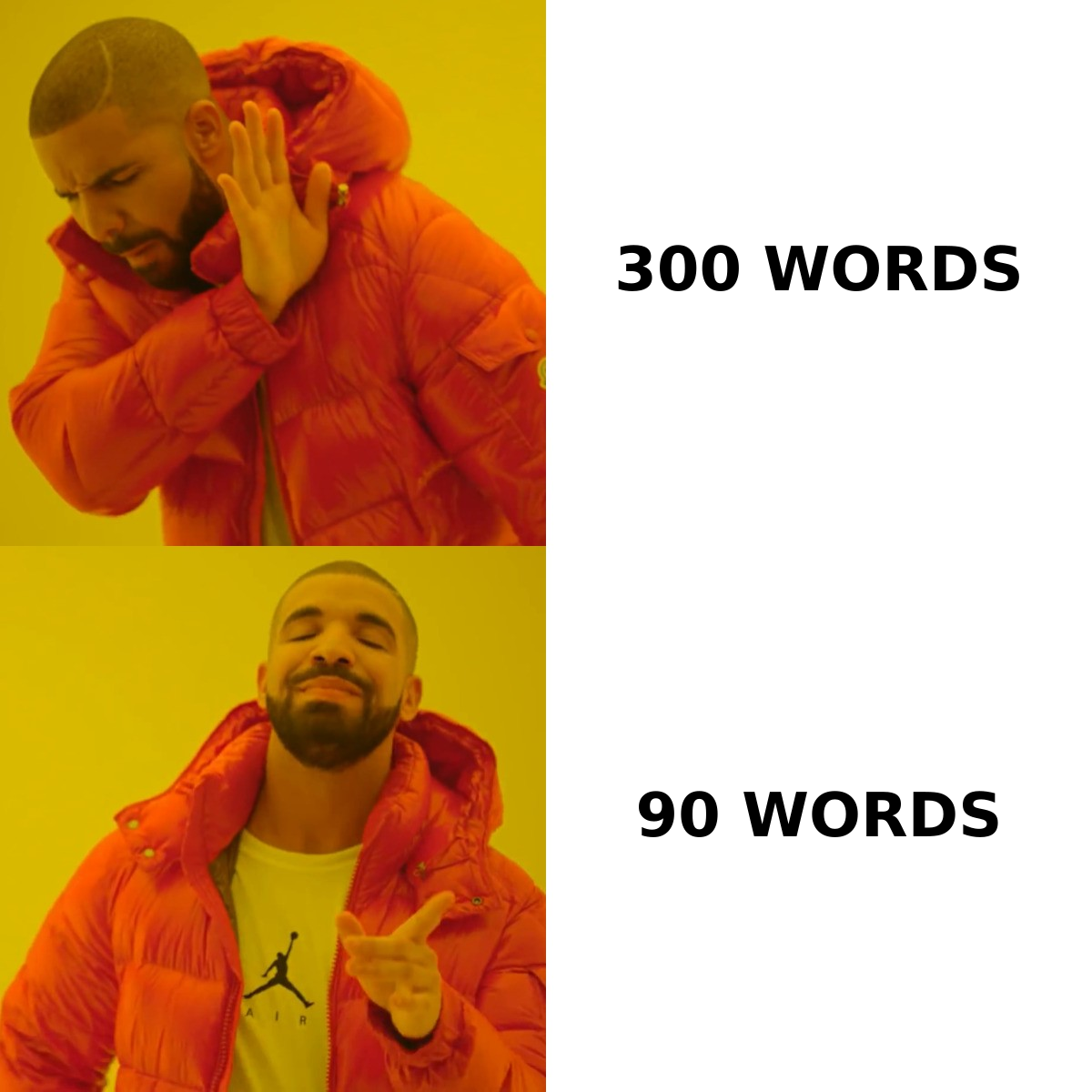
There is a counterweight, though, and it is why blanket "shorter is always better" advice fails. Below about 40 words, cold emails often lose credibility — there is no room for the specific detail that proves you did the research. A 25-word email that says "Saw your site. Can we talk Thursday?" reads as automated, because it is indistinguishable from automation. The floor exists for the same reason the ceiling does.
How long should each type of email be?#
Different contexts carry different permission levels. An email someone asked for can be long. An email someone did not ask for cannot.
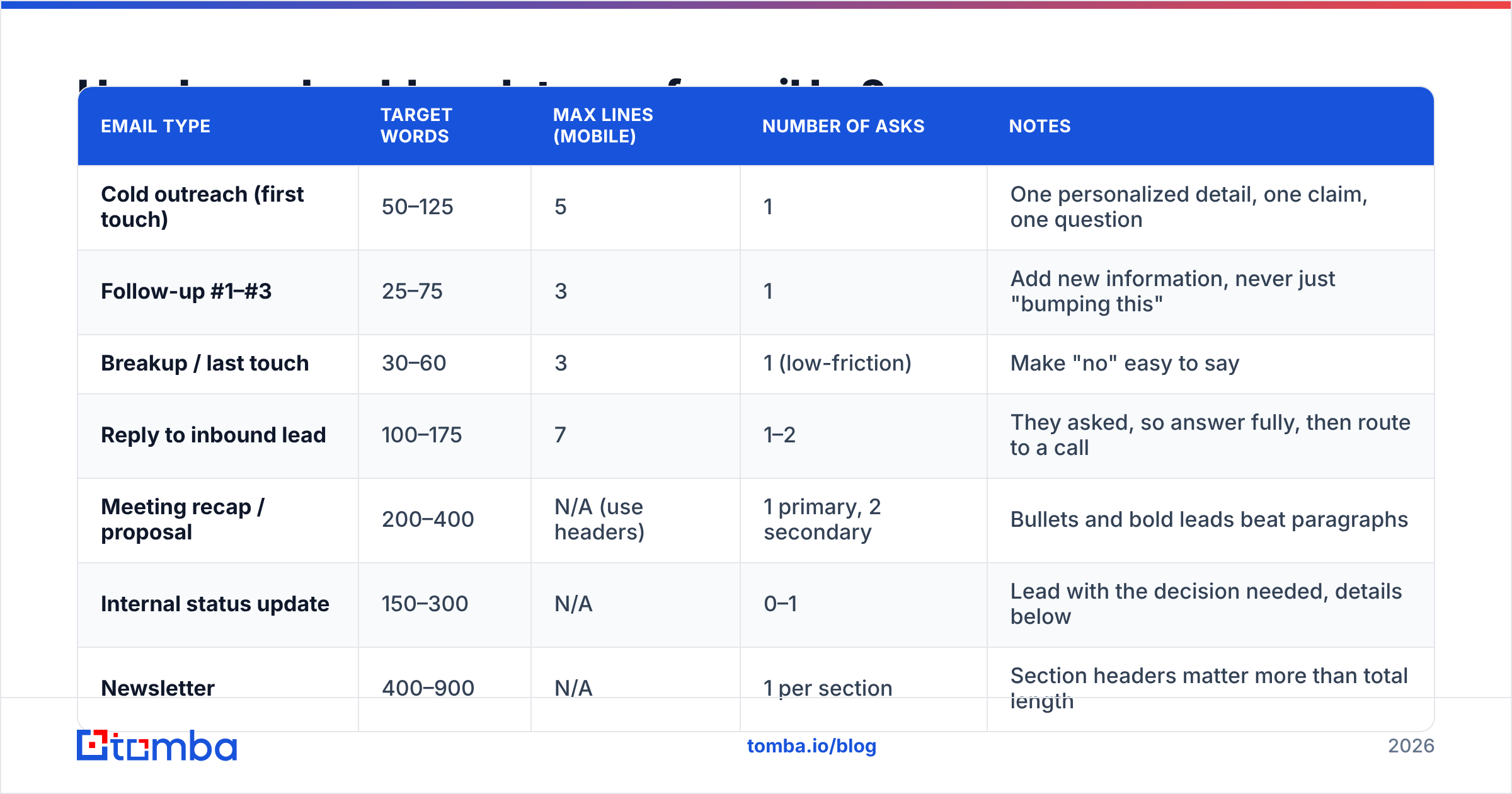
| Email type | Target words | Max lines (mobile) | Number of asks | Notes |
|---|---|---|---|---|
| Cold outreach (first touch) | 50–125 | 5 | 1 | One personalized detail, one claim, one question |
| Follow-up #1–#3 | 25–75 | 3 | 1 | Add new information, never just "bumping this" |
| Breakup / last touch | 30–60 | 3 | 1 (low-friction) | Make "no" easy to say |
| Reply to inbound lead | 100–175 | 7 | 1–2 | They asked, so answer fully, then route to a call |
| Meeting recap / proposal | 200–400 | N/A (use headers) | 1 primary, 2 secondary | Bullets and bold leads beat paragraphs |
| Internal status update | 150–300 | N/A | 0–1 | Lead with the decision needed, details below |
| Newsletter | 400–900 | N/A | 1 per section | Section headers matter more than total length |
| Re-engagement (dormant list) | 40–80 | 4 | 1 | Short, specific, easy opt-out |
Two patterns worth pulling out of that table. First, the ask count matters more than the word count — the emails with the longest budgets are the ones where the reader already opted in. Second, once you cross roughly 200 words, you stop writing an email and start writing a document, at which point structure (headers, bullets, bold leads) does the work that brevity did at shorter lengths.
How do you cut an email down without losing meaning?#
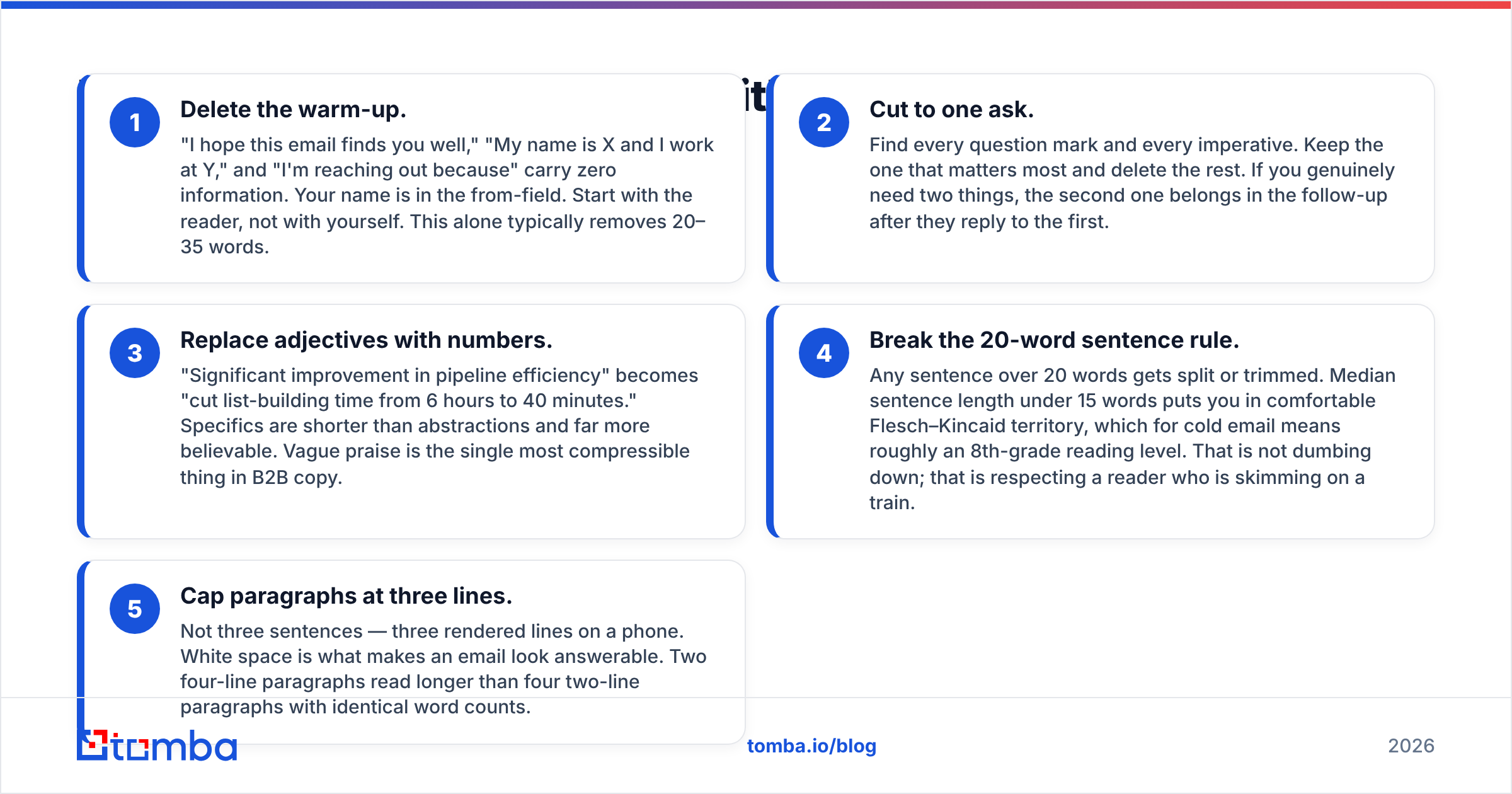
Run these five passes in order. On a typical 220-word draft this takes about 90 seconds and usually lands you between 90 and 120 words.
Delete the warm-up. "I hope this email finds you well," "My name is X and I work at Y," and "I'm reaching out because" carry zero information. Your name is in the from-field. Start with the reader, not with yourself. This alone typically removes 20–35 words.
Cut to one ask. Find every question mark and every imperative. Keep the one that matters most and delete the rest. If you genuinely need two things, the second one belongs in the follow-up after they reply to the first.
Replace adjectives with numbers. "Significant improvement in pipeline efficiency" becomes "cut list-building time from 6 hours to 40 minutes." Specifics are shorter than abstractions and far more believable. Vague praise is the single most compressible thing in B2B copy.
Break the 20-word sentence rule. Any sentence over 20 words gets split or trimmed. Median sentence length under 15 words puts you in comfortable Flesch–Kincaid territory, which for cold email means roughly an 8th-grade reading level. That is not dumbing down; that is respecting a reader who is skimming on a train.
Cap paragraphs at three lines. Not three sentences — three rendered lines on a phone. White space is what makes an email look answerable. Two four-line paragraphs read longer than four two-line paragraphs with identical word counts.
A sixth optional pass: read the email out loud. Anything you would not say to a stranger at a conference gets cut. That kills most of the corporate hedging that inflates B2B drafts.
Does subject line length matter as much as body length?#
Yes, and it operates on a tighter budget. Subject lines get truncated around 40–50 characters on mobile clients and 60–70 on desktop, so the useful information has to live in the first six or seven words.
The practical rules:
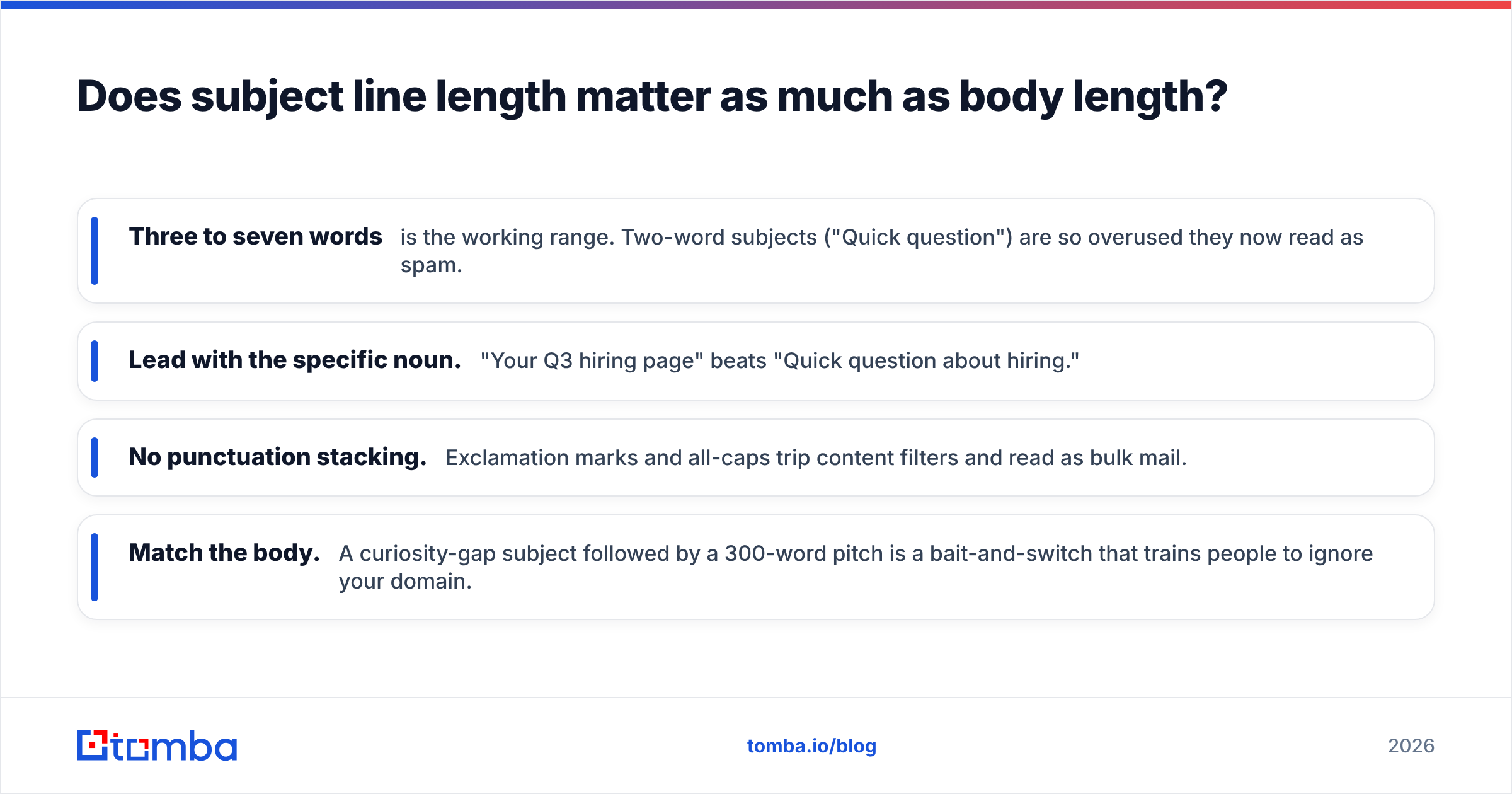
- Three to seven words is the working range. Two-word subjects ("Quick question") are so overused they now read as spam.
- Lead with the specific noun. "Your Q3 hiring page" beats "Quick question about hiring."
- No punctuation stacking. Exclamation marks and all-caps trip content filters and read as bulk mail.
- Match the body. A curiosity-gap subject followed by a 300-word pitch is a bait-and-switch that trains people to ignore your domain.
If you want to sanity-check variants before sending, run them through a subject line tester and compare character counts and spam-trigger words side by side. It takes 30 seconds and catches the truncation problems you cannot see in your own composer.
Is a short email always better?#
No, and this is where most length advice goes wrong. Three situations where longer wins:
Complex or expensive purchases. If your product changes how a team works and costs six figures, a 60-word email cannot carry the credibility required. Enterprise buyers reading a first touch about a platform migration need enough substance to justify forwarding the email internally. That is often 150–200 words with a bulleted proof section.
Replies to inbound interest. Someone who filled out a form and asked three questions deserves three answers. Sending them a two-line "let's book a call" is not brevity, it is evasion, and it reads as a bot.
Technical audiences. Engineers and analysts tend to prefer density over polish. A well-structured 250-word email with concrete numbers and a link to docs will outperform a breezy 70-word note that makes them ask follow-up questions.

The unifying principle: length should be proportional to the reader's existing interest and the complexity of the decision. Cold plus simple equals very short. Warm plus complex equals as long as it needs to be, structured with headers. What is never acceptable is length that comes from imprecision rather than substance.
HubSpot's sales blog has published multiple analyses of outreach performance over the years, and the consistent finding across their data is not that short always wins — it is that clarity of the next step correlates with reply rate more strongly than raw word count does.
How do you test email length on your own list?#
Benchmarks are a starting point, not an answer. Your audience, offer, and sender reputation shift the optimal range. Test it properly.
Set up the comparison. Write two versions of the same email — same subject line, same offer, same call to action — at roughly 70 words and roughly 150 words. Keep every other variable frozen. Split your send list randomly, not by segment, or you will be measuring the segment instead of the length.
Get enough volume. Reply rates on cold email are low enough that you need a few hundred sends per variant before differences mean anything. At 50 sends per arm, you are reading noise.
Measure replies, not opens. Open tracking has been unreliable since Apple Mail Privacy Protection started pre-fetching images, and opens tell you nothing about whether the body length worked. Reply rate and positive-reply rate are the metrics that matter. Track meetings booked if your volume supports it.
Control for deliverability. This is the step teams skip, and it invalidates more tests than any other factor. If variant A landed in 400 inboxes and variant B landed in 250 because of a bad-data spike in that segment, your "length result" is actually a bounce result. Clean both lists with an email verifier before the send and compare bounce rates across arms before you compare replies.
Re-test quarterly. Inbox norms shift. What worked in 2024 is measurably weaker now that AI-generated outreach has flooded inboxes with competent-but-generic 80-word emails. Specificity has become the scarce resource, and specificity sometimes costs words.
What actually breaks cold email before length does?#
Rank-ordering the failure modes, because obsessing over word count while ignoring the rest is a common trap:
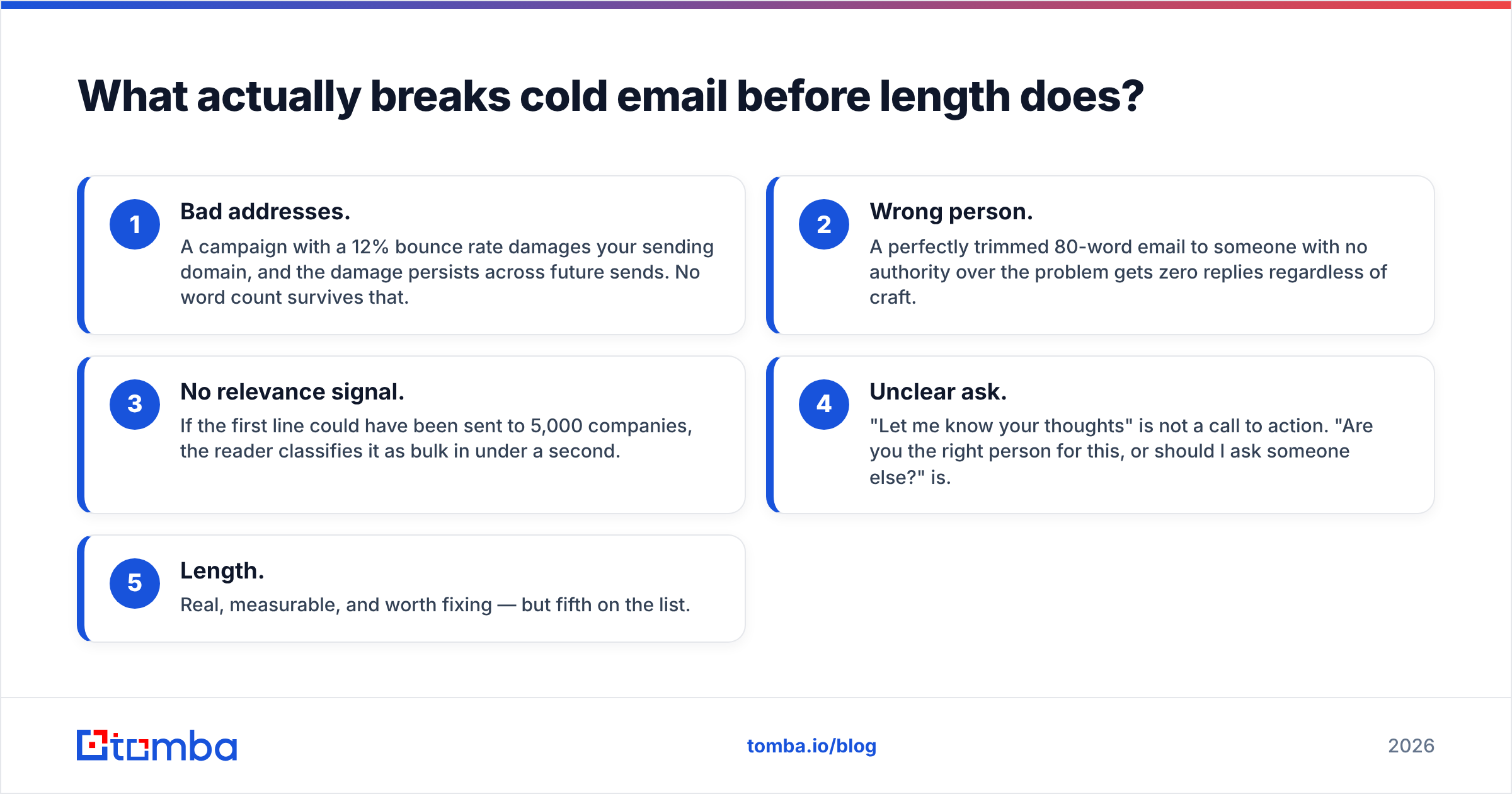
- Bad addresses. A campaign with a 12% bounce rate damages your sending domain, and the damage persists across future sends. No word count survives that.
- Wrong person. A perfectly trimmed 80-word email to someone with no authority over the problem gets zero replies regardless of craft.
- No relevance signal. If the first line could have been sent to 5,000 companies, the reader classifies it as bulk in under a second.
- Unclear ask. "Let me know your thoughts" is not a call to action. "Are you the right person for this, or should I ask someone else?" is.
- Length. Real, measurable, and worth fixing — but fifth on the list.
That ordering is why list quality work pays back faster than copy work. Getting the right verified address for the right decision-maker moves reply rate more than shaving 30 words ever will. A quick domain search to map who actually owns the problem at a target account, followed by verification, changes the denominator of your whole campaign. And if you are sourcing contacts at volume, running them through a bulk email finder with verification built into the same pass keeps bounce rates in the range where length tests are even readable.
What is the practical checklist before you hit send?#
- Under 125 words for a cold first touch, under 75 for a follow-up
- One ask, phrased as a question the reader can answer in a single sentence
- First line references something specific to them, not to you
- No paragraph over three rendered mobile lines
- Median sentence under 20 words
- Subject line 3–7 words, front-loaded with the specific noun
- One link maximum, and only if it is genuinely necessary
- Address verified, domain warmed, SPF and DKIM passing
If every box is checked and replies are still flat, the problem is your offer or your targeting — not your word count.
Where to start#
Fix the input before you fix the prose. The highest-leverage change for most outbound teams is not a shorter email; it is sending a well-sized email to a verified, correctly targeted person. Start with the Tomba Email Finder to source accurate professional addresses by name, domain, or company, verify them before the send, and then run your 70-word versus 150-word test on a list that will not skew the result. The free tier covers 25 searches a month so you can check your targeting assumptions before committing, and paid plans start at $49/mo with verification included — see Tomba pricing for the full breakdown.
Write the short version. Send it to the right person. Measure the replies, not the opens.
Related guides#
Ready to find emails that actually work?
Join 150,000+ professionals who stopped guessing and started sending. Free credits on signup — no credit card required.
Get the Tomba newsletter
Practical outbound tactics and product updates — once every two weeks.
About the author