How Many Buyer Personas Should a Business Have in 2026?
Most B2B teams build twelve buyer personas and use two. Here is the practical range, the test for when a persona earns its place, and how to build them from real contact data instead of workshop guesses.
TL;DR
- Most B2B businesses need 3 to 5 buyer personas. Below 3 you are usually describing a market, not a buyer. Above 5 you are usually describing job titles, not decision patterns.
- A persona earns its place only if it changes something: the message, the channel, the offer, or the pricing conversation. If two personas get the same email, they are one persona.
- Enterprise and multi-product companies can justify 6 to 8, but only when each one maps to a separate revenue motion with its own owner and its own pipeline.
- Buying-committee roles (champion, economic buyer, blocker) are not separate personas. They are stages inside one deal, and they belong in your account map instead.
- Personas built from real contact data — actual titles, actual domains, actual seniority mixes in closed-won accounts — outperform workshop personas because they survive contact with your list.
What counts as a buyer persona, and what doesn't?#
A buyer persona is a compressed model of a repeat buyer: who they are, what problem pushes them to act, what they compare you against, and what language makes them reply. It exists to make a decision faster — which subject line, which case study, which pricing page.
What it is not: a demographic profile with a stock photo and a name like "Marketing Mary." The persona concept came out of product design, where the point was behavioral, not decorative. Somewhere between design and B2B marketing, the behavior fell out and the stock photo stayed.
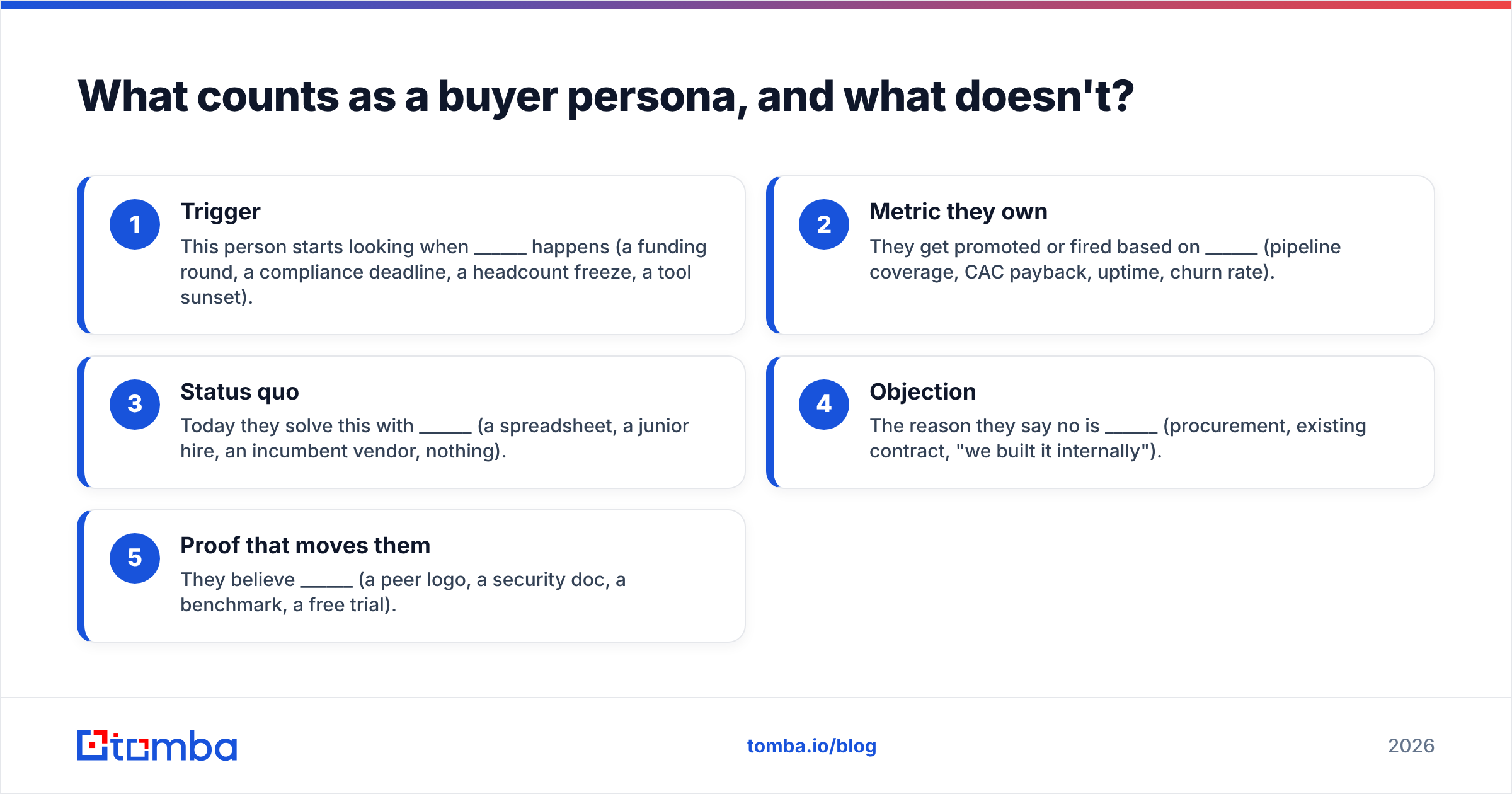
Here is the working test. A persona is real if you can finish these five sentences without guessing:
- Trigger — This person starts looking when ______ happens (a funding round, a compliance deadline, a headcount freeze, a tool sunset).
- Metric they own — They get promoted or fired based on ______ (pipeline coverage, CAC payback, uptime, churn rate).
- Status quo — Today they solve this with ______ (a spreadsheet, a junior hire, an incumbent vendor, nothing).
- Objection — The reason they say no is ______ (procurement, existing contract, "we built it internally").
- Proof that moves them — They believe ______ (a peer logo, a security doc, a benchmark, a free trial).
If two of your personas produce identical answers to all five, you have one persona wearing two hats. Merge them. That single test cuts most bloated persona libraries in half within an hour.

How many buyer personas should a business have?#
Three to five, for the overwhelming majority of B2B companies. That is the range where each persona still carries enough distinct information to change what you actually send, while the set stays small enough that a rep can hold it in working memory during a call.
The number is not arbitrary. It falls out of three constraints:
- Message maintenance. Every persona needs its own sequence, its own two or three proof points, and a refresh at least twice a year. A team of five SDRs can realistically maintain four sequence families. Twelve is theater.
- Data volume per segment. Statistical signal needs volume. If you split a 40,000-contact list into ten personas, most segments never gather enough sends to tell you whether a message worked or whether you got unlucky.
- Committee size. Gartner's research on the B2B buying journey puts a typical enterprise purchase committee at six to ten people. Those are roles inside one deal, not ten separate personas. Treating them as separate personas is the single most common way persona counts balloon.
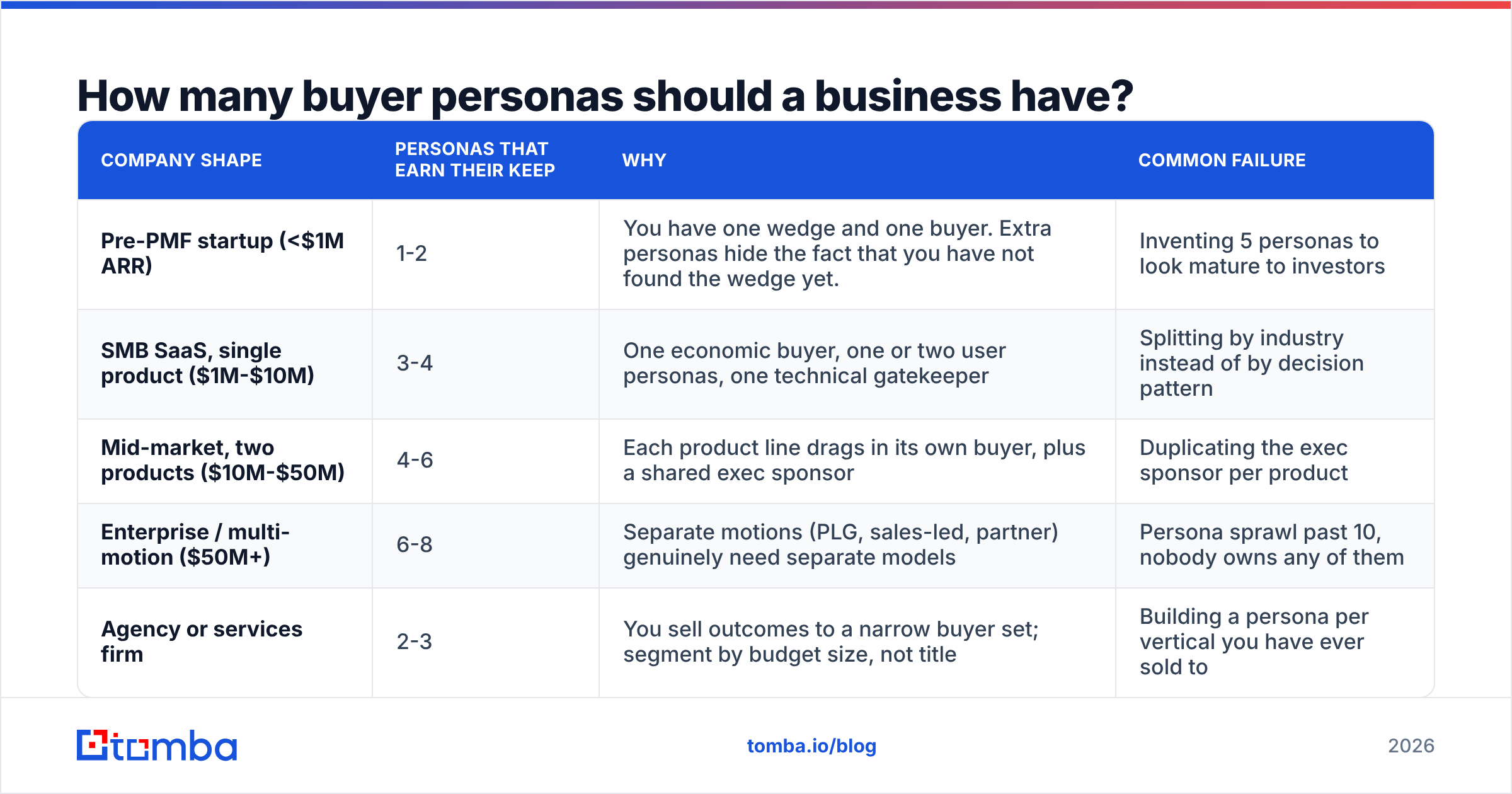
Here is how the ranges map to company shapes in practice.
| Company shape | Personas that earn their keep | Why | Common failure |
|---|---|---|---|
| Pre-PMF startup (<$1M ARR) | 1-2 | You have one wedge and one buyer. Extra personas hide the fact that you have not found the wedge yet. | Inventing 5 personas to look mature to investors |
| SMB SaaS, single product ($1M-$10M) | 3-4 | One economic buyer, one or two user personas, one technical gatekeeper | Splitting by industry instead of by decision pattern |
| Mid-market, two products ($10M-$50M) | 4-6 | Each product line drags in its own buyer, plus a shared exec sponsor | Duplicating the exec sponsor per product |
| Enterprise / multi-motion ($50M+) | 6-8 | Separate motions (PLG, sales-led, partner) genuinely need separate models | Persona sprawl past 10, nobody owns any of them |
| Agency or services firm | 2-3 | You sell outcomes to a narrow buyer set; segment by budget size, not title | Building a persona per vertical you have ever sold to |
Notice the pattern: the count grows with the number of revenue motions, not with the number of job titles in your CRM. Two products sold to the same buyer is still one persona. One product sold through both self-serve and enterprise contracts is two.
Why do too many personas quietly break outbound?#
Persona sprawl rarely announces itself. It shows up as a slow decay in everything downstream.
- Dilution. Ten personas means ten sets of copy written at 30% effort each, instead of four written properly. Reply rates track copy quality far more tightly than segment count.
- Untestable data. Split-testing needs sample size. A segment of 800 contacts producing 12 replies tells you nothing you can act on. Your response rate becomes noise.
- Routing chaos. Every persona needs a lead-scoring rule, a routing rule, and a nurture path. Ten personas mean 30 rules nobody audits. RevOps inherits a maintenance tax with no revenue attached.
- Rep abandonment. Reps use what fits on one page. Give them a 40-page persona deck and they will build their own two-persona mental model and ignore yours — which is worse than having none, because now marketing and sales are optimizing against different targets.
- False precision. A persona split you cannot detect in your data is not a segment. If you cannot tell from a contact record whether someone is "Growth-Stage Gina" or "Scaling Sam," the split does not exist operationally.
The cost is real but invisible on any dashboard, which is why persona libraries keep growing. Nobody has ever been fired for adding a persona.
How do you decide the right number for your own company?#
Run this in an afternoon. It is a subtraction exercise, not an addition one.
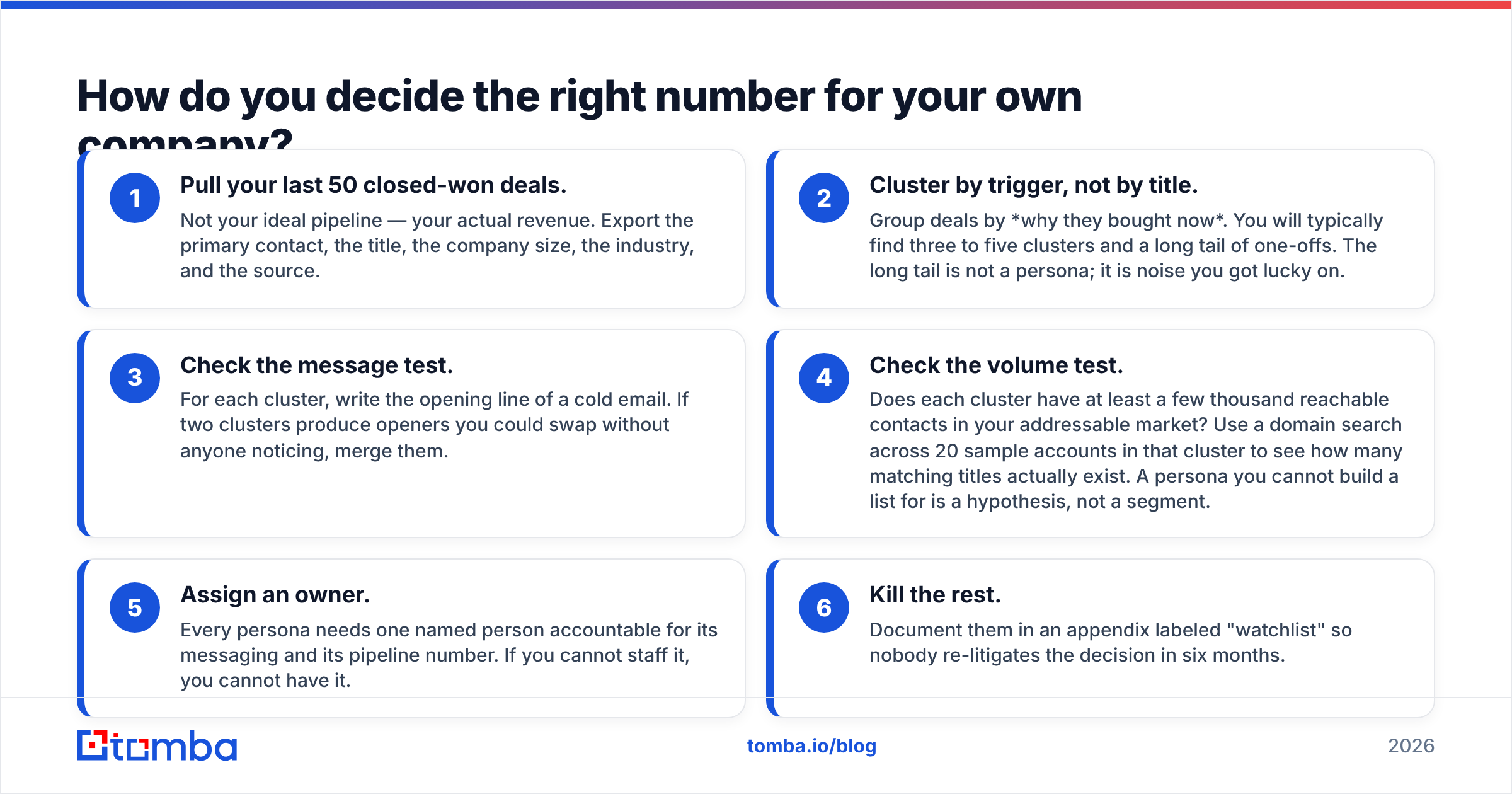
- Pull your last 50 closed-won deals. Not your ideal pipeline — your actual revenue. Export the primary contact, the title, the company size, the industry, and the source.
- Cluster by trigger, not by title. Group deals by why they bought now. You will typically find three to five clusters and a long tail of one-offs. The long tail is not a persona; it is noise you got lucky on.
- Check the message test. For each cluster, write the opening line of a cold email. If two clusters produce openers you could swap without anyone noticing, merge them.
- Check the volume test. Does each cluster have at least a few thousand reachable contacts in your addressable market? Use a domain search across 20 sample accounts in that cluster to see how many matching titles actually exist. A persona you cannot build a list for is a hypothesis, not a segment.
- Assign an owner. Every persona needs one named person accountable for its messaging and its pipeline number. If you cannot staff it, you cannot have it.
- Kill the rest. Document them in an appendix labeled "watchlist" so nobody re-litigates the decision in six months.
Step 4 is the one teams skip, and it is the one that saves the most wasted quarters. A persona that sounds compelling in a workshop but yields 60 reachable contacts across your entire TAM is an expensive fiction.
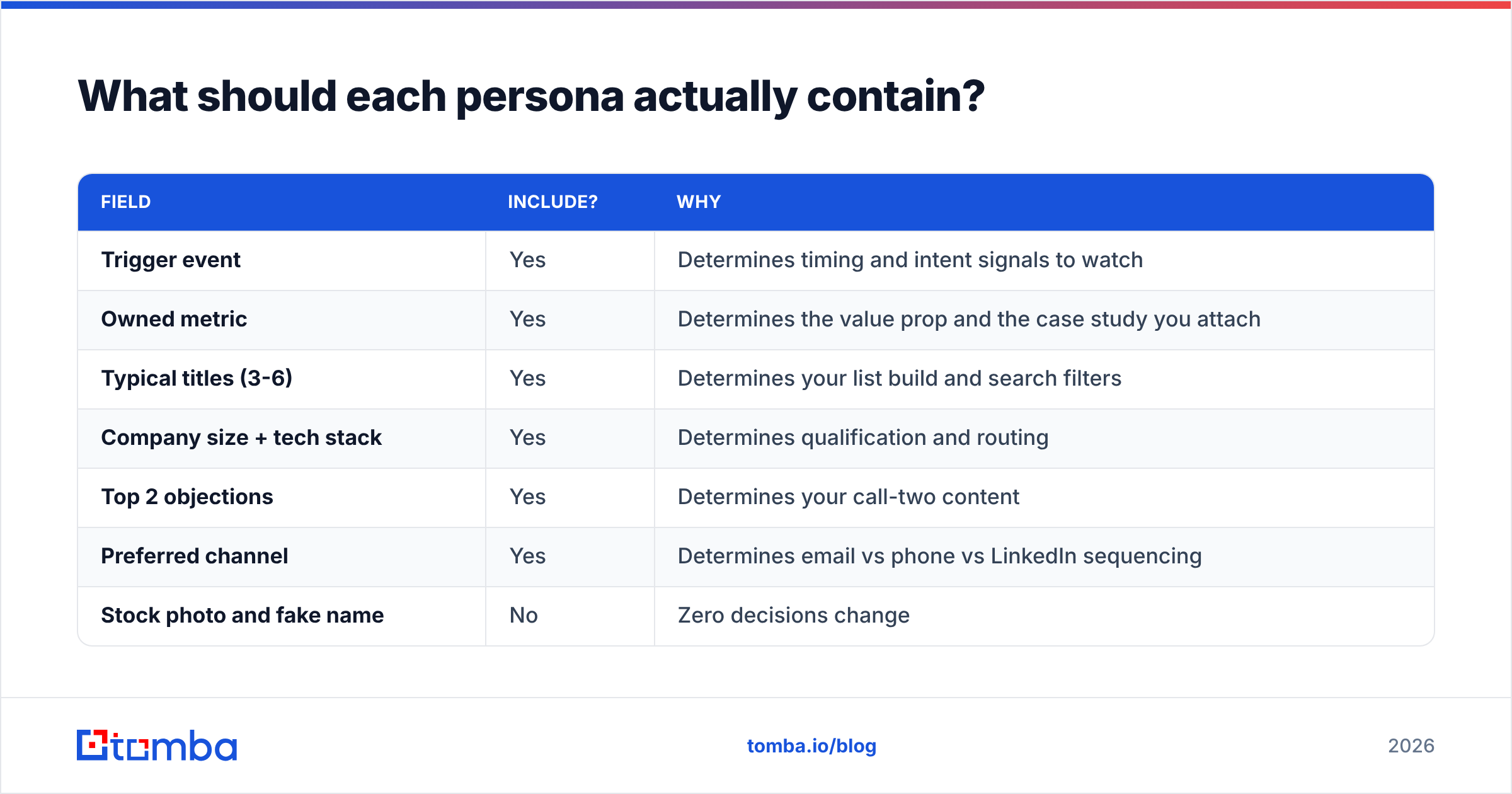
What should each persona actually contain?#
Strip out everything that does not change an action. A usable persona fits on one screen.
| Field | Include? | Why |
|---|---|---|
| Trigger event | Yes | Determines timing and intent signals to watch |
| Owned metric | Yes | Determines the value prop and the case study you attach |
| Typical titles (3-6) | Yes | Determines your list build and search filters |
| Company size + tech stack | Yes | Determines qualification and routing |
| Top 2 objections | Yes | Determines your call-two content |
| Preferred channel | Yes | Determines email vs phone vs LinkedIn sequencing |
| Stock photo and fake name | No | Zero decisions change |
| Hobbies, favorite coffee | No | Padding that makes the doc unreadable |
| Vague "pain points" list | No | Restates the trigger with less precision |
Two additions worth making that most templates miss. First, the disqualifier: what makes this persona a bad fit even when they look right on paper. Second, the reachability note: which channel actually gets a response. A VP of Engineering and a VP of Revenue Operations may sit in the same account at the same seniority and respond to completely different channels — one ignores email entirely, the other never answers a phone. Capturing that at the persona level saves your reps from learning it one wasted week at a time.
For the research side, HubSpot's guide to buyer persona research is a reasonable interview framework, provided you treat the output as hypotheses and validate them against closed-won data rather than adopting them wholesale.

How do you build personas from real data instead of guesswork?#
The gap between a persona doc and a working segment is a list. Most persona projects die in that gap: the doc exists, but nobody can actually assemble 2,000 contacts matching it.
Close the gap in this order:
Start from accounts you have already won. Take the domains of your best 50 customers and reverse-engineer the buying committee. Who was on the thread? What were their titles? What was the seniority mix? This is descriptive work, and it beats speculation every time.
Expand to lookalikes. Take the pattern — company size, stack, geography, hiring signals — and find matching domains. A B2B database or firmographic filter gets you the account list; the account list is worthless until it has people in it.
Populate the committee. For each target domain, find the two or three titles your persona says matter. This is where a domain search or email finder turns an account list into a contact list you can actually sequence. If a persona consistently returns thin results here, that is your signal to merge or drop it.
Enrich, then re-cluster. Add seniority, department, and company attributes with data enrichment, then re-run your clustering on the enriched set. Personas often shift after enrichment: what looked like two segments by title turns out to be one segment by seniority band.
Measure per persona, not in aggregate. Track reply rate, meeting rate, and close rate separately for each persona. After one quarter, the ranking is usually brutal and clarifying — two personas carry the pipeline, one is flat, and one has never produced a deal. Retire the last one.
When should you add a persona — or retire one?#
Add a persona when a new pattern proves itself, not when someone suggests it in a planning meeting. Concrete triggers:
- You ship a product that a genuinely different buyer owns the budget for.
- A cluster of inbound deals keeps closing from a segment you never targeted, and it has run for two consecutive quarters.
- You enter a market where the same title carries different authority (a "Head of Growth" in the US versus in Japan is often not the same buyer).
- A regulatory or compliance change creates a new budget owner.
Retire a persona when it fails any of these for two quarters running: no closed-won deals, no owner, reply rate more than 40% below your blended average, or reps cannot describe it from memory. Retiring is not failure — it is how the set stays sharp. Treat your persona library the way you treat your CRM fields: everything in it should be actively used or actively deleted.
One caution on the annual re-do. Rebuilding personas from scratch every January destroys the longitudinal data that makes them useful. Amend instead. Keep the persona identity stable, update the triggers and objections quarterly, and you can compare this year's reply rates to last year's honestly.
What is the fastest way to go from persona to pipeline?#
Pick your three strongest personas. For each, write one sequence built entirely around the trigger and the owned metric — no feature lists. Build a list of 500 contacts per persona from real, verified data. Send for four weeks. Compare.
That experiment costs less than a persona workshop and tells you more, because it measures the only thing personas exist to improve: whether the right person replies.
The bottleneck is almost always the list, not the copy. If you want to test three personas properly, you need three clean, deliverable contact sets — same size, same freshness, no bounces skewing the comparison. Start with the Tomba Email Finder to build each persona's contact set from the titles and domains your data actually supports, verify before you send, and let the reply rates decide which personas survive the quarter. The free tier gives you 25 searches a month to sanity-check a segment before you commit; paid plans start at $49/mo, and you can see the full breakdown on the Tomba pricing page.
Three personas you can list-build and message precisely will beat twelve you can only describe. Cut first, then send.
Related guides#
Ready to find emails that actually work?
Join 150,000+ professionals who stopped guessing and started sending. Free credits on signup — no credit card required.
Get the Tomba newsletter
Practical outbound tactics and product updates — once every two weeks.
About the author