How Many Cold Calls a Day Should Reps Make in 2026?
Most teams chase a dial number that quietly destroys their pipeline. Here is what the data says about how many cold calls a day actually produce meetings, and how to set a quota that holds up.
TL;DR
- The honest answer to "how many cold calls a day" is 60–100 dials for a full-cycle AE and 120–200 dials for a dedicated SDR — but only if your list is verified and your dialer is decent.
- Dial count is an output of three inputs: list quality, connect rate, and talk-time discipline. Fixing the list moves the number more than yelling about activity.
- A rep working a bad list at 200 dials/day can book fewer meetings than a rep at 70 dials/day on a verified list with direct numbers.
- The realistic math in 2026: ~5–8% connect rate on mobile-verified numbers, ~15–25% of connects turn into a real conversation, ~10–20% of those book.
- Set a conversation quota (8–12 live conversations/day) instead of a raw dial quota. Dials become the means, not the scoreboard.
What is a realistic number of cold calls a day?#
Start with the range, then earn the right to argue with it.
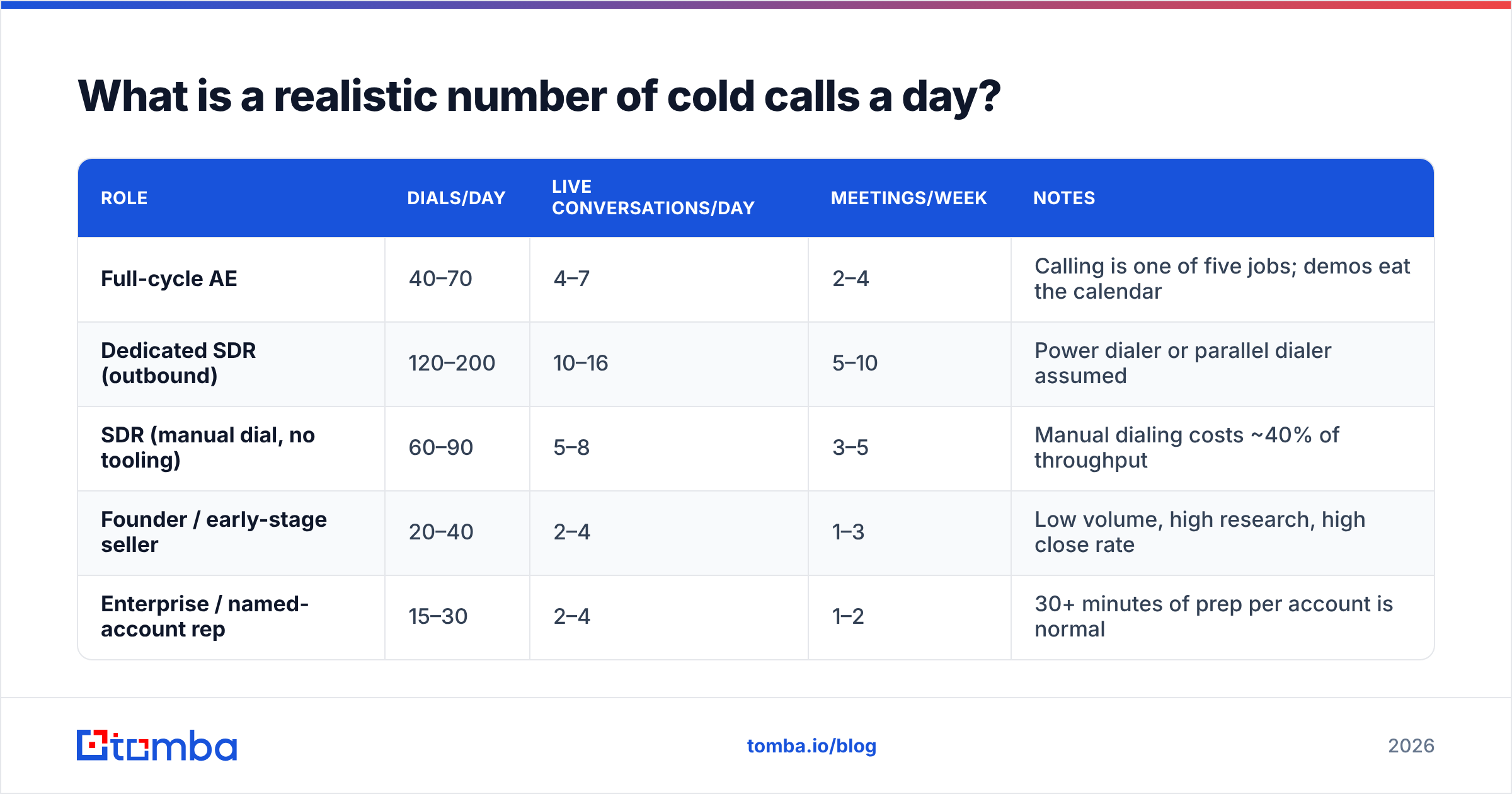
| Role | Dials/day | Live conversations/day | Meetings/week | Notes |
|---|---|---|---|---|
| Full-cycle AE | 40–70 | 4–7 | 2–4 | Calling is one of five jobs; demos eat the calendar |
| Dedicated SDR (outbound) | 120–200 | 10–16 | 5–10 | Power dialer or parallel dialer assumed |
| SDR (manual dial, no tooling) | 60–90 | 5–8 | 3–5 | Manual dialing costs ~40% of throughput |
| Founder / early-stage seller | 20–40 | 2–4 | 1–3 | Low volume, high research, high close rate |
| Enterprise / named-account rep | 15–30 | 2–4 | 1–2 | 30+ minutes of prep per account is normal |
Notice how the meetings column does not scale linearly with the dials column. That is the whole point of this article. An enterprise rep making 20 calls a day into a researched account list can outproduce an SMB SDR making 180 into a scraped list, because the denominator changed.
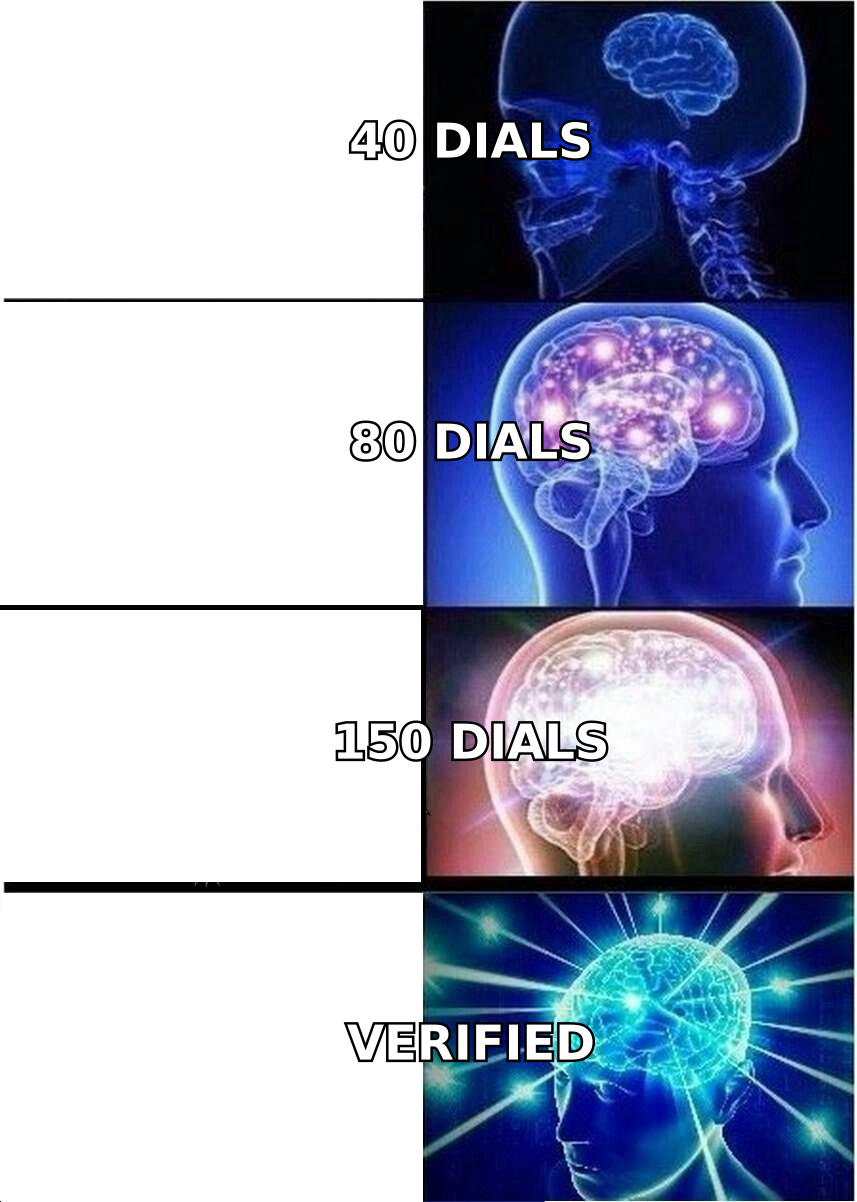
The 200-dial number gets quoted constantly because it is easy to inspect on a dashboard. It survives as a management ritual, not because it reflects what a human can do well. Sustained 200-dial days require a parallel dialer, a pre-verified list, and a rep who does nothing else — no email, no LinkedIn, no CRM hygiene. Most teams have none of those three and still copy the number.
Why does dial count matter less than connect rate?#
Because dials are the cheapest number in your funnel and the least predictive.
Think of it like fishing. You can measure how many times you cast, or you can measure how many fish are actually in the water where you're casting. Casting 300 times into an empty pond is impressive activity and zero dinner. The industry has spent a decade optimizing casts.
Run the arithmetic both ways:
Scenario A — high volume, bad data
- 200 dials/day
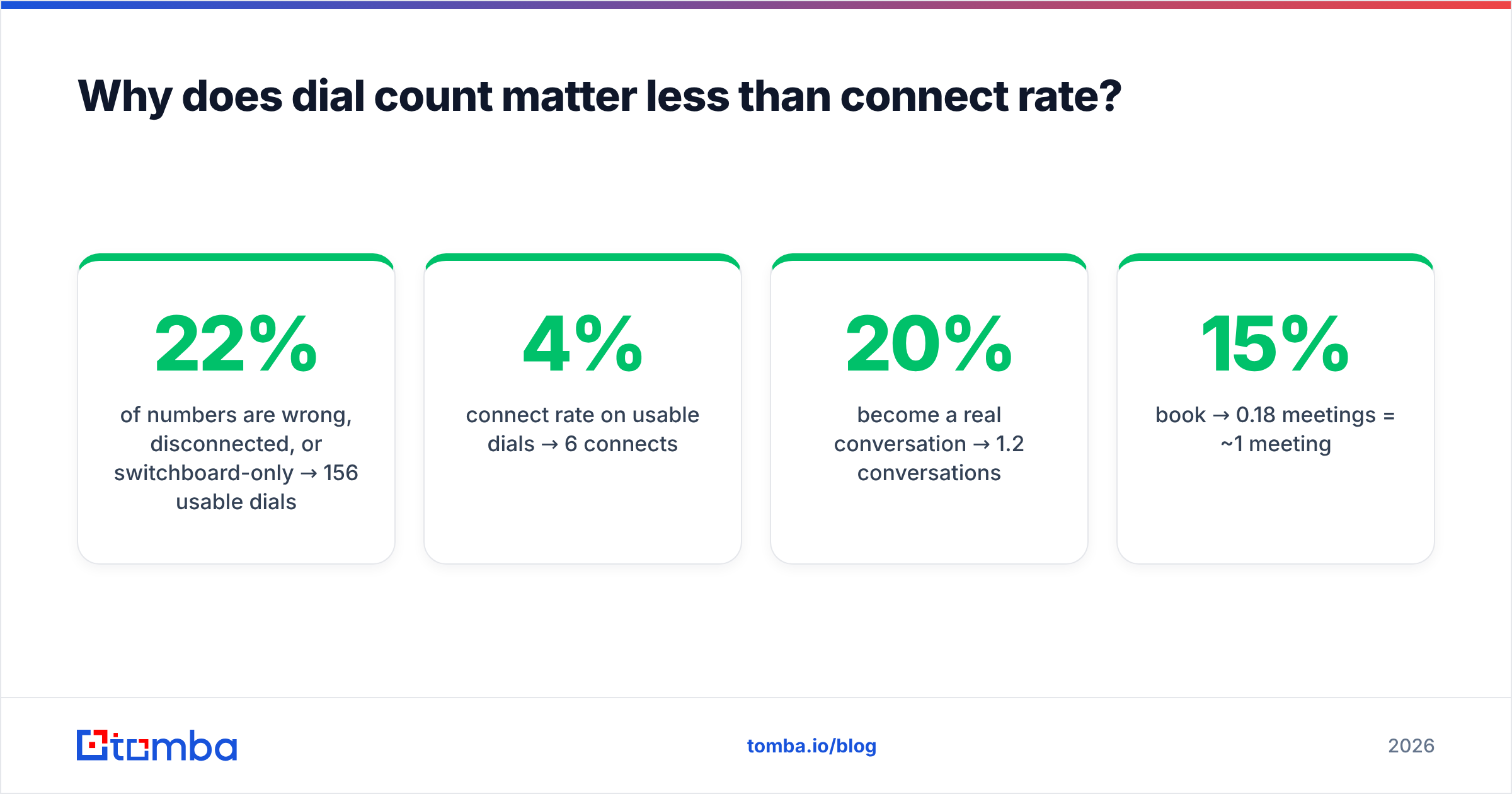
- 22% of numbers are wrong, disconnected, or switchboard-only → 156 usable dials
- 4% connect rate on usable dials → 6 connects
- 20% become a real conversation → 1.2 conversations
- 15% book → 0.18 meetings/day = ~1 meeting/week
Scenario B — moderate volume, verified data
- 80 dials/day
- 4% bad numbers → 77 usable dials
- 8% connect rate (direct mobiles, not switchboards) → 6.2 connects
- 30% become a real conversation (right person, right title) → 1.9 conversations
- 18% book → 0.33 meetings/day = ~1.7 meetings/week
Scenario B makes 60% fewer calls and books nearly twice as many meetings. The rep in Scenario B also ends the day with energy left over, which matters over a quarter.
The lever that moved was never dial count. It was the percentage of numbers that reach a human with buying authority. That is a data problem, and it is solvable before anyone picks up a headset. Feeding your dialer from a B2B phone numbers source with direct-dial coverage, then running the list through a phone validator to strip disconnected lines, changes the connect rate more reliably than any script tweak.
How do you calculate your own daily call target?#
Work backwards from the meeting number, not forwards from a dial number someone picked in 2019.
- Start with your meeting quota. Say you need 8 discovery calls booked per week.
- Divide by your book rate per conversation. If 18% of real conversations book, you need ~44 conversations per week.
- Divide by your conversation rate per connect. If 25% of connects become a real conversation, you need ~176 connects.
- Divide by your connect rate per dial. At 6%, that's ~2,900 dials per week — a red flag. At 6% you cannot hit 8 meetings with one rep and a 5-day week.
- Adjust the input that's broken. Raising connect rate from 6% to 9% drops the requirement to ~1,950 dials. Raising the conversation rate from 25% to 35% drops it further to ~1,400. Now you're at 280/day, still high — so you trim the meeting quota or add a channel.
- Set the daily number and the conversation floor. Publish both: "110 dials, 10 conversations." When conversations are hit early, the rep stops dialing and starts researching tomorrow's list.
That step-5 moment is where most call-quota conversations should live. If the math says 2,900 dials a week, the answer is not "call harder." The answer is that one of your rates is broken, or cold calling alone cannot carry that quota and needs email and LinkedIn alongside it.
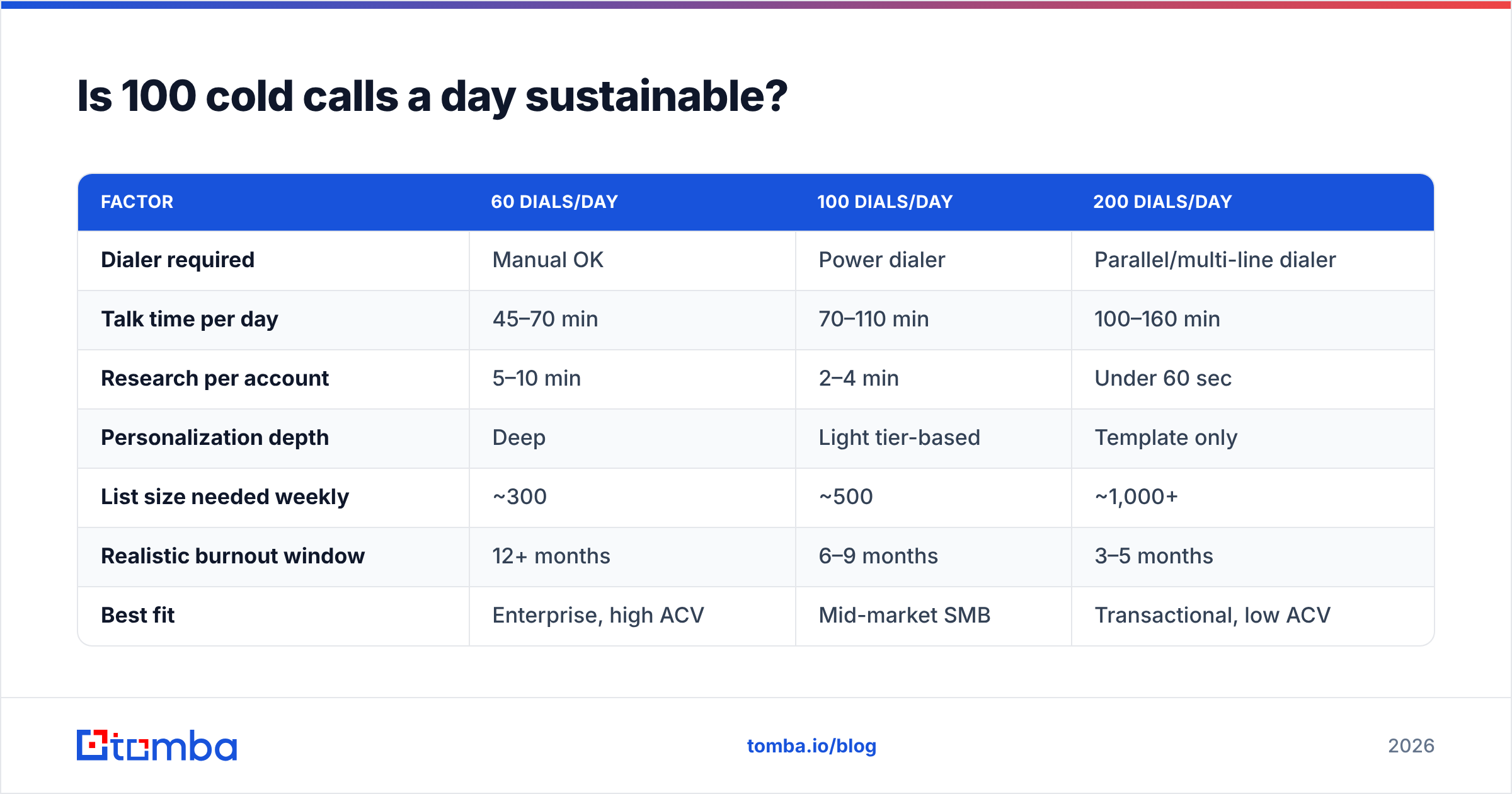
Is 100 cold calls a day sustainable?#
Yes — for a dedicated caller, with tooling, and with a hard stop.
| Factor | 60 dials/day | 100 dials/day | 200 dials/day |
|---|---|---|---|
| Dialer required | Manual OK | Power dialer | Parallel/multi-line dialer |
| Talk time per day | 45–70 min | 70–110 min | 100–160 min |
| Research per account | 5–10 min | 2–4 min | Under 60 sec |
| Personalization depth | Deep | Light tier-based | Template only |
| List size needed weekly | ~300 | ~500 | ~1,000+ |
| Realistic burnout window | 12+ months | 6–9 months | 3–5 months |
| Best fit | Enterprise, high ACV | Mid-market SMB | Transactional, low ACV |
Three things break at 200 dials that nobody puts on the dashboard. Rep tenure drops, so you pay recruiting costs that dwarf the extra meetings. Number reputation degrades — carriers flag high-velocity outbound and your calls start landing as "Spam Likely," which quietly halves your connect rate. And list burn accelerates: at 1,000 dials a week you exhaust a 10,000-contact TAM in ten weeks, then start recycling contacts who already said no.
The 100-dial number is the sustainable ceiling for most SMB and mid-market SDR teams. Above that, you are trading next quarter's connect rate for this week's activity report.
What actually changes the numbers?#
Five inputs, ranked by how much they move meetings per rep:
- Direct dial vs. switchboard ratio. A list of company mainlines has a connect rate near zero once gatekeepers are counted. A list of mobile numbers can hit 8–12%. This single variable is worth more than everything below it combined.
- Contact accuracy. Every wrong number is a dial you paid for and got nothing back. Bad B2B data decays fast — job changes alone invalidate a meaningful slice of any list within a year. Refresh quarterly with contact enrichment rather than re-buying lists.
- Time-of-day blocking. Connect rates cluster. Most teams see peaks in the first 90 minutes of the workday and the last 90 minutes. Two blocks beat eight scattered attempts.
- Multi-touch sequencing. A call after an email that got opened converts far better than a cold ring. Pair your dialing with a verified email list — the Tomba Email Finder and an email verifier pass keep the email leg from bouncing and burning the domain.
- Call attempts per contact. Most meetings come on attempt 3–6, not attempt 1. Teams that dial each contact once and move on inflate their dial count while destroying their conversion.
Two of those five are data problems you can fix on a Tuesday afternoon. The other three are process problems. None of them are "the rep isn't trying hard enough," which is where dial-quota arguments usually end up.
How do the tools compare for hitting your call volume?#
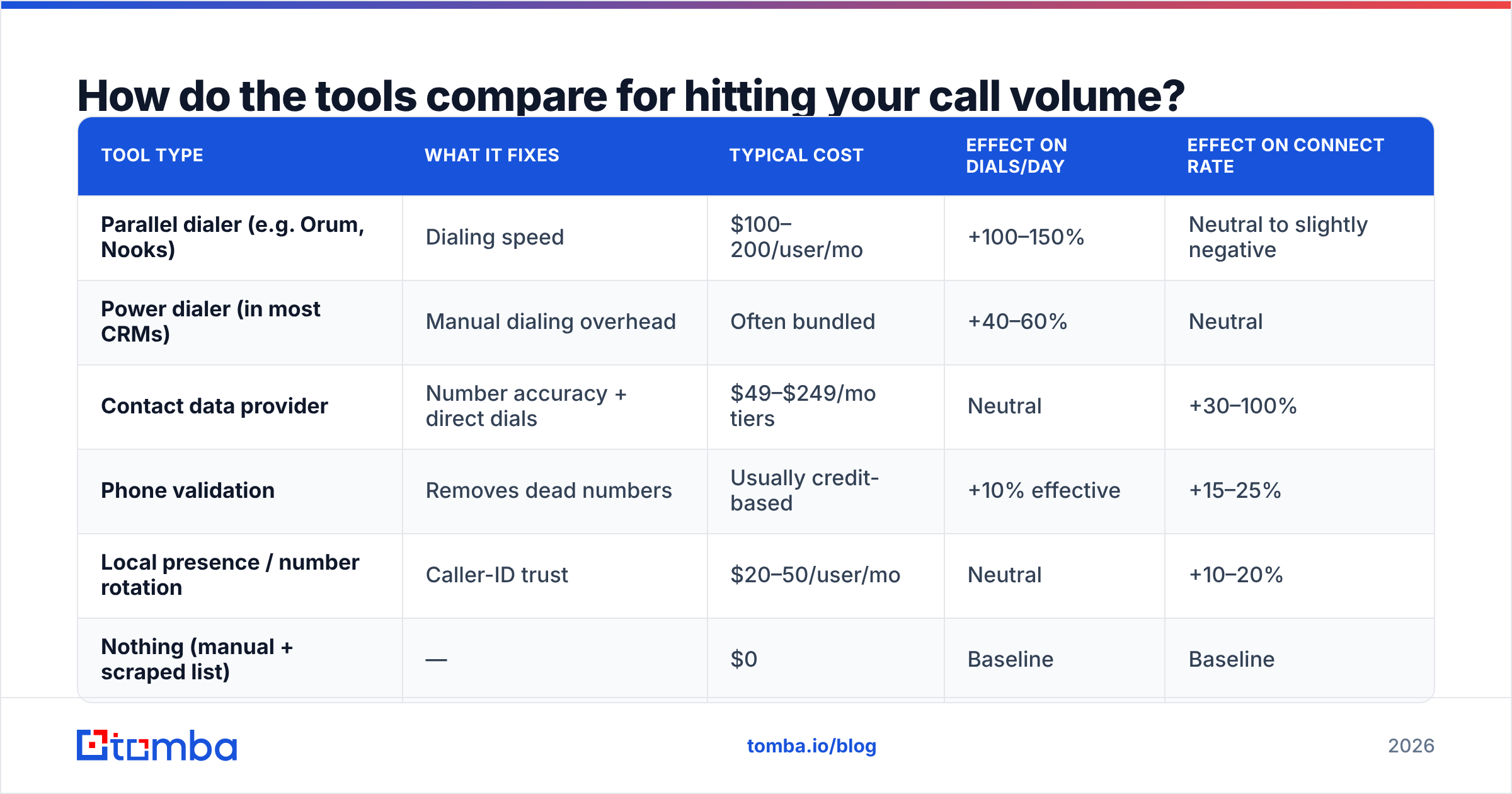
Your daily call ceiling is set by two things: how fast you can dial, and how good the numbers are. Different stacks solve different halves.
| Tool type | What it fixes | Typical cost | Effect on dials/day | Effect on connect rate |
|---|---|---|---|---|
| Parallel dialer (e.g. Orum, Nooks) | Dialing speed | $100–200/user/mo | +100–150% | Neutral to slightly negative |
| Power dialer (in most CRMs) | Manual dialing overhead | Often bundled | +40–60% | Neutral |
| Contact data provider | Number accuracy + direct dials | $49–$249/mo tiers | Neutral | +30–100% |
| Phone validation | Removes dead numbers | Usually credit-based | +10% effective | +15–25% |
| Local presence / number rotation | Caller-ID trust | $20–50/user/mo | Neutral | +10–20% |
| Nothing (manual + scraped list) | — | $0 | Baseline | Baseline |
Buying a parallel dialer before fixing your data is the classic mistake. You will dial three times faster into the same broken list and your meeting count will barely move — you just reach the end of the bad list sooner.
On the data side, the market splits into a few honest options. BookYourData is a solid pick when you want a pay-as-you-go, prebuilt list with strong coverage and no subscription commitment — useful for teams that buy in bursts rather than continuously. Tomba sits at the other end: subscription-based, API-first, and built for teams that need to enrich and re-verify continuously as their list decays. Tomba's Free tier gives you 25 searches a month to sanity-check coverage in your ICP before committing; Starter is $49/mo, Growth $99/mo, and Pro $249/mo. Full Tomba pricing is public, which is more than can be said for most enterprise data vendors.
If your ICP is heavily LinkedIn-native, sourcing contacts through a LinkedIn finder and enriching from there tends to produce better title accuracy than generic list buying — because you're anchoring on a profile a human maintains, not a database record nobody has touched since 2023.
What should managers measure instead of dials?#
Publish these four, in this order, and dial count becomes a diagnostic rather than a target:
- Live conversations per day. The only activity metric that correlates with meetings. Floor of 8–12 for an SDR.
- Connect rate by list source. Break it down by where the numbers came from. This surfaces bad vendors within two weeks instead of two quarters.
- Attempts per contact before disposition. If it's under 3, your reps are burning TAM. Cap dials-per-day until it's above 4.
- Meetings held, not booked. Booked-meeting quotas produce no-shows. Held-meeting quotas produce qualification.
Industry benchmark work from Gartner and buyer-behavior research consistently shows B2B buyers spending a small fraction of their purchase journey with any single vendor's reps. That's the structural reality behind low connect rates — not rep effort. Peer reviews on G2 for dialers and data providers tell the same story from the practitioner side: the complaints are almost never about dialing speed, and almost always about data quality.
If you track only dials, you get more dials. Reps optimize for what's on the board — that's not cynicism, it's just how quotas work. Put conversations on the board and reps start pruning bad numbers themselves, because a dead number now costs them something.
What does a good calling day actually look like?#
A realistic 100-dial SDR day, block by block:
- 8:00–8:30 — List prep. Pull today's 120 contacts, verify numbers, check for job changes. Never do this during a calling block.
- 8:30–10:00 — Block one. ~45 dials. Highest connect window of the day for most B2B segments.
- 10:00–10:30 — Logging and follow-up. Send the emails you promised on connects. Set callbacks.
- 10:30–12:00 — Block two. ~35 dials into a second time zone or a second persona.
- 1:00–2:00 — Research and sequencing. Build tomorrow's list. Layer email and LinkedIn touches on today's non-connects.
- 4:00–5:00 — Block three. ~20 dials into the late-afternoon window, which often outperforms midday for director-and-above titles.
That's 100 dials, roughly 4.5 hours of calling-adjacent work, and 3.5 hours of everything else — which is what actually makes the next day's 100 dials worth making. Teams that schedule 8 straight hours of dialing get 100 dials on Monday and 40 on Thursday.
Get the numbers right before you raise the quota#
Before you push your team from 80 dials to 150, run one test: take a sample of 200 contacts from your current list, verify the numbers and emails, and call the clean version for a week. If your connect rate jumps and your meetings jump with it, your problem was never volume — and raising the quota would have made it worse by burning your list faster.
Start there. Use Tomba Email Finder to build a verified contact base for your ICP, layer in direct phone numbers, and let the connect rate tell you what your real daily call target should be. The free tier is 25 searches a month — enough to test coverage on your top accounts before you commit to anything.
Related guides#
Ready to find emails that actually work?
Join 150,000+ professionals who stopped guessing and started sending. Free credits on signup — no credit card required.
Get the Tomba newsletter
Practical outbound tactics and product updates — once every two weeks.
About the author