How Many Emails In A Nurture Sequence? The 2026 Data
Five emails? Twelve? The right nurture sequence length depends on deal size, buying cycle, and how the lead entered your list. Here is how to calculate yours.
TL;DR
- There is no universal number. The honest answer is 5 to 12 emails, and where you land is a function of deal size, sales-cycle length, and how the lead entered your list.
- Self-serve or low-ticket offers convert on 4-6 emails over 14 days. Mid-market lands at 7-9 emails over 30-45 days. Enterprise nurture runs 10-14 emails over 90+ days.
- Sequence length matters far less than list hygiene. A 12-email nurture sent to a list with 18% dead addresses will damage your domain faster than it books meetings.
- Most teams over-index on email count and under-index on exit triggers — the rules that pull a lead out of nurture the moment they show intent.
- Build the sequence backward from your sales cycle, not forward from a template you found on a blog.
What is a nurture sequence, and why does the count matter?#
A nurture sequence is a scheduled series of emails sent to a lead who is interested but not ready to buy. Think of it like watering a plant you already own — different from cold outreach, which is closer to planting seeds in someone else's yard.
The count matters for two reasons that pull in opposite directions.
Too few emails and you abandon leads mid-consideration. B2B buyers spend most of their journey doing independent research, and a three-email sequence stops talking to them around week two of a four-month evaluation. Too many emails and you burn goodwill, trigger spam complaints, and train your recipients to ignore your sender name — which then poisons your actual sales emails later.
So the question "how many emails in a nurture sequence" is really the question "how long is my buyer's decision window, and how often can I show up in it without becoming noise?"

How many emails in a nurture sequence do you actually need?#
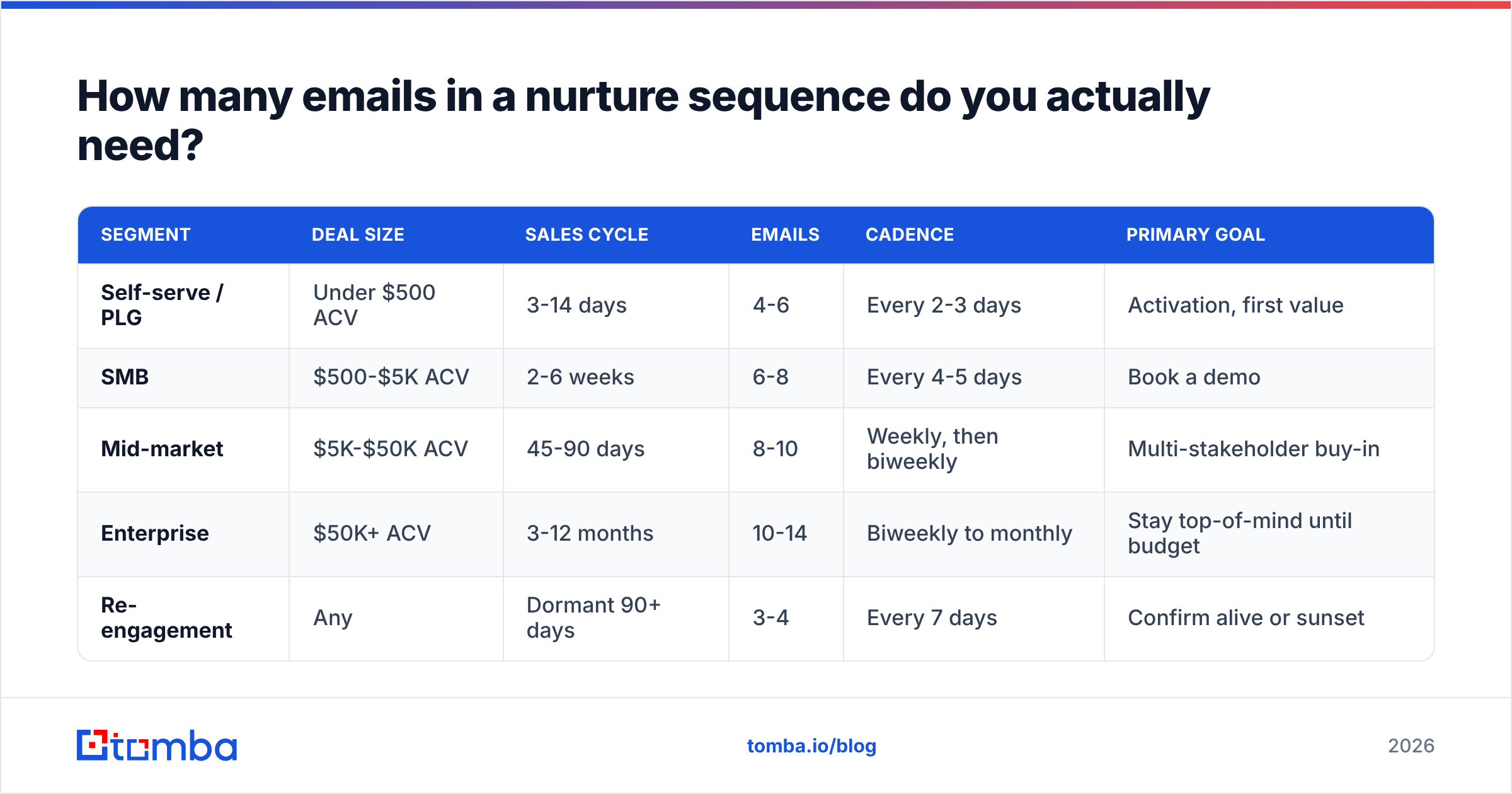
Start with the two variables that determine everything: deal size and sales-cycle length. Here is the working matrix most B2B teams land on after a year of testing.
| Segment | Deal size | Sales cycle | Emails | Cadence | Primary goal |
|---|---|---|---|---|---|
| Self-serve / PLG | Under $500 ACV | 3-14 days | 4-6 | Every 2-3 days | Activation, first value |
| SMB | $500-$5K ACV | 2-6 weeks | 6-8 | Every 4-5 days | Book a demo |
| Mid-market | $5K-$50K ACV | 45-90 days | 8-10 | Weekly, then biweekly | Multi-stakeholder buy-in |
| Enterprise | $50K+ ACV | 3-12 months | 10-14 | Biweekly to monthly | Stay top-of-mind until budget |
| Re-engagement | Any | Dormant 90+ days | 3-4 | Every 7 days | Confirm alive or sunset |
Two things to notice.
First, the email count scales with the cycle, not with your enthusiasm. A 14-email sequence sent over three weeks is not "thorough" — it is a 14-email sequence sent over three weeks, and it will read like a malfunctioning autoresponder.
Second, the re-engagement row is the shortest for a reason. If a lead has ignored you for 90 days, a long sequence will not fix that. Three emails and a clean exit protects your sender reputation better than a heroic twelve-email revival attempt.
How do you calculate your own sequence length?#
Use this formula rather than copying a template:
- Measure your median sales cycle. Pull the last 50 closed-won deals from your CRM and take the median days from first touch to signature. Median, not average — one 400-day enterprise deal will wreck the mean.
- Divide by your safe touch interval. For most B2B audiences, that is 5-7 days early in the cycle and 14-21 days later. A 60-day cycle at a 7-day interval gives you roughly 8 slots.
- Subtract the touches other channels already own. If your SDR is calling and your retargeting ads are running, email does not need to carry all eight. Drop two.
- Add one exit-trigger branch per buying signal. Pricing-page visit, demo request, reply — each one should immediately pull the lead out of nurture and into a human conversation.
- Cap at 14. Beyond that, engagement data from most marketing automation vendors shows open rates flattening near zero while unsubscribes keep climbing. There is no upside past two weeks of ignored sends.
- Reserve the last email as a genuine sunset. "Should I close your file?" outperforms a fourteenth value-add PDF, and it cleans your list for free.
That gives you a number derived from your business rather than from a template written for someone else's business.
Why does list quality beat sequence length?#
Because a nurture sequence multiplies whatever is already in your list — including the rot.
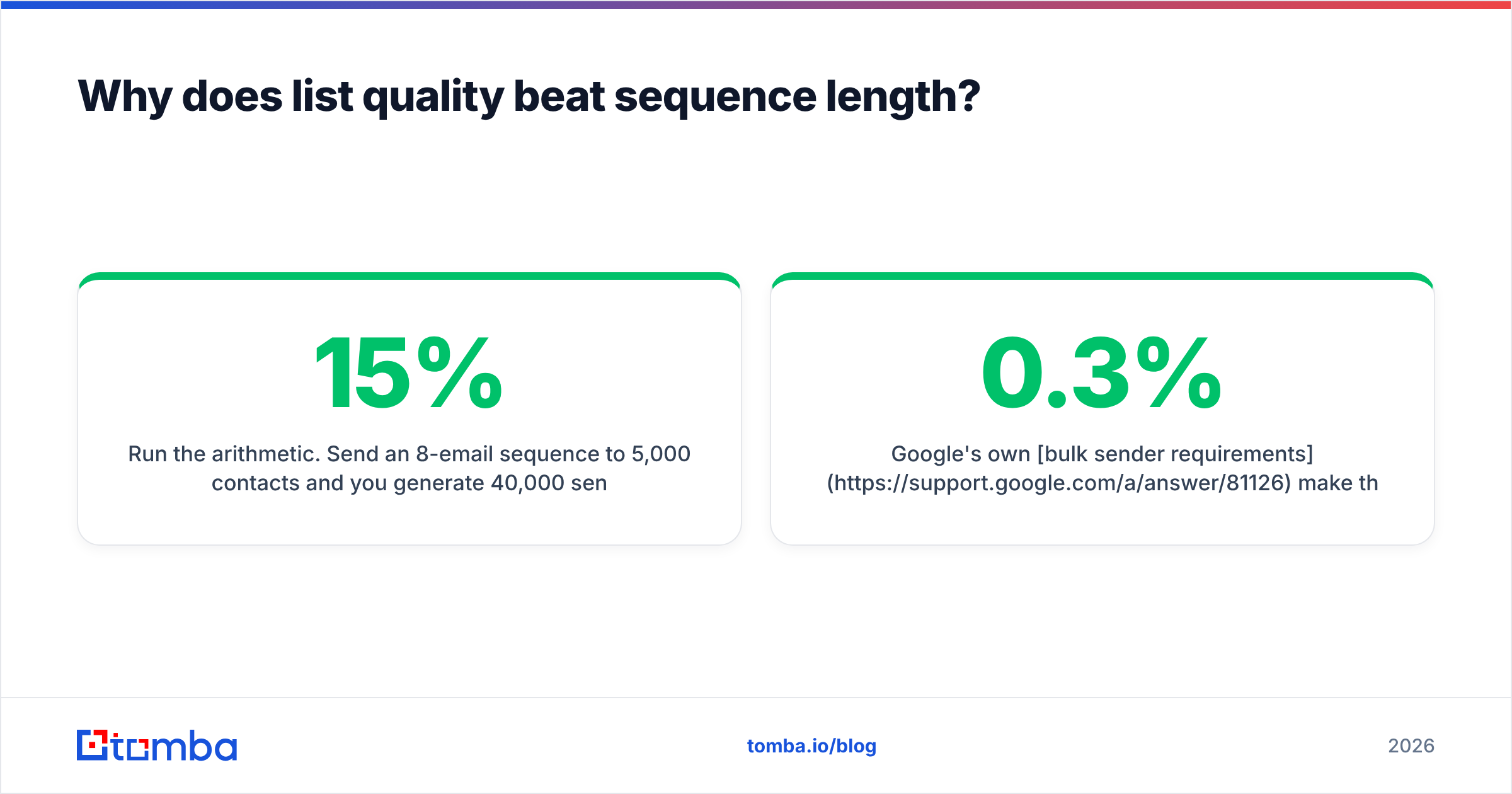
Run the arithmetic. Send an 8-email sequence to 5,000 contacts and you generate 40,000 sends. If 15% of those addresses are dead — a conservative figure for a list older than a year, since B2B contact data decays roughly 2-2.5% per month as people change jobs — you have just fired 6,000 emails at nonexistent mailboxes. Mailbox providers read that as a spam signal long before your eighth email lands.
This is the failure mode nobody blames the sequence for. Reply rates drop, the team concludes the copy is weak, and they rewrite emails 3 through 6. The copy was fine. The list was not.
Fix the input before you tune the sequence:
- Run the full list through an email verifier before the first send, and re-verify anything older than 90 days.
- Handle catch-all domains explicitly. A catch-all verifier tells you whether a domain that accepts everything actually routes to a human, which is the difference between a soft bounce and a silent black hole.
- Suppress role addresses (info@, sales@, support@) from nurture entirely. They rarely convert and they complain more.
- When a contact bounces because they changed jobs, do not just delete them — re-find them. An email finder keyed to their name and new company recovers a lead you already qualified.
Google's own bulk sender requirements make the stakes concrete: keep spam complaints below 0.3%, authenticate with SPF and DKIM, and honor one-click unsubscribe. A long sequence to a stale list violates the first rule mechanically, not stylistically.
What should each email in the sequence actually do?#
Assign one job per email. A nurture email that tries to educate, prove, and close at once does none of the three.
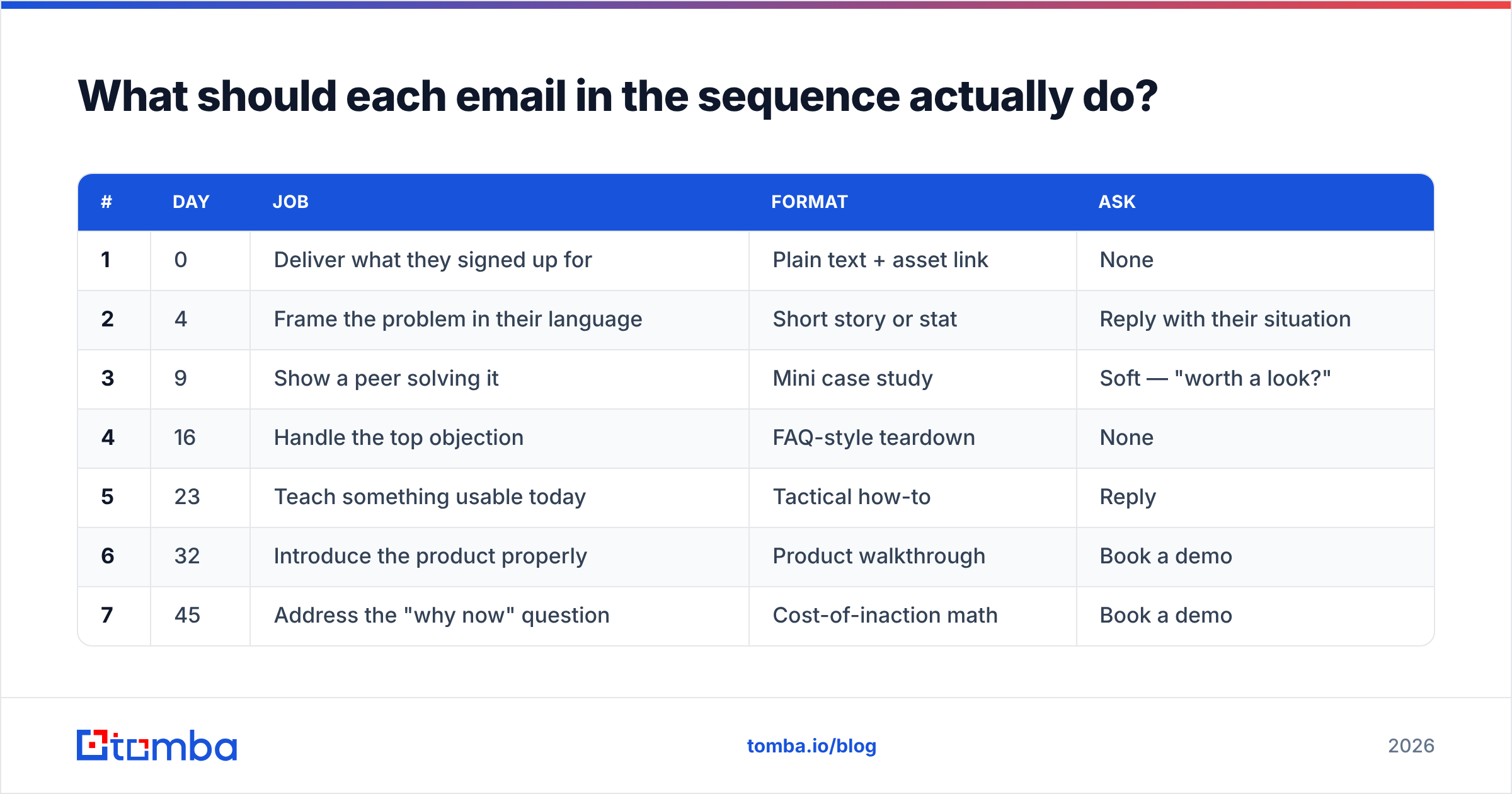
Here is an 8-email mid-market structure that works as a starting skeleton:
| # | Day | Job | Format | Ask |
|---|---|---|---|---|
| 1 | 0 | Deliver what they signed up for | Plain text + asset link | None |
| 2 | 4 | Frame the problem in their language | Short story or stat | Reply with their situation |
| 3 | 9 | Show a peer solving it | Mini case study | Soft — "worth a look?" |
| 4 | 16 | Handle the top objection | FAQ-style teardown | None |
| 5 | 23 | Teach something usable today | Tactical how-to | Reply |
| 6 | 32 | Introduce the product properly | Product walkthrough | Book a demo |
| 7 | 45 | Address the "why now" question | Cost-of-inaction math | Book a demo |
| 8 | 60 | Sunset | Two-line plain text | Yes/no |
Notice that only two of the eight emails ask for a meeting. That ratio is deliberate. If every email closes, the sequence reads as a pitch, and unsubscribes cluster around email three.
Notice also that email 8 is a real exit. Teams that skip the sunset email keep unengaged contacts in rotation forever, which is how a healthy list quietly becomes a liability.
For the copy itself, HubSpot's lead nurturing research is a reasonable benchmark on segmentation and timing. If you want a fast starting point for the writing, Tomba's cold email templates library covers most of these slots.
How do timing and cadence change the answer?#
Cadence is the hidden variable in every "how many emails" debate. The same eight emails perform completely differently at two-day and ten-day spacing.
Three rules that hold across most B2B audiences:
- Front-load, then decay. Interest is highest right after the signup event. Send emails 1-3 within the first ten days, then stretch the interval. A sequence with even spacing wastes the hottest window.
- Match the interval to the commitment. Someone who downloaded a checklist is not ready for weekly contact for three months. Someone who requested pricing is.
- Never send two emails on the same weekday two weeks running without checking overlap. If your newsletter goes out Thursday and your nurture emails 4 and 5 also land Thursday, that contact received four emails from you in a fortnight and remembers only the volume.
Which tools handle nurture sequences, and how do they compare?#
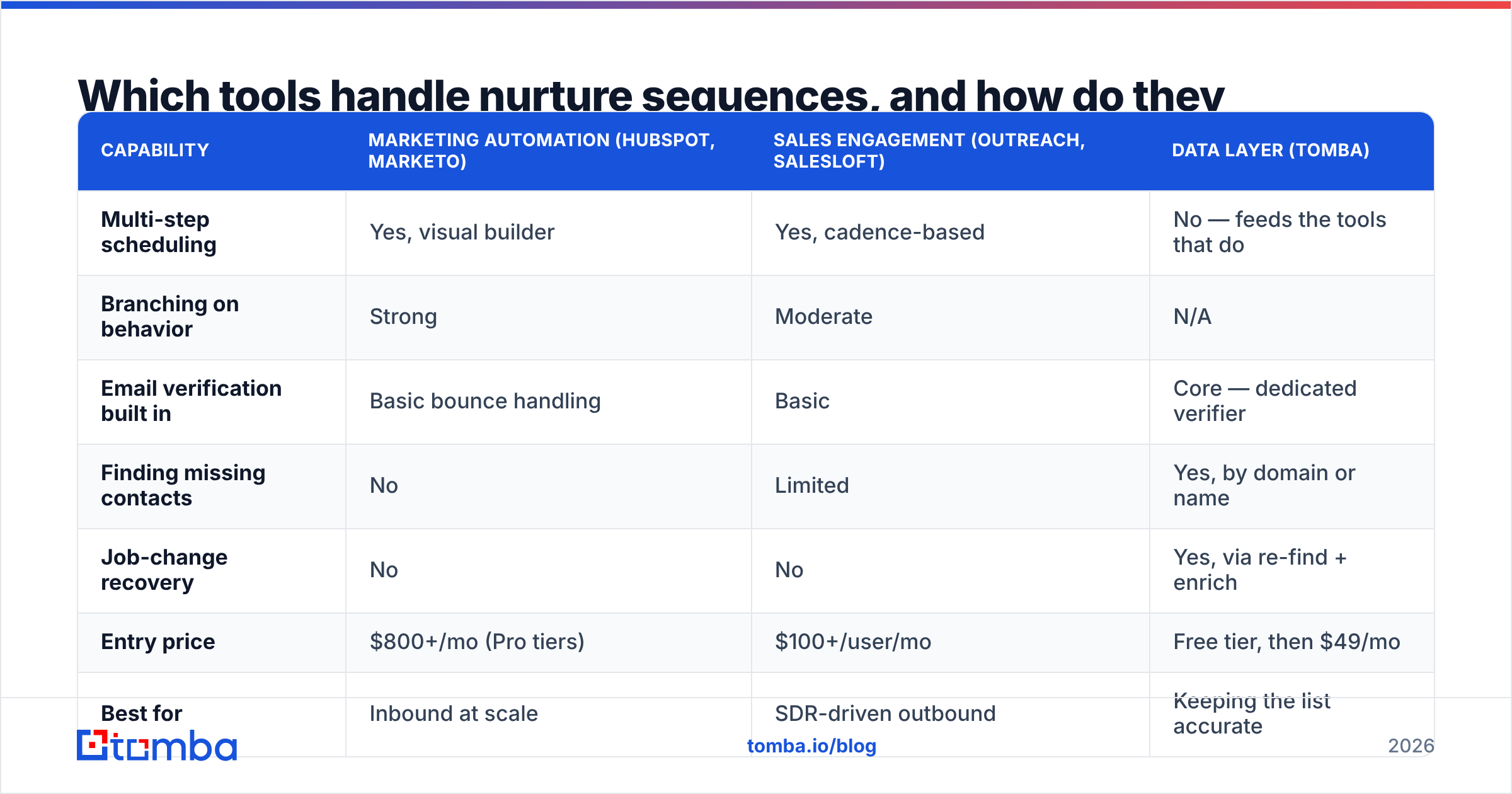
Sequence sending and sequence data are different problems, and most teams need both.
| Capability | Marketing automation (HubSpot, Marketo) | Sales engagement (Outreach, Salesloft) | Data layer (Tomba) |
|---|---|---|---|
| Multi-step scheduling | Yes, visual builder | Yes, cadence-based | No — feeds the tools that do |
| Branching on behavior | Strong | Moderate | N/A |
| Email verification built in | Basic bounce handling | Basic | Core — dedicated verifier |
| Finding missing contacts | No | Limited | Yes, by domain or name |
| Job-change recovery | No | No | Yes, via re-find + enrich |
| Entry price | $800+/mo (Pro tiers) | $100+/user/mo | Free tier, then $49/mo |
| Best for | Inbound at scale | SDR-driven outbound | Keeping the list accurate |
The practical stack for most teams: run the sequence in whatever automation platform you already pay for, and put a data layer in front of it so the list going in is clean. Check Tomba pricing against what you currently spend on bounce-driven credit waste — for many teams, the verification cost is lower than the credits they burn on invalid sends.
If you are enriching leads in bulk before a campaign, the bulk email finder handles list-sized jobs, and the Tomba API lets you verify at the point of form submission so bad addresses never enter the sequence at all.
What are the most common nurture sequence mistakes?#
- Copying a template count without adjusting the cadence. A 12-email sequence built for a 6-month enterprise cycle, compressed into 30 days, is spam with good intentions.
- No exit triggers. If a lead books a demo on email 3 and still receives emails 4 through 8, you have told them nobody is paying attention.
- Treating all entry points identically. A webinar attendee and a pricing-page visitor need different sequences. Same list, different intent, different length.
- Measuring opens only. Apple Mail Privacy Protection made open rates decorative. Track replies, clicks to pricing, and demo bookings instead.
- Never sunsetting. Every contact you keep emailing after 90 days of silence is a small ongoing tax on your email deliverability.
- Rewriting copy when the problem is data. Check bounce rate before you check subject lines. If bounces exceed 3%, the copy is not your issue.
How do you know your sequence length is right?#
Watch three numbers per email position, not per campaign:
Reply rate by position. If replies drop to near zero after email 5 and never recover, your sequence is two emails too long. Cut it.
Unsubscribe rate by position. A spike at a specific email means that email is the problem, not the length. Rewrite it before you shorten the sequence.
Bounce rate on first send. Above 3% and you have a list problem that no amount of sequence tuning will fix. Verify, then resend.
Run one variable at a time. Testing a shorter sequence and new copy and a new cadence in the same quarter tells you nothing about which change moved the number. G2's marketing automation category reviews are a useful sanity check on which platforms actually surface per-position reporting — several popular ones do not.
Where should you start this week?#
Pick the row in the first table that matches your deal size. Build that many emails. Add exit triggers for pricing-page visits and replies. Verify your list before the first send. Then let it run for one full cycle before you touch anything.
The teams that get nurture right are rarely the ones with the cleverest email seven. They are the ones whose list is accurate, whose exits are wired, and whose sequence length actually matches how long their buyers take to decide.
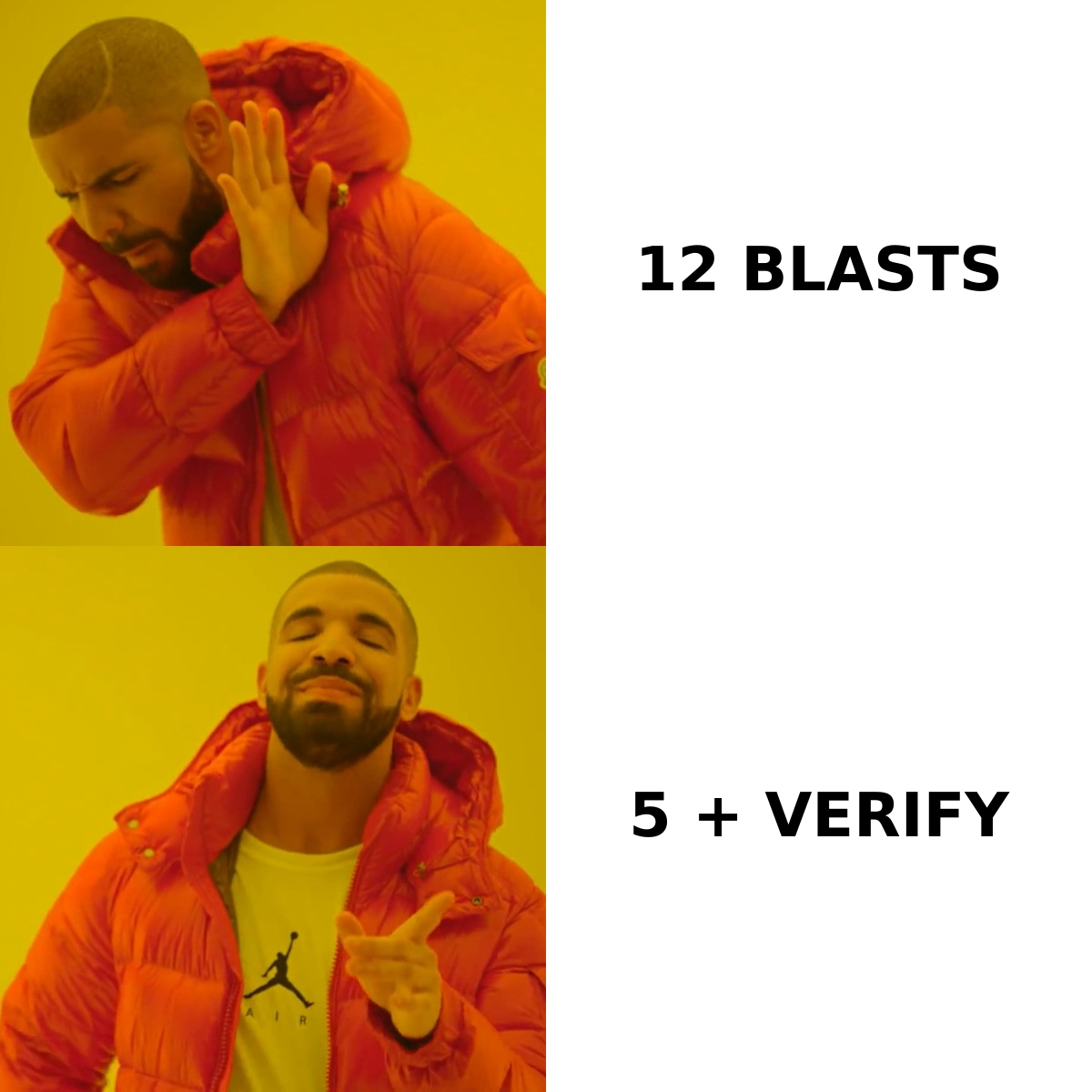
Start with the input. Before you write a single nurture email, run your list through Tomba's Email Finder to fill gaps and recover contacts who changed jobs, then verify what you have. The free tier gives you 25 searches a month to test the workflow; paid plans start at $49/mo when you are ready to run it across a full list. A five-email sequence to verified contacts beats a twelve-email sequence to a list you are hoping still works.
Related guides#
Ready to find emails that actually work?
Join 150,000+ professionals who stopped guessing and started sending. Free credits on signup — no credit card required.
Get the Tomba newsletter
Practical outbound tactics and product updates — once every two weeks.
About the author