How Many Follow Up Emails Is Too Many? The Honest Answer
Most reps quit after two follow-ups. Most spam complaints come from senders who never quit. Here is where the line actually sits, backed by reply-curve math and a sequence you can copy.
TL;DR
- Four to six total touches (one initial + three to five follow-ups) captures the large majority of replies you will ever get from a cold sequence. Past touch seven, incremental replies collapse while complaint risk climbs.
- The real cap is not a number — it is four stop signals: flat reply curve, rising spam-complaint rate, bounce spikes, and any explicit or implicit "no."
- Spacing beats volume. Day 0 / 3 / 7 / 14 outperforms five emails in five days on both reply rate and deliverability.
- Warm inbound leads tolerate fewer touches (2-4) than cold outbound (4-6) because intent decays fast, not because they are more fragile.
- Bad data inflates your "too many" count. If 20% of your list bounces, you burn sender reputation before touch two — verify before you sequence.
What Does "Too Many Follow-Up Emails" Actually Mean?#
Too many is the touch where the marginal cost exceeds the marginal reply. That is the whole definition, and it is why a single universal number is a trap.
Think of a follow-up sequence like knocking on a door. The first knock might be missed. The second and third are reasonable — the person may be in the back room. By the eighth knock you are no longer trying to be heard, you are making a statement about yourself. The neighbors notice. In email, the neighbors are Google and Microsoft, and they keep score.
Three costs stack up with every extra send:
- Reply cost — each additional touch yields fewer replies than the one before it. This is not linear decay; it is closer to exponential.
- Reputation cost — spam complaints, deletes-without-open, and "mark as not important" signals feed your sender reputation. Those compound across your entire domain, not just this prospect.
- Brand cost — the prospect who ignores touch three and gets touch nine now remembers your company for the wrong reason. That is a future deal you will never see in a dashboard.
The number you are looking for is where those three curves cross. For most B2B cold sequences in 2026, that crossing point sits between touch four and touch six.
How Many Follow-Up Emails Is Too Many, By Sequence Type?#
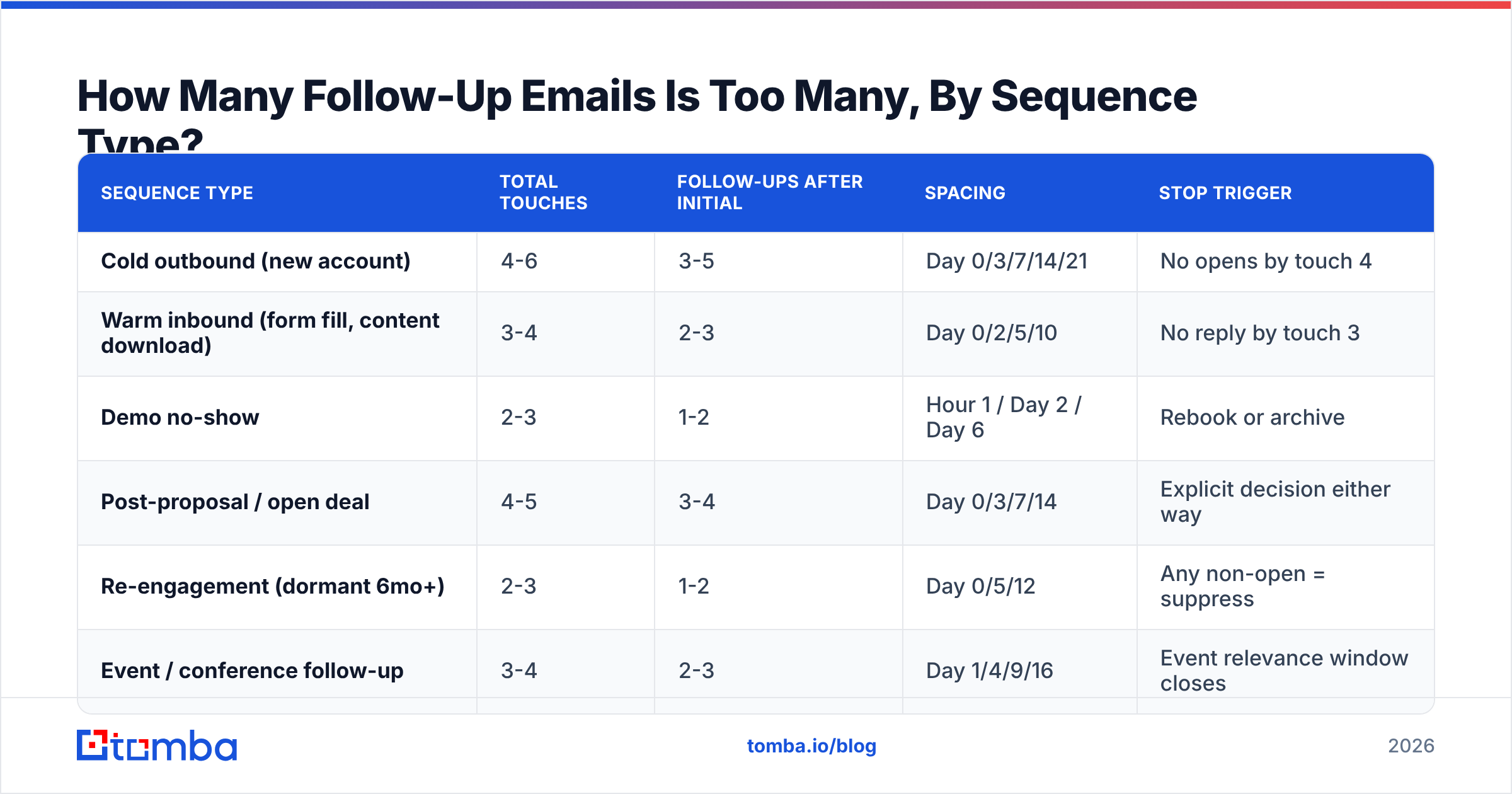
Not every sequence has the same ceiling. A cold prospect who has never heard of you needs more touches to build recognition. A demo no-show who booked time last week needs fewer, because the context is already loaded and intent decays within days.
Here is how the ceilings differ:
| Sequence type | Total touches | Follow-ups after initial | Spacing | Stop trigger |
|---|---|---|---|---|
| Cold outbound (new account) | 4-6 | 3-5 | Day 0/3/7/14/21 | No opens by touch 4 |
| Warm inbound (form fill, content download) | 3-4 | 2-3 | Day 0/2/5/10 | No reply by touch 3 |
| Demo no-show | 2-3 | 1-2 | Hour 1 / Day 2 / Day 6 | Rebook or archive |
| Post-proposal / open deal | 4-5 | 3-4 | Day 0/3/7/14 | Explicit decision either way |
| Re-engagement (dormant 6mo+) | 2-3 | 1-2 | Day 0/5/12 | Any non-open = suppress |
| Event / conference follow-up | 3-4 | 2-3 | Day 1/4/9/16 | Event relevance window closes |
Two patterns fall out of that table. First, the shorter the intent half-life, the shorter the sequence — a no-show is either rebooking this week or not at all. Second, the colder the contact, the wider the spacing, because you are building recognition rather than closing a loop.
Where Does the Reply Curve Actually Flatten?#
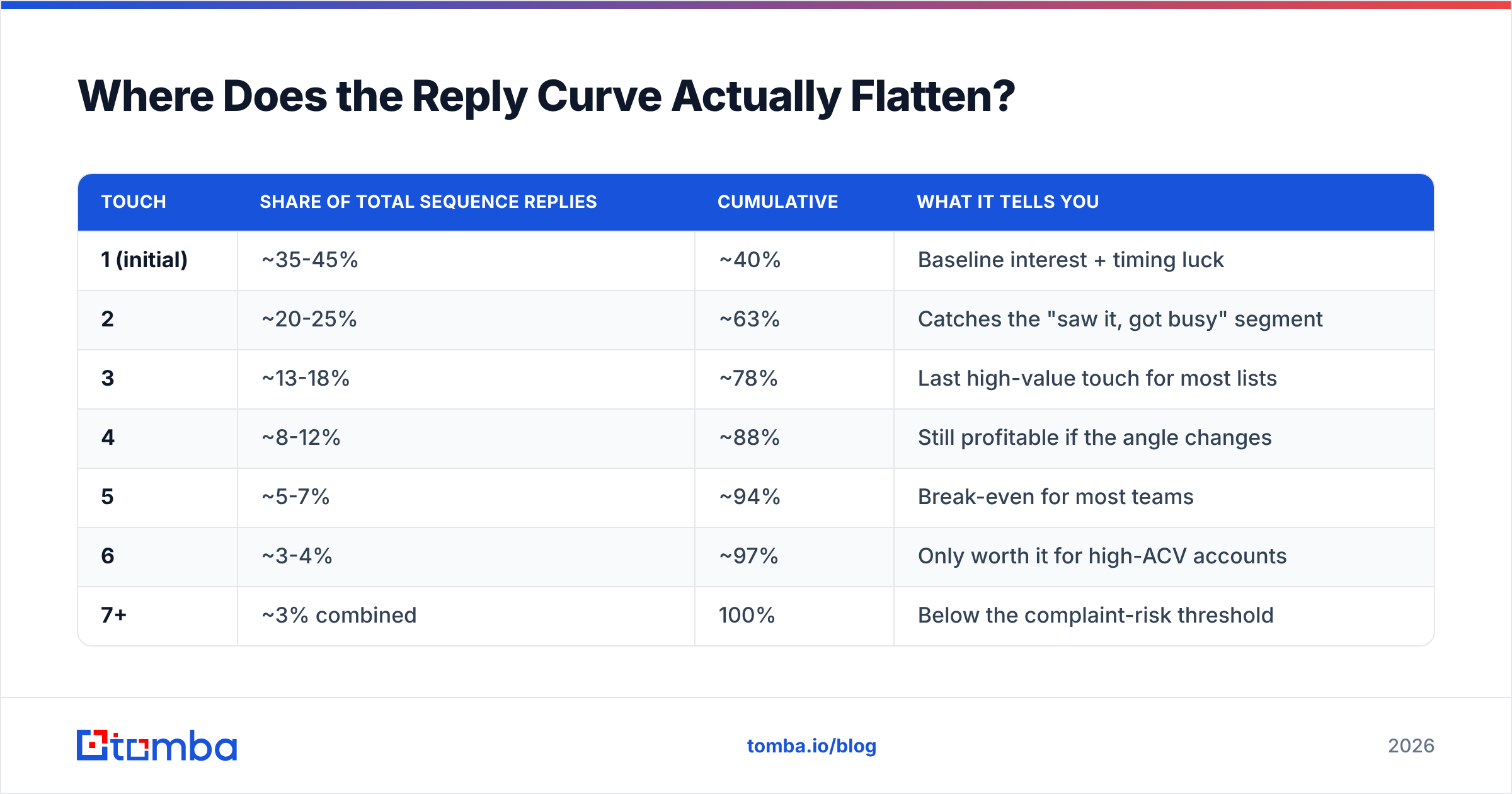
Replies concentrate hard in the first three touches, then trail off into noise.
Across published aggregate benchmarks from major outbound platforms, the shape is consistent enough to plan against. Treat these as directional bands, not guarantees — your list quality moves them more than any copy change:
| Touch | Share of total sequence replies | Cumulative | What it tells you |
|---|---|---|---|
| 1 (initial) | ~35-45% | ~40% | Baseline interest + timing luck |
| 2 | ~20-25% | ~63% | Catches the "saw it, got busy" segment |
| 3 | ~13-18% | ~78% | Last high-value touch for most lists |
| 4 | ~8-12% | ~88% | Still profitable if the angle changes |
| 5 | ~5-7% | ~94% | Break-even for most teams |
| 6 | ~3-4% | ~97% | Only worth it for high-ACV accounts |
| 7+ | ~3% combined | 100% | Below the complaint-risk threshold |
The takeaway is not "stop at three." It is that touches five through seven need to be cheap to be worth running. If each one costs a rep ten minutes of manual personalization, kill them. If they are automated, well-spaced, and genuinely add a new angle, keep them for accounts worth the reputation risk.
The teams who get away with six or seven touches share one trait: every email carries new information. A "just bumping this to the top of your inbox" send is not a touch — it is a tax on the recipient's attention that returns almost nothing. HubSpot's research on sales follow-up cadence lands in the same territory, recommending persistence paired with variation rather than raw repetition. You can read their breakdown at hubspot.com.
What Are the Four Signals That You Have Sent Too Many?#
Stop counting emails and start watching signals. These four beat any fixed number.
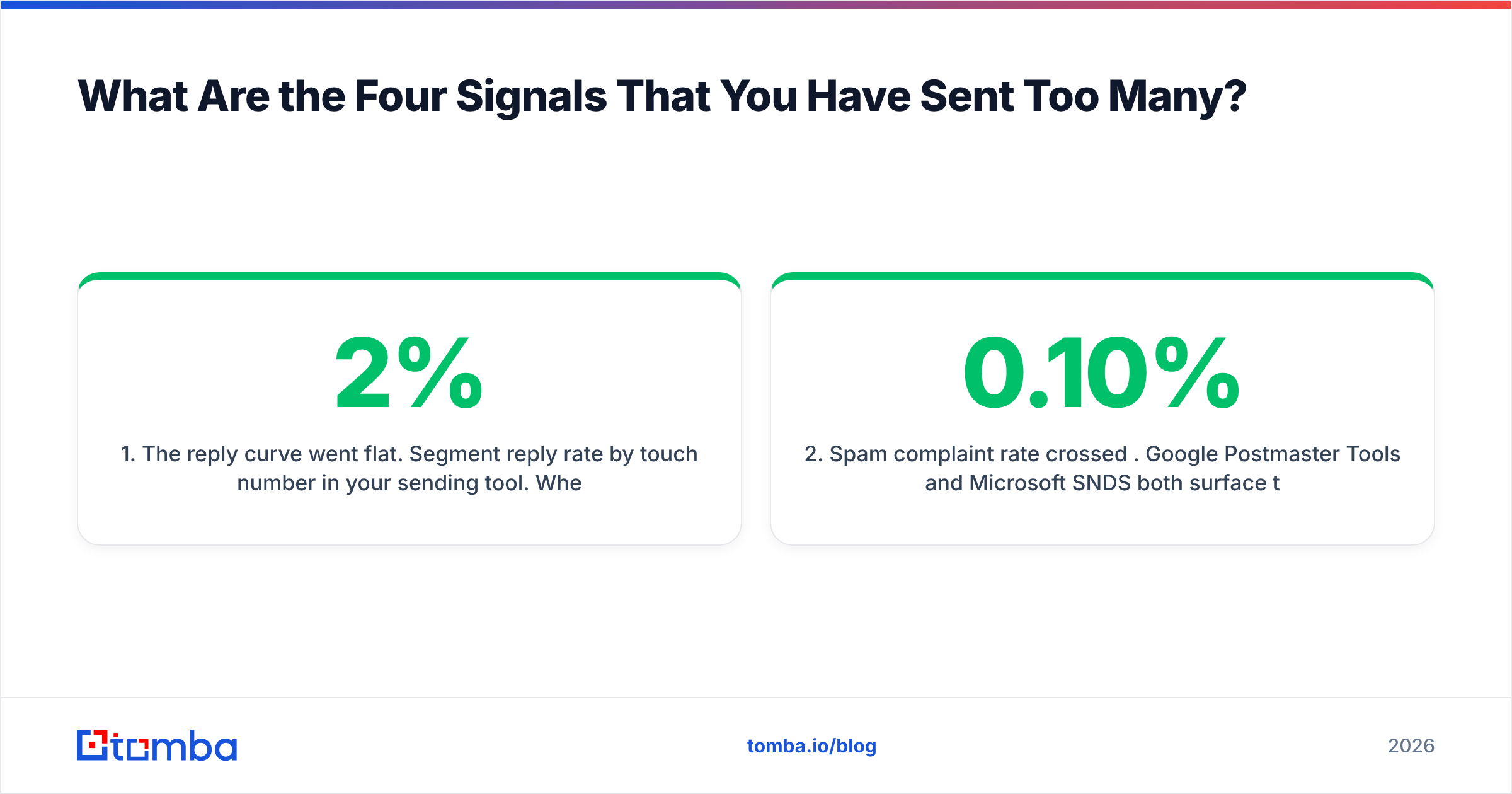
- The reply curve went flat. Segment reply rate by touch number in your sending tool. When touch N delivers under 2% of the sequence's total replies, that touch is not paying rent. Cut it from the template, not just from this campaign.
- Spam complaint rate crossed 0.10%. Google Postmaster Tools and Microsoft SNDS both surface this. Google's bulk sender guidance treats 0.3% as the hard failure line and 0.1% as the ceiling you should stay under. Complaint rate is the single most direct measurement of "too many," because it is literally the recipient telling you so. See Google's sender requirements for the current thresholds.
- Bounces spike mid-sequence. A rising bounce rate across touches three, four, and five usually means your list was stale before you started, and the mailbox provider is now throttling you. That is a data problem masquerading as a cadence problem.
- You got an implicit no. Out-of-office with a permanent replacement contact. A one-word "not now." A LinkedIn profile change to a new company. Opened every email, replied to none. Each of these is an answer. Continuing past it is not persistence — it is not listening.
The fourth one is the hardest for reps to accept, because the standard sales advice says most deals close after the fifth touch. That statistic is about deals in a working pipeline, not about strangers who have never acknowledged you exist. Do not import a closing-stage cadence into a prospecting-stage sequence.
Does Spacing Matter More Than Volume?#
Yes — and it is not close.
Five emails in five business days reads as pressure. Five emails over four weeks reads as follow-through. Same volume, opposite perception, and materially different email deliverability outcomes because burst sending to a non-engaging recipient is exactly the pattern spam filters are tuned to catch.
A defensible default cadence for cold outbound:
- Day 0 — initial email. One specific, researched reason you are writing.
- Day 3 — first follow-up. New angle, not a bump. Reference something they published or shipped.
- Day 7 — second follow-up. Social proof: a customer in their segment, one sentence, one number.
- Day 14 — third follow-up. Shortest email in the sequence. One question, no pitch.
- Day 21 — breakup email. Explicitly close the loop and offer a clean exit.
That is five touches over three weeks. It sits inside the safe band, gives each message room to breathe, and ends on a note that preserves the relationship for a future quarter.
The breakup email is the most underrated send in the sequence. It converts at a surprisingly high rate precisely because it removes pressure, and it gives you a clean signal to suppress the contact if nothing comes back. If you want copy starting points, our cold email templates library covers the breakup pattern and the four touches before it.
How Does Bad Data Make You Look Like a Spammer?#
Your cadence is not the problem if a fifth of your list does not exist.
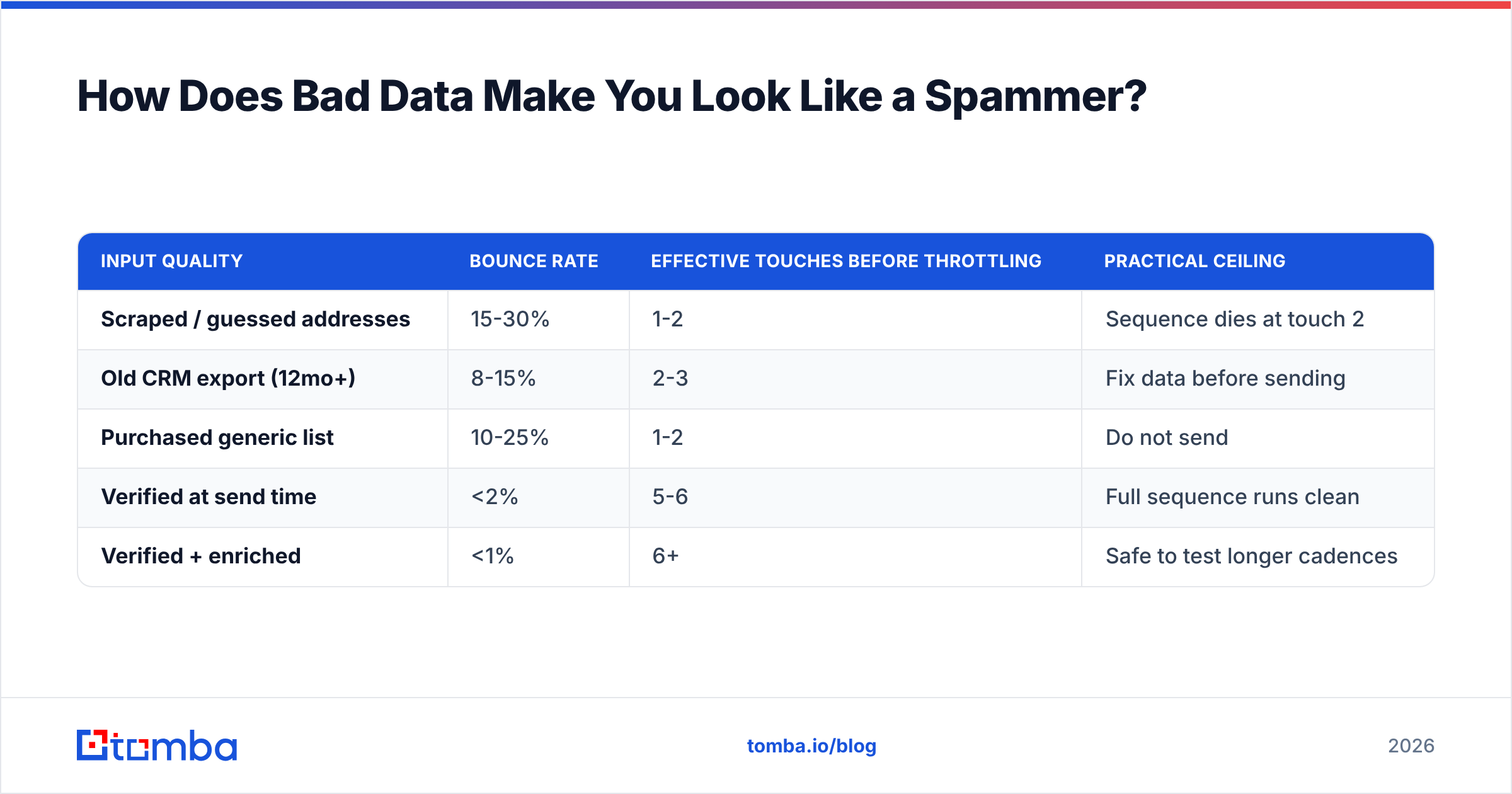
Here is the mechanism. You send touch one to 1,000 contacts. 180 hard bounce because the addresses were scraped, guessed, or eighteen months stale. Mailbox providers now flag your domain as a low-quality sender. Touch two lands in Promotions for the contacts who are real. Touch three lands in spam. By touch four your open rate looks like the prospects are annoyed — but they never saw the emails at all.
You then conclude "four follow-ups is too many" and shorten the sequence. Wrong diagnosis, wrong fix. The list was the problem.
| Input quality | Bounce rate | Effective touches before throttling | Practical ceiling |
|---|---|---|---|
| Scraped / guessed addresses | 15-30% | 1-2 | Sequence dies at touch 2 |
| Old CRM export (12mo+) | 8-15% | 2-3 | Fix data before sending |
| Purchased generic list | 10-25% | 1-2 | Do not send |
| Verified at send time | <2% | 5-6 | Full sequence runs clean |
| Verified + enriched | <1% | 6+ | Safe to test longer cadences |
The fix is unglamorous: verify before you sequence, and re-verify anything older than 90 days. Running your list through an email verifier before the first send buys you three to four extra safe touches, which is more sequence headroom than any subject-line optimization will ever give you. For domains that accept everything, a catch-all verifier tells you whether the mailbox is genuinely reachable instead of leaving you guessing.
If you are building the list rather than cleaning one, sourcing verified addresses up front is cheaper than cleaning up after. A domain search that returns confidence-scored contacts for a target company puts you at the "verified + enriched" row from day one.
What Should You Change Instead of Adding Another Email?#
When a sequence underperforms, adding touch seven is the laziest available lever. Five better ones:
- Change the channel. A LinkedIn view plus a comment on their post between touch two and three lifts reply rates without adding inbox load. Multi-threading beats multi-sending.
- Change the recipient. If the VP never answers, the director who owns the workflow might. Same account, new person, fresh sequence, zero fatigue.
- Change the ask. "Worth a 20-minute call?" is a big ask for a stranger. "Is this even your area?" is a small one, and small asks get answered.
- Change the length. Follow-up four should be under 40 words. Long follow-ups signal that you are talking to yourself.
- Change the trigger. Wait for a hiring signal, funding round, or product launch, then restart with relevance instead of pushing through with volume.
The pattern across all five: reduce the friction of replying rather than increasing the frequency of asking. G2's buyer behavior research consistently shows B2B buyers self-educate long before they respond — your job is to be present and easy to answer when they surface, not to be loud while they are still reading. Their vendor category data is at g2.com.
When Is a Longer Sequence Actually Justified?#
Three situations earn extra touches.
High-ACV enterprise accounts. If a closed deal is worth six figures, seven or eight well-spaced touches across a quarter is rational — but only with genuinely varied content and multiple contacts at the account. Never eight identical bumps to one inbox.
Existing customers and warm networks. Someone who already pays you has a different relationship with your emails. Reputation risk is far lower because engagement history protects you at the filter level.
Genuinely time-sensitive events. A contract expiring, a compliance deadline, an event registration closing. Urgency is real here and recipients recognize it — but only if the urgency is theirs, not yours. "End of quarter" is your deadline, not theirs.
Outside those three, treat six touches as your ceiling and four as your default. And when you extend, extend the calendar, not the count: a quarterly re-touch is safer and more effective than crowding two more emails into an already-saturated three-week window.
Track it honestly. Segment response rate by touch number, by segment, and by data source. The answer to "how many follow up emails is too many" for your list is sitting in that report — and it will be a different number than your competitor's.
Get the Data Right Before You Get the Cadence Right#
Every cadence question downstream of your list quality is unanswerable until the list is clean. If a third of your contacts are guesses, you will keep misreading deliverability problems as fatigue problems and cutting sequences that would have worked.
Start with verified, confidence-scored addresses. The Tomba Email Finder returns professional email addresses by name, domain, or company with a confidence score attached, so you know which contacts deserve a five-touch sequence and which should never enter one. The free tier covers 25 searches a month if you want to test it against a segment you already know; paid plans start at $49/month on Starter, with Growth at $99/month — full Tomba pricing is public. Clean the input, then argue about touch five.
Related guides#
Ready to find emails that actually work?
Join 150,000+ professionals who stopped guessing and started sending. Free credits on signup — no credit card required.
Get the Tomba newsletter
Practical outbound tactics and product updates — once every two weeks.
About the author