How Many Touchpoints Before a Sale? 2026 B2B Data
Most B2B deals need 8 to 20+ touchpoints across email, phone, and LinkedIn — but the number that matters is the one your own pipeline data proves. Here's how to find it.
TL;DR
- There is no universal number. Published B2B benchmarks land between 8 and 20+ touchpoints per closed deal, and the spread is driven by deal size, buying-committee size, and channel mix — not by some law of sales physics.
- The "8 touches" figure everyone quotes is a lead-response statistic from an era of single-decision-maker buying. Enterprise deals in 2026 routinely need 20-30 interactions across 6-10 stakeholders.
- Touch count is the wrong first question. Touch quality, channel spread, and contact accuracy move win rates far more than adding a sixth follow-up email.
- Every bounced email is a wasted touchpoint that also damages your ability to make the next one land. Verify before you sequence.
- Calculate your own number: total logged activities on closed-won deals ÷ number of closed-won deals, segmented by ICP tier. That number beats any benchmark you read online — including this one.
What Does "Touchpoint" Actually Mean?#
A touchpoint is any deliberate contact between your revenue team and a buyer that the buyer perceives. That includes cold email, connection requests, LinkedIn messages, cold calls, voicemails, direct mail, event conversations, and personalized video. It usually does not include passive events like an ad impression or a newsletter open, though marketing attribution models often count them — which is exactly why touchpoint benchmarks vary so wildly between sources.
The distinction matters because two teams can report wildly different numbers while doing identical work:
- Sales-logged touches — activities recorded in the CRM by a rep: emails sent, calls dialed, LinkedIn messages. Typically 8-15 per opportunity.
- Marketing-attributed touches — every session, download, webinar, and ad interaction attributed to the account. Often 25-60 per deal.
- Buyer-perceived touches — what the prospect would actually recall if you asked them. Usually 4-8, because most of your outreach never registers.
- Committee-multiplied touches — sales-logged touches multiplied across every stakeholder. This is the number enterprise teams should track, and it is the one most CRMs report badly.
- Response-triggering touches — the subset that produced a reply. Rarely more than 2-3, and almost always concentrated in a specific window.
When someone tells you "it takes 8 touchpoints to make a sale," ask which of those five they mean. Half the disagreement in this space is definitional, not empirical.
How Many Touchpoints Before a Sale, According to Real Benchmarks?#
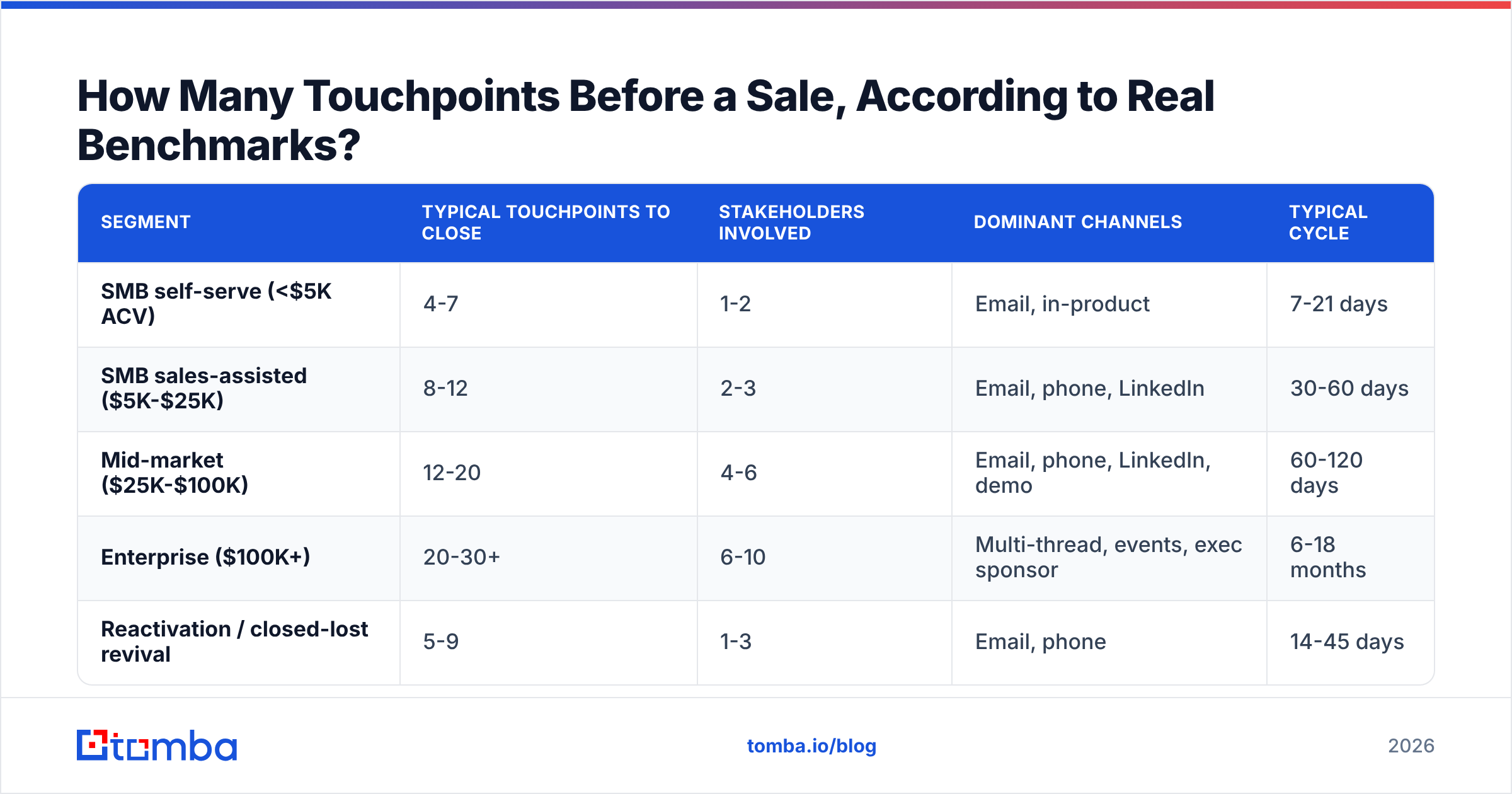
Here is the honest state of the evidence. The widely circulated figures come from different eras, different sample sets, and different definitions, so treat them as ranges rather than targets.
| Segment | Typical touchpoints to close | Stakeholders involved | Dominant channels | Typical cycle |
|---|---|---|---|---|
| SMB self-serve (<$5K ACV) | 4-7 | 1-2 | Email, in-product | 7-21 days |
| SMB sales-assisted ($5K-$25K) | 8-12 | 2-3 | Email, phone, LinkedIn | 30-60 days |
| Mid-market ($25K-$100K) | 12-20 | 4-6 | Email, phone, LinkedIn, demo | 60-120 days |
| Enterprise ($100K+) | 20-30+ | 6-10 | Multi-thread, events, exec sponsor | 6-18 months |
| Reactivation / closed-lost revival | 5-9 | 1-3 | Email, phone | 14-45 days |
Two patterns hold across nearly every dataset. First, touchpoint requirements scale with the size of the buying committee more than with deal value itself — a $40K deal with seven stakeholders needs more contact than a $90K deal with two. Gartner's B2B buying research has consistently found buying groups of six to ten people for complex solutions, each of whom brings four or five independently gathered pieces of information to the table. Every one of those people is a separate touchpoint stream.
Second, the distribution is heavily skewed. A minority of deals close on touch two or three; a long tail requires fifteen or more. Reporting a mean here is misleading. Track the median and the 80th percentile instead, because the 80th percentile is what tells you when to stop.
Why Does the "8 Touchpoints" Rule Keep Getting Quoted?#
Because it was true for a narrower question than the one people apply it to. The original research behind the number measured how many contact attempts it took to reach a lead by phone in an era when a direct dial usually landed on a desk the buyer sat at. It answered "how many dials to a conversation," not "how many interactions to a signature."
Three things broke that number:
- Channel fragmentation. Buyers now split attention across email, LinkedIn, Slack communities, podcasts, and peer review sites. A single-channel eight-touch sequence reaches a fraction of the attention it once did.
- Committee expansion. Eight touches spread across seven stakeholders is roughly one contact each. That is not a sequence; that is a rounding error.
- Self-education. Buyers complete most of their research before talking to a rep. The touchpoints that used to be discovery calls are now G2 review pages and vendor docs the buyer reads without telling you.
The practical takeaway: stop treating 8 as a target and start treating it as a floor for anything above transactional deal sizes. If your sequence stops at five emails because "most replies come early," you're optimizing for reply rate on the deals you were going to get anyway.
Do More Touchpoints Actually Increase Win Rate?#
Up to a point, and then sharply not. The relationship is a curve, not a line, and the inflection point depends almost entirely on whether the additional touches carry new information.
Adding touchpoints helps when each one:
- Introduces a new angle — a different pain, a different proof point, a different stakeholder's priority.
- Changes channel — an email after a call, a LinkedIn comment after an email. Channel switches reset attention in a way repetition does not.
- Reaches a new person — multi-threading into a second stakeholder is worth roughly three more emails to the first one.
- Carries a specific trigger — a funding round, a job posting, a tech-stack change, a competitor announcement.
Adding touchpoints hurts when they are "just bumping this up," "circling back," or "did you see my last email." Those touches consume the same sender reputation budget as a good one and produce measurable negative sentiment. Worse, they train your prospect to filter your domain.
Here's the part most teams miss: touchpoints that never arrive still cost you. A bounced email is counted as a touch in your sequence tool, is not perceived by the buyer, and actively degrades deliverability for every valid address on the same domain. If 12% of your list is invalid — a normal figure for scraped or aging data — then a nominal 12-touch sequence delivers about 10.5 real touches, and the two missing ones are the reason your inbox placement slid.
How Do You Calculate Your Own Touchpoint Number?#
Do this once a quarter. It takes about an hour and replaces every benchmark in this article with something true about your business.
Step 1 — Pull closed-won opportunities from the last two quarters. Exclude inbound-sourced and referral deals; those distort the number downward. You want outbound-sourced deals only, or you'll build sequences for a motion you don't run.
Step 2 — Count logged activities per opportunity. Emails sent, calls dialed, LinkedIn messages, meetings held. Count per contact, then sum per account. Most CRM reports give you account-level totals that hide the multi-threading picture.
Step 3 — Segment by deal size and committee size. Report the median and the 80th percentile in each segment. If your median mid-market deal took 14 touches and your 80th percentile took 24, your sequence should run to at least 24 — anything shorter abandons a fifth of your winnable pipeline.
Step 4 — Do the same for closed-lost. If closed-lost deals show more touches than closed-won at the same segment, you have a qualification problem, not a persistence problem. Cut the sequence and fix the targeting.
Step 5 — Divide by channel. Calculate what share of touches came from each channel and cross-reference against reply source. Teams routinely find that 70% of effort goes to email while 40% of first replies come from phone.
Step 6 — Subtract your bounce rate. Multiply your planned touch count by (1 − bounce rate) to get delivered touches. Then fix the bounce rate rather than padding the sequence.
What Does a Well-Structured Multi-Touch Sequence Look Like?#
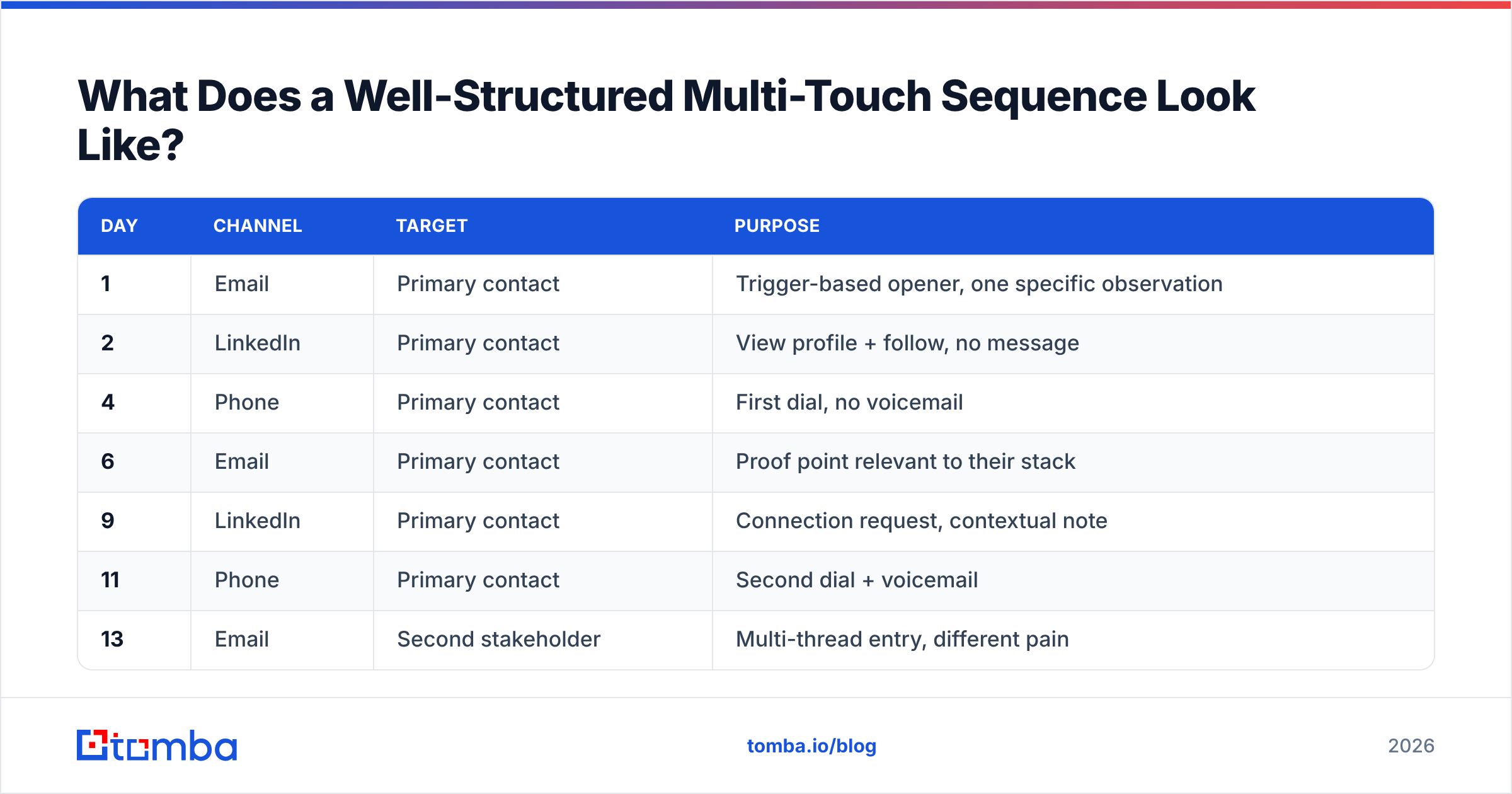
Below is a 17-touch, 34-day framework for mid-market outbound. It is a structure, not a script — the value is in the channel rotation and the multi-threading, not the exact day numbers.
| Day | Channel | Target | Purpose |
|---|---|---|---|
| 1 | Primary contact | Trigger-based opener, one specific observation | |
| 2 | Primary contact | View profile + follow, no message | |
| 4 | Phone | Primary contact | First dial, no voicemail |
| 6 | Primary contact | Proof point relevant to their stack | |
| 9 | Primary contact | Connection request, contextual note | |
| 11 | Phone | Primary contact | Second dial + voicemail |
| 13 | Second stakeholder | Multi-thread entry, different pain | |
| 16 | Primary contact | Customer story, same segment | |
| 18 | Phone | Second stakeholder | First dial |
| 21 | Primary contact | Comment on their recent post | |
| 23 | Primary contact | Direct ask, short | |
| 26 | Phone | Primary contact | Third dial + voicemail |
| 28 | Third stakeholder | Exec-level framing | |
| 31 | Primary contact | Value-add resource, no ask | |
| 34 | Primary contact | Breakup, permission to close file |
Notice the ratio: roughly 55% email, 25% phone, 20% LinkedIn, across three stakeholders. That spread is what turns 17 nominal touches into meaningful coverage. Compare it to the typical failed sequence — 6 emails to 1 person over 12 days — and the reason for the win-rate gap becomes obvious. HubSpot's sales research has repeatedly shown persistence beyond the fourth attempt separating top-quartile reps from the rest, and the gains come disproportionately from channel variety.
What Breaks a Touchpoint Sequence Before It Starts?#
Bad data. Specifically, four failure modes that no amount of copywriting fixes:
- Invalid addresses. They bounce, they burn reputation, and they silently remove touches from your count. Run every list through an email verifier before the first send, not after the first bounce report.
- Catch-all domains. These accept everything and deliver nothing. A domain that accepts all mail looks valid to naive verification and represents pure wasted touch budget. A dedicated catch-all verifier resolves most of them one way or the other.
- Role accounts. info@, sales@, support@ — technically deliverable, functionally unreachable. Filter them out of outbound sequences entirely.
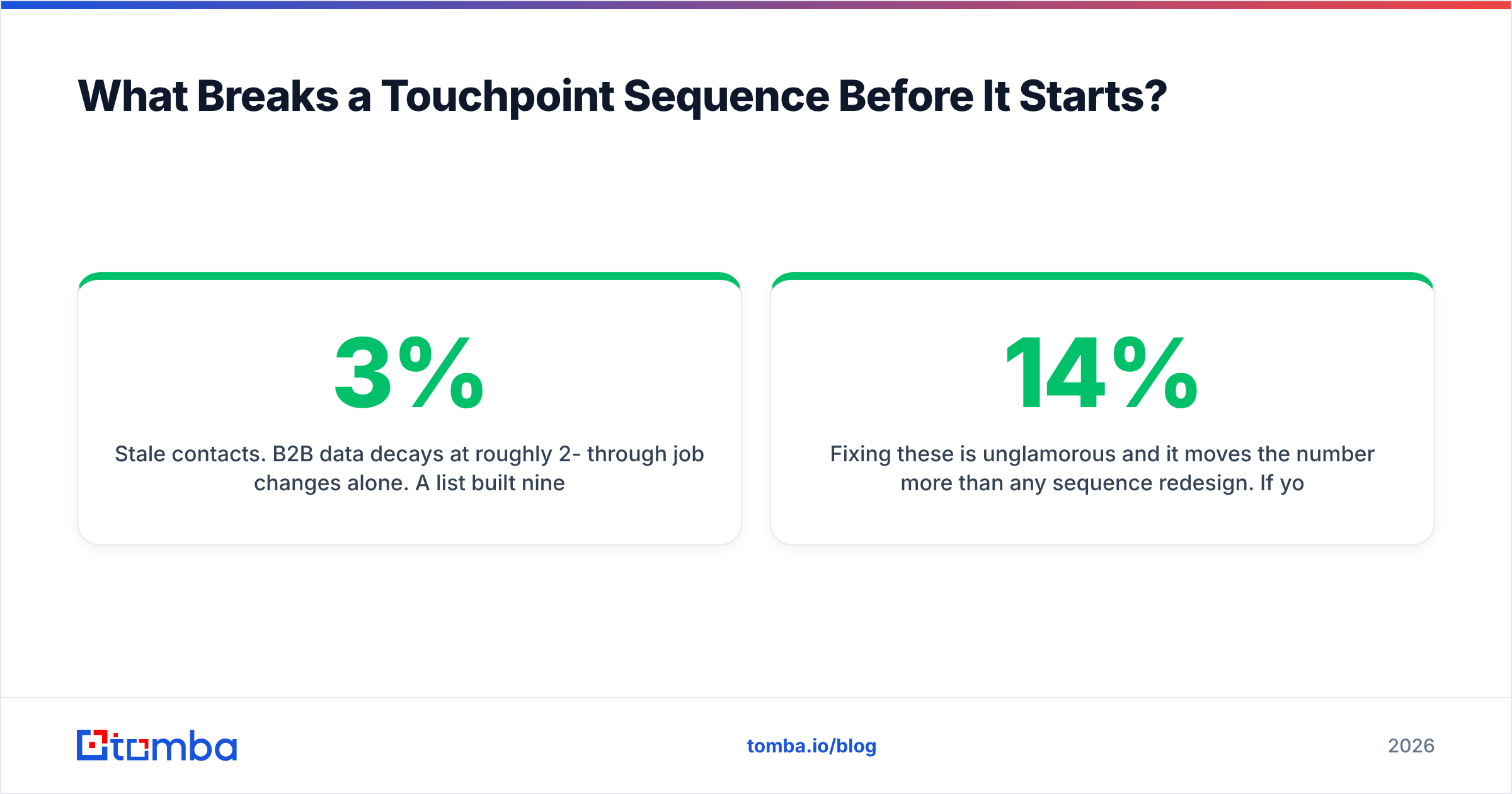
- Stale contacts. B2B data decays at roughly 2-3% per month through job changes alone. A list built nine months ago has lost a meaningful share of its accuracy. Re-verify before every campaign.
Fixing these is unglamorous and it moves the number more than any sequence redesign. If you go from a 14% bounce rate to under 2%, a 17-touch sequence goes from delivering ~14.6 touches to ~16.7 — a 14% increase in real coverage with zero additional rep effort.
How Should Touchpoint Strategy Differ by Channel?#
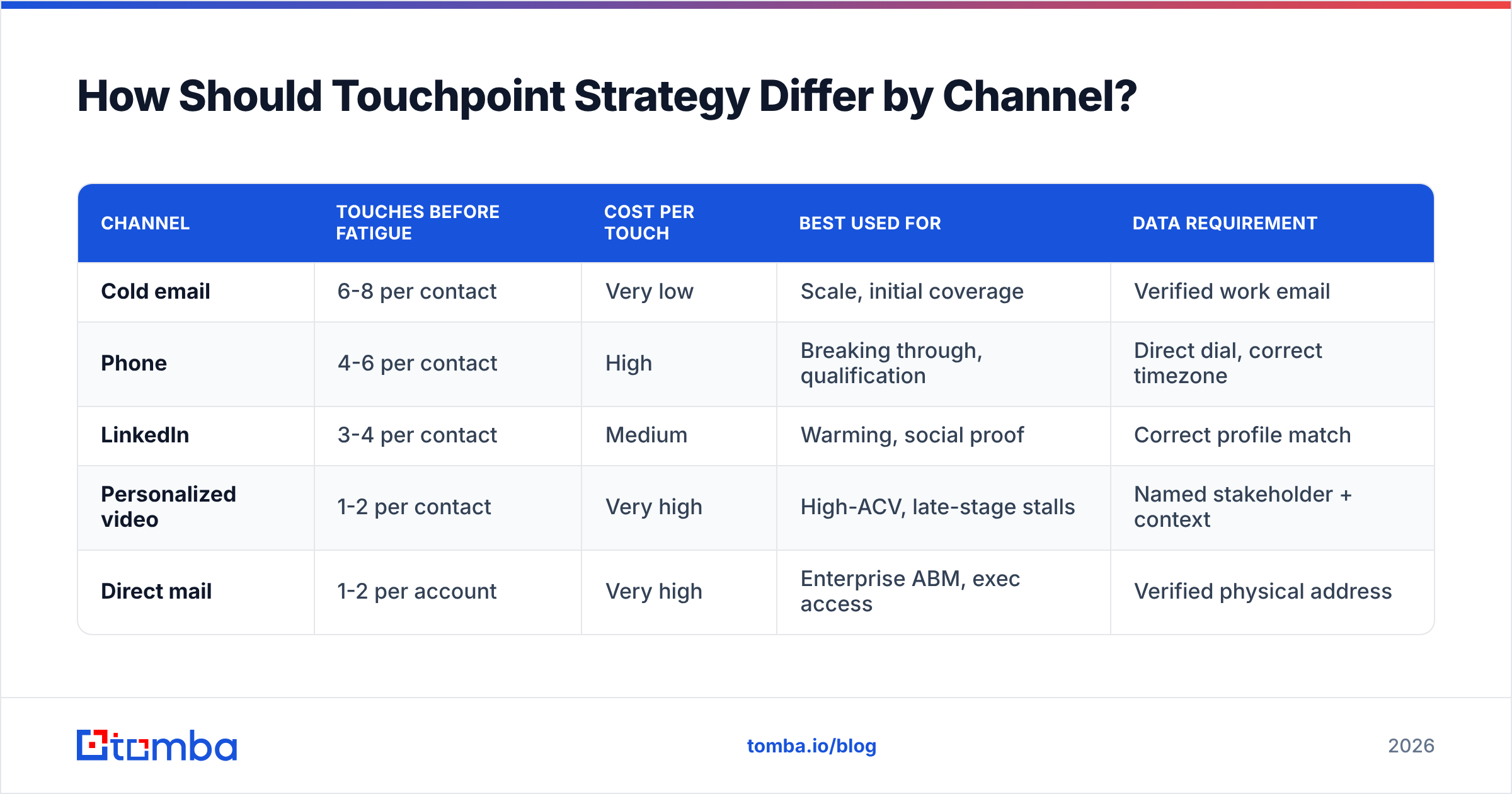
Each channel has a different tolerance for repetition and a different cost per touch.
| Channel | Touches before fatigue | Cost per touch | Best used for | Data requirement |
|---|---|---|---|---|
| Cold email | 6-8 per contact | Very low | Scale, initial coverage | Verified work email |
| Phone | 4-6 per contact | High | Breaking through, qualification | Direct dial, correct timezone |
| 3-4 per contact | Medium | Warming, social proof | Correct profile match | |
| Personalized video | 1-2 per contact | Very high | High-ACV, late-stage stalls | Named stakeholder + context |
| Direct mail | 1-2 per account | Very high | Enterprise ABM, exec access | Verified physical address |
The strategic implication: front-load the cheap, scalable channels for coverage and reserve high-cost touches for accounts that have already shown a signal. A team that opens with personalized video on cold accounts is spending enterprise budget on SMB conversion odds.
Sourcing the data for a genuinely multi-channel sequence means you need more than an email column. Direct dials come from a phone finder, profile matches come from a LinkedIn finder, and firmographic context for the personalization layer comes from data enrichment. Building all three from a single domain list is now a routine workflow rather than a project.
When Should You Stop Touching a Prospect?#
Stop when one of four conditions is met, not when you run out of email templates.
- Explicit no. Suppress and note the reason. Revisit in two quarters if the reason was timing.
- Hard signal absence past your 80th percentile. If your winnable deals close by touch 24 and you're at touch 30 with zero engagement, the account is not in market. Move it to a nurture cadence.
- Deliverability degradation. If a domain starts routing you to spam, additional touches actively harm the accounts you can reach on that domain.
- Trigger expiry. If your outreach was based on a funding announcement six months stale, the reason for the conversation is gone. Restart when a new trigger appears rather than continuing the old thread.
The nurture path matters more than most teams think. Deals that go quiet at touch 12 and return nine months later on a new trigger convert well, because the earlier sequence built recognition. Track that as a separate motion with its own — much shorter — touchpoint budget.
The Bottom Line on Touchpoint Math#
The answer to "how many touchpoints before a sale" is: more than you're doing now, spread across more channels and more stakeholders than you're currently using, and every one of them delivered to an address that actually exists. For most B2B teams, that means 12-20 touches for mid-market and 20+ for enterprise, structured across email, phone, and LinkedIn, aimed at three or more people inside the account.
Get the sequence architecture right and you fix half the problem. Get the underlying contact data right and you fix the half nobody talks about — the touches that were logged but never landed.
Start with the data layer. Use the Tomba Email Finder to build verified, deliverable contact lists from a domain or a name, so every touch in your sequence counts as a touch the buyer actually receives. The free tier includes 25 searches a month if you want to sanity-check a segment before committing; paid plans start at $49/mo, with full details on the Tomba pricing page.
Related guides#
Ready to find emails that actually work?
Join 150,000+ professionals who stopped guessing and started sending. Free credits on signup — no credit card required.
Get the Tomba newsletter
Practical outbound tactics and product updates — once every two weeks.
About the author