How Marketing Can Help Sales: A 2026 Alignment Playbook
Most marketing-sales handoffs break in the same four places. Here is a concrete playbook for lead quality, content that closes, shared data, and the metrics that actually prove marketing moved pipeline.

TL;DR
- Marketing helps sales most by shrinking three gaps: bad-fit leads, missing context at handoff, and dirty contact data. Everything else is downstream.
- Replace volume-based MQL targets with a fit + intent definition both teams sign. If sales can't reject a lead with a reason code, your definition isn't real.
- Sales-enablement content beats top-funnel content for revenue impact: objection docs, competitor teardowns, ROI calculators, and reference stories.
- One shared data layer — enriched, verified contacts flowing into the CRM — removes the single biggest source of inter-team friction.
- Measure marketing on pipeline created, pipeline accepted, and influenced win rate. Not on lead count.
Marketing and sales don't misalign because people dislike each other. They misalign because the two teams are graded on different numbers, work in different tools, and rarely see the same version of a contact record. Marketing gets paid for volume. Sales gets paid for closed revenue. Those two incentives pull apart every single quarter unless someone deliberately wires them together.
This is a practical guide to that wiring: what marketing can actually do — this month, not "eventually" — to make sales quotas easier to hit.
Why does the marketing-sales handoff break in the first place?#
Three structural causes, in order of damage.
1. Different definitions of "good." Marketing hits its number by generating leads. Sales hits its number by closing deals. A lead that downloaded a listicle is a win for one team and a waste of an hour for the other. Without a jointly-owned definition of a marketing qualified lead, every handoff is a small argument.
2. Context loss at the border. Marketing knows the prospect read three pricing-adjacent pages, attended a webinar on migration, and works at a company that just raised a Series B. Sales gets a name, an email, and "Requested demo." All the signal that would have shaped the first call evaporates in the CRM sync.
3. Data decay. B2B contact data goes stale fast — people change jobs, companies rebrand domains, and role titles shift. When marketing pushes a list into the CRM and 20% of the emails bounce, sales stops trusting anything marketing sends. That trust is very hard to rebuild.
Fix those three and most of the "marketing doesn't understand sales" complaints resolve themselves.
What does marketing-sales alignment actually look like day to day?#
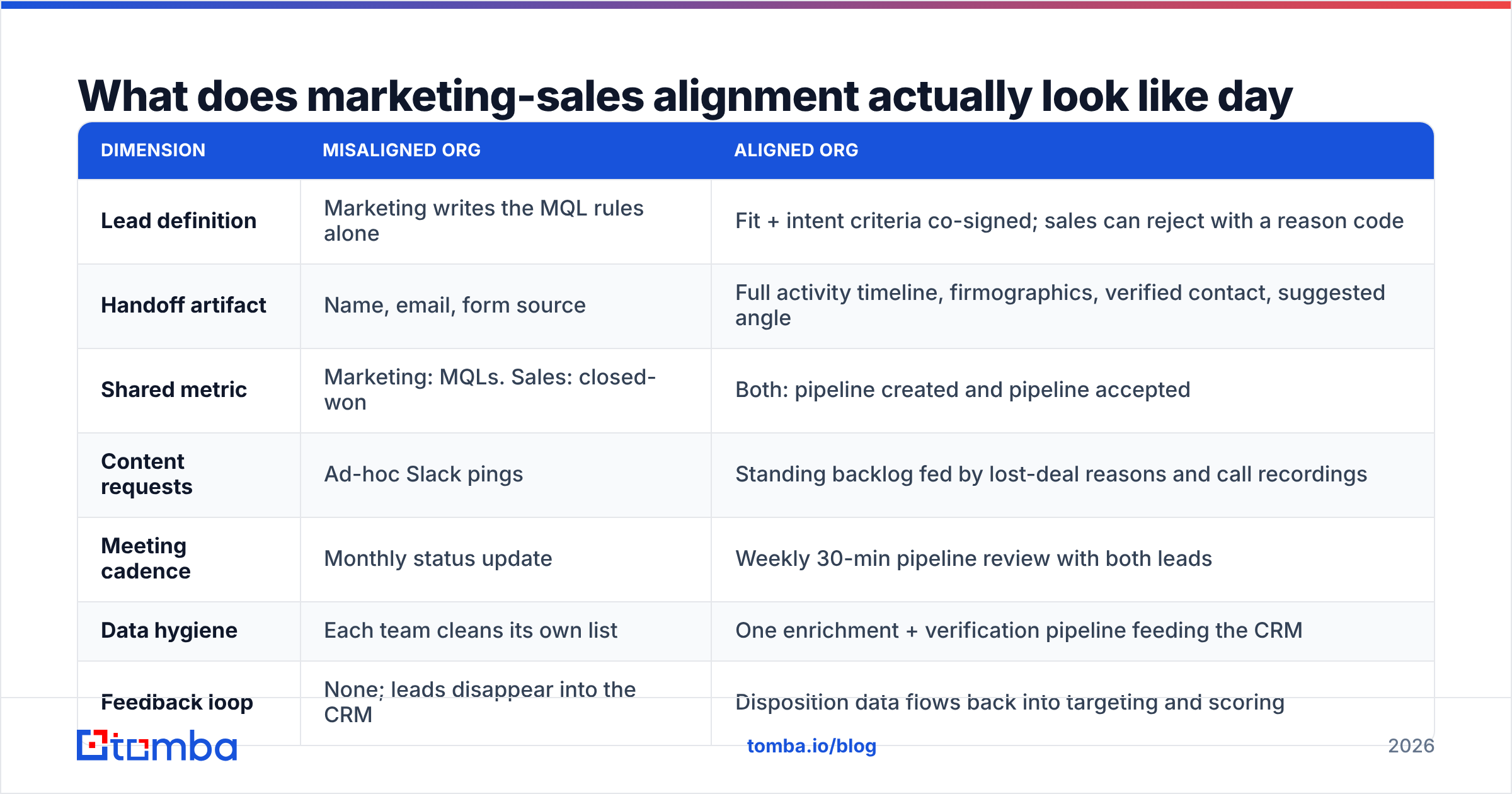
Alignment isn't a quarterly offsite. It's a set of recurring, boring mechanics. Here is the difference between the version companies claim and the version that moves revenue:
| Dimension | Misaligned org | Aligned org |
|---|---|---|
| Lead definition | Marketing writes the MQL rules alone | Fit + intent criteria co-signed; sales can reject with a reason code |
| Handoff artifact | Name, email, form source | Full activity timeline, firmographics, verified contact, suggested angle |
| Shared metric | Marketing: MQLs. Sales: closed-won | Both: pipeline created and pipeline accepted |
| Content requests | Ad-hoc Slack pings | Standing backlog fed by lost-deal reasons and call recordings |
| Meeting cadence | Monthly status update | Weekly 30-min pipeline review with both leads |
| Data hygiene | Each team cleans its own list | One enrichment + verification pipeline feeding the CRM |
| Feedback loop | None; leads disappear into the CRM | Disposition data flows back into targeting and scoring |
The right-hand column is not expensive. It's mostly agreements and one shared data pipeline.
How can marketing improve lead quality instead of lead volume?#
Start by killing the volume target. If marketing's compensation is tied to MQL count, marketing will optimize for MQL count, and you'll get gated PDFs that attract students and competitors.
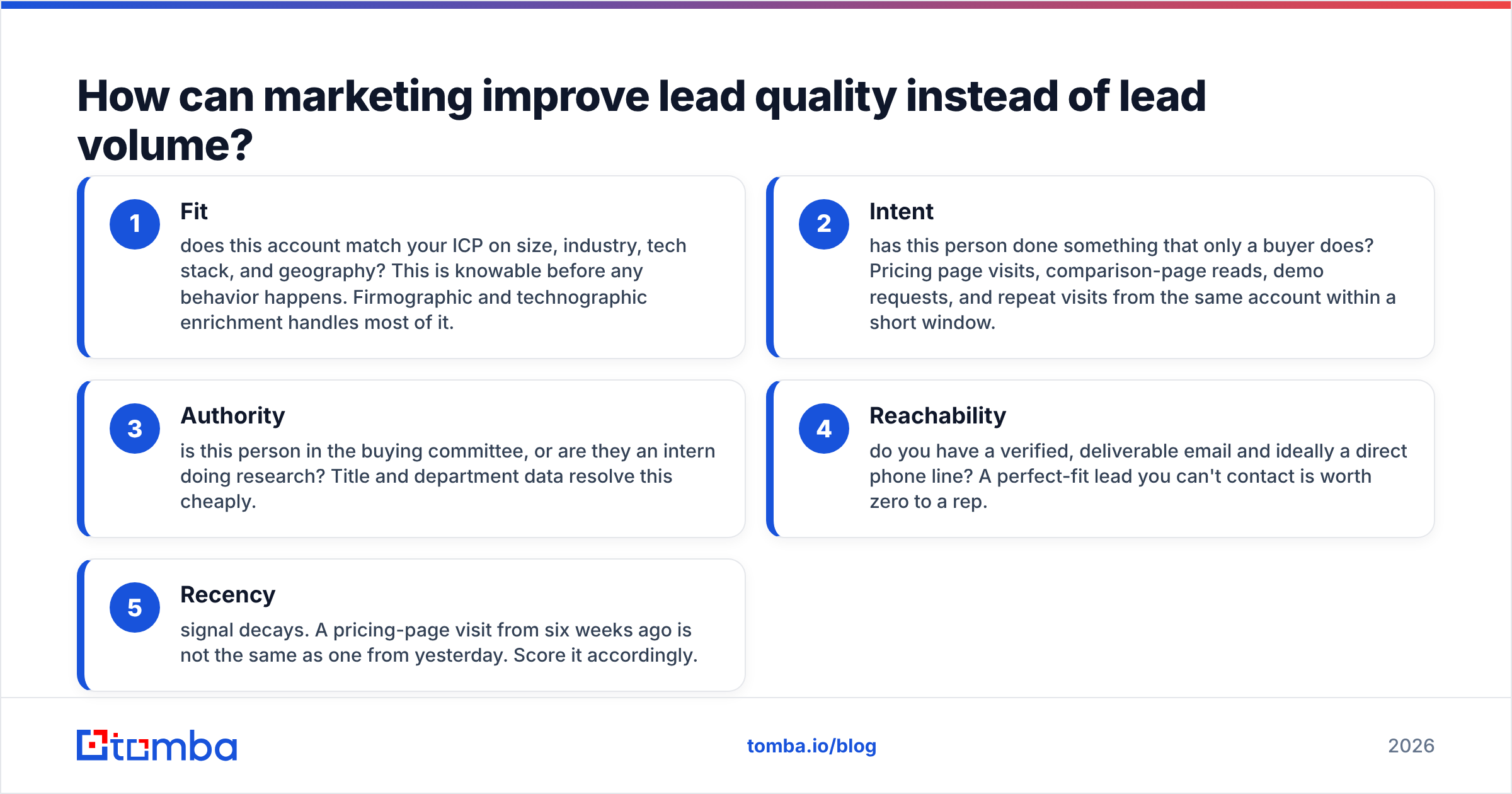
Replace it with a two-axis qualification model:
- Fit — does this account match your ICP on size, industry, tech stack, and geography? This is knowable before any behavior happens. Firmographic and technographic enrichment handles most of it.
- Intent — has this person done something that only a buyer does? Pricing page visits, comparison-page reads, demo requests, and repeat visits from the same account within a short window.
- Authority — is this person in the buying committee, or are they an intern doing research? Title and department data resolve this cheaply.
- Reachability — do you have a verified, deliverable email and ideally a direct phone line? A perfect-fit lead you can't contact is worth zero to a rep.
- Recency — signal decays. A pricing-page visit from six weeks ago is not the same as one from yesterday. Score it accordingly.
A lead should only route to sales when fit and intent are both present. Fit without intent goes to nurture. Intent without fit goes nowhere — politely. This one rule typically cuts MQL volume by half and raises sales-accepted rates enough that reps stop complaining.
For the reachability piece, marketing should own the verification step rather than dumping raw form fills into the CRM. Running new contacts through an email verifier before they hit a rep's queue is a two-second API call that prevents an entire category of friction. Same for enrichment: appending company size, industry, and role via data enrichment means the rep opens a record that already tells a story.
What content should marketing build for sales, not for Google?#
Most content teams over-index on top-of-funnel. That's understandable — it's measurable in analytics dashboards. But the content that shortens sales cycles sits much lower in the funnel and rarely ranks for anything.
Ask your reps what they retype in emails every week. That list is your backlog. It usually looks like this:
- Objection-handling one-pagers. One doc per recurring objection — price, migration risk, security review, "we already use X." Written to be forwarded to an internal champion, not read by a rep.
- Competitor teardowns. Honest, specific, with a table. Where the competitor genuinely wins, say so. Champions forward documents that look fair; they hide documents that look like brochures.
- ROI and payback calculators. The single highest-leverage asset for deals stuck in procurement. Give the champion numbers they can defend to a CFO.
- Reference stories by segment. Not a generic case study PDF — a two-paragraph story matched to the prospect's industry and company size, with a named metric.
- Security and compliance packets. SOC 2 summary, DPA template, subprocessor list. Pre-assembled, so a deal doesn't stall for eleven days waiting on legal.
- First-call decks that reps will actually use. Ten slides maximum, editable, with a slide the rep can swap for the prospect's own screenshot.
HubSpot's research on sales enablement consistently finds that reps spend a large share of their week on non-selling activity — much of it recreating assets marketing could have shipped once. Every hour of asset-building marketing does is an hour of selling time returned across the entire team.
One practical rule: every piece of enablement content gets an owner in marketing and a named rep who validated it in a live deal. Unvalidated enablement content is just more clutter in the shared drive.
How does shared data close the gap between the two teams?#
This is the unglamorous part that fixes the most. If marketing and sales look at different contact records, no amount of alignment theater helps.
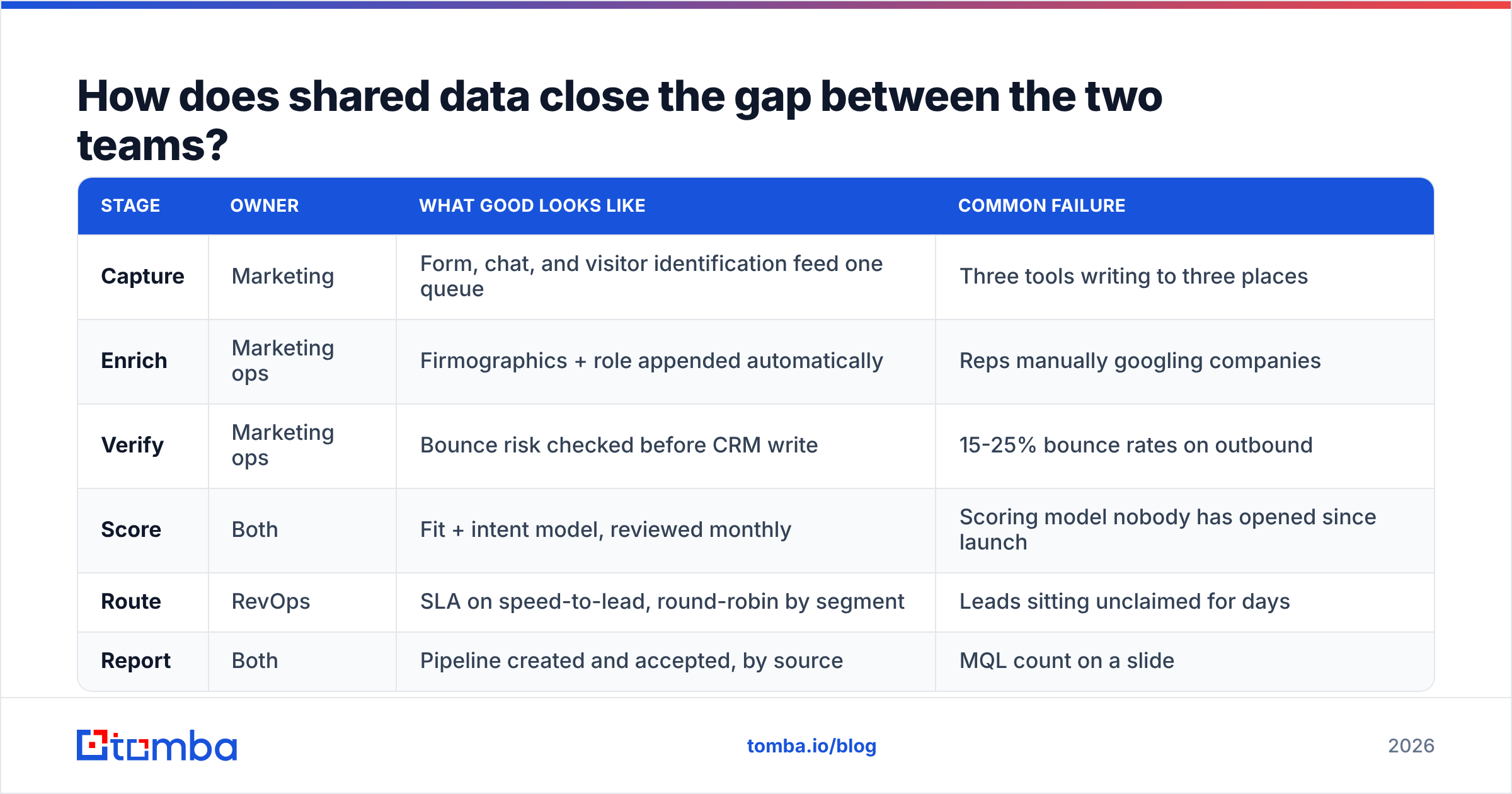
The target state is one pipeline: capture → enrich → verify → score → route → report, with disposition data flowing back to the start.
| Stage | Owner | What good looks like | Common failure |
|---|---|---|---|
| Capture | Marketing | Form, chat, and visitor identification feed one queue | Three tools writing to three places |
| Enrich | Marketing ops | Firmographics + role appended automatically | Reps manually googling companies |
| Verify | Marketing ops | Bounce risk checked before CRM write | 15-25% bounce rates on outbound |
| Score | Both | Fit + intent model, reviewed monthly | Scoring model nobody has opened since launch |
| Route | RevOps | SLA on speed-to-lead, round-robin by segment | Leads sitting unclaimed for days |
| Report | Both | Pipeline created and accepted, by source | MQL count on a slide |
The verify step is where most teams leak the most credibility. Bounces damage sender reputation, which quietly degrades every subsequent campaign and every rep's cold outreach from the same domain. Marketing usually owns domain reputation, so marketing should own list hygiene — including for lists sales built.
For accounts where marketing has a company but not a person, a domain search pulls the addressable contacts and their patterns, so a rep isn't guessing at firstname.lastname@ formats. For the inbound side, website visitor reveal turns anonymous high-intent traffic into named accounts marketing can score before a form is ever filled.

Whatever tooling you pick, the requirement is the same: one record, one truth, both teams reading it. That's the entire principle.
What metrics should both teams be graded on?#
Change the scoreboard or nothing else sticks. Four metrics, shared:
Pipeline created. Dollar value of qualified opportunities sourced or influenced by marketing. Replaces MQL count outright.
Sales-accepted rate. Percentage of routed leads a rep accepts as legitimately worth working. This is marketing's quality grade and the fastest feedback loop you have. Below 60% means your definition is broken.
Speed to first touch. Minutes from lead creation to first rep contact. Owned by RevOps, but marketing sees it. Response times degrade conversion sharply once you're past the first hour.
Influenced win rate. Compare win rate on deals that touched enablement content or a nurture track against those that didn't. Imperfect attribution, but directionally honest, and it justifies the enablement budget.
Report all four in the same weekly meeting, to the same audience. When the marketing lead has to explain a 42% sales-accepted rate to the sales lead in front of the CRO, targeting gets fixed quickly.
Vendor-neutral research from G2 and Gartner is useful here for benchmarking, but treat external benchmarks as rough guardrails. Your own quarter-over-quarter trend matters more than an industry median that averages across wildly different motions.
How do you run the weekly loop that keeps this working?#
Thirty minutes, same time every week, both leads present, four agenda items:
- Lead quality review. Pull ten routed leads from last week. Sales says accept or reject, with a reason. Marketing takes notes. No debate about individual leads — look for the pattern.
- Content gaps. Reps name one thing they had to write from scratch. It goes into the backlog with a deadline.
- Deal-loss reasons. Two or three losses, read out loud. Marketing listens for messaging problems it can fix upstream.
- Data issues. Bounces, duplicates, wrong titles. Whoever owns the pipeline reports the number and the fix.
That's it. No slides. The discipline is in the recurrence, not the format.
One extra practice worth adopting: marketers should listen to two full sales calls per month. Not summaries — actual recordings. Nothing improves messaging faster than hearing a prospect struggle to describe what your product does.
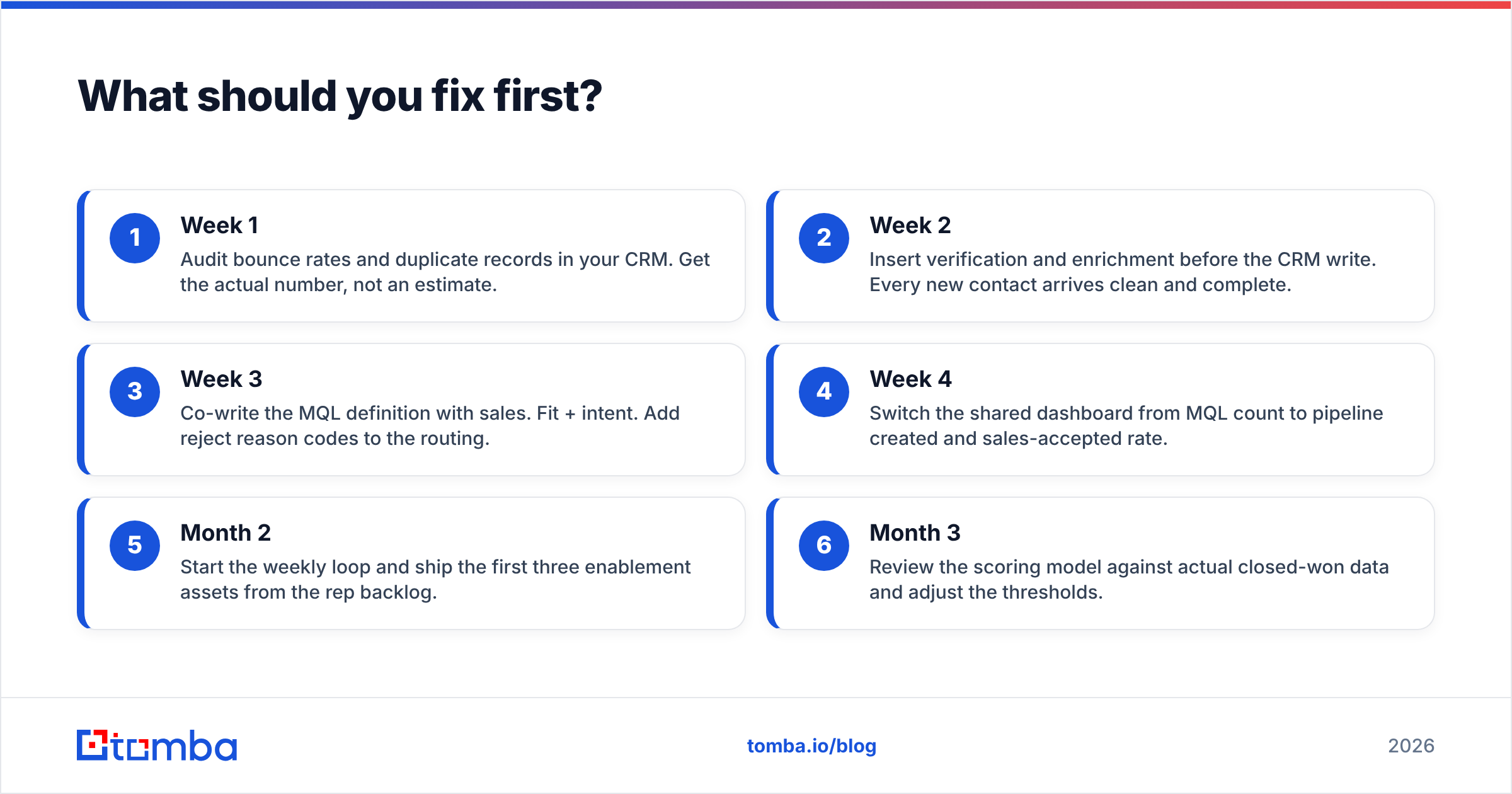
What should you fix first?#
If you can only do one thing this quarter, fix the data layer. It's the least political change and it unblocks the rest.
Order of operations:
- Week 1 — Audit bounce rates and duplicate records in your CRM. Get the actual number, not an estimate.
- Week 2 — Insert verification and enrichment before the CRM write. Every new contact arrives clean and complete.
- Week 3 — Co-write the MQL definition with sales. Fit + intent. Add reject reason codes to the routing.
- Week 4 — Switch the shared dashboard from MQL count to pipeline created and sales-accepted rate.
- Month 2 — Start the weekly loop and ship the first three enablement assets from the rep backlog.
- Month 3 — Review the scoring model against actual closed-won data and adjust the thresholds.
Nothing on that list requires a reorg or a new headcount. It requires agreement and a working data pipeline — and the second one is the part you can buy.
Where does tooling fit in all of this?#
Tooling doesn't create alignment, but bad tooling reliably prevents it. What you need is narrow: a way to find the right person at a target account, confirm their contact details are real, and enrich the record enough that a rep opens it already knowing the story.
That's the job Tomba's Email Finder is built for — resolving a name and domain into a verified, deliverable business email, with domain search, verification, phone lookup, and enrichment sitting alongside it. Marketing ops can wire it into the capture flow through the Tomba API or push clean lists straight into HubSpot and Salesforce via the integrations, so both teams read the same record from day one. Plans start free at 25 searches a month and scale from $49/mo on Starter — see Tomba pricing for the full breakdown.
Start with the free tier, run it against one segment of your inbound leads, and compare the bounce rate against your current baseline. If marketing can hand sales a list that doesn't bounce and doesn't need googling, half the alignment problem is already solved.
Related guides#
Ready to find emails that actually work?
Join 150,000+ professionals who stopped guessing and started sending. Free credits on signup — no credit card required.
Get the Tomba newsletter
Practical outbound tactics and product updates — once every two weeks.
About the author