How Often To Send Follow Up Emails: A 2026 Cadence Guide
Most reps quit after one follow-up and blame the list. Here is the data-backed cadence — how many touches, how many days apart, and when silence really means no.
TL;DR
- Send 4 to 6 total touches per sequence. Most replies land on touches 2 through 4; after touch 6 the reply curve flattens and your spam-complaint risk starts climbing.
- Use widening gaps, not fixed ones: day 0, +3, +4, +7, +10, +14. Tight early, patient later.
- Follow-ups should carry new information — a case study, a trigger event, a different angle. A "just bumping this" email is a deliverability tax with no upside.
- Cadence only works on a clean list. If 15% of your sends bounce, no send frequency saves you — fix the data first with an email verifier.
- Reply-rate ceiling is roughly 8-12% for a well-targeted 5-touch sequence in 2026. Anyone promising 40% is counting opens.
What does "how often to send follow up emails" actually mean?#
It means two separate decisions that people constantly collapse into one:
- Volume — how many follow-ups you send in total before you stop.
- Spacing — how many days sit between each one.
Get volume right and spacing wrong, and you look desperate (five emails in six days). Get spacing right and volume wrong, and you evaporate (one polite nudge, then silence). The two levers are independent and they fail differently.
There's a third thing hiding underneath: content variance. A sequence of five identical bumps is functionally one email sent five times. Your prospect's brain deduplicates it. So does Gmail's clustering.
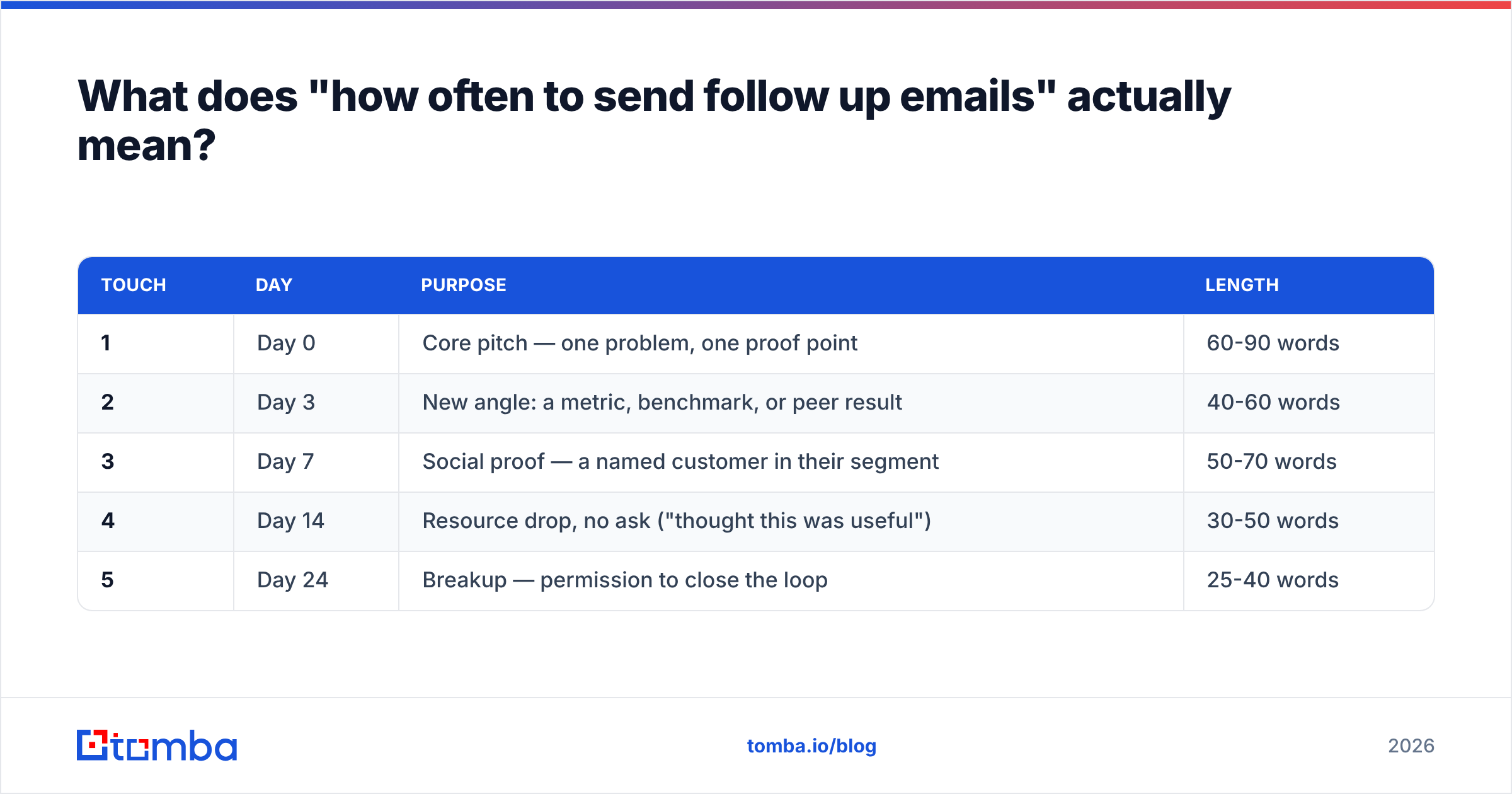
Here's the baseline most B2B teams should start from, then adjust:
| Touch | Day | Purpose | Length |
|---|---|---|---|
| 1 | Day 0 | Core pitch — one problem, one proof point | 60-90 words |
| 2 | Day 3 | New angle: a metric, benchmark, or peer result | 40-60 words |
| 3 | Day 7 | Social proof — a named customer in their segment | 50-70 words |
| 4 | Day 14 | Resource drop, no ask ("thought this was useful") | 30-50 words |
| 5 | Day 24 | Breakup — permission to close the loop | 25-40 words |
Five touches, 24 days, five genuinely different messages. That's the shape.
How many follow-up emails is too many?#
Six is the practical ceiling for cold outbound. Past that, three things happen at once.
Reply rate per touch collapses. Aggregated cold-email data consistently shows touch 1 pulling the largest single share of replies, touches 2-4 adding meaningful incremental volume, and touches 5+ adding thin slices. By touch 7 you're often adding under half a percentage point per send.
Complaint rate rises. Gmail and Yahoo enforce a spam-complaint threshold of 0.3% for bulk senders, with 0.1% as the practical safe zone. Every unwanted extra touch pushes you toward that line — and the sender reputation damage applies to your whole domain, not just that campaign.
Unsubscribe stacking. Each extra touch increases the odds the prospect opts out permanently instead of going quiet. A quiet no can be re-approached next quarter. An unsubscribe cannot.
The counter-case: warm and inbound follow-ups tolerate more. Someone who downloaded your pricing page, replied once and went dark, or met you at an event has already given consent signals. Eight to ten touches spread over a quarter is defensible there. The 4-6 ceiling is for cold.
What's the right gap between follow-up emails?#
Widen the gaps as the sequence progresses. The logic is simple: early on you're fighting inbox burial, later on you're fighting annoyance.
The 3-2-1 rule of thumb:
- First gap: 2-4 days. Long enough that your first email is genuinely buried, short enough that the context is still recoverable. Sending 24 hours later reads as anxiety.
- Second gap: 4-7 days. You've now crossed a weekend. Different day-of-week, different mental state.
- Third gap: 7-10 days. They didn't reply twice. Assume they're busy, not hostile, and give them room.
- Fourth gap: 10-14 days. This is your resource-drop or breakup window. A near-two-week silence resets the relationship.
- After the breakup: 60-90 days. Re-approach with a genuine trigger — funding round, new hire, product launch — not a "circling back."
Two mechanical details that matter more than the exact numbers:
- Vary the send day and hour. If all five touches land Tuesday 9:14am, you're testing one time slot five times. Spread them across Tue/Wed/Thu and shift the hour by a few hours each touch.
- Break the thread after touch 3. Threading keeps context but also buries later touches under a collapsed conversation. Switching to a fresh subject line at touch 4 lifts visibility.
Does the follow-up cadence change by channel or deal size?#
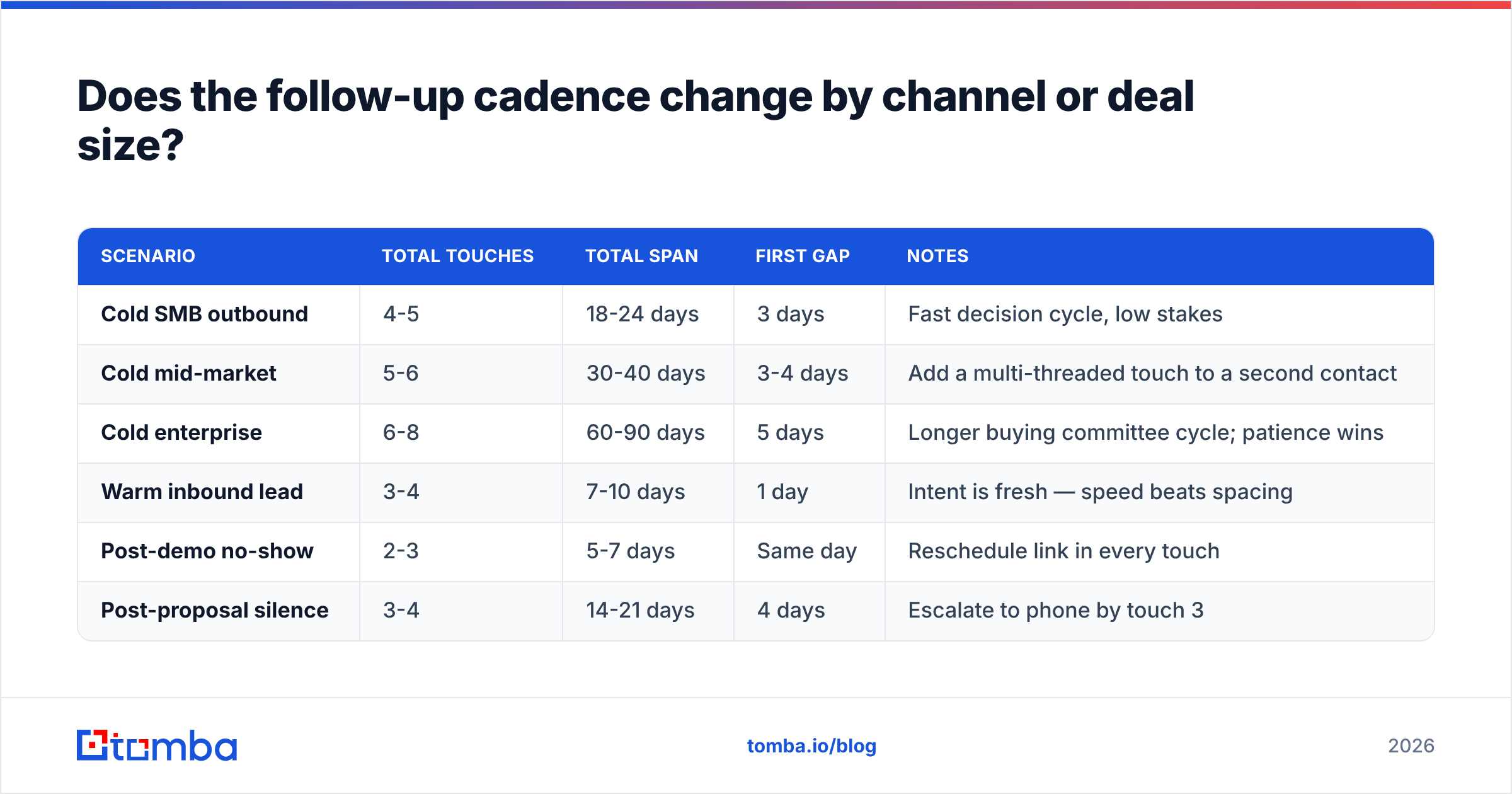
Yes, substantially. A $500/mo SaaS tool and a $250k enterprise platform should not run the same sequence.
| Scenario | Total touches | Total span | First gap | Notes |
|---|---|---|---|---|
| Cold SMB outbound | 4-5 | 18-24 days | 3 days | Fast decision cycle, low stakes |
| Cold mid-market | 5-6 | 30-40 days | 3-4 days | Add a multi-threaded touch to a second contact |
| Cold enterprise | 6-8 | 60-90 days | 5 days | Longer buying committee cycle; patience wins |
| Warm inbound lead | 3-4 | 7-10 days | 1 day | Intent is fresh — speed beats spacing |
| Post-demo no-show | 2-3 | 5-7 days | Same day | Reschedule link in every touch |
| Post-proposal silence | 3-4 | 14-21 days | 4 days | Escalate to phone by touch 3 |
The pattern: higher deal value buys you more patience and more touches; higher intent buys you speed. A post-demo no-show gets an email within the hour. An enterprise CFO gets five days of breathing room.
Multi-channel changes the math again. If touches 2 and 4 are a LinkedIn message and a phone call, your email count drops to three while total touch count stays at six. That's usually the better trade — LinkedIn outreach and a well-timed call spread the load across inboxes you're not burning.
What should each follow-up actually say?#
Every follow-up needs a reason to exist that isn't your quota. Here are the five reusable angles, roughly in the order they work best:
- New proof. A specific number from a customer resembling them. "Ramp cut their enrichment spend 40% in Q1" beats "we help companies save money."
- New angle. Same problem, different entry point. If touch 1 was about cost, touch 2 is about the ops hours nobody's counting.
- Trigger reference. They just hired three SDRs, opened a new region, or shipped a product. Now the timing argument writes itself.
- Zero-ask value. A teardown, a benchmark, a template. No meeting request at all. This is the one most teams skip and the one that most reliably restarts dead threads.
- The breakup. "I'll assume this isn't a priority and close the loop — happy to revisit if that changes." Short, no guilt, no fake deadline. It reliably produces replies, some of which are yeses.
What to cut: "just following up," "bumping this to the top of your inbox," "did you see my last email," and anything with "circling back." These signal that you had nothing new to say and sent anyway.
Length discipline matters too. Follow-ups should get shorter as the sequence goes, not longer. If touch 5 is your longest email, something has gone wrong. If you want a starting library, Tomba's cold email templates cover the standard angles you can then rewrite in your own voice.
How do you know when to stop following up?#
Stop on any one of these signals:
- They said no. Not "not now" — an actual no. Mark it, set a 6-month reminder, move on.
- You hit your touch ceiling (5-6 cold) with zero engagement of any kind: no opens, no clicks, no page visits, no LinkedIn view.
- Hard bounce or repeated soft bounce. The address is dead. Continuing to send at a dead address is a direct hit to email deliverability.
- They unsubscribed or asked to stop. Obvious, but check that your tooling actually honours it across all campaigns, not just the one.
- The company disqualified itself. Layoffs, acquisition, pivot away from your ICP.
What is not a stop signal: silence with engagement. Someone opening every email and never replying is reading you. They're often the person who books three months later. Keep them in a low-frequency nurture, not the active sequence.
One measurement warning: open rates are no longer trustworthy as a stop signal on their own. Apple Mail Privacy Protection and similar proxies pre-fetch images and inflate opens. Use replies, clicks, and site visits as your engagement truth. If you want to see how the industry is measuring this, G2's email tracking category and HubSpot's sales email research are reasonable neutral reference points.
Why does list quality beat cadence every time?#
Because cadence is a multiplier, and multiplying zero is still zero.
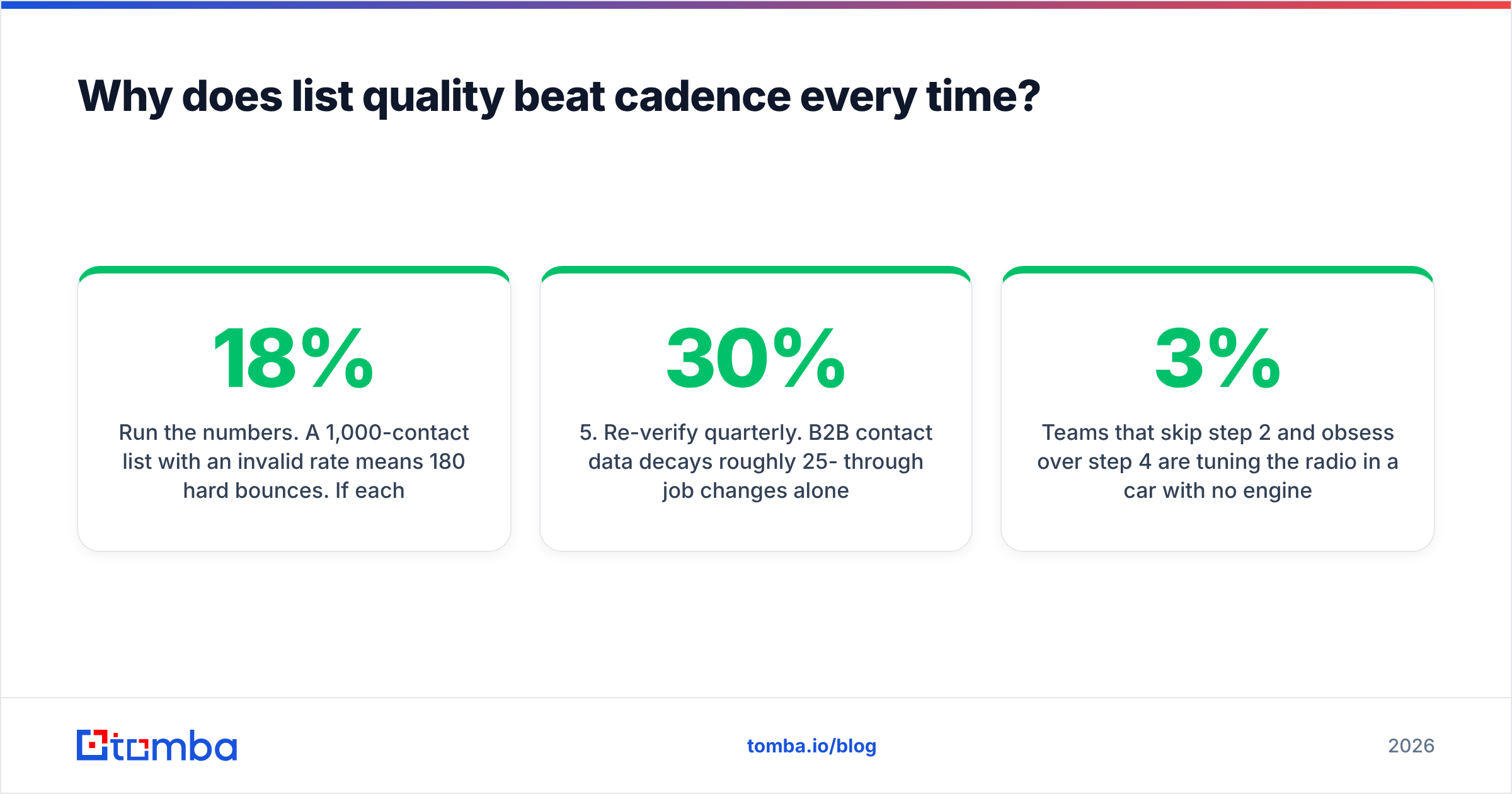
Run the numbers. A 1,000-contact list with an 18% invalid rate means 180 hard bounces. If each of those contacts gets a five-touch sequence, you're generating up to 900 bounce events. Mailbox providers read that as a sender who doesn't know who they're mailing, and they throttle the entire domain — including the emails going to your 820 valid contacts.
The order of operations is not negotiable:
- Source accurately. Verified, pattern-confirmed addresses rather than guessed permutations. A domain search that returns confirmed addresses for a company beats a generator that produces plausible-looking strings.
- Verify before the first send. Catch syntax errors, dead mailboxes, role accounts, and known spam traps. Catch-all domains need their own handling — a catch-all verifier tells you which catch-alls are actually safe.
- Warm the sending domain. New domains need 3-6 weeks of gradual ramp. Don't launch a 5-touch sequence to 2,000 people on a domain that's ten days old.
- Then set cadence. Now the spacing question actually matters.
- Re-verify quarterly. B2B contact data decays roughly 25-30% per year through job changes alone.
Teams that skip step 2 and obsess over step 4 are tuning the radio in a car with no engine. If your bounce rate is above 3%, stop reading cadence advice and go clean the list.
What does a good follow-up sequence look like in practice?#
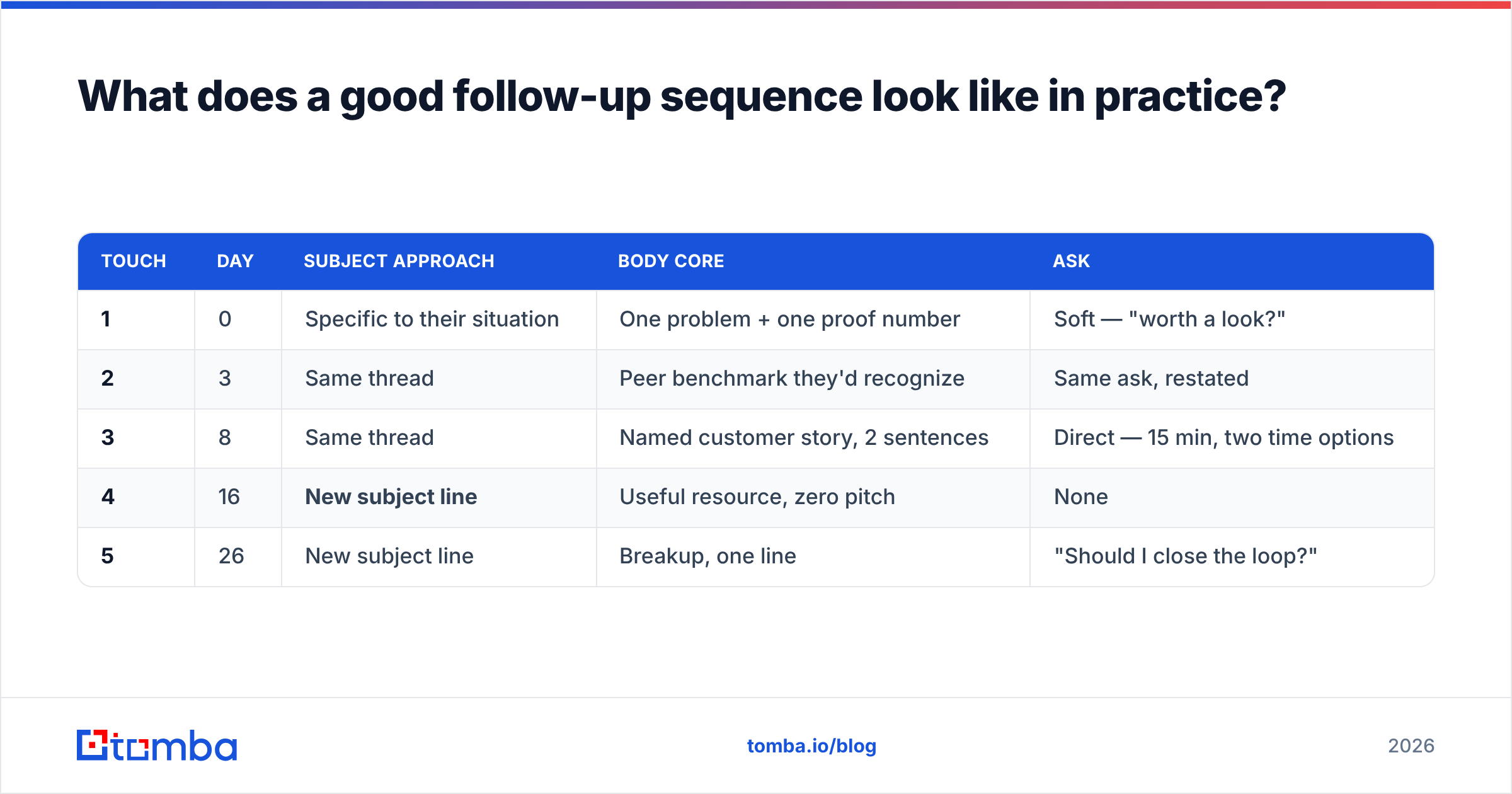
Here's a complete 5-touch cold sequence for a mid-market prospect, with the reasoning attached:
| Touch | Day | Subject approach | Body core | Ask |
|---|---|---|---|---|
| 1 | 0 | Specific to their situation | One problem + one proof number | Soft — "worth a look?" |
| 2 | 3 | Same thread | Peer benchmark they'd recognize | Same ask, restated |
| 3 | 8 | Same thread | Named customer story, 2 sentences | Direct — 15 min, two time options |
| 4 | 16 | New subject line | Useful resource, zero pitch | None |
| 5 | 26 | New subject line | Breakup, one line | "Should I close the loop?" |
Notice: 26 days, 5 emails, subject-line break at touch 4, the ask escalating then disappearing then returning as a soft exit. Total prospect time cost: under two minutes across a month. That's the bar — your entire sequence should cost less attention than one meeting.
Layer phone and LinkedIn in the gaps if you have the capacity. A call on day 5 and a LinkedIn connect on day 12 roughly doubles your surface area without adding a single email.
Frequently asked questions#
How long should I wait before the first follow-up? Three days for cold outbound, 24 hours for warm inbound, same-day for a no-show. Anything under 48 hours on cold reads as pressure.
Should follow-ups be in the same thread? Yes for touches 2 and 3, no for touches 4 and 5. Threading preserves context early, then buries you late.
Do follow-ups hurt deliverability? Only to bad addresses or unengaged recipients. Sending five emails to a verified, well-targeted contact is fine. Sending five to a guessed address that bounces is not.
What reply rate should I expect? 8-12% total across a well-targeted 5-touch sequence to a verified list. Under 3% usually means a targeting or data problem, not a cadence problem.
Can I automate the whole cadence? Yes, but automate the sending, not the thinking. Touch 3 onward should have at least one manually personalized line, or your sequence becomes a mail merge with extra steps.
Where to start#
Fix the input before you tune the machine. Build your list with verified, confirmed contacts, run it through verification once before the first send, and only then argue about whether touch 3 belongs on day 7 or day 8.
Start with the Tomba Email Finder to source addresses by domain, name, or company, then verify them in bulk before your sequence goes live. The free tier gives you 25 searches a month to test the workflow; Starter runs $49/mo and Growth $99/mo if you're sending at volume — full Tomba pricing is public. A clean list plus a 5-touch, 26-day cadence outperforms a dirty list on any schedule you can invent.
Related guides#
Ready to find emails that actually work?
Join 150,000+ professionals who stopped guessing and started sending. Free credits on signup — no credit card required.
Get the Tomba newsletter
Practical outbound tactics and product updates — once every two weeks.
About the author