How to A-B Test Emails: The Practical 2026 Framework
Most email A/B tests are decided before they reach significance. Here is a concrete framework for sample size, variable isolation, and reading results you can actually trust.
Here is how to A-B test emails without fooling yourself: change one variable, send enough of them, and judge the result on a metric that still works in 2026.
TL;DR
- Most cold email A/B tests fail because the sample is too small. Under roughly 1,000 sends per variant, an "8% lift" in open rate is usually noise.
- Test one variable at a time — subject line, first line, CTA, or send time. Two changes at once tells you nothing about which one moved the number.
- Open rate is a broken primary metric in 2026 thanks to Apple Mail Privacy Protection and Gmail image proxying. Optimize for reply rate and positive reply rate instead.
- Bad data poisons every test. If Variant A goes to a list with 12% bounces and Variant B goes to a clean one, you measured list quality, not copy.
- Run tests for a full business cycle (5–10 business days minimum), not until you like the result.
Why do most email A/B tests produce garbage?#
Because they stop early and celebrate randomness.
Here is the pattern almost every SDR team falls into: you send 100 emails with Subject A and 100 with Subject B. A gets 22 opens, B gets 29. You declare B the winner, roll it out to 5,000 prospects, and watch performance land somewhere between the two. Nothing was learned. Nothing was gained.
The arithmetic is unforgiving. With 100 sends per variant and a baseline reply rate near 5%, the challenger has to hit about 13% to clear significance. Anything smaller sits inside the margin of error. You are reading tea leaves.
Testing email is like tasting soup. One spoonful off the top tells you almost nothing about the pot. You have to stir first, then take a real sample, and taste it more than once. Small samples, tested once, on a single day, are a spoonful off the top.
The good news: you do not need a data team. You need three habits — isolate one variable, hit a real sample size, and pick a metric that still means something in 2026.

What exactly should you A/B test in a cold email?#
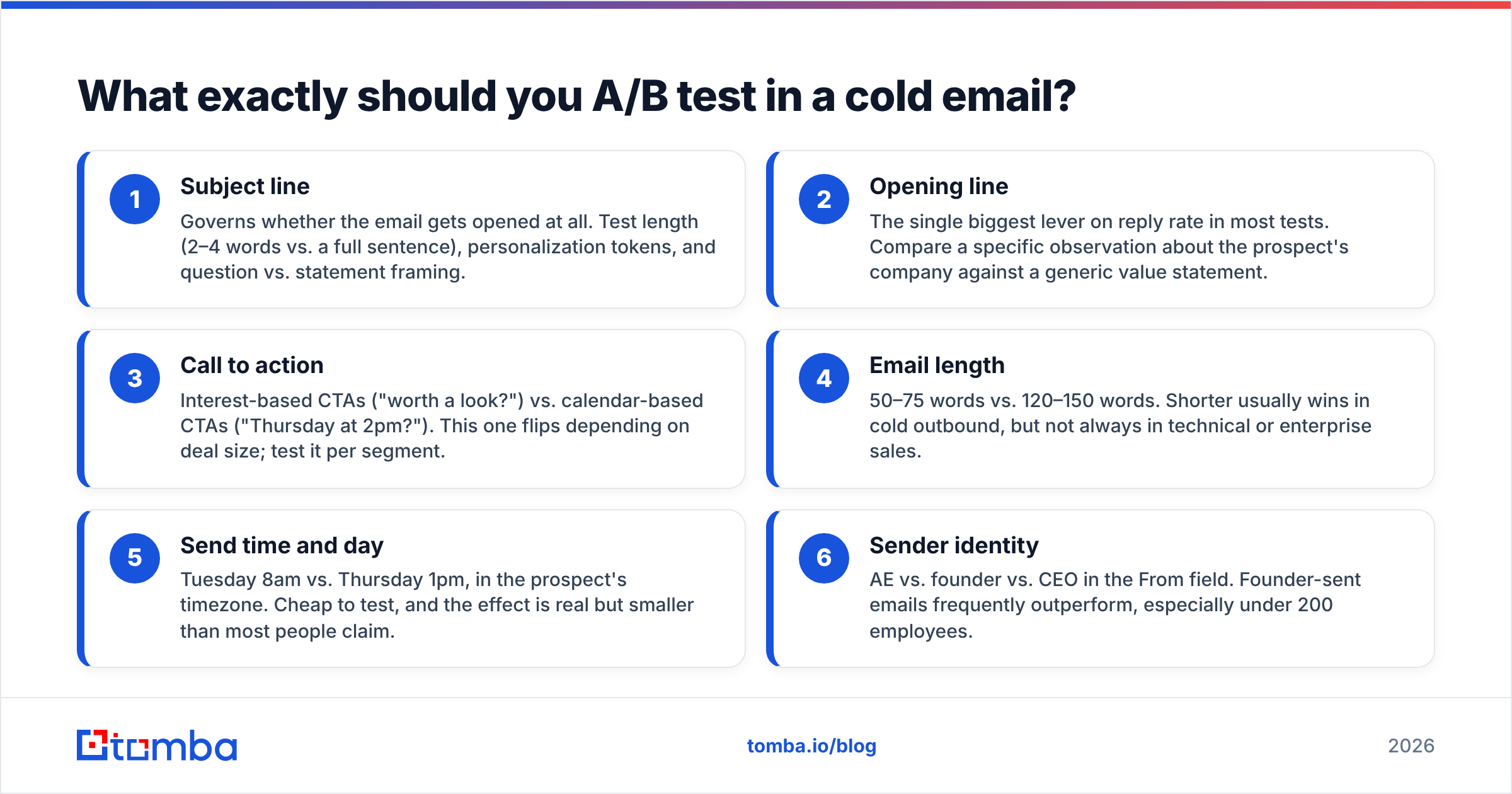
Test the things that carry the most leverage, in the order they affect the funnel. Every element below is worth a dedicated test — but only one per experiment.
- Subject line — Governs whether the email gets opened at all. Test length (2–4 words vs. a full sentence), personalization tokens, and question vs. statement framing.
- Opening line — The single biggest lever on reply rate in most tests. Compare a specific observation about the prospect's company against a generic value statement.
- Call to action — Interest-based CTAs ("worth a look?") vs. calendar-based CTAs ("Thursday at 2pm?"). This one flips depending on deal size; test it per segment.
- Email length — 50–75 words vs. 120–150 words. Shorter usually wins in cold outbound, but not always in technical or enterprise sales.
- Send time and day — Tuesday 8am vs. Thursday 1pm, in the prospect's timezone. Cheap to test, and the effect is real but smaller than most people claim.
- Sender identity — AE vs. founder vs. CEO in the From field. Founder-sent emails frequently outperform, especially under 200 employees.
Do not test all six at once and call it a "multivariate test." Real multivariate testing needs thousands of sends per cell. With a 2,000-contact list, you get one clean test. Pick the variable with the biggest expected impact and run it properly.
How many emails do you need for a valid test?#
More than you think. This is where the math either protects you or embarrasses you.
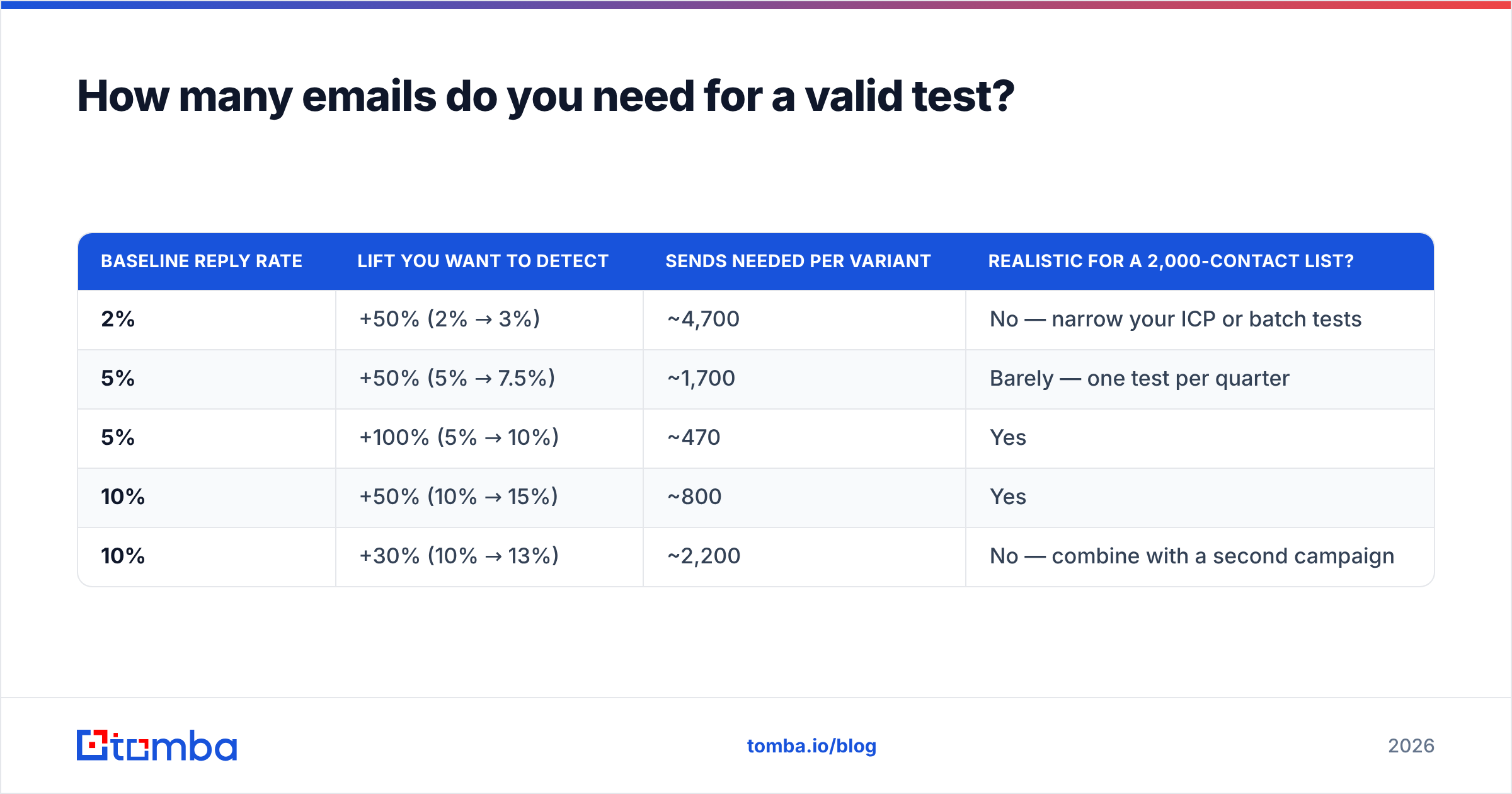
Sample size depends on your baseline conversion rate and the size of the lift you want to detect. Smaller baselines and smaller lifts both demand far more volume. Here is the practical shape of it at 95% confidence:
| Baseline reply rate | Lift you want to detect | Sends needed per variant | Realistic for a 2,000-contact list? |
|---|---|---|---|
| 2% | +50% (2% → 3%) | ~4,700 | No — narrow your ICP or batch tests |
| 5% | +50% (5% → 7.5%) | ~1,700 | Barely — one test per quarter |
| 5% | +100% (5% → 10%) | ~470 | Yes |
| 10% | +50% (10% → 15%) | ~800 | Yes |
| 10% | +30% (10% → 13%) | ~2,200 | No — combine with a second campaign |
Two implications people hate but should accept.
First, if you cannot reach the sample size, only test big swings. Do not test "Quick question" vs. "Quick question about hiring." Test a completely different angle — a customer-story opener against a pain-point opener. Small tweaks need huge samples. Large structural changes show up faster.
Second, stop peeking. Checking results daily and stopping the moment one variant leads is called optional stopping. It inflates your false positive rate. Decide the sample size before you launch, and do not look at the winner declaration until you hit it. Optimizely's statistics documentation covers why sequential peeking breaks classical significance testing.
Which metric should you actually optimize?#
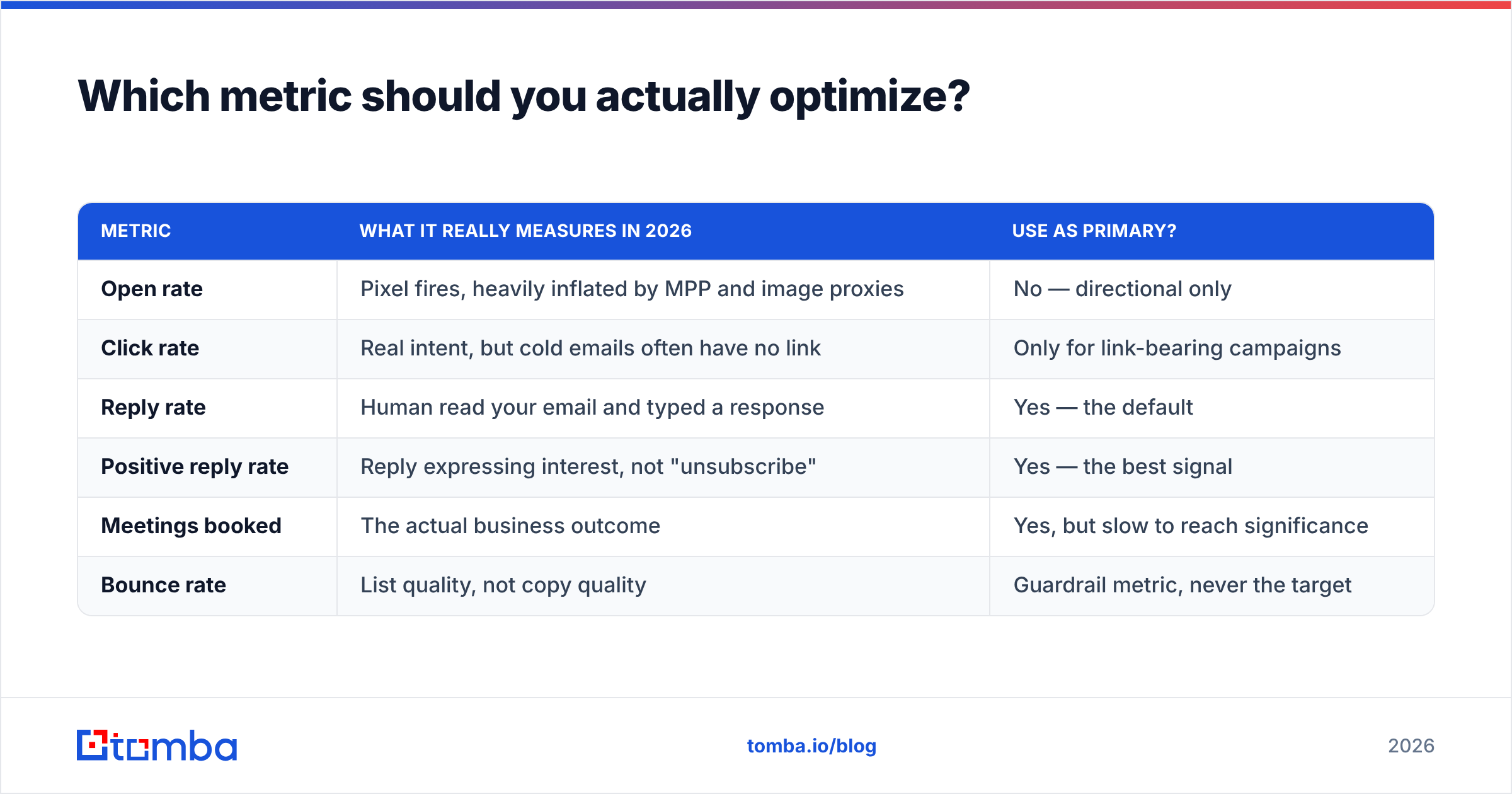
Reply rate. Then positive reply rate. Open rate is close to useless as a primary metric now.
Apple's Mail Privacy Protection pre-loads tracking pixels for every Apple Mail user, read or not. Gmail proxies images through its own servers. Depending on your ICP's device mix, 40–70% of your "opens" may be machine-generated. A subject line test decided on open rate in 2026 is a test decided by iOS market share.
| Metric | What it really measures in 2026 | Use as primary? |
|---|---|---|
| Open rate | Pixel fires, heavily inflated by MPP and image proxies | No — directional only |
| Click rate | Real intent, but cold emails often have no link | Only for link-bearing campaigns |
| Reply rate | Human read your email and typed a response | Yes — the default |
| Positive reply rate | Reply expressing interest, not "unsubscribe" | Yes — the best signal |
| Meetings booked | The actual business outcome | Yes, but slow to reach significance |
| Bounce rate | List quality, not copy quality | Guardrail metric, never the target |
Track bounce rate as a guardrail on every test. If one variant bounces at 9% and the other at 2%, you have a data problem contaminating a copy experiment — kill the test, clean the list, and start over. Running everything through an email verifier before the split is the cheapest insurance available, and it protects your sender reputation at the same time.
How to A-B Test Emails, Step by Step#
Six steps. Skip any of them and the result is not trustworthy.
Step 1 — Write a falsifiable hypothesis. Not "let's try a shorter subject line." Instead: "A subject line under 4 words will increase reply rate from 6% to at least 9% among Series-A SaaS heads of sales, because shorter subjects read as internal mail on mobile." Now you know what result would prove you wrong.
Step 2 — Build one list, then split it randomly. This is the step teams botch most often. Do not send Variant A to your enterprise segment and Variant B to your mid-market segment. Build a single homogeneous list — same industry, same seniority band, same company size — then randomize the split. If your tool splits by upload order, shuffle the CSV first.
Step 3 — Verify and dedupe before splitting. Deduplicate contacts across campaigns so the same person does not receive both variants, and verify every address. A bulk email finder run followed by verification gets both jobs done in one pass. If you are pulling contacts by company, domain search keeps the list to a single confirmed pattern per domain, which reduces the guessed-address bounces that skew results.
Step 4 — Change exactly one thing. Same sender, same send window, same signature, same follow-up sequence, same tracking settings. If the subject line changes, every other byte stays identical.
Step 5 — Send across a full business cycle. Five to ten business days minimum, covering multiple weekdays. A test that runs only on Monday morning measures Monday morning. Spread sends evenly across variants each day so a Wednesday inbox surge does not land disproportionately on one side.
Step 6 — Read results against your pre-registered threshold. Compute significance and compare it to the sample size you committed to. Accept the answer even when it is "no meaningful difference." That outcome is a real finding: the variable does not matter for this audience, so spend the next test on something else.

What are the traps that quietly invalidate results?#
Six failure modes account for nearly every bogus email test result.
- Contaminated splits. Variant A drawn from a scraped list, Variant B from an inbound list. You measured intent, not copy.
- Deliverability drift mid-test. A domain gets throttled on day 3 and one variant's inbox placement collapses. Check email deliverability signals before and during the test, not after.
- Follow-up leakage. Variant A gets three follow-ups, Variant B gets two, because someone edited the sequence mid-flight. Freeze the sequence.
- Small-sample subgroup slicing. "It won among VPs in fintech!" With n=23, that is not a finding — it is a coincidence you went looking for.
- Winner's curse. The first observed winner usually regresses. Re-run the winning variant against the original in a second test before rolling it out to your whole database.
- Testing on a dirty list. Invalid addresses inflate bounces asymmetrically and can trip spam filters, which changes inbox placement mid-test. Check Google's bulk sender guidelines for the thresholds that matter.
The last one deserves emphasis. Data quality is upstream of every experiment you will ever run. Two teams running identical tests on identical copy get opposite results if one has 95% valid addresses and the other has 78%. Before you argue about subject lines, argue about your list.
How do the major sending platforms handle A/B testing?#
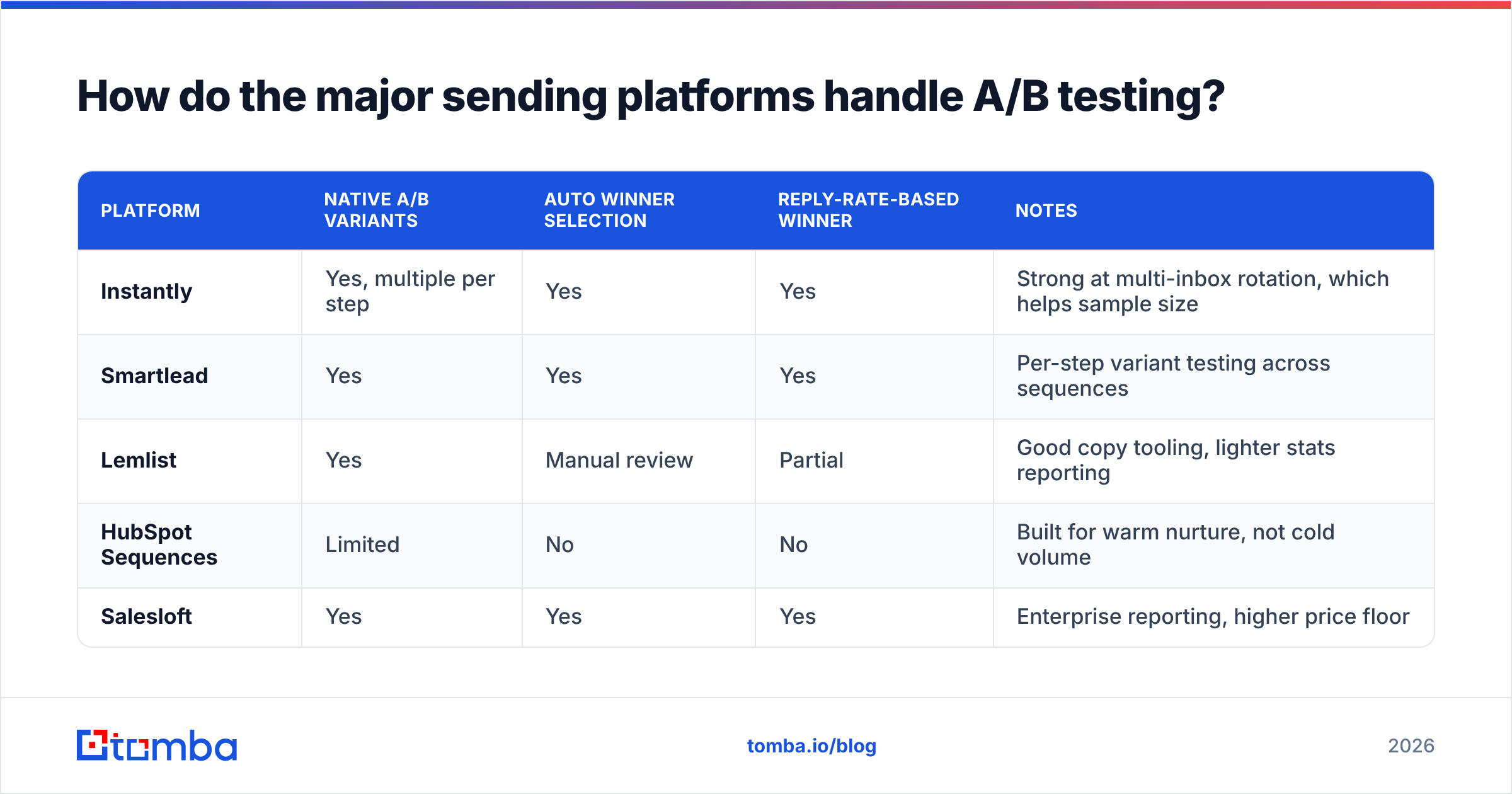
Feature depth varies more than pricing pages suggest. Here is where the common outbound tools land on native testing capability.
| Platform | Native A/B variants | Auto winner selection | Reply-rate-based winner | Notes |
|---|---|---|---|---|
| Instantly | Yes, multiple per step | Yes | Yes | Strong at multi-inbox rotation, which helps sample size |
| Smartlead | Yes | Yes | Yes | Per-step variant testing across sequences |
| Lemlist | Yes | Manual review | Partial | Good copy tooling, lighter stats reporting |
| HubSpot Sequences | Limited | No | No | Built for warm nurture, not cold volume |
| Salesloft | Yes | Yes | Yes | Enterprise reporting, higher price floor |
None of them will fix a small sample or a contaminated split. Auto-winner features in particular tend to declare victory fast — check whether your tool lets you set a minimum sample threshold before it picks, and set it manually if so. G2's outbound email software category is a reasonable place to compare current feature sets, since vendors ship changes to these modules frequently.
How should you build a testing roadmap instead of one-off tests?#
Learning how to A-B test emails is a program, not a single experiment. Sequence tests by leverage, and keep a log. One test per campaign per cycle, four to six tests a quarter, each building on the last.
A workable 90-day sequence for a team sending ~3,000 emails a month:
- Weeks 1–3: Opening line. Specific-observation opener vs. generic value-prop opener. Biggest expected effect on reply rate.
- Weeks 4–6: CTA. Soft interest ask vs. specific time proposal, using the winning opener from test 1.
- Weeks 7–9: Length. 60-word vs. 130-word body, holding opener and CTA constant.
- Weeks 10–12: Sender identity. Founder vs. AE, with the winning copy from tests 1–3.
Keep a shared log with hypothesis, sample size, dates, raw numbers, significance, and decision for each test. Without it, teams re-test the same variable every two quarters and forget the previous answer. The log is also what stops a new hire from "trying something" mid-experiment.
One more discipline: re-validate winners every two quarters. Audience behavior shifts, inbox providers change filtering, and a subject line that worked in Q1 can fade by Q4. Treat winners as current best guesses, not permanent truths.
Where does contact data fit into all of this?#
At the foundation. Testing copy on unverified contacts is like tuning an engine while the fuel line leaks — you will get numbers, but they will not mean what you think.
Before a single test goes out, your list should be deduplicated, verified, and pattern-consistent per domain. Catch-all domains deserve special handling: they accept everything at SMTP time and tell you nothing, so route them through a catch-all verifier rather than assuming validity or discarding them wholesale. Both moves protect the bounce guardrail that keeps your test honest.
If you are building lists from scratch, start with the Tomba Email Finder to get verified, source-attributed addresses by name and domain, then split the clean list into your variants. The free tier gives you 25 searches a month to sanity-check the workflow; Starter runs $49/mo and Growth $99/mo when you need real volume — full Tomba pricing is on the site. That is the last piece of how to A-B test emails properly: clean inputs first, then argue about subject lines.
Related guides#
Ready to find emails that actually work?
Join 150,000+ professionals who stopped guessing and started sending. Free credits on signup — no credit card required.
Get the Tomba newsletter
Practical outbound tactics and product updates — once every two weeks.
About the author