How to Align Sales and Marketing: A 2026 Playbook
Sales and marketing misalignment quietly burns pipeline every quarter. Here are the seven concrete moves — shared definitions, one data layer, a real SLA — that fix it in a single quarter, not a single meeting.
TL;DR
- Sales and marketing alignment fails when it's treated as a culture problem. It's a definitions, data, and incentives problem — fix those three and the culture follows.
- Start with one written definition of an MQL, an SQL, and "accepted" that both VPs sign. Most orgs cannot produce this document on request.
- Run one data layer. Two teams enriching contacts from two vendors with two different formats will never agree on what happened.
- Put alignment in writing as an SLA with numbers: lead response time, follow-up attempts, feedback loop cadence, and monthly disqualification review.
- Measure the handoff, not the departments. Lead-to-opportunity conversion by source is the single metric that exposes misalignment fastest.
Alignment is not a workshop. It's a set of contracts.
Every quarter, marketing reports a record month of leads and sales reports a dry pipeline. Both are telling the truth about different numbers. The fix isn't a better offsite — it's writing down what a qualified lead is, running both teams off one contact database, and holding each side to a response-time SLA that a dashboard can score. This guide walks through exactly how to do that, in the order that actually works.
What does sales and marketing alignment actually mean?#
Alignment means both teams operate from the same definitions, the same data, and the same revenue number — not that they like each other.
Most "alignment initiatives" fail because they start with relationship-building and never touch the mechanics. Two teams can have great rapport and still fight over every lead, because nobody wrote down what "qualified" means. Conversely, teams that barely socialize can run tight pipelines if their handoff rules are unambiguous.
Think of it like a relay race. Nobody wins because the runners get along. They win because the exchange zone is marked, the handoff technique is drilled, and both runners know exactly when to let go. Alignment is the exchange zone.
Here's what an aligned org has that a misaligned one doesn't:
- One qualification rubric. A written definition of marketing qualified lead, SQL, and "sales accepted lead" that both leaders signed — with examples of what fails each bar.
- One source of contact truth. Both teams enrich, verify, and store records in the same system, in the same format, from the same vendor.
- A two-way SLA. Marketing commits to volume and quality; sales commits to speed and follow-up depth. Both are scored.
- A shared revenue target. Marketing carries a pipeline-sourced number, not an MQL number. This one change ends more arguments than any other.
- A recurring disqualification review. A 30-minute monthly meeting where sales walks through the leads they rejected and why. This is the feedback loop.
- Shared reporting. One dashboard, one definition of every metric on it, visible to both teams without asking.
If you can't produce items 1 through 3 as documents today, you don't have an alignment problem — you have a documentation problem wearing an alignment costume.

Why do sales and marketing fall out of alignment?#
Because the two teams are measured on metrics that can both improve while revenue falls.
Marketing is scored on lead volume, cost per lead, and MQL count. Sales is scored on closed revenue and quota attainment. A marketer can double MQLs by loosening the form gate — their number goes up, sales' number goes down, and both are behaving rationally. That's not laziness. That's a compensation design bug.
The four common root causes, in the order they show up:
Metric mismatch. Marketing owns a volume metric; sales owns a revenue metric. Fix by giving marketing a pipeline-sourced or revenue-influenced target. Forrester and Gartner have both published extensively on revenue-team models built on this exact principle.
Definition drift. The MQL definition was written in 2023, the ICP changed twice since, and nobody updated the doc. Sales quietly stopped trusting the MQL flag and started working their own lists. Now you have two pipelines.
Data fragmentation. Marketing enriches from one vendor into the marketing automation platform. Sales enriches from another into the CRM. The same person exists as two records with different job titles. Attribution reporting becomes fiction.
No feedback channel. Sales rejects 60% of MQLs and never tells marketing why in a structured way. Marketing keeps producing the same leads. The loop is open.
Data fragmentation is the one most teams underestimate. When your two teams are working from contact records that disagree on job title, company size, or whether the email even works, no amount of process design saves you. Standardizing on a single email verifier and one enrichment source removes an entire category of arguments before they start.
How do you write a sales and marketing SLA that holds?#
Write it with numbers, owners, and a review date — or it's a poster, not an agreement.
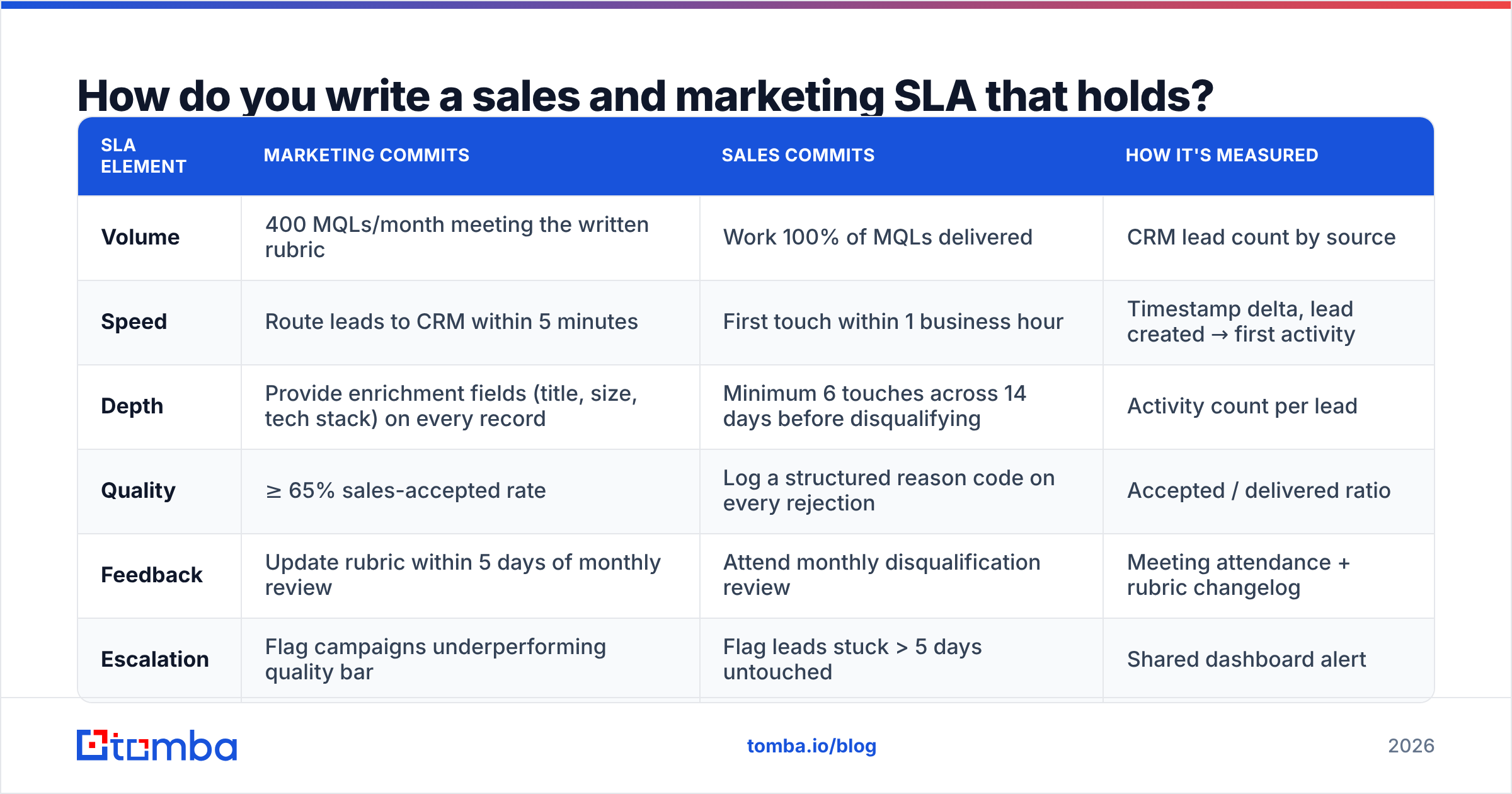
The SLA has two sides. Marketing commits to quantity and quality. Sales commits to speed and effort. Both sides are measurable, and both are reported in the same weekly meeting.
| SLA Element | Marketing Commits | Sales Commits | How It's Measured |
|---|---|---|---|
| Volume | 400 MQLs/month meeting the written rubric | Work 100% of MQLs delivered | CRM lead count by source |
| Speed | Route leads to CRM within 5 minutes | First touch within 1 business hour | Timestamp delta, lead created → first activity |
| Depth | Provide enrichment fields (title, size, tech stack) on every record | Minimum 6 touches across 14 days before disqualifying | Activity count per lead |
| Quality | ≥ 65% sales-accepted rate | Log a structured reason code on every rejection | Accepted / delivered ratio |
| Feedback | Update rubric within 5 days of monthly review | Attend monthly disqualification review | Meeting attendance + rubric changelog |
| Escalation | Flag campaigns underperforming quality bar | Flag leads stuck > 5 days untouched | Shared dashboard alert |
Three rules make this stick:
- Both sides can fail. An SLA that only scores marketing is a blame document. Sales missing the 1-hour touch target must be as visible as marketing missing the quality bar.
- Reason codes are a closed list. "Bad lead" is not a reason code. "Wrong title," "no budget authority," "competitor," "invalid contact data," and "not in ICP" are. You cannot improve what you cannot categorize.
- Review monthly, revise quarterly. Numbers get reviewed every month. The rubric itself gets rewritten every quarter, because your ICP moves.
Lead response time deserves special attention. The classic Harvard Business Review research on lead response found conversion odds drop off a cliff after the first hour. If your SLA has only one number in it, make it that one.
What does one shared data layer look like?#
It looks like both teams pulling contact and company data from one API, in one format, with one verification standard.
This is the least glamorous part of alignment and the highest-leverage. When marketing's contact list and sales' contact list disagree, every downstream metric is contaminated — attribution, conversion rate, cost per opportunity, all of it.
A workable shared data layer has four properties:
- Single enrichment source. One vendor supplies email, phone, title, and company firmographics. Multiple vendors mean multiple truths and reconciliation work nobody has time for.
- Verification before entry. Every email is validated before it touches the CRM. Unverified addresses inflate your list, wreck your email deliverability, and make bounce-rate reporting meaningless.
- Bidirectional sync. Enrichment writes back to both the marketing automation platform and the CRM automatically — not via a monthly CSV.
- Field-level ownership. Someone owns "job title." Someone owns "employee count." When two systems disagree, the rule for which wins is written down.
Tools that plug into both sides of the stack make this easier. Tomba's HubSpot integration and Salesforce integration let both teams enrich from the same source without exporting anything, and the bulk email finder handles list-level enrichment when marketing needs to clean a segment before a campaign. The point isn't the specific vendor — it's that there's exactly one.
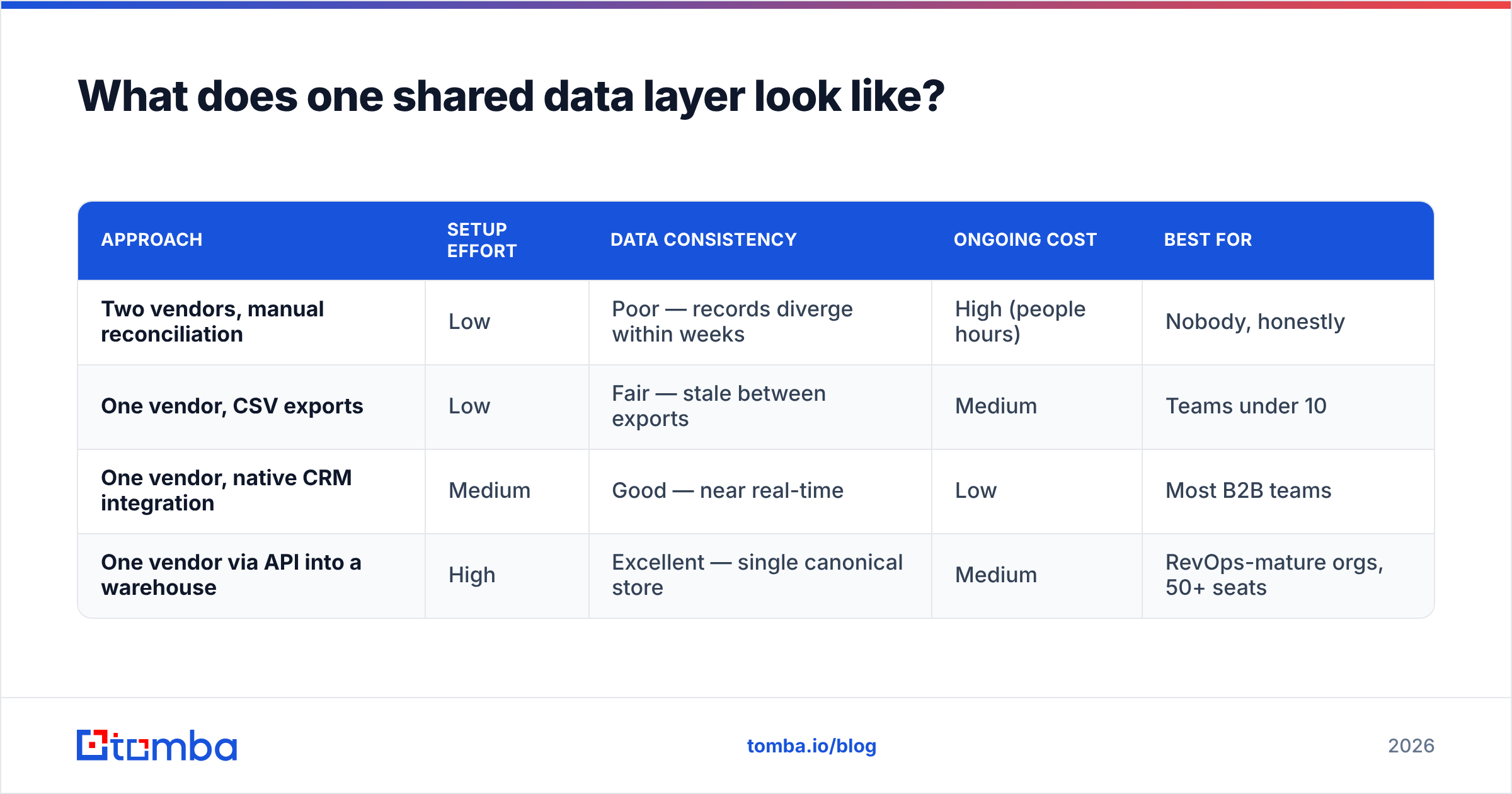
Here's how the common approaches compare in practice:
| Approach | Setup Effort | Data Consistency | Ongoing Cost | Best For |
|---|---|---|---|---|
| Two vendors, manual reconciliation | Low | Poor — records diverge within weeks | High (people hours) | Nobody, honestly |
| One vendor, CSV exports | Low | Fair — stale between exports | Medium | Teams under 10 |
| One vendor, native CRM integration | Medium | Good — near real-time | Low | Most B2B teams |
| One vendor via API into a warehouse | High | Excellent — single canonical store | Medium | RevOps-mature orgs, 50+ seats |
Most teams should target row three and graduate to row four when they hire their first dedicated RevOps person.
How do you build the feedback loop between teams?#
Run a 30-minute monthly disqualification review where sales explains rejected leads using the reason codes, and marketing leaves with a rubric edit.
The structure that works:
- First 10 minutes: Marketing presents last month's delivered volume, sources, and accepted rate. No storytelling, just numbers.
- Next 15 minutes: Sales walks through the top three rejection reason codes with two real examples each. Real records, real names, screen-shared.
- Last 5 minutes: One decision. Either a rubric change, a campaign kill, or a routing change. Written down before the call ends, with an owner.
What makes this fail: inviting fifteen people, having no reason-code data to review, and ending without a decision. Keep it to the two team leads plus whoever owns the CRM.
The second loop runs weekly and is much lighter — a shared dashboard channel where both teams see the same six numbers. Lead volume, accepted rate, average response time, opportunities created, pipeline value, and win rate. Post it automatically via a Slack integration so nobody has to log in to see it.
A third loop, often skipped, is closed-won interviews. Once a month, marketing sits in on one closed-won and one closed-lost call recording. Nothing changes messaging faster than hearing a prospect explain, in their own words, why the pitch landed or didn't. Tools reviewed on G2 in the conversation-intelligence category make this a two-click exercise.
Which metrics prove alignment is working?#
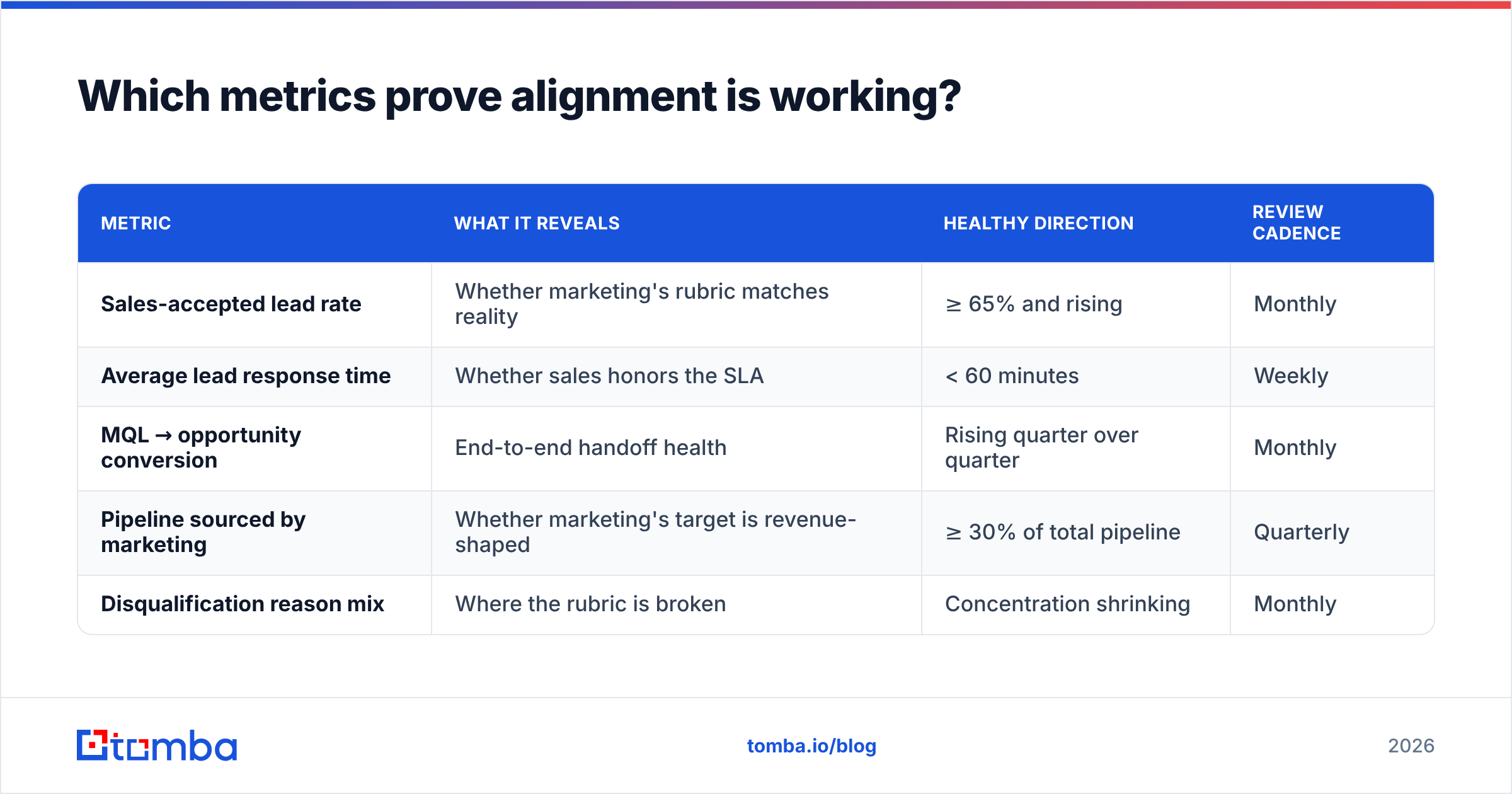
Track the handoff, not the departments. Five metrics tell you everything.
| Metric | What It Reveals | Healthy Direction | Review Cadence |
|---|---|---|---|
| Sales-accepted lead rate | Whether marketing's rubric matches reality | ≥ 65% and rising | Monthly |
| Average lead response time | Whether sales honors the SLA | < 60 minutes | Weekly |
| MQL → opportunity conversion | End-to-end handoff health | Rising quarter over quarter | Monthly |
| Pipeline sourced by marketing | Whether marketing's target is revenue-shaped | ≥ 30% of total pipeline | Quarterly |
| Disqualification reason mix | Where the rubric is broken | Concentration shrinking | Monthly |
Two traps to avoid.
Don't celebrate MQL growth. If MQLs rise and accepted rate falls, you got worse. Report the two numbers together, always, on the same slide.
Don't measure attribution before you fix data. Attribution modeling on top of duplicated, unverified contact records produces confident-looking nonsense. Clean the data layer first, then argue about first-touch versus multi-touch.
One more practical check: pull a random sample of 50 MQLs from last month and have both leaders independently score them against the written rubric. If their scores agree less than 80% of the time, your rubric is too vague. Rewrite it with examples before you touch anything else.
What's the 90-day plan to get aligned?#
Days 1–30: Define. Write the qualification rubric with both leaders in the room. Include five example records that pass and five that fail. Publish it where both teams can see it. Draft the SLA with real numbers pulled from your last two quarters, not aspirational ones.
Days 31–60: Consolidate. Pick one enrichment and verification vendor. Deduplicate the contact database. Set up bidirectional sync between the marketing platform and CRM. Turn on reason codes as a required field on lead rejection. Expect this month to be unglamorous and to surface data problems nobody knew about.
Days 61–90: Operate. Run the first two monthly disqualification reviews. Ship the shared weekly dashboard. Recalibrate the SLA numbers with real data. Move marketing's primary target from MQL count to sourced pipeline, with comp adjusted accordingly.
At day 90 you won't be perfectly aligned. You will have three artifacts — a rubric, an SLA, and a shared dashboard — that make the next quarter's conversation about numbers instead of blame. That's the whole game.
The teams that stay aligned aren't the ones with the best relationships. They're the ones whose handoff is boring, documented, and scored.
Ready to fix the data layer under your alignment?#
Alignment work stalls when both teams argue over contact records that don't agree. Give sales and marketing one source of verified contact data: Tomba's Email Finder finds professional email addresses by domain, name, or company, verifies them before they hit your CRM, and syncs into HubSpot, Salesforce, Pipedrive, and Sheets so both teams see the same record. Start on the free tier with 25 searches a month, or check Tomba pricing — Starter is $49/mo, Growth $99/mo, and Pro $249/mo for teams running enrichment at scale.
Related guides#
Ready to find emails that actually work?
Join 150,000+ professionals who stopped guessing and started sending. Free credits on signup — no credit card required.
Get the Tomba newsletter
Practical outbound tactics and product updates — once every two weeks.
About the author